
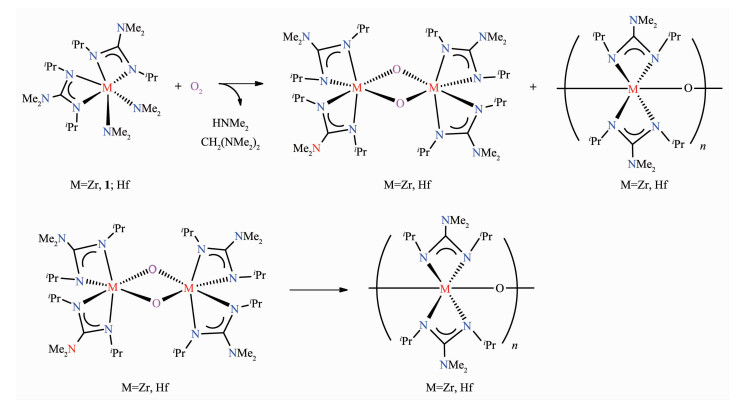
Scheme 1.
Reaction of 1 and its Hf analog with O2[19]


Earlier transition metal complexes with alkyl, amide, and hydride ligands[1-5] often contain polar bonds between metal atoms and anionic ligands. These ligands usually behave as nucleophiles similar to their main group counter parts such as LiR, RMgX (X=halide), LiNR2 and NaBH4. Early transition metal amidinate and guanidinate complexes have attracted much research interest recently[6-18]. In certain reactions, amidinate and guanidinate ligands act as spectators. We reported earlier the reaction of guanidinate amide Zr(NMe2)2[iPrNC(NMe2)NiPr]2 (1) with O2 (Scheme 1)[19], as part of the studies of O2 reactions with d0 transition metal complexes[20-37]. The d0 metal centers in the complexes formally have no d electrons. Their reactions with the oxidant O2 thus typically involve the ligand oxidation. This is in contrast to the reactions of dn complexes, in which the metal centers are often oxidized. From the chemistry shown in Scheme 1[19], it appears to be a good candidate to test the radical trapping[38-40]. Because of CH2(NMe2)2 formed as a side product in this reaction in Scheme 1[19], the reaction is believed to follow a radical mechanism. In addition, the rate of the reaction was enhanced several folds with the addition of the radical initiator 2, 2′-azobis(2-methylpropionitrile) (AIBN)[19].
CBrCl3 and CCl4 have been used extensively for radical trapping[38-40]. For example, cyclopropyl radical is known to behave as a rapidly inverting σ radical of high reactivity. Experiments have been performed using radical trapping to determine the extent to which a variety of substituted cyclopropyl radicals are capable of maintaining their original configuration[38]. BrCCl3 was chosen as a trap for the cyclopropyl radical (Eq.(1)).
|
$ \mathrm{c}-\mathrm{C}_{3} \mathrm{H}_{5} \cdot+\mathrm{BrCCl}_{3} \rightarrow \mathrm{c}-\mathrm{C}_{3} \mathrm{H}_{5} \mathrm{Br}+\cdot \mathrm{CCl}_{3} $ |
(1) |
Radical trapping has also been used to probe organometallic reactions[39]. For example, irradiation of metal-metal bonded complexes leads to the formation of radicals that may be captured by chlorine atom abstraction from CCl4 (Eq.(2), Cp=C5H5)[39].
|
$ \mathrm{C}_{\mathrm{p}_{2}} \mathrm{Mo}_{2}(\mathrm{CO})_{6}+2 \mathrm{CCl}_{4} \rightarrow 2 \mathrm{CpMo}(\mathrm{CO})_{3} \mathrm{Cl}+2 \cdot \mathrm{CCl}_{3} $ |
(2) |
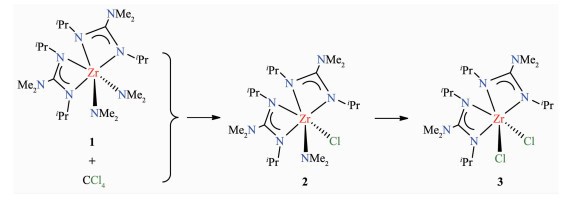
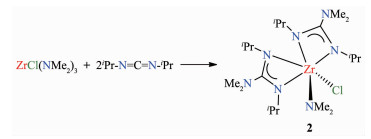
Prior to the use of CCl4 as a radical trap to probe the reaction of Zr(NMe2)2[iPrNC(NMe2)NiPr]2 (1) with O2, it is, however, necessary to investigate whether 1 would react with CCl4 itself in the absence of O2. Indeed we have found that Zr(NMe2)2[iPrNC(NMe2)NiPr]2 (1) does react with CCl4, yielding sequentially ZrCl(NMe2)[iPrNC(NMe2)NiPr]2 (2) and ZrCl2[iPrNC(NMe2)NiPr]2 (3). Complex 2 is a new compound. In addition to observing 2 from the reaction between CCl4 and 1, 2 has been prepared by a different route-direct insertion of iPr-N=C=N-iPr into Zr-NMe2 bonds in ZrCl(NMe2)3. Our studies of the reaction between CCl4 and 1, preparation of 2, and its characterization are reported.
All manipulations were performed under a dry nitrogen atmosphere with the use of either a drybox or standard Schlenk techniques. All solvents such as pentane, tetrahydrofuran (THF), hexanes were dried over potassium/benzophenone, distilled, and stored under nitrogen. Benzene-d6 was dried over activated molecular sieves and stored under nitrogen. CCl4 was also dried over activated molecular sieves and stored under nitrogen. NMR spectra were recorded on a Varian 500 MHz Fourier transform spectrometer unless otherwise noted, and were referenced to solvents. Elemental analyses were conducted via Complete Analysis Laboratories, Inc., Parsippany, NJ.
In a Young′s NMR tube, 1 (15 mg, 0.029 mmol) was dissolved in benzene-d6. Excess CCl4 was then added to this Young′s tube. Immediately after the addition of CCl4, the intensities of the peaks corres-ponding to 1 started decreasing. The progress of the reaction was followed with 1H NMR spectroscopy. The 1H NMR peaks of 2 first started to appear after ~2 h. This process eventually led to the formation of 3.
ZrCl4 (1.620 g, 6.952 mmol) in THF was added LiNMe2 (1.062 g, 20.84 mmol) in THF. After stirring overnight, the solution was filtrated to remove LiCl, and volatiles were removed in vacuo to give crude ZrCl(NMe2)3 (0.963 g, 3.72 mmol, Yield: 59.4%). This crude product was then re-dissolved in hexanes and cooled to give pure ZrCl(NMe2)3 as crystals. These crystals were then separated from mother liquor solution and washed with cooled hexanes.
ZrCl(NMe2)3 (282.6 mg, 1.092 mmol) was then reacted with iPr-N=C=N-iPr (275.7 mg, 2.185 mmol) in pentane overnight. The volatiles were then removed in vacuo to give the crude product of 2 as an off-white solid (isolated solid: 198 mg, 0.388 mmol, Yield: 70.1%). Repeated attempts to grow the crystals of 2 in different solvents did not yield crystals suitable for single-crystal X-ray diffraction. 1H NMR (benzene-d6, 499.7 MHz, 25 ℃): δ 3.59 (m, 4H, CHMe2), 3.39 (s, 6H, Zr-NMe2), 2.43 (s, 12H, C-NMe2), 1.37 (d, 12H, 3JH-H=6.43 Hz, CHMe2), 1.32 (d, 12H, 3JH-H=6.42 Hz, CHMe2). 13C{1H} NMR (benzene-d6, 125 MHz, 25 ℃): δ 172.01 (C-NMe2), 47.58 (CHMe2), 47.12 (Zr-NMe2), 39.75 (C-NMe2), 25.18 (CHMe2), 24.99 (CHMe2). Anal. Calcd. for C20H46ClN7Zr(%): C, 46.98; H, 9.07; N, 19.18. Found(%): C, 46.91; H, 9.13; N, 19.11.
The reaction between 1 and CCl4 is given in Scheme 2. 1H NMR spectrum of 1 itself is given in Fig.S1 (Supporting information) for comparison. In a Young′s tube, 1 in benzene-d6 was added CCl4, and the progress of the reaction was followed by 1H NMR spectroscopy. Right after the addition of CCl4, new NMR peaks were observed, which were assigned to ZrCl(NMe2)[iPrNC(NMe2)NiPr]2 (2), a mono-chloride derivative of 1 (Scheme 2, Fig.S2). With the passage of time, 1H NMR peaks of 1 decreased in intensity. After 2~3 d at room temperature, 1H NMR peaks corresponding to ZrCl2[iPrNC(NMe2)NiPr]2 (3), a di-chloride derivative of 1, started to appear as well (Scheme 2). After ca. one week, 1H NMR spectrum of the solution showed only 3 (Fig.S3). Complex 3 has been reported by Arnold, Bergman and coworkers[41], and it was prepared by direct insertion of iPr-N=C=N-iPr into the Zr-NMe2 bonds in (Me2N)2ZrCl2(THF)2. Comparison of its 1H (Fig.S3) and 13C{1H} NMR spectra with those reported confirmed the formation of 3 in the reaction in Scheme 2.
The mono-chloride ZrCl(NMe2)[iPrNC(NMe2)NiPr]2 (2) is a new compound. In the reaction between Zr(NMe2)2[iPrNC(NMe2)NiPr]2 (1) with CCl4, it is an intermediate in the formation of the di-chloride 3 (Scheme 2) and it was difficult to control the reaction to just form 2. Thus, 2 from this reaction was not isolated. Instead, 2 was directly prepared through the insertion of iPr-N=C=N-iPr into two Zr-NMe2 bonds in ZrCl(NMe2)3. ZrCl(NMe2)3, as solvent-free [Cl(Me2N)2Zr ( μ-NMe2)]2, has been prepared by the reaction of ZrCl4 with LiNMe2 in ether[42]. Its X-ray structure showed a dimer with two NMe2 bridges. Our group has earlier prepared ZrCl(NMe2)3 as a THF adduct, (Me2N)3Zr( μ-Cl)2( μ-NMe2)Zr(NMe2)2(THF), from either the reaction between ZrCl4 and LiNMe2 (n:n=1:3) in THF or Zr(NMe2)4 and (Me2N)2ZrCl2(THF)2 (n:n=1:1) in THF[43]. The THF adduct is a dimer bridged by one chloride and one amide ligand.
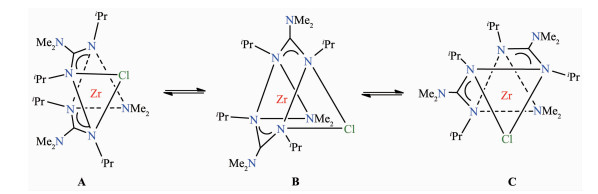
In the current work, ZrCl(NMe2)3 was synthesized by the direct reaction of 3 equiv of LiNMe2 with ZrCl4 (n:n=1:3) in THF. After filtration to remove LiCl and volatiles were removed in vacuo, the crude product was recrystallized in hexanes to give THF-free ZrCl(NMe2)3, as its 1H NMR spectrum shown in Fig.S4. ZrCl(NMe2)3 was then reacted with iPr-N=C-N-iPr (n:n=1:2), resulting in the formation of ZrCl(NMe2)[iPrNC(NMe2)NiPr]2 (2, Schme 3). This compound was then characterized by 1H, 13C{1H} and HSQC NMR spectroscopies (Fig.S5~S7). In 1H NMR spectrum (Fig.S5), two doublets at δ 1.32 and 1.37 are assigned to the two different CHMe2 groups. One peak at δ 2.43 was observed for the C-NMe2 groups on the guanidinate ligands. These may be understood by the Bailar twist mechanism in Scheme 4 (There is a mirror plane in B)[44]. The exchange leads to an intermediate B in which there is a mirror plane through the molecule. As a result, the two iPr groups in the bottom face of B from two different guanidinate ligands are chemically equivalent. Similarly the two iPr groups on the top face, also from two different guanidinate ligands, are chemically equivalent. The two C-NMe2 groups on the two guanidinate ligands were equivalent. The multiplet at δ 3.59 was assigned to CHMe2, and the resonances from two different iPr groups may overlap here. The peak at δ 3.39 was assigned to the Zr-NMe2 group.
In the 13C{1H} NMR spectrum (Fig.S6) of ZrCl(NMe2)[iPrNC(NMe2)NiPr]2 (2), the two peaks at δ 24.99 and 25.18 were assigned to the CHMe2 groups. The C-NMe2 group was observed at δ 39.75. The Zr-NMe2 group appeared at δ 47.12. The peak at δ 47.58 was assigned to the CHMe2 group. Finally the peak at δ 172.01 was assigned to the quaternary carbon atom of the C-NMe2 group. These assignments were confirmed with an HSQC experiment (Fig.S7), and it is consistent with the Bailar twist mechanism in Scheme 4.
The solid product of 2 from the reaction in Scheme 3, without further purification, passed elemental analysis.
The mechanistic pathway in the reaction between 1 and CCl4 was not investigated in the current work. The following are considerations that based in part on observations in the current studies and in part on the reported properties of CCl4 and Zr(NMe2)2[iPrNC(NMe2)NiPr]2 (1). It should be pointed out that these considerations are essentially speculations.
CCl4 is a radical trap, forming ·CCl3 through its reaction with another radical, as discussed earlier (Eq.(2))[39]. The C-Cl bond in CCl4 may also undergo homol-ytic splitting to give two radicals, ·CCl3 and ·Cl, espe-cially under photo-irradiation (Eq.(3))[45-46]. Our earlier studies of the reactions of 1 with O2 (Scheme 1) showed 1 may undergo reactions with radicals such as O2[19].
|
$ \mathrm{CCl}_{4} \stackrel{h \nu}{\longrightarrow} \cdot \mathrm{Cl}+\cdot \mathrm{CCl}_{3} $ |
(3) |
One possible pathway in the reaction of 1 with CCl4 in Scheme 2 is that CCl4 undergoes the homolytic splitting in Eq.(3) in its solution with Zr(NMe2)2[iPrNC(NMe2)NiPr]2 (1) in benzene-d6, perhaps during the initial brief exposure of CCl4 to room light during the sample preparation. The newly formed ·Cl radical attacks a Zr-NMe2 bond in 1, forming ZrCl(NMe2)[iPrNC(NMe2)NiPr]2 (2) and radical ·NMe2. 2 may react with another ·Cl radical, giving the dichloride complex ZrCl2[iPrNC(NMe2)NiPr]2 (3). The radicals ·CCl3, ·NMe2 and ·Cl may react with each other or attack other bonds of the molecules, including those of CCl4, in the solution, giving new radicals such as ·Cl. The newly formed ·Cl may repeat the process described above, giving more products 2 and 3. It is not clear why 2 and 3 are the major products, but not other possible complexes such as (Cl3C)(Me2N)Zr[iPrNC(NMe2)NiPr]2 from the hypothetical attack of ·CCl3 on 1. Giving the nature of radical reactions, it is perhaps not surprising that no major organic products appeared in 1H NMR spectrum of the reaction mixture at the end of the reaction (Fig.S3).
Metathesis or substitution reactions, also known as double displacement reactions, are those involving the exchanges between two reacting chemical species[47-50]. If metathesis occurs in the reaction of Zr(NMe2)2[iPrNC(NMe2)NiPr]2 (1) with CCl4, formation of Me2N-CCl3 and/or (Me2N)2CCl2 as major products is expected. Since no major organic product appeared to be obvious in the reaction mixture (Fig.S3), metathesis is probably unlikely the pathway.
CCl4 has been used in various reactions as a radical trap. It is essential to first make sure that CCl4 does not directly react with reactants. It is not surprising to discover that CCl4 in fact reacts with 1, first giving monochloride 2 and then dichloride 3. Complex 2 is a new compound, and it has been prepared from direct insertion reaction between ZrCl(NMe2)3 and diisopropyl carbodiimide (iPr-N=C=N-iPr, (n:n=1:2)).
Acknowledgments: The authors thank financial support by the U.S. National Science Foundation (Grants No.CHE-1362548, CHE-1900296).
Supporting information is available at http://www.wjhxxb.cn
Crabtree R H. The Organometallic Chemistry of the Transition Metals, Ch. 3. 7th Ed. Hoboken, N.J.: Wiley, 2019.
Hartwig J F. Organotransition Metal Chemistry: From Bonding to Catalysis, Ch. 3. Sausalito, C.A.: University Science Books, 2010.
Pantazis D A, McGrady J E, Besora M, et al. Organometallics, 2008, 27:1128-1134 doi: 10.1021/om701211r
Hoskin A J, Stephan D W. Coord. Chem. Rev., 2002, 233-234:107-129 doi: 10.1016/S0010-8545(02)00030-9
Labinger J A, Komadina K H. J. Organomet. Chem., 1978, 155:C25-C28 doi: 10.1016/S0022-328X(00)93299-6
Wei J, Duman L M, Redman D W, et al. Organometallics, 2017, 36:4202-4207 doi: 10.1021/acs.organomet.7b00643
Kaipio M, Blanquart T, Banerjee M, et al. Chem. Vap. Deposition, 2014, 20:209-216 doi: 10.1002/cvde.201407115
Li W, Bai S D, Su F, et al. New J. Chem., 2017, 41:661-670 doi: 10.1039/C6NJ02537D
Bazinet P, Wood D, Yap G P A. Inorg. Chem., 2003, 42:6225-6229 doi: 10.1021/ic034445a
Fernández-Galán R, Antiolo A, Carrillo-Hermosilla F, et al. Organometallics, 2012, 31:8360-8369 doi: 10.1021/om300942p
Elorriaga D, Carrillo-Hermosilla F, Antiolo A, et al. Dalton Trans., 2014, 43:17434-17444 doi: 10.1039/C4DT01975J
Mullins S M, Bergman R G, Arnold J. Dalton Trans., 2006:203-212
Baunemann A, Bekermann D, Thiede T B, et al. Dalton Trans., 2008:3715-3722
Ong T G, Yap G P A, Richeson D S. Chem. Commun., 2003(20):2612-2613 doi: 10.1039/B308710G
Sun J F, Chen S J, Duan Y. Organometallics, 2009, 28:3088-3092 doi: 10.1021/om900162b
Cook T M, Steren C A, Xue Z L. Dalton Trans., 2018, 47:11030-11040 doi: 10.1039/C8DT02523A
Sharma B, Chen S J, Abbott J K C, et al. Inorg. Chem., 2012, 51:25-27 doi: 10.1021/ic2021676
Richmond M G, Xue Z L. Dalton Trans., 2014, 43:12390-12395 doi: 10.1039/C4DT01521E
Sharma B, Callaway T M, Lamb A C, et al. Inorg. Chem., 2013, 52:11409-11421 doi: 10.1021/ic4016965
Wang R, Zhang X H, Chen S J, et al. J. Am. Chem. Soc., 2005, 127:5204-5211 doi: 10.1021/ja042307u
Chen S J, Zhang X H, Yu X, et al. J. Am. Chem. Soc., 2007, 129:14408-14421 doi: 10.1021/ja075076a
Stanciu C, Jones M E, Fanwick P E, et al. J. Am. Chem. Soc., 2007, 129:12400-12401 doi: 10.1021/ja075396u
Wu Z Z, Cai H U, Yu X H, et al. Organometallics, 2002, 21:3973-3978 doi: 10.1021/om020537g
Chen S J, Zhang X H, Lin Z Y. Sci. Chin. Ser. B Chem., 2009, 52:1723-1733
Lu F, Zarkesh R A, Heyduk A F. Eur. J. Inorg. Chem., 2012(3):467-470
Chen S, Yap G P A, Xue Z. Sci. Chin. Ser. B Chem., 2009, 52:1583-1589 doi: 10.1007/s11426-009-0236-3
Chen S J, Zhang J, Yu X, et al. Inorg. Chem., 2010, 49:4017-4022 doi: 10.1021/ic901889m
Chen T, Zhang X H, Wang C, et al. Organometallics, 2005, 24:1214-1224 doi: 10.1021/om049031j
Qiu H, Chen S J, Wang C S. Inorg. Chem., 2009, 48:3073-3079 doi: 10.1021/ic802380u
Yu X, Chen X T, Xue Z L. Organometallics, 2009, 28:6642-6645 doi: 10.1021/om900773w
Chen S J, Xue Z L. Organometallics, 2010, 29:5579-5584 doi: 10.1021/om100493s
Lamb A C, Wang Z, Cook T M, et al. Polyhedron, 2016, 103:2-14 doi: 10.1016/j.poly.2015.07.045
Morton L A, Miao M, Callaway T M, et al. Chem. Commun., 2013, 49:9555-9557 doi: 10.1039/c3cc46014b
Lamb A C, Lu Z, Xue Z L. Chem. Commun., 2014, 50:10517-10520 doi: 10.1039/C4CC04032E
Woods J B, Beach D B, Nygren C L, et al. Chem. Vap. Deposition, 2005, 11:289-291 doi: 10.1002/cvde.200504205
Hunter S C, Chen S J, Steren C A, et al. Organometallics, 2015, 34:5687-5696 doi: 10.1021/acs.organomet.5b00558
Cook T M, Lamb A C, Xue Z L. Chin. J. Inorg. Chem., 2017, 33:1947-1958
Johnston L J, Ingold K U. J. Am. Chem. Soc., 1986, 108:2343-2348 doi: 10.1021/ja00269a034
Tyler D R, Chen R. Macromol. Symp., 2004, 209:231-251 doi: 10.1002/masy.200450517
Schutte E, Weakley T J R, Tyler D R. J. Am. Chem. Soc., 2003, 125:10319-10326 doi: 10.1021/ja035030r
Duncan A P, Mullins S M, Arnold J. Organometallics, 2001, 20:1808-1819 doi: 10.1021/om000995u
Kempe R, Hillebrand G, Spannenberg A. Z. Kristallogr.-New Cryst. Struct., 1997, 212:490 doi: 10.1524/ncrs.1997.212.1.490
Wu Z, Diminnie J B, Xue Z. Inorg. Chem., 1998, 37:2570-2574 doi: 10.1021/ic980046h
Bailar J C. J. Inorg. Nucl. Chem., 1958, 8:165-175 doi: 10.1016/0022-1902(58)80179-7
Plyusnin V F, Kolomeets A V, Grivin V P, et al. J. Phys. Chem. A, 2011, 115:1763-1773 doi: 10.1021/jp105755f
Yang X, Li Y, Lu A H, et al. Sol. Energy Mater. Sol. Cells, 2011, 95:1915-1921 doi: 10.1016/j.solmat.2011.02.020
McNaught A D, Wilkinson A. Compendium of Chemical Terminology. 2nd Ed. (the "Gold Book"). Oxford: Blackwell Scientific Publications, 1997.
Dilworth J R, Hussain W, Hutson A J, et al. Inorg. Synth., 1997, 31:257-262
Le Bras J, Jiao H, Meyer W E, et al. J. Organomet. Chem., 2000, 616:54-66 doi: 10.1016/S0022-328X(00)00531-3
Payack J F, Hughes D L, Cai D, et al. Org. Synth., 2002, 79:19-25 doi: 10.15227/orgsyn.079.0019

 扫一扫看文章


扫一扫关注我们
 下载:

 下载:


