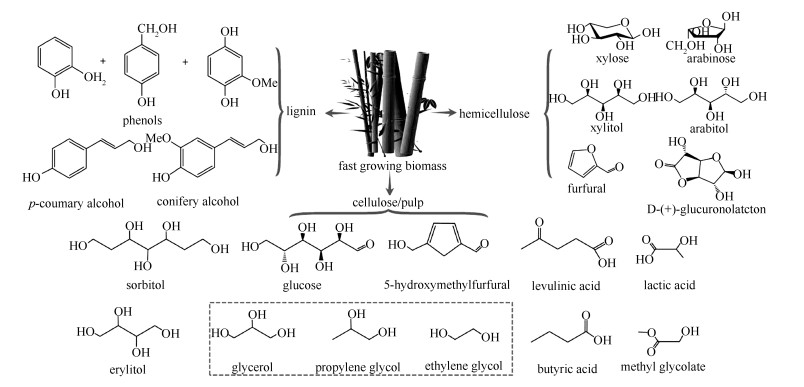
Figure 1.
Representative bio-based chemicals derived from lignin, hemicellulose and cellulose

Organic nitrogen promotes stability of metallic catalysts in conversion of bamboo pulp to low carbon polyols
Zhu-qian XIAO , Qiang ZHANG , Xiao-lei WANG , Qing GE , Xi-kun GAI , Jian-wei MAO , Jian-bing JI


The current chemical and energy industries heavily depend on petroleum, coal and natural gas, which have limited reserve and nonrenewable exploiting. In this case, most countries worldwide have devoted their researchers to studying utilization of renewable biomass to ease resource constrains[1]. Lignocellulose has been regarded as a promising alternative source to substitute fossil fuels to produce bio-based chemicals and fuels owing to its abundance and renewability[2, 3]. Cellulose, lignin and hemicellulose constitute the main components of lignocellulose and they have exhibited huge research value, as showed in Figure 1. Recently, the lignin has been adopted as the feedstock to synthesize phenolic compounds and derived fuels while the hemicellulose has been extensively explored to produce C5 chemicals[4-7]. So far, there has been several studies on the conversion of cellulose to glucose, polyols, 5-hydroxymethyl furfural (5-HMF), organic acids, ethanol and methyl glycolate[8]. Low carbon (C2, 3) polyols, including ethylene glycol (EG), propylene glycol (PG) and glycerol (Gly), are predominating intermediates in the manufacture of plastics, food additives, pharmaceuticals and cosmetics, etc.
However, recalcitrance of cellulose exhibits great challenges for oriented depolymerization under mild environmental conditions while some enzymolysis and physical pretreatment strategies were investigated for deforming its robust structure[9-11]. In order to satisfy more rigid environmental regulations, the researchers face the choices of using the various catalysts for degradation of cellulose because of its recalcitrance. According to previous studies, cellulose could be transformed into C2, 3 polyols in the presence of hydrogen at high temperature (220-245 ℃) via chemical catalytic process[12, 13]. In order to crack the bonds of β-1, 4-glycosidic bond and C-C bonds in inner molecular of cellulose, several active metals in nanoscale supported by inorganic materials were further investigated[14]. The employed catalyst reagents can roughly be divided into non-noble metals such as Ni[15], Cu[16] and W[17], etc. and noble metals such as Pt[18] and Ru[19, 20], etc. Successfully, the presence of different active metals on supports promoted the occurrence of various complex reaction pathways in a one-pot reaction of cellulose conversion. Among the active metals, catalysts containing nickel and different forms of tungsten (W/C[21], WO3[22] and NiW alloys[23]) were revealed extremely high activity and selectivity for formation of C2, 3 polyols, especially for EG. The catalysts with tungsten sites were highly active in promoting the selective cleavage of C-C bonds and the retro-aldol condensation which was the most acceptable mechanism for formation of low carbon unsaturated intermediates in liquid medium[24]. Nickel sites mainly played an important role in hydrogenation of unsaturated intermediates to form polyols[25]. W and Ni sites occurred the compatible and synergetic catalysis in cellulose conversion. Although the metallic catalysts at the nanoscale can be good candidates for degradation of cellulose, many important factors including particle size, morphology, electrical conductivity and surface modification also had an obvious influence on their activities[14]. In order to consolidate the active sites resisting to leaching under hydrothermal acid conditions, some researchers dedicated to investigate the activities of metallic catalysts hybridized with nitrogen-doping in hydrogenation reaction[26, 27]. Benefiting from the excellent thermal stability and corrosion resistance against acid and alkali, carbon from biomass materials was widely studied and applied in this catalytic system. Due to its neutral chemical properties, bio-carbon exhibited extreme compatibility for loading of active metals, such as Ni, W, Ru and Pt. Moreover, recently, some reports about the catalysts construction for oxygen reduction revealed that the graphitic carbon nitride (g-C3N4) phase showed high chemical stability in hydrothermal circumstance[28, 29]. The usual binding configuration of N dopants in a given carbon matrix were pyridinic, pyrrolic and graphitic N, which are available for complex metal cations including Ni2+, Fe2+, Cu2+ and Pt2+. This function could inspire a new strategy for catalysts preparation. Thus, N-containing complex agent was adopted to have a complex reaction with metal cations and eventually producing Metal-Nx-Cy or specific stable Nx-Cy phase.
In order to prove the scientific hypothesis mentioned above, it was aimed to synthesize nickel-tungsten catalysts supported on N-doping porous carbon through calcining specific catalyst precursors and organic nitrogen sources. The carbon would be from carbonization of raw bamboo powder. These fabricated catalysts would be applied into bamboo pulp conversion into ethylene glycol under hydrothermal reaction condition. The dispersion of particles, leaching resistance and catalytic efficiency of these nickel-tungsten catalysts would be further studied in this catalytic system.
The bimetallic 15%Ni-20%W/MBC@Y-x catalysts were prepared by incipient-wetness impregnation method (Y: nitrogen source; x: the mass fraction of nitrogen source based on the mass of MBC). MBC was from carbonization of bamboo powder. All the mass fractions were calculated on the base of supports weight. Briefly: the nickel nitrate (Ni(NO3)2·6H2O, Energy Chemical Co., Ltd., China.) and phosphotungstic acid (H3PW12O40·xH2O, Sinopharm Chemical Reagent Co., Ltd., China.) were impregnated on the mesoporous bamboo carbon (MBC) under vigorous stirring while the nitrogen source (melamine, ethanediamine, carbamide or arginine) was mixed with MBC. The analytical grade melamine (M), ethanediamine (EDA), carbamide (CAR) and arginine (ARG) were purchased from Aladdin Co. Ltd (Shanghai, China). Subsequently, the catalyst samples were oven dried at 90 ℃ for 12 h and followed by milling and screening into powders. Finally, the dry samples were calcined in a tubular calciner under a N2 flow of 20 mL/min at 650 ℃ for 3.0 h with the heating rate of 3 ℃/min. The calcined samples were reduced in a H2/N2 (1:4 in volume) flow with a rate of 10 mL/min at 500 ℃ for 3.0 h.
The hydrogenolysis of bamboo pulp was performed in a batch reactor (Yanzheng Equipment Co., Ltd., 100 mL stainless steel autoclave) at a stirring speed of 600 r/min. Typically, 0.5 g bamboo pulp and 0.2 g catalyst mixed with 50.0 mL deionized water were introduced into the autoclave. Afterwards, the reactor was purged with 5.0 MPa H2 after removing air by N2 for three times. Subsequently, the reactor was heated to 240 ℃ and the reaction process lasted for 1.5 h. The liquid phase after reaction were filtrated and analyzed by high performance liquid chromatography (HPLC, Waters, USA) equipped the refraction index detector (RID 2414, Waters, USA). 20 μL liquid samples were injected to HPLC under 0.5 mL/min of deionized water (mobile phase) and then detected by Welch X'mate-Ca (7.8 mm×300 mm, 5 μm) column at 80 ℃ heated through an external column oven. The conversion of bamboo pulp and yields of polyols are calculated based on the following formulas[12, 30]:
|
$ {x_{{\text{ bamboo}}\;{\text{pulp }}}} = \frac{{{M_0} - {M_{\text{R}}}}}{{{M_0}}} \times 100\% $ |
(1) |
|
$ {w_{{\text{ plovols }}}} = \frac{{{M_{\text{p}}}}}{{{M_0}}} \times 100\% $ |
(2) |
Where x and w are the conversion of feedstocks and yield of polyols, respectively; M0 represents the weight of bamboo pulp before reaction, MR is the residual weight of bamboo pulp after reaction and MP is the polyols mass in liquid products.
N2 adsorption-desorption isotherms were measured at -196 ℃ by the Micromeritics ASAP 2420 degassed at 200 ℃ to release the physically adsorbed impurities for 8 h in vacuum. BET area and BJH pore size distribution were calculated according to the desorption branch of the isotherms.
The thermogravimetric analysis (Thermogravimetry, TG) of the catalyst samples was done by STA 449 of F3 Jupiter synchronization comprehensive thermal analyzer (Germany NETZSCH, Germany). The heating rate was set at 10 ℃/min from room temperature to 900 ℃ under the mixed flow rate of air (20 mL/min) and the nitrogen (5 mL/min).
The phase compositions of the catalytic species were characterized by X-ray diffraction (XRD) on a SmartLab X-ray diffractometer (Rigaku, Japan) in the 2θ range of 5°-85° using a Cu Kα1 X-ray radiation operating at 40 kV and 100 mA.
X-ray photoelectron (XPS) was measured on a Kα spectrometer (Thermo Fisher Scientific, USA) with an Al Kα X-ray source (1486.6 eV, 15 kV, 150 W). The obtained binding energies were calibrated using the C 1s peak at 284.6 eV as the reference. The photo-peak area was determined after the subtraction of the linear spectral background. The spectral simulations were based on a Gaussian profile.
The catalyst particles distribution was observed by transmission electron microscope (TEM) on a JEOL JEM-2100F microscope at accelerating voltage of 80 kV. Catalyst samples were suspended in ethanol with an ultrasonic dispersion for 20 min and deposited on copper grids coated with amorphous carbon films.
ICP-OES test of reaction liquid was performed on Perkin Elmer ICP instrument (Optima 5300DV, 40.68 MHz) with an optical resolution of 0.006 nm at the wave length of 200 nm and the detection limit was up to (0.1-1.0)×10-6.
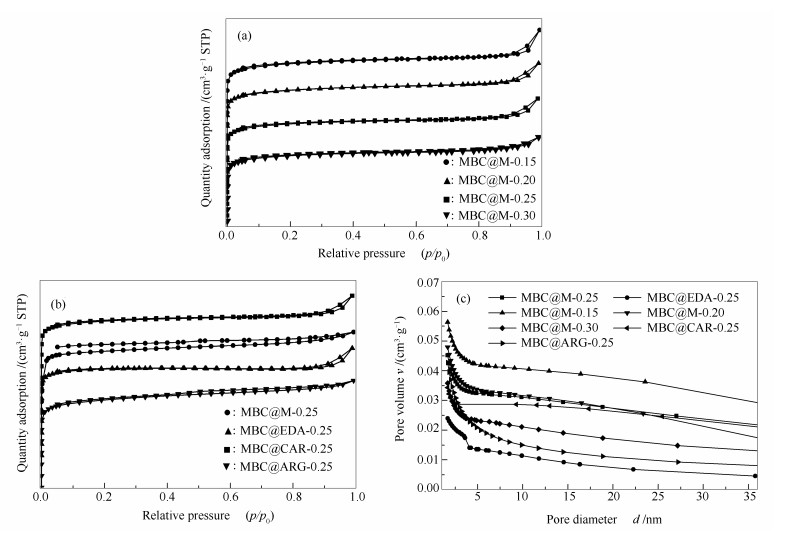
The physical properties of different nickel-tungsten catalysts, including surface area (ABET), total pore volume (vtotal), average pore size and pore-size distribution, were determined by N2 adsorption-desorption experiments and the results are shown in Table 1 and Figure 2. The melamine content, as observed, has very small effects on enlargement of surface area (from 280.7 to 262.9 m2/g) and average pore volume of MBC (vtotal) is held as a constant at 0.12 cm3/g. Comparatively, when ethanediamine (EDA) is adopted as the nitrogen source, the BET surface decreases to 164.2 m2/g. According to Figure 2(a) and 2(b), the adsorption-desorption isotherms of the catalysts can be roughly defined as the isotherm of micro and mesopores. In Figure 2(c), large platforms of isotherm curves are observed when p/p0 was at 0.1-0.8 and the adsorption capacity increases rapidly at relative lower pressure (p/p0 < 0.1), which implies the emblematic adsorption of micro pores. By contrast, the isotherms increase swiftly to form an inflection point at the higher relative pressure (p/p0 > 0.9) in Figure 2(a) and 2(b). This result probably elucidates that a large amount of adsorption condensation occurs on the outer surface of the sample particles or some macro pores are formed during the preparation of MBC.

 下载:
导出CSV
下载:
导出CSV
| Sample | ABET/(m2·g-1) | vtotal/(cm3·g-1) | Average pore size d/nm |
| MBC@M-0.15 | 280.7 | 0.12 | 7.1 |
| MBC@M-0.20 | 276.1 | 0.12 | 6.1 |
| MBC@M-0.25 | 271.6 | 0.12 | 6.6 |
| MBC@M-0.30 | 262.9 | 0.12 | 5.4 |
| MBC@EDA-0.25 | 164.2 | 0.07 | 5.2 |
| MBC@CAR-0.25 | 256.1 | 0.12 | 9.3 |
| MBC@ARG-0.25 | 264.1 | 0.11 | 4.1 |
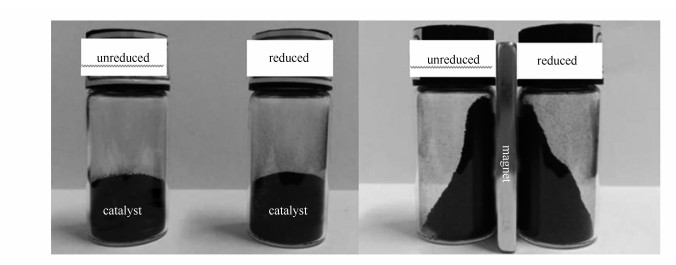
The phase compositions of the Ni-W/MBC@M-x (x = 0.15-0.30) and Ni-W/MBC@Y-0.25 (Y=EDA, CAR, ARG and M) catalyst samples are characterized by XRD in Figure 3 for 2θ values ranging from 5°-90°. The peaks at 2θ values of 44.4°, 51.8° and 76.1° are corresponded to metal Ni crystallites (JCPDS file No. 04-0850)[13]. All samples show these Ni0 characteristic peaks in Figure 3(a) and 3(b) while the peak intensities are different. This is the reason why the catalysts after calcination show the strong magnetic in Figure 4 when the organic N-containing compounds are introduced during preparation. The nickel phosphide phase is observed at 54.6° since the introduction of P is from phosphotungstic acid. By contrast, the tungstic phases appeared at 33.3° and 36.4° are associated with WOx species including WO3 (JCPDS No. 32-1395) and WO2.83 (JCPDS No. 36-0103)[12]. The very small intensity of the peaks at 32.7° and 47.5° could be explained by the formation of tungsten nitride (WN, JCPDS No. 32-1395) on account of melamine addition. Previous studies elucidated that metal-nitrogen (M-Nx) could be engaged as an active catalyst for electrocatalytic performance[31]. Interestingly, another low-intensity peak at 27.4° is corresponded to graphitic carbon nitride (g-C3N4) phase which is known as a good photocatalytic performance for hydrogen production via water splitting under visible-light irradiation[32]. This metal-free g-C3N4 also possesses very high thermal and chemical stability as well as its electronic properties. Moreover, the XRD patterns also indicate the strong interactions between the nickel and tungsten occurring to form NixWy (x, y represented molar ration in alloys) alloys during the calcination process. According to XRD characterization, the NixWy alloys mainly consiste of NiWO4 (JCPDS No. 15-0755) which are corresponded by 2θ of 19.2°, 23.4°, 24.8°, 30.8°, 36.4°, 41.5°, 52.1°, 62.3° and 65.6°[33]. Interestingly, these NixWy alloys are formed only when the content of melamine is less than 20% as shown in Figure 3(a). The presence of NiWO4 formation is the most significant discrepancy among Ni-W/MBC@M and Ni-W/MBC@Y (Y=EDA, CAR and ARG) catalysts. In other words, these results suggested that the high content of melamine could hinder the formation of NixWy alloys. What's more, WO3 species also could be observed scarcely at 33.3° or 36.4°. The WO3 phase had been proved to demonstrate high catalytic activity in hydrogenolysis of cellulose attributing for C-C bonds cracking[34, 35]. In order to analyze the characteristic peaks of the support MBC, the XRD pattern of MBC pretreated by ethanol, alkali and water respectively is recorded in 2θ of 5°-50° in Figure 3(c). Accordingly, the results reveal that the presence of bulky crystals of carbon could not be found, implying that the phase of MBC is amorphous.
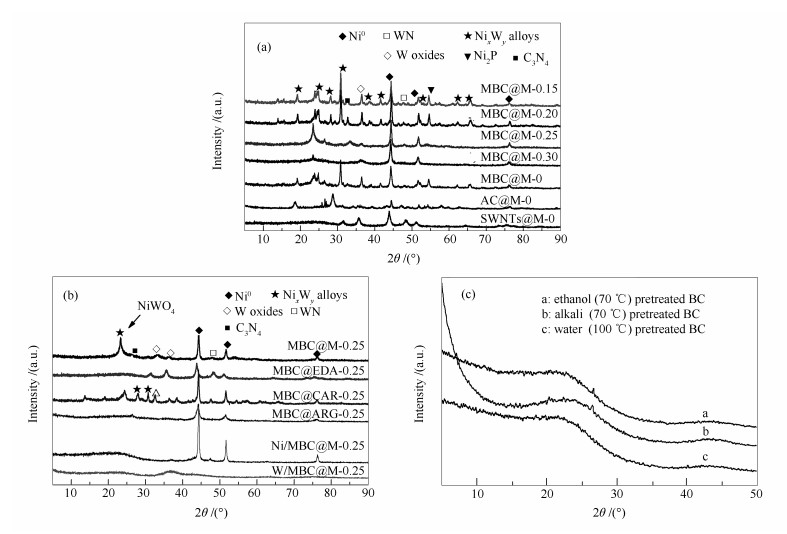
(a): amount of melamine as the variable;
(b): the catalysts prepared by addition of multifarious nitrogen sources;
(c): MBC was pretreated by ethanol, alkali and water, respectively
The morphologies and structure of Ni-W/MBC catalysts were investigated by transmission electron microscopy (TEM) analysis. Three different morphologies about Ni-W/MBC@M-0.25 (a), Ni-W/MBC@ARG-0.25 (b) and Ni-W/MBC@CAR-0.25 (c) are exhibited in Figure 5(a)-5(c).
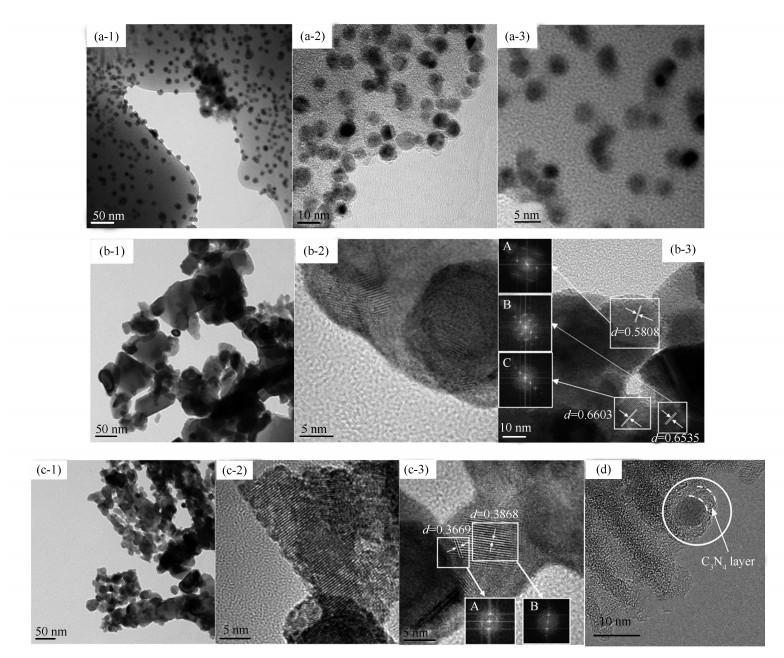
This TEM characterization is mainly performed to study the effect of organic nitrogen sources on particle distribution. Definitely, the results demonstrate that the dispersion of metallic particles show great discrepancy among these catalysts. A small broad and well-distributed metallic particles can be clearly observed on MBC according to Figure 5(a) in different scales. The crystallites size is approximately in range of 3-8 nm. Previous studies implied that smaller particles possessed more accordingly catalytic sites since dominating the same concentration of precursors, which could be responsible for the catalytic activity toward the hydrogenation of C=O bonds (unsaturated aldehydes to saturated polyols)[36]. However, the Ni-W/MBC@ARG and Ni-W/MBC@CAR catalysts exhibite relatively large particles on the surface of MBC, indicating that the crystal shapes are more pronounced. Comparatively, on the surface of the two catalysts, there existed different types of particles probably including metallic alloys and monocrystals. The clear and continuous lattice spacing is measured with a d-spacing of 0.5808, 0.6603 and 0.6535 nm, which are respectively attributed to the (211) [Ni4W], (111) [Ni17W3] and (042) [NiW] planes on surface of Ni-W/MBC@ARG catalyst despite the less amount of Ni17W3 and NiW alloys are formed according to previous characterization[33, 37, 38]. Accordingly, well resolved lattice fringes with interplanar distance of 0.3868 and 0.3669 nm are observed in Figure 5(c), which is closed to the (022) plane of Ni monocrystal at 5-10 nm scale. This characterization results indicate the successful formation of NixWy alloys and metallic Ni species. In order to observe the relative position of metallic particles and C3N4 phase (characterized by XRD), the catalyst sample was characterized by HRTEM. According to Figure 5(d), it is clearly observed that the metallic particles is surrounded by some disordered layer. Therefore, it is deduced that C3N4 phase could generate a protecting layer to inhibit the aggregation under this hydrothermal condition. This structure provided a material basis for remaining the chemical stability of catalysts. However, no further evidence could prove that all the particles on the surface of support were surrounded by C3N4 layer. These observations were basically consistent with results of XRD characterization. Successful formation of Ni and Ni-W alloys species might result in a cooperation effects in catalysis for degradation of bamboo pulp.
XPS analysis was conducted to evaluated the chemical states of the surface tungsten and nickel species. The W 4f and Ni 2p spectra, presented in Figure 6, are obtained for Ni-W/MBC, Ni-W/MBC@ARG, Ni-W/MBC@CAR and Ni-W/MBC@M catalysts.
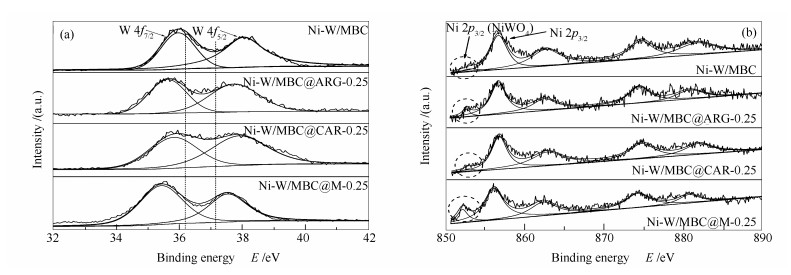
The W 4f spectrum contains two overlapping doublets including W 4f5/2 and W 4f7/2 at binding energies of 37.5 and 35.6 eV. These peaks at 37.5 and 35.6 eV could be attributed to W6+ species according to deconvolution[12], which is mainly ascribed to tungsten oxides such as WO3 and WO2.83 characterized by XRD. Comparatively, these binding energies of the two peaks exhibite a small shift to higher energy probably because the strong interactions among metals cause oxygen vacancy (WO3-x species) during calcination. Previously, it was studied that WO3 was well known for its non-stoichiometric properties since the lattice could withdraw a considerable number of oxygen vacancies[39]. The phenomenon of oxygen vacancies was beneficial to promote the surface conductivity of catalysts[38, 40], which would enhance the prosperity of transferring of electron and charged particles. Accordingly, the binding energy of Ni 2p3/2 is observed at 857.2 eV while the binding energy of Ni 2p3/2 has shifted to lower energy at 856.1 eV illustrated by Figure 6(b). These characteristic binding energies were assigned to metallic Ni0. The formation of Ni0 implied that the nickel nitrate was decomposed to form NiO phase and it was consecutively reduced to Ni0 during calcination because of existence of organic carbon source which could be converted to reducing agent under N2 atmosphere. The relative high content of Ni0 contributed to hydrogenating process of unsaturated intermediates such as alcohol aldehydes and glyceraldehyde. More importantly, the binding energy fitting peak of Ni 2p3/2 at 852.3 eV about NiWO4 phase can observed according to Figure 6(b) marked by the red dotted circle.
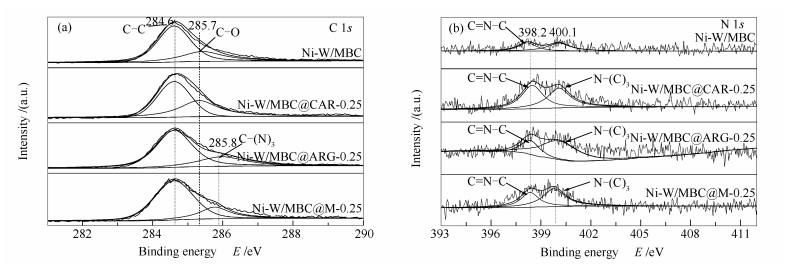
Moreover, asymmetrical but obvious C 1s peak (in Figure 7) of the XPS spectra at 284.6 eV proves the significant modification of the sp2 carbon atoms on the surface of the support, which is mainly from the carbonization of organic nitrogen[41], and carbon sources (melamine, arginine, ethanediamine and carbamide) accompanied interaction between N and C atoms to form C3N4 composite at 398.2 and 400.1 eV demonstrated in Figure 7(b). The C 1s peak at 285.7 eV is usually assigned to the oxygen-containing carbonaceous bands (C-O). The existence of foreign atoms including N and O is due to addition of nitrogen source and its inadequate carbonization. According to N 1s XPS spectra of the different catalysts, the asymmetrical and broad features of the observed N 1s XPS peaks at 398.2 and 400.1 eV indicate the existence of chemically different N species in the C3N4 composite deduced from deconvolution after Gaussian curve fitting in Figure 7(b). The N 1s peak at 398.2 eV could be assigned to sp2-hybridized nitrogen (C=N-C)[42]. The other peak at about 400.1 eV could be attributed to tertiary nitrogen [N-(C)3] pointed out by red arrow in the figure. The other peak at about 400.1 eV could be attributed to tertiary nitrogen [N-(C)3][43, 44], which confirms the polymerization of nitrogen sources especially for melamine. This characterization supported the well-modified character of the catalyst surface by C3N4 composite.
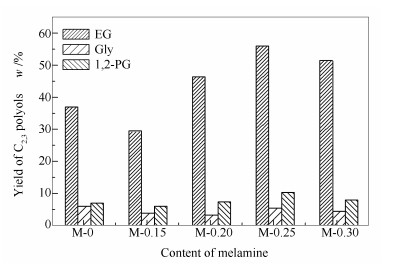
Actually, the one-pot conversion of cellulose or lignocellulose was a complex transformation process, where the nickel and tungsten based catalytic species contributed to retro-aldol condensation and hydrogenation of unsaturated intermediates[45]. Here, the bamboo pulp, removing most of lignin and hemicellulose was adopted as the feedstock to investigate the catalytic performance of prepared nickel-tungsten catalysts under condition of 240 ℃ and 5.0 MPa H2. The 15%Ni-20%W/MBC@M catalysts exhibite relative high performance obtaining 76%-100% conversion of bamboo pulp in Table 2. Comparatively, the catalytic results demonstrate the perceptible activity discrepancy among these catalysts in Entry 1-3 and 5. A high EG yield of 55.8% is achieved using 15%Ni-20%W/MBC@M-0.25 catalyst prepared with addition of 25% melamine while the 15%Ni-20%W/MBC@M-0.15 only obtains 29.4% EG yield. The control experiment in Entry 6 shows slightly low yield of polyols without any nitrogen source. These findings obviously indicate that the content of melamine has an influence on the catalytic efficiency. According to Figure 8, it can be clearly observed that the introduction of melamine has function on yield of EG but a slight influence on the other products. Yang et al[17, 46]reported that the tungsten species could facilitate the C-O and C-C bonds cracking and improve the selectivity of EG significantly. From this view, it was speculated that the interactions mainly among tungsten participations occurred during the decomposed of nitrogen sources in calcination. However, according to XRD and XPS analysis, the introduction of melamine scarcely affected the formation of N-containing composites such as nitride tungsten and nitride nickel but the interactions among metallic particles and MBC were promoted which would enhanced catalytic activity eventually. Interestingly, for another hand, the glycerol (Gly), 1, 2-propanediol (1, 2-PG) and glucose show similar distributions as below 10% yield, indicating that this series of catalysts present the moderate activity for C3 products except that the glucose could be transformed to glucuronic acid at 240 ℃[47]. Afterwards, the traditional carbon materials were employed to investigate the attribution of supports to cellulose conversion and the corresponding catalytic results in Table 2 Entry 6-8 reveal the apparent discrepancy of polyol yields. Even though 15%Ni-20%W/SWCNTs (single-walled nano carbon tubers) showed the common activation in this condition, the exorbitant price of SWCNTs resulted in lower process economy.
下载:
导出CSV
| Entry | Catalyst | Yield of product/% | Conv. x/% | ||||
| EG b | Gly | 1, 2-PG | glucose | sor | |||
| 1 | 15%Ni-20%W/MBC@M-0.15 | 29.4 | 4.1 | 6.1 | 5.4 | 5.1 | 83 |
| 2 | 15%Ni-20%W/MBC@M-0.20 | 46.2 | 3.5 | 7.6 | 3.5 | 4.3 | 100 |
| 3 | 15%Ni-20%W/MBC@M-0.25 | 55.8 | 5.6 | 10.5 | 4.8 | 6.1 | 100 |
| 4 | 15%Ni-20%W/MBC@M-0.25 b | 25.4 | 3.3 | 2.1 | 1.3 | trace | 76 |
| 5 | 15%Ni-20%W/MBC@M-0.30 | 51.2 | 4.7 | 8.1 | 3.5 | 5.3 | 100 |
| 6 | 15%Ni-20%W/MBC | 36.9 | 6.1 | 7.2 | 2.9 | 3.9 | 95 |
| 7 | 15%Ni-20%W/AC | 21.6 | 2.3 | 7.8 | 3.1 | trace | 84 |
| 8 | 15%Ni-20%W/SWCNTs c | 33.1 | 8.1 | 5.6 | 3.6 | 4.6 | 100 |
| 9 | 15%Ni/MBC@M-0.25 | 10.3 | trace | 1.2 | 6.1 | 1.4 | 78 |
| 10 | 20%W/MBC@M-0.25 | 6.5 | trace | trace | 1.2 | UD.g | 95 |
| 11 | 15%Ni-20%W/MBC@EDA-0.25 d | 44.6 | 4.5 | 5.3 | 5.7 | 4.1 | 100 |
| 12 | 15%Ni-20%W/MBC@CAR-0.25 e | 31.0 | 5.6 | 3.2 | 4.3 | 0.9 | 91 |
| 13 | 15%Ni-20%W/MBC@ARG-0.25 f | 54.1 | 6.1 | 3.0 | 4.1 | 3.2 | 100 |
| a : reaction conditions: bamboo pulp 0.5 g, 5.0 MPa H2, 240 ℃ for 1.5 h; b: feedstock: raw bamboo powder; c: SWNTs: single-walled carbon nanotubes; d: EDA: ethanediamine; e: CAR: carbamide; f: ARG: arginine; g: undetected | |||||||
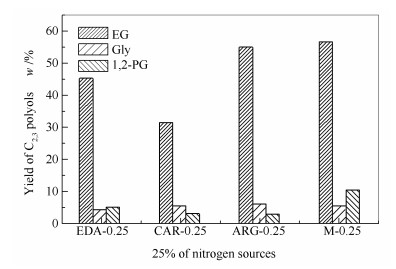
What's more, in the domain of nitrogen sources, the other nickel-tungsten catalysts were also prepared using ethanediamine, carbamide and arginine besides melamine, and the addition amount was brought up to 25% correspondently based on the mass of the support MBC. This process was used to investigate the possible synergistic effect among metals and support composites by adjusting the nitrogen sources, which might be regarded as a surface modification to mesoporous bamboo carbon. According to the catalytic results in Table 2 Entry 11-13, the yields of EG demonstrate relatively great discrepancies because of various adding amount of different nitrogen sources. Compared to Ni-W/MBC@M-0.25 catalyst, the Ni-W/MBC@ARG-0.25 catalyst could obtain 63.2% of C2, 3 polyols (54.1% yield of EG) while the others could only achieve 54.4% (EDA) and 39.8% (ARG) yield of C2, 3 polyols. Furthermore, the addition of ARG inhibites the bamboo pulp conversion slightly (95% in Entry 6 decreased to 91% in Entry 12). Interestingly, this influence seemingly brings the difference of EG yield while the distribution of C2, 3 polyols still remained in range of 3.0%-6.1% as exhibited in Figure 9. From the mechanism point of view, the bio-nitrogen could promote the interactions between metals and even formed new phases including NiWO4 and C3N4 species. According to our previous studies, the Ni-W alloys including NiW, Ni4W and NiWO4 phases could supplement and enhance the incorporation of intrinsic nickel and tungsten catalytic activity[23]. Moreover, the NiWO4 alloy might inhibit the catalysts deactivation at reaction condition because of its hydrothermal resistibility[48, 49]. Furthermore, Ni-W alloy has been nominated as a promising environmental friendly alloy and its anti-corrosion and-leaching properties probably preserved the stability of nickel under this reaction condition[50, 51]. The XPS analysis behaves as proof to prove the formation of NiWO4 alloy when the melamine is added during the catalyst is prepared (Figure 7).
Otherwise, the XPS analysis also revealed that C3N4 phase was formed on the prepared catalysts. During the calcination, the nitrogen sources such as ethanediamine, carbamide, arginine and melamine could be carbonized on the surface of MBC to form limited amount of C3N4 phase. Previous studies indicated that graphitic carbon nitride (g-C3N4) possessed very high thermal and chemical stability as well as interesting electronic properties[52]. But this study just focus on the formation of C3N4, and its possible functions on how to promote the catalytic efficiency and how the specific structure of C3N4 was achieved would be further analyzed next step. Though C3N4 phase loaded on the MBC has no drastically promotion for catalytic efficiency seemingly, its hydrothermal stability could afford a preponderance of maintaining surficial physical circumstance of the support, which might encourage the permanence of recycle use of the catalysts. Afterwards, the recyclability of the 15%Ni-20%W/MBC@M-0.25 catalyst was tested and the results are shown in Figure 10.
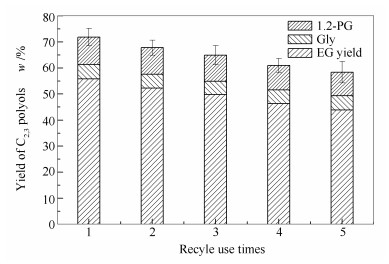
Similar conversions were conducted for each run, irrespective of the using time of the catalyst. The trend yield of C2, 3 polyols could remain relative stable from the first time to the fourth time (from 71.9% to 58.4%). However, a slight deactivation of tested 15%Ni-20%W/MBC@M-0.25 catalyst could be defined as yield of C2, 3 polyols decreased. It was speculated that the metallic particles under this hydrothermal condition were probably gathered or active nickel was leached into acid water. The solution of the reactions conducted with 15%Ni-20%W/MBC (without N source)and 15%Ni-20%W/MBC@M-0.25 catalyst (with 25% melamine) were analyzed by ICP-OES. It is determined that the nickel concentrations of (0.15±0.02) to(0.23±0.03) mg/mL are in recycle use reaction liquids (in Figure 11).
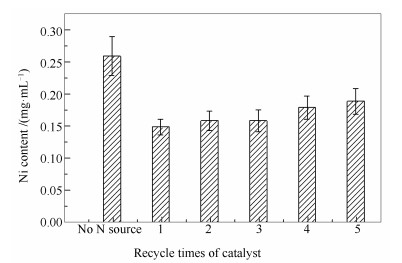
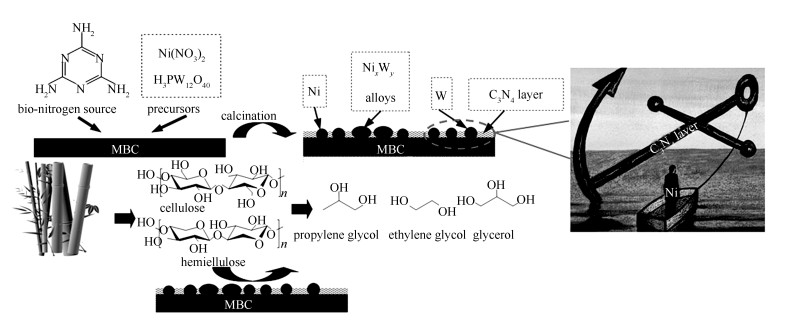
In contrast, (0.26 ± 0.02) mg/mL of nickel is detected in the liquid conducted by 15%Ni-20%W/MBC used for the first time. Given that the lower Ni leaching was detected with 15%Ni-20%W/MBC@M-0.25 catalyst, it suggested that adding organic nitrogen source was helpful to immobilize Ni particles and suppress the leaching of Ni species, compared to the catalyst without N source. It was also speculated that the active center (Ni sites) had been anchored on the surface of support surrounded by graphitic nitrogen to form C3N4 layer. This nitride carbon layer could promote resistance ability for acid-etching of Ni and W sites through anchoring the metallic sites as shown in Figure 12.
In summary, a series of MBC supported nickel-tungsten catalysts were successfully prepared by addition of specific nitrogen sources and applied in bamboo pulp conversion to C2, 3 polyols. During calcination of the catalysts, some Ni-W alloys were formed besides metallic Ni0 and tungsten species characterized by XRD, XPS and TEM. Besides, the organic N sources were decomposed, and the C3N4 phase with high hydrothermal property was formed simultaneously. For catalytic efficiency, Ni-W/MBC@M-0.25 catalyst acquired the highest EG yield (55.8%). Catalyst recycle using investigation implied that Ni-W/MBC@M-0.25 could remain relative stable under this reaction condition. The Ni-W alloys and the C3N4 phase was identified as the main contributors to maintain the catalyst stability. Thus, knowledge acquired in this study may inspire further research on analysis of catalyst species when hybridization with heteroatoms and studies of their possible functions on catalytic performance in the field of biomass conversion in liquid.
KUMAR A K, SHARMA S. Recent updates on different methods of pretreatment of lignocellulosic feedstocks:A review[J]. Bioresour Bioprocess, 2017, 4(1): 7-25. doi: 10.1186/s40643-017-0137-9
JI N, ZHANG T, ZHENG M Y, WANG A Q, WANG H, WANG X D, CHEN J G. Direct catalytic conversion of cellulose into ethylene glycol using nickel-promoted tungsten carbide catalysts[J]. Angew Chem, 2008, 120(44): 8638-8641. doi: 10.1002/ange.v120:44
WANG A Q, ZHANG T. One-pot conversion of cellulose to ethylene glycol with multifunctional tungsten-based catalysts[J]. Acc Chem Res, 2013, 46(7): 1377-1386. doi: 10.1021/ar3002156
KIM K H, DUTTA T, SUN J, SIMMONS B, SINGH S. Biomass pretreatment using deep eutectic solvents from lignin derived phenols[J]. Green Chem, 2018, 20(4): 809-815. doi: 10.1039/C7GC03029K
LUO H, ABU-OMAR M M. Lignin extraction and catalytic upgrading from genetically modified poplar[J]. Green Chem, 2018, 20(3): 745-753. doi: 10.1039/C7GC03417B
DIETRICK K, HERNANDEZ-MEJIA C, VERSCHUREN P, ROTHENBERG G, SHIJU N R. One-pot selective conversion of hemicellulose to xylitol[J]. Org Process Res Dev, 2017, 21(2): 165-170. doi: 10.1021/acs.oprd.6b00169
ZHANG Z H, HUBER G W. Catalytic oxidation of carbohydrates into organic acids and furan chemicals[J]. Chem Soc Rev, 2018, 47(4): 1351-1390.
XU G, WANG A Q, PANG J F, ZHAO X C, XU J M, LEI N, WANG J, ZHENG M Y, YIN J Z, ZHANG T. Chemocatalytic conversion of cellulosic biomass to methyl glycolate, ethylene glycol, and ethanol[J]. ChemSusChem, 2017, 10(7): 1390-1394. doi: 10.1002/cssc.v10.7
DING D Y, ZHOU X, YOU T T, ZHANG X, ZHANG X M, XU F. Exploring the mechanism of high degree of delignification inhibits cellulose conversion efficiency[J]. Carbohydr Polym, 2017, 181(2): 931-938.
SHINOHARA N, SUNAGAWA N, TAMURA S, YOKOYAMA R, UEDA M, IGARASHI K, NISHITANI K. The plant cell-wall enzyme AtXTH3 catalyses covalent cross-linking between cellulose and cellooligosaccharide[J]. Sci Rep, 2017, 7(4): 46099-46108.
ZHENG J, CHOO K, REHMANN L. Xylose removal from lignocellulosic biomass via a twin-screw extruder:The effects of screw configurations and operating conditions[J]. Biomass Bioenergy, 2016, 88(5): 10-16.
HAMDY M S, EISSA M A, KESHK S M A S. New catalyst with multiple active sites for selective hydrogenolysis of cellulose to ethylene glycol[J]. Green Chem, 2017, 19(21): 5144-5151. doi: 10.1039/C7GC02122D
XIAO Z Q, FAN Y, CHENG Y J, ZHANG Q, GE Q, SHA R Y, JI J B, Mao J W. Metal particles supported on SiO2-OH nanosphere:New insight into interactions with metals for cellulose conversion to ethylene glycol[J]. Fuel, 2018, 215(3): 406-416.
WANG Y Z, DE S, YAN N. Rational control of nano-scale metal-catalysts for biomass conversion[J]. Chem Commun, 2016, 52(37): 6210-6224. doi: 10.1039/C6CC00336B
BAEK I G, YOU S J, PARK E D. Direct conversion of cellulose into polyols over Ni/W/SiO2-Al2O3[J]. Bioresour Technol, 2012, 114(3): 684-690.
LIU H L, HUANG Z W, XIA C G, JIA Y Q. Selective hydrogenolysis of xylitol to ethylene glycol and propylene glycol over silica dispersed copper catalysts prepared by a precipitation-gel method[J]. ChemCatChem, 2014, 6(10): 2918-2928. doi: 10.1002/cctc.v6.10
YANG Y, ZHANG W, YANG F, BROWN D E, REN Y, LEE S, ZENG D H, GAO Q, ZHANG X. Versatile nickel-tungsten bimetallics/carbon nanofiber catalysts for direct conversion of cellulose to ethylene glycol[J]. Green Chem, 2016, 18(14): 3949-3955. doi: 10.1039/C6GC00703A
FUKUOKA A, DHEPE P L. Catalytic conversion of cellulose into sugar alcohols[J]. Angew Chem Int Ed, 2006, 118(12): 5285-5287.
RIBEIRO L S, DELGADO J J, ÍRFAO J J M, PEREIRA M F R. Carbon supported Ru-Ni bimetallic catalysts for the enhanced one-pot conversion of cellulose to sorbitol[J]. Appl Catal B:Environ, 2017, 217(15): 265-274.
HAUSOUL P J C, BEINE A K, NEGHADAR L, PALKOVITS R. Kinetics study of the Ru/C-catalysed hydrogenolysis of polyols-insight into the interactions with the metal surface[J]. Catal Sci Technol, 2017, 7(1): 56-63. doi: 10.1039/C6CY02104B
ZHENG M Y, WANG A Q, JI N, PANG J F, WANG X D, ZHANG T. Transition metal-tungsten bimetallic catalysts for the conversion of cellulose into ethylene glycol[J]. ChemSusChem, 2010, 3(1): 63-66. doi: 10.1002/cssc.v3:1
LI N X, ZHENG Y, WEI LF, TENG H C, ZHOU J C. Metal nanoparticles supported on WO3 nanosheets for highly selective hydrogenolysis of cellulose to ethylene glycol[J]. Green Chem, 2017, 19(3): 682-691. doi: 10.1039/C6GC01327A
XIAO Z Q, ZHANG Q, CHEN T T, WANG X N, FAN Y, GE Q, ZHAI R, SUN R, JI JB, MAO J W. Heterobimetallic catalysis for lignocellulose to ethylene glycol on nickel tungsten catalysts:Influenced by hydroxy groups[J]. Fuel, 2018, 230(8): 332-343.
TAI Z J, ZHANG J Y, WANG A Q, ZHENG M Y, ZHANG T. Temperature-controlled phase-transfer catalysis for ethylene glycol production from cellulose[J]. Chem Commun, 2012, 48(56): 7052-7054. doi: 10.1039/c2cc32305b
OOMS R, DUSSELIER M, GEBOERS J A, BEECK B O D, VERHAEVEN R, GOBECHIYA E, MARTENS J A, REDL A, SELS B F. Conversion of sugars to ethylene glycol with nickel tungsten carbide in a fed-batch reactor:High productivity and reaction network elucidation[J]. Green Chem, 2014, 16(2): 695-707. doi: 10.1039/C3GC41431K
WANG J, WEI Z Z, MAO S J, LI H R, WANG Y. Highly uniform Ru nanoparticles over N-doped carbon:pH and temperature-universal hydrogen release from water reduction[J]. Energy Environ Sci, 2018, 11(4): 800-806. doi: 10.1039/C7EE03345A
CHEN X L, ZHENG J, ZHONG X, JIN Y H, ZHUANG G L, LI X N, DENG S W, WANG J G. Tuning the confinement space of N-carbon shell coated ruthenium nanoparticles:Highly efficient electrocatalysts for hydrogen evolution reaction[J]. Catal Sci Technol, 2017, 7(7): 4964-4970.
DU X D, YI X H, WANG P, DENG J G, WANG C C. Enhanced photocatalytic Cr(Ⅵ) reduction and diclofenac sodium degradation under simulated sunlight irradiation over MIL-100(Fe)/g-C3N4 heterojunctions[J]. Chin J Catal, 2019, 40(1): 70-79.
HUANG L Y, XU H, LI Y P, LI H M, CHENG X N, XIA J X, XU Y G, CAI G B. Visible-light-induced WO3/g-C3N4 composites with enhanced photocatalytic activity[J]. Dalton Trans, 2013, 42(24): 8606-8616. doi: 10.1039/c3dt00115f
PAN G Y, MA Y L, MA X X, SUN Y G, LV J M, ZHANG J L. Catalytic hydrogenation of corn stalk into polyol over Ni-W/MCM-41 catalyst[J]. Chem Eng J, 2016, 299(1): 386-392.
YAN C C, LIN L, WANG GX, BAO X H. Transition metal-nitrogen sites for electrochemical carbon dioxide reduction reaction[J]. Chin J Catal, 2019, 40(1): 23-37.
XIANG Q J, YU J G, JARONIEC M. Preparation and enhanced visible-light photocatalytic H2-production activity of graphene/C3N4 composites[J]. J Phys Chem C, 2011, 115(15): 7355-7363. doi: 10.1021/jp200953k
NAZARIAN-SAMANI M, MOBARRA R, KAMALI A R, NAZARIAN-SAMANI M. Structural evolution of nanocrystalline nickel-tungsten alloys upon mechanical alloying with subsequent annealing[J]. Metall Mater Trans A, 2014, 45(1): 510-521. doi: 10.1007/s11661-013-1960-z
SUDARSANAM P, ZHONG R Y, BOSCH S V D, COMAN S M, PARVULESCU V I, SELS B F. Functionalised heterogeneous catalysts for sustainable biomass valorisation[J]. Chem Soc Rev, 2018, 47(5): 8349-8402.
LI X H, KURASCH S, KAISER U, ANTONIETTI M. Synthesis of monolayer-patched graphene from glucose[J]. Angew Chem Int Ed, 2012, 51(38): 9689-9692. doi: 10.1002/anie.v51.38
PUTRO W S, KOJIMA T, HARA T, ICHIKUNI N, SHIMAZU S. Selective hydrogenation of unsaturated carbonyls by Ni-Fe-based alloy catalysts[J]. Catal Sci Technol, 2017, 7(16): 3637-3646. doi: 10.1039/C7CY00945C
BOONYONGMANEERAT Y, SAENGKIETTIYUT K, SAENGPITAK S, SANGSUK S. Pulse co-electrodeposition and characterization of NiW-WC composite coatings[J]. J Alloys Compd, 2010, 506(1): 151-154. doi: 10.1016/j.jallcom.2010.06.162
HONG S H, AHN S H, CHOI J, KIM J Y, KIM H Y, KIM H J, JIANG J H, KIM H, KIM S K. High-activity electrodeposited NiW catalysts for hydrogen evolution in alkaline water electrolysis[J]. Appl Surf Sci, 2015, 349(5): 629-635.
DI V C, VALENTIN G. Spectroscopic properties of doped and defective semiconducting oxides from hybrid density functional calculations[J]. Acc Chem Res, 2014, 47(11): 3233-3241. doi: 10.1021/ar4002944
HUANG Z F, SONG J J, PAN L, ZHANG X W, WANG L, ZOU J J. Tungsten oxides for photocatalysis, electrochemistry and phototherapy[J]. Adv Mater, 2015, 27(36): 5309-5327. doi: 10.1002/adma.201501217
ZHANG S M, ZHANG H Y, ZHANG W M, YUAN X X, CHEN S L, MA Z F. Induced growth of Fe-Nx active sites using carbon templates[J]. Chin J Catal, 2018, 39(8): 1427-1435. doi: 10.1016/S1872-2067(18)63107-9
XIANG Q J, YU J G, JARONIEC M. Preparation and enhanced visible-light photocatalytic H2-production activity of graphene/C3N4 composites[J]. J Phys Chem C, 2011, 115(15): 7355-7363. doi: 10.1021/jp200953k
YAN S C, LI Z S, ZOU Z G. Photodegradation of rhodamine B and methyl orange over boron-doped g-C3N4 under visible light irradiation[J]. Langmuir, 2010, 26(6): 3894-3901. doi: 10.1021/la904023j
SUN Y Q, LI C, XU Y X, SHI G Q. Chemically converted graphene as substrate for immobilizing and enhancing the activity of a polymeric catalyst[J]. Chem Commun, 2010, 46(26): 4740-4742. doi: 10.1039/c001635g
FABICOVICOVA K, LUCAS M, CLAUS P. From microcrystalline cellulose to hard-and softwood-based feedstocks:Their hydrogenolysis to polyols over a highly efficient ruthenium-tungsten catalyst[J]. Green Chem, 2015, 17(15): 3075-3083.
ZHOU L K, WANG A Q, LI C Z, ZHENG M Y, ZHANG T. Selective production of 1, 2-propylene glycol from Jerusalem Artichoke tuber using Ni-W2C/AC catalysts[J]. ChemSusChem, 2012, 5(5): 932-938. doi: 10.1002/cssc.201100545
ZEMANOVA M, KRIVOSUDSKA M, CHOVANCOVA M, JORIK V. Pulse current electrodeposition and corrosion properties of Ni-W alloy coatings[J]. J Appl Electrochem, 2011, 41(11): 1077-1085.
AMANIAMPONG P N, KARAM A, TTINK Q T, XU K, HIRAO H, JEROME F, CHATEL G. Selective and catalyst-free oxidation of D-Glucose to D-Glucuronic acid induced by high-Frequency ultrasound[J]. Sci Rep, 2017, 7(2): 40650-40657.
AHMADI M, GUINEL M J F. Electrodeposition and characterization of amorphous-nanocrystalline nickel-tungsten alloys[J]. Microsc Microanal, 2012, 18(S2): 1694-1695. doi: 10.1017/S143192761201032X
LIU H L, QIN L, WANG X Y, DU C H, SUN D, MENG X C. Hydrolytic hydro-conversion of cellulose to ethylene glycol over bimetallic CNTs-supported NiWB amorphous alloy catalyst[J]. Catal Commun, 2016, 77(14): 47-51.
PEREYMA V Y, KLIMOV O V, PROSVITIN I P, GERASIMOV E Y, YASHNIK S A, NOSKOV A S. Effect of thermal treatment on morphology and catalytic performance of NiW/Al2O3 catalysts prepared using citric acid as chelating agent[J]. Catal Today, 2018, 305(7): 162-170.
LI X H, ZHANG J, ZHOU F, ZHANG H L, BAI J, WANG Y J, WANG H Y. Preparation of N-vacancy-doped g-C3N4 with outstanding photocatalytic H2O2 production ability by dielectric barrier discharge plasma treatment[J]. Chin J Catal, 2018, 39(6): 1090-1098. doi: 10.1016/S1872-2067(18)63046-3

Figure 1 Representative bio-based chemicals derived from lignin, hemicellulose and cellulose

Figure 2 N2 adsorption-desorption isotherms and the pore size distribution of MBC with various nitrogen sources and quantities

Figure 3 XRD patterns of different catalysts and MBC
(a): amount of melamine as the variable;
(b): the catalysts prepared by addition of multifarious nitrogen sources;
(c): MBC was pretreated by ethanol, alkali and water, respectively

Figure 5 TEM images of (a) Ni-W/MBC@M-0.25, (b) Ni-W/MBC@ARG-0.25, (c) Ni-W/MBC@CAR-0.25 catalysts and (d) the structure of metallic particles surrounded by C3N4 layer in high resolution

Figure 6 X-ray photoelectron spectra of (a) W 4f region and (b) Ni 2p of various 15%Ni-20%W/MBC@M-0.25 catalysts

Figure 7 X-ray photoelectron spectra of (a) C 1s and (b) N 1s on different nickel-tungsten catalysts

Figure 8 Effect of melamine addition on distribution of C2, 3 polyols: M-x represented the mass ratio of melamine based on the weight of MBC

Figure 9 Performance of nickel-tungsten catalysts influenced by adopting various nitrogen sources

Figure 10 Recycling experiments on the conversion of bamboo pulp into polyols over 15%Ni-20%W/MBC@M-0.25 catalyst: 5.0 MPa H2, 240 ℃ for 1.5 h

Figure 11 Concentrations of Ni cations in reaction liquids catalyzed by 15%Ni-20%W/MBC (with no N source, used for one time) and 15%Ni-20%W/MBC catalysts @M-0.25 (recycle use for five times)

Figure 12 Ni-W alloys and the C3N4 layer were identified as the main contributors to maintain the catalyst stability in the proposal reaction pathway
Table 1. Physical properties of different supported 15%Ni-20%W catalysts measured by BET
| Sample | ABET/(m2·g-1) | vtotal/(cm3·g-1) | Average pore size d/nm |
| MBC@M-0.15 | 280.7 | 0.12 | 7.1 |
| MBC@M-0.20 | 276.1 | 0.12 | 6.1 |
| MBC@M-0.25 | 271.6 | 0.12 | 6.6 |
| MBC@M-0.30 | 262.9 | 0.12 | 5.4 |
| MBC@EDA-0.25 | 164.2 | 0.07 | 5.2 |
| MBC@CAR-0.25 | 256.1 | 0.12 | 9.3 |
| MBC@ARG-0.25 | 264.1 | 0.11 | 4.1 |
 下载: 导出CSV
Table 2. Distribution of polyol products from bamboo pulp via nickel-tungsten catalysts a
| Entry | Catalyst | Yield of product/% | Conv. x/% | ||||
| EG b | Gly | 1, 2-PG | glucose | sor | |||
| 1 | 15%Ni-20%W/MBC@M-0.15 | 29.4 | 4.1 | 6.1 | 5.4 | 5.1 | 83 |
| 2 | 15%Ni-20%W/MBC@M-0.20 | 46.2 | 3.5 | 7.6 | 3.5 | 4.3 | 100 |
| 3 | 15%Ni-20%W/MBC@M-0.25 | 55.8 | 5.6 | 10.5 | 4.8 | 6.1 | 100 |
| 4 | 15%Ni-20%W/MBC@M-0.25 b | 25.4 | 3.3 | 2.1 | 1.3 | trace | 76 |
| 5 | 15%Ni-20%W/MBC@M-0.30 | 51.2 | 4.7 | 8.1 | 3.5 | 5.3 | 100 |
| 6 | 15%Ni-20%W/MBC | 36.9 | 6.1 | 7.2 | 2.9 | 3.9 | 95 |
| 7 | 15%Ni-20%W/AC | 21.6 | 2.3 | 7.8 | 3.1 | trace | 84 |
| 8 | 15%Ni-20%W/SWCNTs c | 33.1 | 8.1 | 5.6 | 3.6 | 4.6 | 100 |
| 9 | 15%Ni/MBC@M-0.25 | 10.3 | trace | 1.2 | 6.1 | 1.4 | 78 |
| 10 | 20%W/MBC@M-0.25 | 6.5 | trace | trace | 1.2 | UD.g | 95 |
| 11 | 15%Ni-20%W/MBC@EDA-0.25 d | 44.6 | 4.5 | 5.3 | 5.7 | 4.1 | 100 |
| 12 | 15%Ni-20%W/MBC@CAR-0.25 e | 31.0 | 5.6 | 3.2 | 4.3 | 0.9 | 91 |
| 13 | 15%Ni-20%W/MBC@ARG-0.25 f | 54.1 | 6.1 | 3.0 | 4.1 | 3.2 | 100 |
| a : reaction conditions: bamboo pulp 0.5 g, 5.0 MPa H2, 240 ℃ for 1.5 h; b: feedstock: raw bamboo powder; c: SWNTs: single-walled carbon nanotubes; d: EDA: ethanediamine; e: CAR: carbamide; f: ARG: arginine; g: undetected | |||||||
下载: 导出CSV

 扫一扫看文章


扫一扫关注我们