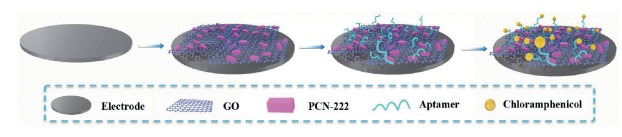
Scheme 1.
The preparation process of the PCN-222/GO-based electrochemical aptasensor for detecting CAP.

Artful union of a zirconium-porphyrin MOF/GO composite for fabricating an aptamer-based electrochemical sensor with superb detecting performance
Hong-Kai Li , Hai-Lin Ye , Xiao-Xue Zhao , Xiao-Long Sun , Qian-Qian Zhu , Zhang-Ye Han , Rongrong Yuan , Hongming He


Recently, an increasing number of attentions have been focused on design and preparation of hybrid functional materials with unique performance through subtle regulation at the atomic scale. Metal–organic frameworks (MOFs) are thriving porous solid materials, which are constructed by the coordination-driven assembly by organic ligand and metal ion [1-3]. By virtue of their high surface areas, adjustable pore microenvironment and plentiful structures, MOFs have been extensively implemented in various applications in fluorescence detection [4-6], optical device [7-10], separation and storage [11, 12]. However, the poor electrical conductivity of MOFs severely limits their applications in electrochemistry. On the other hand, graphene oxide (GO) as a popular material is broadly explored and employed in the electric field by reason of excellent electrical conductivity and modifiability [13-15]. Surface functionalized graphene can be intelligently integrated with other materials to fabricate hybrid materials by coordination or covalent bond [16, 17]. If the surface of graphene is modified by carboxyl group (−COOH), MOFs can be well dispersed on graphene to obtain MOF/GO hybrid materials through the coordination bond between metal site and −COOH [18]. MOF/GO hybrid materials possess the merits of both materials to significantly enhance their performance, but few composites are investigated as functional materials to prepare electrochemical aptasensors for detecting analytes.
Aptamers, as single-stranded oligonucleotides, are subtly designed and prepared by utilizing the systematic evolution of ligands by exponential enrichment (SELEX) [19]. Aptamers have been extensively used to specifically recognize target analytes for environmental protection and human health due to their unique identification sites and configurations [20-23]. Additionally, aptamers have lots of distinct advantages, such as diminutive size, easy functionalization, low cost, high usability and expandability [24-26]. Electrochemical aptasensors take full advantage of electrochemical technology and aptamer to detect trace analytes [27-32]. To further increase the detection capability, various functional materials have been designed and employed to modify electrodes, which can immobilize aptamers to fabricate sensitive electrochemical aptasensors [33-36]. Thereinto, MOF/GO hybrid composites are potentially functional materials to cover working electrodes with more aptamers due to porous structure, preferable electroconductibility and multifunctional sites. Therefore, rational construction of electrochemical aptasensors based on MOF/GO is a meaningful research work for super-efficient electrochemical detection.
In this work, a representative mesoporous Zr-MOF (PCN-222) is successfully prepared by the coordination assembly of meso-tetra(4-carboxyphenyl)porphine and Zr(Ⅳ), which has outstanding stability, high surface area and abound Zr(Ⅳ) sites. GO with−COOH group is employed as substrate material to support PCN-222 and improve its electroconductibility. Comparison with our reported electrochemical impedance aptasensor based on silver nanoparticles embedded in porous organic frameworks [37], the PCN-222/GO composite can facilitate the immobilization ability of aptamers through strong π-π stacking interaction and high affinity between phosphate group of aptamer and Zr(Ⅳ) site of PCN-222 simultaneously, which is beneficial to fabricate electrochemical aptasensors with high stability and sensitivity. Chloramphenicol (CAP) is selected as a research mode, because it is broadly used to fight off viral infections and also may result in some adverse effects on human body and environment [38]. As illustrated in Scheme 1, the prepared PCN-222/GO composite is employed to modify the electrode to construct an electrochemical aptasensor for detecting CAP. In virtue of the specific interaction of aptamer and analyte, this aptasensor exhibits the excellent recognition capability toward CAP.
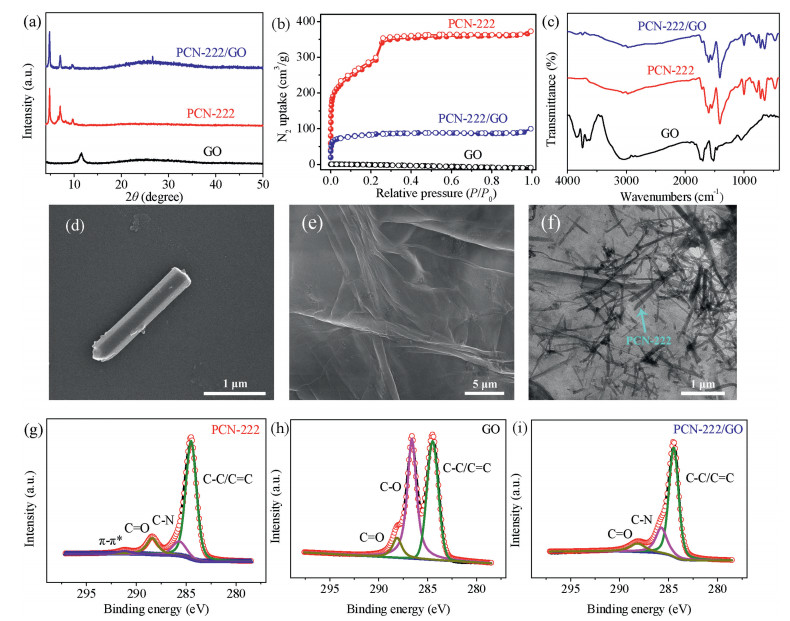
The powder X-ray diffraction (PXRD) profile of PCN-222/GO shows the same diffraction signals with PCN-222 to attest the presence of PCN-222 in this composite (Fig. 1a). However, the broad diffraction peak of GO cannot be found in this hybrid material, which is mainly attributed to the relative weak diffraction intensity of GO and the complete exfoliation of GO flakes through the intercalated PCN-222 on the surface as previous reports [39, 40]. Thermogravimetric analysis (TGA) curves indicate that they both have excellent thermal stability in air (Figs. S1-S3 in Supporting information). N2 sorption isotherms at 77 K are measured to study the internal pore structure (Fig. 1b). There is almost no any N2 sorption in GO by reason of its nonporous structure. The N2 sorption isotherm of PCN-222 belongs to the type-Ⅳ curve and has a maximal N2 adsorption amount of 373 cm3/g. The fabricated PCN-222/GO has the saturated adsorption capacity of 100 cm3/g because of the existence of GO. The results are also in coordination with the pore size distributions (Figs. S4 and S5 in Supporting information). The Brunauer-Emmett-Teller (BET) surface areas are calculated to be 311 m2/g for PCN-222/GO and 1097 m2/g for PCN-222, respectively (Figs. S6 and S7 in Supporting information). As displayed in Fig. 1c, some characteristic peaks exist in the Fourier transform infrared (FT-IR) spectrum of GO, including 3192 and 1728 cm–1 from stretching vibrations of O-H and carbonyl, 1600 and 1357 cm–1 from benzene ring vibration, and 1220 and 1061 cm–1 from epoxy stretching [41, 42]. However, these peaks of GO are not found in PCN-222/GO, which is similar with pure PCN-222 due to the coordination interaction between O atoms in GO and Zr(Ⅳ) sites in MOFs. Scanning electron microscope (SEM) images indicate that the as-synthesized PCN-222 is elongated shape (Fig. 1d) [43] and the surface of GO is very smooth (Fig. 1e). The transmission electron microscopy (TEM) image of this composite exhibits that PCN-222 crystals are well dispersed on the surface of GO (Fig. 1f). In addition, chemical components are analyzed by using X-ray photoelectron spectroscopy (XPS), which show the characteristic binding energies of C and O in GO, C, O, N and Zr in PCN-222, and C, O, N and Zr in PCN-222/GO (Figs. S8-S10 in Supporting information). The C 1s core-level XPS of PCN-222 shows four peaks, including π-π* (291.2 eV), C=O (288.1 eV), C-N (285.7 eV) and C-C/C=C (284.5 eV), respectively (Fig. 1g) [44]. The high-resolution C 1s spectrum of GO is divided into three bands at 288.1 eV of C=O, 286.6 eV of C-O and 284.5 eV of C-C/C=C, respectively (Fig. 1h) [45]. The C 1s spectrum of PCN-222/GO can be well fitted by three bands, corresponding to 288.4 eV (C=O), 285.7 eV (C-N) and 284.5 eV (C-C/C=C) (Fig. 1i). Moreover, the Zr 3d XPS signal only can be observed in PCN-222 and PCN-222/GO (Figs. S11-S13 in Supporting information) [46]. These results can clearly prove that the PCN-222/GO composite is successfully prepared by in-situ synthesis.
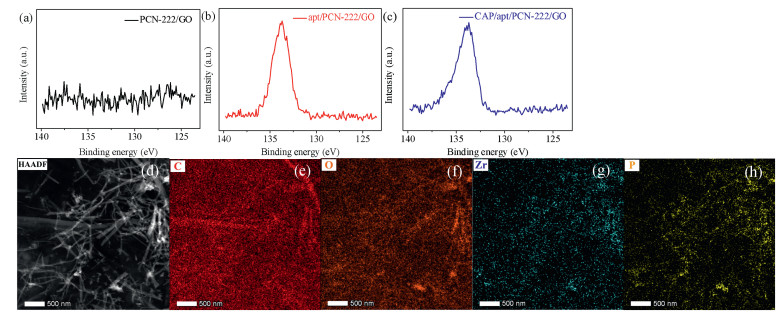
The PCN-222/GO composite is used to modify an Au electrode (AE) to obtain PCN-222/GO/AE, which is further immersed in the aptamer solution to fabricate the electrochemical aptasensor (apt/PCN-222/GO/AE). XPS spectra can be further utilized to investigate the preparing process of this aptasensor. The XPS characteristic peak of P 2p cannot be observed in the PCN-222/GO composite by reason of no P element in this composite (Fig. 2a), but the P 2p signal is obviously detected in apt/PCN-222/GO and CAP/apt/PCN-222/GO because of aptamers immobilized on PCN-222/GO (Figs. 2b and c) [47]. Moreover, the high-angle annular dark field-scanning transmission electron microscopy (HAADF-STEM) with energy-dispersive spectroscopy (EDS) elemental mappings of apt/PCN-222/GO directly manifest that the P element from aptamer is dispersed on the fabricated electrochemical aptasensor, especially in the place of PCN-222 (Figs. 2d-h). The outstanding immobilization ability of aptamer on the PCN-222/GO composite is mainly attributed to the strong π-π stacking force between aptamer and GO, and high affinity between aptamer and Zr(Ⅳ) site [48, 49].
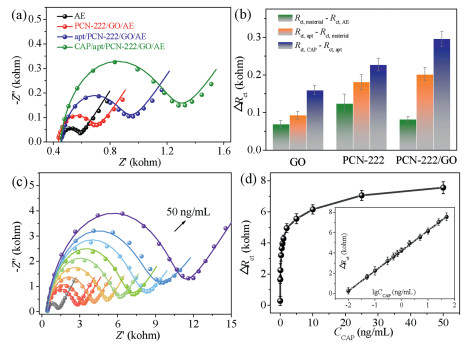
Electrochemical impedance spectroscopy (EIS) and cyclic voltammetry (CV) are both used to investigate the electrochemical signal variation of electrode interface. EIS plots are simulated by using the Randles equivalent circuit (Fig. S14 in Supporting information). As shown in Fig. 3a, the AE has a small Rct value of 0.118 kohm, but Rct values gradually increase to 0.201 kohm (PCN-222/GO/AE), 0.403 kohm (apt/PCN-222/GO/AE) and 0.699 kohm (CAP/apt/PCN-222/GO/AE) at 0.01 ng/mL, respectively. The performance is mainly attributed to the cover layers of PCN-222/GO, aptamer and CAP with poor electroconductivity along with the reduction of diffusion coefficient and electron transfer between electrode surface and electrolyte [50, 51]. The CV curve of bure AE shows a separate peak-to-peak peaks of [Fe(CN)6]3–/4–. Similar with the EIS result, CV curves gradually occur remarkable changes in AE, PCN-222/GO/AE, apt/PCN-222/GO/AE and CAP/apt/PCN-222/GO/AE (Fig. S15 in Supporting information). The CV and EIS results can prove that this electrochemical aptasensor has the potential application to detect CAP by electrochemical signal. To confirm the merit of the PCN-222/GO-based aptasensor, GO and PCN-222 are individually employed to cover AE and immobilize aptamer to fabricate GO- and PCN-222-based electrochemical aptasensors. The corresponding CV and EIS plots exhibit the similar electrochemical signal variation (Figs. S16-S19 in Supporting information). The Rct variation (ΔRct) values of these aptasensors clearly show that the PCN-222/GO-based aptasensor represents preferable electrical conductivity and aptamer load capacity with increasing electrochemical detection performance (Fig. 3b). According to the Randled−Sevcik equation [52] of Ip=2.69×10⁵n3/2AD1/2ν1/2C, where Ip is defined as the peak current (A), n is the quantity of electrons referring to the redox reaction process (=1), A is the effective electrode surface area (cm2), D shows the diffusion coefficient (7.6×10⁻⁶ cm2/s), the scan rate is ν (0.1 V/s) and the C value is 5.0×10⁻⁷ mol/cm3. Effective surface areas of AE, PCN-222/GO, apt/PCN-222/GO and CAP/apt/PCN-222/GO-modified electrodes are 0.843, 0.772, 0.665 and 0.537 cm2, which is mainly attributed to the additional organic layers with poor electroconductibility. In order to further explore the detectability of the PCN-222/GO-based aptasensor toward CAP, the aptasensor is continually incubated in the CAP solution with different amounts to collect EIS spectra. The Rct value is progressive increment at high CAP concentration because of the formation of more CAP/aptamer compositions with poor electroconductibility (Fig. 3c). The Rct value is non-linear relationship with CAP concentration, but a fine linear relationship of ΔRct value and concentration can be found in a wide concentration range from 0.01 to 50 ng/mL. The fitted linear regression equation is ΔRct=1.97 lgCCAP + 4.24 with a fine correlation coefficient (R2) of 0.999, which is used to quantitatively detect CAP (Fig. 3d). The theoretical LOD of this biosensor is calculated as low as 7.04 pg/mL (21.79 pmol/L) with signal noise ratio of 3 though the simulated linear regression equation when the ΔRct value causes a slight change. As shown in Table S1 (Supporting information), the PCN-222/GO-based electrochemical aptasensor has sensitive detection capability toward CAP among most reported materials and methodologies [53-63].
The specific selectivity can be confirmed by using ΔRct values of the PCN-222/GO-based sensor in CAP or other commonly used antibiotics, including oxytetracycline (OTC), tetracycline (TTC), kanamycin sulfate (KS), metronidazole (MDZ) and nitrofurantoin (NFT). The ΔRct value of this aptasensor only reveals a subtle change in these interferences at 0.1 ng/mL, but a significant impedance change happens after soaking in the CAP solution with the same concentration (Fig. 4a). The electrochemical response behavior indicates that this fabricated aptasensor has the superior sensitivity and specificity toward CAP. The reproducibility was tested by using five electrodes for monitoring CAP at 0.1 ng/mL with the similar ΔRct value (Fig. 4b). The relative standard deviation (RSD) values are all lower than 5.29%. The PCN-222/GO-based electrochemical aptasensor is able to detect CAP with the similar ΔRct value for 10 days due to the good long-term storage and stability (Fig. 4c). Therefore, this PCN-222/GO composite is an outstanding modified material to fabricate aptasensor for monitoring trace CAP with high selectivity, acceptable reproducibility and preferable stability.
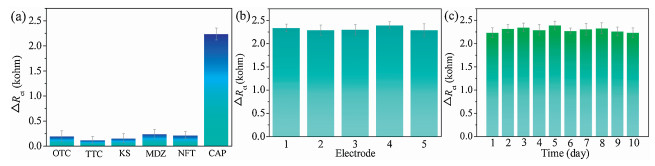
Moreover, the sensing ability of this aptasensor based on PCN-222/GO is explored in various real samples with different CAP amounts by using the standard addition method. The test method and condition are same with those in the pure aqueous solution. As summarized in Table S2 (Supporting information), all corresponding ΔRct values of apt/PCN-222/GO/AE in real samples at different concentrations are almost consistent well with those values in pure aqueous solutions at the same concentration. Meanwhile, all RSD values are smaller than 5.69% with the recovery values from 94.6% to 107.2%. According to the above results, this electrochemical aptasensor possesses the fine quantitative detection performance toward CAP in such real samples.
In this work, a PCN-222/GO composite and its electrochemical aptasensor are both ingeniously prepared. This aptasensor can quantitatively and sensitively detect CAP via EIS responsive signal even in real samples. Additionally, this electrochemical aptasensor has high selectivity, good stability and fine repeatability. We expect that this work can expand the synthesis of MOF/GO composites and their application in the fabrication of ultrasensitive electrochemical aptasensors.
The authors report no declarations of interest.
This research was financially supported by the National Natural Science Foundation of China (No. 21801187).
Supplementary material related to this article can be found, in the online version, at doi:https://doi.org/10.1016/j.cclet.2021.02.042.
H. He, J.A. Perman, G. Zhu, S. Ma, Small 12 (2016) 6309-6324 doi: 10.1002/smll.201602711
F. Saraci, V. Quezada-Novoa, P.R. Donnarumma, A.J. Howarth, Chem. Soc. Rev. 49 (2020) 7949-7977 doi: 10.1039/d0cs00292e
W. Lu, Z. Wei, Z.Y. Gu, et al., Chem. Soc. Rev. 43 (2014) 5561-5593 doi: 10.1039/C4CS00003J
H. He, Q.Q. Zhu, C.P. Li, M. Du, Cryst. Growth Des. 19 (2019) 694-703 doi: 10.1021/acs.cgd.8b01271
X. Qian, S. Deng, X. Chen, et al., Chin. Chem. Lett. 31 (2020) 2211-2214 doi: 10.1016/j.cclet.2019.09.024
R. Yuan, H. He, Inorg. Chem. Front. 7 (2020) 4293-4319 doi: 10.1039/d0qi00955e
D. Gu, W. Yang, D. Lin, et al., J. Mater. Chem. C 8 (2020) 13648-13654 doi: 10.1039/d0tc03266b
A. Wang, Y.L. Hou, F. Kang, et al., J. Mater. Chem. C 7 (2019) 2207-2211 doi: 10.1039/c8tc04171g
H. He, Q. Sun, W. Gao, et al., Angew. Chem., Int. Ed. 57 (2018) 4657-4662 doi: 10.1002/anie.201801122
E. Geravand, F. Farzaneh, R. Gil-San-Millan, F.J. Carmona, J.A.R. Navarro, Inorg. Chem. 59 (2020) 16160-16167 doi: 10.1021/acs.inorgchem.0c01434
H. Zhang, C. Shang, L.M. Yang, E. Ganz, Inorg. Chem. 59 (2020) 16665-16671 doi: 10.1021/acs.inorgchem.0c02654
P.A. Demakov, A.S. Poryvaev, K.A. Kovalenko, et al., Inorg. Chem. 59 (2020) 15724-15732 doi: 10.1021/acs.inorgchem.0c02125
L.M.C. Silva, B.S. Gonçalves, J.O. Braga, et al., Appl. Surf. Sci. 538 (2021) 148029 doi: 10.1016/j.apsusc.2020.148029
L. Sun, K. Wang, N. Li, et al., Chin. Chem. Lett. 31 (2020) 2333-2338 doi: 10.1016/j.cclet.2020.02.006
J. Tian, S. Wu, X. Yin, W. Wu, Appl. Surf. Sci. 496 (2019) 143696 doi: 10.1016/j.apsusc.2019.143696
Y.H. Yao, J. Li, H. Zhang, et al., J. Mater. Chem. A 8 (2020) 8949-8956 doi: 10.1039/d0ta02202k
Y. Xiao, B. Guo, J. Zhang, et al., Dalton Trans. 49 (2020) 5730-5735 doi: 10.1039/d0dt00976h
P. Yang, Q. Liu, J. Liu, et al., J. Mater. Chem. A 5 (2017) 17933-17942 doi: 10.1039/C6TA10022H
A. Mansouri, K. Abnous, M.S. Nabavinia, M. Ramezani, S.M. Taghdisi, J. Pharmaceut. Biomed. 177 (2020) 112853
R. Nezlin, Immunol. Lett. 162 (2014) 252-255 doi: 10.1016/j.imlet.2014.10.001
M. Vorobyeva, P. Vorobjev, A. Venyaminova, Molecules 21 (2016) 1613 doi: 10.3390/molecules21121613
T. Li, E. Wang, S. Dong, PLoS One 4 (2009) e5126 doi: 10.1371/journal.pone.0005126
R.E. Wang, H. Wu, Y. Niu, J. Cai, Curr. Med. Chem. 18 (2011) 4126-4138 doi: 10.2174/092986711797189565
C. Wang, L. Sun, Q. Zhao, Chin. Chem. Lett. 30 (2019) 1017-1020 doi: 10.1016/j.cclet.2019.01.029
Z.X. Huang, Q. Xie, Q.P. Guo, et al., Chin. Chem. Lett. 28 (2017) 1252-1257 doi: 10.1016/j.cclet.2017.01.002
Z. Zhang, X. Zhao, J. Liu, J. Yin, X. Cao, Sensor. Actual. B-Chem. 311 (2020) 127920 doi: 10.1016/j.snb.2020.127920
A. Raouafi, A. Sanchez, N. Raouafi, R. Villalonga, Sensor. Actual. B: Chem. 297 (2019) 126762 doi: 10.1016/j.snb.2019.126762
Y. Song, M. Xu, Z. Li, et al., Sensor. Actual. B: Chem. 321 (2020) 128527 doi: 10.1016/j.snb.2020.128527
C. Guo, Z. Li, F. Duan, et al., J. Mater. Chem. B 8 (2020) 9951-9960 doi: 10.1039/d0tb01910k
X. Yang, C. Zhao, C. Zhang, K. Wen, Y. Zhu, Sensor. Actual. B: Chem. 323 (2020) 128666 doi: 10.1016/j.snb.2020.128666
S. Hu, Y. Yu, Y. Guan, et. al., Chin. Chem. Lett. 31 (2020) 2839-2842 doi: 10.1016/j.cclet.2020.08.021
Q. Bao, G. Li, Z. Yang, et al., Chin. Chem. Lett. 31 (2020) 2752-2756 doi: 10.1016/j.cclet.2020.06.021
Y. Wang, G. Zhao, G. Zhang, et al., Sensor. Actual. B: Chem. 319 (2020) 128313 doi: 10.1016/j.snb.2020.128313
G. Ran, F. Wu, X. Ni, et al., Sensor. Actual. B-Chem. 320 (2020) 128326 doi: 10.1016/j.snb.2020.128326
S. Jampasa, J. Pummoree, W. Siangproh, et al., Sensor. Actual. B: Chem. 320 (2020) 128389 doi: 10.1016/j.snb.2020.128389
Y. Zhao, H. Liu, L. Shi, W. Zheng, X. Jing, Sensor. Actual. B: Chem. 315 (2020) 128155 doi: 10.1016/j.snb.2020.128155
Z.Y. Han, H.K. Li, Q.Q. Zhu, R. Yuan, H. He, Chin. Chem. Lett. 32 (2021)2865-2868 doi: 10.1016/j.cclet.2021.02.013
C. Yan, J. Zhang, L. Yao, et al., Food Chem. 260 (2018) 208-212 doi: 10.1016/j.foodchem.2018.04.014
S.C. Wu, L.L. Yu, F.F. Xiao, et al., J. Alloy. Compd. 724 (2017) 625-632 doi: 10.1016/j.jallcom.2017.07.095
X. Wang, J. Zhang, Y. Wei, et al., Analyst 145 (2020) 1933-1942 doi: 10.1039/c9an02398d
X. Yang, Y. Tu, L. Li, S. Shang, X.M. Tao, ACS Appl. Mater. Interfaces 2 (2010) 1707-1713 doi: 10.1021/am100222m
C. Rodríguez-González, A.L. Martínez-Hernández, V.M. Castaño, et al., Ind. Eng. Chem. Res. 51 (2012) 3619-3629 doi: 10.1021/ie200742x
G.Y. Zhang, Y.H. Zhuang, D. Shan, et al., Anal. Chem. 88 (2016) 11207-11212 doi: 10.1021/acs.analchem.6b03484
Q.Q. Zhu, W.W. Zhang, H.W. Zhang, R. Yuan, H. He, J. Mater. Chem. C 8 (2020) 16984-16991 doi: 10.1039/d0tc04202a
Y. He, L. Qian, K. Zhou, et al., ACS Sustain. Chem. Eng. 7 (2019) 10283-10292 doi: 10.1021/acssuschemeng.8b06823
Y. Li, M. Hu, X. Huang, et al., Sensor. Actual. B: Chem. 306 (2020) 127608 doi: 10.1016/j.snb.2019.127608
P.J. Gomes, A.M. Ferraria, A.M. Botelho do Reg, et al., J. Phys. Chem. B 119 (2015) 5404-5411 doi: 10.1021/acs.jpcb.5b01439
Q.Q. Zhu, H.W. Zhang, R. Yuan, H. He, J. Mater. Chem. C 8 (2020) 15823-15829 doi: 10.1039/d0tc04176a
G. Dai, Z. Li, F. Luo, et al., Microchim. Acta 186 (2019) 620 doi: 10.1007/s00604-019-3724-y
H. He, S.Q. Wang, Z.Y. Han, et al., Appl. Surf. Sci. 531 (2020) 147342 doi: 10.1016/j.apsusc.2020.147342
R. Yuan, Z. Yan, A. Shaga, H. He, Sensor. Actual. B: Chem. 327 (2021) 128949 doi: 10.1016/j.snb.2020.128949
J. Zhou, Y. Zhao, J. Bao, et al., Electrochim. Acta 250 (2017) 152-158 doi: 10.1016/j.electacta.2017.08.044
Y. Yuan, X. Xu, J. Xia, et al., Microchim. Acta 186 (2019) 191 doi: 10.1080/14777622.2019.1675430
M. Yadav, V. Ganesan, R. Gupta, D.K. Yadav, P.K. Sonkar, Microchem. J. 146 (2019) 881-887 doi: 10.1016/j.microc.2019.02.025
P. Jakubec, V. Urbanova, Z. Medrikova, R. Zboril, Chem. Eur. J. 22 (2016) 14279-14284 doi: 10.1002/chem.201602434
W. Yi, Z. Li, C. Dong, H.W. Li, J. Li, Microchem. J. 148 (2019) 774-783 doi: 10.1016/j.microc.2019.05.049
Z. Tan, H. Xu, G. Li, X. Yang, M.M.F. Choi, Spectrochim Acta A 149 (2015) 615-620 doi: 10.1016/j.saa.2015.04.109
N. Sebastian, W.C. Yu, D. Balram, Inorg. Chem. Front. 6 (2019) 82-93 doi: 10.1039/c8qi01000e
S. Meenakshi, S.J. Sophia, K. Pandian, Mater. Sci. Eng. C 90 (2018) 407-419 doi: 10.1016/j.msec.2018.04.064
Y. Liu, K. Yan, O.K. Okoth, J. Zhang, Biosens. Bioelectron. 74 (2015) 1016-1021 doi: 10.1016/j.bios.2015.07.067
T.X. Chu, V.P. Vu, H.T. Tran, et al., J. Electrochem. Soc. 167 (2020) 027527 doi: 10.1149/1945-7111/ab6a7e
A.T.E. Vilian, S.Y. Oh, M. Rethinasabapathy, et al., J. Hazard. Mater. 399 (2020) 122868 doi: 10.1016/j.jhazmat.2020.122868
T. Yang, H. Chen, T. Ge, et al., Talanta 144 (2015) 1324–1328 doi: 10.1016/j.talanta.2015.08.004

Scheme 1 The preparation process of the PCN-222/GO-based electrochemical aptasensor for detecting CAP.

Figure 1 PXRD patterns (a), N2 sorption isotherms (b) and FT-IR spectra (c) of GO, PCN-222 and PCN-222/GO. SEM images of PCN-222 (d) and GO (e). (f) The TEM image of PCN-222/GO. C 1s XPS of PCN-222 (g), GO (h) and PCN-222/GO (i).

Figure 2 XPS spectra of P 2p of PCN-222/GO (a), apt/PCN-222/GO (b) and CAP/apt/PCN-222/GO (c). (d-h) The HAADF-STEM with EDS elemental mappings of apt/PCN-222/GO.

Figure 3 (a) EIS Nyquist plots of AE with different modified layers. (b) ΔRct values of these aptasensors. (c) EIS Nyquist plots of atp/PCN-222/GO/AE in the detection of CAP (0.01, 0.05, 0.1, 0.3, 0.5, 0.7, 1.0, 2.0, 5.0, 10.0, 25.0 and 50.0 ng/mL). (d) The relationship between ΔRct value and CAP concentration with the inserted linear curve.

 扫一扫看文章


扫一扫关注我们
 DownLoad:
 下载:
