Table 1.
Crystallographic data for 1 and 2


Recently, Zn(Ⅱ) Schiff base complexes and their analogs have played a special role in assembling high-performance single-molecule magnets (SMMs)[1-3] and fluorescent SMM multifunctional molecular materials[4-6], mainly because they can be used as complex-type ligands to chelate lanthanide(Ⅲ) ions, especially the Dy(Ⅲ) ion, forming a coordination configuration in favor of SMM properties together with other co-ligands[1-3]; in addition, they can provide antenna effects to promote the emission of lanthanide(Ⅲ) ions[4-8]. Notably, luminescent SMMs have potential applications in the fields of optoelectronics and multimode sensing[9]. However, it is still a great challenge to obtain fluorescent SMMs due to the difficulty of luminous energy matching in lanthanide(Ⅲ)-based SMM systems, in which other two prerequisites (a large spin ground state (S) and a negative magnetic anisotropy parameter (D)) must be met.
We have also been studying 3d-4f heterometallic SMMs[10-17], and looking forward to obtaining some fluorescent SMMs. Notably, we found that Zn(salen) (H2salen=N, N′-bis(3-methoxysalicylidene)-1, 3-diamino-propane) can be used as a good building block to construct 3d-4f heterometallic SMMs under solvothermal conditions by virtue of the coordination of bridging ligands or co-ligands[16-17]. The choice of co-ligands is important, since these co-ligands determine whether the 3d-4f heterometallic cluster product can be formed and determine the structure of the product. Recently, we chose 6-(hydroxymethyl)pyridine-2-carboxylic acid (HCO2PyCH2OH) as the co-ligand to assembly such 3d-4f heterometallic cluster complexes for exploring new fluorescent SMMs. Herein we report solvothermal syntheses, crystal structures, fluorescence and magnet properties of two new 3d-4f tetranuclear cluster complexes based on the Zn(salen) building block, [Zn2Ln2(salen)2(CO2PyCH2O)2(MeOH)2](ClO4)2·2MeOH (Ln=Dy (1), Tb (2)), which are isostructural compounds with a Zn-Ln2-Zn core. Complex 1 exhibits magnet relaxation under a dc field, while complex 2 shows both field-induced magnet relaxation and fluorescence properties.
All reagents were purchased and used without further purification. Zn(salen)(H2O) was prepared by reference method[18]. Elemental analyses for C, H and N were performed on a Heraeus Chn-Rapid instrument. The fluorescence spectra in the solid state were measured on a HITACHI F-4500 luminescence spectrophotometer at room temperature. The magnetic susceptibility measurements were performed on a Quantum Design MPMS-XL5 SQUID magnetometer. Diamagnetic corrections were estimated from Pascal′s constants.
Caution! Perchlorate compounds are potentially explosive and should be handled with care and used only in small amounts.
6-(Hydroxymethyl)pyridine-2-carboxylic acid (0.1 mmol), Dy(ClO4)3·6H2O (0.05 mmol) and Zn(salen)(H2O) (0.1 mmol) in 10 mL methanol were stirred at room temperature for 10 min, and this mixture was then transferred into 25 mL Teflon-lined stainless steel vessel and kept at 100 ℃ for 3 days under autogenous pressure. After the autoclave had cooled to room temperature at rate of 0.15 ℃·min-1, yellow plate crystals of 1 were harvested, washed with methanol and then dried at ambient temperature (Yield: 18% based on Dy). Anal. Calcd. for C56H66Cl2Dy2N6O26Zn2(%): C, 38.09; H, 3.77; N, 4.76. Found(%): C, 38.12; H, 3.61; N, 4.73. IR (KBr, cm-1): 3 593m, 3 436s, 3 095w, 3 044w, 2 953w, 2 939w, 2 920w, 2 849w, 2 825w, 1 626vs, 1 603m, 1 564w, 1 469s, 1 443w, 1 367m, 1 300m, 1 277w, 1 225s, 1 198w, 1 167w, 1 094s, 1 063s, 1 021w, 1 004w, 983w, 946w, 927w, 807w, 774w, 741m, 714w, 685w, 651w, 634w, 623w, 600w, 555w, 530w, 465w, 434w.
The preparation procedure for 2 was the same as that for 1 but using Tb(ClO4)3·6H2O (0.05 mmol) instead of Dy(ClO4)3·6H2O (0.05 mmol). Yellow block crystals of 2 were harvested, washed with methanol and then dried at ambient temperature (Yield 16% based on Tb). Anal. Calcd. for C56H66Cl2N6O26Tb2Zn2(%): C, 38.24; H, 3.78; N, 4.78. Found(%): C, 38.29; H, 3.81; N, 4.75. IR (KBr, cm-1): 3 595m, 3 431s, 3 089w, 3 042w, 2 953w, 2 941w, 2 921w, 2 848w, 2 824w, 1 627vs, 1 602m, 1 564w, 1 469s, 1 416m, 1 366m, 1 299s, 1 276w, 1 224s, 1 199w, 1 176w, 1 094s, 1 063s, 1 021w, 1 004w, 980w, 946w, 927w, 850w, 806w, 774w, 741m, 714w, 685w, 650w, 624m, 600w, 556w, 531w, 506w, 464w, 432w.
Single-crystal diffraction data′s collection for complexes 1 and 2 was carried out on a Bruker SMART APEX-CCD with Mo Kα radiation (λ=0.071 073 nm) at 170 K. The data were corrected for Lorentz-polarization effects, and absorption corrections were applied. The structures of complexes 1 and 2 were solved by direct methods. The structures were refined using SHELXL-2015[19]. All non-hydrogen atoms were refined anisotropically; the hydroxyl hydrogen atoms in the methanol molecules were located in difference Fourier maps, all other hydrogen atoms were generated geometrically and allowed to ride on their parent carbon atoms. The crystallographic data and refinement parameters are listed in Table 1. Selected bond lengths and angles for the two complexes are given in Table 2.
 下载:
导出CSV
| Complex | 1 | 2 |
| Chemical formula | C56H66Cl2Dy2N6O26Zn2 | C56H66Cl2N6O26Tb2Zn2 |
| Formula weight | 1 765.79 | 1 758.62 |
| Crystal system | Monoclinic | Monoclinic |
| Space group | P21/c | P21/c |
| a / nm | 1.081 050(10) | 1.080 32(2) |
| b / nm | 1.660 92(2) | 1.659 19(2) |
| c / nm | 1.746 71(2) | 1.750 17(2) |
| β / (°) | 94.566 0(10) | 94.639 0(10) |
| V / nm3 | 3.126 33(6) | 3.126 83(8) |
| Z | 2 | 2 |
| Dc / (g·cm-3) | 1.876 | 1.868 |
| μ / mm-1 | 3.296 | 3.168 |
| F(000) | 1 756 | 1 752 |
| θ range (data collection) / (°) | 3.39~30.78 | 3.71~30.74 |
| Indices range (h, k, l) | -15≤h≤12, -23≤k≤23, -23≤l≤24 | -15≤h≤15, -23≤k≤22, -24≤l≤22 |
| Reflection collected, unique | 56 413, 8 975 | 48 122, 8 906 |
| Rint | 0.024 9 | 0.023 7 |
| Data, restrain, parameter | 8 975, 2, 428 | 8 906, 3, 428 |
| GOF on F2 | 1.030 | 1.052 |
| R1, wR2 [I > 2σ(I)] | 0.017 9, 0.042 1 | 0.019 3, 0.044 8 |
| R1, wR2 (all data) | 0.020 4, 0.042 8 | 0.021 3, 0.045 4 |
| (Δρ)max, (Δρ)min / (e·nm-3) | 820, -790 | 820, -810 |
下载:
导出CSV
| 1 | |||||
| Dy(1)-O(1) | 0.248 60(11) | Dy(1)-O(2) | 0.232 52(11) | Dy(1)-O(3) | 0.230 48(11) |
| Dy(1)-O(4) | 0.246 94(12) | Dy(1)-O(5) | 0.227 71(11) | Dy(1)-O(5)i | 0.230 82(11) |
| Dy(1)-O(7)i | 0.237 57(12) | Dy(1)-N(3)i | 0.246 50(13) | Zn(1)-O(2) | 0.208 44(11) |
| Zn(1)-O(3) | 0.202 80(11) | Zn(1)-O(8) | 0.204 65(11) | Zn(1)-N(1) | 0.204 32(14) |
| Zn(1)-N(2) | 0.204 91(14) | ||||
| O(2)-Dy(1)-O(1) | 65.33(4) | O(3)-Dy(1)-O(2) | 66.19(4) | O(3)-Dy(1)-O(4) | 65.51(4) |
| O(5)-Dy(1)-O(5)i | 69.88(4) | O(5)i-Dy(1)-N(3)i | 65.68(4) | O(7)i-Dy(1)-N(3)i | 65.33(4) |
| O(3)-Zn(1)-O(2) | 75.85(4) | O(3)-Zn(1)-N(2) | 90.82(5) | N(1)-Zn(1)-N(2) | 97.90(6) |
| N(1)-Zn(1)-O(2) | 88.34(5) | Dy(1)-O(5)-Dy(1)i | 110.12(4) | ||
| 2 | |||||
| Tb(1)-O(1) | 0.249 33(12) | Tb(1)-O(2) | 0.233 24(12) | Tb(1)-O(3) | 0.231 16(12) |
| Tb(1)-O(4) | 0.231 16(12) | Tb(1)-O(5) | 0.229 49(12) | Tb(1)-O(5)i | 0.231 21(12) |
| Tb(1)-O(6)i | 0.239 08(12) | Tb(1)-N(3)i | 0.247 98(14) | Zn(1)-O(2) | 0.208 30(12) |
| Zn(1)-O(3) | 0.202 98(12) | Zn(1)-O(8) | 0.204 56(12) | Zn(1)-N(1) | 0.204 11(15) |
| Zn(1)-N(2) | 0.204 74(15) | ||||
| O(2)-Tb(1)-O(1) | 65.18(4) | O(3)-Tb(1)-O(2) | 66.13(4) | O(3)-Tb(1)-O(4) | 65.25(4) |
| O(5)-Tb(1)-O(5)i | 69.91(5) | O(5)i-Tb(1)-N(3)i | 65.49(4) | O(6)i-Tb(1)-N(3)i | 65.06(5) |
| O(3)-Zn(1)-O(2) | 76.04(5) | O(3)-Zn(1)-N(2) | 90.76(6) | N(1)-Zn(1)-N(2) | 90.76(6) |
| N(1)-Zn(1)-O(2) | 88.33(5) | Tb(1)-O(5)-Tb(1)i | 110.09(5) | ||
| Symmetry code: i 1-x, 1-y, 1-z. | |||||
CCDC: 1968639, 1; 1968640, 2.
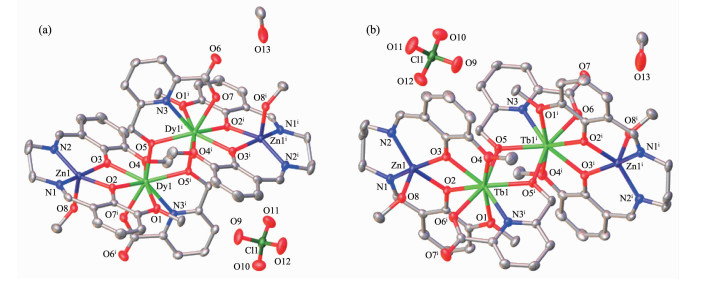
Complexes 1 and 2 are isomorphic, so we use compound 1 as an example to describe the crystal structure. The crystal space group of compound 1 is P21/c. As shown in Fig. 1a, this complex consists of [Zn2Ln2(salen)2(CO2PyCH2O)2(MeOH)2]2+ cluster cation, perchlorate anions and solvent methanol molecules. Two CO2PyCH2O2- ligands provide two O atoms on the η2-CH2O- arms to bridge two Dy atoms, while the pyridine N atom and the carboxyl O atom in each CO2PyCH2O2- ligand chelate the respective Dy atom, generating the crystallographically centrosymmetric [Dy2(CO2PyCH2O)2]2+ core, with the Dy…Dy separation of 0.375 9 nm. The [Zn2Ln2(salen)2(CO2PyCH2O)2(MeOH)2]2+ cluster cation is thus formed by two Zn(salen)(MeOH) building blocks chelating the [Dy2(CO2PyCH2O)2]2+ core from opposite directions.
All H atoms are omitted for clarity; Symmetry code: i 1-x, 1-y, 1-z
The Zn1 atom is chelated by two phenol O atoms and two imine N atoms from the Schiff base ligand to form the bottom of the square pyramid, and the apex of the square pyramid is provided by the terminal methanol oxygen atom. The average bond distance of Zn-N (0.204 6 nm) is a little shorter than the average bond distance of Zn-Obase (0.205 6 nm), and the latter is also slightly longer than the Zn-Oapex bond (0.204 6 nm) (Table 2); the N1-Zn1-N2 bond angle (97.90°) is larger than the O2-Zn1-O3 bond angle (75.85°) (Table 2). The Dy1 atom is eight-coordinated by two phenol O atoms and two methoxy O atoms from the Schiff base ligand, one pyridine N atom, one carboxyl O atom and one η2-CH2O- arm O atom from the CO2PyCH2O2- ligand as well as another η2-CH2O- arm O atom from the other CO2PyCH2O2- ligand. The mean bond length of Dy-O is 0.236 4 nm, which is shorter than that of Dy-N (0.246 5 nm) (Table 2). The Dy1-O5-Dy1i (Symmetry code: i 1-x, 1-y, 1-z) bond angle (110.12°, Table 2) is comparable with the Dy-O-Dy bond angle (110.88°) in Dy2(pdmH)2(DBM)4·2EtOH (H2pdm=2, 6-pyridinedi-methanol, DBM=dibenzoylmethanato)[20]. The SHAPE software[21] analysis reveals that the coordination configuration of Dy1 is the triangular dodecahedron, with an offset value of 2.210 from the D2d symmetry. The Zn1 atom is connected to the Dy1 atom through the bridging effect of the phenol O atom from the Schiff base ligand, with the Zn1…Dy1 separation of 0.353 4 nm; these Zn1-Dy1 hetero-metallic atoms together with the crystallographically symmetrical Zn1i-Dy1i (Symmetry code: i 1-x, 1-y, 1-z) heterometallic atoms form a Zn-Ln2-Zn topology structure. Such a cluster core is reminiscent of some Zn2Dy2 SMMs with carbonate bridges formed by fixing carbon dioxide in the air, which all have similar Zn-Dy2-Zn core structures[22-24]. In addition, the perchlorate anion acts as a balance charge, and solvent methanol molecules are present in the crystal lattice. There is a strong hydrogen bond between the methanol molecule and the uncoordinated carboxyl oxygen atom from the CO2PyCH2O2- ligand with the O13…O6 distance of 0.275 1 nm, which helps to stabilize the crystal structure.
Compound 2 has the same structure (Fig. 1b) as compound 1(Fig. 1a), except that the average bond length of Tb-O (0.237 3 nm) in 2 (Table 2) is slightly longer than the average bond distance of Dy-O (0.236 4 nm) in 1 due to the lanthanum contraction effect.
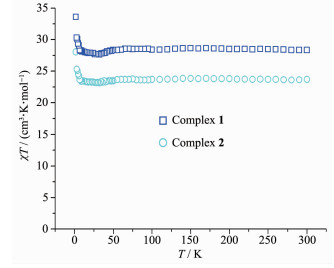
The dc susceptibility of compounds 1 and 2 was measured in a range of 2~300 K. As shown in Fig. 2, the room temperature χT values of compounds 1 and 2 were 28.33 and 23.68 cm3·K·mol-1, respectively, which are consistent with the theoretical values of two isolated Dy(Ⅲ) ions (28.34 cm3·K·mol-1) and two isolated Tb(Ⅲ) ions (23.64 cm3·K·mol-1), respectively. From 300 K to 50 K, the χT values of 1 and 2 were almost unchanged; when the temperature continued to decrease, their χT values decreased slightly; after less than 9 K for 1 and 8 K for 2, their χT values suddenly increased, reaching the maximum values at 2 K (33.59 and 28.05 cm3·K·mol-1 for 1 and 2, respectively). Such magnetic behaviors are the results of the combined effect of the thermal depopulation of mj levels of the Ln(Ⅲ) ion and the ferromagnetic coupling between the Ln(Ⅲ) ions[17, 24-26].
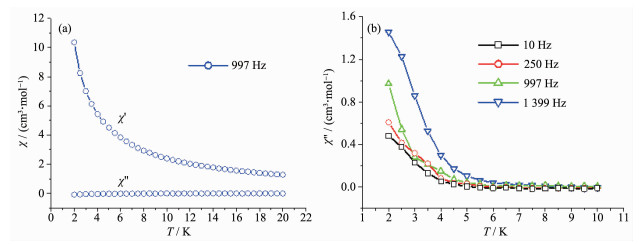
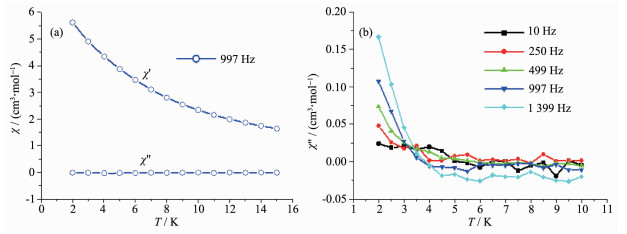
For 1 taking 997 Hz as an example, the imaginary part (χ″) of the ac susceptibility did not appear a response signal at a 0 dc field (Fig. 3a), which may be caused by the existence of the quantum tunneling effect. Therefore, in order to investigate the change in the χ″, a dc field was applied to suppress the quantum tunneling effect[27-28]. As shown in Fig. 3b, at less than 6 K, the χ″ shows a response signal in the frequency range of 10~997 Hz at a 2 000 Oe dc field and displays frequency dependence, indicating that the quantum tunneling effect does exist in 1, which may be suppressed by a dc field. However, no peaks appears in the χ″-T curves of all frequencies at above 2 K, indicating that the energy barrier value of this SMM is very small. This phenomenon is not uncommon. In comparison, many Dy(Ⅲ) complexes will not show a χ″ signal even if a dc field is applied, because they are not SMMs at all[20].
The ac susceptibility of complex 2 was similar to that of complex 1. Under a 0 dc field, no response signal appears at χ″ of complex 2 at 997 Hz (Fig. 4a) due to the quantum tunneling effect too. However, under a 2 000 Oe dc field, in a range of 10~1 399 Hz, the χ″ of complex 2 appears a response signal at less than 4 K, and exhibits frequency dependent (Fig. 4b), indicating that it is also a field-induced SMM. The response temperature region of the χ″ signal of complex 2 was lower than that of complex 1, and its radiance was smaller than that of complex 1, which implies that the energy barrier value of complex 2 is even smaller than that of complex 1.
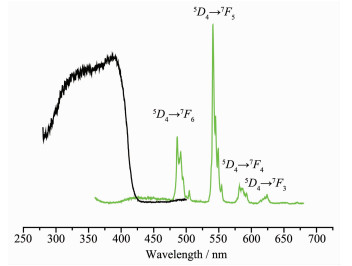
We studied the solid-state excitation spectrum and solid-state emission spectrum of complex 2. As shown in Fig. 5, the solid-state excitation spectrum of 2, which is monitored by the emission of 5D4→7F5 transition of the Tb(Ⅲ) ion at 541 nm, displayed an intense broad band from about 300 nm to about 400 nm, suggesting the strong charge transfer (CT) from ligands to the Tb(Ⅲ) ion[29]. However, in this range, the typical excitation bands of Tb(Ⅲ) ions caused by the 7F5→5L6, 7F5→5L9, 7F5→5L10 and 7F5→5G6 transitions[30] were completely blocked. The solid-state emission spectrum of 2 was excited at 350 nm and showed a very strong emission band at 541 nm, which made 2 emit green light; besides this emission band caused by the 5D4→7F5 transition, the other three emission bands caused by the 5D4→7F6, 5D4→7F4 and 5D4→7F3 transitions could be observed clearly, which had peaks at 486, 582 and 624 nm, respectively.
Notably, Schiff bases are often used as ligands to construct luminescent Zn-Ln heterometallic SMMs[2, 31-32], but the Schiff base ligands themselves tend to have weaker antenna effects on the fluorescence of Dy(Ⅲ) or Tb(Ⅲ) ions. Therefore, it is necessary to resort to other co-ligands. This work shows that the Zn(salen) building block together with the CO2PyCH2O2- ligand can have a good antenna effect on the fluorescence of Tb(Ⅲ) ions. As a comparison, our recent research indicates that the Zn(salen) building block together with the 2, 2′-bipyridine-6, 6′-dicarboxylate ligand only show a weaker antenna effect on the fluorescence of Dy(Ⅲ) ions, in which only two emission bands caused by the 7F9/2→6H15/2 and 7F9/2→6H13/2 transitions are observed[17]. These results imply that the introduction of a suitable aromatic co-ligand can enhance the antenna effect on the fluorescence of Tb(Ⅲ) ions or Dy(Ⅲ) ions.
In summary, two Zn2Ln2 heterometallic cluster complexes derived from salen-type Schiff base ligand and 6-(hydroxymethyl)pyridine-2-carboxylic acid were prepared by solvothermal method. Both complexes display field-induced slow magnet relaxation, furthermore, the Zn2Tb2 complex exhibits additional fluorescence properties due to ligands′ effective antenna effect on the fluorescence of the Tb(Ⅲ) ion. This work demonstrates that the Zn(salen) complex fragment is not only a good building block to construct 3d-4f heterometallic SMMs, but also can play an antenna effect together with other suitable ligands, triggering Ln(Ⅲ) ions to emit light, which is a feasible way to obtain magnetic-optical multifunctional molecular materials.
Sun W B, Yan P F, Jiang S D, et al. Chem. Sci., 2016, 7:684-691 doi: 10.1039/C5SC02986D
Costes J P, Titos-Padilla S, Oyarzabal I, et al. Chem.-Eur. J., 2015, 21:15785-15796 doi: 10.1002/chem.201501500
Liu J L, Chen Y C, Zheng Y Z, et al. Chem. Sci., 2013, 4:3310-3316 doi: 10.1039/c3sc50843a
Long L, Rouquette J, Thibaud J M, et al. Angew. Chem. Int. Ed., 2015, 54:2236-2240 doi: 10.1002/anie.201410523
Wen H R, Dong P P, Liu S J, et al. Dalton Trans., 2017, 46:1153-1162 doi: 10.1039/C6DT04027F
Maity M, Majee M C, Kundu S, et al. Inorg. Chem., 2015, 54:9715-9726 doi: 10.1021/acs.inorgchem.5b01142
沈良, 徐端钧, 徐元植.无机化学学报, 1999, 15:806-808 doi: 10.3321/j.issn:1001-4861.1999.06.019SHEN Liang, XU Duan-Jun, XU Yuan-Zhi. Chinese J. Inorg. Chem., 1999, 15:806-808 doi: 10.3321/j.issn:1001-4861.1999.06.019
杨玉华, 张雨, 于盟.无机化学学报, 2018, 34:997-1006 doi: 10.11862/CJIC.2018.125YANG Yu-Hua, ZHANG Yu, YU Meng. Chinese J. Inorg. Chem., 2018, 34:997-1006 doi: 10.11862/CJIC.2018.125
Cucinotta G, Perfetti M, Luzon J, et al. Angew. Chem. Int. Ed., 2012, 51:1606-1610 doi: 10.1002/anie.201107453
Liu C M, Zhang D Q, Zhu D B. Dalton Trans., 2010, 39:11325-11328 doi: 10.1039/c0dt01189d
Liu C M, Zhang D Q, Hao X, et al. Chem.-Asian J., 2014, 9:1847-1853 doi: 10.1002/asia.201402001
Liu C M, Zhang D Q, Zhu D B. RSC Adv., 2014, 4:53870-53876 doi: 10.1039/C4RA07882A
Liu C M, Zhang D Q, Zhu D B. Sci. Rep., 2017, 7:15483 doi: 10.1038/s41598-017-15852-1
Liu C M, Zhang D Q, Hao X, et al. Inorg. Chem., 2018, 57:6803-6806 doi: 10.1021/acs.inorgchem.8b01210
Liu C M, Zhang D Q, Xiong R G, et al. Chem. Commun., 2018, 54:13379-13382 doi: 10.1039/C8CC07468B
Liu C M, Zhang D Q, Su J B, et al. Inorg. Chem., 2018, 57:11077-11086 doi: 10.1021/acs.inorgchem.8b01653
Liu C M, Zhang D Q, Zhang Y Q, et al. New J. Chem., 2019, 2:14502-14510
Pasatoiu T D, Tiseanu C, Madalan A M, et al. Inorg. Chem., 2011, 50:5879-5889 doi: 10.1021/ic200426w
Sheldrick G M. Acta Crystallogr. Sect. C, 2015, C71:3-8
刘彩明, 黄光熙, 熊明.无机化学学报, 2014, 30:93-98 doi: 10.11862/CJIC.2014.080LIU Cai-Ming, HUANG Guang-Xi, XIONG Ming. Chinese J. Inorg. Chem., 2014, 30:93-98 doi: 10.11862/CJIC.2014.080
Casanova D, Llunell M, Alemany P, et al. Chem.-Eur. J., 2005, 11:1479-1494 doi: 10.1002/chem.200400799
Zhang P, Zhang L, Lin S Y, et al. Inorg. Chem., 2013, 52:6595-6602 doi: 10.1021/ic400620j
Titos-Padilla S, Ruiz J, Herrera J M, et al. Inorg. Chem., 2013, 52:9620-9626 doi: 10.1021/ic401378k
Liu C M, Zhang D Q, Hao X, et al. Dalton Trans., 2020, 49:2121-2128 doi: 10.1039/C9DT04480A
张璐, 曾涑源, 刘涛, 等.无机化学学报, 2015, 31:1761-1773 doi: 10.11862/CJIC.2015.190ZHANG Lu, ZENG Su-Yuan, LIU Tao, et al. Chinese J. Inorg. Chem., 2015, 31:1761-1773 doi: 10.11862/CJIC.2015.190
Liu C M, Zhang D Q, Zhu D B. Chem. Commun., 2016, 52:4804-4807 doi: 10.1039/C6CC00498A
Mishra A, Wernsdorfer W, Abboud K A, et al. J. Am. Chem. Soc., 2004, 126:15648-14549 doi: 10.1021/ja0452727
Habib F, Long J, Lin P H, et al. Chem. Sci., 2012, 3:2158-2164 doi: 10.1039/c2sc01029a
Wen H R, Xie X R, Liu S J, et al. RSC Adv., 2015, 5:98097-98104 doi: 10.1039/C5RA14559G
Liu C M, Zhang D, Hao X, et al. Cryt. Growth Des., 2019, 19:4731-4737 doi: 10.1021/acs.cgd.9b00602
Yamashita K, Miyazaki R, Kataoka Y, et al. Dalton Trans., 2013, 42:1987-1990 doi: 10.1039/c2dt32785f
Boulkedid A L, Long J, Beghidja C, et al. Dalton Trans., 2018, 47:1402-1406 doi: 10.1039/C7DT03842A

Figure 1 Crystal structures of 1 (a) and 2 (b) with ellipsoids at 30% probability
All H atoms are omitted for clarity; Symmetry code: i 1-x, 1-y, 1-z

Figure 3 (a) Ac susceptibilities measured in a 2.5 Oe ac magnetic field for 1 (Hdc=0 Oe); (b) Temperature dependence of χ″ for 1 under a 2 000 Oe dc field

Figure 4 (a) Ac susceptibilities measured in a 2.5 Oe ac magnetic field for 2 (Hdc=0 Oe); (b) Temperature dependence of χ″ for 2 under a 2 000 Oe dc field

Figure 5 Solid-state excitation spectrum and solid-state emission spectrum for complex 2
Table 1. Crystallographic data for 1 and 2
| Complex | 1 | 2 |
| Chemical formula | C56H66Cl2Dy2N6O26Zn2 | C56H66Cl2N6O26Tb2Zn2 |
| Formula weight | 1 765.79 | 1 758.62 |
| Crystal system | Monoclinic | Monoclinic |
| Space group | P21/c | P21/c |
| a / nm | 1.081 050(10) | 1.080 32(2) |
| b / nm | 1.660 92(2) | 1.659 19(2) |
| c / nm | 1.746 71(2) | 1.750 17(2) |
| β / (°) | 94.566 0(10) | 94.639 0(10) |
| V / nm3 | 3.126 33(6) | 3.126 83(8) |
| Z | 2 | 2 |
| Dc / (g·cm-3) | 1.876 | 1.868 |
| μ / mm-1 | 3.296 | 3.168 |
| F(000) | 1 756 | 1 752 |
| θ range (data collection) / (°) | 3.39~30.78 | 3.71~30.74 |
| Indices range (h, k, l) | -15≤h≤12, -23≤k≤23, -23≤l≤24 | -15≤h≤15, -23≤k≤22, -24≤l≤22 |
| Reflection collected, unique | 56 413, 8 975 | 48 122, 8 906 |
| Rint | 0.024 9 | 0.023 7 |
| Data, restrain, parameter | 8 975, 2, 428 | 8 906, 3, 428 |
| GOF on F2 | 1.030 | 1.052 |
| R1, wR2 [I > 2σ(I)] | 0.017 9, 0.042 1 | 0.019 3, 0.044 8 |
| R1, wR2 (all data) | 0.020 4, 0.042 8 | 0.021 3, 0.045 4 |
| (Δρ)max, (Δρ)min / (e·nm-3) | 820, -790 | 820, -810 |
 下载: 导出CSV
Table 2. Selected bond lengths (nm) and angles (°) for 1 and 2
| 1 | |||||
| Dy(1)-O(1) | 0.248 60(11) | Dy(1)-O(2) | 0.232 52(11) | Dy(1)-O(3) | 0.230 48(11) |
| Dy(1)-O(4) | 0.246 94(12) | Dy(1)-O(5) | 0.227 71(11) | Dy(1)-O(5)i | 0.230 82(11) |
| Dy(1)-O(7)i | 0.237 57(12) | Dy(1)-N(3)i | 0.246 50(13) | Zn(1)-O(2) | 0.208 44(11) |
| Zn(1)-O(3) | 0.202 80(11) | Zn(1)-O(8) | 0.204 65(11) | Zn(1)-N(1) | 0.204 32(14) |
| Zn(1)-N(2) | 0.204 91(14) | ||||
| O(2)-Dy(1)-O(1) | 65.33(4) | O(3)-Dy(1)-O(2) | 66.19(4) | O(3)-Dy(1)-O(4) | 65.51(4) |
| O(5)-Dy(1)-O(5)i | 69.88(4) | O(5)i-Dy(1)-N(3)i | 65.68(4) | O(7)i-Dy(1)-N(3)i | 65.33(4) |
| O(3)-Zn(1)-O(2) | 75.85(4) | O(3)-Zn(1)-N(2) | 90.82(5) | N(1)-Zn(1)-N(2) | 97.90(6) |
| N(1)-Zn(1)-O(2) | 88.34(5) | Dy(1)-O(5)-Dy(1)i | 110.12(4) | ||
| 2 | |||||
| Tb(1)-O(1) | 0.249 33(12) | Tb(1)-O(2) | 0.233 24(12) | Tb(1)-O(3) | 0.231 16(12) |
| Tb(1)-O(4) | 0.231 16(12) | Tb(1)-O(5) | 0.229 49(12) | Tb(1)-O(5)i | 0.231 21(12) |
| Tb(1)-O(6)i | 0.239 08(12) | Tb(1)-N(3)i | 0.247 98(14) | Zn(1)-O(2) | 0.208 30(12) |
| Zn(1)-O(3) | 0.202 98(12) | Zn(1)-O(8) | 0.204 56(12) | Zn(1)-N(1) | 0.204 11(15) |
| Zn(1)-N(2) | 0.204 74(15) | ||||
| O(2)-Tb(1)-O(1) | 65.18(4) | O(3)-Tb(1)-O(2) | 66.13(4) | O(3)-Tb(1)-O(4) | 65.25(4) |
| O(5)-Tb(1)-O(5)i | 69.91(5) | O(5)i-Tb(1)-N(3)i | 65.49(4) | O(6)i-Tb(1)-N(3)i | 65.06(5) |
| O(3)-Zn(1)-O(2) | 76.04(5) | O(3)-Zn(1)-N(2) | 90.76(6) | N(1)-Zn(1)-N(2) | 90.76(6) |
| N(1)-Zn(1)-O(2) | 88.33(5) | Tb(1)-O(5)-Tb(1)i | 110.09(5) | ||
| Symmetry code: i 1-x, 1-y, 1-z. | |||||
下载: 导出CSV

 扫一扫看文章


扫一扫关注我们