Table 1.
Crystal data and refined parameters of complex 1


With the increasing application of explosive materials in many areas, sensitive detection of explosive compounds has become a great challenge because of public health threats, environmental safety, and human health[1-5]. An explosive compound, namely 2, 4, 6-trini-trophenol (TNP), has been extensively used in many areas such as rocket fuels, matches, fireworks, dyes, and leather industries[6-7]. Moreover, exposure of TNP to the environment severely affects the aquatic and soil system, causing fatal problems for humans and wildlife. Many methods have been applied to detect TNP, such as ion mobility spectrometry, surface-enhanced Raman spectroscopy, and plasma desorption mass spectrometry[8-9]. However, these high - cost and time - consuming methods are usually performed under harsh conditions.
Recently, coordination polymers (CPs) have attracted tremendous research interests as functional materials owing to their potential applications in magnetism, gas storage and separation, and sensing[10-16]. The crystalline materials of luminescent CPs provide advantages over other sensor materials because of their simplicity, high sensitivity, and instantaneous response. CPs with π - conjugated polytopic ligands may exhibit strong emission and free coordination sites, which play vital roles in improving their sensitivity and selectivity as sensor materials[17].
As part of our research on the design of CPs with interesting properties[18-19], a unique carbazole - based ligand 3, 6-di(pyridin-4-yl)-9-(4-(pyridin-4-yl)phenyl)-9H - carbazole (dppc), was selected to construct novel CPs because of its π-conjugated skeleton and multiple coordination sites. A new stable CP, namely {[Cd(adc) (dppc)(H2O)]·2H2O}n (1), where H2adc=adamantane-1, 3-dicarboxylic acid, was synthesized and structural characterized. It can sensitively detect TNP in DMF solution with a very large quenching coefficient.
All reagents, e.g. TNP, 1, 4 -dinitrobenzene (1, 4 -DNB), 1, 2-dinitrobenzene (1, 2-DNB), 1, 3-dinitroben-zene (1, 3 - DNB), 4 - nitrotoluene (4 - NT), and N, N -dimethylacetamide (DMA) were commercially available as analytical grade and used without further purification. 3, 6-Dibromo-9-(4′-bromophenyl)carbazole was prepared according to the literature[20]. Elemental analysis (C, H, N) was performed on an Elementar Vario EL Ⅲ elemental analyzer. The IR spectra were recorded on a Bruker Vector 22 spectrophotometer in a range of 4 000-400 cm-1 using KBr pellets. The Luminescence spectra were measured on a Hitachi F - 4600 fluorescence spectrometer.
Potassium carbonate (7.6 g, mmol) was suspended in a degassed solution of 1, 4 - dioxane (120 mL) and water (80 mL). 3, 6-Dibromo-9-(4′-bromophenyl)carbazole (4.80 g, 10 mmol), 4-pyridyl boronic acid (6.76 g, 55 mmol), and Pd(PPh3)4 (500 mg, 0.434 mmol) were then added and the reaction mixture was heated at 90 ℃ under nitrogen for 4 d. The solvent was evaporated until the volume was approximately 120 mL, precipitating a white compound. The precipitate was filtered after cooling to r.t., washed with EtOH, and then with water. Yield: 67.5%. Anal. Calcd. for C33H22N4(%): C, 83.52; H, 4.67; N, 11.81. Found(%): C, 83.41; H, 4.59; N, 11.95. 1H NMR (CDCl3, 500 MHz): δ 8.00 (s, 1H), 7.99-7.57 (m, 4H), 7.29 (s, 1H). IR (KBr, cm-1): 3 240 (m), 3 015(w), 1 645(m), 1 591(w), 1 524(m), 1 473(s), 1 403(m), 1 369(w), 1 285(m), 1 228(m), 1 172(w), 1 145 (w), 1 030(w), 996(w), 909(w), 796(s), 758(w), 725(w), 619(m), 578(w), 527(w), 494(w), 421(w).
A mixture of Cd(NO3)2·6H2O (0.016 mmol, 4.8 mg), H2adc(0.016 mmol, 3.6 mg), dppc (0.016 mmol, 7.6 mg) in DMA/H2O (7.0 mL, 5∶2, V/V) was sealed in a 15 mL reactor, heated to 95 ℃ for two weeks, and then cooled to room temperature. Yellow block crystals were obtained by being washed with EtOH, filtrated, and dried in air (Yield: 53% based on dppc). Anal. Calcd. for C45H42CdN4O7(%): C, 62.61; H, 4.90; N, 6.49. Found(%): C, 62.52; H, 4.82; N, 6.56. IR (KBr, cm-1): 3 452(s), 3 382(s), 3 134(s), 2 919(m), 2 852(w), 2 449(w), 2 358(w), 1 708(w), 1 635(m), 1 602(m), 1 521 (w), 1 475(w), 1 394(w), 1 280(w), 1 263(m), 1 220(w), 1 132(s), 1 066(s), 993(m), 950(s), 864(m), 817(m), 761 (w), 705(w), 619(m), 561(m), 538(s), 514(s).
X-ray structural data for complex 1 were recorded on a Bruker Smart-1000 CCD diffractometer equipped with a graphite - monochromatic Mo Kα radiation (λ = 0.071 073 nm) by using an φ-ω scans mode at 293(2) K. Absorption corrections were applied using the program SADABS[21]. The structure was solved using the direct method and refined on F2 with the full - matrix least-squares techniques of the SHELXTL program[22-23]. All non - hydrogen atoms were refined anisotropically and the hydrogen atoms bonded to carbon atoms were generated geometrically. The water hydrogen atoms (H5A, H5B, H6A, H6B, H7A, H7B, H7A′, H7B′) were located in difference Fourier maps and refined with O—H bond length of 0.085(2) nm and H…H distance of 0.135(2) nm as restraints. The disordered atoms O2, O7, and the aryl atoms (C23-C28, C30, C31, N3, C32, C33) were split over two sites, with a total occupancy of 1. SIMU, SADI, and DELU commands in SHEXTL (version 6.10) [22] were used to restrict their Ueq. The details of crystal data and refinement for 1 are given in Table 1. Selected bond lengths and angles for 1 are listed in Table 2.
 下载:
导出CSV
下载:
导出CSV
| Parameter | 1 | Parameter | 1 | |
| Formula | C45H42CdN4O7 | Dc / (g•cm-3) | 1.422 | |
| Formula weight | 863.23 | μ / mm-1 | 0.598 | |
| Crystal system | Monoclinic | F(000) | 3 552 | |
| Space group | C2/c | Unique reflection | 7 107 | |
| a / nm | 2.737 5(3) | Observed reflection [I>2σ(I)] | 5 409 | |
| b / nm | 1.589 97(16) | Parameter | 613 | |
| c / nm | 1.861 58(18) | GOF | 1.068 | |
| β/(°) | 95.728(3) | Final R indices [I>2σ(I)] | R1=0.043 0, wR2=0.118 7 | |
| Z | 8 | R indices (all data) | R1=0.061 4, wR2=0.135 1 | |
| V / nm3 | 8.062 3(14) |
下载:
导出CSV
| Cd1—O1#1 | 0.226 7(3) | Cd1—O5 | 0.232 8(3) | Cd1—N1 | 0.239 1(3) |
| Cd1—O4 | 0.229 5(3) | Cd1—N2#2 | 0.233 7(3) | Cd1—O3 | 0.251 0(3) |
| C13—N4—C9 | 108.2(3) | O1#1—Cd1—N2#2 | 92.80(11) | N2#2—Cd1—N1 | 173.59(12) |
| C13—N4—C23 | 123.7(5) | O4—Cd1—N2#2 | 96.85(12) | O1#1—Cd1—O3 | 171.75(10) |
| C9—N4—C23 | 127.9(5) | O5—Cd1—N2#2 | 86.50(11) | O4—Cd1—O3 | 53.40(9) |
| O1#1—Cd1—O4 | 132.90(10) | O1#1—Cd1—N1 | 87.33(11) | O5—Cd1—O3 | 86.83(9) |
| O1#1—Cd1—O5 | 86.34(10) | O4—Cd1—N1 | 87.72(12) | N2#2—Cd1—O3 | 91.41(10) |
| O4—Cd1—O5 | 140.06(10) | O5—Cd1—N1 | 87.11(11) | N1—Cd1—O3 | 87.70(10) |
| Symmetry codes: #1: 3/2-x, 1/2+y, 3/2-z; #2: -1/2+x, 3/2-y, -1/2+z. | |||||
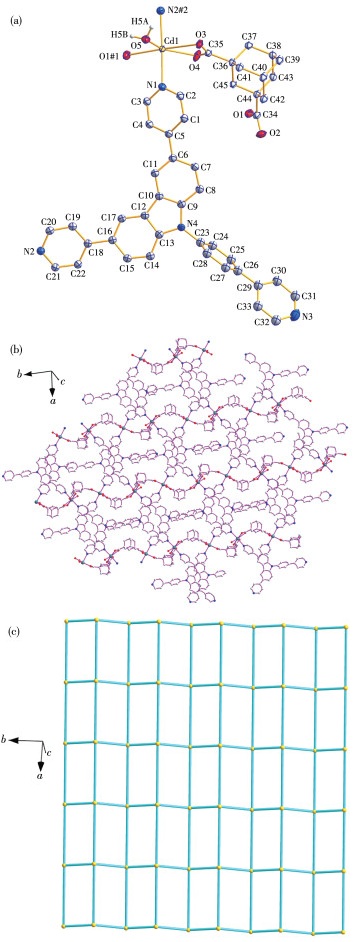
Complex 1 crystallizes in the monoclinic C2/c space group. Its asymmetric unit consists of one Cd(Ⅱ) ion, one adc2- anion, one dppc molecule, one coordinated water molecule, and two lattice water molecules. As shown in Fig. 1a, each Cd(Ⅱ) ion is in a slightly distorted octahedral geometry coordinated by two nitrogen atoms from two individual dppc molecules, three oxygen atoms from two individual adc2- ligands, and one oxygen atom from one coordinated water molecule. The Cd—N distances are 0.233 7(3) and 0.239 1(3) nm, and the Cd—O bonds range between 0.226 7(3) and 0.251 0(3) nm. In addition, the bond angles around each Cd(Ⅱ) range from 53.40(9)° to 173.59(12)° (Table 2). The bond lengths and bond angles are all within the normal range for reported Cd - based complexes[17, 24-26]. The carboxylate groups ligate to the metal ions in a μ2-η0∶η1∶η1∶η1 coordination mode (Fig. 1a). In 1, each adjoining pair of Cd(Ⅱ) ions is connected by adc2- ligands to form a [Cd(adc)]n chain along the b - axis (Fig. 1b). The adjacent [Cd(adc)]n chains are linked by dppc to give rise to a stair-shaped network of [Cd(adc)(dppc)]n extending in the bc plane (Fig. 1c).
Symmetry codes: #1:-x+2, -y+2, -z; #2: -x+1, -y+1, -z.
Based on the simplification principle[27], the Cd(Ⅱ) center is simplified to a 4 - connected node, the adc2- and dppc ligands act as 2-connected linkers, the whole network can be simplified as uninodal {44.62} topology, as shown in Fig. 1c, S1, and Table S1 (Supporting infor-mation). In addition, some C—H···O and O—H···O hydrogen bonds were observed between adjacent layers Fig S1 and Table S1), which are assembled into a 3D supramolecular structure.
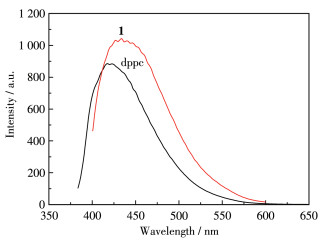
CPs based on d10 metal ions along with the electron-rich π - conjugated ligands often show interesting luminescent properties, which are applied as chemical sensors[28-29]. The solid - state luminescence spectra of complex 1 and ligand dppc were investigated under the same experimental conditions. As shown in Fig. 2, the strong emission of dppc was observed at 423 nm (λex= 363 nm), while the emission of 1 was observed at 433 nm (λex=381 nm). A red - shifted 10 nm as compared with pure dppc ligand was observed, which can be attributed to charge-transfer transitions between ligands and metal ion centers[17, 24]. The strong coordination bonds between the metal ions and the dppc ligand will enhance the rigidity of the dppc ligand in complex 1, and thus decrease the loss of energy upon excitation, which results in the stronger emission of 1 compared to the free dppc ligand[17].
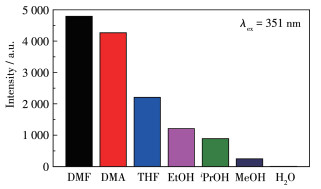
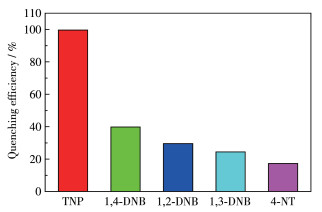
The strong solid-state luminescence of complex 1 encourages us to investigate its potential applications in detecting nitroaromatic compounds. As shown in Fig. 3, the luminescence properties of 1 as a suspension in different solvents such as DMF, DMA, THF, and EtOH are displayed. The emission peaks of 1 were found at 427 nm upon excited at 351 nm and the emission intensities were strongly dependent on the dispersants, with the strongest emission found in the DMF solution. Therefore, luminescence titration experiments were carried out in DMF suspension of 1 by the addition of different nitroaromatic compound solutions (TNP, 1, 4-DNB, 1, 2-DNB, 1, 3-DNB, and 4-NT). Upon the addition of 100 μL TNP solution, the emission intensity of 1 was quenched by nearly 99.59%. In contrast, it was much higher than those for 1 on the addition of 100 μL other different nitroaromatic compound solutions (39.78%, 29.51%, 24.44%, and 17.26% for 1, 4-DNB, 1, 2-DNB, 1, 3-DNB, and 4-NT, respectively) (Fig. 4). The results demonstrate that 1 can be used as chemical sensors with high sensitivity for detecting TNP.
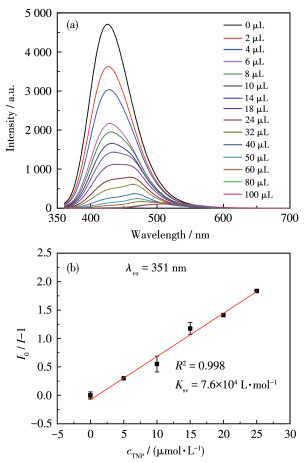
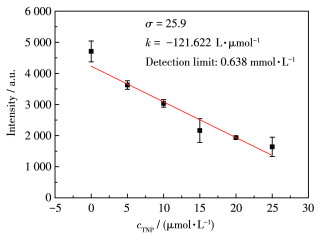
The luminescence quenching efficiency of TNP can be quantitatively investigated using the Stern-Volmer (SV) equation[17]: I0/I=1+KsvcM, where cM is the molar concentration of analyte, I0 and I are the maximum luminescent intensity of complex 1 before and after addition of the analyte, and Ksv is the quenching constant. At low concentrations, the SV plots for nitroaromatic compounds were nearly linear. It could be an energy transfer mechanism occurring between the complex and the analyte since the emission band is red shift (85 nm) upon increasing addition of TNP solution (Fig. 5a). The quenching constant of 1 was found to be 7.6×10⁴ L·mol-1 for TNP from the linear fitting of the plot at low concentration (Fig. 5b). In addition, the detection limit of the assay calculated with 3σ/|k| (k: slope, σ: standard deviation) at the low concentration (0-25 μmol·L-1) was about 0.638 μmol·L-1 for sensing TNP (Fig. 6). The large Ksv and small detection limit values indicate complex 1 were better than those of reported MOFs for detecting TNP (Table 3).
 下载:
导出CSV
下载:
导出CSV
| CP | Ksv / (L•mol-1) | Solvent | Ref. |
| {[Cd(adc)(dppc)(H2O)]•2H2}n | 7.6×10⁴ | DMF | This work |
| {[Zn2(BIDPS)2(OBA)2]•DMA}n | 9.6×10³ | H2O | [28] |
| {[Zn(BIDPT)(PA)]•DMF}n | 7.03×10³ | H2O | [28] |
| {[Zn(BIDPS)(PA)(H2O)2]•2H2}n | 8.58×10³ | H2O | [28] |
| {[Zn(2, 5-tdc)(3-abit)]•H2}n | 4.71×10⁴ | DMF | [29] |
| Cd(INA)(pytpy)(OH)•2H2O | 4.3×10⁴ | DMF | [17] |
| Cd(INA)(pytpy)(OH)•2H2O | 3.3×10⁴ | H2O | [17] |
| (Me2NH2O)[Zn2(L)(H2O)]•0.5DMF | 1.42×10⁴ | DMF | [30] |
| [Pr2(TATMA)2•4DMF•4H2O] | 1.6×10⁴ | DMF | [31] |
| [(Zn4O)(DCPB)3]•11DMF•5H2O | 3.7×10⁴ | DMF | [32] |
| [Zn(BDC)(L)]•xG | 1.16×10⁴ | H2O | [33] |
| [Cd(BDC)(L)]•xG | 1.35×10⁴ | H2O | [33] |
| [Zn2(H2L)2(Bpy)2(H2O)3]•H2O | 1.36×10⁴ | H2O | [26] |
| [Zn(L)(HCOO)•H2O]n | 2.11×10⁴ | H2O | [34] |
| [Cd(5-BrIP)(TIB)]n | 2.68×10⁴ | H2O | [25] |
| [Eu3(bpydb)3(HCOO)(μ3-OH)2(H)] | 1.5×10⁴ | H2O | [35] |
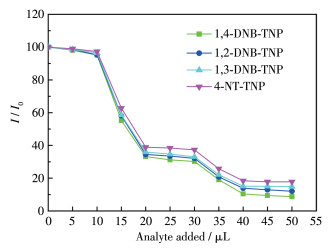
The TNP selective detection capability of complex 1 was investigated through an anti-interference experiment conducted in the presence of other nitroaromatic compounds[17]. Initially, the emission intensity of 1 was monitored. Subsequently, two equal portions of a 10 μL solution of 1, 4 - DNB (5 mmol·L-1) were added to the suspension, resulting in a negligible decrease in emission intensity. However, a significant decrease in emission intensity was observed upon adding an equal amount of a 5 mmol·L-1 TNP solution (Fig. 7). This trend persisted in subsequent cycles of analyte addition. Furthermore, similar results were obtained when evaluating the detecting selectivity between other nitroaromatic compounds and TNP. Based on these findings, it can be concluded that complex 1 exhibits a robust anti-interference ability towards TNP.
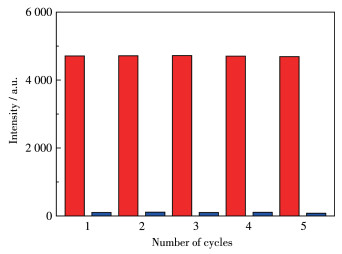
More importantly, complex 1 can be recycled after the luminescence titration experiment. The suspension containing 1 and TNP were centrifuged to separate the solids and washed with DMF, then dried. As illustrated in Fig. 8, the luminescence intensity can be regained and the sensing ability of 1 exhibited little changes after five cycles. These results indicated that 1 is an excellent TNP sensor.
In summary, a carbazole-based Cd(Ⅱ) CP (1) was successfully synthesized and characterized. Complex 1 exhibits a uninodal net with {44·62} topology, construct-ed by Cd(Ⅱ) ions, dppc and adc2-“bridges”. The luminescent investigations suggest that 1 can sensitively detect TNP in DMF solution by luminescent quenching effect. The mechanisms of 1 for detecting TNP have been preliminarily elucidated. The results show that 1 can be used as a stable and recyclable chemical sensor for the detection of TNP.
Meaney M S, McGuffin V L. Investigation of common fluorophores for the detection of nitrated explosives by fluorescence quenching[J]. Anal. Chim. Acta, 2008, 610: 57-67. doi: 10.1016/j.aca.2008.01.016
Pramanik S, Zheng C, Zhang X, Emge T J, Li J. New microporous metal- organic framework demonstrating unique selectivity for detection of high explosives and aromatic compounds[J]. J. Am. Chem. Soc., 2001, 133: 4153-4155.
Nagarkar S S, Desai A V, Ghosh S K. Engineering metal - organic frameworks for aqueous phase 2, 4, 6 - trinitrophenol (TNP) sensing[J]. CrystEngComm, 2016, 18: 2994-3007. doi: 10.1039/C6CE00244G
Nagarkar S S, Desai A V, Samanta P, Ghosh S K. Aqueous phase selective detection of 2, 4, 6-trinitrophenol using a fluorescent metalorganic framework with a pendant recognition site[J]. Dalton. Trans., 2015, 44: 15175-15180. doi: 10.1039/C5DT00397K
Gole B, Bar A K, Mukherjee P S. Multicomponent assembly of fluorescent-tag functionalized ligands in metal-organic frameworks for sensing explosives[J]. Chem.-Eur. J., 2014, 20: 13321-13326. doi: 10.1002/chem.201402791
He G, Peng H N, Liu T H, Yang M N, Zhang Y, Fang Y. A novel picric acid film sensor via combination of the surface enrichment effect of chitosan films and the aggregation - induced emission effect of siloles[J]. J. Mater. Chem., 2009, 19: 7347-7353. doi: 10.1039/b906946a
Li A, Li L, Lin Z, Song L, Wang Z H, Chen Q, Yang T, Zhou X H, Xiao H P, Yin X J. Guest - induced reversible structural transitions and concomitant on/off luminescence switching of an Eu(Ⅲ) metal - organic framework and its application in detecting picric acid[J]. New J. Chem., 2015, 39: 2289-2295. doi: 10.1039/C4NJ01946F
Li Y H, Han X J, Song Y. An azo-phenol derivative probe: Colorimetric and"turn-on"fluorescent detection of copper(Ⅱ) ions and pH value in aqueous solution[J]. RSC Adv., 2017, 7: 20537-20541. doi: 10.1039/C7RA01109A
Harper R J, Almirall J R, Furton K G. Identification of dominant odor chemicals emanating from explosives for use in developing optimal training aid combinations and mimics for canine detection[J]. Talanta, 2005, 67: 313-327. doi: 10.1016/j.talanta.2005.05.019
Hasegawa S, Horike S, Matsuda R, Furukawa S, Mochizuki K, Kinoshita Y, Kitagawa S. Three - dimensional porous coordination polymer functionalized with amide groups based on tridentate ligand: Selective sorption and catalysis[J]. J. Am. Chem. Soc., 2007, 129: 2607-2614. doi: 10.1021/ja067374y
Li J R, Kuppler R J, Zhou H C. Selective gas adsorption and separation in metal- organic frameworks[J]. Chem. Soc. Rev., 2009, 38: 1477-1504. doi: 10.1039/b802426j
Hu Z, Deibert B J, Li J. Luminescent metal-organic frameworks for chemical sensing and explosive detection[J]. Chem. Soc. Rev., 2014, 43: 5815-5840. doi: 10.1039/C4CS00010B
Jia C, He T, Wang G M. Zirconium-based metal-organic frameworks for fluorescent sensing[J]. Coord. Chem. Rev., 2023, 476: 214930. doi: 10.1016/j.ccr.2022.214930
Li J R, Sculley J, Zhou H C. Metal- organic frameworks for separations[J]. Chem. Rev., 2012, 112: 869-932. doi: 10.1021/cr200190s
Stock N, Biswas S. Synthesis of metal- organic frameworks (MOFs): Routes to various MOF topologies, morphologies, and composites[J]. Chem. Rev., 2012, 112: 933-969. doi: 10.1021/cr200304e
Guillerm V, Kim D, Eubank J F, Luebke R, Liu X, Adil K, Lah M S, Eddaoudi M. A supermolecular building approach for the design and construction of metal-organic frameworks[J]. Chem. Soc. Rev., 2014, 43: 6141-6172. doi: 10.1039/C4CS00135D
Zhang J F, Wu J J, Tang G D, Feng J Y, Luo F M, Xu B, Zhang C. Multiresponsive water - stable luminescent Cd coordination polymer for detection of TNP and Cu2+[J]. Sens. Actuator B-Chem., 2018, 272: 166-174. doi: 10.1016/j.snb.2018.05.121
Wang G F, Yang H Y, Peng D Q, Sun S W. Two zinc and cadmium coordination polymers constructed with bis(4 - (1H - imidazol - 1 - yl) phenyl)methanone and naphthalene-1, 4-dicarboxylate ligands: Synthesis and structural characterization[J]. Z. Naturforsch., 2022, 77b: 643-649.
Wang G F. Structural diversity of two coordination polymers based on bis(4-(1H-Imidazol-1- yl)phenyl)methanone and polycarboxylate coligands: Syntheses, structures, and fluorescent properties[J]. Russ. J. Coord. Chem., 2018, 44: 540-546. doi: 10.1134/S1070328418090075
Shi H P, Xin D H, Dong X Q, Dai J X, Wu X H, Miao Y Q, Fang L, Wang H, Choi M M F. A star-shaped bipolar host material based on carbazole and dimesitylboron moieties for fabrication of highly efficient red, green and blue electrophosphorescent devices[J]. J. Mater. Chem. C, 2014, 2: 2160-2168. doi: 10.1039/C3TC32236J
Sheldrick G M. SADABS, Program for empirical adsorption correction of area detector data. University of Göttingen, Germany, 2003.
Sheldrick G M. SHELXL 2014/7, Program for crystal structure refinement. University of Göttingen, Germany, 2014.
Sheldrick G M. A short history of SHELX[J]. Acta Crystallogr. Sect. A, 2008, A64: 112-122.
Tian D, Li Y, Chen R Y, Chang Z, Wang G. Y, Bu X H. , Bu X H[J]. A luminescent metal- organic framework demonstrating ideal detection ability for nitroaromatic explosives. J. Mater. Chem. A, 2014, 2: 1465-1470.
Rachuri Y, Parmar B, Bishta K K, Suresh E. Mixed ligand two dimensional Cd(Ⅱ)/Ni(Ⅱ) metal organic frameworks containing dicarboxylate and tripodal N - donor ligands: Cd(Ⅱ) MOF is an efficient luminescent sensor for detection of picric acid in aqueous media[J]. Dalton. Trans., 2016, 45: 7881-7892. doi: 10.1039/C6DT00753H
Parmar B, Rachuri Y, Bisht K K, Suresh E. Syntheses and structural analyses of new 3D isostructural Zn(Ⅱ) and Cd(Ⅱ) luminescent MOFs and their application towards detection of nitroaromatics in aqueous media[J]. ChemistrySelect, 2016, 1: 6308-6315. doi: 10.1002/slct.201601134
Blatov V A. Multipurpose crystallochemical analysis with the program package TOPOS. [2023-11-03].
徐涵, 潘兆瑞, 亓昭鹏, 孙洁. 基于V型配体的三个荧光Zn-MOF对水溶液中2, 4, 6-三硝基苯酚和Fe3+的荧光传感[J]. 无机化学学报, 2022,38,(12): 2479-2490. XU H, PAN Z R, QI Z P, SUN J. Three luminescent Zn-MOFs based on V-shaped ligands for fluorescence sensing of 2, 4, 6-trinitrophenol and Fe3+ in aqueous solution[J]. Chinese J. Inorg. Chem, 2022, 38(12): 2479-2490.
Zhang J F, Wu J J, Gong L P, Feng J Y, Zhang C. Water-stable luminescent Zn(Ⅱ) metal-organic framework as rare multifunctional sensor for Cr(Ⅵ) and TNP[J]. ChemistrySelect, 2017, 2: 7465-7473. doi: 10.1002/slct.201701253
Wang J, Wu X R, Liu J Q, Li B H, Singh A, Kumar A, Batten S R. An uncommon (5, 5)-connected 3D metal organic material for selective and sensitive sensing of nitroaromatics and ferric ion: Experimental studies and theoretical analysis[J]. CrystEngComm, 2017, 19: 3519-3525. doi: 10.1039/C7CE00912G
He H M, Chen S H, Zhang D Y, Yan E C, Zhao X J. A luminescent metal- organic framework as an ideal chemosensor for nitroaromatic compounds[J]. RSC Adv., 2017, 7: 38871-38876. doi: 10.1039/C7RA06320B
He H M, Song Y, Sun F X, Bian Z, Gao L X, Zhu G S. A porous metal-organic framework formed by a V-shaped ligand and Zn(Ⅱ) ion with highly selective sensing for nitroaromatic explosives[J]. J. Mater. Chem. A, 2015, 3: 16598-16603. doi: 10.1039/C5TA03537F
Deng Y J, Chen N J, Li Q Y, Wu X J, Huang X L, Lin Z H, Zhao Y G. Highly fluorescent metal-organic frameworks based on a benzenecored tetraphenylethene derivative with the ability to detect 2, 4, 6 - trinitrophenol in water[J]. Cryst. Growth Des., 2017, 17: 3170-3177. doi: 10.1021/acs.cgd.7b00131
Yang Y, Shen K, Lin J Z, Zhou Y, Liu Q Y, Hang C, Abdelhamid H N, Zhang Z Q, Chen H. A Zn-MOF constructed from electron-rich π- conjugated ligands with an interpenetrated graphene-like net as an efficient nitroaromatic sensor[J]. RSC Adv., 2016, 6: 45475-45481. doi: 10.1039/C6RA00524A
Song X Z, Song S Y, Zhao S N, Hao Z M, Zhu M, Meng X, Wu L L, Zhang H J. Single-crystal-to-single-crystal transformation of a europium(Ⅲ) metal-organic framework producing a multi-responsive luminescent sensor[J]. Adv. Funct. Mater., 2014, 24: 4034-4041. doi: 10.1002/adfm.201303986

Figure 1 Crystal structure of complex 1: (a) Coordination environment, where another part of the disordered atoms, hydrogen atoms bonded to carbon atoms, and lattice water molecules are omitted for clarity; (b) View of the layer structure; (c) Simplified structure with the (44·62) topology
Symmetry codes: #1:-x+2, -y+2, -z; #2: -x+1, -y+1, -z.

Figure 3 Comparisons of the luminescence intensities of complex 1 in different dispersants

Figure 4 Comparison of the quenching efficiency of 1 for different nitroaromatic compounds (5 mmol·L-1, 100 μL)

Figure 5 (a) Emission spectra of complex 1 dispersed in DMF upon addition of TNP solution (5 mmol· L-1); (b) SV plot for sensing TNP of 1 in DMF suspension at the low concentration (0-25 μmol·L-1)

Figure 6 Detection limit for sensing TNP of complex 1 in DMF suspension calculated with 3σ/|k| (k: slope, σ: standard deviation) at the low concentration (0-25 μmol·L-1)

Figure 7 Competitive luminescence quenching of complex 1 upon addition of other nitroaromatic compounds followed by TNP
Table 1. Crystal data and refined parameters of complex 1
| Parameter | 1 | Parameter | 1 | |
| Formula | C45H42CdN4O7 | Dc / (g•cm-3) | 1.422 | |
| Formula weight | 863.23 | μ / mm-1 | 0.598 | |
| Crystal system | Monoclinic | F(000) | 3 552 | |
| Space group | C2/c | Unique reflection | 7 107 | |
| a / nm | 2.737 5(3) | Observed reflection [I>2σ(I)] | 5 409 | |
| b / nm | 1.589 97(16) | Parameter | 613 | |
| c / nm | 1.861 58(18) | GOF | 1.068 | |
| β/(°) | 95.728(3) | Final R indices [I>2σ(I)] | R1=0.043 0, wR2=0.118 7 | |
| Z | 8 | R indices (all data) | R1=0.061 4, wR2=0.135 1 | |
| V / nm3 | 8.062 3(14) |
 下载: 导出CSV
Table 2. Selected bond lengths (nm) and bond angles (°) for complex 1
| Cd1—O1#1 | 0.226 7(3) | Cd1—O5 | 0.232 8(3) | Cd1—N1 | 0.239 1(3) |
| Cd1—O4 | 0.229 5(3) | Cd1—N2#2 | 0.233 7(3) | Cd1—O3 | 0.251 0(3) |
| C13—N4—C9 | 108.2(3) | O1#1—Cd1—N2#2 | 92.80(11) | N2#2—Cd1—N1 | 173.59(12) |
| C13—N4—C23 | 123.7(5) | O4—Cd1—N2#2 | 96.85(12) | O1#1—Cd1—O3 | 171.75(10) |
| C9—N4—C23 | 127.9(5) | O5—Cd1—N2#2 | 86.50(11) | O4—Cd1—O3 | 53.40(9) |
| O1#1—Cd1—O4 | 132.90(10) | O1#1—Cd1—N1 | 87.33(11) | O5—Cd1—O3 | 86.83(9) |
| O1#1—Cd1—O5 | 86.34(10) | O4—Cd1—N1 | 87.72(12) | N2#2—Cd1—O3 | 91.41(10) |
| O4—Cd1—O5 | 140.06(10) | O5—Cd1—N1 | 87.11(11) | N1—Cd1—O3 | 87.70(10) |
| Symmetry codes: #1: 3/2-x, 1/2+y, 3/2-z; #2: -1/2+x, 3/2-y, -1/2+z. | |||||
下载: 导出CSV
Table 3. Quenching constants of the reported CPs for detecting TNP in DMF or H2O suspension
| CP | Ksv / (L•mol-1) | Solvent | Ref. |
| {[Cd(adc)(dppc)(H2O)]•2H2}n | 7.6×10⁴ | DMF | This work |
| {[Zn2(BIDPS)2(OBA)2]•DMA}n | 9.6×10³ | H2O | [28] |
| {[Zn(BIDPT)(PA)]•DMF}n | 7.03×10³ | H2O | [28] |
| {[Zn(BIDPS)(PA)(H2O)2]•2H2}n | 8.58×10³ | H2O | [28] |
| {[Zn(2, 5-tdc)(3-abit)]•H2}n | 4.71×10⁴ | DMF | [29] |
| Cd(INA)(pytpy)(OH)•2H2O | 4.3×10⁴ | DMF | [17] |
| Cd(INA)(pytpy)(OH)•2H2O | 3.3×10⁴ | H2O | [17] |
| (Me2NH2O)[Zn2(L)(H2O)]•0.5DMF | 1.42×10⁴ | DMF | [30] |
| [Pr2(TATMA)2•4DMF•4H2O] | 1.6×10⁴ | DMF | [31] |
| [(Zn4O)(DCPB)3]•11DMF•5H2O | 3.7×10⁴ | DMF | [32] |
| [Zn(BDC)(L)]•xG | 1.16×10⁴ | H2O | [33] |
| [Cd(BDC)(L)]•xG | 1.35×10⁴ | H2O | [33] |
| [Zn2(H2L)2(Bpy)2(H2O)3]•H2O | 1.36×10⁴ | H2O | [26] |
| [Zn(L)(HCOO)•H2O]n | 2.11×10⁴ | H2O | [34] |
| [Cd(5-BrIP)(TIB)]n | 2.68×10⁴ | H2O | [25] |
| [Eu3(bpydb)3(HCOO)(μ3-OH)2(H)] | 1.5×10⁴ | H2O | [35] |
下载: 导出CSV

 扫一扫看文章


扫一扫关注我们