Contributions of Cs and Rb on Inhibiting Photo-induced Phase Segregation and Enhancement Optoelectronic Performances of MA1-yXyPbI1.8Br1.2 (X = Cs, Rb) Single Crystals

Qing Yao Kaiyu Wang Jie Zhang Changqian Li Chenyu Shang Feitong Chen Qi Huang Qiqi Zhao Weiwei Zhang Xiaoyuan Zhan Jianxu Ding

Citation:  Qing Yao, Kaiyu Wang, Jie Zhang, Changqian Li, Chenyu Shang, Feitong Chen, Qi Huang, Qiqi Zhao, Weiwei Zhang, Xiaoyuan Zhan, Jianxu Ding. Contributions of Cs and Rb on Inhibiting Photo-induced Phase Segregation and Enhancement Optoelectronic Performances of MA1-yXyPbI1.8Br1.2 (X = Cs, Rb) Single Crystals[J]. Chinese Journal of Structural Chemistry, 2022, 41(5): 220507. doi: 10.14102/j.cnki.0254-5861.2022-0089 shu

Contributions of Cs and Rb on Inhibiting Photo-induced Phase Segregation and Enhancement Optoelectronic Performances of MA1-yXyPbI1.8Br1.2 (X = Cs, Rb) Single Crystals

English

  • Due to the advantages of large absorption coefficient, small exciton binding energy, high carrier mobility, adjustable band gap and easy manufacturing, organic-inorganic hybrid metal halide perovskites CH3NH3PbX3 (X = I, Br, Cl) have attracted much attention as light absorbers for optoelectronic devices.[1-5] Till now, the power conversion efficiency (PCE) of perovskite solar cells has reached a record of 25.5%.[6] However, the application and deve-lopment of perovskite optoelectronic devices still face many difficulties, such as instability and toxicity of lead, etc.[7-9] Improving the stability and optoelectronic property of perovskites is greatly demanded for further commercial applications.[10-11]

    To improve the stability and optoelectronic property of perovskites, many efforts have been made, among which mixed halide is one of the most effective methods.[12-14] For instance, mixed halide can regulate the absorption range and band gap of MAPbBr3-xClx and MAPbI3-xBrx perovskites covering the entire UV-visible region.[15] Besides, mixed halide can adjust carrier diffusion dynamics. It was reported that in MAPbI3-xBrx perovskite films, the carrier diffusion rate of photo-generated carriers is dependent on Br content.[16] It should be noted that in the mixed halide perovskites, the molar ratio of halides should be strictly controlled. Unsuitable mixed halide ratio brings fatal defect of photo-induced phase segregation, which ultimately induces instability in the mixed halide perovskites. Draguta et al[17] quantitatively analyzed the phase segregation process of MAPbI3-xBrx perovskites using spectral measurement and theoretical modeling. They believed that the phase segregation driving force is the I-rich phase with the reduction of band gap, and phase segregation could be suppressed by deliberately designing carrier diffusion length and injected carrier concentration. Byun reported the optical and structural properties of mixed halide perovskite MAPbBr3-xIx SCs to investigate the underlying mechanisms of the light soaking effect and found that the photo-induced phase segregation is completely reversible.[18]

    To suppress photo-induced phase segregation in the mixed halide perovskites, various strategies are proposed, among which partial replacement of organic cation (MA, FA) by smaller polarity of inorganic cations (Cs, Rb) can reduce the electron-phonon coupling and inhibit halide segregation.[19-21] Bischak[22] demonstrated that photo-induced phase segregation is an intrinsic property of mixed halide perovskites, and the segregation severity and dynamics depend on the electron-phonon coupling strength. Knight[23] provided evidence for low-barrier ionic pathways in MAPb(Br0.5I0.5)3, which brought rearrangement of halide ions in localized region. In contrast, FA0.83Cs0.17Pb(Br0.4I0.6)3 lacks such low-barrier ionic pathways and is, consequently, more stable against halide segregation. Compared with perovskite films, perovskite SCs have lower defect densities and no grain boundary, so it is expected that the photo-induced phase segregation effect might be different from that in film.[24-27] Nonetheless, the photo-induced phase segregation mechanism in perovskite SCs is still unclear yet.

    Doping I in MAPbBr3 perovskite can effectively control the crystal band gap, but a large amount of I doping will lead to the crystal structure from cubic phase (MAPbBr3) to tetragonal phase (MAPbI3). Thus, we controlled the I content to about 60%. To clarify the mechanism of phototropic phase segregation in perovskite SCs, here we successfully grow a series of MA1-yXyPbI1.8Br1.2 (X = Rb, Cs) SCs to investigate the light soaking effect on SC. In particular, the photo-induced phase segregation is systematically investigated through PL, UV-vis and XRD, which testifies that phase segregation is a completely reversible process. In addition, Cs and Rb can significantly improve the optical stability, and effectively improve the crystal properties.

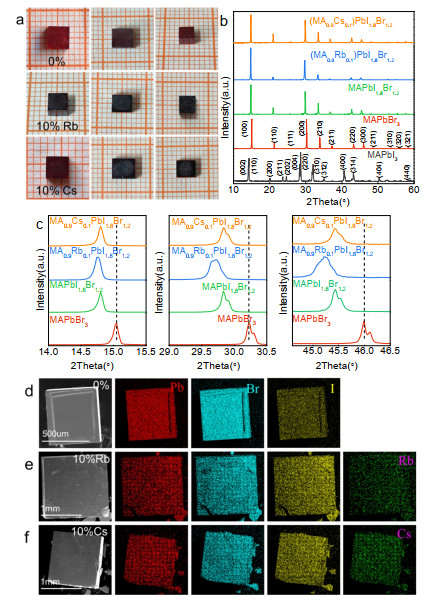
    Figure 1a shows photographs of MA1-yXyPbI1.8Br1.2 SCs, whose shapes are similar cubic. The crystal color is related with the crystal thickness, which gradually transforms from black red to black because of the thickness related transmittance. For instance, the color of MA0.9Cs0.1PbI1.8Br1.2 SCs illustrated in Figure S1a testifies this phenomenon. Therefore, through controlling the growth time within 2-3 days, thinner MA1-yXyPbI1.8Br1.2 SCs are grown (Figure S1b-d), confirming that the thickness affects the color of crystals, which in turn affects the absorption of the crystals. Figure S2 shows the UV-vis absorption spectra of MAPbI1.8Br1.2 powder and the transmittance of MAPbI1.8Br1.2 SC at thicknesses of 1 and 2.5 mm. It is found that with the increase of crystal thickness, the transmittance decreased, and thus the absorption coefficient was enhanced.

    Figure 1

    Figure 1.  (a) Photographs of MAPbI1.8Br1.2, MA0.9Rb0.1PbI1.8Br1.2 and MA0.9Cs0.1PbI1.8Br1.2 SCs; (b-c) XRD patterns and enlarged XRD patterns of MAPbI3, MAPbBr3 and MA1-yXyPbI1.8Br1.2 powders; (d-f) Element distribution of MAPbI1.8Br1.2, MA0.9Rb0.1PbI1.8Br1.2 and MA0.9Cs0.1PbI1.8Br1.2 SCs, respectively.

    In order to characterize the crystal structure, XRD patterns of MAPbI3, MAPbBr3 and MA1-yXyPbI1.8Br1.2 powders were carried out (Figure 1b). The diffraction peaks of MA1-yXyPbI1.8Br1.2 crystals correspond to cubic MAPbBr3 and are different from that of tetrahedral MAPbI3. According to the crystallization theory, lead halide and methylamine halide perovskite precursors can coordinate with organic solvent molecules to form complexes. Since Pb-I has weaker bond energy than Pb-Br, the coordination between PbI2 and solvent is stronger than that of PbBr2, resulting in PbBr2-GBL complexes requiring higher temperatures to dissociate. Compared with PbI2-GBL, the PbBr2-GBL complexes are easier to dissociate at 60 ℃, so that the content of Br in the precursor solution increases sharply and reaches the saturated state, and the grown single crystals are more inclined to the MAPbBr3 structure. Therefore, the as-grown MA1-yXyPbI1.8Br1.2 crystals belong to cubic structure and Pm3̅m space group. Compared with MAPbI1.8Br1.2, incorporation of Rb or Cs increases the concentration of I into crystal lattice, causing the increase of I in the crystal. Thus, the color of MA0.9Cs0.1PbI1.8Br1.2 and MA0.9Rb0.1PbI1.8Br1.2 SCs are deeper than that of MAPbI1.8Br1.2, and the crystal lattices are expanded through the diffraction peak shift to the small angles (Figure 1c). By comparison with the X-site halide anion, the A-site mixed cations play a role of charge compensation in lattice and stabilize the crystal structure, contributing relatively little to the structural distortion.[28] Besides, we further investigate the stability of MA1-yXyPbI1.8Br1.2 perovskites at room temperature via XRD. As shown in Figure S3, after the MA1-yXyPbI1.8Br1.2 perovskites are placed in the air environment for 4 months, the diffraction peaks remain unchanged compared with the fresh samples, thereby confirming their good stability. Furthermore, the energy dispersive X-ray spectrometer (EDS) in Figure 1(d-f) also shows that the I contents of the crystals with the addition of RbI or CsI are higher than that in MAPbI1.8Br1.2 SC, which is consistent with the XRD data.

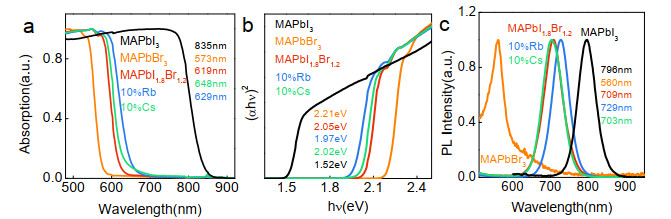
    Figure 2a shows the UV-vis absorption spectra of MAPbI3, MAPbBr3 and MA1-yXyPbI1.8Br1.2 crystal powders. Compared with MAPbI1.8Br1.2, redshift of the absorption onsets of MA1-yXyPbI1.8Br1.2 with incorporation of RbI or CsI occurs, and the corresponding optical band gaps are 2.05, 1.97 and 2.02 eV respectively, as shown in Figure 2b. The changes of band gaps and absorption onsets are attributed to the increase of I into crystal lattice. The main contribution of Cs and Rb cations adjusts the structural stability and electrical neutrality.[29] Therefore, the contribution of Rb and Cs to the optical absorption and band gap of the crystals is not as obvious as that of I, which is consistent with the results of XRD. It is worth noting that the PL emission peaks of MA1-yXyPb-I1.8Br1.2 crystals are 709, 729 and 703 nm respectively, which have obvious Stokes shift compared with the absorption onsets (Figure 2c). In addition, under strong light illumination, the color of crystals changes from dark red to black (Figure S4), which means the phase segregation appears in the crystal under illumination, resulting in the emergence of I-rich region and thus bringing red shift of PL peaks.

    Figure 2

    Figure 2.  Optical performance of MA1-yXyPbI1.8Br1.2 crystals: (a) UV-vis absorption, (b) Optical band gaps, (c) Steady-state PL spectra.

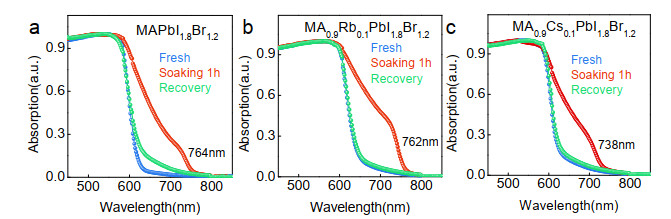
    Figure 3 shows absorption spectra of MA1-yXyPbI1.8Br1.2 crystals under strong light illumination (power density: 6 mW·cm-2) for 1 h. The absorption onsets of MA1-yXyPbI1.8Br1.2 crystals change significantly after 1 h illumination, and the absorption capacity of the crystals towards longer wavelength (730-760 nm) is significantly enhanced. However, the Rb and Cs can reduce the change of the absorption onsets of the crystals under illumination. The smaller polarity of Rb and Cs leads to weak interaction between free charge and ion lattice and form less polar lattice, [29] which can effectively inhibit ion migration (photo-induced phase segregation) under light illumination. Figure S4 shows the evolution process of MA1-yXyPbI1.8Br1.2 powders under continuous illumination, in which the color of MA1-yXyPbI1.8Br1.2 powders changes from black red to black. After the withdrawal of illumination for 3 hours, the absorption onsets recover to their original position and the color of the powders returns to its original color under environment conditions. This phenomenon indicates that photo-induced phase segregation is an almost reversible process, [30] and provides a promising prospect for the crystal in future commercial applications.

    Figure 3

    Figure 3.  (a-c) UV-vis absorption of MA1-yXyPbI1.8Br1.2 before and after light illumination and after recovery.

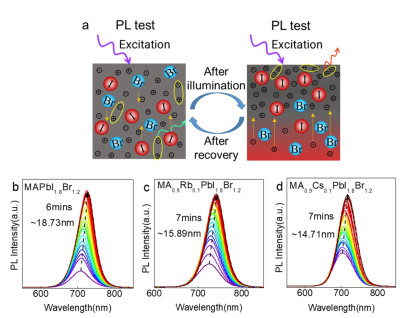
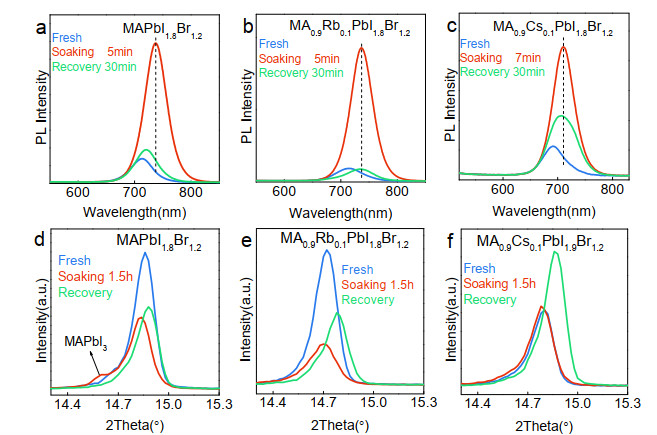
    To better investigate the photo-induced phase segregation in MA1-yXyPbI1.8Br1.2 crystals, the in situ PL and XRD were carried out. As we all know, the halide ions in the crystal migrate when obtaining sufficient energy, and form I-rich and Br-rich regions.[31] Meanwhile, the activated carriers (electrons and holes) migrate to the I-rich region and recombine here, resulting in the redshift of PL positions (Figure 4). Obviously, from the PL spectra the PL peak of MAPbI1.8Br1.2 is ~18.73 nm redshifted after illumination, and the intensity is remarkably enhanced. However, the MA1-yXyPb-I1.8Br1.2 crystals with Rb or Cs have significant lower redshift of ~15.89 and ~14.71 nm, respectively, as shown in Figure 4(b-d). Cs significantly reduces the trap density, as well as the secondary recombination rate of free mobile carriers in perovskite bulk materials. Furthermore, the trap states in Cs-containing perovskites are at shallow states. In contrast, the addition of Rb has only a minor impact on the trap states.[32] Therefore, the inhibition effect of Rb on photo-induced phase segregation is weaker than introducing Cs. In addition, the PL spectra of MA1-yXyPbI1.8Br1.2 SCs after illumination for 7 min and recovery for 30 min were investigated, as shown in Figure 5(a-c). It is found that the PL intensity of MA1-yXyPbI1.8Br1.2 SCs is significantly reduced after recovery for 30 min, confirming that the photo-induced phase segregation is an almost reversible process. After recovery, compared with MAPbI1.8Br1.2, the red shift of PL peaks of Rb and Cs doped crystals is not obvious, indicating that Rb and Cs inhibit the migration of halide ions not only in the light illumination but also during the recovery process.

    Figure 4

    Figure 4.  (a) Schematic of relevant kinetic processes during halide phase segregation; (b-d) PL spectra of MA1-yXyPbI1.8Br1.2, recorded under a wavelength of 445 nm.

    Figure 5

    Figure 5.  (a-c) PL spectra of fresh, soaking, and recovered MA1-yXyPbI1.8Br1.2, recorded under a wavelength of 445 nm; (d-f) XRD patterns of MA1-yXyPbI1.8Br1.2 before and after illumination intensity of 6 mW·cm−2 and a wavelength of 365 nm.

    On the other hand, through the XRD data in Figure S5, the diffraction peaks of MAPbI1.8Br1.2 and MA0.9Rb0.1PbI1.8Br1.2 decrease significantly after 1.5 h illumination due to the fact that illumination destroys the structures of the crystals to reduce the crystallinity. However, diffraction peaks of MA0.9Cs0.1PbI1.8Br1.2 crystals maintain stable after illumination, indicating that Cs is beneficial to stabilize the crystal structure, and the enhanced bonding between Cs and the inorganic metal skeleton.

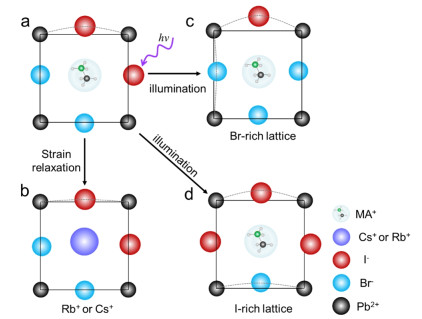
    The enlarged XRD of MA1-yXyPbI1.8Br1.2 is shown in Figure 5(d-f). For MAPbI1.8Br1.2, the diffraction peaks are obviously broadened and asymmetric under illumination, and an obvious diffraction peak at 14.6° belonging to MAPbI3 crystal occurs, implying that MAPbI1.8Br1.2 crystals show phase segregation and form I-rich and Br-rich regions, and thus MAPbI3 phase appears in the crystals. From the absorption spectra, it is noteworthy that the photo-induced phase segregation in MAPbI1.8Br1.2 crystals is reversible. Illumination stimulant ions migrate inside the crystals to from I- and Br-rich regions (Figure 6a), which increases the lattice stress (Figure 6c-d).[19] When illumination disappears, ions reversely migrate under the stress inside the crystal lattice and concentration gradient, and the redistribution of ions leads to a change in the lattice parameters. Non-uniform strains and local distortions associated with the halide distribution are in existence, which is manifested through the shift of diffraction peaks between fresh and recovered XRD. The recovery diffraction peaks shift towards larger angles implies that the recovered crystal lattice shrinks and shortens the inter-ion spacing. On the other hand, ion redistribution repairs shallow-level defects and improves crystal quality. After recovery, the diffraction peaks of 14.6° of MAPbI1.8Br1.2 crystal disappears, implying the redistribution of halide ions and disappearance of I-rich and Br-rich regions.

    Figure 6

    Figure 6.  Schematic diagram of Rb and Cs inhibit phase segregation: (a) MAPbI1.8Br1.2 lattice; (b) MA1-yXyPbI1.8Br1.2 lattice; (c-d) Formation of Br- or I-rich regions in MAPbI1.8Br1.2 crystals.

    Nevertheless, no diffraction peaks of MAPbI3 are detected in MA0.9Cs0.1PbI1.8Br1.2 and MA0.9Cs0.1PbI1.8Br1.2 in Figure 5(d-f), indicating that Rb and Cs improve the structural stability, which in turn improves the photo-stability. The smaller size of Rb and Cs compared with MA increases the lattice tolerance, which is sufficient to relieve the lattice stress, thus achieving the purpose of stabilizing the lattice structure and inhibiting the migration of halide ions, as shown in Figure 6b. On the other hand, the smaller polarity of Rb and Cs can reduce the electron-phonon coupling and adjust the lattice distortion, [33-34] therefore significantly suppressing the migration of halide ions.

    Besides, the diffraction peak intensity of MA1-yXyPbI1.8Br1.2 crystals after recovery increased significantly compared with those after illumination. The redistribution of ions after light withdrawal and Cs doping lead to the reduction of defects and carrier migration in the crystal lattice.[35] Therefore, the crystals recover to the stable phase and the crystallinity increases after the light withdrawal.

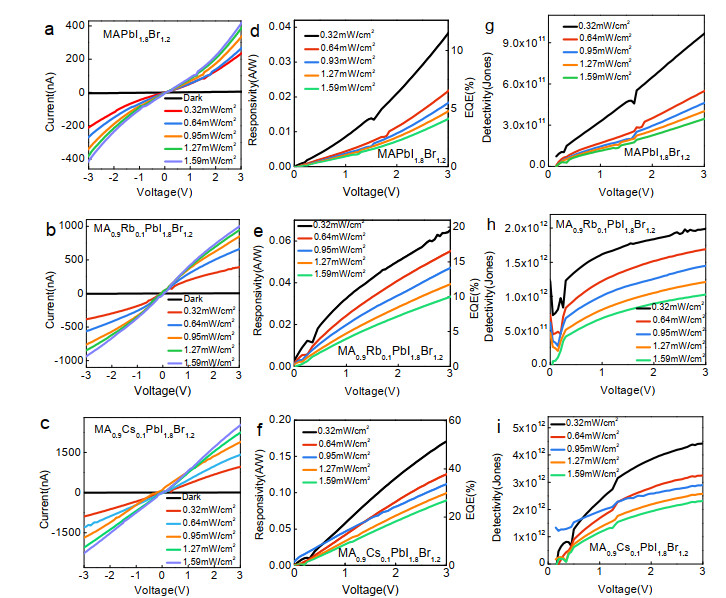
    To dig out the roles of Cs and Rb on optoelectronic properties, planar photo-detectors were fabricated. Figure 7(a-c) depicts the I-V characteristics of the devices in the dark and under light illumination of 405 nm with various power densities. As an increase of power density, the photocurrent of the devices gradually increases. The dark current of MA1-yXyPbI1.8Br1.2 with Rb or Cs are 3.96 and 4.64 nA respectively at 3 V bias, lower than that of the MAPbI1.8Br1.2 SC (4.88 nA). In addition, the photocurrent of MA1-y-XyPbI1.8Br1.2 SCs with Rb or Cs (996.60 nA, 2512.05 nA) is much larger than 413.15 nA for MAPbI1.8Br1.2. The enhancement of optoelectronic properties by Rb and Cs is ascribed to that Rb and Cs passivate the surface and eliminate surface defects, thereby hindering the recombination of carriers.[28] On the other hand, compared with MA, Rb and Cs have higher migration activation energies because of their stronger binding force with inorganic metal skeleton and result in better optoelectronic performances.

    Figure 7

    Figure 7.  Optoelectronic properties of photo-detectors based MA1-yXyPbI1.8Br1.2 SCs: (a-c) Photocurrent; (d-f) Responsivities and EQEs; (g-i) Detectivities.

    In addition, the responsivity (R), external quantum efficiency (EQE) and detectivity (D*) are the key parameters of the photo-detector and calculated according to the following equations: [36-37]

    $ R=\frac{{I}_{ph}-{I}_{dark}}{{P}_{in}*S} $

    (1)

    $ EQE=\frac{R*h*c}{e\lambda } $

    (2)

    $ {D}^{*}=\frac{R}{\sqrt{2e*{I}_{dark}}} $

    (3)

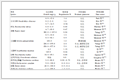
    Where Iph and Idark represent the photocurrent and dark current, Pin is the incident light intensity, S is the effective area of photo-detector, h is the Planck's constant, c is the speed of light, e is the elementary charge, and λ is the wavelength of the laser. The relationships of R, EQE and D* of MA1-yXyPbI1.8Br1.2 SCs with various illumination powers and bias are shown in Figure 7(d-i). The responsivity of MAPbI1.8Br1.2 photo-detector is about 0.038 A/W, while it is enhanced to 0.065 and 0.170 A/W of MA0.9Rb0.1PbI1.8Br1.2 and MA0.9Cs0.1PbI1.8Br1.2 SCs, respectively. The EQE values increased from 11.54% for the MAPbI1.8Br1.2 SC photo-detector to 19.65% and 51.39% for the MA0.9Rb0.1PbI1.8Br1.2 and MA0.9Cs0.1Pb-I1.8Br1.2 SCs photo-detectors. The D* of the photo-detector also increased from 9.66 × 10¹¹ Jones in MAPbI1.8Br1.2 SC to 1.99 × 10¹² and 4.42 × 10¹² Jones in MA0.9Rb0.1PbI1.8Br1.2 and MA0.9Cs0.1PbI1.8Br1.2 SCs under 405 nm. Rb and Cs significantly improve the responsivity and detectivity of the crystal, because Rb and Cs improve the photo-stability and passivate the surface to reduce defects and improve the crystal quality.[38-40] As a result, the optoelectronic properties of the crystal are enhanced. Table 1 lists the intrinsic optoelectronic properties of other organic-inorganic halide perovskite photo-detectors, implying MA1-yXyPbI1.8Br1.2 SCs have excellent optoelectronic properties.

    Table 1

    Table 1.  Key Parameters of Others Halide Perovskite Photo-detectors
    DownLoad: CSV
    Devices Light (nm) Responsivity (A·W-1) EQE (%) D (Jones) On-off ratio Refs.
    MA0.9Cs0.1PbI1.8Br1.2 SC 405 0.170 51.39 4.42 × 10¹² 522 This work
    MAPb(I1-xBrx)3 films 532-808 0.331 50.3 4.27 × 10¹⁰ [41]
    CH3NH3PbI3 film 405 12 6.5 × 10¹¹ [42]
    (FAPbI3)1–x(MAPbBr3)x films 254 0.15 25 7.21 × 10¹⁰ 337.14 [43]
    MAPbCl3 SC 365 0.047 1.2 × 10¹⁰ 1.1×10³ [44]
    MA0.6FA0.4PbI3 film 775 0.27 1.49 × 10¹² [45]
    MAPbI3/UCns film 0.27 46 0.76 × 10¹² 103 [46]
    MAPbI3 SC 405 0.019 6.55 1.0 × 10¹¹ 17 [47]
    MAPbBr3 SC 405 0.038 0.113 55 [48]

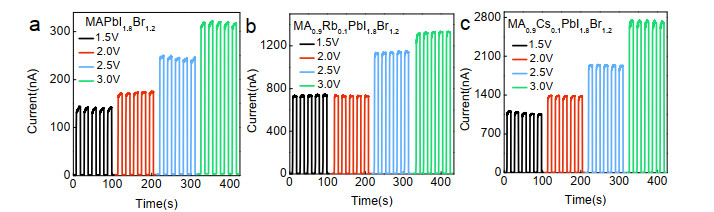
    Transient photo-response is one of the key parameters of optoelectronic devices. To illustrate the transient photo-response of MA1-yXyPbI1.8Br1.2 SCs photo-detectors, we measured the current-time (I-t) curves of the photo-detectors. As shown in Figure 8(a-c), switching cycles illustrate a reproducible photocurrent response with good cycling stability. For MAPbI1.8Br1.2 SC device, the highest on-off ratio is 89 under 1.5 V bias, which is enhanced to 201 (MA0.9Rb0.1PbI1.8Br1.2) and 522 (MA0.9Cs0.1PbI1.8Br1.2), respectively. The enhancement of on-off ratios is considered to be ascribed to the higher photocurrent. In MAPbI1.8Br1.2, halide ions migrate to form more defects in the crystal under illumination and electric field, causing poor optoelectronic performance. While Rb and Cs inhibit ion migration, and improve the light tolerance of MA1-yXyPbI1.8Br1.2 SCs, optical stability, and the optoelectronic performance of the device.

    Figure 8

    Figure 8.  (a-c) Continuous on-off circles under different applied voltages of the photo-detector devices on (100) planes.

    In summary, the contributions of Cs and Rb in MA1-yXyPbI1.8Br1.2 SCs on photo-induced phase segregation and optoelectronic performance are investigated. The introduction of Rb and Cs into the crystal lattice effectively alleviates the photo-induced phase seg-

    regation, inhibits defect formation and improves the optoelectronic performance of devices.

    Chemicals. Methylamine (CH3NH2, 40 wt%) was purchased from Kelon Chemical Reagent Factory. Hydroiodic acid (HI, 47 wt%), lead iodide (PbI2, 98%), and cesium iodide (CsI, 99.9%) were obtained from Macklin. Hydrobromic acid (HBr, 40 wt%), rubidium iodide (RbI, 99.9%), N, N-dimethylformamide (DMF, 99.8%) and γ-butyrolactone (GBL, 99%) and lead bromide (PbBr2, 99%) were commercially available from Aladdin. MAI and MABr were synthesized according to the previous report.[49-50]

    Growth of MAPbI3, MAPbBr3 and MA1-yXyPbI1.8Br1.2 SCs. The equal mole ratio MAI (or MABr) and PbI2 (or PbBr2) were dissolved in 5 mL GBL (or DMF) solvent, and 1 M yellow transparent solution (or the transparent colorless solution) was obtained by continuous stirring at room temperature. After 3-4 days, centimeter-grade MAPbI3 (or MAPbBr3) SCs were obtained at 100 and 60 ℃, as shown in Figure S6(a-b). MA1-yXyPbI1.8Br1.2 SCs can be obtained by dissolving MABr and PbI2 in a solvent mixture of GBL and DMF (volume ratio GBL: DMF = 5:1) in the designed ratio to obtain 0.8 M clear solution. Then, 10% RbI and CsI were added to the solution, the yellow transparent solution was sealed and heated to 60 ℃. Large-scale MA1-yXyPbI1.8Br1.2 SCs can be obtained within 2-5 days as shown in Figure S7(a-c).

    Devices Fabrications. The planar photo-detectors with interdigitated Au electrodes (150 μm interdigital width) were fabricated on the polished (100) crystal facet of MA1-yXyPbI1.8Br1.2 SCs by thermal evaporation (VZZ-300, Vnano), using an interdigitated mask (3×3 mm2) placed on the (100) facet.

    Characterizations. The XRD patterns of MA1-yXyPbI1.8Br1.2 crystal powders were collected on X-ray diffractometer (D/Max 2500 PC, CuKα radiation with wavelength of 0.154 nm). UV-vis absorption spectra of MA1-yXyPbI1.8Br1.2 crystal powders were recorded by UV-8000 spectrophotometer. The in-situ photoluminescence (PL) spectrum was recorded by Ocean Optics QE65000 spectrometer. A series of photocurrents of the planar photo-detectors based on MA1-yXyPbI1.8Br1.2 SCs were obtained by the electrical characteristic measurement system (Keithley 2450) under illumination using 405 nm InGaN-based semiconductor diodes. Besides this, the continuous on/off photocurrents under various applied voltages were harvested through setting the on/off interval time (20 s). All measurements were conducted in a dark space in order to eliminate the effect of light on the experiments.


    ACKNOWLEDGEMENTS: This work was financially supported by the National Natural Science Foundation of China (No. 52072225). The author gratitude the environmental and function material team, supported by the Project of Shandong Province Higher Educational Young Innovative Talent Introduction and Cultivation. The authors declare no competing financial interest.
    COMPETING INTERESTS
    For submission: https://mc03.manuscriptcentral.com/cjsc
    ADDITIONAL INFORMATION
    The descriptions of photographs of MA1-yXyPbI1.8Br1.2 SCs, UV-absorption spectra and transmittance of different thicknesses of MAPbI1.8Br1.2 SCs, stability of MA1-yXyPbI1.8Br1.2 at room temperature, photographs of MA1-yXyPbI1.8Br1.2 powders with light and recovery at different times, XRD patterns of MA1-yXyPbI1.8Br1.2 samples before illumination, after blue-violet light illumination and after recovery, growth of MAPbI3 and MAPbBr3 SCs, and growth process and photographs of thinner MA1-yXyPbI1.8Br1.2 SCs.
    Supplementary information is available for this paper at http://manu30.magtech.com.cn/jghx/EN/10.14102/j.cnki.0254-5861.2022-0089
    ADDITIONAL INFORMATION
    1. [1]

      Liu, N.; Huang, C. Y.; Zhu, L.; Chen, Y.; Xu, G. W.; Chu, L.; Ma, X. G. Organic cation effect on the physical properties of CH3NH3PbI3 perovskite from the first-principles study. Chin. J. Struct. Chem. 2016, 35, 1297-1305.

    2. [2]

      Tao, J. L.; Wang, Z. W.; Wang, H. W.; Shen, J. L.; Liu, X. N.; Xue, J. W.; Guo, H. S.; Fu, G. S.; Kong, W. G.; Yang, S. P. Additive engineering for efficient and stable MAPbI3-perovskite solar cells with an efficiency of over 21%. ACS Appl. Mater. Interfaces 2021, 13, 44451-44459. doi: 10.1021/acsami.1c13136

    3. [3]

      Wang, Y.; Zhu, L. P.; Du, C. F. Polarization-sensitive light sensors based on a bulk perovskite MAPbBr3 single crystal. Materials 2021, 14, 1238. doi: 10.3390/ma14051238

    4. [4]

      Jiang, S.; Wu, C. C.; Li, F.; Zhang, Y. Q.; Zhang, Z. H.; Zhang, Q. H.; Chen, Z. J.; Qu, B.; Xiao, L. X.; Jiang, M. L. Machine learning (ML)-assisted optimization doping of KI in MAPbI3 solar cells. Rare Met. 2020, 40, 1-10.

    5. [5]

      Mao, G. P.; Wang, W.; Shao, S.; Sun, X. J.; Chen, S. A.; Li, M. H.; Li, H. M. Research progress in electron transport layer in perovskite solar cells. Rare Met. 2018, 2, 95-106.

    6. [6]

      Min, H.; Lee, D. Y.; Kim, J.; Kim, G.; Lee, K. S.; Kim, J.; Paik, M. J.; Kim, Y. K.; Kim, K. S.; Kim, M. G.; Shin, T. J.; Seok, S. I. Perovskite solar cells with atomically coherent interlayers on SnO2 electrodes. Nature 2021, 598, 444-450. doi: 10.1038/s41586-021-03964-8

    7. [7]

      Wang, R.; Wang, J. T.; Tan, S.; Duan, Y.; Wang, Z. K.; Yang, Y. Opportunities and challenges of lead-free perovskite optoelectronic devices. Trends Chem. 2019, 1, 368-379. doi: 10.1016/j.trechm.2019.04.004

    8. [8]

      Lee, J. W.; Dai, Z. H.; Han, T. H.; Choi, C.; Chang, S. Y.; Lee, S. J.; Marco, N. D.; Zhao, H. X.; Sun, P. Y.; Huang, Y.; Yang, Y. 2D perovskite stabilized phase-pure formamidinium perovskite solar cells. Nat. Commun. 2018, 9, 3021. doi: 10.1038/s41467-018-05454-4

    9. [9]

      Gu, H.; Chen, C. S.; Zheng, Q. D. Long-term stable 2D Dion-Jacobson phase perovskite photodiode with low dark current and high on/off ratio. Chin. J. Struct. Chem. 2021, 40, 1621-1630.

    10. [10]

      Liu, Y.; Han, S. G.; Wang, J. Q.; Ma, Y.; Guo, W. Q.; Huang, X. Y.; Luo, J. H.; Hong, M. C.; Sun, Z. H. Spacer cation alloying of a homoconformational carboxylate trans isomer to boost in-plane ferroelectricity in a 2D hybrid perovskite. J. Am. Chem. Soc. 2021, 143, 2130-2137. doi: 10.1021/jacs.0c12513

    11. [11]

      Li, M. F.; Han, S. G.; Liu, Y.; Luo, J. H.; Hong, M. C.; Sun, Z. H. Soft perovskite-type antiferroelectric with giant electrocaloric strength near room temperature. J. Am. Chem. Soc. 2020, 142, 20744-20751. doi: 10.1021/jacs.0c09601

    12. [12]

      Li, Y. B.; Yang, T.; Xu, Z. Y.; Liu, X. T.; Huang, X. Y.; Han, S. G.; Liu, Y.; Li, M. F.; Luo, J. H.; Sun, Z. H. Dimensional reduction of Cs2AgBiBr6: a 2D hybrid double perovskite with strong polarization sensitivity. Angew. Chem. Int. Ed. 2020, 59, 3429-3433. doi: 10.1002/anie.201911551

    13. [13]

      Wang, Y. T.; Guan, X. W.; Chen, W. J.; Yang, J.; Hu, L.; Yang, J.; Li, S.; Zadeh, K. K.; Wen, X. M.; Wu, T. Illumination-induced phase segregation and suppressed solubility limit in Br-rich mixed-halide inorganic perovskites. ASC Appl. Mater. Interfaces 2020, 12, 38376-38385. doi: 10.1021/acsami.0c10363

    14. [14]

      Chen, Y. Y.; Gao, C. H.; Yang, T.; Li, W. J.; Xu, H. J.; Sun, Z. H. Research advances of ferroelectric semiconductors of 2D hybrid perovskites toward photoelectronic applications. Chin. J. Struct. Chem. 2022, 41, 2204001-2204011.

    15. [15]

      Fang, Y.; Dong, Q.; Shao, Y.; Yuan, Y.; Huang, J. Highly narrowband perovskite single-crystal photodetectors enabled by surface-charge recombination. Nat. Photonics 2015, 9, 679–686. doi: 10.1038/nphoton.2015.156

    16. [16]

      Shi, W. J.; Wang, Y.; Zhang, T. Y.; Zhang, H. J.; Zhao, Y. X.; Chen, J. Fast charge diffusion in MAPb(I1-xBrx)3 films for high-efficiency solar cells revealed by ultrafast time-resolved reflectivity. J. Phys. Chem. A 2019, 123, 2674-2678. doi: 10.1021/acs.jpca.9b00978

    17. [17]

      Draguta, S.; Sharia, O.; Yoon, S. J.; Brennan, M. C.; Morozov, Y. V.; Manser, J. S.; Kamat, P. V.; Schneider, W. F.; Kuno, M. Rationalizing the light-induced phase segregation of mixed halide organic-inorganic perovskites. Nat. Commun. 2017, 8, 1-8. doi: 10.1038/s41467-016-0009-6

    18. [18]

      Byun, H. R.; Park, D. Y.; Oh, H. M.; Namkoong, G.; Jeong, M. S. Light soaking phenomena in organic-inorganic mixed halide perovskite single crystals. ACS Photonics 2017, 4, 2813-2820. doi: 10.1021/acsphotonics.7b00797

    19. [19]

      Sutter-Fella, C. M.; Ngo, Q. P.; Cefarin, N.; Gardner, K. L.; Tamura, N.; Stan, C. V.; Drisdell, W. S.; Javey, A.; Toma, F. M.; Sharp, I. D. Cation-dependent light-induced halide demixing in hybrid organic-inorganic perovskites. Nano Lett. 2018, 18, 3473-3480. doi: 10.1021/acs.nanolett.8b00541

    20. [20]

      Zhang, S.; Tang, M. C.; Fan, Y. Y.; Li, R. P.; Nguyen, N. V.; Zhao, K.; Anthopoulos, T. D.; Hacker, C. A. Role of alkali-metal cations in electronic structure and halide segregation of hybrid perovskites. ACS Appl. Mater. Interfaces 2020, 12, 34402-34412. doi: 10.1021/acsami.0c08396

    21. [21]

      Wang, K. Y.; Yao, Q.; Zhang, J.; Shang, C. Y.; Li, C. Q.; Chen, F. T.; Zhou, T. L.; Sun, H. Q.; Zhang, W. W.; Zhu, H. L.; Ding, J. X. Short-range migration of A‑site cations inhibit photoinduced phase segregation in FAxMAyCs1-x-yPbI3-zBrz single crystals. J. Phys. Chem. C 2021, 125, 23050-23057. doi: 10.1021/acs.jpcc.1c08346

    22. [22]

      Bischak, C. G.; Wong, A. B.; Lin, E.; Limmer, D. T.; Yang, P. D.; Gins berg, N. S. Tunable polaron distortions control the extent of halide demixing in lead halide perovskites. J. Phys. Chem. Lett. 2018, 9, 3998-4005. doi: 10.1021/acs.jpclett.8b01512

    23. [23]

      Knight, A. J.; Borchert, J.; Oliver, R. D. J.; Patel, J. B.; Radaelli, P. G.; Snaith, H. J.; Johnston, M. B.; Herz, L. M. Halide segregation in mixed-halide perovskites: influence of A-site cations. ACS Energy Lett. 2021, 6, 799-808. doi: 10.1021/acsenergylett.0c02475

    24. [24]

      Doherty, T. A. S.; Winchester, A. J.; Macpherson, S.; Johnstone, D. N.; Pareek, V.; Tennyson, E. M.; Kosar, S.; Kosasih, F. U.; Anaya, M, Abdi-Jalebi, M.; Andaji-Garmaroudi, Z.; Wong, E. L.; Madeo, J.; Chiang, Y. H.; Park, J. S.; Jung, Y. K.; Petoukhoff, C. E.; Divitini, G.; Man, M. K. L.; Ducati, C.; Walsh, A.; Midgley, P. A.; Dani, K. M.; Stranks, S. D. Performance-limiting nanoscale trap clusters at grain junctions in halide perovskites. Nature 2020, 580, 360-366. doi: 10.1038/s41586-020-2184-1

    25. [25]

      Jiang, J.; Sun, X.; Chen, X. C.; Wang, B. W.; Chen, Z. Z.; Hu, Y.; Guo, Y. W.; Zhang, L. F.; Ma, Y.; Gao, L.; Zheng, F. S.; Jin, L.; Chen, M.; Ma, Z. W.; Zhou, Y. Y.; Padture, N. P.; Beach, K.; Terrones, H.; Shi, Y. F.; Gall, D.; Lu, T. M.; Wertz, E.; Feng, J.; Shi, J. Carrier lifetime enhancement in halide perovskite via remote epitaxy. Nat. Commun. 2019, 10, 4145. doi: 10.1038/s41467-019-12056-1

    26. [26]

      Chen, J.; Morrow, D. J.; Fu, Y. P.; Zheng, W. H.; Zhao, Y. Z.; Dang, L. N.; Stolt, M. J.; Kohler, D. D.; Wang, X. X.; Czech, K. J.; Hautzinger, M. P.; Shen, S. H.; Guo, L. J.; Pan, A.; Wright, J. C.; Jin, S. Single-crystal thin films of cesium lead bromide perovskite epitaxially grown on metal oxide perovskite (SrTiO3). J Am. Chemical Soc. 2017, 139, 13525-13532. doi: 10.1021/jacs.7b07506

    27. [27]

      Makarov, S.; Furasova, A.; Tiguntseva, E.; Hemmetter, A.; Berestennikov, A.; Pushkarev, A.; Zakhidov, A.; Kivshar, Y. Halide-perovskite resonant nanophotonics. Adv. Opt. Mater. 2019, 7, 1800784. doi: 10.1002/adom.201800784

    28. [28]

      Xue, J. J.; Wang, R.; Chen, X.; Yao, C. L.; Jin, X. Y.; Wang, K. L.; Huang, W. C.; Huang, T. Y.; Zhao, Y. P.; Zhai, Y. X.; Meng, D.; Tan, S.; Liu, R. Z.; Wang, Z. K.; Zhu, C. H.; Zhu, K.; Beard, M. C.; Yan, Y. F.; Yang, Y. Reconfiguring the band-edge states of photovoltaic perovskites by conjugated organic cations. Science 2021, 371, 636-640. doi: 10.1126/science.abd4860

    29. [29]

      Frost, J. M. Calculating polaron mobility in halide perovskites. Phys. Rev. B: Condens. Matter Mater. Phys. 2017, 96, 195202. doi: 10.1103/PhysRevB.96.195202

    30. [30]

      Tang, X. F.; Berg, M. V. D.; Gu, E.; Horneber, A.; Matt, G. J.; Osvet, A.; Meixner, A. J.; Zhang, D.; Brabec, C. J. Local observation of phase segregation in mixed-halide perovskite. Nano Lett. 2018, 18, 2172-2178. doi: 10.1021/acs.nanolett.8b00505

    31. [31]

      Li, Z.; Zheng, X.; Xiao, X.; An, Y. K.; Wang, Y. B.; Huang, Q. Y.; Li, X.; Cheacharoen, R. R.; An, Q. Y.; Rong, Y. G.; Wang, T.; Xu, H. X. Beyond the phase segregation: probing the irreversible phase reconstruction of mixed-halide perovskites. Adv. Sci. 2021, 2103948.

    32. [32]

      Hu, Y. H.; Hutter, E. M.; Rieder, P.; Grill, I.; Hanisch, J.; Aygüler, M. F.; Hufnagel, A. G.; Handloser, M.; Bein, T.; Hartschuh, A.; Tvingstedt, K.; Dyakonov, V.; Baumann, A.; Savenije, T. J.; Petrus, M. L.; Docampo, P. Understanding the role of cesium and rubidium additives in perovskite solar cells: trap states, charge transport, and recombination. Adv. Energy Mater. 2018, 8, 1703057. doi: 10.1002/aenm.201703057

    33. [33]

      Mattoni, A.; Filippetti, A.; Caddeo, C. Modeling hybrid perovskites by molecular dynamics. J. Phys.: Condens. Matter 2017, 29, 043001. doi: 10.1088/1361-648X/29/4/043001

    34. [34]

      Zheng, K.; Zhu, Q.; Abdellah, M.; Messing, M. E.; Zhang, W.; Generalov, A.; Niu, Y.; Ribaud, L.; Canton, S. E.; Pullerits, T. Exciton binding energy and the nature of emissive states in organometal halide perovskites. J. Phys. Chem. Lett. 2015, 6, 2969-2975. doi: 10.1021/acs.jpclett.5b01252

    35. [35]

      Damle, V. H.; Gouda, L.; Tirosh, S.; Tischler, Y. R. Structural characterization and room temperature low-frequency Raman scattering from MAPbI3 halide perovskite films rigidized by cesium incorporation. ACS Appl. Energy Mater. 2018, 1, 6707-6713. doi: 10.1021/acsaem.8b01539

    36. [36]

      Cheng, X. H.; Yuan, Y.; Jing, L.; Zhou, T. L.; Li, Z. X.; Peng, Z. W.; Yao, Q.; Zhang, J.; Ding, J. X. Nucleation-controlled growth of superior long oriented CsPbBr3 microrod single crystals for high detectivity photodetectors. J. Mater. Chem. C 2019, 7, 14188. doi: 10.1039/C9TC05333F

    37. [37]

      Wang, Y. C.; Zhang, Y. M.; Liu, Y. T.; Pang, T. Q.; Hu, Z. Y.; Zhu, Y. J.; Luan, S. Z.; Jia, R. X. Temperature-dependence studies of organolead halide perovskite-based metal/semiconductor/metal photodetectors. RSC Adv. 2017, 7, 20206-20211. doi: 10.1039/C7RA01496A

    38. [38]

      Park, I. J.; Seo, S.; Park, M. A.; Lee, S.; Kim, D. H.; Zhu, K.; Shin, H.; Kim, J. Y. Effect of rubidium incorporation on the structural, electrical, and photovoltaic properties of methylammonium lead iodide-based perovskite solar cells. ACS Appl. Mater. Interfaces 2017, 9, 41898-41905. doi: 10.1021/acsami.7b13947

    39. [39]

      Du, S. J.; Jing, L.; Cheng, X. H.; Yuan, Y.; Ding, J. X.; Zhou, T. L.; Zhan, X. Y.; Cui, H. Z. Incorporation of cesium ions into MA1-xCsxPbI3 single crystals: crystal growth, enhancement of stability, and optoelectronic properties. J. Phys. Chem. Lett. 2018, 9, 5833-5839. doi: 10.1021/acs.jpclett.8b02390

    40. [40]

      Ding, J. X.; Du, S. J.; Zhou, T. L.; Yuan, Y.; Cheng, X. H.; Jing, L.; Yao, Q.; Zhang, J.; He, Q. K.; Cui, H. Z.; Zhan, X. Y.; Sun, H. Q. Cesium decreases defect density and enhances optoelectronic properties of mixed MA1-xCsxPbBr3 single crystal. J. Phys. Chem. C 2019, 123, 14969-14975. doi: 10.1021/acs.jpcc.9b03987

    41. [41]

      Qiao, S.; Liu, Y.; Liu, J. H.; Fu, G. S.; Wang, S. F. High-responsivity, fast, and self-powered narrowband perovskite heterojunction photodetectors with a tunable response range in the visible and near-infrared region. ACS Appl. Mater. Interfaces 2021, 13, 34625-34636. doi: 10.1021/acsami.1c09642

    42. [42]

      Subramanian, A.; Akram, J.; Hussain, S.; Chen, J.; Qasim, K.; Lei, W. High-performance photodetector based on a graphene quantum dot/CH3NH3PbI3 perovskite hybrid. ACS Appl. Electron. Mater. 2020, 2, 230-237. doi: 10.1021/acsaelm.9b00705

    43. [43]

      Nguyen, T. M. H.; Lee, S. K.; Kim, S.; Bark, C. W. Practical demonstration of deep-ultraviolet detection with wearable and self-powered halide perovskite-based photodetector. ACS Appl. Mater. Interfaces 2021, 13, 57609-57618. doi: 10.1021/acsami.1c18099

    44. [44]

      Maculan, G.; Sheikh, A. D.; Abdelhady, A. L.; Saidaminov, M. I.; Haque, M. A.; Murali, B.; Alarousu, E.; Mohammed, O. F.; Wu, T.; Bakr, O. M. CH3NH3PbCl3 single crystals: inverse temperature crystallization and visible-blind UV-photodetector. J. Phys. Chem. Lett. 2015, 6, 3781-3786. doi: 10.1021/acs.jpclett.5b01666

    45. [45]

      Maity, A.; Raychaudhuri, A. K.; Ghosh, B. Paper-based stable broad optical detector made from cation organic perovskite halides. J. Phys. Chem. C 2021, 125, 10646-10652. doi: 10.1021/acs.jpcc.1c01252

    46. [46]

      Li, J. B.; Shen, Y. L.; Liu, Y. C.; Shi, F.; Ren, X. D.; Niu, T. Q.; Zhao, K.; Liu, S. Z. Stable high-performance flexible photodetector based on upconversion nanoparticles/perovskite microarrays composite. ACS Appl. Mater. Interfaces 2017, 9, 19176-19183. doi: 10.1021/acsami.7b03229

    47. [47]

      Ding, J. X.; Jing, L.; Cheng, X. H.; Zhao, Y.; Du, S. J.; Zhan, X. Y.; Cui, H. Z. Design growth of MAPbI3 single crystal with (220) facets exposed and its superior optoelectronic properties. J. Phys. Chem. Lett. 2018, 9, 216-221. doi: 10.1021/acs.jpclett.7b03020

    48. [48]

      Zuo, Z. Y.; Ding, J. X.; Zhao, Y.; Du, S. J.; Li, Y. F.; Zhan, X. Y.; Cui, H. Z. Enhanced optoelectronic performance on the (110) lattice plane of an MAPbBr3 single crystal. J. Phys. Chem. Lett. 2017, 8, 684-689. doi: 10.1021/acs.jpclett.6b02812

    49. [49]

      Ding, J. X.; Du, S. J.; Cheng, X. H.; Jing, L.; Zhao, Y.; Zuo, Z. Y.; Cui, H. Z.; Zhan, X. Y. Anisotropic optoelectronic performances on (112) and (100) lattice plane of perovskite MAPbI3 single crystal. Mater. Chem. Phys. 2018, 204, 222-227. doi: 10.1016/j.matchemphys.2017.10.052

    50. [50]

      Wang, K. Y.; Yao, Q.; Zhang, J.; Jing, L.; Cheng, X. H.; Shang, C. Y.; Li, C. Q.; Chen, F. T.; Zhou, T. L.; Zhu, H. L.; Li, T. X.; Li, H. P.; Wang, Z. W.; Ding, J. X. How ternary cations and binary halogens stabilize trigonal FA1-x-yMAxCsyPbI3-zBrz perovskites: from a single crystal perspective. Chem. Mater. 2022, 34, 1179-1190. doi: 10.1021/acs.chemmater.1c03710


  • Figure 1  (a) Photographs of MAPbI1.8Br1.2, MA0.9Rb0.1PbI1.8Br1.2 and MA0.9Cs0.1PbI1.8Br1.2 SCs; (b-c) XRD patterns and enlarged XRD patterns of MAPbI3, MAPbBr3 and MA1-yXyPbI1.8Br1.2 powders; (d-f) Element distribution of MAPbI1.8Br1.2, MA0.9Rb0.1PbI1.8Br1.2 and MA0.9Cs0.1PbI1.8Br1.2 SCs, respectively.

    Figure 2  Optical performance of MA1-yXyPbI1.8Br1.2 crystals: (a) UV-vis absorption, (b) Optical band gaps, (c) Steady-state PL spectra.

    Figure 3  (a-c) UV-vis absorption of MA1-yXyPbI1.8Br1.2 before and after light illumination and after recovery.

    Figure 4  (a) Schematic of relevant kinetic processes during halide phase segregation; (b-d) PL spectra of MA1-yXyPbI1.8Br1.2, recorded under a wavelength of 445 nm.

    Figure 5  (a-c) PL spectra of fresh, soaking, and recovered MA1-yXyPbI1.8Br1.2, recorded under a wavelength of 445 nm; (d-f) XRD patterns of MA1-yXyPbI1.8Br1.2 before and after illumination intensity of 6 mW·cm−2 and a wavelength of 365 nm.

    Figure 6  Schematic diagram of Rb and Cs inhibit phase segregation: (a) MAPbI1.8Br1.2 lattice; (b) MA1-yXyPbI1.8Br1.2 lattice; (c-d) Formation of Br- or I-rich regions in MAPbI1.8Br1.2 crystals.

    Figure 7  Optoelectronic properties of photo-detectors based MA1-yXyPbI1.8Br1.2 SCs: (a-c) Photocurrent; (d-f) Responsivities and EQEs; (g-i) Detectivities.

    Figure 8  (a-c) Continuous on-off circles under different applied voltages of the photo-detector devices on (100) planes.

    Table 1.  Key Parameters of Others Halide Perovskite Photo-detectors

    Devices Light (nm) Responsivity (A·W-1) EQE (%) D (Jones) On-off ratio Refs.
    MA0.9Cs0.1PbI1.8Br1.2 SC 405 0.170 51.39 4.42 × 10¹² 522 This work
    MAPb(I1-xBrx)3 films 532-808 0.331 50.3 4.27 × 10¹⁰ [41]
    CH3NH3PbI3 film 405 12 6.5 × 10¹¹ [42]
    (FAPbI3)1–x(MAPbBr3)x films 254 0.15 25 7.21 × 10¹⁰ 337.14 [43]
    MAPbCl3 SC 365 0.047 1.2 × 10¹⁰ 1.1×10³ [44]
    MA0.6FA0.4PbI3 film 775 0.27 1.49 × 10¹² [45]
    MAPbI3/UCns film 0.27 46 0.76 × 10¹² 103 [46]
    MAPbI3 SC 405 0.019 6.55 1.0 × 10¹¹ 17 [47]
    MAPbBr3 SC 405 0.038 0.113 55 [48]
    下载: 导出CSV
  • 加载中
计量
  • PDF下载量:  2
  • 文章访问数:  1836
  • HTML全文浏览量:  79
文章相关
  • 发布日期:  2022-05-20
  • 收稿日期:  2022-04-18
  • 接受日期:  2022-05-07
通讯作者: 陈斌, bchen63@163.com
  • 1. 

    沈阳化工大学材料科学与工程学院 沈阳 110142

  1. 本站搜索
  2. 百度学术搜索
  3. 万方数据库搜索
  4. CNKI搜索

/

返回文章