
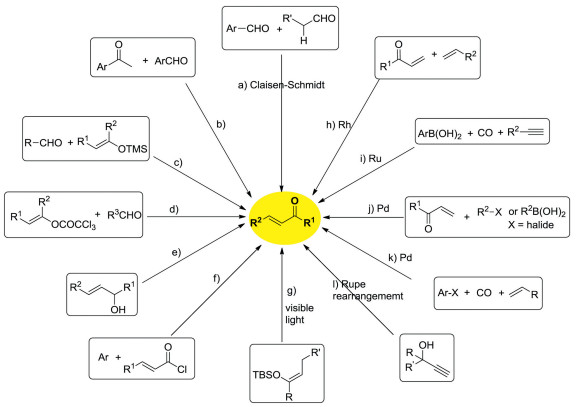
Scheme 1.
Synthesis of α, β-unsaturated ketones.


α, β-Unsaturated ketones are key reagents and can be widely used in organic transformations [1, 2]. They can be employed in a variety of transformations such as epoxidation [3-5], Morita-Baylis-Hillman reaction [6-8], Michael addition [9-13], and hydrogenation [14-19]. Due to their significant importance in organic synthesis, various methods for the synthesis of α, β-unsaturated ketones have been developed (Scheme 1). The most common way is Claisen-Schmidt condensation of ketones with aldehydes in the presence of base (Scheme 1a) [20]. Condensation of aldehydes with acetophenones is also a concise route to chalcones (Scheme 1b) [21]. Mukaiyama aldol reaction with the subsequent Lewis acid-catalyzed dehydration (Scheme 1c) [22] and catalytic aldol condensation of aldehyde with trichloroacetates (Scheme 1d) [23] can also give rise to α, β-unsaturated ketones. Additionally, oxidation of allylic alcohols (Scheme 1e) [24] and Friedel-Crafts acylation of arenes from α, β-unsaturated acyl chlorides (Scheme 1f) [25] can generate stereodefined α, β-unsaturated ketones. Moreover, photoinduced reactions under visible light irradiation have been applied for the preparation of α, β-unsaturated ketones as well (Scheme 1g) [26]. Transition-metal-catalyzed approaches including rhodium-catalyzed carbonylative addition of arylboronic acids to terminal alkynes (Scheme 1h) [27], ruthenium-catalyzed cross-metathesis of terminal alkenes with vinyl ketones (Scheme 1i) [28], palladium-catalyzed Heck-type coupling of vinyl ketone derivatives with arylboronic acids or iodoarenes (Scheme 1j) [29, 30], palladium-catalyzed carbonylative Heck reaction of aryl triflates or aryl halides with styrenes (Scheme 1k) [31] and Rupe rearrangement (Scheme 1l) [32], are also regarded as a powerful tool for the generation of α, β-unsaturated ketones.
Although continuous efforts have been given to the synthesis of α, β-unsaturated ketones, complementary methods are still highly desirable due to the substrates tolerance and functional groups compatibility in transformations. Acylation of 1-alkenylsilanes is an alternative and concise way for the preparation of α, β-unsaturated ketones, especially in the outcomes for regioselectivity and stereoselectivity. However, this method usually required the use of more than a stoichiometric amount of Lewis acid such as AlCl3 [33], which limited its further application. Therefore, developing catalytic process for the acylation of 1-alkenylsilanes is of significant importance. In 2004, Narasaka's group developed the first example of rhodium-catalyzed acylation of 1-alkenylsilanes with acid anhydrides [34]. Subsequently, further development of this powerful method was disclosed by Wagner, Pawluć and Gu. Additionally, this approach is applied to the asymmetric synthesis of atropisomers possessing silanol groups with excellent enantioselectivity. Since the catalytic synthesis of α, β-unsaturated ketones from the acylation of 1-alkenylsilanes and acid anhydrides is promising, recent advances in the desilylative acylation of 1-alkenylsilanes with acid anhydrides under transition metal catalysis is summarized (Scheme 2).

In 2004, Narasaka's group developed the first catalytic process to synthesize α, β-unsaturated ketones from 1-alkenylsilanes and acid anhydrides by using rhodium as the catalyst [34].β-Alkyl vinysilanes with phenyl and methyl substitutions were well tolerated, affording the corresponding carbonyl compounds in good yields. Additionally, a variety of acid anhydrides, such as acetic, propionic, and isobutyric anhydrides were compatible under the conditions, providing the desired ketones in moderate to good yields. Moreover, α-acyloxy vinylsilane could participate in this reaction well. A plausible mechanism was proposed, as shown in Scheme 3. It was reasoned that intermediate 6 would be generated from 1-alkenylsilane 1 and rhodium catalyst 4, which would subsequently undergo oxidative addition with acid anhydride 2 to afford rhodium species 7. Further reductive elimination of intermediate 7 would occur, leading to α, β-unsaturated ketone 3. A control experiment showed that no reaction took place when a stoichiometric amount of rhodium salt 4 reacted with acetic anhydride at 80℃, indicating that the reaction was initiated by the transmetallation from 1-alkenylsilane 1 and rhodium catalyst 4. Since the transmetallation occurred selectively between rhodium catalyst and 1-alkenylsilane, α, β-unsaturated ketones would be afforded regioselectively and the stereoselectivity was remained.
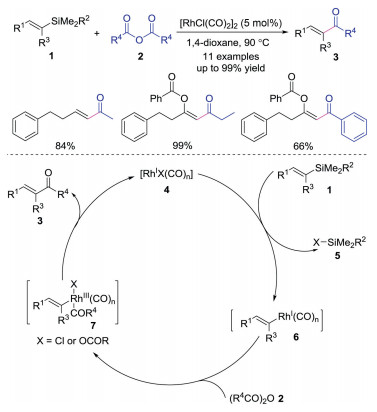
Later, Narasaka and co-workers reported a full account of this Rh-catalyzed acylation reaction from 1-alkenylsilanes and acid anhydrides, and described the synthetic method for the generation of α-diketones, α-acyloxy enones and their derivatives in details (Scheme 4) [35].

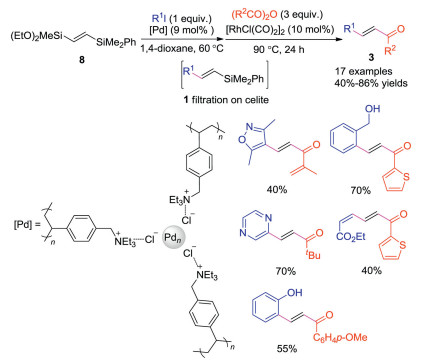
In 2009, Wagner's group developed a sequential Hiyama coupling/Narasaka acylation reaction of (E)-1, 2-disilylethene to produce α, β-unsaturated ketones (Scheme 5) [36]. In this transformation, (E)-1, 2-disilylethene underwent Hiyama coupling in the presence of ionic gel palladium catalyst leading to 1-alkenylsilanes, which were employed in the subsequent Narasaka acylation reaction after simple filtration on celite. α, β-Unsaturated ketones could be rapidly assembled through this sequential reaction. Additionally, α, β-unsaturated ketones bearing isoxazole moiety and substituted chalcone skeletons could be provided in moderate to good yields.
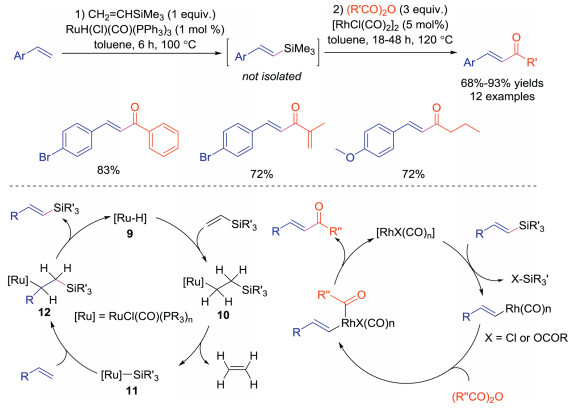
A highly stereoselective one-pot synthesis of (E)-α, β-unsaturated ketones through sequential ruthenium-catalyzed silylative coupling and rhodium-catalyzed desilylative acylation was described by Pawluć and co-workers in 2011 [37]. Diverse α, β-unsaturated ketones possessing various functional groups were produced in moderate to good yields from simple and inexpensive starting materials such as styrenes, vinylsilanes and carboxylic acid anhydrides. A cascade Ru/Rh catalyzed cycle was proposed for this reaction, as shown in Scheme 6. Initially, the addition between ruthenium catalyst 9 and vinylsilane would generate ruthenium species 10, which subsequently underwent reductive elimination to provide intermediate 11 and ethylene. Then, another addition between intermediate 11 and styrene would occur, leading to 1-alkenylsilane 1 for the next cycle. The procedure for generating α, β-unsaturated ketones was similar to that in Scheme 3. This method provided a more reactive way for trimethylsilyl-substituted styrenes. In 2012, the same group reported a similar transformation to synthesize (E)-β-silyl-α, β-unsaturated ketones (Scheme 7) [38].
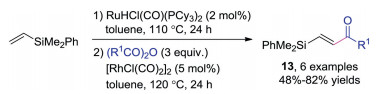
In 2015, Pawluć and co-workers further developed the synthesis of 1, 3-butadiene 14 from vinylsilane via ruthenium catalysis (Scheme 8) [39]. The generated 1, 3-butadiene 14 could react with acid anhydride under rhodium catalysis to produce α, β-unsaturated ketone 15 in 70% yield.

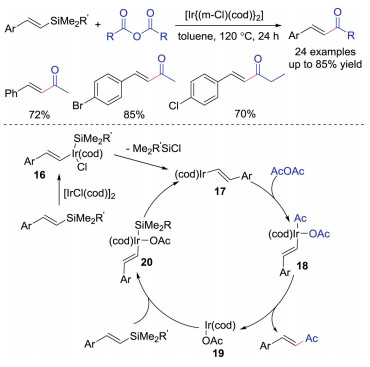
In the above studies, the desilylative acylation reaction of vinylsilanes was catalyzed by rhodium catalysts. In 2017, Pawluć's group discovered that iridium complex could promote the desilylative acylation reaction smoothly, affording the corresponding α, β-unsaturated ketones in 58%–85% yields. This report was slightly better in most cases than Rh catalysts, although a higher temperature was required [40]. A similar mechanism was proposed with Rh catalysis cycle, as shown in Scheme 9. It was reasoned that Ir species would react with vinylsilane to afford Ir species 16, which subsequently underwent reductive elimination to provide intermediate 17. Then, oxidative addition of intermediate 17 with acid anhydride would occur, giving rise to Ir species 18. Further reductive elimination would take place to provide the final product.
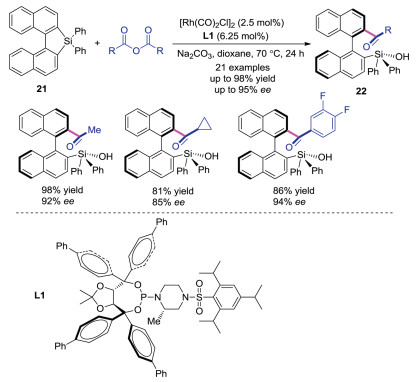
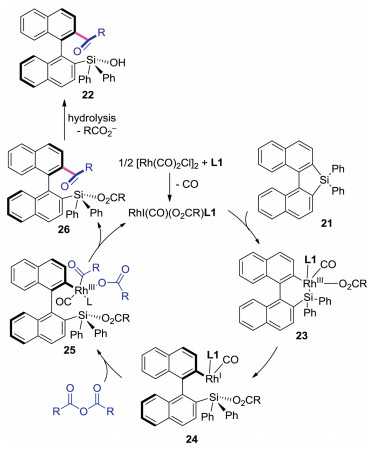
Atropisomers play an important role in natural products, drugs and chiral catalysts. However, the catalytic synthesis of atropisomers possessing silanol groups is quite challenging. In 2020, Gu and co-workers developed a rhodium-catalyzed asymmetric ring-opening reaction to synthesize α-silyl biaryl atropisomers (Scheme 10) [41]. The reaction was promoted by torsional strain, and the stereochemistry was controlled by a phosphoramidite ligand L1. Diverse α-silyl biaryl atropisomers containing various groups were prepared in good yields with excellent enantioselectivity. A plausible mechanism was shown in Scheme 11. The interaction between rhodium catalyst and L1 would afford another active rhodium species, which would react with substrate 21 leading to intermediate 23. Next, the Rh-Si bond of intermediate 23 would undergo cleavage to produce intermediate 24. Subsequently, oxidation addition between intermediate 24 and acid anhydride would take place, giving rise to intermediate 25. Further reductive elimination of intermediate 25 and subsequent hydrolysis would afford the final product.
In conclusion, recent advances in the desilylative acylation of 1-alkenylsilanes with acid anhydrides under transition metal catalysis is summarized. Since the first report by Narasaka in 2004 describing the rhodium-catalyzed acylation of 1-alkenylsilanes with acid anhydrides [19], continuous efforts have been made for the development of this powerful method. This catalytic desilylative acylation of 1-alkenylsilanes provides an efficient route to α, β-unsaturated ketones, which can be catalyzed by either rhodium or iridium. Moreover, various one pot sequence reactions have been developed, which can synthesize α, β-unsaturated ketones from simple starting materials in an economic way. Additionally, this approach is applied to the asymmetric synthesis of atropisomers possessing silanol groups with excellent enantioselectivity.
Although the strategy for the synthesis of α, β-unsaturated ketones via desilylative acylation of 1-alkenylsilanes has been studied, there are still some issues to be solved. In this reaction, an equivalent amount of silane compounds is produced, which is wasteful during the reaction process. Additionally, this approach can be only utilized to synthesize α, β-unsaturated ketones or aryl ketones, preparation of more unsaturated ketones with functional groups diversity and excellent stereoselectivity is anticipated by using this method.
The authors declare that they have no known competing financial interests or personal relationships that could have appeared to influence the work reported in this paper.
Financial support from National Natural Science Foundation of China (No 21871053), the Leading Innovative and Entrepreneur Team Introduction Program of Zhejiang (No. 2019R01005), and the Open Research Fund of School of Chemistry and Chemical Engineering, Henan Normal University (No. 2020ZD04) is gratefully acknowledged.
A.K. Bagdi, P. Pattanayak, S. Paul, et al., Adv. Syn. Catal. 362 (2020) 5601-5621 doi: 10.1002/adsc.202000970
B. Chaudhary, N. Kulkarni, N. Saiyed, et al., Adv. Syn. Catal. 362 (2020) 4794-4819 doi: 10.1002/adsc.202001018
Y. Wu, G. Zhou, Q. Meng, et al., J. Org. Chem. 83 (2018) 13051-13062 doi: 10.1021/acs.joc.8b01710
Y. Li, Y. Zhang, H.Y. Zhang, Y.P. Han, J. Zhao, Asian J. Org. Chem. 9 (2020) 616-621 doi: 10.1002/ajoc.202000070
M. Majdecki, A. Tyszka-Gumkowska, J. Jurczak, Org. Lett. 22 (2020) 8687-8691 doi: 10.1021/acs.orglett.0c03272
S. Cihalova, P. Dziedzic, A. Cordova, J. Vesely, Adv. Syn. Catal. 353 (2011) 1096-1108 doi: 10.1002/adsc.201000951
Y.Q. Li, H.J. Wang, Z.Z. Huang, J. Org. Chem. 81 (2016) 4429-4433 doi: 10.1021/acs.joc.6b00684
Y. Li, Z. Huang, Acta Chim. Sin. 75 (2017) 280-283 doi: 10.6023/A16110587
T. Cong, H. Wang, Y. Liu, H. Wu, J. Zhang, Chin. J. Org. Chem. 39 (2019) 2157-2165 doi: 10.6023/cjoc201906005
R. Arai, S. i. Hirashima, T. Nakano, et al., J. Org. Chem. 85 (2020) 3872-3878 doi: 10.1021/acs.joc.9b02553
T. Hong, Z. Zhang, Y. Sun, et al., J. Am. Chem. Soc. 142 (2020) 10244-10249 doi: 10.1021/jacs.0c01563
Z. Wu, X.X. Feng, Q.D. Wang, et al., Chin. Chem. Lett. 31 (2020) 1297-1300 doi: 10.1016/j.cclet.2019.09.017
X. Xu, Y. He, J. Zhou, et al., J. Org. Chem. 85 (2020) 574-584 doi: 10.1021/acs.joc.9b02676
A.H. Aboo, R. Begum, L. Zhao, Z.H. Farooqi, J. Xiao, Chin. J. Catal. 40 (2019) 1795-1799 doi: 10.1016/S1872-2067(19)63367-X
P. Chen, W. Li, Y. Wang, Catal. Commun. 125 (2019) 10-14 doi: 10.1016/j.catcom.2019.03.008
J. Li, Y. Lu, Y. Zhu, et al., Org. Lett. 21 (2019) 4331-4335 doi: 10.1021/acs.orglett.9b01514
Z. Csaszar, E.Z. Szabo, A.C. Benyei, J. Bakos, G. Farkas, Catal. Commun. 146 (2020) 106128. doi: 10.1016/j.catcom.2020.106128
T.H. Hall, H. Adams, V.K. Vyas, K.L.M. Chu, M. Wills, Tetrahedron 77 (2021) 131771. doi: 10.1016/j.tet.2020.131771
G. Liu, C. Yin, X. Yang, et al., Org. Lett. 23 (2021) 19-24 doi: 10.1021/acs.orglett.0c03517
B.M. Trost, I. Fleming, Comprehensive Organic Synthesis, 2nd Ed., Pergamon Press, Oxford, 1991, pp. 133–179.
K. Sathiyamoorthi, V. Mala, S.P. Sakthinathan, et al., Spectrochim, Acta Part A: Mol. Biomol. Spectrosc. 112 (2013) 245-256 doi: 10.1016/j.saa.2013.04.048
K. Ishihara, H. Kurihara, H. Yamamoto, Synlett 5 (1997) 597–599
A. Yanagisawa, R. Goudu, T. Arai, Org. Lett. 6 (2004) 4281–4283 doi: 10.1021/ol0482700
M. Shibuya, S. Ito, M. Takahashi, Y. Iwabuchi, Org. Lett. 6 (2004) 4303–4306 doi: 10.1021/ol048210u
W. Yin, Y. Ma, J. Xu, Y. Zhao, J. Org. Chem. 71 (2006) 4312–4315 doi: 10.1021/jo060022p
J. Zhang, L. Wang, Q. Liu, Z. Yang, Y. Huang, Chem. Commun. 49 (2013) 11662–11664 doi: 10.1039/c3cc46778c
A.K. Chatterjee, F.D. Toste, T.L. Choi, R.H. Grubbs, Adv. Synth. Catal. 344 (2002) 634–637 doi: 10.1002/1615-4169(200208)344:6/7<634::AID-ADSC634>3.0.CO;2-K
J. Dheur, M. Sauthier, Y. Castanet, A. Mortreux, Adv. Synth. Catal. 349 (2007) 2499–2506 doi: 10.1002/adsc.200700141
A. Bianco, C. Cavarischia, M. Guiso, Eur. J. Org. Chem. 2004 (2004) 2894–2898; doi: 10.1002/ejoc.200400032
K.S. Yoo, C.H. Yoon, K.W. Jung, J. Am. Chem. Soc. 128 (2006) 16384–16399 doi: 10.1021/ja063710z
X.F. Wu, H. Neumann, A. Spannenberg, et al., J. Am. Chem. Soc. 132 (2010) 14596–14602 doi: 10.1021/ja1059922
V. Cadierno, S.E. García-Garrido, J. Gimeno, Adv. Synth. Catal. 348 (2006) 101–110 doi: 10.1002/adsc.200505294
W.E. Fristad, D.S. Dime, T.R. Bailey, L.A. Paquette, Tetrahedron Lett. 20 (1979) 1999-2002 doi: 10.1016/S0040-4039(01)86247-X
M. Yamane, K. Uera, K. Narasaka, Chem. Lett. 33 (2004) 424-425 doi: 10.1246/cl.2004.424
M. Yamane, K. Uera, K. Narasaka, Bull. Chem. Soc. Jpn., 78 (2005) 477-486 doi: 10.1246/bcsj.78.477
C. Thiot, C. Mioskowski, A. Wagner, Eur. J. Org. Chem. 2009 (2009) 3219-3227
P. Pawluc, J. Szudkowska, G. Hreczycho, B. Marciniec, J. Org. Chem. 76 (2011) 6438-6441 doi: 10.1021/jo201036x
P. Pawluc, Catal. Commun. 23 (2012) 10-13 doi: 10.1016/j.catcom.2012.03.004
J. Szudkowska-Fratczak, B. Marciniec, G. Hreczycho, M. Kubicki, P. Pawluc, Org. Lett. 17 (2015) 2366-2369 doi: 10.1021/acs.orglett.5b00865
M. Zaranek, M. Skrodzki, J. Szudkowska-Fratczak, et al., J. Mol. Catal. Chem. 426 (2017) 75-78 doi: 10.1016/j.molcata.2016.10.035
J. Feng, X. Bi, X. Xue, et al., Nat. Commun. 11 (2020) 1-12

Scheme 3 Rh-catalyzed synthesis of α, β-unsaturated ketones from vinylsilanes and acid anhydrides.

Scheme 7 Ruthenium-catalyzed desilylative acylation reaction for the synthesis of (E)-β-silyl-α, β-unsaturated ketones.

 扫一扫看文章


扫一扫关注我们
 DownLoad:

 下载:


