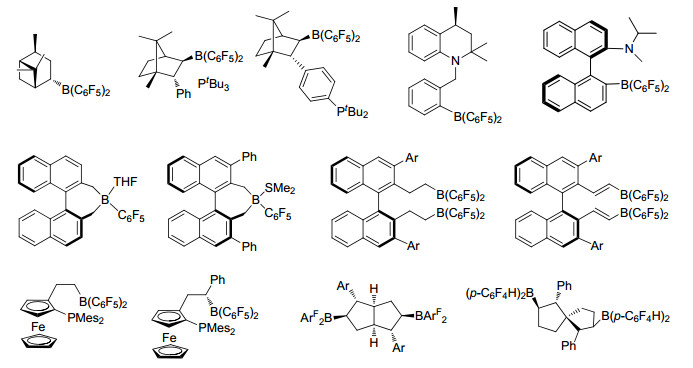
Figure 1.
Representative chiral FLP catalysts


In 2006, Stephan and co-workers[1] reported their seminal work on the reversible activation of H2 with sterically hindered Lewis acid and base pairs, which rapidly opened up a famous field as the chemistry of frustrated Lewis pairs (FLPs). In the past decade, the FLP-catalyzed metal-free hydrogenation and Piers-type hydrosilylation have achieved a great success.[2] However, in contrast, the development of asymmetric reactions with chiral FLPs is still sluggish.[3] Only a very few FLP catalysts can give satisfactory enantioselectivities.[4, 5] The difficulty to access highly efficient chiral FLPs with suitable backbones and diverse structures seems to be the major obstacle in this field. At present, two protocols have been developed for the synthesis of chiral boron Lewis acids. One is hydroboration of chiral alkenes with Piers' borane HB(C6F5)2, [6] and the other is substitution of boron chlorides with chiral organometallic reagents.[4] As shown in Figure 1, the chiral frameworks of reported FLPs usually include bicycle, [5b, 5c, 5e] C2-symmetric binaphthyl, [4b~4f] and ferrocene.[5d] Recently, we have developed a novel strategy for the in situ synthesis of chiral boranes by the hydroboration of binaphthyl-based chiral dienes with HB(C6F5)2.[7] Very recently, Wang et al.[8] reported chiral C2-symmetric bicyclic [3.3.0] and spiro-bicyclic diboranes. Generally, the chiral frameworks are very likely to influence the reactivity and enantioselectivity largely. Further developing chiral FLPs bearing novel backbones is therefore of great importance.
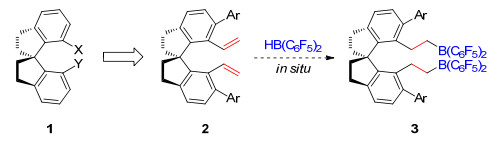
Spiro chirality has attracted considerable attention for the design of chiral ligands and catalysts, and numerous excellent chiral ligands and catalysts have already been successfully developed.[9] It is noteworthy that C2-symmetric 1, 1'-spirobiindane 1 has proven to be one of privileged frameworks.[10] On the basis of our previous work, we wish to further devote our efforts on the development of novel chiral dienes 2 bearing 1, 1'-spirobiindane frameworks (Scheme 1). The corresponding chiral boranes 3 can be easily accessed via the in situ hydroboration with HB(C6F5)2, which can be utilized in the FLP-catalyzed asymmetric reactions.
Piers-type hydrosilylation has received intensive attention due to its synthetic and mechanistic interests.[11] Despite some important advances, the asymmetric Piers-type hydrosilylation is far less developed in the past two decades.[2i] Especially for ketone substrates, very few examples can afford high enantioselectivities.[12] In 2016, our group reported an asymmetric hydrosilylation of 1, 2-dicarbonyl compounds using chiral diyne-derived alkenylborane and tricyclohexylphosphine to give up to 99% ee.[7d] Oestreich and co-workers[4d] employed the binaphthyl-based chiral borane to realize the asymmetric hydrosilylation of simple ketones with up to 99% ee. Herein, we report our preliminary results on the synthesis of chiral spiro boranes and their application in the asymmetric Piers-type hydrosilylation of simple ketones.
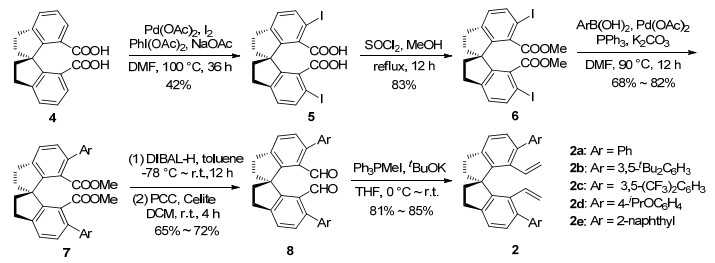
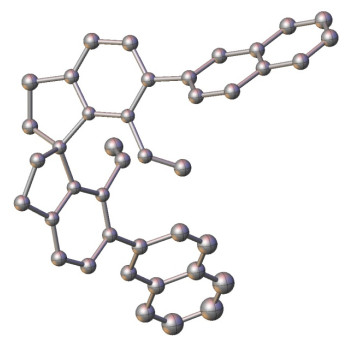
The synthesis of chiral spiro dienes 2 with chiral dicarboxylic acid 4[13] as starting material was shown in Scheme 2. A Pd-catalyzed directed ortho-C—H iodination of compound 4 gave diiodide 5 in 42% yield.[14] Further treating diiodide 5 with thionyl dichloride in methanol furnished the corresponding ester 6 in 83% yield. Various aryl substituents can be easily incorporated by Suzuki coupling reactions to afford compounds 7 in moderate to good yields. A sequence DIBAL-H reduction and PCC oxidation gave dialdehydes 8 in reasonable yields. Followed by a Wittig-reaction, chiral dienes 2a~2e were obtained in 81%~85% yields. A single crystal of chiral diene 2e was obtained, and its structure was confirmed by X-ray crystallographic analysis (Figure 2).[15]
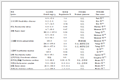
With novel chiral dienes 2 in hand, the asymmetric Piers-type hydrosilylation of acetophenone (9a) with PhMe2SiH was next investigated. As shown in Table 1, using chiral boranes generated in situ from dienes 2a~2e (5 mol%) and HB(C6F5)2 (10 mol%) in the presence of tBu3P (10 mol%) as a Lewis base, all the reactions proceeded smoothly to give alcohol 10a in high conversions with low to moderate ee's (Entries 1~5). Chiral diene 2b containing 3, 5-di-tert-butylphenyl substituents gave the optimal enantioselectivity (Table 1, Entry 2). Lewis base components were found to have a large impact on the enantioselectivities (Table 1, Entries 2 vs 6~8). Without Lewis base, a much lower ee was obtained (Table 1, Entries 3 vs 9). Various silanes were subsequently studied, and Ph2SiH2 gave a promising 80% ee (Table 1, Entries 2, 10~13). Reducing the catalyst loading from 10 mol% to 5 mol% only resulted in a slight loss of ee (Table 1, Entries 11 vs 14). Several solvents were also examined, and toluene proved to be a more suitable solvent (Table 1, Entries 14~17).
 下载:
导出CSV
下载:
导出CSV
 |
||||||
| Entry | Chiral diene 2 | Phosphine | Silane | Solvent | Conv./% | ee/% |
| 1 | 2a | tBu3P | PhMe2SiH | Toluene | 95 | 40 |
| 2 | 2b | tBu3P | PhMe2SiH | Toluene | > 99 | 56 |
| 3 | 2c | tBu3P | PhMe2SiH | Toluene | 94 | 34 |
| 4 | 2d | tBu3P | PhMe2SiH | Toluene | 94 | 43 |
| 5 | 2e | tBu3P | PhMe2SiH | Toluene | 93 | 35 |
| 6 | 2b | Cy3P | PhMe2SiH | Toluene | 71 | 0 |
| 7 | 2b | Mes3P | PhMe2SiH | Toluene | 73 | 17 |
| 8 | 2b | (C6F5)Ph2P | PhMe2SiH | Toluene | 96 | 0 |
| 9 | 2c | — | PhMe2SiH | Toluene | 91 | 23 |
| 10 | 2b | tBu3P | Et3SiH | Toluene | 59 | 47 |
| 11 | 2b | tBu3P | Ph2SiH2 | Toluene | > 99 | 80 |
| 12 | 2b | tBu3P | PhSiH3 | Toluene | > 99 | 44 |
| 13 | 2b | tBu3P | Ph3SiH | Toluene | 95 | 7 |
| 14e | 2b | tBu3P | Ph2SiH2 | Toluene | > 99 | 79 |
| 15e | 2b | tBu3P | Ph2SiH2 | Hexane | > 99 | 42 |
| 16e | 2b | tBu3P | Ph2SiH2 | THF | > 99 | 0 |
| 17e | 2b | tBu3P | Ph2SiH2 | DCM | 88 | 46 |
| a All reactions were carried out with acetophenone (0.1 mmol), HB(C6F5)2 (10 mol%), chiral spiro diene 2 (5 mol%), tBu3P (10 mol%), and silane (1.5 equiv.) in solvent (1.0 mL) at 60 ℃ for 12 h, followed by removal the silyl group with TBAF at room temperature for 2 h. b Determined by crude 1H NMR. c Determined by chiral HPLC. e HB(C6F5)2 (5 mol%), 2b (2.5 mol%) and tBu3P (5 mol%) was used. | ||||||
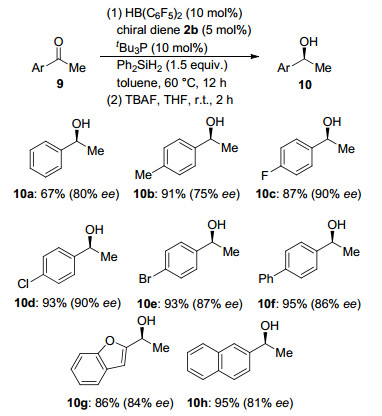
Various ketones 9a were subjected to the asymmetric hydrosilylation using chiral diene 2b (5 mol%), HB(C6F5)2 (10 mol%), and tBu3P (10 mol %), with Ph2SiH2 (1.5 equiv.) in toluene for 12 h followed by the deprotection of silyl group with tetrabutylammonium fluoride (TBAF). As shown in Scheme 3, all these reactions went well to furnish the desired secondary alcohols in 67%~95% yields with 75%~90% ee's. 1-(Benzofuran-2-yl)ethan-1-one (9g) and 1-(naphthalen-1-yl)ethan-1-one (9h) were also effective substrates to afford the corresponding alcohols with 84% and 81% ee, respectively.
A variety of chiral dienes bearing C2-symmetric 1, 1'- spirobiindane framework were prepared in reasonable yields for the first time via a five-step synthesis with chiral dicarboxylic acid as starting material. The corresponding chiral spiro boranes were easily accessed by the in situ hydroboration with HB(C6F5)2. Further application of these chiral boranes with tBu3P as chiral FLP catalysts for the asymmetric Piers-type hydrosilylation of simple ketones to furnish the desired secondary alcohols in 67%~95% yields with 75%~90% ee's. The unique spiro skeleton for this type of chiral boranes makes them potentially useful in other asymmetric reactions, and further efforts on this subject are still underway in our laboratory.
All air-sensitive compounds were handled under an atmosphere of argon or in a nitrogen-filled glovebox. All reagents and solvents were analytical grade materials purchased from commercial sources and used as received unless otherwise stated. Reactions were monitored by TLC (Qingdao Haiyang Chemical Co. Ltd. Silica gel 60 F254) and detected using an UV/Vis lamp (254 nm). Column chromatography was performed on a Qingdao Haiyang Chemical Co. Ltd. Silica gel 60 (200~300 mesh).
1H NMR and 13C NMR spectra were recorded on a Bruker AV 400 at ambient temperature with CDCl3 and C6D6 as solvent and TMS as internal standard. Chemical shifts (δ) were referenced to the residual proton resonance of TMS (0) or to the carbon resonance of the CDCl3 (77.23), C6D6 (126.85). All solvents were purified by conventional methods, distilled before use. Commercially available reagents were used without further purification.
Compound (S)-4 (0.2000 g, 0.66 mmol), Pd(OAc)2 (0.0323 g, 0.132 mmol), iodobenzene diacetate (0.5315 g, 1.65 mmol) and I2 (0.4191 g, 1.65 mmol) were dissolved in N, N-dimethylformamide (DMF, 6.6 mL) under argon. The tube was sealed with a cap and the reaction mixture was stirred at 100 ℃ for 36 h. The reaction mixture was cooled to room temperature. After the solvent was evaporated to vacuum, saturated Na2SO3 (30 mL) was added. The mixture was acidified with 2 mol/L HCl (10 mL), extracted with dichloromethane (DCM, 10 mL×3) and dried over Na2SO4. The solvent was removed in a rotary evaporator and the residue (S)-6, 6'-diiodo-2, 2', 3, 3'-tetrahydro-1, 1'- spirobi[indene]-7, 7'-dicarboxylic acid (5) (0.2060 g, 42% yield) was used directly without other purification.
To a 50 mL three-neck flash, 5 (0.0900 g, 0.16 mmol) was dissolved in SOCl2 (2.1 mL) under argon. The reaction mixture was refluxed at 90 ℃ for 8 h, and then solvent was evaporated directly. MeOH (20 mL) was added, and it was refluxed at 90 ℃ for 12 h. The reaction mixture was cooled to room temperature. The solvent was filtered, residue was collected to afford target product 6 as a white solid (0.0764 g, 82% yield). m.p. 151~154 ℃; 1H NMR (400 MHz, CDCl3) δ: 7.68 (d, J=8.0 Hz, 2H), 7.01 (d, J=8.0 Hz, 2H), 3.25 (s, 6H), 3.04~2.89 (m, 4H), 2.67~2.56 (m, 2H), 2.27~2.16 (m, 2H); 13C NMR (100 MHz, CDCl3) δ: 167.8, 147.3, 145.3, 138.1, 136.4, 127.2, 90.4, 62.7, 51.4, 39.8, 30.3; HRMS (APCI) calcd for C21H19O4I2[M+H]+ 588.9367, found 588.9360.
To a 50 mL three-neck flash, 6 (0.5880 g, 1.0 mmol), (3, 5-di-tert-butylphenyl)boronic acid (0.7020 g, 3.0 mmol), Pd(OAc)2 (0.0112 g, 0.05 mmol), PPh3 (0.0393 g, 0.15 mmol), K2CO3 (0.4140 g, 3.0 mmol) were dissolved in DMF (25 mL) under argon. The reaction mixture was stirred at 90 ℃ for 12 h. The reaction mixture was cooled to room temperature, the mixture was poured into saturated NH4Cl (aq.) and extracted with Et2O (20 mL×2). The organic layers were combined, dried over Na2SO4, filtered. After removal of solvents, the residue was purified by flash column chromatography on silica gel to afford dimethyl (S)-6, 6'-bis(3, 5-di-tert-butylphenyl)-2, 2', 3, 3'-tetrahydro-1, 1'-spirobi[indene]-7, 7'-dicarboxylate(7b) (0.6070 g, 82% yield) as a white solid. m.p. 227~229 ℃; 1H NMR (400 MHz, CDCl3) δ: 7.35 (s, 1H), 7.33 (s, 1H), 7.32~7.30 (m, 2H), 7.25 (s, 1H), 7.23 (s, 1H), 7.11 (d, J=2.5 Hz, 4H), 3.19~3.03 (m, 4H), 2.88 (s, 6H), 2.87~2.78 (m, 2H), 2.43~2.35 (m, 2H), 1.29 (s, 36H); 13C NMR (125 MHz, CDCl3) δ: 169.1, 150.3, 146.3, 144.0, 140.5, 140.4, 129.6, 128.6, 125.2, 122.7, 120.6, 62.2, 50.7, 39.9, 34.8, 31.5, 30.4; HRMS (APCI) calcd for C47H53O2[M+H]+ 649.4040, found 649.4030.
To a 50 mL three-neck flash, 7b (0.4000 g, 0.56 mmol) was dissolved in toluene (10 mL) under argon. The reaction mixture was cooled down to -78 ℃, DIBAL-H (1.5 mol/L, 1.5 mL, 1.7 mmol) was dropwise added and then stirred at -78 ℃ for 3 h. After that mixture was warmed up to room temperature and further stirred overnight. The mixture was poured into saturated NH4Cl (aq.) and extracted with Et2O (20 mL×2). The organic layers were combined, dried over Na2SO4, and filtered. Solvent was removed under reduced pressure to afford a mixture of dialcohols (0.3930 g). The mixture was dissolved in DCM (25 mL) in a 50 mL three-neck flash under argon, then PCC (1.3000 g, 6 mmol), Celite (0.3000 g) were added subsequently. The reaction mixture was stirred at room temperature for 4 h. The resulting suspension solution was filtered through a short pad of Celite, and the solid was washed with CH2Cl2 (5.0 mL×2). After removal of the solvents, the residue was purified by flash chromatography on silica gel to afford (S)-6, 6'-bis(3, 5-di-tert-butylphenyl)-2, 2', 3, 3'-tetrahydro-1, 1'-spirobi[indene]-7, 7'-dicarbaldehyde (8b) (0.2450 g, 67% yield) as a white solid. m.p. 121~125 ℃; 1H NMR (400 MHz, CDCl3) δ: 9.50 (s, 2H), 7.53 (d, J=8.0 Hz, 2H), 7.39~7.36 (m, 2H), 7.31 (d, J=7.6 Hz, 2H), 7.08 (d, J=1.6 Hz, 4H), 3.31~3.09 (m, 4H), 2.79~2.66 (m, 2H), 2.50~2.40 (m, 2H), 1.29 (s, 36H); 13C NMR (125 MHz, CDCl3) δ: 193.7, 150.5, 149.7, 145.3, 144.8, 138.2, 129.7, 129.4, 128.3, 124.7, 121.4, 63.3, 39.5, 34.8, 31.4, 30.7; HRMS (APCI) calcd for C47H57O2[M+H]+ 653.4353, found 653.4338.
To a 10 mL Schlenk tube, PPh3MeI (1.1000 g, 2.7 mmol) and THF (5.0 mL) was cooled to 0 ℃, then tBuOK (0.3020 g, 2.7 mmol) was added. After that, the solution of 8b (0.1740 g, 0.27 mmol) in THF (1.0 mL) was added subsequently. The reaction mixture was stirred for 20 min and quenched with water, extracted with Et2O (5 mL×2). The organic phase was dried over Na2SO4, filtered. After removal of the solvent, the residue was purified by flash column chromatography [V(hexanes):V(DCM)=100:1] to give chiral diene 2b as a white solid (0.1410 g, 81% yield). Chiral dienes 2a, 2c~2e were synthesized by this method.
(S)-6, 6'-Diphenyl-7, 7'-divinyl-2, 2', 3, 3'-tetrahydro-1, 1'-spirobi[indene] (2a): White solid, m.p. 100~103 ℃; [α]D27 -457.2 (c 0.5, CH2Cl2); 1H NMR (500 MHz, C6D6)δ: 7.33 (d, J=7.5 Hz, 4H), 7.20~7.12 (m, 6H), 7.09~7.01 (m, 4H), 6.52 (dd, J=17.5, 11.5 Hz, 2H), 4.79 (dd, J=19.0, 11.5 Hz, 4H), 2.93~2.72 (m, 4H), 2.33 (q, J=10.5 Hz, 2H), 2.12~2.03 (m, 2H); 13C NMR (125 MHz, C6D6) δ: 146.9, 143.1, 142.4, 140.2, 133.9, 133.3, 130.3, 130.1, 127.9, 126.1, 123.5, 120.6, 62.4, 37.8, 30.3; IR (film) ν: 3360, 2929, 2848, 1460, 919, 713 cm-1; HRMS (APCI) calcd for C33H31 [M+H]+ 425.2264, found 425.2260.
(S)-6, 6'-Bis(3, 5-di-tert-butylphenyl)-7, 7'-divinyl-2, 2', 3, 3'-tetrahydro-1, 1'-spirobi[indene](2b): White solid, m.p. 121~123 ℃; [α]D27-278.7 (c 0.53, CH2Cl2); 1H NMR (300 MHz, CDCl3) δ: 7.29~7.24 (t, J=1.6 Hz, 2H), 7.23 (d, J=2.4 Hz, 1H), 7.20 (d, J=2.4 Hz, 3H), 7.11 (d, J=1.8 Hz, 4H), 6.20 (dd, J=17.7, 11.4 Hz, 2H), 4.76 (dd, J=11.4, 1.8 Hz, 2H), 4.49(dd, J=17.7, 1.8 Hz, 2H), 3.14~2.88 (m, 4H), 2.37~2.23 (m, 4H), 1.29 (s, 36H); 13C NMR (125 MHz, C6D6)δ: 150.0, 147.0, 142.3, 142.2, 141.3, 134.1, 133.6, 130.3, 124.9, 123.4, 120.2, 119.6, 62.5, 37.7, 34.6, 31.4, 30.3; IR (film): 3055, 2961, 2865, 1595, 1249, 917, 746 cm-1; HRMS (APCI) calcd for C49H61[M+H]+649.4768, found 649.4757.
(S)-6, 6'-Bis(3, 5-bis(trifluoromethyl)phenyl)-7, 7'-divinyl-2, 2', 3, 3'-tetrahydro-1, 1'-spirobi[indene] (2c): White solid, m.p. 127~129 ℃; [α]D27-283.8 (c 0.39, CH2Cl2); 1H NMR (500 MHz, C6D6) δ: 7.66 (s, 2H), 7.58 (s, 4H), 6.99 (d, J=8.0 Hz, 2H), 6.78 (d, J=7.5 Hz, 2H), 6.19 (dd, J=17.5, 11.0 Hz, 2H), 4.58 (d, J=10.0 Hz, 2H), 4.36 (d, J=16.5, Hz, 2H), 2.85~2.66 (m, 4H), 2.19~2.08 (m, 2H), 2.05~1.97 (m, 2H); 13C NMR (125 MHz, C6D6)δ: 146.8, 144.7, 143.8, 136.7, 133.8, 132.6, 131.2 (q, J=32.9 Hz), 130.3, 130.15, 124.0, 123.6 (d, J=271.0 Hz), 121.9, 119.9, 62.0, 37.5, 30.3; 19F NMR (376 MHz, CDCl3) δ: -62.62; IR (film) ν: 2920, 2848, 1644, 1379, 1278, 1133, 740 cm-1; HRMS (APCI) calcd for C37H23F2 (M-H) 695.1614; Found: 695.1620.
(S)-6, 6'-Bis(4-isopropoxyphenyl)-7, 7'-divinyl-2, 2', 3, 3'-tetrahydro-1, 1'-spirobi[indene](2d): White solid, m.p. 123~125 ℃; [α]D27-390.1 (c 0.78, CH2Cl2); 1H NMR (500 MHz, C6D6) δ: 7.31~7.27 (m, 4H), 7.25 (d, J=8.0 Hz, 2H), 7.08 (d, J=7.5 Hz, 2H), 6.87~6.80 (m, 4H), 6.63~6.54 (m, 2H), 4.88 (dq, J=14.5, 1.5 Hz, 4H), 4.24~4.14 (m, 2H), 2.94~2.75 (m, 4H), 2.43~2.32 (m, 2H), 2.16~2.07 (m, 2H), 1.11 (d, J=6.0 Hz, 12H); 13C NMR (125 MHz, C6D6) δ: 156.0, 146.1, 141.2, 139.1, 134.3, 133.1, 132.8, 130.3, 129.5, 122.7, 119.5, 114.4, 68.2, 61.6, 37.0, 29.5, 20.9(2), 20.9(0); IR (film) ν: 3361, 2975, 2934, 2848, 1512, 1240, 1119, 819 cm-1; HRMS (APCI) calcd for C39H41O2 [M+H]+ 541.3101, found 541.3097.
(S)-6, 6'-Di(naphthalen-2-yl)-7, 7'-divinyl-2, 2', 3, 3'-tetrahydro-1, 1'-spirobi[indene] (2e): White solid, m.p. 221~223 ℃; [α]D27-547.8 (c 0.54, CH2Cl2); 1H NMR (400 MHz, CDCl3) δ: 7.77~7.68 (m, 6H), 7.66 (d, J=8.4 Hz, 2H), 7.41~7.33 (m, 4H), 7.28 (d, J=8.4 Hz, 2H), 7.21~7.13 (m, 4H), 6.21 (dd, J=17.6, 11.6 Hz, 2H), 4.74 (d, J=12.0, 2H), 4.53 (d, J=17.6 Hz, 2H), 3.08~2.86 (m, 4H), 2.33~2.18 (m, 4H); 13C NMR (100 MHz, CDCl3) δ: 146.9, 142.8, 140.7, 139.6, 134.1, 133.5, 133.2, 132.0, 130.4, 129.2, 128.2, 127.9, 127.6, 126.9, 125.9, 125.6, 123.5, 121.2, 62.3, 37.9, 30.5; IR (film) ν: 3054, 2939, 1265, 742 cm-1; HRMS (APCI) calcd for C41H33[M+H]+ 525.2577, found 525.2573.
To a 15 mL sealed tube was added HB(C6F5)2 (0.0107 g, 0.03 mmol), chiral diene 2b (0.0097 g, 0.015 mmol), and dry toluene (3.0 mL) in a nitrogen atmosphere glovebox. The resulting mixture was stirred for 5 min at room temperature followed by addition of Ph2SiH2 (0.0830 g, 0.45 mmol), PtBu3 (10 wt% in n-pentane, 0.0607 g, 0.03 mmol), and ketone 9a (0.0360 g, 0.3 mmol). The reaction mixture was stirred at 60 ℃ for 12 h. The reaction mixture was cooled to room temperature and TBAF (0.3 mmol, 0.3 mL, 1.0 mol/L in THF) was added and stirred at room temperature for 2 h. The resulting solution was added water (15 mL) and extracted with CH2Cl2 (10 mL×3). The resulting residue was purified by column chromatography on silica gel (petroleum ether/ethyl acetate, V/V=50/1) to afford the desired (S)-10a as a colorless oil (0.0246 g, 67% yield, 80% ee). 10b~10h were obtained in a similar manner.
(S)-1-Phenylethan-1-ol (10a): Colorless oil, 0.0246 g, 67% yield, 80% ee. [α]D27-29.4 (c 0.76, CHCl3)[lit.[16a] [α]D24+42.92 (c 1.04, CHCl3) (96% ee for R-isomer)]; 1H NMR (500 MHz, CDCl3)δ: 7.37~7.30 (m, 4H), 7.28~7.22 (m, 1H), 4.84 (q, J=6.5 Hz, 1H), 2.22 (s, 1H), 1.46 (d, J=6.5 Hz, 3H); 13C NMR (125 MHz, CDCl3) δ: 145.8, 128.5, 127.4, 125.4, 70.3, 25.1. Enantiomeric excess was determined by HPLC with a Chiralcel OD-H column [V(hexane)/V(iPrOH)=95/5, 1.0 mL/min, 210 nm], minor enantiomer tr=8.71 min, major enantiomer tr=10.01 min.
(S)-1-(p-Tolyl)ethan-1-ol (10b): Colorless oil, 0.0370 g, 91% yield, 75% ee. [α]D27-39.2 (c 1.04, CH2Cl2)[lit.[16b] [α]D26+55.2 (c 0.50, CH2Cl2) (99.7% ee for R-isomer)]; 1H NMR (400 MHz, CDCl3)δ: 7.22 (d, J=8.0 Hz, 2H), 7.12 (d, J=8.0 Hz, 2H), 4.79 (q, J=6.4 Hz, 1H), 2.32 (s, 3H), 2.22 (br s, 1H), 1.43 (d, J=6.4 Hz, 3H); 13C NMR (100 MHz, CDCl3) δ: 143.0, 137.1, 129.2, 125.4, 70.2, 25.1, 21.1; Enantiomeric excess was determined by HPLC with a Chiralcel OJ-H column [V(hexane)/V(iPrOH)=95/5, 1.0 mL/min, 220 nm], major enantiomer tr=12.08 min, minor enantiomer tr=13.22 min.
(S)-1-(4-Fluorophenyl)ethan-1-ol (10c): Colorless oil, 0.0360 g, 87% yield, 90% ee. [α]D27-52.8 (c 1.20, CH2Cl2)[lit.[16b] [α]D20+49.0 (c 0.20, CH2Cl2) (99.9% ee for R-isomer)]; 1H NMR (400 MHz, CDCl3)δ: 7.50~7.38 (m, 2H), 7.17~7.06 (m, 2H), 4.98 (q, J=6.4 Hz, 1H), 1.87 (br s, 1H), 1.56 (d, J=6.4 Hz, 3H); 13C NMR (100 MHz, CDCl3) δ: 161.1(d, J=243.7 Hz), 140.5, 126.0 (d, J=8.1 Hz), 114.3 (d, J=21.3 Hz), 68.8, 24.3; 19F NMR (376 MHz, CDCl3) δ: -115.5; Enantiomeric excess was determined by HPLC with a Chiralcel OJ-H column [V(hexane)/ V(iPrOH)=70/30, 1.0 mL/min, 210 nm], minor enantiomer tr=23.04 min, major enantiomer tr=24.27 min.
(S)-1-(4-Chlorophenyl)ethan-1-ol (10d): Colorless oil, 0.0423 g, 90% yield, 90% ee. [α]D27-35.7 (c 1.17, CHCl3)[lit.[16c] [α]D26+38.7 (c 1.12, CHCl3) (93% ee for R-isomer)]; 1H NMR (400 MHz, CDCl3)δ: 7.24~7.16 (m, 4H), 4.76 (d, J=6.4 Hz, 1H), 2.18 (brs, 1H), 1.36 (d, J=6.4 Hz, 3H); 13C NMR (100 MHz, CDCl3) δ: 144.3, 133.0, 128.6, 126.8, 69.7, 25.2; Enantiomeric excess was determined by HPLC with a Chiralpak IC-H column [V(hexane)/V(iPrOH)=99/1, 1.0 mL/min, 210 nm], major enantiomer tr=20.60 min, minor enantiomer tr=22.87 min.
(S)-1-(4-Bromophenyl)ethan-1-ol (10e): Colorless oil, 0.0558 g, 93% yield, 87% ee. [α]D27-49.6 (c 1.6, CH2Cl2)[lit.[16d] [α]D24+30.86 (c 0.915, CHCl3) (95% ee for R-isomer)]; 1H NMR (400 MHz, CDCl3)δ: 7.45 (d, J=8.4 Hz, 2H), 7.21 (d, J=8.4 Hz, 2H), 4.82 (q, J=6.4 Hz, 1H), 2.26 (brs, 1H), 1.44 (d, J=6.4 Hz, 3H); 13C NMR (100 MHz, CDCl3) δ: 144.8, 131.5, 127.2, 121.1, 69.7, 25.2; Enantiomeric excess was determined by HPLC with a Chiralcel OD-H column [V(hexane)/V(iPrOH)=98/2, 1.0 mL/min, 210 nm], major enantiomer tr=17.23 min, minor enantiomer tr=19.42 min.
(S)-1-([1, 1'-Biphenyl]-4-yl)ethan-1-ol (10f): White solid, m.p. 93~95 ℃; 0.0567 g, 95% yield, 86% ee. [α]D27-39.3 (c 1.01, CHCl3)[lit.[16e] [α]D20-30.0 (c 0.94, CHCl3) (70% ee for S-isomer)]; 1H NMR (400 MHz, CDCl3)δ: 7.58~7.50 (m, 4H), 7.44~7.35 (m, 4H), 7.35~7.28 (m, 1H), 4.92~4.81 (m, 1H), 2.40 (s, 1H), 1.48 (d, J=6.4 Hz, 3H); 13C NMR (100 MHz, CDCl3) δ: 145.0, 140.9, 140.4, 128.9, 127.3, 127.3, 127.2, 126.0, 70.1, 25.2; Enantiomeric excess was determined by HPLC with a Chiralpak AD-H column [V(hexane)/V(iPrOH)=95/5, 0.8 mL/min, 220 nm], major enantiomer tr=35.88 min, minor enantiomer tr=41.45 min.
(S)-1-(Benzofuran-2-yl)ethan-1-ol (10g): White solid, m.p. 39~42 ℃; 0.0461 g, 94% yield, 84% ee. [α]D27-12.4 (c 1.38, CHCl3)[lit.[16f] [α]D26+15.9 (c 0.96, CHCl3) (93% ee for R-isomer)]; 1H NMR (500 MHz, CDCl3) δ: 7.49~7.44 (m, 1H), 7.42~7.38 (m, 1H), 7.24~7.11 (m, 2H), 6.50 (s, 1H), 4.98~4.87 (m, 1H), 3.08 (s, 1H), 1.55 (d, J=6.5 Hz, 3H); 13C NMR (125 MHz, CDCl3) δ: 160.4, 154.8, 128.3, 124.2, 122.8, 121.1, 111.3, 101.8, 64.1, 21.5; Enantiomeric excess was determined by HPLC with a Chiralpak AS-H column [V(hexane)/V(iPrOH)=98/2, 1.0 mL/min, 254 nm], major enantiomer tr=20.60 min, minor enantiomer tr=22.87 min.
(S)-1-(Naphthalen-2-yl)ethan-1-ol (10h): White solid, m.p. 71~73 ℃; 0.0490 g, 95% yield, 81% ee. [α]D27-42.4 (c 1.05, CH2Cl2)[lit.[16b] [α]D20+37.0 (c 0.50, CH2Cl2) (99% ee for R-isomer)]; 1H NMR (400 MHz, CDCl3)δ: 7.84~7.75 (m, 4H), 7.73 (s, 1H), 7.49~7.38 (m, 3H), 4.98 (q, J=6.4 Hz, 1H), 2.33 (br s, 1H), 1.52 (d, J=6.4 Hz, 3H); 13C NMR (100 MHz, CDCl3) δ: 143.3, 133.4, 133.0, 128.3, 128.0, 127.7, 126.2, 125.8, 123.9, 123.8, 70.5, 25.1; Enantiomeric excess was determined by HPLC with a Chiralcel OD-H column [V(hexane)/V(iPrOH)=98/2, 1.0 mL/min, 210 nm], major enantiomer tr=34.64 min, minor enantiomer tr=45.86 min.
Supporting Information 1H NMR and 13C NMR spectra of compounds 2a~2e, 5, 6, 7b, 8b, 10a~10h and X-ray crystal structure and data of (S)-2e. Determination of enantiomeric excess of compounds 10a~10h. The Supporting Information is available free of charge via the Internet at http://sioc-journal.cn/.
Welch, G. C.; San Juan, R. R.; Masuda, J. D.; Stephan, D. W. Science 2006, 314, 1124. doi: 10.1126/science.1134230
(a) Stephan, D. W. Org. Biomol. Chem. 2008, 6, 1535.
(b) Kenward, A. L.; Piers, W. E. Angew. Chem., Int. Ed. 2008, 47, 38.
(c) Stephan, D. W.; Erker, G. Angew. Chem., Int. Ed. 2010, 49, 46.
(d) Soös, T. Pure Appl. Chem. 2011, 83, 667.
(e) Erker, G. Pure Appl. Chem. 2012, 84, 2203.
(f) Stephan, D. W. Org. Biomol. Chem. 2012, 10, 5740.
(g) Paradies, J. Angew. Chem., Int. Ed. 2014, 53, 3552.
(h) Stephan, D. W. Acc. Chem. Res. 2015, 48, 306.
(i) Stephan, D. W.; Erker, G. Angew. Chem., Int. Ed. 2015, 54, 6400.
(j) Oestreich, M.; Hermeke, J.; Mohr, J. Chem. Soc. Rev. 2015, 44, 2202.
(k) Stephan, D. W. Science 2016, 354, aaf7229.
(a) Liu, Y.; Du, H. Acta Chim. Sinica 2014, 72, 771(in Chinese).
(刘勇兵, 杜海峰, 化学学报, 2014, 72, 771.)
(b) Feng, X.; Du, H. Tetrahedron Lett. 2014, 55, 6959.
(c) Shi, L.; Zhou, Y.-G. ChemCatChem 2015, 7, 54.
(d) Meng, W.; Feng, X.; Du, H. Acc. Chem. Res. 2018, 51, 191.
(a) Sumerin, V.; Chernichenko, K.; Nieger, M.; Leskelä, M.; Rieger, B.; Repo, T. Adv. Synth. Catal. 2011, 353, 2093.
(b) Mewald, M.; Fröhlich, R.; Oestreich, M. Chem.-Eur. J. 2011, 17, 9406.
(c) Mewald, M.; Oestreich, M. Chem.-Eur. J. 2012, 18, 14079.
(d) Lindqvist, M.; Borre, K.; Axenov, K.; Kótai, B.; Nieger, M.; Leskelä, M.; Pápai, I.; Repo, T. J. Am. Chem. Soc. 2015, 137, 4038.
(e) Süsse, L.; Hermeke, J.; Oestreich, M. J. Am. Chem. Soc. 2016, 138, 6940.
(f) Lam, J.; Günther, B. A. R.; Farrell, J. M.; Eisenberger, P.; Bestvater, B. P.; Newman, P. D.; Melen, R. L.; Crudden, C. M.; Stephan, D. W. Dalton Trans. 2016, 45, 15303.
(a) Chen, D.; Wang, Y.; Klankermayer, J. Angew. Chem., Int. Ed. 2010, 49, 9475.
(b) Chen, D.; Leich, V.; Pan, F.; Klankermayer, J. Chem.-Eur. J. 2012, 18, 5184.
(c) Ghattas, G.; Chen, D.; Pan, F.; Klankermayer, J. Dalton Trans. 2012, 41, 9026.
(d) Ye, K.-Y.; Wang, X.; Daniliuc, C. G.; Kehr, G.; Erker, G. Eur. J. Inorg. Chem. 2017, 368.
(e) Chen, D.; Klankermayer, J. Chem. Commun. 2008, 2130.
(a) Parks, D. J.; Spence, R. E. von H.; Piers, W. E. Angew. Chem., Int. Ed. 1995, 34, 809.
(b) Parks, D. J.; Piers, W. E.; Yap, G. P. A. Organometallics 1998, 17, 5492.
(a) Liu, Y.; Du, H. J. Am. Chem. Soc. 2013, 135, 12968.
(b) Wei, S.; Du, H. J. Am. Chem. Soc. 2014, 136, 12261.
(c) Zhang, Z.; Du, H. Angew. Chem., Int. Ed. 2015, 54, 623.
(d) Ren, X.; Du, H. J. Am. Chem. Soc. 2016, 138, 810.
(e) Liu, X.; Wang, Q.; Han, C.; Feng, X.; Du, H. Chin. J. Chem. 2019, 37, 663.
(a) Tu, X.-S.; Zeng, N.-N.; Li, R.-Y.; Zhao, Y.-Q.; Xie, D.-Z.; Peng Q.; Wang, X.-C. Angew. Chem., Int. Ed. 2018, 57, 15096.
(b) Li, X.; Tian, J.-J.; Liu, N.; Tu, X.-S.; Zeng, N.-N.; Wang, X.-C. Angew. Chem., Int. Ed. 2019, 58, 4664.
Zhou, Q.-L., Privileged Chiral Ligands and Catalysts, Wiley-VCH, Weinheim, Germany, 2011.
For selected reviews, see: (a) Xie, J.-H.; Zhou, Q.-L. Acc. Chem. Res. 2008, 41, 581.
(b) Ding, K.-L.; Han, Z.-B.; Wang, Z. Chem. Asian J. 2009, 4, 32.
(c) Xie, J.-H.; Zhou, Q.-L. Acta Chim. Sinica 2014, 72, 778(in Chinese).
(谢建华, 周其林, 化学学报, 2014, 72, 778.)
(d) Xie, J.-H.; Bao, D.-H.; Zhou, Q.-L. Synthesis 2015, 47, 460.
(d) Zhu, S.-F.; Zhou, Q.-L. Acc. Chem. Res. 2012, 45, 1365.
For a pioneering work, see: Parks, D. J.; Piers, W. E. J. Am. Chem. Soc. 1996, 118, 9440.
Rendler, S.; Oestreich, M. Angew. Chem., Int. Ed. 2008, 47, 5997. doi: 10.1002/anie.200801675
Zhu, S.-F.; Yang, Y.; Wang, L.-X.; Liu, B.; Zhou, Q.-L. Org. Lett. 2005, 7, 2333. doi: 10.1021/ol050556x
Zheng, J.; Cui, W.-J.; Zheng, C.; You, S.-L. J. Am. Chem. Soc. 2016, 138, 5242. doi: 10.1021/jacs.6b02302
For details, see the Supporting Information. CCDC 1905630 contains the supplementary crystallographic data for this paper. These data can be obtained free of charge from The Cambridge Crystallographic Data Centre via www.ccdc.cam.ac.uk/data_request/cif.
(a) Sokeirik, Y. S.; Mori, H.; Omote, M; Sato, K.; Tarui, A.; Kumadaki, I.; Ando, A. Org. Lett. 2007, 9, 1927.
(b) Wu, W.; Liu, S.; Duan, M.; Tan, X.; Chen, C.; Xie, Y.; Lan, Y.; Dong, X.; Zhang, X. Org. Lett. 2016, 18, 2938.
(c) Ren, X.; Li, G.; Wei, S.; Du, H. Org. Lett. 2015, 17, 990.
(d) Zhang, Z.; Jain, P.; Antilla, J. C. Angew. Chem., Int. Ed. 2011, 50, 10961.
(e) Süsse, L.; Hermeke, J.; Oestreich, M. J. Am. Chem. Soc. 2016, 138, 6940.
(f) Chen, X.; Lu, Z. Org. Lett. 2016, 18, 4658.
Table 1. Optimization of reaction conditions for the asymmetric hydrosilylationa
|
||||||
| Entry | Chiral diene 2 | Phosphine | Silane | Solvent | Conv./% | ee/% |
| 1 | 2a | tBu3P | PhMe2SiH | Toluene | 95 | 40 |
| 2 | 2b | tBu3P | PhMe2SiH | Toluene | > 99 | 56 |
| 3 | 2c | tBu3P | PhMe2SiH | Toluene | 94 | 34 |
| 4 | 2d | tBu3P | PhMe2SiH | Toluene | 94 | 43 |
| 5 | 2e | tBu3P | PhMe2SiH | Toluene | 93 | 35 |
| 6 | 2b | Cy3P | PhMe2SiH | Toluene | 71 | 0 |
| 7 | 2b | Mes3P | PhMe2SiH | Toluene | 73 | 17 |
| 8 | 2b | (C6F5)Ph2P | PhMe2SiH | Toluene | 96 | 0 |
| 9 | 2c | — | PhMe2SiH | Toluene | 91 | 23 |
| 10 | 2b | tBu3P | Et3SiH | Toluene | 59 | 47 |
| 11 | 2b | tBu3P | Ph2SiH2 | Toluene | > 99 | 80 |
| 12 | 2b | tBu3P | PhSiH3 | Toluene | > 99 | 44 |
| 13 | 2b | tBu3P | Ph3SiH | Toluene | 95 | 7 |
| 14e | 2b | tBu3P | Ph2SiH2 | Toluene | > 99 | 79 |
| 15e | 2b | tBu3P | Ph2SiH2 | Hexane | > 99 | 42 |
| 16e | 2b | tBu3P | Ph2SiH2 | THF | > 99 | 0 |
| 17e | 2b | tBu3P | Ph2SiH2 | DCM | 88 | 46 |
| a All reactions were carried out with acetophenone (0.1 mmol), HB(C6F5)2 (10 mol%), chiral spiro diene 2 (5 mol%), tBu3P (10 mol%), and silane (1.5 equiv.) in solvent (1.0 mL) at 60 ℃ for 12 h, followed by removal the silyl group with TBAF at room temperature for 2 h. b Determined by crude 1H NMR. c Determined by chiral HPLC. e HB(C6F5)2 (5 mol%), 2b (2.5 mol%) and tBu3P (5 mol%) was used. | ||||||
 下载: 导出CSV

 扫一扫看文章


扫一扫关注我们