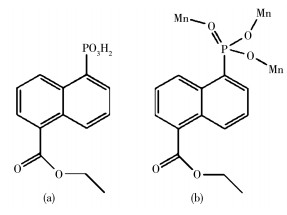
Scheme 1.
Molecular structure (a) and coordination mode (b) of H2L


During the past two decades, single-molecule magnets (SMMs) have gained considerable attention because of their intriguing applications in the fields of high-density data storage, quantum computing, and molecular spintronics[1-7]. SMMs exhibit slow relaxation of their magnetization induced by the combined effect of a high-spin ground state (ST) and uniaxial anisotropy (D), which generate an energy barrier between spin-up and spin-down states[8]. Given this, metal ions with unquenched orbital angular momentum including 3d metal ions with certain oxidation states and geometries, f-block elements, have been targeted[9-11]. Among the reported SMMs, high spin MnⅢ-Schiff base (SB) complexes play very important roles as structural building units to design several types of magnetic materials, such as single-chain magnets(SCMs)[12-14], SMMs[15], ferromagnets[16], and antiferromagnets[17], thanks to several unique properties of the Mn(Ⅲ) ions: (ⅰ) stable oxidation state, (ⅱ) high spin configuration (S=2), (ⅲ) easily substitutable axial sites, and (ⅳ) strong uniaxial anisotropy created by Jahn-Teller distortion in octahedral ligand field[18].
It is common knowledge that the employment of bridging ligands in polynuclear complexes can mediate the magnetic coupling between the local spin carriers to enhance their ground spin states and thus achieve SMMs. In this regard, phosphonate (RPO32-) or phosphinate (RHPO2-) ligands can offer two or three oxygen donors to link the metal ions, as an important class of three-atom bridges, have been used to construct a rich variety of complexes with unique network topologies[19-22]. Metal phosphonates showing long-range magnetic ordering have been reported, depending on the structural parameters such as the metal…metal distances and metal—O…O—metal torsion angles over the O—P—O bridges. Some [Mn(SB)] phosphonates derivatives have been reported, in which O—P—O acting as a mer-μ2-coordinating-donor building block, binds two MnⅢ-Schiff base moieties through two phosphonate oxygens[23-26]. However, as far as we are aware, only in one case, [Mn6(5-Brsalen)6(C10H7PO3)2(H2O)2](ClO4)2·7.6H2O[26], O—P—O acting as a mer-μ3-coordinating-donor building block, and binding three MnⅢ-Schiff base moieties, has been reported. To explore new SMMs based on MnⅢ-Schiff base and O—P—O linkages, herein we report two new MnⅢ-Schiff base phosphonate complexes using an 5-(ethoxycarbonyl)-naphthalen-1-yl)phosphonic acid (H2L) (Scheme 1a), namely, [Mn3(salen)3(L)]ClO4·H2O (1) and [Mn3(salpn)3(L)]ClO4 (2), where salen2-=N, N′-(ethylene)bis(salicylideneiminato), salpn2-=N, N′-(propylene)bis(salicylideneiminato). Their syntheses, structures, and magnetic properties are documented here.
All reagents and solvents were purchased from commercial sources and used without further purification. The MnⅢ-Schiff bases used were prepared according to the modified literature procedure[27]. H2L was prepared according to the literature[28].
Caution! Perchlorate salts are potentially explosive and should be handled carefully.
Elemental analyses (C, H, and N) were performed on a Perkin-Elmer 240C elemental analyzer. IR spectra were recorded on a Bruker VERTEX70 spectrometer in a range of 400-4 000 cm-1 using KBr pellets. Powder X-ray diffraction (PXRD) data were collected on a Bruker D8 ADVANCE X-ray powder diffractometer (Cu Kα, λ=0.154 06 nm) operating at 45 kV and 40 mA in a scan range of 5.00°-50.00° at room temperature. Variable-temperature magnetic susceptibility was performed on a Quantum Design MPMS-XL7 SQUID magnetometer. The diamagnetic contribution of the sample itself was estimated from Pascal′s constant[29].
A mixture of [Mn(salen)(H2O)]ClO4 (0.032 8 g, 0.07 mmol) and H2L (0.028 6 g, 0.1 mmol) in 10 mL of methanol solution, adding two drops of triethylamine, was kept in a 25 mL sealed vial. After stirring for 5 h the dark brown solution was filtrated, and the filtrate was left to stand for 5 d at room temperature. Dark brown block-like crystals were collected by suction filtration, and washed with a minimum amount of methanol. Yield: 69%. Elemental analysis Calcd. for C122H110Mn6O31N12P2Cl2(%): C, 54.22; H, 4.10; N, 6.22. Found(%): C, 54.13; H, 4.06; N, 6.29. IR (KBr, cm-1): 3 444(w), 2 975(w), 1 702(m), 1 620(vs), 1 600(s), 1 542(m), 1 446(m), 1 389(w), 1 334(w), 1 295(s), 1 203(w), 1 091(vs), 905(w), 801(m), 757(m), 631(m), 597(w).
Compound 2 was prepared as dark-brown block-like crystals using a similar method to that of 1, except that [Mn(salpn)(H2O)]ClO4 instead of [Mn(salen)(H2O)]ClO4 was used. Yield: 70%. Elemental analysis Calcd. for C64H58Mn3O15N6PCl(%): C, 55.60; H, 4.23; N, 6.07. Found(%): C, 55.09; H, 4.11; N, 6.12. IR (KBr, cm-1): 3 420(w), 2 933(m), 1 637(s), 1 528(s), 1 455(s), 1 419(w), 1 352(w), 1 308(s), 1 285(s), 1 177(s), 1 133(m), 1 089(m), 1 067(m), 1 029(m), 1 015(m), 911(m), 821(s), 754(m), 716(m), 655(s), 575(m), 436(m).
For complex 1, single-crystal X-ray diffraction data were collected on a ROD, Synergy Custom DW system, HyPix diffractometer using graphite-monochromated Cu Kα radiation (λ=0.154 784 nm). The crystal was kept at 100.01(10) K during data collection. Using Olex2[30], the structure was solved with the XT[31] structure solution program using Intrinsic Phasing and refined with the SHELXL[32] refinement package using Least Squares minimization. 31 057 reflections were measured (5.74°≤2θ≤151.598°), in which 11 429 unique (Rint=0.061 9, Rσ=0.056 4) were used in all calculations. For 2, single-crystal X-ray diffraction data were collected on a Bruker APEX-Ⅱ CCD diffractometer using graphite-monochromated Cu Kα radiation (λ=0.154 784 nm) at 134 K. The numbers of observed and unique reflections were 19 682 and 10 661 (Rint=0.051 6). The data were integrated using the Siemens SAINT program[33], with the intensities corrected for the Lorentz factor, polarization, air absorption, and absorption due to variation in the path length through the detector faceplate. Empirical absorption and extinction corrections were applied. The structures were solved by direct methods and refined on F 2 by full-matrix least squares using SHELXTL[34]. All the non-hydrogen atoms were refined anisotropically. All the hydrogen atoms except those attached to water molecules were put in calculated positions and refined isotropically with the isotropic vibration parameters related to the non-hydrogen atoms to which they are bonded. The hydrogen atoms attached to water molecules were found from Fourier maps and were refined isotropically. All the crystallographic data and refinement parameters of both complexes are presented in Table 1. Selected bond lengths and bond angles are given in Table 2.
 下载:
导出CSV
下载:
导出CSV
| Parameter | 1 | 2 |
| Empirical formula | C122H110Mn6O31N12P2Cl2 | C64H58Mn3O15N6PCl |
| Formula weight | 2 702.69 | 1 382.40 |
| Crystal system | Triclinic | Triclinic |
| Space group | P1 | P1 |
| a / nm | 1.372 25(5) | 1.392 17(12) |
| b / nm | 1.373 15(4) | 1.398 78(19) |
| c / nm | 1.652 68(4) | 1.730 09(14) |
| α / (°) | 107.554(3) | 98.805(9) |
| β / (°) | 97.695(2) | 111.677(8) |
| γ / (°) | 102.310(3) | 101.084(9) |
| Z | 1 | 2 |
| V / nm3 | 2.834(16) | 2.978(5) |
| Dc / (g·cm-3) | 1.583 | 1.542 |
| Parameter | 1 | 2 |
| μ(Mo Kα) / mm-1 | 6.717 | 6.400 |
| F(000) | 1 388.00 | 1 422 |
| Rint | 0.061 9 | 0.051 6 |
| Goodness-of-fit on F 2 | 1.038 | 1.013 |
| R, wR [I > 2σ(I)]* | R1=0.084 4, wR2=0.224 6 | R1=0.095 3, wR2=0.231 1 |
| R, wR (all data) | R1=0.098 9, wR2=0.235 9 | R1=0.145 9, wR2=0.273 7 |
| (Δρ)max, (Δρ)min / (e·nm-3) | 1 580, -1 340 | 1 077, -843 |
| *R=∑||Fo|-|Fc||/∑|Fo|, wR=[∑w(Fo2-Fc2)2/∑w(Fo2)2]1/2. | ||
下载:
导出CSV
| 1 | |||||
| Mn1—O1 | 0.204 0(4) | Mn2—O2 | 0.203 9(3) | Mn3—O3 | 0.200 7(4) |
| Mn1—O6 | 0.188 5(3) | Mn2—O8 | 0.188 6(4) | Mn3—O10 | 0.188 9(4) |
| Mn1—O7 | 0.189 3(3) | Mn2—O9 | 0.188 2(3) | Mn3—O11 | 0.188 0(4) |
| Mn1—N1 | 0.197 7(4) | Mn2—N3 | 0.199 2(4) | Mn3—N5 | 0.199 0(5) |
| Mn1—N2 | 0.199 0(5) | Mn2—N4 | 0.197 7(4) | Mn3—N6 | 0.197 2(5) |
| O1—Mn1—O6 | 102.13(15) | O8—Mn2—O2 | 95.93(16) | O10—Mn3—O3 | 100.31(18) |
| O6—Mn1—O7 | 91.05(16) | O8—Mn2—N3 | 89.63(18) | O10—Mn3—N5 | 91.52 |
| O6—Mn1—N1 | 90.74(17) | O8—Mn2—N4 | 160.69(19) | O10—Mn3—N6 | 163.5(2) |
| O6—Mn1—N2 | 159.1(2) | O9—Mn2—O2 | 105.15(15) | O11—Mn3—O3 | 100.11(17) |
| O7—Mn1—O1 | 101.15(16) | O9—Mn2—O8 | 91.27(15) | O11—Mn3—O10 | 90.30(19) |
| O7—Mn1—N1 | 161.42(17) | O9—Mn2—N3 | 162.09(17) | O11—Mn3—N5 | 156.4(2) |
| O7—Mn1—N2 | 90.15(18) | O9—Mn2—N4 | 91.39(17) | O11—Mn3—N6 | 91.8(2) |
| N1—Mn1—O1 | 96.54(16) | N3—Mn2—O2 | 92.54(16) | N5—Mn3—O3 | 102.70(19) |
| N1—Mn1—N2 | 81.7(2) | N4—Mn2—O2 | 101.81(15) | N5—Mn3—O3 | 95.41(19) |
| N2—Mn1—O1 | 98.1(2) | N4—Mn2—N3 | 82.10(19) | N6—Mn3—N5 | 80.1(3) |
| 2 | |||||
| Mn1—O1 | 0.186 8(5) | Mn2—O4 | 0.187 5(5) | Mn3—O5 | 0.187 4(5) |
| Mn1—O2 | 0.187 86 | Mn2—O3 | 0.188 16 | Mn3—O6 | 0.187 7(5) |
| Mn1—N2 | 0.195 17 | Mn2—N4 | 0.196 8(7) | Mn3—N6 | 0.197 9(6) |
| Mn1—N1 | 0.197 57 | Mn2—N3 | 0.199 6(7) | Mn3—N5 | 0.198 8(6) |
| Mn1—O9 | 0.201 2(5) | Mn2—O8 | 0.200 6(5) | Mn3—O7 | 0.202 8(4) |
| O1—Mn1—O2 | 90.5(2) | N1—Mn1—O9 | 91.3(3) | O5—Mn3—O6 | 90.5(2) |
| O1—Mn1—N2 | 160.4(3) | O4—Mn2—O3 | 160.1(3) | O5—Mn3—N6 | 163.3(2) |
| O2—Mn1—N2 | 91.7(3) | O4—Mn2—N4 | 92.1(3) | O6—Mn3—N6 | 91.5(2) |
| O1—Mn1—N1 | 90.9(3) | O3—Mn2—N4 | 90.5(3) | O5—Mn3—N5 | 89.5(2) |
| O2—Mn1—N1 | 159.1(3) | O4—Mn2—N3 | 162.7(3) | O6—Mn3—N5 | 157.1(2) |
| N2—Mn1—N1 | 80.4(3) | O3—Mn2—N3 | 80.6(3) | N6—Mn3—N5 | 82.3(3) |
| O1—Mn1—O9 | 100.7(2) | N4—Mn2—N3 | 102.0(2) | O5—Mn3—O7 | 96.2(2) |
| O2—Mn1—O9 | 103.4(2) | O4—Mn2—O8 | 100.7(2) | O6—Mn3—O7 | 109.5(2) |
| N2—Mn1—O9 | 97.7(2) | O3—Mn2—O8 | 96.7(3) | N6—Mn3—O7 | 98.8(2) |
| N1—Mn1—O9 | 96.9(3) | N4—Mn2—O8 | 95.8(3) | N5—Mn3—O7 | 93.3(2) |
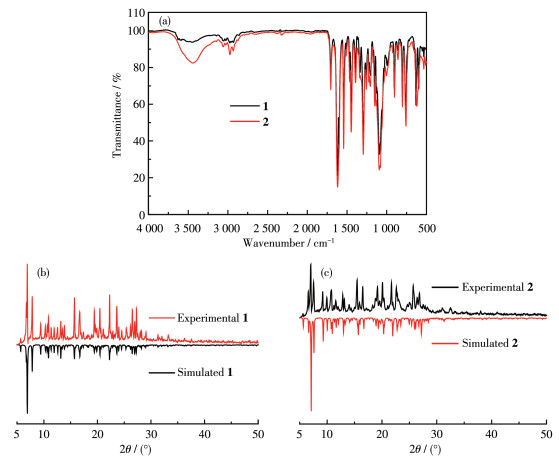
The FTIR spectra of complexes 1 and 2 exhibited strong absorption at 1 600, 1 620, and 1 702 cm-1, assignable to the C=N or C=O vibration. Also, the characteristic absorption of CH or NH groups was detected in a range of 2 930-3 600 cm-1. The strong absorption at 1 091 cm-1 is attributed to the coordinated phosphonate group (CPO32-). The strong absorption peak for vibration of ClO4- was also observed at about 1 100 and 630 cm-1 (Fig. 1a). PXRD patterns were gained at room temperature. The peak positions of the simulated by Mercury 3.3 and experimental patterns were in good agreement with each other, indicating the phase purity of complexes 1 and 2, respectively (Fig. 1b and 1c).
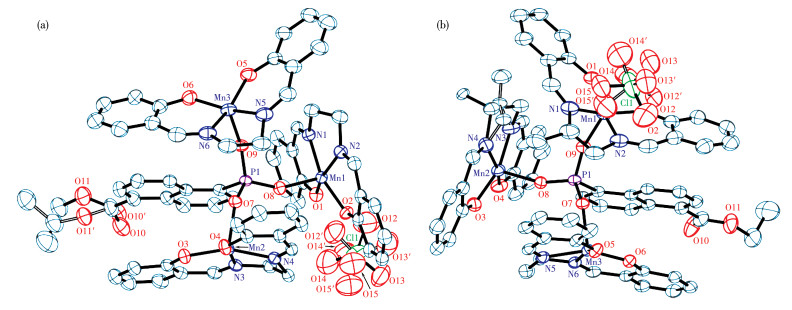
Single-crystal X-ray structural analyses revealed that both complexes crystallize in the triclinic P1 space group (Table 1). As shown in Fig. 2, complex 1 features a trinuclear cluster. The asymmetric unit consists of three [Mn(salen)]+ units, one L2- ion, one disordered ClO4- ion, and one disordered lattice H2O molecule. Each Mn(Ⅲ) ion is five coordinated by two O atoms (O6, O7 for Mn1, O8, O9 for Mn2, and O10, O11 for Mn3) and two N atoms (N1, N2 for Mn1, N3, N4 for Mn2, and N5, N6 for Mn3) from Schiff base ligand salen2-, and one O atom (O1 for Mn1, O2, for Mn2, and O3 for Mn3) from one L2- ion. The three Mn centers are bridged by O—P—O from tridentate L2- ligands, forming a tirnuclear unit of [Mn3(salen)3(L)]+ with a Mn1…Mn2 distance of 0.598 7 nm, Mn1…Mn3 distance of 0.565 4 nm and Mn2…Mn3 distance of 0.588 7 nm. The Mn—O and Mn—N bond lengths for the Schiff base donor atoms are in the normal range: Mn—O(salen) 0.188 0(4)-0.189 3(3) nm, Mn—N(salen) 0.196 5(9)-0.199 2(4) nm, whereas the axial bond lengths are comparatively longer: Mn—O(P) 0.200 7(4)-0.204 0(4) nm.
Hydrogen atoms are omitted for clarity.
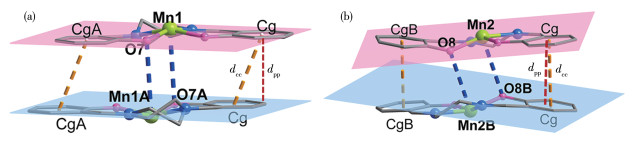
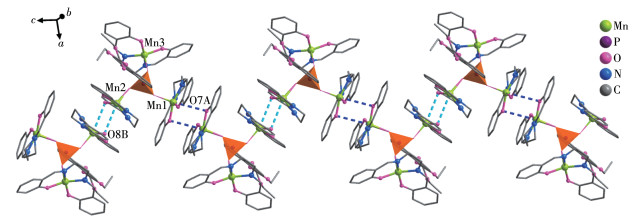
As shown in Fig. 3, the neighboring two [Mn(salen)]+ units are bridged by two Mn—O bonds (Mn1—O7A 0.345 9 nm, Mn2—O8B 0.331 7 nm, Symmetry codes: A: 2-x, 1-y, 1-z; B: 2-x, 1-y, 2-z). In general, [Mn2(SB)2]-type complexes are classified into three types depending on the dimerization distance (MnⅢ—Oph). Types Ⅰ, Ⅱ, and Ⅲ have shorter MnⅢ—Oph (ca. 0.25 nm), longer MnⅢ—Oph (ca. 0.37 nm), and no contact between Mn(Ⅲ) ions and Oph atoms, respectively[16-17]. Thus, both Mn1 and Mn2 are classified as type Ⅱ.
Symmetry codes: A: 2-x, 1-y, 1-z, B: 2-x, 1-y, 2-z.
The [Mn1(salen)]+ and [Mn2(salen)]+ groups are paired face-to-face in a syn-cis mode to neighboring molecules (intermolecular center-to-center distance dcc=0.357 1 nm, plane-to-plane distance dpp=0.326 1 nm for [Mn1(salen)]+, and dcc=0.407 7 nm, dpp=0.364 1 nm for [Mn2(salen)]+) respectively, forming a supramolecular dimer ([Mn(salen)]2+ dimer), and the Mn…Mn distance through face-to-face is 0.411 6 nm for Mn1…Mn1A, and 0.379 7 nm for Mn2…Mn2B (Fig. 3). The difference in Mn-Mn dimers is that the salen2- ligand are coplanar and parallel to the adjacent molecules for [Mn1(salen)]2+ (Fig. 3a), whereas in [Mn2(salen)]2+ the salen2- ligands are not in the same plane and their torsion angle is 11.03° (Fig. 3b). Unlike the π-π interaction in [Mn1(salen)]2+ and [Mn2(salen)]2+, [Mn3(salen)]+ unit is isolated, which may have significant implications on the electronic distribution.
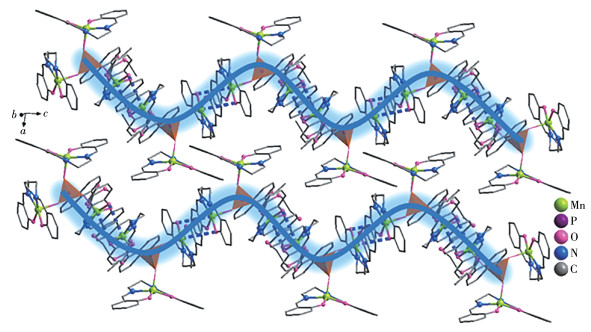
The coordination mode of L2- in 1 is unique compared with those in the other metal phosphonates[23-24]. As shown in Fig. 2, in complex 1, ligand L2-, acting as a mer-μ3-coordinating-donor building block, binds three [Mn(salen)]+ moieties through three phosphonate oxygen atoms (Scheme 1b), forming a trimetric unit of [Mn3(salen)3(L)]+. The equivalent trinuclear is fused by π-π interactions, forming a supramolecular wave chain along the c-axis (Fig. 4). The neighboring waved chains are held together by van der Waals forces in the ab plane (Fig. 5). The nearest interchain Mn…Mn distance is 0.698 8 nm. These layers are stacked along the c-axis by electrostatic interaction, generating 1D channels in which the ClO4- anions reside. The perchlorate anion balances the overall charge of the structure and stabilizes the crystal lattice through C—H…O1W…H—O (ClO4-) hydrogen bonds between the L2- ligand, lattice water, and perchlorate oxygen atoms.
Symmetry codes: A: 2-x, 1-y, 1-z, B: 2-x, 1-y, 2-z.
Complex 2 has a similar trinuclear structure, except that [Mn(salpn)]+ replaces [Mn(salen)]+ in structure 1 (Fig. 2). The different alkyl substituent of the Mn-Schiff base has an influence on the coordination environment of the Mn ion, as evidenced by the slight changes in bond lengths and angles (Table 1 and 2). The two structures are distinct in several aspects: (a) the ester group of L2- ligand in 2 is disordered over two sites, but in 1 they are fully ordered; (b) the lattice water molecule is present in 1 but not in 2; (c) compared to 1, the interdimer Mn…Mn distances over the O—P—O bridges in 2 is slightly reduced (0.559 8-0.589 9 nm vs 0.567 9-0.589 9 nm in 1).
It is worth mentioning that the structures of 1 and 2 are remarkably different from that of the previously reported 1D O—P—O bridged MnⅢ-Schiff base complexes [Mn2(salen)2(C6H9PO3H)](ClO4)[23] and [Mn((R, R)-5-Brsalcy)(2-FC6H4PO3H)]·3H2O[24], in which O—P—O acting as a mer-μ2-coordinating-donor building block, binds two MnⅢ-Schiff base moieties through two phosphonate oxygens. Compared to complex [Mn6(5-Brsalen)6(C10H7PO3)2(H2O)2](ClO4)2·7.6H2O[26], which shows hexa-nuclear structure by μ3-O—P—O bridging MnⅢ2(SB)2 dimers, in this work, we report that O—P—O from phosphonate acting as a mer-μ3-coordinating-donor building block, connects three MnⅢ(SB) moieties through all of three phosphonate oxygens, yielding zero-dimensional trinuclear complexes.
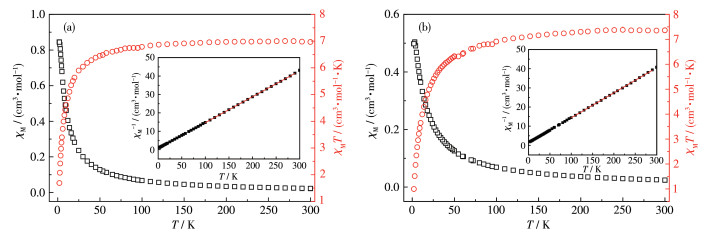
The temperature-dependent magnetic susceptibilities of complexes 1 and 2 were measured in a temperature range of 2-300 K under an applied field of 1 kOe. Fig. 6 shows the χM, χMT vs T plots. The χMT value of all three MnⅢ units at 300 K was 6.97 cm3·mol-1·K, which was close to the theoretical value (7.0 cm3·mol-1·K) for two pure high-spin (HS) Mn(Ⅲ) ions (3d4, S=2) and a single pure low-spin (LS) Mn(Ⅲ) ion (3d4, S=1) with g=2.0. Based on the coordination configuration analysis, the configuration of Mn1 is closer to the spherical square pyramid (C4v) than that of Mn2 and Mn3 (CShM values for Mn1, Mn2, and Mn3: 0.242 13, 0.331 72, 0.309 04, respectively), so Mn1 may be LS. In terms of the packing structure, Mn3 does not face to face with Mn of another molecule through π-π interaction, so Mn3 may be also LS. Upon cooling, the χMT value decreased continuously down to 2 K. The susceptibility data obeyed the Curie-Weiss law in a range of 100-300 K with a Curie constant of C=7.14 cm3·mol-1·K and a Weiss constant of θ=-5.38 K. The negative value of θ signifies antiferromagnetic interaction between the Mn(Ⅲ) ions bridged by O—P—O moiety. The magnetic behavior of 2 was similar to that of 1. The χMT values at 300 and 2 K were 7.36 and 1.00 cm3·mol-1·K, respectively. Above 100 K, the susceptibility obeyed the Curie-Weiss law with C=7.69 cm3·mol-1·K and θ=-10.5 K (Fig. 6b). The antiferromagnetic interaction is dominant among Mn(Ⅲ) in complex 2[23]. The temperature-dependent alternating current susceptibilities were also measured at zero direct current field (Hac=3.5 Oe). In both cases, no obvious peaks were observed for the in-phase (χM′) and out-of-phase (χM″) signals at 1 Hz, excluding the occurrence of long-range magnetic ordering down to 2 K.
The straight line shows the Curie-Weiss fitting.
In summary, we report two isostructural complexes [Mn3(SB)3(L)]ClO4 based on a phosphonate ligand. They exhibit similar trinuclear [Mn3(SB)3(L)]+, in which O—P—O groups among the phosphonate ligand bridge three Mn(Ⅲ) ions centers, assembling by π-π interaction from the neighboring complexes, giving rise to a supramolecular 1D chain. Magnetic measurements of 1 and 2 indicate that the dominant antiferromagnetic interactions are mediated between the Mn(Ⅲ) ions centers.
Gao S. Molecular nanomagnets and related phenomena. Berlin: Springer-Verlag, 2015.
Winpenny R E P. Molecular cluster magnets. Singapore: World Scientific, 2012.
Gatteschi D S, Sessoli R, Villain J. Molecular nanomagnets. Oxford: Oxford University Press, 2006.
张柯, 王会生, 于灵燕, 陈勇, 潘志权. 第一过渡系金属-镝单分子磁体研究进展与展望[J]. 无机化学学报, 2020,36,(12): 2205-2226. ZHANG K, WANG H S, YU L Y, CHEN Y, PAN Z Q. Research progress and prospect on the first series transition metal-Dy single molecule magnets[J]. Chinese J. Inorg. Chem., 2020, 36(12): 2205-2226.
朱振华, 郭梅, 李晓磊, 唐金魁. 单分子磁体研究的最新进展[J]. 中国科学: 化学, 2018,48,(8): 790-803. ZHU Z H, GOU M, LI X L, TANG J K. Recent advance on single molecule magnets[J]. Sci. Sin. Chim., 2018, 48(8): 790-803.
任旻, 郑丽敏. 稀土单分子磁体[J]. 化学学报, 2015,73,(11): 1091-1113. REN M, ZHENG L M. Lanthanide-based single molecule magnets[J]. Acta Chim. Sini., 2015, 73(11): 1091-1113.
张璐, 曾涑源, 刘涛, 孙君善, 窦建民, 姜建壮. 周边硅笼取代的混杂酞菁卟啉三层铽单分子磁体[J]. 无机化学学报, 2015,31,(9): 1761-1773. ZHANG L, ZENG S Y, LIU T, SUN J S, DOU J M, JIANG J Z. Mixed tetrapyrrole terbium triple-decker single molecule magnets with bulky inorganic polyhedral oligomeric silsesquioxanes moieties at outer porphyrin peripheries[J]. Chinese J. Inorg. Chem., 2015, 31(9): 1761-1773.
Lu Z L, Yuan M, Pan F, Gao S, Zhang D Q. Syntheses, crystal structures, and magnetic characterization of five new dimeric manganese(Ⅲ) tetradentate Schiff base complexes exhibiting single-molecule-magnet behavior[J]. Inorg. Chem., 2006, 45: 3538-3548. doi: 10.1021/ic051648l
Frost J M, Harriman K L M, Murugesu M. The rise of 3d single-ion magnets in molecular magnetism: Towards materials from molecules?[J]. Chem. Sci., 2016, 7: 2470-2491. doi: 10.1039/C5SC03224E
Chen Y C, Liu J L, Wernsdorfer W, Liu D, Chibotaru L F, Chen X M, Tong M L. Hyperfine interaction driven suppression of quantum tunneling at zero field in a holmium(Ⅲ) single-ion magnet[J]. Angew. Chem. Int. Ed., 2017, 56: 4996-5000. doi: 10.1002/anie.201701480
Liu B C, Ge N, Zhai Y Q, Zhang T, Ding Y S, Zheng Y Z. An imido ligand significantly enhances the effective energy barrier of dysprosium(Ⅲ) single-molecule magnets[J]. Chem. Commun., 2019, 55: 9355-9358. doi: 10.1039/C9CC04687A
Zhang W X, Shiga T, Miyasaka H, Yamashita M. New approach for designing single-chain magnets: Organization of chains via hydrogen bonding between nucleobases[J]. J. Am. Chem. Soc., 2012, 134: 6908-6911. doi: 10.1021/ja300152k
Ferbinteanu M, Miyasaka H, Wernsdorfer W, Nakata K, Sugiura K, Yamashita M, Coulon C, Clerac R. Single-chain magnet (NEt4)[Mn2(5-MeOsalen)2Fe(CN)6] made of MnⅢ-FeⅢ-MnⅢ trinuclear single-molecule magnet with an ST=9/2 spin ground state[J]. J. Am. Chem. Soc., 2005, 127: 3090-3099. doi: 10.1021/ja0468123
Bhowmick I, Hillard E A, Dechambenoit P, Coulon C, Harris T D, Clerac R. A canted antiferromagnetic ordered phase of cyanido-bridged MnⅢ2ReⅣ single-chain magnets[J]. Chem. Commun., 2012, 48: 9717-9719. doi: 10.1039/c2cc34066f
Wang T T, Ren M, Bao S S, Liu B, Pi L, Cai Z S, Zheng Z H, Xu Z L, Zheng L M. Effect of structural isomerism on magnetic dynamics: from single molecule magnet to single-chain magnet[J]. Inorg. Chem., 2014, 53: 3117-3125. doi: 10.1021/ic403042p
Miyasaka H, Clerac R, Ishii T, Chang H C, Kitagawa S, Yamashita M. Out-of-plane dimers of Mn(Ⅲ) quadridentate Schiff-base complexes with saltmen2- and naphtmen2- ligands: Structure analysis and ferromagnetic exchange[J]. J. Chem. Soc. Dalton Trans., 2002, (7): 1528-1534. doi: 10.1039/b111094m
Aono Y, Yoshida H, Katoh K, Breedlove B K, Kagesawa K, Yamashita M. Tuning interchain interactions in two-dimensional networks of MnⅢ Schiff-base complexes and dicarboxylic acids by varying the linker[J]. Inorg. Chem., 2015, 54: 7096-7102. doi: 10.1021/acs.inorgchem.5b01154
Goswami S, Singha S, Saha I, Chatterjee A, Dey S K, García C J G, Frontera A, Kumar S, Saha R. Selective metal-ligand bond-breaking driven by weak intermolecular interactions: From metamagnetic Mn(Ⅲ)-monomer to hexacyanoferrate(Ⅱ)-bridged metamagnetic Mn2Fe trimer[J]. Inorg. Chem., 2020, 59(12): 8487-8497. doi: 10.1021/acs.inorgchem.0c00909
Liu X G, Bao S S, Huang J, Otsubo K, Feng J S, Ren M, Hu F C, Sun Z, Zheng L M, Wei S, Kitagawa H. Homochiral metal phosphonate nanotubes[J]. Chem. Commun., 2015, 51: 15141-15144. doi: 10.1039/C5CC05647K
Huang J, Ding H M, Xu Y, Zeng D, Zhu H, Zang D M, Bao S S, Ma Y Q, Zheng L M. Chiral expression from molecular to macroscopic level via pH modulation in terbium coordination polymers[J]. Nat. Commun., 2017, 8: 2131-2142. doi: 10.1038/s41467-017-02260-2
Liu B, Liu J C, Shen Y, Feng J S, Bao S S, Zheng L M. Polymorphic layered copper phosphonates: Exfoliation and proton conductivity studies[J]. Dalton Trans., 2019, 48: 6539-6545. doi: 10.1039/C9DT00970A
Jia J G, Feng J S, Huang X D, Bao S S, Zheng L M. Homochiral iron(Ⅱ)-based metal-organic nanotubes: Metamagnetism and selective nitric oxide adsorption in a confined channel[J]. Chem. Commun., 2019, 55: 2825-2828. doi: 10.1039/C9CC00506D
Wang T T, Ren M, Bao S S, Cai Z S, Liu B, Zheng Z H, Xu Z L, Zheng L M. The O—P—O bridged Mn2(salen)2 chains showing coexistence of single chain magnet and metamagnet behavior[J]. Dalton Trans., 2015, 44: 4271-4279. doi: 10.1039/C4DT03888F
Wang T T, Bao S S, Huang J, Li Y Z, Zheng L M. Chiral one-dimensional O—P—O bridged MnⅢ-Schiff base complexes[J]. Dalton Trans., 2013, 42: 1842-1847. doi: 10.1039/C2DT32171H
Kagesawa K, Nishimura Y, Yoshida H, Breedlove B K M, Yamashita H. Slow relaxation of the magnetization observed in an antiferromagnetically ordered phase for SCM-based two-dimensional layered compounds[J]. Dalton Trans., 2017, 46: 3170-3178. doi: 10.1039/C6DT04636C
Wang T T, Ren Min, Bao S S, Zheng L M. Switching on single-molecule-magnet behavior in MnⅢ-Schiff base out-of-plane dimers by the phosphonate terminal ligand[J]. Eur. J. Inorg. Chem., 2014, : 1042-1050.
Przychodzeń P, Lewiński K, Bałanda M, Pełka R, Rams M, Wasiutyński T, Guyard D C, Sieklucka B. Crystal structures and magnetic properties of two low-dimensional materials constructed from [MnⅢ(salen)H2O]+ and [M(CN)8]3-/4- (M=Mo or W) precursors[J]. Inorg. Chem., 2004, 43: 2967-2974. doi: 10.1021/ic035464n
Zheng T, Bao S S, Ren M, Zheng L M. Cobalt phosphonates based on 4-(ethoxycarbonyl)-naphthalen-1-yl)phosphonic acid[J]. Dalton Trans., 2013, 42: 16396-16402. doi: 10.1039/c3dt52125g
Kahn O. Molecular magnetism. New York, Weinheim, and Cambridge: VCH Publishers, Inc., 1993.
Dolomanov O V, Bourhis L J, Gildea R J, Howard J A K, Puschmann H. OLEX2: A complete structure solution, refinement and analysis program[J]. J. Appl. Cryst., 2009, 42: 339-341. doi: 10.1107/S0021889808042726
Sheldrick G M. SHELXT-Integrated space-group and crystal-structure determination[J]. Acta Crystallogr. Sect. A, 2015, A71: 3-8.
Sheldrick G M. Crystal structure refinement with SHELXL[J]. Acta Crystallogr. Sect. C, 2015, C71: 3-8.
SAINT, Program for data extraction and reduction. Siemens Analytical X-ray Instruments, Madison, WI, 1994-1996.
SHELXTL Version 5.0, Reference manual. Siemens Industrial Automation, Analytical Instruments, Madison, WI, 1995.

Figure 2 Building units of 1 (a) and 2 (b) with the atomic labeling scheme except for all carbon atoms (30% probability)
Hydrogen atoms are omitted for clarity.

Figure 3 Supramolecular dimer formation with π-π interactions for Mn1 (a) and Mn2 (b) in complex 1
Symmetry codes: A: 2-x, 1-y, 1-z, B: 2-x, 1-y, 2-z.

Figure 4 Adjacent [Mn3(salen)3(L)]+ trimers connected through π-π interactions, forming a supramolecular chain
Symmetry codes: A: 2-x, 1-y, 1-z, B: 2-x, 1-y, 2-z.

Figure 5 Adjacent waved chains connected through van der Waals forces, forming a 2D structure of 1

Figure 6 Temperature dependence of χM (□), χMT (○) and 1/χM (■) for complexes 1 (a) and 2 (b)
The straight line shows the Curie-Weiss fitting.
Table 1. Crystallographic data of complexes 1 and 2
| Parameter | 1 | 2 |
| Empirical formula | C122H110Mn6O31N12P2Cl2 | C64H58Mn3O15N6PCl |
| Formula weight | 2 702.69 | 1 382.40 |
| Crystal system | Triclinic | Triclinic |
| Space group | P1 | P1 |
| a / nm | 1.372 25(5) | 1.392 17(12) |
| b / nm | 1.373 15(4) | 1.398 78(19) |
| c / nm | 1.652 68(4) | 1.730 09(14) |
| α / (°) | 107.554(3) | 98.805(9) |
| β / (°) | 97.695(2) | 111.677(8) |
| γ / (°) | 102.310(3) | 101.084(9) |
| Z | 1 | 2 |
| V / nm3 | 2.834(16) | 2.978(5) |
| Dc / (g·cm-3) | 1.583 | 1.542 |
| Parameter | 1 | 2 |
| μ(Mo Kα) / mm-1 | 6.717 | 6.400 |
| F(000) | 1 388.00 | 1 422 |
| Rint | 0.061 9 | 0.051 6 |
| Goodness-of-fit on F 2 | 1.038 | 1.013 |
| R, wR [I > 2σ(I)]* | R1=0.084 4, wR2=0.224 6 | R1=0.095 3, wR2=0.231 1 |
| R, wR (all data) | R1=0.098 9, wR2=0.235 9 | R1=0.145 9, wR2=0.273 7 |
| (Δρ)max, (Δρ)min / (e·nm-3) | 1 580, -1 340 | 1 077, -843 |
| *R=∑||Fo|-|Fc||/∑|Fo|, wR=[∑w(Fo2-Fc2)2/∑w(Fo2)2]1/2. | ||
 下载: 导出CSV
Table 2. Selected bond lengths (nm) and bond angles (°) for complexes 1 and 2
| 1 | |||||
| Mn1—O1 | 0.204 0(4) | Mn2—O2 | 0.203 9(3) | Mn3—O3 | 0.200 7(4) |
| Mn1—O6 | 0.188 5(3) | Mn2—O8 | 0.188 6(4) | Mn3—O10 | 0.188 9(4) |
| Mn1—O7 | 0.189 3(3) | Mn2—O9 | 0.188 2(3) | Mn3—O11 | 0.188 0(4) |
| Mn1—N1 | 0.197 7(4) | Mn2—N3 | 0.199 2(4) | Mn3—N5 | 0.199 0(5) |
| Mn1—N2 | 0.199 0(5) | Mn2—N4 | 0.197 7(4) | Mn3—N6 | 0.197 2(5) |
| O1—Mn1—O6 | 102.13(15) | O8—Mn2—O2 | 95.93(16) | O10—Mn3—O3 | 100.31(18) |
| O6—Mn1—O7 | 91.05(16) | O8—Mn2—N3 | 89.63(18) | O10—Mn3—N5 | 91.52 |
| O6—Mn1—N1 | 90.74(17) | O8—Mn2—N4 | 160.69(19) | O10—Mn3—N6 | 163.5(2) |
| O6—Mn1—N2 | 159.1(2) | O9—Mn2—O2 | 105.15(15) | O11—Mn3—O3 | 100.11(17) |
| O7—Mn1—O1 | 101.15(16) | O9—Mn2—O8 | 91.27(15) | O11—Mn3—O10 | 90.30(19) |
| O7—Mn1—N1 | 161.42(17) | O9—Mn2—N3 | 162.09(17) | O11—Mn3—N5 | 156.4(2) |
| O7—Mn1—N2 | 90.15(18) | O9—Mn2—N4 | 91.39(17) | O11—Mn3—N6 | 91.8(2) |
| N1—Mn1—O1 | 96.54(16) | N3—Mn2—O2 | 92.54(16) | N5—Mn3—O3 | 102.70(19) |
| N1—Mn1—N2 | 81.7(2) | N4—Mn2—O2 | 101.81(15) | N5—Mn3—O3 | 95.41(19) |
| N2—Mn1—O1 | 98.1(2) | N4—Mn2—N3 | 82.10(19) | N6—Mn3—N5 | 80.1(3) |
| 2 | |||||
| Mn1—O1 | 0.186 8(5) | Mn2—O4 | 0.187 5(5) | Mn3—O5 | 0.187 4(5) |
| Mn1—O2 | 0.187 86 | Mn2—O3 | 0.188 16 | Mn3—O6 | 0.187 7(5) |
| Mn1—N2 | 0.195 17 | Mn2—N4 | 0.196 8(7) | Mn3—N6 | 0.197 9(6) |
| Mn1—N1 | 0.197 57 | Mn2—N3 | 0.199 6(7) | Mn3—N5 | 0.198 8(6) |
| Mn1—O9 | 0.201 2(5) | Mn2—O8 | 0.200 6(5) | Mn3—O7 | 0.202 8(4) |
| O1—Mn1—O2 | 90.5(2) | N1—Mn1—O9 | 91.3(3) | O5—Mn3—O6 | 90.5(2) |
| O1—Mn1—N2 | 160.4(3) | O4—Mn2—O3 | 160.1(3) | O5—Mn3—N6 | 163.3(2) |
| O2—Mn1—N2 | 91.7(3) | O4—Mn2—N4 | 92.1(3) | O6—Mn3—N6 | 91.5(2) |
| O1—Mn1—N1 | 90.9(3) | O3—Mn2—N4 | 90.5(3) | O5—Mn3—N5 | 89.5(2) |
| O2—Mn1—N1 | 159.1(3) | O4—Mn2—N3 | 162.7(3) | O6—Mn3—N5 | 157.1(2) |
| N2—Mn1—N1 | 80.4(3) | O3—Mn2—N3 | 80.6(3) | N6—Mn3—N5 | 82.3(3) |
| O1—Mn1—O9 | 100.7(2) | N4—Mn2—N3 | 102.0(2) | O5—Mn3—O7 | 96.2(2) |
| O2—Mn1—O9 | 103.4(2) | O4—Mn2—O8 | 100.7(2) | O6—Mn3—O7 | 109.5(2) |
| N2—Mn1—O9 | 97.7(2) | O3—Mn2—O8 | 96.7(3) | N6—Mn3—O7 | 98.8(2) |
| N1—Mn1—O9 | 96.9(3) | N4—Mn2—O8 | 95.8(3) | N5—Mn3—O7 | 93.3(2) |
下载: 导出CSV

 扫一扫看文章


扫一扫关注我们