Received Date:
26 February 2018 Accepted Date:
17 April 2018 Available Online:
18 August 2018
Abstract:
A series of 2, 3-diphenyl-4-thiazolidinone derivatives were synthesized and characterized by 1H NMR and MS. Their antifungal activities were also evaluated in vitro at the concentration of 100 μg/mL against seven phytopathogenic fungi, namely F. graminearum, A. alternata, F.oxysporium f. sp. vasinfectum, P.oryzae, V.mali, A.solani and A.brassicae. Among all compounds, 4g exhibits a potential antifungal activity against V. mali with the highest inhibition rates of 62.7%. Introduction of the methyl group at the phenyl ring of 4-thiazolidinone derivatives could generally increase the potency.
Thiazolidinones are a very important class of heterocyclic compounds and exhibit various biolog-ical activities, such as antiinflammatory activity [1], antitumor activity[2], selective cyclooxygenase inhibitory activity[3], antimalarial activity[4] and antifungal activity against human b pathogenic fungi[5]. However, to the best of our knowledge, only a few reports of the activities of thiazinanone fragment based derivatives against phytopathogenic fungi are presented in literature. Recently, Qu et al. has prepared a series of 2-(N-Arylsulfonylindol-3-yl)-3-aryl-1, 3-thiazinan-4-ones as fungicides, and found some compounds show potent activity against phytopathogenic fungi[6]. Encouraged by the results, and in continuation of our program aimed at the discovery and development of novel fungicides, here we designed and prepared a series of 5-arylidene-2, 3-diphenyl-4-thiazolidinones and evaluated their antifungal activities against seven phytopathogenic fungi.
1.
Experimental
1.1
General experiment
All reagents and solvents were of reagent grade or purified according to standard methods before use. Analytical thin-layer chromatography (TLC) and preparative TLC (PTLC) were performed with silica gel plates using silica gel 60 GF254 (Qingdao Haiyang Chemical Co., Ltd., China). Melting points (mp) were determined on a XT-4 digital melting point apparatus (Beijing Tech Instrument Co., Ltd., Beijing, China, temperature were uncorrected). 1H NMR were recorded in CDCl3 on a Bruker Avance 500MHz instrument, and TMS was used as the internal standard. ESI-MS was carried out with a Thermo DSQ GC/MS instrument.
1.2
Syntheses
Preparation of 2, 3-diphenyl-4-thiazolidinones 4a~g: Mercaptoacetic acid (0.015mol) was added to a well stirred mixture of aldehydes ((0.01mol) and appropriate amine (0.01mol) in 15mL of dry toluene at room temperature. The mixture was then refluxed with a Dean and Stark water separator for 10h till no more water collected. The solvent was evaporated in vacuo, and the residue was dissolved in EtOAc (15mL), washed with saturated aqueous NaHCO3 (30mL×2) and brine (30mL) in turn, dried over anhydrous Na2SO4, filtered, concentrated in vacuo and purified by PTLC to give pure compounds 4a~g.
The antifungal activities of the 2, 3-diphenyl-4-thiazolidinone derivatives against seven phytopat-hogenic fungi (Fusarium graminearum, Alternaria alternata, Fusarium oxysporium f. sp. vasinfectum, Pyricularia oryzae, Valsa mali, Alternaria solani and Alternaria brassicae) were investigated in vitro by poisoned food technique[7]. Potato dextrose agar (PDA) medium was prepared in the flasks and sterilized. Compounds 4a~g were dissolved in acetone before mixing with PDA, and the concen-tration of test compounds in the medium was fixed at 100μg/mL. The medium was then poured into sterilized Petri dishes. All types of fungi were incubated in PDA at (28±1)℃ for 4 days to obtain new mycelium for the antifungal assays, and a mycelia disk of approximately 5mm diameter cut from culture medium was picked up with a sterilized inoculation needle and inoculated in the center of the PDA Petri dishes. The inoculated Petri dishes were incubated at (28±1)℃ for 4 days. Acetone without any compounds mixed with PDA was served as a control, while hymexazol, a commercial agricultural fungicide were used as positive controls. For each treatment, three replicates were conducted. The radial growths of the fungal colonies were measured and the data were statistically analyzed. The inhibitory effects of the test compounds on these fungi in vitro were calculated by the formula: Inhibition rate (%)=(C-T)×100/C, in which C represents the diameter of fungi growth on untreated PDA, and T represents the diameter of fungi on treated PDA.
2.
Results and Discussion
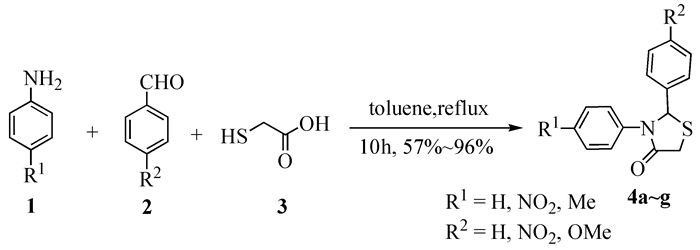
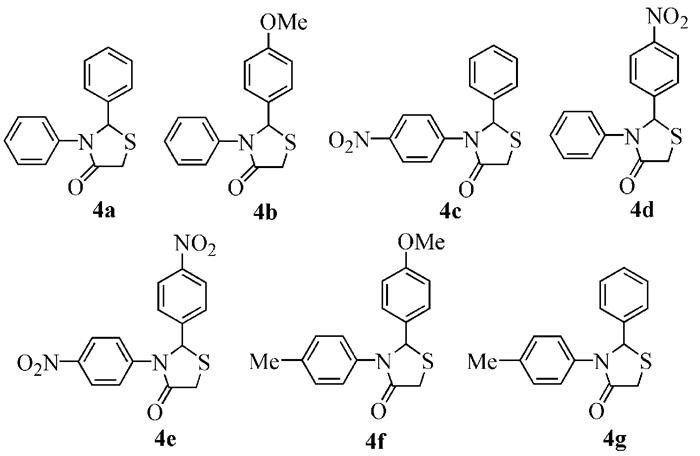
As shown in Scheme 1, 2, 3-diphenyl-4-thiazolidinone derivatives 4a~g (Fig. 1) were synthesized via closing ring reaction of aldehydes, amine, mercaptoacetic acid, and characterized for structural confirmation by 1H NMR, mp and ESI-MS.
Scheme 1
图式 1.
2, 3-二苯基-4-噻唑酮类衍生物的合成路线
Scheme 1.
Synthetic route of 2, 3-diphenyl-4-thiazolidinone derivatives (4a~g)
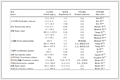
As shown in Tab. 1, most 2, 3-diphenyl-4-thiazolidinones showed the broad spectra of antifungal activities against the seven phytopatho-genic fungi at the concentration of 100μg/mL. For example, compounds 4e and 4g inhibited the growth of F. graminearum by 32.7% and 36.6%, respectively; compounds 4c, 4d and 4g inhibited the growth of A. alternata by 40.4%, 40.18% and 45.0%, respectively; compounds 4b, 4c and 4g inhibited the growth of F. oxysporium f. sp. vasinf-ectum by 44.3%, 43.9% and 55.9%, respe-ctively; compounds 4e and 4g inhibited the growth of P. oryzae by 43.8%and 51.5%, respectively; compounds 4a, 4b, 3c and 4g inhibited the growth of V. mali by 45.0%, 51.8%, 50.3% and 62.7%, respectively; compounds 4d and 4g inhibited the growth of A. solani by 43.6% and 49.1%, respectively; compounds 4d and 4g inhibited the growth of A. brassicae by 36.7% and 37.8%, respectively. Among all the compounds, 4g exhibits the greatest broad spectra of antifungal activities against the above-mentioned seven phytopathogenic fungi, and the percentage inhibitions of 4g on the growth of F. graminearum, A. alternata, F. oxysporium f. sp. vasinfectum, P. oryzae, V. mali, A. solani and A. brassicae were 36.6%, 45.0%, 55.9%, 51.5%, 62.7%, 49.1%, and 37.8%, respectively. Especially, the percentage inhibition of 4g on the growth of V. mali was 62.7%, which surpass the percentage inhibitions (28.6%) of Hymexazol, a commercially available agricultural fungicide.
Table 1
表 1
2, 3-二苯基-4-噻唑酮类衍生物在100μg/mL浓度下的体外抑菌活性
Table 1.
Antifungal activities of 2, 3-diphenyl-4-thiazolidinones against phytopathogenic fungi at 100 μg/mL in vitro
aValues are means of three experiments, standard deviations are given in parentheses; b Control.
Some structure-activity relationships of the 2, 3-diphenyl-4-thiazolidinones against phytopathogenic fungi were observed. When the methyl group were introduced at the phenyl ring of the 3-position of 4a, the inhibition rate was generally increased (4a vs. 4g). However, the introduction of electron-withdrawing group had little influence on inhibition rates (4a vs. 4e).
3.
Conslusion
In conclusion, all the 2, 3-diphenyl-4-thiazoli-dinones 4a~g were evaluated in vitro against F. graminearum, A. alternata, F. oxysporium f. sp. vasinfectum, P. oryzae, V. mali, A. solani and A. brassicae. Compounds 4g exhibits favorable antifu-ngal activity against V. mali at the concentration of 100μg/mL. Their structure-activity relationships shows that the introduction of the methyl group at the phenyl ring of 4-thiazolidinone derivatives can generally increase the inhibition rates.



 下载:
下载:

 下载:
下载: