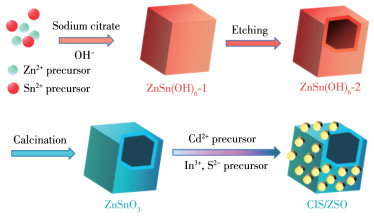
Figure 1.
Schematic diagram of the preparation process of the CIS/ZSO heterostructures

Construction of Z-scheme CdIn2S4/ZnSnO3 heterostructure for photocatalytic hydrogen production performance
Chuan-Tao WANG , Ying-Xian WANG , Li GUO , Zhi-Xiong YANG , Si-Fan ZHOU , Rui DU , Dan-Jun WANG


In recent years, the exploration of clean energy has become a major trend in energy development[1-3]. The more popular areas of research are the continuous development and application of hydrogen energy sources[4]. However, traditional hydrogen energy production methods usually have the disadvantages of high cost, high pollution, and low efficiency, regretfully[5-7]. Therefore, it is urgent to find a new type of pollution - free, low-cost, and high-efficiency hydrogen production strategy[8-10]. Fortunately, photocatalytic hydrogen production technology has been recognized as a new type of high - efficiency hydrogen production technology with great potential[11-15]. It is crucial to design and develop efficient photocatalysts for hydrogen production. In many challenges, developing efficient catalysts for photocatalytic hydrogen production is critical.
ZnSnO3 (ZSO) has been widely studied as a multifunctional material, but in the field of photocatalytic field, its large - scale application has been hampered due to the wide gap, low light utilization, and low efficiency[16-18]. Therefore, researchers have used various methods such as noble metal modification, narrow bandgap semiconductor coupling, ion doping, and other means to improve photocatalytic activity[19-22]. Among them, semiconductor recombination is a research hotspot to improve the photocatalytic efficiency of catalysts[23]. Transition metal sulfides have been extensively studied for photocatalytic hydrogen production reactions. As an efficient narrow band gap photocatalytic material, CdIn2S4 (CIS) is usually combined with the broadband gap photocatalytic material to improve the photocatalytic activity[24-26].
There are very few studies of ZnSnO3 (ZSO)-based semiconductors for photocatalytic hydrogen production[27]. Our synthetic CdIn2S4/ZnSnO3 (CIS/ZSO) heterostructure materials are relatively novel. The rationally designed Z-scheme heterostructure facilitates the separation of photogenerated electrons and holes and significantly increases the photocatalytic efficiency[28-30]. This paper may create a new idea that belongs to the composite of ZSO-based photocatalyst and transition metal sulfide for photocatalytic hydrogen production.
Sodium hydroxide (NaOH, 96.0%) and zinc chloride (ZnCl2, 98.0%) were obtained from Tianjin Kemiou Chemical Reagent Co., Ltd. and Tianjin Tianli Chemical Reagent Co., Ltd. (Tianjin, China), respectively. Absolute alcohol (C2H5OH, 99.7%), cadmium nitrate tetrahydrate (CdN2O6·4H2O, 99.0%), and trisodium citrate dihydrate (Na3C6H5O7·2H2O, 99.0%) were obtained from Tianjin Zhiyuan Chemical Reagent Co., Ltd. (Tianjin, China). Thiourea (CH4N2S, 99.0%) was obtained from Sinopharm Chemical Reagent Co., Ltd. (Shanghai, China). Hydrated stannic chloride (SnCl4 ∙ 5H2O, 99.0%) and indium nitrate hydrate (InN3O9· xH2O) were obtained from Shanghai Aladdin Biochemical Technology Co., Ltd. (Shanghai, China). The deionized water was used as the solvent. All chemicals were analytical grade and used as received.
ZSO was synthesized by a facile calcination method[31]. First, 2 g of SnCl4·5H2O was dispersed in 25 mL of ethanol (EtOH) solution. After the solution was evenly stirred, and 0.5 g of ZnCl2, 0.75 g of Na3C6H5O7·2H2O were dispersed to 50 mL of deionized water. After the solution was evenly stirred, 100 mL of 0.4 mol·L-1 NaOH was dispersed to form solution A. After magnetically stirring for 1 h, the resulting solution was washed several times, and dried overnight in an oven at 70 ℃ to obtain the precursor ZnSn(OH)6-1. Then the previous steps were repeated to obtain solution A. The prepared precursor was dispersed and magnetically stirred for 0.5 h. Then 50 mL of 2 mol·L-1 NaOH solution was dispersed and magnetically stirred for 0.5 h. The resulting solid was washed with deionized water and absolute EtOH several times, then placed in a 70 ℃ oven to dry overnight to obtain the ZnSn(OH)6 - 2. Finally, the obtained sample was calcined in a muffle furnace at 300 ℃ for 3 h.
The CIS/ZSO heterostructures were synthesized by a hydrothermal process[32]. Typically, 0.079 g of CdN2O6·4H2O, 0.077 g of InN3O9·xH2O, and 0.019 g of CH4N2S were dispersed in 30 mL of mixed solution of water and absolute alcohol (1∶1, V/V). After stirring for 0.5 h, the mixture was transferred into a Teflon - lined stainless autoclave. Then, as - prepared ZSO (1 g) was dispersed and stirred for 0.5 h and the mixture maintained at 180 ℃ for 24 h hydrothermally. After the reaction, the mixture was cooled to room temperature, centrifuged, washed with water and EtOH three times, and the solid was finally dried overnight at 70 ℃ to obtain 12% CIS/ZSO (12% meant the molar ratio of CIS to ZSO). Similarly, a series of X% CIS/ZSO (X% meant molar ratios of CIS to ZSO, X=1, 4, 8, 16) can be obtained by changing the amount of CdN2O6·4H2O, InN3O9·xH2O, and CH4N2S. For comparison, pristine CIS and ZSO were also prepared.
The crystal structures of the prepared catalysts were determined with powder X-ray diffraction (XRD, Shimadzu XRD-7000) (Cu Kα irradiation, λ=0.154 18 nm, U=40 kV, I=30 mA, 2θ =10° - 80°). The binding energies of elements can be tested by X-ray photoelectron spectroscopy (XPS, PHI - 5400 (America PE) 250 xi system). The morphological characteristics and microstructure of the catalysts were determined with scanning electron microscopy (SEM, JSM-6700F) under the accelerating voltage of 15 kV and transmission electron microscopy (TEM, JEM-2100) (Japan electronics) under the accelerating voltage of 200 kV. Optical properties were tested by the UV - Vis diffuse reflectance spectra (UV - Vis DRS) (Shimadzu, Japan). The electrochemical properties, including photocurrent density versus time (i-t) curves and electrochemical impedance spectroscopy (EIS), were measured on a CHI660E electrochemical workstation (Chenhua Instruments, China). Photoluminescence (PL) spectra were measured on an F-4600 fluorescence spectrophotometer (Hitachi, Japan). Time - resolved photoluminescence (TR - PL) spectra were conducted on an FLS920 fluorescence spectrometer (Edinburgh Analytical Instruments, UK). The in-situ electron spin resonance (in-situ ESR) signals of the ·OH and ·O2- radicals spin - trapped 5, 5 -dimethyl-1-pyrroline N-oxide (DMPO) as the spin-trap reagent (JEOL JES-FA200).
Photocatalytic H2 evolution experiments were carried out on a sealed Pyrex top-irradiation photoreactor (LabSobar - ⅢAG, Beijing Pect Light Technology Co., Ltd.), using the Xenon lamp (300 W) as a light source for the excitation of photocatalytic materials. Before illumination, high-purity nitrogen (99.999%) was kept feeding and the solution was continuously stirred for 30 min to remove the dissolved oxygen in the photocatalytic system. The 30 mg catalyst was dissolved into 100 mL sacrificial agents, including 100 mL Na2S (0.4 mol·L-1) and Na2SO3 (0.4 mol·L-1) solution, 100 mL triethanolamine (TEOA) aqueous solution (7∶3, V/V), 100 mL methanol (MeOH) aqueous solution (7∶3, V/V), 100 mL EtOH aqueous solution (7∶3, V/V), 100 mL triethylamine (TEA) aqueous solution (7∶3, V/V), and 100 mL deionized water for control experiment, respectively. The generated hydrogen was detected by gas chromatography, and nitrogen was used as carrier gas. The stability experiment was carried out. The apparent quantum yield (AQY) was calculated using the following equation (Eq.1):
|
|
(1) |
Where Nr represents the number of reacted electrons and Ni represents the number of incident photons.
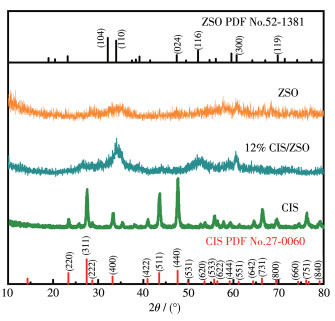
The synthetic route of CIS/ZSO heterostructures was presented in Fig. 1. Firstly, the double-shelled ZSO cubes were synthesized according to the previous report[31]. Then, the CIS nanoparticles were deposited on the surface of ZSO by a hydrothermal method. As shown in XRD patterns of catalysts (Fig. 2 and Fig.S1, Supporting information), the diffraction pattern for ZSO exhibited two broad peaks at 32.1° and 60.6°, respectively, corresponding to (110) and (300) planes of ZSO (PDF No. 52 - 1381). Compared with pristine ZSO, X% CIS/ZSO (X=1, 4, 8, 12, 16) heterostructures exhibited the extra peaks at 27.2°, 43.3°, and 47.4°, respectively, corresponding to (311), (511), and (440) characteristic lattice planes of CIS (PDF No. 27 - 0060) [33]. The XRD results proved that CIS had been successfully coupled with ZSO.
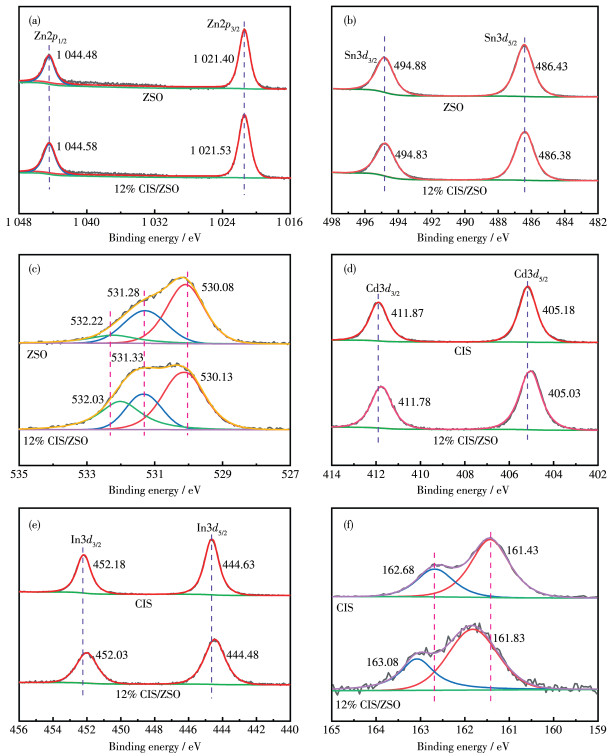
XPS was employed to investigate the surface chemical state and composition of the catalysts[34]. Fig. S2 exhibited the survey spectra of the prepared catalysts, which can determine the elements contained in the samples. As shown in Fig. 3a, the binding energies of Zn2p1/2 and Zn2p3/2 for 12% CIS/ZSO located at 1 044.58 and 1 021.53 eV[35], which are attributed to Zn2+ and slightly shifted compared with pristine ZSO. The binding energies of 494.88 and 486.43 eV, 494.83 and 486.38 eV corresponded to Sn3d3/2 and Sn3d5/2 for ZSO and 12% CIS/ZSO heterostructure, respectively, which are assigned to Sn2+ [36], as shown in Fig. 3b. For CIS/ZSO heterostructure, the binding energy of Sn2+ shifted to a certain extent after the coupling of CIS. As shown in Fig. 3c, the O1s binding energy of 12% CIS/ZSO may be fitted into 530.13, 531.33, and 532.03 eV, respectively, corresponding to lattice and absorbed oxygen species[37]. The XPS peak of Cd3d3/2 and Cd3d5/2 for 12% CIS/ZSO were located at 411.78 and 405.03 eV, respectively, which can be assigned to Cd2+ (Fig. 3d) [38]. The In3d XPS binding energy was located at 444.48 and 452.03 eV (Fig. 3e), which can be assigned to In3d5/2 and In3d3/2 of 12% CIS/ZSO[39]. The binding energy of S2p for 12% CIS/ZSO was also found at 163.08 and 161.83 eV (Fig. 3f), respectively, which belonged to S2- [40]. The above XPS analysis proved that CIS and ZSO were successfully compounded, and the formed heterostructure promoted the interface charge transfer between the two pristine components.
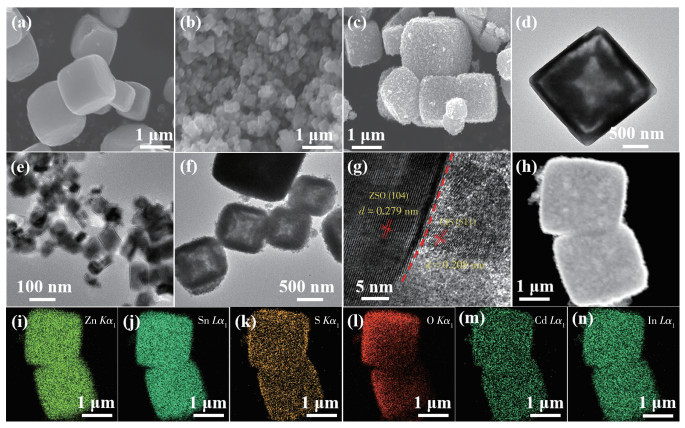
The morphologies of the prepared samples were characterized by SEM, TEM, and high-resolution TEM (HR-TEM). Fig. 4a-4c are the SEM images of the prepared samples[41-43]. The pristine ZSO exhibited a double-shell cubic structure, and the CIS exhibited an octahedral structure (Fig. 4a, 4b). In the CIS/ZSO heterostructure, CIS nanoparticles covered the surface of the ZSO cube, which proved the successful preparation of CIS and ZSO (Fig. 4c). The morphology of the prepared catalysts was further investigated by TEM (Fig. 4d-4f). As shown in Fig. 4d-4f, ZSO possessed a novel double - shell hollow cubic structure, and CIS exhibited a clear nanocrystalline structure. At the same time, the surface of ZSO was covered by CIS nanoparticles in the heterostructure (Fig. 4f), which was further confirmed by HR - TEM. The lattice fringes d- spacing of 0.208 and 0.279 nm corresponded to the (511) plane of CIS and (104) plane of ZSO, respectively (Fig. 4g), which are in good agreement with those calculated from the XRD results. Moreover, the EDS mapping images (Fig. 4h-4n) indicated that Zn, Sn, O, Cd, In, and S elements were uniformly distributed on the surface of CIS/ZSO.
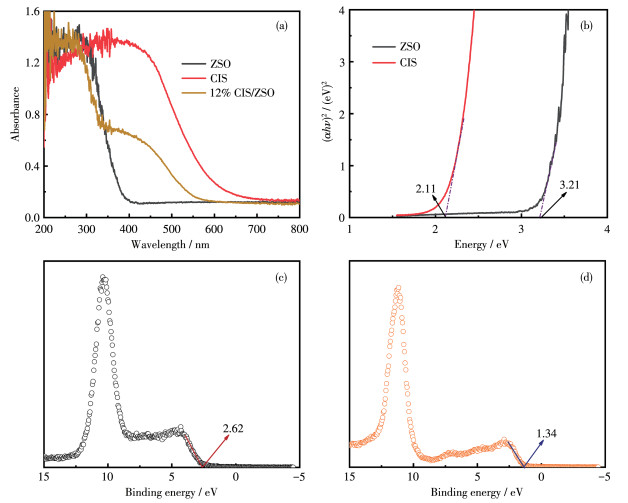
The optical properties of the prepared photocatalysts were studied by UV - Vis DRS[44]. As shown in Fig. 5a, the CIS/ZSO heterostructure had a red shift compared with pristine ZSO, which enhanced the light response range. And pristine ZSO had a basic absorption edge of 386 nm and poor light response capability. Compared with pristine ZSO, the prepared CIS/ZSO heterostructure had an expanded visible light absorption range and produced more photogenerated carriers. As shown in Fig. 5b, the band gap (Eg) was estimated from a plot of (αhν)2 versus hν[45]. The band gaps of CIS and ZSO were calculated as 2.11 and 3.21 eV, respectively. Fig. 5c and 5d showed the valence band (VB) - XPS results, which indicated that the valence band maximum (VBM) of ZSO and CIS were 2.62 and 1.34 V, respectively. Using the empirical formula, EVBM= ECBM+Eg, the conduction band minimum (CBM) of ZSO and CIS was estimated to be -0.04 and -0.78 V, respectively. Thus the band structure of the heterostructure can be determined.
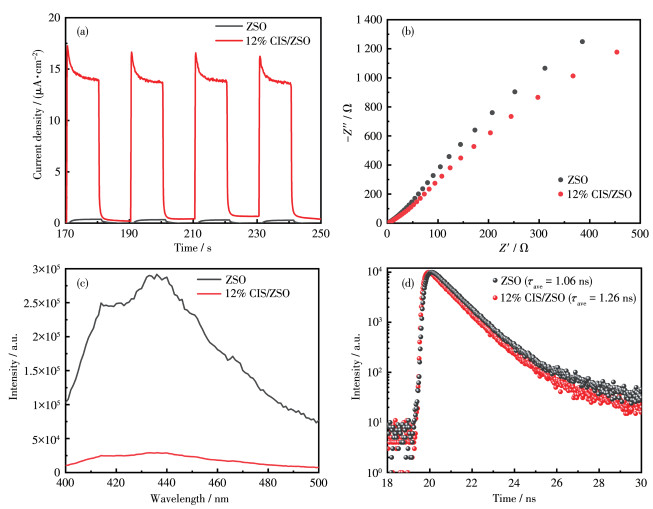
As shown in Fig. 6a, the ZSO electrode showed negligible photocurrent response due to the rapid charge recombination, while the 12% CIS/ZSO electrode showed a considerably increased photocurrent response, indicating that the CIS/ZSO heterostructure can effectively suppress the charges recombination. The origin of the enhanced charge separation efficiency was further studied by EIS measurement. As depicted in Fig. 6b, 12% CIS/ZSO exhibited a much smaller semicircle diameter than ZSO, suggesting a reduced charge transfer resistance at the interface between ZSO and CIS, which is favorable to enhance the charge separation efficiency of the CIS/ZSO photocatalyst. The PL spectrum was used to evaluate the separation efficiency of photogenerated carriers of the photocatalyst. The PL intensity of 12% CIS/ZSO heterostructure was weaker than ZSO (Fig. 6c), indicating that the loading of CIS promotes the effective separation of photogenerated electrons and holes. Moreover, the average fluorescent lifetimes (τave) of 12% CIS/ZSO and ZSO were determined to be 1.26 and 1.06 ns (Fig. 6d), evidencing that the construction of heterostructure can effectively accelerate the charges separation efficiency.
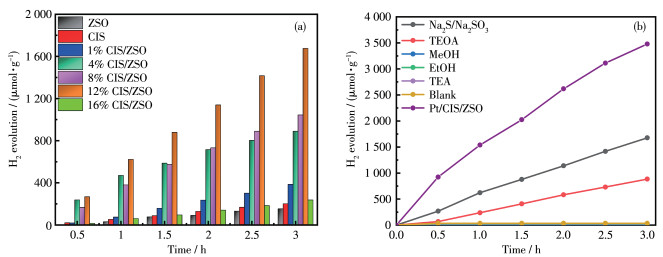
Photocatalytic hydrogen production of various related catalysts was evaluated. Whether compared to pristine CIS or ZSO, the heterostructures had better photocatalytic hydrogen production activity[46-49]. Fig. 7a showed the increase in the amount of hydrogen generated by pristine ZSO, CIS, and X% CIS/ZSO heterostructures under simulated sunlight with the change of irradiation time. It is worth noting that when a load of CIS increased from 1% to 12%, the amount of hydrogen generated increased from 385.35 to 1 676.48 μmol·g-1, which is owing to the addition of CIS significantly promotes the photogenic carrier separation ability of ZSO and improves the optical response range. However, the activity decreased significantly when the loading increased to 16%, which may be due to the recombination of photo-generated charge carriers that prevent the process of photocatalytic performance. Simultaneously, the influence of different sacrificial agents (Na2S/ Na2SO3, TEOA, MeOH, EtOH, and TEA) on the photocatalytic hydrogen production activity was studied, which contained abundant proton sources. As shown in Fig. 7b, sulfate as the sacrificial agent had the best effect on hydrogen evolution. When S2-/SO32- was used as a sacrificial donor, it could be protonation. For example, the dissolved Na2S formed SH- (alkaline aqueous solution) (Eq.2). Simultaneously, SH- was oxidized to form hydrogen (Eq.3) [50]. Therefore, in the choice of sacrificial agent, Na2S/Na2SO3 has the advantage.
|
|
(2) |
|
|
(3) |
When TEOA was used as a sacrificial donor, the HER activity was lower than using Na2S/Na2SO3. Surprisingly, when MeOH, EtOH, and TEA were used as sacrificial agents, hydrogen production was almost negligible. Furthermore, the HER activity of the photocatalyst was related to the oxidation potential of the hole scavenger[51]. The driving force of the hole scavenging was the largest for the hole scavenger with the greater oxidation potential. Among the selected hole scavengers, S2-/SO32- had the high oxidation potential with an electronic energy level at -3.0 V, followed by TEOA at -3.4 V, MeOH at -4.5 V, EtOH at -4.6 V, and TEA at -5.1 V vs vacuum[52-53]. It is obvious that using S2- or SO32- as sacrificial reagents instead of alcohols is advantageous because they are more easily oxidizable than alcohols. Accordingly, using Na2S/Na2SO3 as sacrificial reagents CdS/ZSO exhibited the best HER activity than others. Furthermore, the presence of H2Pt2Cl6· 3H2O significantly boosted the HER activity of CIS/ ZSO heterostructure, achieving higher HER activity (3 479.04 μmol·g-1).
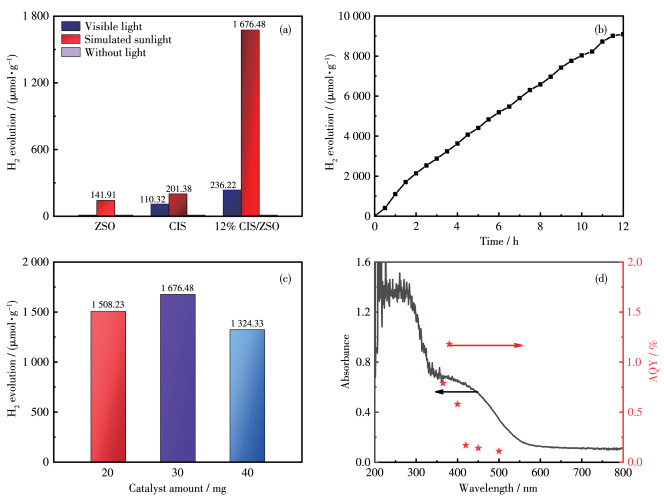
Furthermore, using different light sources to evaluate the photocatalytic hydrogen production activity of the catalyst (Fig. 8a). Photocatalytic performance was optimal in simulated light. And the long-time test was carried out, which showed that the heterostructure had excellent stability (Fig. 8b). The amount of catalyst used to determine the optimal HER activity was 30 mg (Fig. 8c). As shown in Fig. 8d, 12% CIS/ZSO heterostructure photocatalyst presented excellent AQY of 1.18% at the wavelength of 420 nm. In addition, XRD, XPS, and SEM of 12% CIS/ZSO after irradiation were also investigated (Fig. S3). It showed that the phase structure and composition can be well maintained, confirming the excellent stability of 12% CIS/ZSO heterostructure.
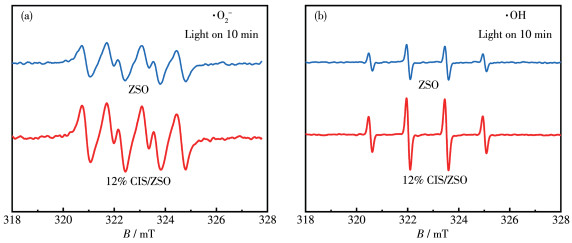
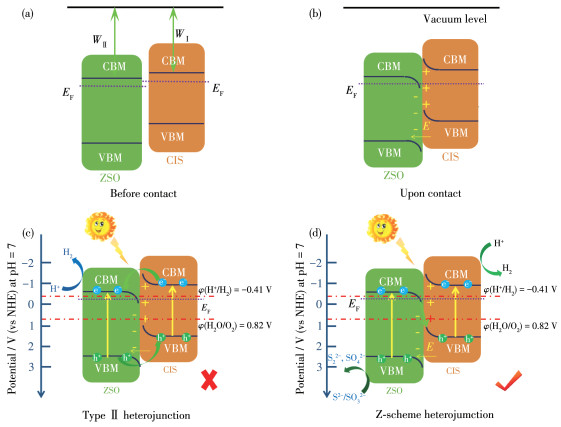
Based on the VBM and CBM positions of CIS and ZSO described above, the charge transfer between two semiconductors may follow a type Ⅱ or Z - scheme mechanism. To further demonstrate the catalytic mechanism of CIS/ZSO photocatalyst, the in - situ ESR was conducted to probe the main active species in the process of photogenerated carrier transfer by employing DMPO as a trapping agent. As expected, the prepared catalysts detected two signal peaks, which presented a standard four peak with a peak height ratio of 1∶2∶2∶1 and 1∶1∶1∶1, which were consistent with the literature reports[54]. The ESR signal of CIS/ZSO was stronger than pristine ZSO, which indicated the formation of heterostructure enhanced effectively the separation efficiency of photogenerated electron and hole pairs, and the photocatalytic hydrogen production performance was improved (Fig. 9 and S4). According to the traditional type Ⅱ mechanism analysis, the holes in the VBM of ZSO were transferred to the VBM of CIS. H2O or OH- cannot be oxidized to ·OH by the holes in VBM of CIS (1.34 V vs NHE) due to it was more negative than E(·OH/H2O) (2.27 V vs NHE) and E(·OH/OH-) (1.99 V vs NHE). However, the results of ESR verified the obvious signals of ZSO and CIS/ZSO for producing ·OH, indicating that the charge transfer in CIS/ZSO prefers to be a Z-scheme rather than a type Ⅱ mechanism.
Furthermore, according to the calculated work function (W) in Fig. S5, the work function of ZSO was larger than CIS, on the contrary, the Fermi level (EF) of ZSO was lower than CIS (Fig. 10a). Therefore, after the contact between the two semiconductors, the electrons will transfer from CIS to ZSO until the Fermi level reaches equilibrium[55-56]. As a result, CIS lost electrons and became positively charged, while ZSO gained electrons with negative charges, which can generate an internal electric field at the interface (Fig. 10b). Meanwhile, the energy band of CIS bent upward due to the loss of electrons, while that of ZSO bent downward caused by the accumulation of electrons[57]. The VB electrons of CIS and ZSO were excited and transited to the conduction band under simulated sunlight. As mentioned above, the electrons transfer between ZSO and CIS does not follow the traditional type Ⅱ mechanism where holes in the VBM of ZSO are transferred to the VBM of CIS (Fig. 10c). Therefore, under the action of the built-in electric field, the electrons in the CBM of ZSO recombined with the holes in the VBM of CIS (Fig. 10d). Meanwhile, in the influence of these factors, the photogenerated carriers separation efficiency of CIS and ZSO was greatly improved. The electron and hole transfer process enables CIS/ZSO composite heterostructure to have strong redox ability and realized photocatalytic water splitting for hydrogen production. The above results further confirm that charge transfer in CIS/ZSO heterojunction follows the Z - scheme mechanism.
In summary, CIS/ZSO heterostructures were synthesized by hydrothermal method, and the CIS/ZSO heterostructures improved the visible light response range, conspicuously. After 3 h, the hydrogen production of 12% CIS/ZSO can reach 1 676.48 μmol·g-1 under the simulated sunlight irradiation, and the corresponding long-time test also proves the stability of the catalyst. The better photocatalytic hydrogen production performance of the prepared heterostructure compared with the pristine catalysts may be due to the accelerated separation of photogenic carriers and the wider range of visible light response. The work may open up new ways to synthesize photocatalysts that efficiently use solar energy to produce hydrogen.
Supporting information is available at
Bie C B, Wang L X, Yu J G. Challenges for photocatalytic overall water splitting[J]. Chem, 2022, 8(6): 1567-1574. doi: 10.1016/j.chempr.2022.04.013
Villa K, Galán-Mascarós J R, López N, Palomares E. Photocatalytic water splitting: Advantages and challenges[J]. Sustain. Energ. Fuels, 2021, 5(18): 4560-4569. doi: 10.1039/D1SE00808K
Wang L, Wan Y Y, Ding Y J, Wu S K, Zhang Y, Zhang X L, Zhang G Q, Xiong Y J, Wu X J, Yang J L, Xu H X. Conjugated microporous polymer nanosheets for overall water splitting using visible light[J]. Adv. Mater, 2017, 29(38): 1702428. doi: 10.1002/adma.201702428
Dawood F, Anda M, Shafiullah G M. Hydrogen production for energy: An overview[J]. Int. J. Hydrog. Energy, 2020, 45(7): 3847-3869. doi: 10.1016/j.ijhydene.2019.12.059
Stegbauer L, Schwinghammer K, Lotsch B V. A hydrazone-based covalent organic framework for photocatalytic hydrogen production[J]. Chem. Sci, 2014, 5(7): 2789-2793. doi: 10.1039/C4SC00016A
Ruan Q, Luo W J, Xie J J, Wang Y O, Liu X, Bai Z M, Carmalt C J, Tang J W. A nanojunction polymer photoelectrode for efficient charge transport and separation[J]. Angew. Chem. Int. Ed, 2017, 56(28): 8221-8225. doi: 10.1002/anie.201703372
Zhang G G, Lan Z A, Lin L H, Lin S, Wang X C. Overall water splitting by Pt/gC3N4 photocatalysts without using sacrificial agents[J]. Chem. Sci, 2016, 7(5): 3062-3066. doi: 10.1039/C5SC04572J
操振宇, 吴耘, 高建华. Bi9P2O18Cl的相变及其可见光催化水产氢[J]. 无机化学学报, 2022,38,(5): 969-976. CAO Z Y, WU Y, GAO J H. Bi9P2O18Cl: Phase transition and hydrogen production by photocatalytic water-splitting[J]. Chinese J. Inorg. Chem, 2022, 38(5): 969-976.
祖雯琳, 李莉, 黄继玮, 孙英茹, 马凤延, 曹艳珍. AgIn5S8/碳量子点/ZnIn2S4的多途径电子迁移与光催化性能[J]. 无机化学学报, 2022,38,(6): 1059-1072. ZU W L, LI L, HUANG J W, SUN Y R, MA F Y, CAO Y Z. Multipathway photoelectron migration and photocatalytic properties of AgIn5S8/carbon quantum dots/ZnIn2S4[J]. Chinese J. Inorg. Chem, 2022, 38(6): 1059-1072.
Mu J L, Teng F, Miao H, Wang Y S, Hu X Y. In-situ oxidation fabrication of 0D/2D SnO2/SnS2 novel step-scheme heterojunctions with enhanced photoelectrochemical activity for water splitting[J]. Appl. Surf. Sci, 2020, 501: 143974. doi: 10.1016/j.apsusc.2019.143974
Ng B J, Putri L K, Tan L L, Pasbakhsh P, Chai S P. All-solid-state Z-scheme photocatalyst with carbon nanotubes as an electron mediator for hydrogen evolution under simulated solar light[J]. Chem. Eng. J, 2017, 316: 41-49. doi: 10.1016/j.cej.2017.01.054
Xia P F, Cao S W, Zhu B C, Liu M J, Shi M S, Yu J G, Zhang Y F. Designing 0D/2D S-scheme heterojunction over polymeric carbon nitride for visible-light photocatalytic inactivation of bacteria[J]. Angew. Chem. Int. Ed, 2020, 59(13): 5218-5225. doi: 10.1002/anie.201916012
Weng B, Qi M Y, Han C, Tang Z R, Xu Y J. Photocorrosion inhibition of semiconductor-based photocatalysts: Basic principle, current development, and future perspective[J]. ACS Catal, 2019, 9: 4642-4687. doi: 10.1021/acscatal.9b00313
唐玉朋, 赵燕飞, 杨海英, 李楠. 能量最低构型Ca2B4团簇的储氢性能[J]. 无机化学学报, 2022,38,(7): 1391-1401. TANG Y P, ZHAO Y F, YANG H Y, LI N. Hydrogen storage capa-bilities of the low-lying Ca2B4 clusters[J]. Chinese J. Inorg. Chem, 2022, 38(7): 1391-1401.
Weng B, Lu K Q, Tang Z C, Chen H M, Xu Y J. Stabilizing ultrasmall Au clusters for enhanced photoredox catalysis[J]. Nat. Commun, 2018, 9(1): 1543. doi: 10.1038/s41467-018-04020-2
Beshkar F, Amiri O, Salehi Z. Synthesis of ZnSnO3 nanostructures by using novel gelling agents and their application in degradation of textile dye[J]. Sep. Purif. Technol, 2017, 184: 66-71. doi: 10.1016/j.seppur.2017.04.024
Guo R J, Tian R, Shi D L, Li H, Liu H Z. S-doped ZnSnO3 nanoparticles with narrow band gaps for photocatalytic wastewater treatment[J]. ACS Appl. Nano Mater, 2019, 2(12): 7755-7765. doi: 10.1021/acsanm.9b01804
Guo R J, Guo Y P, Duan H N, Li H, Liu H Z. Synthesis of orthorhombic perovskite-type ZnSnO3 single-crystal nanoplates and their application in energy harvesting[J]. ACS Appl. Mater. Interfaces, 2017, 9(9): 8271-8279. doi: 10.1021/acsami.6b16629
Lim W Y, Hong M H, Ho G W. In situ photo-assisted deposition and photocatalysis of ZnIn2S4/transition metal chalcogenides for enhanced degradation and hydrogen evolution under visible light[J]. Dalton Trans, 2016, 45(2): 552-560. doi: 10.1039/C5DT03775A
Han C, Yang M Q, Weng B, Xu Y J. Improving the photocatalytic activity and anti-photocorrosion of semiconductor ZnO by coupling with versatile carbon[J]. Chem. Chem. Phys, 2014, 16(32): 16891-16903. doi: 10.1039/C4CP02189D
潘良峰, 阎鑫, 王超莉, 谢铭, 李卓, 艾涛, 牛艳辉. 中空管状g-C3N4/Ag3PO4复合催化剂的制备及其可见光催化性能[J]. 无机化学学报, 2022,38,(4): 695-704. PAN L F, YAN X, WANG C L, XIE M, LI Z, AI T, NIU Y H. Preparation and visible light photocatalytic activity of hollow tubular g-C3N4/Ag3PO4 composite catalyst[J]. Chinese J. Inorg. Chem, 2022, 38(4): 695-704.
Luo J H, Lin Z X, Zhao Y, Jiang S J, Song S Q. The embedded CuInS2 into hollow-concave carbon nitride for photocatalytic H2O splitting into H2 with S-scheme principle[J]. Chinese J. Catal, 2020, 41(1): 122-130. doi: 10.1016/S1872-2067(19)63490-X
Li H Q, Cui Y M, Hong W S, Xu B L. Enhanced photocatalytic activities of BiOI/ZnSn(OH)6 composites towards the degradation of phenol and photocatalytic H2 production[J]. Chem. Eng. J, 2013, 228: 1110-1120. doi: 10.1016/j.cej.2013.05.086
Wu T, Zhang Q, Hou Y, Wang L, Mao C Y, Zheng S T, Bu X H, Feng P Y. Monocopper doping in Cd-In-S supertetrahedral nanocluster via two-step strategy and enhanced photoelectric response[J]. J. Am. Chem. Soc, 2013, 135(28): 10250-10253. doi: 10.1021/ja404181c
Dhandole L K, Mahadik M A, Chung H S, Chae W C, Cho M, Jang J S. CdIn2S4 chalcogenide/TiO2 nanorod heterostructured photoanode: An advanced material for photoelectrochemical applications[J]. Appl. Surf. Sci, 2019, 490: 18-29. doi: 10.1016/j.apsusc.2019.05.222
Song J P, Yin P F, Mao J, Qiao S Z, Du X W. Catalytically active and chemically inert CdIn2S4 coating on a CdS photoanode for efficient and stable water splitting[J]. Nanoscale, 2017, 9(19): 6296-6301. doi: 10.1039/C7NR01170A
Zhang M Y, Hu Q Y, Ma K, Ding Y, Li C. Pyroelectric effect in CdS nanorods decorated with a molecular Co-catalyst for hydrogen evolution[J]. Nano Energy, 2020, 73: 104810. doi: 10.1016/j.nanoen.2020.104810
Liao G F, Li C X, Liu S Y, Fang B Z, Yang H M. Emerging frontiers of Z-scheme photocatalytic systems[J]. Trends Chem, 2022, 4(2): 111-127. doi: 10.1016/j.trechm.2021.11.005
Li X Y, Sun H B, Xie Y Y, Liang Y S, Gong X M, Qin P F, Jiang L B, Guo J Y, Liu C, Wu Z B. Principles, synthesis and applications of dual Z-scheme photocatalysts[J]. Coord. Chem. Rev, 2022, 467: 214596. doi: 10.1016/j.ccr.2022.214596
Wang S, Zhu B C, Liu M J, Zhang L Y, Yu J G, Zhou M H. Direct Z-scheme ZnO/CdS hierarchical photocatalyst for enhanced photocatalytic H2-production activity[J]. Appl. Catal. B-Environ, 2019, 243: 19-26. doi: 10.1016/j.apcatb.2018.10.019
Dong S Y, Cui L F, Zhang W, Xia L J, Zhou S J, Russell C K, Fan M H, Feng J L, Sun J H. Double-shelled ZnSnO3 hollow cubes for efficient photocatalytic degradation of antibiotic wastewater[J]. Chem. Eng. J, 2020, 384: 123279. doi: 10.1016/j.cej.2019.123279
Peng Z Y, Jiang Y H, Xiao Y, Xu H Q, Zhang W L, Ni L. CdIn2S4 surface-decorated Ta3N5 core-shell heterostructure for improved spatial charge transfer: In-situ growth, synergistic effect and efficient dual-functional photocatalytic performance[J]. Appl. Surf. Sci, 2019, 487: 1084-1095. doi: 10.1016/j.apsusc.2019.05.163
Li X, Jiang H P, Ma C C, Zhu Z, Song X H, Li X Y, Wang H Q, Huo P W, Chen X B. Construction of a multi-interfacial-electron transfer scheme for efficient CO2 photoreduction: A case study using CdIn2S4 micro-flower spheres modified with Au nanoparticles and reduced graphene oxide[J]. J. Mater. Chem. A, 2020, 8(36): 18707-18714. doi: 10.1039/D0TA06602H
Wu H J, Li C M, Che H N, Hu H, Hu W, Liu C B, Ai J Z, Dong H J. Decoration of mesoporous Co3O4 nanospheres assembled by monocrystal nanodots on g-C3N4 to construct Z-scheme system for improving photocatalytic performance.[J]. Appl. Surf. Sci, 2018, 440: 308-319. doi: 10.1016/j.apsusc.2018.01.134
Chong W K, Ng B J, Kong X Y, Tan L L, Putri L K, Chai S P. Nonmetal doping induced dual p-n charge properties in a single ZnIn2S4 crystal structure provoking charge transfer behaviors and boosting photocatalytic hydrogen generation[J]. Appl. Catal. B-Environ, 2023, 325: 122372. doi: 10.1016/j.apcatb.2023.122372
Deng D, Lee J Y. Hollow core-shell mesospheres of crystalline SnO2 nanoparticle aggregates for high capacity Li+ ion storage[J]. Chem. Mater, 2008, 20(5): 1841-1846. doi: 10.1021/cm7030575
Zhang Y C, Du Z N, Li K W, Zhang M, Dionysiou D D. High-performance visible-light-driven SnS2/SnO2 nanocomposite photocatalyst prepared via in situ hydrothermal oxidation of SnS2 nanoparticles[J]. ACS Appl. Mater. Interfaces, 2011, 3(5): 1528-1537. doi: 10.1021/am200102y
Li S S, Wang L, Li Y D, Zhang L H, Wang A X, Xiao N, Gao Y Q, Li N, Song W Y, Ge L, Liu J. Novel photocatalyst incorporating Ni-Co layered double hydroxides with P-doped CdS for enhancing photocatalytic activity towards hydrogen evolution[J]. Appl. Catal. B-Environ, 2019, 254: 145-155. doi: 10.1016/j.apcatb.2019.05.001
Dai M, He Z L, Zhang P, Li X, Wang S G. ZnWO4-ZnIn2S4 S-scheme heterojunction for enhanced photocatalytic H2 evolution[J]. J. Mater. Sci. Technol, 2022, 122: 231-242. doi: 10.1016/j.jmst.2022.02.014
Zhang J Y, Wang Y H, Jin J, Zhang J, Zhang L, Huang F, Yu J G. Efficient visible-light photocatalytic hydrogen evolution and enhanced photostability of core/shell CdS/g-C3N4 nanowires[J]. ACS Appl. Mater. Interfaces, 2013, 5(20): 10317-10324. doi: 10.1021/am403327g
Shen H Q, Wang J X, Jiang J H, Luo B F, Mao B D, Shi W D. All-solid-state Z-scheme system of RGO-Cu2O/Bi2O3 for tetracycline degradation under visible-light irradiation[J]. Chem. Eng. J, 2017, 313: 508-517. doi: 10.1016/j.cej.2016.11.161
Li C M, Yu S Y, Wang Y, Han J, Dong H J, Chen G. Fabrication, physicochemical properties and photocatalytic activity of Ag0.68V2O5hierarchical architecture assembled by ultrathin nanosheets[J]. J. Taiwan Inst. Chem. Eng, 2018, 87: 272-280. doi: 10.1016/j.jtice.2018.03.055
Chen F, Li D, Luo B F, Chen M, Shi W D. Two-dimensional hetero-junction photocatalysts constructed by graphite-like C3N4 and Bi2WO6 nanosheets: Enhanced photocatalytic activities for water purification[J]. J. Alloy. Compd, 2017, 694: 193-200. doi: 10.1016/j.jallcom.2016.09.326
Reddy D, Kim E H, Gopannagari M, Ma R, Bhavaniet P, Kumar D, Kim T K. Enhanced photocatalytic hydrogen evolution by integrating dual co-catalysts on heterophase CdS nano-junctions[J]. ACS Sustain. Chem. Eng, 2018, 6(10): 12835-12844. doi: 10.1021/acssuschemeng.8b02098
Zou Y J, Shi J W, Ma D D, Fan Z Y, Niu C M, Wang L Z. Fabrication of g-C3N4/Au/C-TiO2 hollow structure as visible-light-driven Z-scheme photocatalyst with enhanced photocatalytic H2 evolution[J]. ChemCatChem, 2017, 9(19): 3752-3761. doi: 10.1002/cctc.201700542
Chen X B, Shen S H, Guo L J, Mao S S. Semiconductor-based photocatalytic hydrogen generation[J]. Chem. Rev, 2010, 110(11): 6503-6570. doi: 10.1021/cr1001645
Ren Y Y, Li Y, Wu X Y, Wang J L, Zhang G K. S-scheme Sb2WO6/g-C3N4 photocatalysts with enhanced visible-light-induced photocatalytic NO oxidation performance[J]. Chinese J. Catal, 2021, 42(1): 69-77. doi: 10.1016/S1872-2067(20)63631-2
Xie Q, He W M, Liu S W, Li C H, Zhang J F, Wong P K. Bifunctional S-scheme g-C3N4/Bi/BiVO4 hybrid photocatalysts toward artificial carbon cycling[J]. Nat. Commun, 2020, 41(1): 140-153.
Xu F Y, Meng K, Cheng B, Wang S Y, Xu J S, Yu J G. Unique S-scheme heterojunctions in self-assembled TiO2/CsPbBr3 hybrids for CO2 photoreduction[J]. Nat. Commun, 2020, 11(1): 4613. doi: 10.1038/s41467-020-18350-7
Muradov N Z, Rustamov M I, Guseinova A D, Bazhutin Y V. Photocatalytic production of hydrogen from H2S solutions over CdS/Pt colloids[J]. React. Kinet. Catal. Lett, 1987, 33(2): 279-283. doi: 10.1007/BF02128076
Wen Y H, Zhang H M, Qian P, Zhou H T, Zhao P, Yi B L, Yang Y S. A study of the Fe(Ⅲ)/Fe(Ⅱ)-triethanolamine complex redox couple for redox flow battery application[J]. Electrochim. Acta, 2006, 51(18): 3769-3775. doi: 10.1016/j.electacta.2005.10.040
Berr M J, Wagner P, Fischbach S, Vaneski A, Schneider J. Hole scavenger redox potentials determine quantum efficiency and stability of Pt-decorated CdS nanorods for photocatalytic hydrogen generation[J]. Appl. Phys. Lett, 2012, 100(22): 223903. doi: 10.1063/1.4723575
Lin W C, Jayakumar J, Chang C L, Ting L Y, Elsayed M H, Abdellah M, Zheng K B, Elewa A M, Lin Y T, Liu J J, Wang W S, Lu C Y, Chou H H. Effect of energy bandgap and sacrificial agents of cyclo-pentadithiophene-based polymers for enhanced photocatalytic hydrogen evolution[J]. Appl. Catal. B-Environ, 2021, 298: 120577. doi: 10.1016/j.apcatb.2021.120577
Xia P F, Cao S W, Zhu B C, Liu M j, Shi M S, Yu J G, Zhang Y F. Designing a 0D/2D S-scheme heterojunction over polymeric carbon nitride for visible-light photocatalytic inactivation of bacteria[J]. Angew. Chem. Int. Ed, 2020, 59(13): 5218-5225. doi: 10.1002/anie.201916012
Jia X M, Han Q F, Liu H Z, Li S Z, Bi H P. A dual strategy to construct flowerlike S-scheme BiOBr/BiOAc1-xBrx heterojunction with enhanced visible-light photocatalytic activity[J]. Chem. Eng. J, 2020, 399: 125701. doi: 10.1016/j.cej.2020.125701
Wang C T, Dang Y C, Pang X X, Zhang L, Bian Y J, Duan W, Yang C M, Zhen Y Z, Fu F. A novel S-scheme heterojunction based on 0D/3D CeO2/Bi2O2CO3 for the photocatalytic degradation of organic pollutants[J]. New J. Chem, 2022, 46: 15987. doi: 10.1039/D2NJ03192B
Wang Y X, Yang C M, Guo L, Yang Z X, Jin B B, Du R, Fu F, Wang D J. Plate-on-plate structured MoS2/Cd0.6Zn0.4S Z-scheme heterostructure with enhanced photocatalytic hydrogen production activity via hole sacrificial agent synchronously strengthen half-reactions.[J]. J. Colloid Interface Sci, 2023, 630: 341-351. doi: 10.1016/j.jcis.2022.10.053

Figure 3 High-resolution XPS spectra of (a) Zn2p, (b) Sn3d, (c) O1s, (d) Cd3d, (e) In3d, and (f) S2p for the samples

Figure 4 SEM images of (a) ZSO, (b) CIS, and (c) 12% CIS/ZSO; TEM images of (d) ZSO, (e) CIS, and (f) 12% CIS/ZSO; (g) HR-TEM image of 12% CIS/ZSO; (h) Spatial distribution of all the elements in 12% CIS/ZSO, and elemental mappings of (i) Zn, (j) Sn, (k) S, (l) O, (m) Cd, and (n) In

Figure 5 (a) UV-Vis DRS of ZSO, CIS, and 12% CIS/ZSO; (b) Plots of (αhν)2 vs hν for ZSO and CIS; VB-XPS spectra of (c) ZSO and (d) CIS

Figure 6 (a) Transient photocurrent response, (b) EIS, (c) PL spectra, and (d) TR-PL spectra of ZSO and 12% CIS/ZSO

Figure 7 (a) Hydrogen production activity of X% CIS/ZSO (X=1, 4, 8, 12, 16), ZSO, and CIS under simulated solar light; (b) Photocatalytic H2 evolution of 12% CIS/ZSO in different sacrificial agents and Pt/CIS/ZSO using Na2S/Na2SO3 as sacrificial agent

Figure 8 (a) Hydrogen production activity of ZSO, CIS, and 12% CIS/ZSO under visible light, simulated sunlight, and without light irradiation for 3 h; (b) 12 h hydrogen production test of 12% CIS/ZSO; (c) Optimization of 12% CIS/ZSO dosage; (d) Wavelength dependent AQY of H2 evolution over 12% CIS/ZSO and UV-Vis absorption spectrum of 12% CIS/ZSO

Figure 9 ESR spectra of (a) DMPO-·O2- trapping and (b) DMPO-·OH trapping of the as-prepared catalysts under the illumination

 扫一扫看文章


扫一扫关注我们
 下载:
下载:

 下载:
下载:

