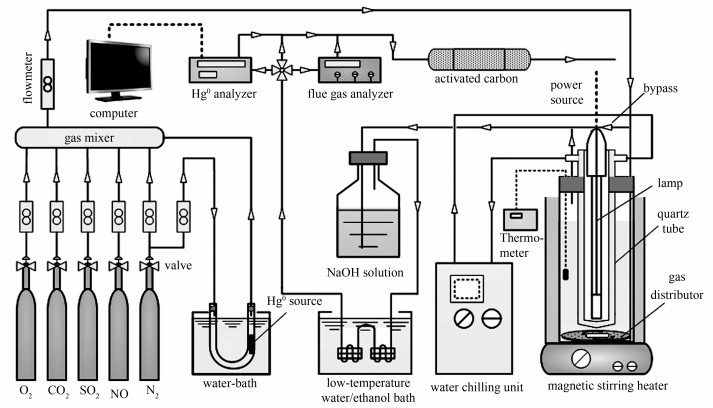
图 1
Schematic diagram of the experimental setup
Figure 1.
Schematic diagram of the experimental setup

Effects of experimental parameters on Hg0 removal over magnetic AgI-BiOI/CoFe2O4 photocatalysts using wet process
Li-xiang ZHANG , An-chao ZHANG , Qi-feng ZHU , Hua WANG , Chun-jing ZHANG


Mercury is considered a major air pollutant because of its toxicity and bioaccumulation[1, 2]. Currently, coal-fired power plant has been the largest single-known source of anthropogenic mercury emissions in the world. In China, coal constitutes about 70% of the total primary energy consumption[3]. For controlling and reducing mercury emission, the Ministry of Environmental Protection of China issued a new pollution discharge standard in 2011 and specified the emission limits of mercury and its compounds from coal-fired flue gas[4]. There are three forms of mercury in flue gas: elemental mercury vapor (Hg0), oxidized mercury (Hg2+) and particulate-bound mercury (Hgp)[5]. Among them, Hg0 is the most difficult to capture because of its high volatility and poor solubility in water. Thus, it is highly desirable to develop novel and efficient methods to remove Hg0 from flue gas in coal-fired power plant.
During the past two decades, considerable efforts have been undertaken to remove Hg0. Some materials including activated carbon[6] and metal oxide[7] all have been widely explored. However, there were still some crucial drawbacks that restrained their practical applications, including the high cost and low adsorption and oxidation efficiency. Recently, photocatalytic oxidation (PCO) technique for Hg0 removal using TiO2 as photocatalyst has been extensively investigated to convert Hg0 to Hg2+ in simulated flue gas[8-11]. When TiO2 was irradiated under ultraviolet (UV) light, the electrons would be photoexcited from the valence band (VB) to the conduction band (CB), generating electron-hole (e--h+) pairs that can recombine or initiate redox reactions. The e- could reduce O2 adsorbed on the material surface to generate superoxide radicals (·O2-), while the h+ could be trapped by H2O and OH- to generate hydroxyl radicals (·OH). As reported, the photogenerated ·O2- and/or ·OH radicals with enough oxidizability displayed important roles in Hg0 oxidation process as follows[8-12]:
|
$ \cdot {\rm{OH + H}}{{\rm{g}}^{\rm{0}}} \to {\rm{HgOH}} $ |
|
$ \cdot {\rm{OH + HgOH}} \to {\rm{HgO + }}{{\rm{H}}_{\rm{2}}}{\rm{O}} $ |
|
$ \cdot {\rm{O}}_2^-{\rm{ + H}}{{\rm{g}}^{\rm{0}}}{\rm{ + 2}}{{\rm{H}}^{\rm{ + }}} \to {\rm{HgO + }}{{\rm{H}}_{\rm{2}}}{\rm{O}} $ |
The photocatalytic oxidation of Hg0 using TiO2 could be promising because of its low cost, high chemical stability and absence of secondary pollution. However, TiO2 has a large band gap (3.2 eV) and can only be excited under UV light, which represents merely 5% of the sunlight. In addition, the high rate of recombination between photogenerated electrons and holes resulted in a limited photocatalytic activity and rate[4]. To prevent the recombination between photogenerated electrons and holes, the modified TiO2 materials such as CuO/TiO2[4], SiO2-TiO2[13] and TiO2-aluminum silicate fiber[14] had been investigated and much higher Hg0 removal efficiencies were obtained under UV light than that of pure TiO2. To extend the absorption spectra of photocatalysts in pollutant gas treatment and air purification, several newly visible-light-driven photocatalysts such as BiOIO3[15], BiOI[16] and BiVO4[17] also have been synthesized and satisfactory results were obtained in removing Hg0 and NO under visible light. Our previous studies also observed desirable Hg0 removal efficiencies (more than 90%) using BiOBr, BiOI and Ag-based photocatalysts in a wet PCO reactor under fluorescent light (FSL) irradiation[18, 19]. Furthermore, it was found that this wet PCO system can simultaneously remove Hg0 and SO2 by adding Ca(OH)2 powder into the reaction solution, which had not been reported by other researchers.
Although visible-light-responsive photocatalysis is efficient under FSL light or sunlight, the reusability and separation of photocatalysts from the solution are troublesome. To surmount the disadvantages, a novel magnetic AgI-BiOI/CoFe2O4 composite was synthesized to remove Hg0 from flue gas in our previous study[20]. The experimental results indicated that the as-prepared ternary AgI-BiOI/CoFe2O4 material not only exhibited superior Hg0 oxidation activities but also possessed good magnetic separation performances. Although considerable works of Hg0 removal over AgI-BiOI/CoFe2O4 composites had been carried out in the previous work, some issues such as photocatalyst thermal stability, the effects of solution pH and inorganic anions had not yet been investigated and fully understood. Thus, the aim of the present work was to systematically understand the influences of operational factors including photocatalyst thermal stability, temperature of reaction solution in reactor, reaction solution pH, catalyst dosage, inorganic anions, and concentrations of O2, SO2 and NO on Hg0 removal. The reaction products in supernatant fluid, the reusability and magnetism of photocatalyst after reaction were also explored. The research results could deepen our understanding of Hg0 removal over magnetic AgI-BiOI/CoFe2O4 hybrids using wet photocatalytic oxidation technology in coal-fired power plants.
AgI-BiOI/CoFe2O4 hybrid composites were prepared via a solvothermal and subsequent coprecipitation method. The detailed procedures were provided in the previous work[20]. Based on the previous results, an optimal AgI0.3BiOI/CoFe2O4 material where the mass ratios of AgI and CoFe2O4 to AgI-BiOI/CoFe2O4 were about 0.3 and 0.2, respectively was chosen as default photocatalyst in the present study, and for simplicity it was designated as AgI-BiOI/CoFe2O4.
The performances of Hg0 removal over AgI-BiOI/CoFe2O4 hybrid were carried out on a laboratory-scale wet bubbling photocatalytic reactor. The schematic diagram of the experimental setup is shown in Figure 1.
A detailed description of the experimental system was given elsewhere[19]. During the experiment, baseline flue gas (6% of O2, 12% of CO2, 55 μ g/m3 of Hg0 vapor and balance N2), SO2 (when used) and NO (when used) were employed as the simulated flue gas. The total flow rate of flue gas was about 1.50 L/min. The temperature of reaction solution in photocatalytic reactor (t) was set as 35 ℃. A common fluorescent lamp (FSL) with a power of 11 W was used as the light source. The concentrations of Hg0 were measured by a VM-3000 mercury analyzer and the Hg0 removal efficiency η (%) was calculated according to the following equation:
|
$ \eta {\rm{ = (1-}}{\mathit{C}_{\rm{0}}}\mathit{/}{\mathit{C}_\mathit{i}}{\rm{)}} \times {\rm{100\% }} $ |
where C0 and Ci refer to the outlet and inlet concentrations of Hg0 (μ g/m3).
The thermal gravimetric and differential scanning calorimetry (TG-DSC) was performed on a SDT Q600 thermogravimetric analyzer (TA Instrument, USA). X-ray diffraction (XRD) tests were performed on a D8 advance diffractometer (Bruker, Germany). N2 adsorption-desorption measurements were carried out on an Autosorb iQ surface area and porosity analyzer (Quantachrome, USA). The magnetism of the composite was analyzed on a MPMS XL-7 magnetometer (Quantum Design, USA). The ion products in spent solution were measured via a 792 Basic ion chromatograph (Metrohm AG, Switzerland).
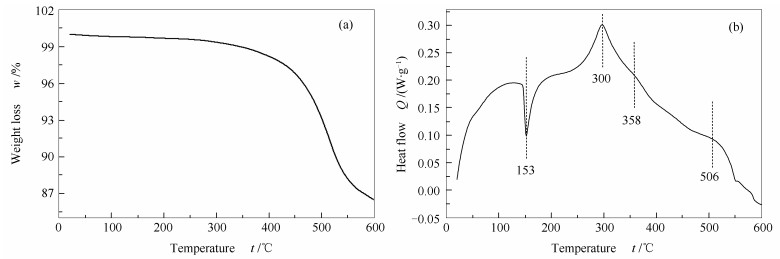
The thermal stability was first detected using thermogravimetric analyzer and the results are given in Figure 2. As shown in Figure 2(a), no significant weight loss of AgI-BiOI/CoFe2O4 is recorded when the temperature is below 350 ℃. However, two peaks appear under 350 ℃ in the DSC curve (Figure 2(b)). The endothermic peak at 153 ℃ and the exothermal peak at 300 ℃ are assigned to the desorption of water and the decomposition of organic substances adsorbed in the sample, respectively. With the temperature increasing from 350 to 600 ℃, a significant weight loss of AgI-BiOI/CoFe2O4 and two exothermal peaks located at 358 and 506 ℃ are observed, indicating the decomposition or transformation of the samples.
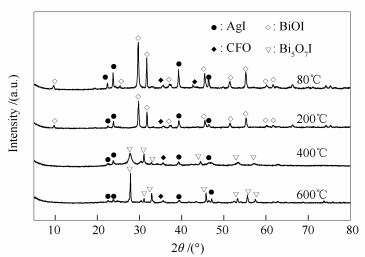
To investigate the effect of thermal stability of photocatalyst on Hg0 removal performance, the photocatalyst was calcinated at 200, 400 and 600 ℃ in air for 5 h and then characterized by N2 adsorption-desorption and X-ray diffraction (XRD) techniques. Table 1 summarizes the physical features of calcinated samples. Obviously, the BET surface area and total pore volume of the composite first slightly increase and then greatly decrease with the increase of calcination temperature. The XRD patterns of the composites with different calcination temperature are shown in Figure 3, when the calcination temperature is below 200 ℃, the two samples display almost the same diffraction peaks, which can be indexed to the hexagonal phase of AgI (JCPDS 09-0374), tetragonal phase of BiOI (JCPDS 73-2062) and signal phase of CoFe2O4 (JCPDS 22-1086)[21]. When the calcination temperature further increases to 400 and 600 ℃, the diffraction peaks of BiOI disappear and some new diffraction peaks belonged to orthorhombic Bi5O7I (JCPDS 40-0548) are detected and strengthened[22], which is in line with the TG-DSC analysis. The above phenomena clearly suggested that much higher calcination temperature would result in inferior pore structure of AgI-BiOI/CoFe2O4 and some transformations of substances in chemical structure.
 下载:
导出CSV
下载:
导出CSV
| Sample | BET surface area A/(m2·g-1) | Total pore volume v/(cm3·g-1) |
| Without calcination | 20.7 | 0.066 |
| 200 ℃ calcination | 33.9 | 0.114 |
| 400 ℃ calcination | 15.1 | 0.056 |
| 600 ℃ calcination | 1.5 | 0.002 |
The activities of Hg0 removal over AgI-BiOI/CoFe2O4 with various calcination temperatures under FSL irradiation are shown in Figure 4.
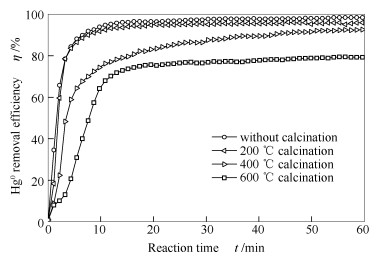
It is obvious that with increasing calcination temperature from 200 to 600 ℃, the Hg0 removal efficiency drops from 92% to 74%. The loss in Hg0 removal efficiency can be ascribed to two reasons: one is as a result of the inferior pore feature of AgI-BiOI/CoFe2O4 calcinated at higher temperature (Table 1) and the other can be due to the transformation of active materials in AgI-BiOI/CoFe2O4 composites. It is reported that the band gap energy of Bi5O7I (2.94 eV) was much larger than that of BiOI (1.73 eV), its visible light absorption ability was lower than that of BiOI[23], thereby resulting in lower generation of photogenerated electron-hole pairs and lower Hg0 removal efficiency.
The effect of reaction solution temperature in reactor on Hg0 removal efficiency is shown in Figure 5. When reaction solution temperature increases from 15 to 75 ℃, the Hg0 removal efficiency increases first and then decreases. At lower reaction solution temperature, the increasement of reaction solution temperature can enhance the reaction rate by lowering the energy barrier, which would accelerate the generation of reactive species on the surface of photocatalyst. However, much higher reaction solution temperature would decrease the solubility of O2 and Hg0 in solution and weaken the adsorption of Hg0 and O2 on the photocatalyst surface, leading to a decrease in Hg0 removal under FSL irradiation[14].
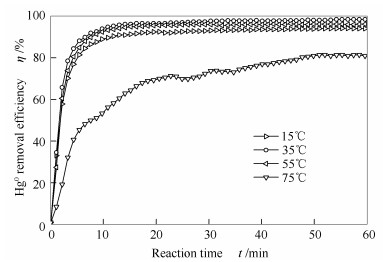
Figure 6 shows the effect of solution pH on Hg0 removal efficiency. It is observed that increasing solution pH from 1 to 7 has little impact on Hg0 removal, while when continuing to increase pH values from 7 to 10 and 13, Hg0 removal efficiencies slightly decreases from 97% to 93% and 80%, respectively, indicating a negative influence on Hg0 removal in alkaline condition. Our previous work[20] indicated that superoxides radical (·O2-) and hydroxyl radicals (·OH) appeared in the solution under visible light irradiation and photogenerated holes (h+) and ·O2- were the main reactive species rather than ·OH in wet PCO of Hg0 system, which was quite different from the gas-phase PCO of Hg0 system in the literatures[8, 13]. In the process of Hg0 oxidation, the following reactions can be happened:
|
$ {{\rm{h}}^{\rm{ + }}}{\rm{ + }}{{\rm{H}}_{\rm{2}}}{\rm{O}} \to {{\rm{H}}^{\rm{ + }}}{\rm{ + }} \cdot {\rm{OH}} $ |
|
$ {\rm{2}}{{\rm{h}}^{\rm{ + }}}{\rm{ + H}}{{\rm{g}}^{\rm{0}}} \to {\rm{H}}{{\rm{g}}^{{\rm{2 + }}}} $ |
|
$ {{\rm{h}}^{\rm{ + }}}{\rm{ + O}}{{\rm{H}}^{\rm{-}}} \to \cdot {\rm{OH}} $ |
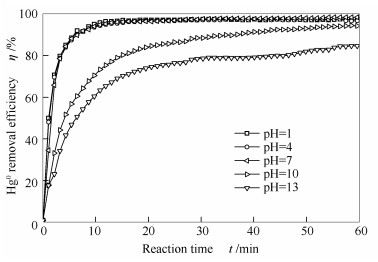
At lower pH value, the content of H+ in the reaction solution is high and the redox reaction of Eq. (5) would be inhibited, and the photogenerated holes can be largely retained to oxidize Hg0 (Eq. (6)). However, when the pH value is high (pH > 8), the amounts of h+ will decrease due to the presence of OH- according to the reaction of Eq. (7), resulting in the reduction of Hg0 removal efficiency.
Considering that some common anions such as NO3-, SO42-, CO32- and Cl- would be dissolved in realistic reaction solution, which would influence on Hg0 removal during the wet PCO process, NaNO3, Na2SO4, Na2CO3 and NaCl salts were employed to investigate the effects of NO3-, SO42-, CO32- and Cl- on Hg0 removal. As shown in Figure 7, when 0.1 mol/L of NO3- is added into the reaction solution, the Hg0 removal efficiency decreases slightly. Previous work[24] had shown that NO3- can scavenge ·OH radicals and generate some amounts of OH- as shown in Eq. (8), causing a slight decrease in Hg0 removal.
|
$ {\rm{NO}}_3^-{\rm{ + }} \cdot {\rm{OH}} \to \cdot {\rm{N}}{{\rm{O}}_{\rm{3}}}{\rm{ + O}}{{\rm{H}}^{\rm{-}}} $ |
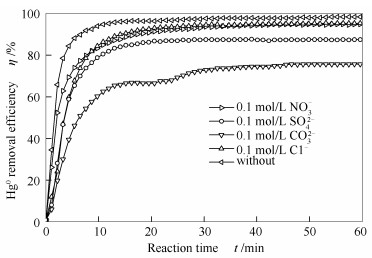
The presence of SO42- in solution also exerted a slightly inhibitory effect on Hg0 removal due to the consumptions of h+ and ·OH by SO42- as follows[24]:
|
$ {\rm{SO}}_4^{2-}{\rm{ + }}{{\rm{h}}^{\rm{ + }}} \to \cdot {\rm{SO}}_4^- $ |
|
$ {\rm{SO}}_4^{2-}{\rm{ + }} \cdot {\rm{OH}} \leftrightarrow \cdot {\rm{SO}}_4^-{\rm{ + O}}{{\rm{H}}^{\rm{-}}} $ |
The reduction of Hg0 removal efficiency in the presence of CO32- was ascribed to the scavenging effect of reactive species (Eqs. (11)and(12))[25]. Moreover, the presence of CO32- could generate a large number of OH- by hydrolysis reaction (Eq. (13)) and the generation of OH- had a negative effect on Hg0 removal as observed in Figure 6.
|
$ {\rm{CO}}_3^{2-}{\rm{ + }} \cdot {\rm{OH}} \to \cdot {\rm{CO}}_3^-{\rm{ + O}}{{\rm{H}}^{\rm{-}}} $ |
|
$ {\rm{CO}}_3^{2-}{\rm{ + }}{{\rm{h}}^{\rm{ + }}} \to \cdot {\rm{CO}}_3^- $ |
|
$ {\rm{CO}}_3^{2-}{\rm{ + }}{{\rm{H}}_{\rm{2}}}{\rm{O}} \leftrightarrow {\rm{HCO}}_3^-{\rm{ + O}}{{\rm{H}}^{\rm{-}}} $ |
From Figure 7, it is also observed that a little decrease in Hg0 removal appears in the presence of Cl- as a result of the depletions of ·OH, H+ and h+ as shown below[24, 26]:
|
$ {\rm{C}}{{\rm{l}}^{\rm{-}}}{\rm{ + }} \cdot {\rm{OH}} \leftrightarrow \cdot {\rm{HOC}}{{\rm{l}}^{\rm{-}}} $ |
|
$ \cdot {\rm{HOC}}{{\rm{l}}^{\rm{-}}}{\rm{ + }}{{\rm{H}}^{\rm{ + }}} \to {\rm{Cl}} \cdot {\rm{ + }}{{\rm{H}}_{\rm{2}}}{\rm{O}} $ |
|
$ {\rm{C}}{{\rm{l}}^{\rm{-}}}{\rm{ + }}{{\rm{h}}^{\rm{ + }}} \to {\rm{Cl}} \cdot $ |
During the Fenton-like oxidation process, the chlorine-containing radicals, such as ·HOCl- and ·Cl generated from ·OH and Cl- could also react with Hg0 to produced oxidized Hg2+ (Eqs. (17) and (18))[27].
|
$ {\rm{H}}{{\rm{g}}^{\rm{0}}}{\rm{ + }} \cdot {\rm{Cl}} \to {\rm{HgCl + }} \cdot {\rm{Cl}} \to {\rm{HgC}}{{\rm{l}}_{\rm{2}}} $ |
|
$ {\rm{H}}{{\rm{g}}^{\rm{0}}}{\rm{ + 2}} \cdot {\rm{HOC}}{{\rm{l}}^{\rm{-}}} \to {\rm{HgC}}{{\rm{l}}_{\rm{2}}}{\rm{ + 2O}}{{\rm{H}}^{\rm{-}}} $ |
By comparison, it was found that among the four anions, CO32- ions showed the most effect on Hg0 removal under FSL irradiation.
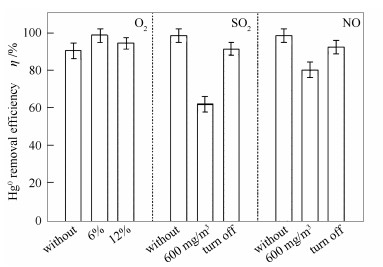
The effect of O2 concentration on the removal of Hg0 was studied. As shown in Figure. 8, when the concentration of O2 increases from 0 to 6%, more reactive ·O2- radicals are generated, which would promote Hg0 removal efficiency (Eqs. (19)and(20)). The catalyst in the absence of O2 exhibits good Hg0 removal efficiency, which can be due to the presence of the adsorbed O2 on the catalyst surface or the O2 dissolved in the water[28].
|
$ {{\rm{O}}_{\rm{2}}}{\rm{ + }}{{\rm{e}}^{\rm{-}}} \to \cdot {\rm{O}}_2^- $ |
|
$ \cdot {\rm{O}}_2^-{\rm{ + H}}{{\rm{g}}^{\rm{0}}}{\rm{ + 2}}{{\rm{H}}^{\rm{ + }}} \to {\rm{HgO + }}{{\rm{H}}_{\rm{2}}}{\rm{O}} $ |
However, when O2 concentration continuously increases to 12%, Hg0 removal efficiency slightly decreases. Excessive content of O2 could result in the generation of hydrogen peroxide (H2O2) (Eq. (21)), reducing the yields of ·O2-[29]. Furthermore, the generated H2O2 could further react with electrons to produce ·OH and OH- (Eq. (22)), leading to a decrease in Hg0 removal[29].
|
$ {{\rm{O}}_{\rm{2}}}{\rm{ + 2}}{{\rm{H}}^{\rm{ + }}}{\rm{ + 2}}{{\rm{e}}^{\rm{-}}} \to {{\rm{H}}_{\rm{2}}}{{\rm{O}}_{\rm{2}}} $ |
|
$ {{\rm{H}}_{\rm{2}}}{{\rm{O}}_{\rm{2}}}{\rm{ + }}{{\rm{e}}^{\rm{-}}} \to \cdot {\rm{OH + O}}{{\rm{H}}^{\rm{-}}} $ |
The effect of SO2 concentration on Hg0 removal efficiency is given in the central region of Figure 8. When 600 mg/m3 of SO2 is introduced into the reaction system, a great decrease in Hg0 removal efficiency from 98% to 62% appears. However, once SO2 is cut off, the Hg0 removal efficiency restores to about 90%. Since SO2 is soluble in water, the effect of SO2 on Hg0 removal could be originated from two aspects: One for the dissolution of SO2 in solution, and the other for the consumption of reactive species by SO2. The detailed reactions can be as follows:
The dissolution reaction of SO2 in reaction solution can lead to the generation of sulphite and bisulfite anions, which can readily react with ·OH, ·O2- and h+, affecting the removal of Hg0 as follows[24, 30]:
|
$ {\rm{S}}{{\rm{O}}_{\rm{2}}}{\rm{ + }}{{\rm{H}}_{\rm{2}}}{\rm{O}} \leftrightarrow {\rm{HSO}}_3^-{\rm{ + }}{{\rm{H}}^{\rm{ + }}} $ |
|
$ {\rm{HSO}}_3^-\leftrightarrow {\rm{SO}}_3^{2-}{\rm{ + }}{{\rm{H}}^{\rm{ + }}} $ |
|
$ {\rm{HSO}}_3^-{\rm{ + }} \cdot {\rm{OH}} \to \cdot {\rm{SO}}_3^-{\rm{ + }}{{\rm{H}}_{\rm{2}}}{\rm{O}} $ |
|
$ {\rm{SO}}_3^{2-}{\rm{ + }} \cdot {\rm{OH + }}{{\rm{H}}^{\rm{ + }}} \to \cdot {\rm{SO}}_3^-{\rm{ + }}{{\rm{H}}_{\rm{2}}}{\rm{O}} $ |
|
$ {\rm{SO}}_3^-{\rm{ + }} \cdot {\rm{OH}} \to {\rm{SO}}_4^{2-}{\rm{ + }}{{\rm{H}}^{\rm{ + }}} $ |
|
$ {\rm{HSO}}_3^-{\rm{ + 2}}{{\rm{h}}^{\rm{ + }}}{\rm{ + }}{{\rm{H}}_{\rm{2}}}{\rm{O}} \to {\rm{SO}}_4^{2-}{\rm{ + 3}}{{\rm{H}}^{\rm{ + }}} $ |
|
$ {\rm{HSO}}_3^-{\rm{ + }}{{\rm{H}}^{\rm{ + }}}{\rm{ + 2}} \cdot {\rm{O}}_2^-\to {\rm{SO}}_4^{2-}{\rm{ + }}{{\rm{O}}_{\rm{2}}}{\rm{ + }}{{\rm{H}}_{\rm{2}}}{\rm{O}} $ |
Since the redox potentials of BiOI and AgI are higher than those of SO42-/H2SO3 (0.172 eV) and SO2/SO42- (0.158 eV)[21, 28], the generated reactive species such as ·OH, ·O2- and h+ can be captured easily and consumed directly by SO2 as described below, resulting in the underutilization of photocatalysts.
|
$ {\rm{S}}{{\rm{O}}_{\rm{2}}}{\rm{ + 2}}{{\rm{h}}^{\rm{ + }}}{\rm{ + 2}}{{\rm{H}}_{\rm{2}}}{\rm{O}} \to {\rm{SO}}_4^{2-}{\rm{ + 4}}{{\rm{H}}^{\rm{ + }}} $ |
|
$ {\rm{S}}{{\rm{O}}_{\rm{2}}}{\rm{ + }} \cdot {\rm{OH}} \to {\rm{HS}}{{\rm{O}}_{\rm{3}}} $ |
|
$ {\rm{HS}}{{\rm{O}}_{\rm{3}}}{\rm{ + }} \cdot {\rm{OH}} \to {\rm{SO}}_4^{2-}{\rm{ + 2}}{{\rm{H}}^{\rm{ + }}} $ |
|
$ {\rm{S}}{{\rm{O}}_{\rm{2}}}{\rm{ + 2}} \cdot {\rm{O}}_2^-\to {\rm{SO}}_4^{2-}{\rm{ + }}{{\rm{O}}_{\rm{2}}} $ |
The effect of NO on Hg0 oxidation is displayed in the right region of Figure 8. The introductions of 600 mg/m3 of NO into the flue gas exhibit an obvious inhibitory effect on Hg0 removal, which could be due to the competition of NO with Hg0 for the active radicals on the catalyst surface[14]. When NO is turned off, similar to SO2, the Hg0 removal efficiency caused by NO also recovered. It was reported that the photocatalytic oxidation processes of NO usually underwent three states (NO → HNO2, HNO2 → NO2, NO2 → HNO3)[28, 31]. Thus, the pathway of NO oxidation could be described as follows:
|
$ {\rm{NO + }} \cdot {\rm{OH}} \to {\rm{HN}}{{\rm{O}}_{\rm{2}}} $ |
|
$ {\rm{HN}}{{\rm{O}}_{\rm{2}}}{\rm{ + }} \cdot {\rm{OH}} \to {\rm{N}}{{\rm{O}}_{\rm{2}}}{\rm{ + }}{{\rm{H}}_{\rm{2}}}{\rm{O}} $ |
|
$ {\rm{N}}{{\rm{O}}_{\rm{2}}}{\rm{ + }} \cdot {\rm{OH}} \to {\rm{HN}}{{\rm{O}}_{\rm{3}}} $ |
Furthermore, NO also can react with ·O2- and h+ as shown below:
|
$ {\rm{NO + }} \cdot {\rm{O}}_2^-\to {\rm{NO}}_3^- $ |
|
$ {\rm{NO + }}{{\rm{h}}^{\rm{ + }}}{\rm{ + }}{{\rm{H}}_{\rm{2}}}{\rm{O}} \to {\rm{HN}}{{\rm{O}}_{\rm{2}}}{\rm{ + }}{{\rm{H}}^{\rm{ + }}} $ |
|
$ {\rm{2NO + 2}}{{\rm{h}}^{\rm{ + }}}{\rm{ + }}{{\rm{O}}_{\rm{2}}}{\rm{ + 2}}{{\rm{H}}_{\rm{2}}}{\rm{O}} \to {\rm{2NO}}_3^-{\rm{ + 4}}{{\rm{H}}^{\rm{ + }}} $ |
It was clear that the competition of NO with Hg0 for the active radicals such as ·OH, ·O2- and h+ appeared on the surface of photocatalyst, leading a negative effect on Hg0 removal.
Figure 9 shows the effect of catalyst dosage on Hg0 removal efficiency.
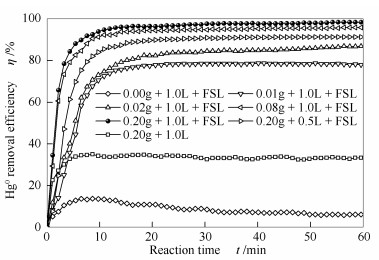
It is found that without the aid of photocatalyst, only about 5% of Hg0 removal efficiency appears under FSL irradiation, which could be due to a small amount of UV light emitted by FSL[32]. When 0.01 g of photocatalyst is added into 1 L reaction solution, Hg0 removal efficiency greatly increases to about 75% under FSL light. With the photocatalyst dosage further increasing from 0.01 g to 0.08 g, Hg0 removal efficiency significantly increases from 75% to 95% due to presence of large amounts of reactive radicals, while further adding the photocatalyst from 0.08 g to 0.20 g, only about 3% of Hg0 removal efficiency is improved. Because the residence time of flue gas through the reaction solution was stationary, Hg0 removal efficiency would be changed slightly even though the dosage of catalyst was enough and substantial reactive species were generated in the solution[33]. In addition, Figure 9 also shows that the Hg0 removal efficiency decreases from 97% to 90% when 1.0 L reaction solution reduces to 0.5 L, indicating that the decrease in residence time between flue gas and reaction solution resulted in a lower Hg0 oxidation efficiency.
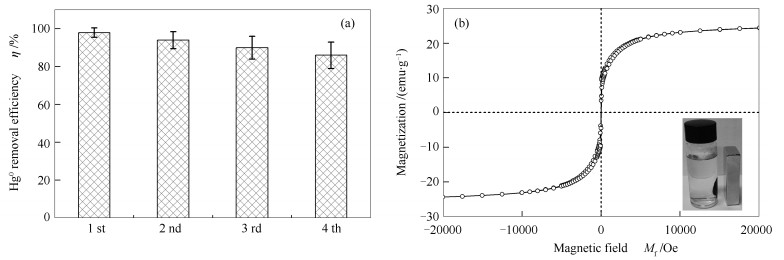
The recovery and reuse of AgI-BiOI/CoFe2O4 for Hg0 removal was examined throughout four consecutive cycles and the results are shown in Figure 10a. It can be clearly observed that about 8% of Hg0 removal efficiency is lost after four cycling runs, suggesting that AgI-BiOI/CoFe2O4 contains good potential for repeated use. Furthermore, the magnetic property of AgI-BiOI/CoFe2O4 after four successive runs is also measured by using vibrating sample magnetometer. As exhibited in Figure 10(b), the composites show a high saturation magnetization (24.4 emu/g) and a superior magnetic separation property (inset of Figure 10(b)), which provides a possibility for its multiple reutilization in the future.
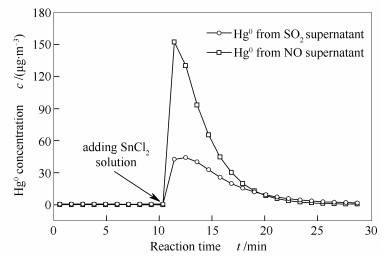
To detect the mercury species in supernatant solution after reaction, the reduction test of reaction solution by SnCl2 solution was carried out as follows: Firstly, 100 mL of supernatant was transferred into a gas-washing bottle, whose inlet kept open with air and the outlet connected with the VM-3000 mercury analyzer. The atmospheric air through the gas-washing bottle was sent into the mercury analyzer using a built-in gas pump. Then, after 10 min later, 50 mL of SnCl2 solution (10%) was quickly added into the above solution from the inlet of the gas-washing bottle. The Hg0 concentration was recorded by the on-line mercury analyzer. Based on the above method, the reduction test of reaction solution in the presence of SO2 or NO was implemented. It should be noticed that to avoid the effect of physical-adsorbed Hg0 dissolved in solution, the supernatant after reaction was first bubbled with air for 30 min before the reduction reaction. From Figure 11, it can be seen that no Hg0 is detected from the supernatant in the first 10 min, however, once SnCl2 solution is added into the supernatant, the concentration of Hg0 sharply rises, suggesting that Hg0 in the reaction stream is completely oxidized and Hg2+ is the final oxidation product.
To understand the ion products in the supernatants after reaction with the presence of SO2 and NO under fluorescent light, ion chromatography (IC) were employed to detect the possible species of SO32-, SO42-, NO2- and NO3-. As shown in Table 2, only SO42- and NO3- are observed in the supernatants after reactions, which are attributed to the final oxidation products of SO2 and NO by reactive species. Furthermore, to assess the stability of photocatalyst, an inductively coupled plasma mass spectrometer (ICP-MS) was utilized to determine the Co2+ concentration in the spent solution of SO2 and NO. The results show that Co2+ concentration is only about 1.94 and 1.21 mg/L, respectively, indicating that a small amount of Co2+ would be separated out from the magnetic AgI-BiOI/CoFe2O4 photocatalyst in the presence of concentration of SO2 or NO. Thus, the possible exposure of little amount of Co2+ to environment and the study of stability of AgI-BiOI/CoFe2O4 photocatalyst in acidic solution should be emphasized and carried out in the further study.
下载:
导出CSV
| Ion category | SO32- | SO42- | NO2- | NO3- |
| Measured concentration | 0 | 40.32 mg/L | 0 | 15.50 mg/L |
In this work, wet photocatalytic oxidation removal of Hg0 from flue gas using AgI-BiOI/CoFe2O4 photocatalyst under FSL irradiation was investigated under different conditions. From the experimental results, the following conclusions can be drawn:
AgI-BiOI/CoFe2O4 composites exhibited a poor thermal stability. BiOI presented in AgI-BiOI/CoFe2O4 would gradually transformed into Bi5O7I after calcinated at 400 ℃, and AgI-BiOI/CoFe2O4 hybrids significantly agglomerated at 600 ℃, leading to lower Hg0 removal activity.
With increasing reaction solution temperature, Hg0 removal efficiency increased first and then decreased. Acid solution had little impact on Hg0 removal while alkaline solution can greatly decrease Hg0 removal efficiency.
The presence of SO2 had an inhibitory effect on Hg0 removal while the inhibition of NO on Hg0 removal was relatively small. The analysis of reaction products indicated that SO42-, NO3- and Hg2+ were the final products of SO2, NO and Hg0 after reaction.
YANG S J, GUO Y F, YAN N Q, WU D Q, HE H P, XIE J K, QU Z, JIA J P. Remarkable effect of the incorporation of titanium on the catalytic activity and SO2 poisoning resistance of magnetic Mn-Fe spinel for elemental mercury capture[J]. Appl Catal B:Environ, 2011, 10(3/4): 698-708.
ZHOU Q, DUAN Y F, HONG Y G, ZHU C, SHE M, ZHANG J, WEI H Q. Experimental and kinetic studies of gas-phase mercury adsorption by raw and bromine modified activated carbon[J]. Fuel Process Technol, 2015, 134: 325-332. doi: 10.1016/j.fuproc.2014.12.052
YOU C F, XU X C. Coal combustion and its pollution control in China[J]. Energy, 2010, 35(11): 4467-4472. doi: 10.1016/j.energy.2009.04.019
WU J, LI C E, ZHAO X Y, WU Q, QI X M, CHEN X T, HU T, CAO Y. Photocatalytic oxidation of gas-phase Hg0 by CuO/TiO2[J]. Appl Catal B:Environ, 2015, 176/177: 559-569. doi: 10.1016/j.apcatb.2015.04.044
张华伟, 陈江艳, 赵可, 牛庆欣, 王力. Mn/Ce掺杂改性半焦对模拟煤气中单质汞的脱除性能研究[J]. 燃料化学学报, 2016,44,(4): 394-400. ZHANG Hua-wei, CHEN Jiang-yan, ZHAO Ke, NIU Qing-xin, WANG Li. Removal of vapor-phase elemental mercury from simulated syngas using semi-coke modified by Mn/Ce doping[J]. J Fuel Chem Technol, 2016, 44(4): 394-400.
HAN L N, HE X X, YUE C X, HU Y F, LI L N, CHANG L P, WANG H, WANG J C. Fe doping Pd/AC sorbent efficiently improving the Hg0 removal from the coal-derived fuel gas[J]. Fuel, 2016, 182: 64-72. doi: 10.1016/j.fuel.2016.05.046
WANG F M, LI G L, SHEN B X, WANG Y Y, HE C. Mercury removal over the vanadia-titania catalyst in CO2-enriched conditions[J]. Chem Eng J, 2015, 263: 356-363. doi: 10.1016/j.cej.2014.10.091
JEON S H, EOM Y J, LEE T G. Photocatalytic oxidation of gas-phase elemental mercury by nanotitanosilicate fibers[J]. Chemosphere, 2008, 71(5): 969-974. doi: 10.1016/j.chemosphere.2007.11.050
WU J, LI X, REN J X, QI X M, HE P, NI B, ZHANG C, HU C Z, ZHOU J. Experimental study of TiO2 hollow microspheres removal on elemental mercury in simulated flue gas[J]. J Ind Eng Chem, 2015, 32: 49-57. doi: 10.1016/j.jiec.2015.07.019
SNIDER G, ARIYA P. Photo-catalytic oxidation reaction of gaseous mercury over titanium dioxide nanoparticle surfaces[J]. Chem Phys Lett, 2010, 491(1/3): 23-28.
SHEN H Z, IE I R, YUAN C S, HUNG C H, CHEN W H, LUO J J, JEN Y H. Enhanced photocatalytic oxidation of gaseous elemental mercury by TiO2 in a high temperature environment[J]. J Hazard Mater, 2015, 289: 235-243. doi: 10.1016/j.jhazmat.2015.02.033
袁媛, 张军营, 赵永椿, 王宇翔, 郑楚光. SO2和NO浓度对TiO2-硅酸铝纤维脱除元素汞的影响[J]. 燃料化学学报, 2012,40,(5): 630-635. YUAN Yuan, ZHANG Jun-ying, ZHAO Yong-chun, WANG Yu-xiang, ZHENG Chu-guang. Effects of SO2 and NO on removal of elemental mercury using a TiO2-aluminum silicate fiber[J]. J Fuel Chem Technol, 2012, 40(5): 630-635.
LI Y, WU C Y. Kinetic study for photocatalytic oxidation of elemental mercury on a SiO2-TiO2 nanocomposite[J]. Environ Eng Sci, 2007, 24(1): 3-12. doi: 10.1089/ees.2007.24.3
YUAN Y, ZHANG J Y, LI H L, LI Y, ZHAO Y C, ZHENG C G. Simultaneous removal of SO2, NO and mercury using TiO2-aluminum silicate fiber by photocatalysis[J]. Chem Eng J, 2012, 192(2): 21-28.
QI X M, GU M L, ZHU X Y, WU J, LONG H M, HE K, WU Q. Fabrication of BiOIO3 nanosheets with remarkable photocatalytic oxidation removal for gaseous elemental mercury[J]. Chem Eng J, 2016, 285: 11-19. doi: 10.1016/j.cej.2015.09.055
DONG G H, HO W K, ZHANG L Z. Photocatalytic NO removal on BiOI surface:The change from nonselective oxidation to selective oxidation[J]. Appl Catal B:Environ, 2015, 168(168/169): 490-496.
OU M, ZHONG Q, ZHANG S L, NIE H Y, LV Z J, CAI W. Graphene-decorated 3D BiVO4 superstructure:Highly reactive (040) facets formation and enhanced visible-light-induced photocatalytic oxidation of NO in gas phase[J]. Appl Catal B:Environ, 2016, 193: 160-169. doi: 10.1016/j.apcatb.2016.04.029
ZHANG A C, XING W B, ZHANG D, WANG H, CHEN G Y, XIANG J. A novel low-cost method for Hg0removal from flue gas by visible-light-driven BiOX (X=Cl, Br, I) photocatalysts[J]. Catal Commun, 2016, 87: 57-61. doi: 10.1016/j.catcom.2016.09.003
ZHANG A C, ZHANG L X, CHEN X Z, ZHU Q F, LIU Z C, XIANG J. Photocatalytic oxidation removal of Hg0 using ternary Ag/AgI-Ag2CO3 hybrids in wet scrubbing process under fluorescent light[J]. Appl Surf Sci, 2017, 392: 1107-1116. doi: 10.1016/j.apsusc.2016.09.116
ZHANG L X, ZHANG A C, LU H, SUN Z J, SHENG W, SUN L S, XIANG J. Magnetically separable AgI-BiOI/CoFe2O4 hybrid composites for Hg0 removal:Characterization, activity and mechanism[J]. RSC Adv, 2017, 7(50): 31448-31456. doi: 10.1039/C7RA04175F
CHENG H F, HUANG B B, DAI Y, QIN X Y, ZHANG X Y. One-Step synthesis of the nanostructured AgI/BiOI composites with highly enhanced visible-light photocatalytic performances[J]. Langmuir, 2010, 26(9): 6618-6624. doi: 10.1021/la903943s
YU C L, FAN C F, YU J C, ZHOU W Q, YANG K. Preparation of bismuth oxyiodides and oxides and their photooxidation characteristic under visible/UV light irradiation[J]. Mater Res Bull, 2011, 46(1): 140-146. doi: 10.1016/j.materresbull.2010.08.013
CAO J, LI X, LIN H L, XU B Y, LUO B D, CHEN S F. Low temperature synthesis of novel rodlike Bi5O7I with visible light photocatalytic performance[J]. Mater Lett, 2012, 76(6): 181-183.
RAUF M A, MARZOUKI N, KORBAHTI B K. Photolytic decolorization of Rose Bengal by UV/H2O2 and data optimization using response surface method[J]. J Hazard Mater, 2008, 159(2/3): 602-609.
SANTIAGO D E, ARANA J, GONZÁLEZ-D O, ALEMÁN-D M E, ACOSTA-D A C, FERNANDEZ-R C, PÉREZ-P J, DONA-R J M. Effect of inorganic ions on the photocatalytic treatment of agro-industrial wastewaters containing imazalil[J]. Appl Catal B:Environ, 2014, 156/157(3): 284-292.
CHEN J, HU Z, WANG D, GAO C, JI R. Photocatalytic mineralization of dimethoate in aqueous solutions using TiO2:Parameters and by-products analysis[J]. Desalination, 2010, 258(1): 28-33.
ZHAO Y, HAO R L. Macrokinetics of Hg0 removal by a vaporized multicomponent oxidant[J]. Ind Eng Chem Res, 2014, 53(27): 10899-10905. doi: 10.1021/ie5009376
XIA D H, HU L L, HE C, PAN W Q, YANG T S, YANG Y C, SHU D. Simultaneous photocatalytic elimination of gaseous NO and SO2 in a BiOI/Al2O3-padded trickling scrubber under visible light[J]. Chem Eng J, 2015, 279: 929-938. doi: 10.1016/j.cej.2015.05.097
KIM J, LEE C W, CHOI W. Platinized WO3 as an environmental photocatalyst that generates OH radicals under visible light[J]. Environ Sci Technol, 2010, 44(17): 6849-6854. doi: 10.1021/es101981r
LIU Y X, ZHANG J, SHENG C D, ZHANG Y C, ZHAO L. Simultaneous removal of NO and SO2 from coal-fired flue gas by UV/H2O2 advanced oxidation process[J]. Chem Eng J, 2010, 162(3): 1006-1011. doi: 10.1016/j.cej.2010.07.009
LASEK J, YU Y H, WU J C S. Removal of NOx by photocatalytic processes[J]. J Photochem Photobiol C, 2013, 14(1): 29-52.
MCLARNON C R, GRANITE E J, PENNLINE H W. The PCO Process for photochemical removal of mercury from flue gas[J]. Fuel Process Technol, 2005, 87(1): 85-89. doi: 10.1016/j.fuproc.2005.07.001
LIU Y X, ZHANG J, SHENG C D, ZHANG Y C, ZHAO L. Preliminary study on a new technique for wet removal of nitric oxide from simulated flue gas with an ultraviolet (UV)/H2O2 process[J]. Energy Fuels, 2010, 24(9): 4925-4930. doi: 10.1021/ef1006325

Figure 4 Effect of calcination temperature on Hg0 removal efficiency
conditions: baseline flue gas, t=35 ℃, initial pH=7, solution volume=1 L, FSL radiation intensity=11 W/L, catalyst dosage=200 mg/L

Figure 5 Effect of reaction solution temperature on Hg0 removal efficiency
conditions: baseline flue gas, initial pH=7, solution volume=1 L, FSL radiation intensity=11 W/L, catalyst dosage=200 mg/L

Figure 6 Effect of solution pH on Hg0 removal efficiency
conditions: baseline flue gas, t=35 ℃, solution volume=1 L, FSL radiation intensity=11 W/L, catalyst dosage=200 mg/L

Figure 7 Effect of anions in solution on Hg0 removal efficiency
conditions: baseline flue gas, t=35 ℃, initial pH=7, solution volume=1 L, FSL radiation intensity=11 W/L, catalyst dosage=200 mg/L

Figure 8 Effect of O2, SO2 and NO on Hg0 removal efficiency
error bars represent standard deviation of means (n=4) conditions: Hg0=55.0 μ g/m3, t=35 ℃, initial pH=7, solution volume=1 L, FSL radiation intensity=11 W/L, catalyst dosage=200 mg/L

Figure 9 Effect of catalyst dosage on Hg0 removal efficiency
conditions: Hg0=55.0 μ g/m3, t=35 ℃, initial pH=7, FSL radiation intensity=11 W/L

Figure 10 (a) Cycling runs for photocatalytic oxidation of Hg0 over AgI-BiOI/CoFe2O4 and (b) magnetic hysteresis loops for AgI-BiOI/CoFe2O4 after four consecutive runs
error bars represent standard deviation of means (n=3) conditions: Hg0=55.0 μ g/m3, t=35 ℃, initial pH=7, solution volume=1 L, FSL radiation intensity=11 W/L, catalyst dosage=200 mg/L
Table 1. Physical features of AgI-BiOI/CoFe2O4 hybrids calcinated at different temperatures
| Sample | BET surface area A/(m2·g-1) | Total pore volume v/(cm3·g-1) |
| Without calcination | 20.7 | 0.066 |
| 200 ℃ calcination | 33.9 | 0.114 |
| 400 ℃ calcination | 15.1 | 0.056 |
| 600 ℃ calcination | 1.5 | 0.002 |
 下载: 导出CSV
Table 2. Reaction products of SO2 and NO by AgI-BiOI/CoFe2O4
| Ion category | SO32- | SO42- | NO2- | NO3- |
| Measured concentration | 0 | 40.32 mg/L | 0 | 15.50 mg/L |
下载: 导出CSV

 扫一扫看文章


扫一扫关注我们