Figure 1.
Nature products with the pyranopyrone skeleton and bioactive pyrano[2, 3-c]pyrazolones


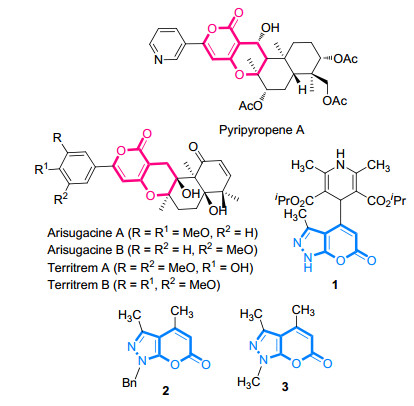
3, 4-Dihydropyrano[4, 3-b]pyran-5(2H)-one skeleton is a common structural unit found in a number of naturally occurring compounds, such as pyripyropene A, arisugacins A, B and territrems A, B (Figure 1). Biological studies reveal that pyripyropene A, arisugacins, territrems and their synthetic analogs are the most potent inhibitors of cholesterol acyl transferase.[1] As a fused nitrogen and oxygen-containing heterocycle, pyrano[2, 3-c]pyrazol-6(1H)-one is also an important structural unit present in a wide range of biologically active synthetic compounds (Figure 1). For example, pyrano[2, 3-c]pyra-zol-6(1H)-one derivative 1 has been identified as a potent positive inotropic agent.[2] 1-Benzyl-3, 4-dimethylpyrano[2, 3-c]pyrazol-6 (1H)-one (2) demonstrates antiplatelet activity.[3] 1, 3, 4-Trimethylpyrano[2, 3-c]pyrazol-6(1H)-one has been found to possess analgesic and antiinflammatory activities.[4] Over the past two decades, the privileged structure-based diversity-oriented synthesis has become a powerful and highly efficient tool for discovering biologically active small molecules.[5] In view of the interesting applications of 3, 4-dihydropyrano[4, 3-b]pyran-5(2H)-one and pyrano-[2, 3-c]pyrazol-6(1H)-ones in the field of drug discovery, the fused-ring system consisting of a 3, 4-dihydropyrano-[4, 3-b]pyran-5(2H)-one skeleton and a pyrano[2, 3-c]pyra-zol-6(1H)-one skeleton will be an important structural motif that has potence among biological activities and synthetic applications. However, this type of novel enantiomerically enriched fused polycyclic 3, 4-dihydropyrano-[4, 3-b]pyran-5(2H)-ones have not been constructed until now. As a result, the development of efficient synthesis of chiral 7, 8-dihydropyrano[2", 3":4', 5']pyrano[2', 3':4, 5]pyra-no[2, 3-c]-pyrazole-5, 10(1H, 6H)-diones with high levels of enantioselectivity will be of great importance and remains a challenge task.
Recently, the 1, 3-bielectrophilic nature makes 2-nitro-allyl acetates service as a versatile 1, 3-bielectrophile in the construction of fused tetrahydropyran scaffold upon treatment with different 1, 3-dinucleophiles.[6] We envisioned that this strategy could also be used to the construction of this novel fused polycyclic 3, 4-dihydropyrano[4, 3-b]py-ran-5(2H)-one skeleton through a formal [3+3] annulation of 4-hydroxy-7-phenyl-2H-pyrano[2', 3':4, 5]pyrano[2, 3-c]-pyrazole-2, 5(7H)-dione 4 and 2-nitroallyl acetates 5 (Eq. 1).
|
|
(1) |
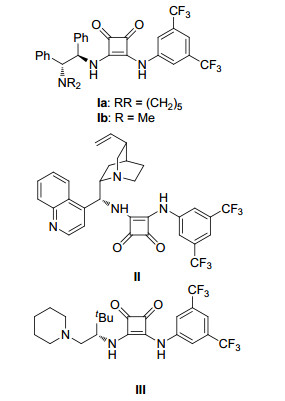
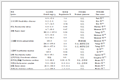
The study was initiated by optimization of the conditions for the reaction between model substrates of 4-hydroxy-9-methyl-7-phenyl-2H-pyrano[2', 3':4, 5]pyrano-[2, 3-c]pyrazole-2, 5(7H)-dione (4a) and (E)-2-nitroallylic acetate (5a) (Table 1). Keeping in mind our previous reports on the reaction of pyrazolin-5-one with (E)-2-nitro-allylic acetates[6d] we first exposed 4 and 5a to the reported condition in the presence of (1R, 2R)-1, 2-diphenyl-ethane-1, 2-diamine-based bifunctional squaramide Ia in dichloromethane at room temperature. The expected cycloaddition product 6a was successfully produced with high level of stereoselectivity, albeit in quite low yield (Entry 1). Several other bifunctional squaramide-based organocatalysts were then examined (Figure 2), and bifunctional squaramide Ib turned out to be the best catalyst for this reaction, delivering annulation product 6a in 46% yield with almost perfect stereocontrol (Entry 2). Notably, a remarkable improvement in the yield with unaltered selectivity was observed when silica gel (1 g) was added as an additive (Entry 5 vs. Entry 2). It is found that the addition of silica gel favoring the transformation of the initial formed conjugate addition product to the desired annulation product through tandem elimination/oxa-Michael addition sequence. Evaluation of other solvents, including ethyl acetate, tetrahydrofuran, ether, acetonitrile and chloroform, with the aim to further improve the yield of the reaction gave no fruitful results (Entries 6~11). Adjusting the catalyst loading to 5 mol% led to a slightly dropped yield but an obviously decreased enantioselectivity (Entry 13). A considerable decrease in enantioselectivity was observed by performing the reaction either at lowed or at elevated temperature (Entries 14, 15).
 下载:
导出CSV
下载:
导出CSV
 | ||||||
| Entry | Catalyst | Solvent | Time/h | Yieldb/% | drc | eed/% |
| 1 | Ia | CH2Cl2 | 21 | 21 | > 19/1 | 98 |
| 2 | Ib | CH2Cl2 | 5 | 46 | > 19/1 | > 99 |
| 3 | II | CH2Cl2 | 36 | 33 | > 19/1 | 99 |
| 4 | III | CH2Cl2 | 72 | Trace | ||
| 5 e | Ib | CH2Cl2 | 12 | 70 | > 19/1 | > 99 |
| 6 e | Ib | AcOEt | 78 | 21 | > 19/1 | 99 |
| 7 e | Ib | THF | 78 | Trace | ||
| 8 e | Ib | Et2O | 78 | 19 | > 19/1 | 92 |
| 9 e | Ib | CH3CN | 78 | 9 | > 19/1 | 88 |
| 10 e | Ib | CHCl3 | 10 | 72 | > 19/1 | 98 |
| 11 e, f | Ib | CH2Cl2 | 42 | 62 | > 19/1 | 86 |
| 12 e, g | Ib | CH2Cl2 | 72 | 69 | > 19/1 | 96 |
| 13 e.h | Ib | CH2Cl2 | 8 | 75 | > 19/1 | 97 |
| a Unless otherwise specified, all reactions were carried out with 4a (0.26 mmol), 5a (0.20 mmol) in the presence of 10 mol% catalyst in solvent (4 mL) at room temperature. b Isolated yield. c Determined by 1H NMR analysis. d Determined by HPLC analysis using a chiral stationary phase. e Silica gel (1 g) was added as an additive. f In the presence of 5 mol% catalyst Ib. g The reaction was performed at 0 ℃. g The reaction was carried at 40 ℃. | ||||||
With the optimized conditions in hand (10 mol% catalyst Ib in dichloromethane at room temperature), the scope of the reaction was examined, and the results are summarized in Table 2.
下载:
导出CSV
 | |||||||
| Entry | R | Ar | 6 | Time/h | Yieldb/% | drc | eed/% |
| 1 | Me | Ph | 6aa | 12 | 70 | > 19:1 | > 99 |
| 2 | Me | 4-FC6H4 | 6ab | 23 | 56 | > 19:1 | 98 |
| 3 | Me | 4-ClC6H4 | 6ac | 13 | 60 | > 19:1 | 96 |
| 4 | Me | 3-ClC6H4 | 6ad | 42 | 61 | > 19:1 | 86 |
| 5 | Me | 4-BrC6H4 | 6ae | 54 | 60 | > 19:1 | 41 |
| 6 | Me | 3-CF3C6H4 | 6af | 24 | 62 | > 19:1 | 46 |
| 7 | Me | 4-MeC6H4 | 6ag | 23 | 55 | > 19:1 | 95 |
| 8 | Me | 3-MeC6H4 | 6ah | 22 | 55 | > 19:1 | 88 |
| 9 | Me | 2-MeC6H4 | 6ai | 48 | 59 | > 19:1 | 91 |
| 10 | Me | 3, 5-Me2C6H3 | 6aj | 72 | 54 | > 19:1 | 64 |
| 11 | Me | 4-MeOC6H4 | 6ak | 11 | 46 | > 19:1 | 88 |
| 12 | Me | 1-Naphthyl | 6al | 11 | 75 | > 19:1 | > 99 |
| 13 | Me | 2-Naphthyl | 6am | 15.5 | 77 | > 19:1 | 84 |
| 14 | Me | 2-Furyl | 6an | 13 | 46 | > 19:1 | 56 |
| 15 | Me | 2-Thienyl | 6ao | 22 | 40 | > 19:1 | 64 |
| 16 | CF3 | 1-Ph | 6ba | 42 | 57 | > 19:1 | NDe |
| a Unless otherwise specified, all reactions were carried out with 4 (0.26 mmol), 5a (0.20 mmol), silica gel (1 g) in the presence of 10 mol% catalyst in dichloromethane (4 mL) at room temperature. b Isolated yield. c Determined by 1H NMR analysis. d Determined by HPLC analysis using a chiral stationary phase. e ND mean not determined. | |||||||
As shown in Table 2, the reaction demonstrated a broad substrate scope, a wide range of (E)-2-nitroallyl acetates 5 bearing different substituents were well tolerated, affording the corresponding annulation products 6 in acceptable yields (40%~77%) with high levels of diastereoselectivity (> 19/1 dr) regardless of the nature of the substituents and the substitution pattern. With respect to the enantioselectivity, an obvious substrate-dependent effect was observed for 2-nitroallyl acetates bearing electron-withdrawing groups (Entries 2~6). The introduction of fluoro or chloro on the phenyl ring of 2-nitroallyl acetate maintained the high levels of enantioselectivity, while the introduction of bromo-or trifluoro-methyl group caused sharp decrease in ee value. The substitution pattern has a considerable effect on the reaction of substrates with electron-donating groups (Entries 7~11). In contrast to monosubstituted substrates, for which good enantioselectivity was obtained, only moderate ee value was observed for disubstituted one. In case of (E)-2-nitroallyl acetates 5l and 5m with a naphthyl group, a significant steric effect was observed. Compared with the result observed for 2-naphthyl substituted substrate, much better stereochemical outcome was obtained for the sterically more bulky 1-naphthyl substituted one (Entry 12 vs. Entry 13). The reaction was also applicable to electron-rich heteroaromatic 2-furyl and 2-thienyl substituted (E)-2-nitroallyl acetates 5n and 5o, delivering the cyclization products 6an and 6ao in acceptable yield albeit with markedly decreased enantioselectivity (Entries 14 and 15). In addition, 3-trifluoromethyl substituted 4-hydroxy-9-methyl-7-phenyl-2H-pyrano[2', 3':4, 5]pyrano[2, 3-c]pyra-zole-2, 5(7H)-dione (4b) also works well to afford fluorinated polycyclic 3, 4-dihydropyrano[4, 3-b]pyran-5(2H)-one (6ba) in acceptable yield with high diastereoselectivity (Entry 16). Unfortunately, the ee value of this product cannot be determined since two enantiomers are inseparable on all the tested chiral stationary phases.
Our methodology was applicable to the gram scale reaction as well (Eq. 2). The reaction of 2.02 g (6.5 mmol) of 4a and 1.36 g of (E)-2-nitroallyl acetate 5l (5 mmol) in the presence of 0.27 g (0.5 mmol, 10 mol%) of catalyst Ib afforded 1.80 g (69%) of the corresponding annulation product 6al without any appreciable change in the diastereo- and enantio-selectivities.
|
|
(2) |
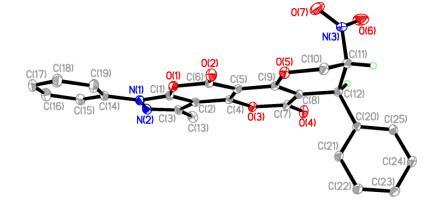
The structure and relative configuration of fused polycyclic 3, 4-dihydropyrano[4, 3-b]pyran-5(2H)-ones were further unequivocally confirmed by single crystal X-ray analysis of a representative compound 6aa (Figure 3). Furthermore, the absolute configuration of 6aa was also assigned to be (6S, 7R) based on X-ray data and the remaining configurations are assumed by analogy.[7]
The products obtained in these [3+3] annulations would have more application in organic synthesis and medicinal chemistry. For example, as outlined in Eq. 3, upon treatment with zinc powder in acetic acid, the nitro group in compound 6al was converted to an amino group. The crude amine was further transformed into the corresponding benzamide 7 by reaction with benzoyl chloride in the presence of triethylamine as an acid binding agent in moderate yield without any loss of stereochemical integrity.
|
|
(3) |
In conclusion, we have developed an organocatalytic asymmetric formal [3+3] annulation of 4-hydroxy-2H-pyrano[2', 3':4, 5]pyrano[2, 3-c]pyrazole-2, 5(7H)-diones and (E)-2-nitroallyl acetates. Under the catalysis of a (1R, 2R)-1, 2-diphenylethane-1, 2-diamine derived tertiary amine-squaramide catalyst, the reactions ran smoothly to provide a series of novel fused polycyclic 3, 4-dihydro-pyrano[4, 3-b]pyran-5(2H)-ones in acceptable yields, high anti-selectivities, and moderate to excellent enantioselectivities. This method serves as a useful tool for the stereocontrolled construction of fused polycyclic 3, 4-dihydro-pyrano[4, 3-b]pyran-5(2H)-one scaffolds with two adjacent tertiary stereogenic centers.
To a solution of 4-hydroxy-2H-pyrano[2', 3':4, 5]pyra-no[2, 3-c]pyrazole-2, 5(7H)-dione (4) (0.26 mmol), (E)-2-nitroallyl acetate 5 (0.20 mmol), squaramide catalyst Ib (10.9 mg, 0.020 mmol) in dichloromethane (4 mL), silica gel (200~300 mesh, 1.0 g) was added, and the resulting solution was stirred at room temperature until the reaction reached completion [monitored by thin-layer chromatography (TLC)]. After the removal of the solvent under reduced pressure, the crude product was purified by chromatography on a silica gel column (200~300 mesh, PE/EtOAc, V:V=4:1) to afford the desired fused polycyclic 3, 4-dihydropyrano[4, 3-b]pyran-5(2H)-ones 6.
(6S, 7R)-3-Methyl-7-nitro-1, 6-diphenyl-7, 8-dihydro-pyrao[2", 3":4', 5']pyrano[2', 3':4, 5]pyrano[2, 3-c]pyrazole-5, 10(1H, 6H)-dione (6aa): White solid, 66 mg, 70% yield. m.p. 236~237 ℃; [α]D20+182.4 (c 0.92, CH2Cl2), > 99% ee. 1H NMR (CDCl3, 400 MHz) δ: 7.86 (d, J=7.6 Hz, 2H), 7.53 (t, J=7.6 Hz, 2H), 7.34~7.42 (m, 4H), 7.29 (d, J=7.2 Hz, 2H), 5.12 (dt, J=13.2, 2.4 Hz, 1H), 4.90 (br s, 1H), 4.84 (dd, J=4.0, 2.0 Hz, 1H), 4.41 (dd, J=13.2, 2.4 Hz, 1H), 2.62 (s, 3H); 13C NMR (CDCl3, 100.6 MHz) δ: 163.0, 162.2, 158.4, 153.8, 150.8, 145.4, 138.5, 136.3, 129.6, 129.5, 128.4, 127.9, 127.8, 120.8, 95.7, 95.4, 90.8, 81.5, 63.2, 38.2, 14.1; HRMS (ESI) calcd for C25H18N3O7 [M+H]+ 472.1139, found 472.1141. HPLC analysis [Chiralpak IG column, hexane/2-propanol (V:V=70:30), flow rate=1.0 mL/min, wavelength=254 nm]: tR=71.05 (minor) and 75.95 (major) min.
(6S, 7R)-6-(4-Fluorophenyl)-3-methyl-7-nitro-1-phenyl-7, 8-dihydropyrano[2", 3":4', 5']pyrano[2', 3':4, 5]pyrano[2, 3- c]pyrazole-5, 10(1H, 6H)-dione (6ab): White solid, 55 mg, 56% yield. m.p. 256~257 ℃; [α]D20+205.8 (c 1.37, CH2Cl2), 98% ee. 1H NMR (DMSO-d6, 400 MHz) δ: 7.79 (d, J=8.0 Hz, 2H), 7.62 (t, J=8.0 Hz, 2H), 7.50 (dd, J=8.4, 5.6 Hz, 2H), 7.46 (t, J=7.6 Hz, 1H), 7.22 (t, J=8.8 Hz, 2H), 5.40 (s, 1H), 5.05 (d, J=13.6 Hz, 1H), 4.78 (s, 1H), 4.29 (d, J=12.8 Hz, 1H), 2.51 (s, 3H); 13C NMR (DMSO-d6, 100.6 MHz) δ: 162.5, 162.3, 161.6 (d, J=244.1 Hz), 158.5, 153.7, 150.8, 144.5, 136.0, 135.2 (d, J=2.7 Hz), 130.5 (d, J=8.2 Hz), 129.7, 127.9, 120.9, 115.6 (d, J=21.3 Hz), 95.5, 95.3, 91.3, 81.2, 63.7, 36.6, 13.7; HRMS (ESI) calcd for C25H17FN3O7 [M+H]+ 490.1045, found 490.1041. HPLC analysis [Chiralpak IG column, hexane/2-propanol (V:V=70:30), flow rate=1.0 mL/min, wavelength=254 nm]: tR=57.68 (minor) and 71.78 (major) min.
(6S, 7R)-6-(4-Chlorophenyl)-3-methyl-7-nitro-1-phenyl-7, 8-dihydropyrano[2", 3":4', 5']pyrano[2', 3':4, 5]pyrano[2, 3-c]pyrazole-5, 10(1H, 6H)-dione (6ac): White solid, 61 mg, 60% yield. m.p. 257~258 ℃; [α]D20+41.2 (c 0.81, CH2Cl2), 96% ee. 1H NMR (Acetone-d6, 400 MHz) δ: 7.87 (d, J=7.6 Hz, 2H), 7.61 (t, J=7.6 Hz, 2H), 7.56 (d, J=8.8 Hz, 2H), 7.45 (t, J=7.6 Hz, 1H), 7.43 (d, J=8.4 Hz, 2H), 5.36 (dd, J=3.6, 2.0 Hz, 1H), 5.16 (dt, J=13.6, 2.0 Hz, 1H), 4.93 (s, 1H), 4.50 (dd, J=13.6, 2.0 Hz, 1H), 2.56 (s, 3H); 13C NMR (Acetone-d6, 100.6 MHz) δ: 163.9, 163.8, 159.3, 154.3, 145.7, 139.4, 137.6, 134.1, 131.7, 131.1, 130.4, 129.8, 128.6, 121.6, 96.3, 96.2, 92.0, 82.3, 64.5, 38.4, 14.1; HRMS (ESI) calcd for C25H17ClN3O7 [M+H]+ 506.0750, found 506.0747. HPLC analysis [Chiralpak IG column, hexane/2-propanol (V:V=70:30), flow rate=1.0 mL/min, wavelength=254 nm]: tR=69.74 (minor) and 72.71 (major) min.
(6S, 7R)-6-(3-Chlorophenyl)-3-methyl-7-nitro-1-phenyl-7, 8-dihydropyrano[2", 3":4', 5']pyrano[2', 3':4, 5]pyrano[2, 3-c]pyrazole-5, 10(1H, 6H)-dione (6ad): White solid, 62 mg, 61% yield. m.p. 178~179 ℃; [α]D20+155.8 (c 2.10, CH2Cl2), 86% ee; 1H NMR (CDCl3, 400 MHz) δ: 7.85 (d, J=8.0 Hz, 2H), 7.53 (t, J=8.0 Hz, 2H), 7.40 (t, J=8.0 Hz, 1H), 7.30~7.36 (m, 2H), 7.09~7.21 (m, 1H), 5.16 (dt, J=13.2 Hz, 1H), 4.88 (s, 1H), 4.82 (dd, J=1.2 Hz, 1H), 4.40 (dd, J=13.2, 2.0 Hz, 1H), 2.63 (s, 3H); 13C NMR (CDCl3, 100.6 MHz) δ: 163.1, 162.5, 158.3, 153.7, 150.8, 145.5, 140.6, 136.25, 135.5, 130.8, 129.6, 128.8, 127.95, 126.1, 120.9, 95.4, 95.0, 90.7, 81.2, 63.1, 37.9, 14.1; HRMS (ESI) calcd for C25H17ClN3O7 [M+H]+ 506.0750, found 506.0748. HPLC analysis [Chiralpak IG column, hexane/2-propanol (V:V=70:30), flow rate=1.0 mL/min, wavelength=254 nm]: tR=50.00 (minor) and 57.00 (major) min.
(6S, 7R)-6-(4-Bromophenyl)-3-methyl-7-nitro-1-phenyl-7, 8-dihydropyrano[2", 3":4', 5']pyrano[2', 3':4, 5]pyrano[2, 3-c]pyrazole-5, 10(1H, 6H)-dione (6ae): White solid, 66 mg, 60% yield. m.p. 250~251 ℃; [α]D20+20.1 (c 0.84, CH2Cl2), 41% ee; 1H NMR (DMSO-d6, 400 MHz) δ: 7.80 (d, J=8.0 Hz, 2H), 7.57~7.64 (m, 4H), 7.41~7.52 (m, 3H), 5.40 (s, 1H), 5.04 (d, J=14.0 Hz, 1H), 4.75 (s, 1H), 4.29 (d, J=13.2 Hz, 1H), 2.52 (s, 3H); 13C NMR (DMSO-d6, 100.6 MHz) δ: 162.7, 162.4, 158.6, 153.7, 150.9, 144.6, 138.5, 136.0, 131.7, 130.8, 129.8, 128.0, 121.1, 121.0, 95.3, 95.2, 91.4, 81.0, 63.8, 36.9, 13.8. HRMS (ESI) calcd for C25H17BrN3O7 [M+H]+ 550.0244, found 550.0241. HPLC analysis [Chiralpak IG-H column, hexane/2-propanol (V:V=70:30), flow rate=1.0 mL/min, wavelength=254 nm]: tR=79.02 (minor) and 90.75 (major) min.
(6S, 7R)-3-Methyl-7-nitro-1-phenyl-6-(3-(trifluorome-thyl)phenyl)-7, 8-dihydropyrano[2", 3":4', 5']pyrano[2', 3': 4, 5]pyrano[2, 3-c]pyrazole-5, 10(1H, 6H)-dione (6af): White solid, 67 mg, 62% yield. m.p. 230~231 ℃; [α]D20+67.3 (c 1.24, CH2Cl2), 46% ee; 1H NMR (CDCl3, 400 MHz) δ: 7.86 (d, J=8.0 Hz, 2H), 7.64 (d, J=7.6 Hz, 1H), 7.51~7.58 (m, 5H), 7.41 (t, J=7.2 Hz, 1H), 5.18 (dt, J=13.2, 2.0 Hz, 1H), 4.98 (s, 1H), 4.83 (d, J=2.0 Hz, 1H), 4.38 (dd, J=13.2, 2.4 Hz, 1H), 2.64 (s, 3H); 13C NMR (CDCl3, 100.6 MHz) δ: 163.2, 162.8, 158.3, 153.7, 150.8, 145.5, 139.7, 136.2, 132.0 (q, J=32.6 Hz), 131.3, 130.1, 129.6, 128.0, 125.5 (q, J=3.5 Hz), 124.5 (q, J=3.7 Hz), 123.6 (q, J=272.6 Hz), 120.9, 95.4, 94.8, 90.7, 81.1, 63.1, 38.1, 14.1; HRMS (ESI) calcd for C26H17F3N3O7 [M+H]+ 540.1013, found 540.1014. HPLC analysis [Chiralpak IG column, hexane/2-propanol (V:V=70:30), flow rate=1.0 mL/min, wavelength=254 nm]: tR=30.62 (minor) and 41.65 (major) min.
(6S, 7R)-3-Methyl-7-nitro-1-phenyl-6-(p-tolyl)-7, 8-dihy-dropyrano[2", 3":4', 5']pyrano[2', 3':4, 5]pyrano[2, 3-c]pyra-zole-5, 10(1H, 6H)-dione (6ag): White solid, 53 mg, 55% yield. m.p. 254~255 ℃; [α]D20+203.8 (c 1.36, CH2Cl2), 95% ee; 1H NMR (DMSO-d6, 400 MHz) δ: 7.78 (d, J=8.0 Hz, 2H), 7.60 (t, J=8.0 Hz, 2H), 7.45 (t, J=7.2 Hz, 1H), 7.31 (d, J=7.6 Hz, 2H), 7.20 (d, J=8.0 Hz, 2H), 5.36 (s, 1H), 5.05 (d, J=13.6 Hz, 1H), 4.74 (s, 1H), 4.27 (d, J=13.6 Hz, 1H), 2.50 (s, 3H), 2.30 (s, 3H); 13C NMR (DMSO-d6, 100.6 MHz) δ: 162.4, 162.3, 158.5, 153.7, 150.8, 144.5, 137.0, 136.2, 136.0, 129.7, 129.5, 128.3, 127.9, 120.8, 95.5, 95.3, 91.3, 81.4, 63.6, 37.0, 20.6, 13.8; HRMS (ESI) calcd for C26H20N3O7 [M+H]+ 486.1296, found 486.1293. HPLC analysis [Chiralpak IA-H column, hexane/2-propanol (V:V=70:30), flow rate=1.0 mL/min, wavelength=254 nm]: tR=54.441 (minor) and 94.522 (major) min.
(6S, 7R)-3-Methyl-7-nitro-1-phenyl-6-(m-tolyl)-7, 8-dihydropyrano[2", 3":4', 5']pyrano[2', 3':4, 5]pyrano[2, 3-c]-pyrazole-5, 10(1H, 6H)-dione (6ah): White solid, 53 mg, 55% yield. m.p. 245~246 ℃; [α]D20+150.5 (c 1.47, CH2Cl2), 88% ee; 1H NMR (CDCl3, 400 MHz) δ: 7.85 (d, J=7.6 Hz, 2H), 7.52 (t, J=7.6 Hz, 2H), 7.39 (t, J=7.6 Hz, 1H), 7.28 (t, J=7.2 Hz, 1H), 7.14 (d, J=7.6 Hz, 1H), 7.08 (s, 1H), 7.07 (d, J=8.0 Hz, 1H), 5.12 (dt, J=13.2, 2.0 Hz, 1H), 4.82~4.85 (m, 2H), 4.41 (dd, J=13.2, 2.0 Hz, 1H), 2.62 (s, 3H), 2.35 (s, 3H); 13C NMR (CDCl3, 100.6 MHz) δ: 162.9, 162.1, 158.4, 153.9, 150.7, 145.4, 139.3, 138.4, 136.2, 129.5, 129.3, 129.2, 128.4, 127.9, 124.8, 120.8, 95.7, 95.4, 90.8, 81.5, 63.2, 38.0, 21.4, 14.1. HRMS (ESI) calc'd for C26H20N3O7 [M+H]+ 486.1296, found 486.1289. HPLC analysis [Chiralpak IG column, hexane/2-propanol (V:V=70:30), flow rate=1.0 mL/min, wavelength=254 nm]: tR=55.56 (minor) and 61.06 (major) min.
(6S, 7R)-3-Methyl-7-nitro-1-phenyl-6-(o-tolyl)-7, 8-dihydropyrano[2", 3":4', 5']pyrano[2', 3':4, 5]pyrano[2, 3- c]pyrazole-5, 10(1H, 6H)-dione (6ai): White solid, 57 mg, 59% yield. m.p. 246~247 ℃; [α]D20+190.2 (c 0.92, CH2Cl2), 91% ee; 1H NMR (CDCl3, 400 MHz) δ: 7.86 (d, J=8.0 Hz, 2H), 7.53 (t, J=8.0 Hz, 2H), 7.40 (t, J=7.6 Hz, 1H), 7.29 (d, J=7.2 Hz, 1H), 7.24 (t, J=7.2 Hz, 1H), 7.18 (t, J=7.2 Hz, 1H), 6.98 (d, J=7.2 Hz, 1H), 5.14 (d, J=13.2 Hz, 1H), 5.03 (s, 1H), 4.68 (s, 1H), 4.43 (d, J=13.2 Hz, 1H), 2.62 (s, 3H), 2.58 (s, 3H); 13C NMR (CDCl3, 100.6 MHz) δ: 162.9, 162.3, 158.3, 153.9, 150.7, 145.4, 136.6, 136.25, 136.2, 131.6, 129.6, 128.4, 127.9, 127.0, 126.7, 120.8, 95.9, 95.4, 90.8, 79.7, 62.8, 35.2, 19.3, 14.1; HRMS (ESI) calcd for C26H20N3O7 [M+H]+ 486.1296, found 486.1293. HPLC analysis [Chiralpak IG column, hexane/2-propanol (V:V=70:30), flow rate=1.0 mL/min, wavelength=254 nm]: tR=81.10 (major) and 118.09 (minor) min.
(6S, 7R)-6-(3, 5-Dimethylphenyl)-3-methyl-7-nitro-1-phenyl-7, 8-dihydropyrano[2", 3":4', 5']pyrano[2', 3':4, 5]-pyrano[2, 3-c]pyrazole-5, 10(1H, 6H)-dione (6aj): White solid, 54 mg, 54% yield. m.p. 181~182 ℃; [α]D20+108.4 (c 1.21, CH2Cl2), 63% ee; 1H NMR (CDCl3, 400 MHz) δ: 7.84 (d, J=8.0 Hz, 2H), 7.52 (t, J=8.0 Hz, 2H), 7.38 (t, J=7.6 Hz, 1H), 6.96 (s, 1H), 6.86 (s, 2H), 5.10 (d, J=13.2 Hz, 1H), 4.81 (s, 2H), 4.42 (d, J=13.2 Hz, 1H), 2.62 (s, 3 H), 2.30 (s, 6H); 13C NMR (CDCl3, 100.6 MHz) δ: 162.9, 162.1, 158.4, 154.0, 150.7, 145.4, 139.2, 138.5, 136.3, 130.1, 129.6, 127.9, 125.5, 120.8, 95.8, 95.5, 90.9, 81.6, 63.2, 38.0, 21.3, 14.1; HRMS (ESI) calcd for C27H22N3O7 [M+H]+: 500.1452, found 500.1457. HPLC analysis [Chiralpak IG-H column, hexane/2-propanol (V:V=70:30), flow rate=1.0 mL/min, wavelength=254 nm]: tR=53.50 (minor) and 68.22 (major) min.
(6S, 7R)-6-(4-Methoxyphenyl)-3-methyl-7-nitro-1-phenyl-7, 8-dihydropyrano[2", 3":4', 5']pyrano[2', 3':4, 5]-pyrano[2, 3-c]pyrazole-5, 10(1H, 6H)-dione (6ak): White solid, 46 mg, 46% yield. m.p. 244~245 ℃; [α]D20+142.8 (c 0.79, CH2Cl2), 88% ee; 1H NMR (CDCl3, 400 MHz) δ: 7.85 (d, J=8.0 Hz, 2H), 7.53 (t, J=8.0 Hz, 2H), 7.39 (t, J=7.2 Hz, 1H), 7.19 (d, J=8.4 Hz, 2H), 6.91 (d, J=8.4 Hz, 2H), 5.12 (d, J=13.2 Hz, 1H), 4.81 (d, J=9.2 Hz, 1H), 4.41 (dd, J=13.2, 2.4 Hz, 1H), 3.79 (s, 3H), 2.62 (s, 3H); 13C NMR (CDCl3, 100.6 MHz) δ: 162.9, 162.1, 159.6, 158.4, 153.9, 150.7, 145.4, 136.3, 130.4, 129.6, 128.9, 127.9, 120.9, 114.9, 96.0, 95.4, 90.8, 81.6, 63.1, 55.4, 37.5, 14.1; HRMS (ESI) calcd for C26H20N3O8 [M+H]+502.1245, found 502.1241. HPLC analysis [Chiralpak IG column, hexane/2-propanol (V:V=60:40), flow rate=1.0 mL/min, wavelength=254 nm]: tR=108.43 (minor) and 134.87 (major) min.
(6S, 7R)-3-Methyl-6-(naphthalen-1-yl)-7-nitro-1-phenyl-7, 8-dihydropyrano[2", 3":4', 5']pyrano[2', 3':4, 5]pyrano[2, 3- c]pyrazole-5, 10(1H, 6H)-dione (6al): White solid, 78 mg, 75% yield. m.p. 267~268 ℃; [α]D20+75.9 (c 0.87, CH2Cl2), > 99% ee; 1H NMR (CDCl3, 400 MHz) δ: 8.29 (d, J=8.4 Hz, 1H), 7.95 (d, J=8.0 Hz, 1H), 7.84~7.88 (m, 3H), 7.71 (dt, J=8.0, 1.2 Hz, 1H), 7.60 (t, J=7.2 Hz, 1H), 7.54 (t, J=8.0 Hz, 2H), 7.39~7.43 (m, 2H), 7.21 (d, J=7.2 Hz, 1H), 5.72 (s, 1H), 5.14 (dt, J=13.2, 2.0 Hz, 1H), 4.98 (d, J=1.2 Hz, 1 H), 4.35 (dd, J=13.2, 2.4 Hz, 1H), 2.64 (s, 3H); 13C NMR (CDCl3, 100.6 MHz) δ: 163.0, 162.8, 158.3, 153.8, 150.8, 145.5, 136.3, 134.3, 134.0, 130.2, 129.6, 129.6, 129.5, 127.9, 127.8, 126.6, 125.7, 125.2, 121.8, 120.8, 95.4, 95.2, 90.8, 79.6, 63.1, 35.1, 14.2; HRMS (ESI) calcd for C29H20N3O7 [M+H]+ 522.1296, found 522.1288. HPLC analysis [Chiralpak IG column, hexane/2-propanol (V:V=60:40), flow rate=1.0 mL/min, wavelength=254 nm]: tR=45.41 (major) and 104.94 (minor) min.
(6S, 7R)-3-Methyl-6-(naphthalen-2-yl)-7-nitro-1-phenyl-7, 8-dihydropyrano[2", 3":4', 5']pyrano[2', 3':4, 5]pyrano[2, 3- c]pyrazole-5, 10(1H, 6H)-dione (6am): White solid, 80 mg, 77% yield. m.p. 253~254 ℃; [α]D20+147.8 (c 1.36, CH2Cl2), 84% ee; 1H NMR (DMSO-d6, 400 MHz) δ: 7.97 (d, J=8.8 Hz, 1H), 7.87~7.94 (m, 3H), 7.81 (d, J=8.0 Hz, 2H), 7.71 (dd, J=8.8, 1.6 Hz, 1H), 7.63 (t, J=8.0 Hz, 2H), 7.50~7.54 (m, 2H), 7.47 (t, J=7.6 Hz, 1H), 5.51 (d, J=1.6 Hz, 1H), 5.07 (d, J=13.6 Hz, 1H), 4.94 (s, 1H), 4.37 (dd, J=13.6, 1.6 Hz, 1H), 2.52 (s, 3H); 13C NMR (DMSO-d6, 100.6 MHz) δ: 162.6, 162.4, 158.6, 153.7, 150.8, 144.5, 136.8, 136.0, 133.0, 132.4, 129.8, 128.6, 128.0, 127.9, 127.5, 127.2, 126.6, 126.4, 126.3, 121.0, 95.5, 95.3, 91.4, 81.1, 63.7, 37.6, 13.8;HRMS (ESI) calcd for C29H20N3O7 [M+H]+ 522.1296, found 522.1291. HPLC analysis [Chiralpak IG column, hexane/2-propanol (V:V=70:30), flow rate=1.0 mL/min, wavelength=254 nm]: tR=106.42 (minor) and 128.52 (major) min.
(6S, 7R)-6-(Furan-2-yl)-3-methyl-7-nitro-1-phenyl-7, 8-dihydropyrano[2", 3":4', 5']pyrano[2', 3':4, 5]pyrano[2, 3- c]pyrazole-5, 10(1H, 6H)-dione (6an): White solid, 42 mg, 46% yield. m.p. 264~265 ℃; [α]D20+53.3 (c 1.01, CH2Cl2), 56% ee; 1H NMR (DMSO-d6, 400 MHz) δ: 7.78 (d, J=7.6 Hz, 2H), 7.70 (d, J=0.8 Hz, 1H), 7.61 (t, J=7.6 Hz, 2H), 7.46 (t, J=7.6 Hz, 1H), 6.44~6.47 (m, 2H), 5.59 (d, J=1.6 Hz, 1H), 5.17 (dt, J=11.6, 2.0 Hz, 1H), 4.81 (s, 1H), 4.44 (dd, J=13.2, 1.6 Hz, 1H), 2.51 (s, 3H); 13C NMR (DMSO-d6, 100.6 MHz) δ: 162.4, 162.3, 158.5, 153.7, 150.9, 144.6, 143.5, 136.0, 129.8, 128.0, 121.0, 111.0, 109.3, 95.3, 93.8, 91.3, 78.4, 64.4, 32.0, 13.8; HRMS (ESI) calcd for C23H16N3O8 [M+H]+ 462.0932, found 462.0930. HPLC analysis [Chiralpak IG-H column, hexane/2-propanol (V:V=70:30), flow rate=1.0 mL/min, wavelength=254 nm]: tR=64.42 (minor) and 87.42 (major) min.
(6S, 7R)-3-Methyl-7-nitro-1-phenyl-6-(thiophen-2-yl)-7, 8-dihydropyrano[2", 3":4', 5']pyrano[2', 3':4, 5]pyrano[2, 3- c]pyrazole-5, 10(1H, 6H)-dione (6ao): White solid, 38 mg, 40% yield. m.p. 231~232 ℃; [α]D20+170.9 (c 0.66, CH2Cl2), 64% ee; 1H NMR (DMSO-d6, 400 MHz) δ: 7.78 (d, J=8.0 Hz, 2H), 7.61 (t, J=7.6 Hz, 2H), 7.52 (dd, J=5.2, 1.2 Hz, 1H), 7.46 (t, J=7.6 Hz, 1H), 7.16 (d, J=3.6 Hz, 1H), 7.05 (dd, J=5.2, 3.6 Hz, 1H), 5.51 (d, J=1.6 Hz, 1H), 5.13 (dt, J=13.6, 2.0 Hz, 1H), 4.99 (s, 1H), 4.44 (dd, J=13.6, 2.0 Hz, 1H), 2.52 (s, 3H); 13C NMR (DMSO-d6, 100.6 MHz) δ: 162.4, 162.0, 158.5, 153.7, 150.9, 144.6, 142.3, 136.0, 129.8, 128.0, 127.5, 127.3, 126.3, 121.0, 96.2, 95.3, 80.8, 64.1, 32.7, 13.8; HRMS (ESI) calcd for C23H16N3O7S [M+H]+ 478.0703, found 478.0697. HPLC analysis [Chiralpak IG column, hexane/2-propanol (V: V=70:30), flow rate=1.0 mL/min, wavelength=254 nm]: tR=62.61 (minor) and 71.33 (major) min.
(6S, 7R)-7-Nitro-1, 6-diphenyl-3-(trifluoromethyl)-7, 8-dihydropyrano[2", 3":4', 5']pyrano[2', 3':4, 5]pyrano[2, 3-c]-pyrazole-5, 10(1H, 6H)-dione (6ba): White solid, 60 mg, 57% yield. 268~269 ℃; [α]D20-0.19 (c 1.08, CH2Cl2); 1H NMR (DMSO-d6, 400 MHz) δ: 7.83 (d, J=7.6 Hz, 2H), 7.69 (t, J=7.6 Hz, 2H), 7.59 (t, J=7.6 Hz, 1H), 7.33~7.45 (m, 5H), 5.43 (d, J=1.6 Hz, 1H), 5.08 (dt, J=13.6, 2.0 Hz, 1H), 4.79 (s, 1H), 4.32 (dd, J=13.6, 1.6 Hz, 1H); 13C NMR (DMSO-d6, 100.6 MHz) δ: 161.9, 159.6, 158.1, 152.8, 151.4, 138.9, 135.1, 134.5 (q, J=40.3 Hz), 130.0, 129.5, 129.0, 128.4, 127.8, 122.4, 119.9 (d, J =269.5 Hz), 97.1, 93.9 (2 C), 81.2, 63.9, 37.4; HRMS (ESI) calcd for C25H15F3N3O7 [M+H]+ 526.0857, found 526.0855.
To a stirred solution of 6al (156.3 mg, 0.30 mmol) in 1.5 mL of acetic acid was added zinc powder (195 mg, 3.0 mmol) in one portion at 0 ℃. Then, the resulting mixture was stirred at room temperature. After completion of the reaction (monitored by TLC), the reaction mixture was filtered through a pad of Celite and concentrated under reduced pressure. The residue was dissolved in aqueous sodium carbonate (10 mL) and extracted with ethyl acetate (10 mL×3). The combined organic phase was dried over anhydrous magnesium sulfate and filtered. Removal of solvent under reduced pressure afforded the crude amine as a pale yellow viscous oil, which was used directly in the next step without further purification. To a solution of the crude amine and triethylamine (104 μL, 0.90 mmol) in 1 mL of dichloromethane was added benzoyl chloride (125 μL, 0.90 mmol) at 0 ℃. The resulting mixture was stirred at the same temperature until the reaction was complete (monitored by TLC). The reaction mixture was purified directly by column chromatography on silica gel (200~300 mesh, dichloromethane/methanol, V:V=100:1) to afford the desired benzamide 7.
N-((6S, 7R)-3-Methyl-6-(naphthalen-1-yl)-5, 10-dioxo-1-phenyl-1, 5, 6, 7, 8, 10-hexahydropyrano[2", 3":4', 5']pyrano- [2', 3':4, 5]pyrano[2, 3-c]pyrazol-7-yl)benzamide (7): White solid, 97 mg, 54% yield. m.p. 205~206 ℃; [α]D20+80.8 (c 0.50, CH2Cl2), > 99% ee; 1H NMR (400 MHz, CDCl3) δ: 8.73 (d, J=8.8 Hz, 1H), 7.90 (d, J=8.4 Hz, 1H), 7.84 (d, J=7.6 Hz, 2H), 7.80 (t, J=8.0 Hz, 3H), 7.68 (t, J=8.0 Hz, 1H), 7.57 (t, J=7.6 Hz, 1H), 7.47 (t, J=7.6 Hz, 3H), 7.33~7.41 (m, 4H), 7.14 (d, J=6.8 Hz, 2H), 5.08 (s, 1H), 4.73 (d, J=6.4 Hz, 1H), 4.64 (d, J=12.0 Hz, 1H), 4.30 (d, J=12.0 Hz, 1H), 2.48 (s, 3H); 13C NMR (101 MHz, CDCl3) δ: 167.7, 163.2, 162.7, 159.1, 154.1, 150.4, 145.1, 136.4, 136.1, 134.2, 133.6, 131.8, 131.2, 129.5, 129.0, 128.7, 128.5, 127.8, 127.3, 126.3, 125.4, 124.8, 123.3, 120.5, 97.4, 95.2, 91.1, 66.3, 46.9, 37.5, 14.0; HRMS (ESI) calcd for C36H26N3O6 [M+H]+ 596.1816, found 596.1817. HPLC analysis [Chiralpak IG column, hexane/2-propanol (V:V=70:30), flow rate=1.0 mL/min, wavelength=254 nm]: tR=91.73 (major) and 109.75 (minor) min.
Supporting Information Crystallography data, copies of NMR and HRMS spectra as well as chiral HPLC chromatograms of the prepared optically active fused polycyclic 3, 4-dihydropyrano[4, 3-b]pyran-5(2H)-ones. The Supporting Information is available free of charge via the Internet at http://sioc-journal.cn.
(a) Liu, Y.; Zhang, X.; Zhan, Y.; Li, B.; Lu, W.; Nan, F. Tetrahedron 2019, 75, 1819.
(b) Zhan, Y.; Zhang, X.-W.; Xiong, Y.; Li, B.-L.; Nan, F.-J. Org. Biomol. Chem. 2016, 14, 747.
(c) Ohshiro, T.; Ohtawa, M.; Nagamitsu, T.; Matsuda, D.; Yagyu, H.; Davis, M. A.; Rudel, L. L.; Ishibashi, S.; Tomoda, H. J. Pharmacol. Exp. Ther. 2015, 355, 297.
(d) Nong, X.-H.; Wang, Y.-F.; Zhang, X.-Y.; Zhou, M.-P.; Xu, X.-Y.; Qi, S.-H. Mar. Drugs 2014, 12, 6113.
(e) Ohtawa, M.; Yamazaki, H.; Matsuda, D.; Ohshiro, T.; Rudel, L. L.; Tomoda, S. H.; Nagamitsu, T. Bioorg. Med. Chem. Lett. 2013, 23, 2659.
(f) Jiang, X.; Ao, L.; Zhou, C.; Yang, L.; Zhang, Q.; Li, H.; Sun, L.; Wu, X.; Bai, H.; Zhao, Y. Chem. Biodiversity 2005, 2, 557.
(g) Handa, M.; Sunazuka, T.; Nagai, K.; Kimura, R.; Shirahata, T.; Tian, Z.-M.; Otoguro, K.; Harigaya, Y.; Ōmura, S. J. Antibiot. 2001, 54, 382.
(h) Otogwo, K.; Kuno, F.; Ōmura, S. Pharmacol. Ther. 1997, 76, 45.
(i) Kuno, F.; Otoguro, K.; Shiomi, K.; Iwai, Y.; Ōmura, S. J. Antibiot. 1996, 49, 742.
(j) Tomoda, H.; Kim, Y. K.; Nishida, H.; Masuma, R.; Ōmura, S. J. Antibiot. 1994, 47, 148.
Kumar, R.; Yadav, N.; Lavilla, R.; Blasi, D.; Quintana, J.; Brea, J. M.; Loza, M. I.; Mestres, J.; Bhandari, M.; Arora, R.; Kakkar, R.; Prasad, A. K. Mol. Diversity 2017, 21, 533. doi: 10.1007/s11030-017-9738-7
Huang, L.-J.; Hour, M.-J.; Teng, C.-M.; Kuo, S.-C. Chem. Pharm. Bull. 1992, 40, 2547. doi: 10.1248/cpb.40.2547
Kuo, S.-C.; Huang, L.-J.; Nakamura, H. J. Med. Chem. 1984, 27, 539. doi: 10.1021/jm00370a020
(a) Nicolaou, K. C.; Pfefferkorn, J. A.; Roecker, A. J.; Cao, G.-Q.; Barluenga, S.; Mitchell, H. J. J. Am. Chem. Soc. 2000, 122, 9939.
(b) Garcia-Castro, M.; Zimmermann, S.; Sankar, M. G.; Kumar, K. Angew. Chem., Int. Ed. 2016, 55, 7586.
(a) Liu, J.-Y.; Yang, X.-C.; Lu, H.; Gu, Y.-C.; Xu, P.-F. Org. Lett. 2018, 20, 2190.
(b) Basu, P.; Sikdar, R.; Kumar, T.; Namboothiri, I. N. N. Eur. J. Org. Chem. 2018, 5735.
(c) Zhang, J.; Yin, G.; Du, Y.; Yang, Z.; Li, Y.; Chen, L. J. Org. Chem. 2017, 82, 13594.
(d) Zheng, Y.; Cui, L.; Wang, Y.; Zhou, Z. J. Org. Chem. 2016, 81, 4340.
(e) Xie, J.; Sha, F.; Wu, X.-Y. Tetrahedron 2016, 72, 4047.
(f) Nair, D. K.; Menna-Barreto, R. F. S.; da Silva Júnior, E. N.; Mobind, S. M.; Namboothiri, I. N. N. Chem. Commun. 2014, 50, 6973.
CCDC-1894281 contains the supplementary crystallographic data for this paper. These data can be obtained free of charge from The Cambridge Crystallographic Data Centre via www.ccdc.cam.ac.uk/data_request/cif.

Figure 1 Nature products with the pyranopyrone skeleton and bioactive pyrano[2, 3-c]pyrazolones

Figure 3 X-ray crystal structure of (6S, 7R)-6aa (most of the hydrogen atoms have been omitted for clarity)
Table 1. Optimization of the reaction conditionsa
| ||||||
| Entry | Catalyst | Solvent | Time/h | Yieldb/% | drc | eed/% |
| 1 | Ia | CH2Cl2 | 21 | 21 | > 19/1 | 98 |
| 2 | Ib | CH2Cl2 | 5 | 46 | > 19/1 | > 99 |
| 3 | II | CH2Cl2 | 36 | 33 | > 19/1 | 99 |
| 4 | III | CH2Cl2 | 72 | Trace | ||
| 5 e | Ib | CH2Cl2 | 12 | 70 | > 19/1 | > 99 |
| 6 e | Ib | AcOEt | 78 | 21 | > 19/1 | 99 |
| 7 e | Ib | THF | 78 | Trace | ||
| 8 e | Ib | Et2O | 78 | 19 | > 19/1 | 92 |
| 9 e | Ib | CH3CN | 78 | 9 | > 19/1 | 88 |
| 10 e | Ib | CHCl3 | 10 | 72 | > 19/1 | 98 |
| 11 e, f | Ib | CH2Cl2 | 42 | 62 | > 19/1 | 86 |
| 12 e, g | Ib | CH2Cl2 | 72 | 69 | > 19/1 | 96 |
| 13 e.h | Ib | CH2Cl2 | 8 | 75 | > 19/1 | 97 |
| a Unless otherwise specified, all reactions were carried out with 4a (0.26 mmol), 5a (0.20 mmol) in the presence of 10 mol% catalyst in solvent (4 mL) at room temperature. b Isolated yield. c Determined by 1H NMR analysis. d Determined by HPLC analysis using a chiral stationary phase. e Silica gel (1 g) was added as an additive. f In the presence of 5 mol% catalyst Ib. g The reaction was performed at 0 ℃. g The reaction was carried at 40 ℃. | ||||||
 下载: 导出CSV
Table 2. Substrate scope and limitations of the organocatalyzed formal [3+3] annulationsa
| |||||||
| Entry | R | Ar | 6 | Time/h | Yieldb/% | drc | eed/% |
| 1 | Me | Ph | 6aa | 12 | 70 | > 19:1 | > 99 |
| 2 | Me | 4-FC6H4 | 6ab | 23 | 56 | > 19:1 | 98 |
| 3 | Me | 4-ClC6H4 | 6ac | 13 | 60 | > 19:1 | 96 |
| 4 | Me | 3-ClC6H4 | 6ad | 42 | 61 | > 19:1 | 86 |
| 5 | Me | 4-BrC6H4 | 6ae | 54 | 60 | > 19:1 | 41 |
| 6 | Me | 3-CF3C6H4 | 6af | 24 | 62 | > 19:1 | 46 |
| 7 | Me | 4-MeC6H4 | 6ag | 23 | 55 | > 19:1 | 95 |
| 8 | Me | 3-MeC6H4 | 6ah | 22 | 55 | > 19:1 | 88 |
| 9 | Me | 2-MeC6H4 | 6ai | 48 | 59 | > 19:1 | 91 |
| 10 | Me | 3, 5-Me2C6H3 | 6aj | 72 | 54 | > 19:1 | 64 |
| 11 | Me | 4-MeOC6H4 | 6ak | 11 | 46 | > 19:1 | 88 |
| 12 | Me | 1-Naphthyl | 6al | 11 | 75 | > 19:1 | > 99 |
| 13 | Me | 2-Naphthyl | 6am | 15.5 | 77 | > 19:1 | 84 |
| 14 | Me | 2-Furyl | 6an | 13 | 46 | > 19:1 | 56 |
| 15 | Me | 2-Thienyl | 6ao | 22 | 40 | > 19:1 | 64 |
| 16 | CF3 | 1-Ph | 6ba | 42 | 57 | > 19:1 | NDe |
| a Unless otherwise specified, all reactions were carried out with 4 (0.26 mmol), 5a (0.20 mmol), silica gel (1 g) in the presence of 10 mol% catalyst in dichloromethane (4 mL) at room temperature. b Isolated yield. c Determined by 1H NMR analysis. d Determined by HPLC analysis using a chiral stationary phase. e ND mean not determined. | |||||||
下载: 导出CSV

 扫一扫看文章


扫一扫关注我们