
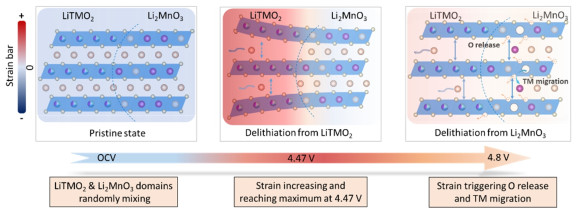
Figure 1.
Schematic of the correlation of strain generation and O release as well as transition metal migration.


In transitional metal (TM) layered oxide cathode materials, the energy storage relies on Li-ion intercalation/de-intercalation in the Li layers. To achieve higher energy density, lithium- and manganese-rich (LMR) layered oxides are developed by enabling Li-storage in TM layers. Nevertheless, this process involves structural evolution (e.g., oxygen release) of cathode materials that might eventually lead to performance degradation. Typically, LMR materials contain two structures (i.e., LiTMO2 and Li2MnO3) that exhibit different electrochemical behaviors during charging/discharging (Figure 1). Limited by characterization techniques, this process is difficult to observe, leaving the relevant mechanism study a challenge.
The LiTMO2 and Li2MnO3 domains share a coherent lattice at the nanoscale but exhibit differentiated electrochemical activities due to different redox chemistries. The initial Li extraction predomi-nately occurs in the LiTMO2 domains and results in local lattice expansion. The lattice expansion is partly confined by the inactive Li2MnO3, which results in tensile strain at the nanoscale. The accumulated tensile strain severely affects the structural stability of the composite LMR cathode, which may trigger the decomposition of Li2MnO3 domains, oxygen release and transition metal (TM) migration. The activation of Li2MnO3 and oxygen release in turn release the lattice strain at high voltages.
To overcome the difficulty in characterizing such materials, Pan and co-workers employed in situ Bragg coherent diffraction imaging to reveal the accumulating lattice strain within LMR particles.[1] It is revealed that the lattice strain causes the unstable structure and oxygen release. Furthermore, the results of spinning-length X-ray diffraction show that the heterogeneous structural dynamics of LMR materials causes uneven Li-ion intercalation and de-intercalation, hence the lattice strain. Therefore, as a commonly observed phenomenon, accumulating lattice strain is undesirable in cathode materials as it may cause structural degradation.
Accordingly, to stabilize LMR materials for better electrochemical performance, some effective strategies have been proposed by Pan and co-workers. Through dispersing Li@Mn6 structural units in TM layers, lattice oxygen loss and irreversible phase transition could be effectively suppressed.[2] Accordingly, a layered oxide consisting of 0.48 Li@Mn6 ordering and 0.52 Mn@Mn6 structure was synthesized, [3] forming an elastic Mn layer after initial cycling (Figure 2). This elastic Mn layer not only enables extra Li+ storage in the tetrahedral sites of Li layer, achieving a reversible capacity as high as 600 mAh g-1, but also tolerates lattice strain during repeated cycling.
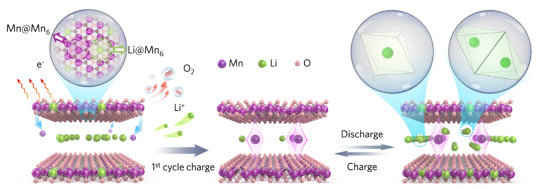
It is clarified that the Mn migration into the Li layer during the initial cycle stabilizes large number of tetrahedral sites for extra and reversible Li-ion storage in this layered compound.
By probing the origin of structural instability, it is suggested that the lattice strain observed not only affects the electrochemical performance of LMR, but also has implication in other layered cathode materials for Li-ion batteries. These findings will provide in-depth perspectives on designing and optimizing high-energy-density cathode materials.
Liu, T. C.; Liu, J. J.; Li, L. X.; Yu, L.; Diao, J. C.; Zhou, T.; Li, S. N.; Dai, A.; Zhao, W. G.; Xu, S. Y.; Ren, Y.; Wang, L. G.; Wu, T. P.; Qi, R.; Xiao, Y. G.; Zheng, J. X.; Cha, W.; Harder, R.; Robinson, I.; Wen, J. G.; Lu, J.; Pan, F.; Amine, K. Origin of structural degradation in Li-rich layered oxide cathode. Nature 2022, 606, 305-312. doi: 10.1038/s41586-022-04689-y
Huang, W. Y.; Lin, C.; Qiu, J. M.; Li, S. N.; Chen, Z. F.; Chen, H. B.; Zhao, W. G.; Ren, G. X.; Li, X. Y.; Zhang, M. J.; Pan, F. Delocalized Li@Mn6 superstructure units enable layer stability of high-performance Mn-rich cathode materials. Chem Doi: 10.1016/j.chempr.2022.04.012(2022).
Huang, W. Y.; Yang, L. Y.; Chen, Z. F.; Liu, T. C.; Ren, G. X.; Shan, P. Z.; Zhang, B. W.; Chen, S. M.; Li, S. N.; Li, J. Y.; Lin, C.; Zhao, W. G.; Qiu, J. M.; Fang, J. J.; Zhang, M. J.; Dong, C.; Li, F.; Yang, Y.; Sun, C. J.; Ren, Y., Q. Z.; Hou, G. J.; Dou, S. X.; Lu, J.; Amine, K.; Pan, F. Elastic lattice enabling reversible tetrahedral Li storage sites in high-capacity manganese oxide cathode. Adv. Mater. Doi: 10.1002/adma.202202745(2022).

Figure 1 Schematic of the correlation of strain generation and O release as well as transition metal migration.

 扫一扫看文章


扫一扫关注我们
 DownLoad:
 下载:
下载:
