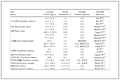
Table 1.
Crystal and structure refinement data for complexes 1~3

Syntheses, Structures and Properties of Three Coordination Polymers Based on Citraconic Acid
Gui-Lian LI , Wei-Dong YIN , Qian-Long LIU , Xiao-Ling LI , Ling-Yun XIN , Guang-Zhen LIU


In recent years, the development of transition metal coordination polymers has been more oriented towards the development of practical applications, such as gas storage/separation, magnetism, catalysis and luminescent sensing[1-7]. The suitable ligands are the key to the design and synthesis of transition metal coordination polymers with interesting structures and good application performances. In the O-donor ligands, the aliphatic carboxylates are widely used in making diverse transition metal coordination polymers due to good flexibility and diverse coordination modes[8]. In our previous work, we obtained a number of transition metal coordination polymers with the fascinating structures and excellent properties based on a flexible itaconic acid[9-10]. The citraconic acid is an isomer of itaconic acid; they are very cheap and excellent flexible ligands with diverse coordination modes. However, there are still few reports on the synthesis of transition metal complexes by citraconic acid as a ligand[11-12].
The N-donor ligands are often used to mediate the structures and properties of transition metal coordination polymers together with the carboxylate groups[13-14]. In the N-donor ligands, 1, 2-bi(4-pyridyl)ethylene (bpe) is one of the most common auxiliary ligands to combine with carboxylates main ligands to obtain a series of transition metal complexes with different structures and properties[15-18]. But as far as we know, there is no report about the 1-(1-imidazolyl)-4-(imidazol-1-ylmethyl)benzene(iimb) as an auxiliary N-donor ligand together with polycarboxylates ligands to synthesize the transition metal coordination polymers until now. In this work, we used flexible citraconic acid (H2ca) as a dicarboxylate ligand and two N-donor ligands such as iimb and bpe as synergistic ligands to synthesize three coordination polymers by hydrothermal techniques, namely {[Zn(ca)(iimb)]·0.75H2O}n (1), {[Cd(ca)(iimb)(H2O)]·0.75H2O}n (2) and {[Zn(ca)(bpe)0.5(H2O)]·H2O}n (3). The structures of three complexes are characterized by elemental analysis, infrared spectroscopy and single crystal X-ray crystallography. The fluorescence properties, thermal stabilities and powder X-ray diffraction for three complexes are given in this paper. The photocatalytic activity of 3 is evaluated by degradation of methylene blue under UV light.
Citraconic acid and bpe were purchased from J&K Scientific Ltd. Ligand iimb was purchased from Jinan Henghua Technology Co., Ltd. All other chemical reagents were of analytical grade and obtained from Tianjin Deen Chemical Reagent Co., Ltd. All chemical reagents were used without further purification. Elemental analyses for C, H and N were performed on a Flash 2000 organic elemental analyzer. Infrared spectra (4 000~600 cm-1) were recorded on powdered samples using a Nicolet 6700 FT-IR spectrometer. Powder X-ray diffraction (PXRD) patterns were taken on a Bruker D8-ADVANCE X-ray diffractometer with Cu Kα radiation (λ=0.154 18 nm; generator voltage: 40 kV; generator current: 40 mA; scanning scope, 2θ: 5°~50°). Thermogravimetric analyses were carried out on a SⅡ EXStar 6000 TG/DTA6300 analyzer heated from 25 to 800 ℃ with a heating rate of 10 ℃·min-1 in N2 atmosphere. Solid fluorescence spectra were performed on an Aminco Bowman Series 2 luminescence spectrometer at room temperature. Solid-state ultraviolet/visible (UV/Vis) diffuse-reflectance spectrum was measured employing a UV-Vis spectrophotometer (Shimadzu, UV-3600 Plus) and a BaSO4 plate was used as the reflectance standard. Solution UV spectra were tested on a Hitachi U-3010 UV-Vis spectro-photometer in the 10 mm quartz cuvette.
A starting mixture containing Zn(OAc)2·2H2O (43.8 mg, 0.20 mmol), H2ca (13.0 mg, 0.10 mmol), iimb (22.4 mg, 0.10 mmol) and H2O (5 mL) was heated at 120 ℃ for 4 days under autogenous pressure in a 23 mL Teflon-lined autoclave, then cooled to room temp-erature. Colorless needle crystals of 1 were collected in 58% yield. Elemental analysis Calcd. for C18H17N4 O4.75Zn(%): C, 50.19; H, 3.98; N, 13.01. Found(%): C, 49.69; H, 4.02; N, 12.85. Selected IR(KBr, cm-1): 3 129(w), 1 588(s), 1 524(s), 1 437(m), 1 401(s), 1 252(s), 1 102(s), 1 065(m), 1 031(m), 953(m), 864(m), 830(m), 754(s), 654(m).
A mixture of Cd(OAc)2·2H2O (54.0 mg, 0.2 mmol), H2ca (0.013 g, 0.10 mmol), iimb (22.4 mg, 0.10 mmol), NaOH (4.0 mg, 0.10 mmol) and 5 mL H2O was heated at 120 ℃ for 4 days under autogenous pressure in a 23 mL Teflon-lined autoclave, then colorless needle crystals were collected with ca. 72% yield. Elemental analysis Calcd. for C18H19.5N4O5.75Cd(%): C, 43.56; H, 3.96; N, 11.29. Found(%): C, 43.48; H, 4.01; N, 11.23. Selected IR (KBr, cm-1): 3 134(w), 1 647(w), 1 563(w), 1 522(s), 1 493(w), 1 402(s), 1 360(m), 1 280(m), 1 230(m), 1 128(s), 1 108(s), 1 062(s), 1 028(m), 963(m), 937(s), 861(w), 822(m), 754(s), 689(m).
A starting mixture containing Zn(OAc)2·2H2O (21.9 mg, 0.10 mmol), H2ca (13.0 mg, 0.10 mmol), bpe (18.2 mg, 0.10 mmol), NaOH (4.0 mg, 0.10 mmol) and H2O (5 mL) was heated at 120 ℃ for 4 days under autogenous pressure, then cooled to room temperature. Colorless sheet crystals of 3 were obtained in 82% yield. Elemental analysis Calcd. for C11H13NO6Zn(%): C, 41.21; H, 4.09; N, 4.37. Found(%): C, 41.18; H, 4.13; N, 4.32. Selected IR (KBr, cm-1): 3 072(w), 1 655(w), 1 612(s), 1 562(s), 1 509(s), 1 432(w), 1 401(s), 1 299(w), 1 262(s), 1 225(m), 1 069(m), 1 065(m), 1 026(s), 985(m), 956(s), 887(m), 872(s), 844(s), 794(m), 726(m).
The photocatalytic activity of complex 3 in degradation of methylene blue (MB) was investigated at ambient temperature under UV light irradiation using a 500 W Xe lamp as light source. The degradation experiments were run as follows: 6 mg complex 3 was added to 6 mL MB (50 μmol·L-1) aqueous solution with 10 μL H2O2 (30%) in a glass bottle. The aqueous suspensions were stirred for 30 min in the dark to ensure the adsorption-desorption equilibrium before the light irradiation. During the tracking photocatalytic reaction, the absorbance of 3 mL MB clear solution was measured at 20 min intervals with a UV-Vis spectrophotometer at a 665 nm absorption wavelength, then the solution was poured back into the original suspension. For comparison, the contrast experiment was completed under the same conditions without any catalyst.
The single-crystal X-ray diffraction analyses were performed on a computer-controlled EosS2 diffracto-meter equipped with graphite-monochromated Mo Kα radiation (λ=0.071 073 nm) by using φ-ω scan technique at room temperature. Using Olex2[19], the structure was solved with the SHELXS[20] program and refined with the SHELXL[21] refinement package. Hydrogen atoms were placed in their geometrically idealized positions and constrained to ride on their parent atoms. The Uiso of the H-atoms were constrained to 1.2 times Ueq of their bonding carbon atoms with dC-H(aromatic)=0.093 nm and dC-H(methylene)=0.097 nm, and 1.5 times Ueq of the hydrogen atoms at water and methyl groups with dC-H(methyl)=0.096 nm. Crystallographic data for com-plexes 1~3 are listed in Table 1. Selected bond distances and angles and hydrogen bonds are listed in Table S1 and Table S2, respectively.
 下载:
导出CSV
下载:
导出CSV
| Complex | 1 | 2 | 3 |
| Empirical formula | C18H17N4O4.75Zn | C18H19.5N4O5.75Cd | C11H13NO6Zn |
| Formula weight | 430.72 | 496.27 | 320.59 |
| Crystal system | Orthorhombic | Monoclinic | Monoclinic |
| Space group | Pbcn | C2/c | P21/n |
| a/nm | 2.164 01(6) | 2.019 24(6) | 0.795 82(3) |
| b/nm | 1.059 10(3) | 1.439 64(5) | 1.863 22(8) |
| c/nm | 1.610 72(3) | 1.431 29(3) | 0.864 82(4) |
| β/(°) | 101.396(3) | 96.327(4) | |
| V/nm3 | 3.691 61(16) | 4.078 7(2) | 1.274 54(10) |
| Z | 8 | 8 | 4 |
| Dc/(g·cm-3) | 1.550 | 1.616 | 1.671 |
| μ/mm-1 | 1.368 | 1.111 | 1.949 |
| F(000) | 1 768 | 1 996 | 656 |
| θ range for data collection/(°) | 3.31 to 25.50 | 3.39 to 25.50 | 3.15 to 25.50 |
| Reflection collected, unique | 63 865, 3 423 | 26 249, 3 767 | 13 970, 2 367 |
| Rint | 0.059 0 | 0.025 2 | 0.043 3 |
| Completeness/% | 99.4 | 99.6 | 99.7 |
| Data, restraint, parameter | 3 423, 103, 278 | 3 767, 124, 315 | 2 367, 0, 174 |
| Goodness-of-fit on F2 | 1.060 | 1.104 | 1.086 |
| R1, wR2 [I>2σ(I)] | 0.056 6, 0.141 6 | 0.037 0, 0.095 4 | 0.032 4, 0.071 2 |
| R1, wR2 (all data) | 0.082 3, 0.152 3 | 0.042 0, 0.098 2 | 0.038 6, 0.073 9 |
| Largest peak and hole /(e·nm-3) | 890 and -530 | 990 and -1 000 | 310 and -310 |
CCDC: 1913976, 1; 1913977, 2; 1913978, 3.
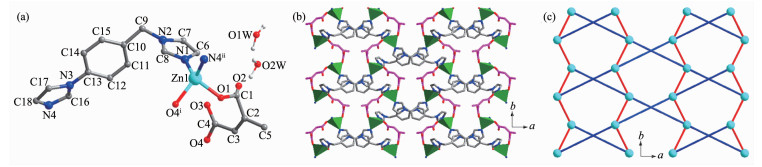
The complex 1 crystallizes in orthorhombic crystal system, space group Pbcn and features a 2D reticular structure. The asymmetric unit contains one crystallo-graphic Zn2+, one ca2-, one iimb molecule, in addition to 0.75 free water molecules. The Zn2+ cation adopts a distorted tetrahedral [ZnN2O2] coordination environment with two carboxylic oxygen atoms from two symmetry-related ca2- and two nitrogen atoms from two symmetry-related iimb co-ligands (Fig. 1a). The Zn-O bond lengths are 0.193 2(10) and 0.196 6(3) nm, and the Zn-N bond lengths are 0.199 9(3) and 0.201 1(3) nm, respectively.
Symmetry codes: ⅰ 1.5-x, -0.5+y, z; ⅱ 0.5+x, -0.5+y, 1.5-z
The adjacent Zn2+ ions are linked through ca2- adopting the monodentate coordination mode to form a metal-carboxylate chain with the Zn…Zn distance of 0.5913 3(1) nm. The adjacent metal-carboxylate chains are further linked by iimb molecules adopting cross connection method along two different directions with the Zn…Zn distance of 1.255 41(3) nm to produce two-dimensional network structure (Fig. 1b). Each Zn(Ⅱ) ion is connected to four adjacent ones through two ca2- and two iimb co-ligands. The 2D layer can be simplified as a commonly uninodal 4-connected net (Fig. 1c). There is no face-face stacking π…π interac-tion between the two pyridine and benzene rings of two iimb ligands. The 3D supramolecular structure is formed through weak van der Waals force.
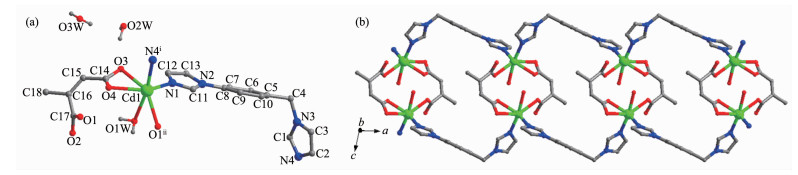
The complex 2 crystallizes in monoclinic crystal system, space group C2/c and features a one-dimensional double-stranded chain structure. The asymmetric unit contains one crystallographic Cd2+, one ca2-, one iimb molecule, one coordinated water molecule, in addition to 0.75 free water molecule. The Cd(Ⅱ) ion is coor-dinated by two nitrogen atoms from two symmetry-related iimb co-ligands, four oxygen atoms from two symmetry-related ca2- and one coordinated water molecule, thus creating a distorted octahedron coor-dination [Cd(O4N2)] geometry (Fig. 2a). The Cd-O bond lengths are in a range of 0.230 4(7)~0.266 2(5) nm, and the Cd-N bond lengths are 0.226 1(3) and 0.225 9(3) nm, respectively.
Symmetry codes: ⅰ -0.5+x, -0.5+y, z; ⅱ 0.5-x, 0.5-y, 1-z
The two carboxylate groups of ca2- adopt the chelating-bidentate and monodentate coordination mode, respectively. Two adjacent Cd(Ⅱ) ions are linked together to form a binuclear cluster with the Cd…Cd distance of 0.513 46(1) nm. The carboxylate-bridged dinuclears are extended along the [110] direction by mated iimb co-ligands to produce one 1D coordination polymer with quasi-trapezoidal shape (Fig. 2b).
The adjacent chains are linked together by H-bond interactions to form its entire three-dimensional supramolecular structure (Fig.S1). There exist weak inter-chain offset π…π interactions between benzene ring and imidazole ring of iimb co-ligands, between two parallel benzene rings of iimb co-ligands. The centroids Cg1 (coordinate: -0.044 30, 0.925 04, -0.906 50), Cg3 (coordinate: 0.044 30, 0.925 04, -0.593 50) and Cg4 (coordinate: -0.044 30, 1.074 96, -0.406 50) are made up of atoms including C5, C6, C7, C8, C9 and C10 atoms, moreover, the centroid Cg2 (coordinate: -0.134 23, 1.033 17, 0.703 73) is made up of atoms including N1, C11, N2, C12 and C13 atoms. The centroid-centroid distance (Cg1-Cg2) and the dihedral angle between benzene ring and imidazole ring of iimb co-ligands are 0.402 8 nm and 23.651° respectively. The centroid-centroid distance (Cg3-Cg4) and the dihedral angle between two benzene rings are 0.411 3 nm and 0°, respectively (Fig.S2). It is obvious that the hydrogen bonds and π…π interactions among the coordination polymers play important roles in the self-assembly and enhanced stability of the resultant structure.
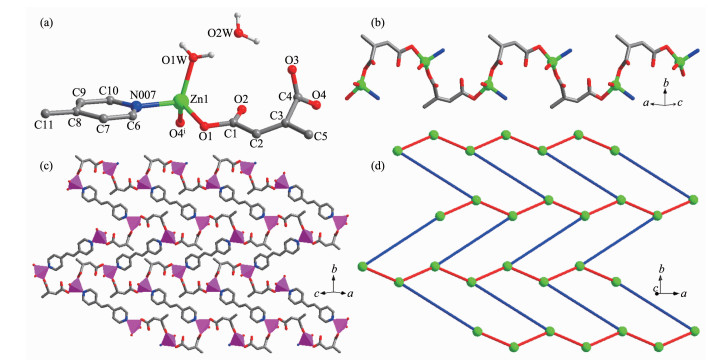
The complex 3 crystallizes in monoclinic crystal system, space group P21/n and features a two-dimensional wave layer. The asymmetric unit contains one crystallographic Zn2+, one ca2-, half a bpe molecule, one coordinated water and one free water molecule. The Zn2+ cation adopts the distorted tetrahedral [ZnNO3] coordination environment with three oxygen atoms from two symmetry-related ca2- and one coordinated water, one nitrogen atom from one bpe co-ligand (Fig. 3a). The Zn-O bond lengths are 0.198 11(1), 0.198 79(1) and 0.202 47(1) nm, respectively, and the Zn-N bond length is 0.206 43(1) nm.
Symmetry codes: ⅰ-0.5+x, 0.5-y, 0.5+z
The ca2- indeed coordinates to two Zn(Ⅱ) ions from two monodentate sites. The adjacent Zn(Ⅱ) ions are connected by the ca2- to form an interesting corrugated 1D metal-carboxylate chain with the Zn…Zn distance of 0.658 09(3) nm (Fig. 3b). The neighboring chains are connected by bpe molecules along b direction with the Zn…Zn distance of 1.349 50(4) nm to produce a 2D layer (Fig. 3c). Each Zn(Ⅱ) ion is connected to three adjacent atoms through two ca2- and one bpe ligand. The 2D layer can be simplified as a commonly uninodal 3-connected grid (Fig. 3d).
The adjacent layers are stacked in a -AAA- sequence along special direction to form a three-dimensional supramolecular polymer by interlayer H-bond interactions between the coordinatedwater O atom and the carboxylate O atom of ca2- anions (O(1W)-H(1WA)…O(4ⅰ): O(1W)…O(4ⅰ) 0.271 3(3) nm, ∠O(1W)-H(1WA)…O(4ⅰ)=133.2°), between the free water O atom and the carboxylate O atom of ca2- (O(2W)-H(2WA)…O(2ⅱ): O(2W)…O(2ⅱ) 0.287 6(3) nm, ∠O(2W)-H(2WA)…O(2ⅱ)= 171.2°, Symmetry codes: ⅰ x-1, y, z; ⅱ x-1/2, -y+1/2, z-1/2). There also exist abundant intralayer H-bond interactions between the coordinated water molecule and the guest water molecule (O(1W)-H(1WB)…O(2W): O(1W)…O(2W) 0.266 6(3) nm, ∠O(1W)-H(1WB)…O(2W)=151.4°), between the free water O atom and the carboxylate O atom of ca2- anions (O(2W)-H(2WB)…O(3): O(2W)…O(3) 0.278 8(3) nm, ∠O(2W)-H(2WB)…O(3)=165.5°) (Fig.S3).
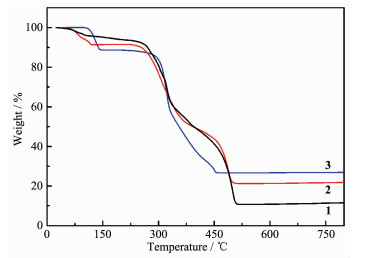
The thermogravimetric analyses (TGA) of 1~3 were performed on the polycrystalline samples from 25 to 800 ℃ at a heating rate of 10 ℃·min-1 under nitrogen atmosphere (Fig. 4). The TGA curve of 1 displayed the first weight loss of 3.78% from 60 to 100 ℃ corresponding approximately to release of 0.75 H2O per formula unit (Calcd. 3.14%). The framework of 1 had a series of weight loss from 260 to 515 ℃ attributed to the decomposition of organic components. The final residue of 10.74% can′t be specifically identified because the theoretical remaining mass of 18.89% is calculated by assuming a final phase ZnO. The TGA curve of 2 displayed 8.59% weight loss in a region of 60~120 ℃, which is not agreement with the calculated value of 1.75 H2O per formula unit (6.35%), so the 2.24% weight loss corresponds to the water because the sample is not completely dry. Over 250 ℃, the framework of 2 began to gradually decompose until 500 ℃. The final residue of 21.65% can be approximatively identified to final phase CdO because the calculated value of the mass remnant is 25.87%. For 3, there was no weight loss before 110 ℃, and the first weight loss of 11.16% between 110 and 143 ℃ corresponds to the loss of two water molecules from one coordinated water and one guest water (Calcd. 11.23%). The second weight loss began over 295 ℃ and ended until 454 ℃ corresponding to the decom-position of organic ligands. The observed final mass remnant of 26.63% is almost agreement with the calculated value of the final product ZnO (Calcd. 25.27%). All major peaks in experimental PXRD match quite well that of simulated from the respective single-crystal data, implying their good phase purity (Fig.S4~S6).
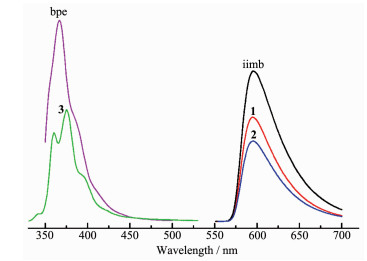
The solid-state luminescent properties of three complexes 1~3 and free ligands were investigated in the solid state at room temperature, as illustrated in Fig. 5. The free H2ca ligand had no emission peak in a very wide excitation wavelength because of the absence of its conjugation effect. The free bpe and iimb ligands showed fluorescent emission bands at 367 nm (λex=334 nm) and 595 nm (λex=376 nm). The emission maximums for 1 and 2 occurred at 595 nm upon excitation at a wavelength of 376 nm[9]. The emission spectra of complexes 1 and 2 are completely consistent with that of the powdered free iimb molecule, which should be assigned as the π-π* and/or n-π* transition of the iimb linker. The emission maximum for complex 3 located at 375 nm upon excitation at 280 nm, which displays similar emission spectrum feature to that of the powdered free bpe ligand. The slight red-shift may be attributed to the increase of the ligand conformational rigidity because of the unique coordination of bpe to the Zn(Ⅱ) ion.
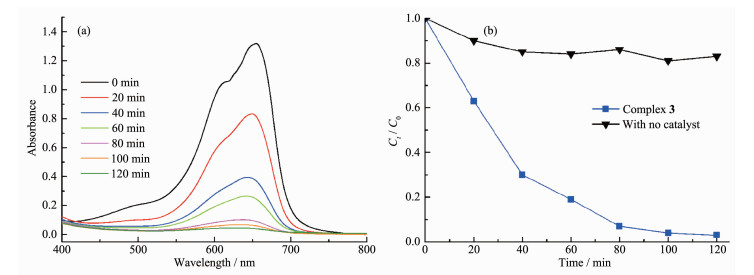
The organic dyes are one of the largest sources of industrial pollutants. Furthermore, it is difficult to remove organic dyes from industrial wastewater due to their high photo and chemical stability. In recent years, transition metal coordination polymers have been used as a new class of photocatalyst for the decomposition of organic dyes[22-24]. The UV-Vis diffuse reflectance spectrum of complex 3 showed absorption bands at 328 nm, which can be attributed to π-π* transitions of the ligand[25]. The band gap (Eg) derived from Kubelka-Munk function plot is 3.24 eV (Fig.S7). Methylene blue (MB) is one of the largest sources of industrial pollutants. So we chose MB as a represen-tative to investigate the degradation process in detail. There is almost no reduction in concentration of MB with time, and the degradation is almost negligible without H2O2 or light irradiation. The photocatalytic behavior of the complex 3 in MB solution is displayed in Fig. 6. The organic dye concentrations were estimated by the absorbance at 665 nm (MB). According to Lambert-Beer′s law, the absorbance of a solution is proportional to the concentration of the substance. As shown in Fig. 6, approximately 70% of MB was decom-posed after 40 min. After 120 min, the photocatalytic efficiency of MB was found to be 97% for 3. In comparison, the degradation efficiency of MB without any photocatalyst was only about 20% after the same time under the same experimental conditions[26-27]. The apparent rate constant of MB was 0.033 6 min-1, which can be confirmed by the pseudo-first-order reaction model: ln(Ct/C0)=-kt[28] (Fig.S8), where Ct and C0 are the concentration of MB at time t and at t=0, and k is the apparent rate constant. To evaluate the stability of photocatalyst 3, after the photocatalytic process, the complex 3 was recycled by the centrifugation method and monitored by powder X-ray diffraction (PXRD) (Fig.S6). The results demonstrated that the complex 3 still maintained a good crystal state after the photocatalytic experiments.
In summary, three Zn/Cd(Ⅱ) coordination polymers have been successfully synthesized under hydrothermal conditions. Both complexes 1 and 3 exhibit two dimensional layers containing the metal-carboxylate chains. The complex 2 features a 1D chain structure containing carboxylate-bridged dinuclears. All three complexes show good phase purity and high thermal stability. The emission spectra of three complexes are similar to those of the corresponding N-donor ligands. The photocatalytic experiment result indicates that complex 3 has good photocatalytic activity in decom-posing MB in the presence of H2O2. The result shows that complex 3 may be a good candidate as photo-catalyst with a potential application in wastewater treatment.
Supporting information is available at http://www.wjhxxb.cn
Yu J M, Xie L H, Li J R, et al. Chem. Rev., 2017, 117:9674-9754 doi: 10.1021/acs.chemrev.6b00626
Zhao Y, Wang L, Fan N N, et al. Cryst. Growth Des., 2018, 47:7114-7121
Xin L Y, Liu G Z, Li X L, et al. Cryst. Growth Des., 2012, 12:147-157 doi: 10.1021/cg200903k
Zhu L, Liu X Q, Jiang H L, et al. Chem. Rev., 2017, 117:8129-8176 doi: 10.1021/acs.chemrev.7b00091
Liu G Z, Li S H, Li X L, et al. CrystEngComm, 2013, 15:4571-4580 doi: 10.1039/c3ce40109j
Xue X, Wang H, Han Y, et al. Dalton Trans., 2018, 47:13-22 doi: 10.1039/C7DT03989A
尹卫东, 李桂连, 刘广臻, 等.无机化学学报, 2015, 31:1439-1446 http://www.wjhxxb.cn/wjhxxbcn/ch/reader/view_abstract.aspx?file_no=20150725YIN Wei-Dong, LI Gui-Lian, LIU Guang-Zhen, et al. Chinese J. Inorg. Chem., 2015, 31:1439-1446 http://www.wjhxxb.cn/wjhxxbcn/ch/reader/view_abstract.aspx?file_no=20150725
Naira R M, Sudarsanakumara M R, Sumab S, et al. J. Mol. Struct., 2016, 1105:316-321 doi: 10.1016/j.molstruc.2015.10.035
尹卫东, 李桂连, 李晓玲, 等.无机化学学报, 2016, 32:662-668 doi: 10.11862/CJIC.2016.063YIN Wei-Dong, LI Gui-Lian, LI Xiao-Ling, et al. Chinese J. Inorg. Chem., 2016, 32:662-668 doi: 10.11862/CJIC.2016.063
Yin W D, Shen J, He Y Y, et al. Transition Met. Chem., 2019, 44:89-97 doi: 10.1007/s11243-018-0272-y
Xu X X, Zhang X, Liu X X, et al. Cryst. Growth Des., 2010, 10:2272-2277 doi: 10.1021/cg901605j
Di Nicola C, Forlin E, Garau F, et al. J. Organomet. Chem., 2012, 714:74-80 doi: 10.1016/j.jorganchem.2012.03.026
Yin W D, Li G L, Xin L Y, et al. Chin. J. Struct. Chem., 2017, 36:1502-1510
王玉芳, 太军慧, 颜小伟, 等.无机化学学报, 2018, 34:1121-1126 doi: 10.11862/CJIC.2018.135WANG Yu-Fang, TAI Jun-Hui, YAN Xiao -Wei, et al. Chinese J. Inorg. Chem., 2018, 34:1121-1126 doi: 10.11862/CJIC.2018.135
Liu G Z, Xin L Y, Wang L Y. CrystEngComm, 2011, 13:3013-3020 doi: 10.1039/c0ce00873g
Li X L, Liu G Z, Xin L Y, et al. CrystEngComm, 2012, 14:1729-1736 doi: 10.1039/C1CE06050C
Xin L Y, Liu G Z, Ma L F, et al. J. Solid State Chem., 2013, 206:233-241 doi: 10.1016/j.jssc.2013.08.010
Li Z H, Xue L P, Qin Q P, et al. J. Solid State Chem., 2019, 274:81-85 doi: 10.1016/j.jssc.2019.03.020
Dolomanov O V, Bourhis L J, Gildea R J, et al. J. Appl. Cryst., 2009, 42:339-341 doi: 10.1107/S0021889808042726
Sheldrick G M. Acta Crystallogr. Sect. A:Found. Crystallogr., 2015, A71:3-8 http://onlinelibrary.wiley.com/resolve/doi?DOI=10.1107%2FS2053273314026370
Sheldrick G M. Acta Crystallogr. Sect. C:Cryst. Struct. Commun., 2015, C71:3-8
刘媛媛, 张慧敏, 王鑫蕊, 等.无机化学学报, 2018, 34:791-799 doi: 10.11862/CJIC.2018.097LIU Yuan-Yuan, ZHANG Hui-Min, WANG Xin-Rui, et al. Chinese J. Inorg. Chem., 2018, 34:791-799 doi: 10.11862/CJIC.2018.097
Qin L, Chen H Z, Lei J, et al. Cryst. Growth Des., 2017, 17:1293-1298 doi: 10.1021/acs.cgd.6b01690
Wang C, Xing F, Bai Y L, et al. Cryst. Growth Des., 2016, 16:2277-2288 doi: 10.1021/acs.cgd.6b00065
Hao S Y, Hou S X, Van Hecke K, et al. Dalton Trans., 2017, 46:1951-1964 doi: 10.1039/C6DT04516B
Guo J, Ma J F, Li J J, et al. Cryst. Growth Des., 2012, 12:6074-6082 doi: 10.1021/cg301208d
Wang Z H, Hao R, Zhu S, et al. Chin. J. Struct. Chem., 2018, 37:803-810
翟丽军, 牛宇岚, 郝小艳, 等.无机化学学报, 2018, 34:1936-1942 doi: 10.11862/CJIC.2018.242ZHAI Li-Jun, NIU Yu-Lan, HAO Xiao-Yan, et al. Chinese J. Inorg. Chem., 2018, 34:1936-1942 doi: 10.11862/CJIC.2018.242

Figure 1 (a) View of the asymmetric unit showing the local coordination environments of Zn(Ⅱ) in 1; (b) Polyhedral view of a 2D layer extending in complex 1; (c) View of schematic representation of 2D layer
Symmetry codes: ⅰ 1.5-x, -0.5+y, z; ⅱ 0.5+x, -0.5+y, 1.5-z

Figure 2 (a) View of the asymmetric unit showing the local coordination environments of Cd(Ⅱ) in 2; (b) Polyhedral view of 1D quasi-trapezoidal shape chain with the dinuclear units
Symmetry codes: ⅰ -0.5+x, -0.5+y, z; ⅱ 0.5-x, 0.5-y, 1-z

Figure 3 (a) View of the asymmetric unit showing the local coordination environments of Zn(Ⅱ) in 3; (b) View of a section of the 1D chain by ca2- and Zn2+; (c) Polyhedral view of a 2D wave layer extending in complex 3; (d) View of schematic representation of 2D layer
Symmetry codes: ⅰ-0.5+x, 0.5-y, 0.5+z

Figure 5 Solid-state emission spectra of complexes 1~3 along with the free iimb and bpe ligands

Figure 6 (a) Absorption spectra of the MB solutions during the photodegradation reaction under UV light in the presence of 3; (b) Concentration changes of MB as a function of irradiation time in the present of 3 and the control experiment without any catalyst
Table 1. Crystal and structure refinement data for complexes 1~3
| Complex | 1 | 2 | 3 |
| Empirical formula | C18H17N4O4.75Zn | C18H19.5N4O5.75Cd | C11H13NO6Zn |
| Formula weight | 430.72 | 496.27 | 320.59 |
| Crystal system | Orthorhombic | Monoclinic | Monoclinic |
| Space group | Pbcn | C2/c | P21/n |
| a/nm | 2.164 01(6) | 2.019 24(6) | 0.795 82(3) |
| b/nm | 1.059 10(3) | 1.439 64(5) | 1.863 22(8) |
| c/nm | 1.610 72(3) | 1.431 29(3) | 0.864 82(4) |
| β/(°) | 101.396(3) | 96.327(4) | |
| V/nm3 | 3.691 61(16) | 4.078 7(2) | 1.274 54(10) |
| Z | 8 | 8 | 4 |
| Dc/(g·cm-3) | 1.550 | 1.616 | 1.671 |
| μ/mm-1 | 1.368 | 1.111 | 1.949 |
| F(000) | 1 768 | 1 996 | 656 |
| θ range for data collection/(°) | 3.31 to 25.50 | 3.39 to 25.50 | 3.15 to 25.50 |
| Reflection collected, unique | 63 865, 3 423 | 26 249, 3 767 | 13 970, 2 367 |
| Rint | 0.059 0 | 0.025 2 | 0.043 3 |
| Completeness/% | 99.4 | 99.6 | 99.7 |
| Data, restraint, parameter | 3 423, 103, 278 | 3 767, 124, 315 | 2 367, 0, 174 |
| Goodness-of-fit on F2 | 1.060 | 1.104 | 1.086 |
| R1, wR2 [I>2σ(I)] | 0.056 6, 0.141 6 | 0.037 0, 0.095 4 | 0.032 4, 0.071 2 |
| R1, wR2 (all data) | 0.082 3, 0.152 3 | 0.042 0, 0.098 2 | 0.038 6, 0.073 9 |
| Largest peak and hole /(e·nm-3) | 890 and -530 | 990 and -1 000 | 310 and -310 |
 下载: 导出CSV

 扫一扫看文章


扫一扫关注我们