
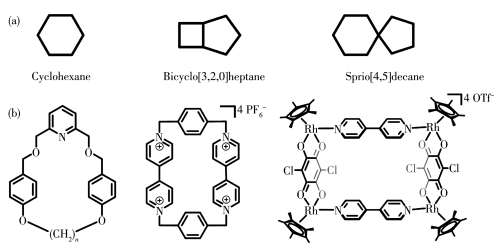
Figure 1.
(a) Organic cyclic hydrocarbon compounds (left), bridged hydrocarbon compounds (middle), and spirocyclic hydrocarbon compounds (right); (b) Examples of supramolecular cyclic compounds


Cyclic compound was one kind of the most significant compound in organic chemistry. If some atoms simply connected head to tail, regular cyclic compounds were obtained such as cyclohexane or tetrahydrofuran. However, some complex situations usually happen in common compounds. Two or more atoms were shared by two or more rings in some compounds, which were called bridged compounds such as bicyclo[3,2,0]heptane. Similarly, spirocyclic compounds were defined by the situation in which only one atom was shared by two or more rings, such as sprio[4,5]decane (Fig. 1a)[1]. With the rapid development of modern chemistry, the amount of research fields was increasing and some scientists in supramolecular chemistry pay attention to cyclic compounds.
In recent decades, scientists have synthesized some supramolecular macrocycles referring to the shape of regular organic cyclic compounds in the supramolecular chemistry field[2]. David A. Leigh and his co-workers synthesized an ether macrocycle by organic coupling reaction, which was a pure organic electroneutral molecule (Fig. 1b, left)[3]. J. Fraser Stoddart and his co-workers obtained a cationic macrocycle by coupling reaction of 1,4-dibromoxylene and 4,4′-bipyridine, which was neutralized by PF6- (Fig. 1b, middle)[4]. The supramolecular macrocycle mentioned above were organic compounds without metal ions. Coordination-driven chemical self-assembly developed rapidly in recent decades[5]. Therefore, plentiful scientists tried to construct supramolecular macrocycles by inorganic self-assembly method. M. Fujita′s[6] research group and Peter J. Stang′s[7] research group constructed coordinative macrocycles by Pd(Ⅱ) or Pt(Ⅱ) metal corners. In the past 20 years, the Cp*Rh unit attracted scientists′ sight, which had three free orthogonal coordinative sites and was convenient for designing macrocycles. JIN Guoxin and his co-workers synthesized a supramolecular macrocycle by coordination-driven self-assembly of 4,4′-bipyridine and Cp*Rh units (Fig. 1b, right)[8]. In addition, some more complicated derivates of supramolecular macrocycles were synthesized such as catenanes[9-10], knots[11-12], and ravels[13]. However, too many sights concentrated the research on macrocycles and their derivates but ignored research on other cyclic supramolecular compounds.
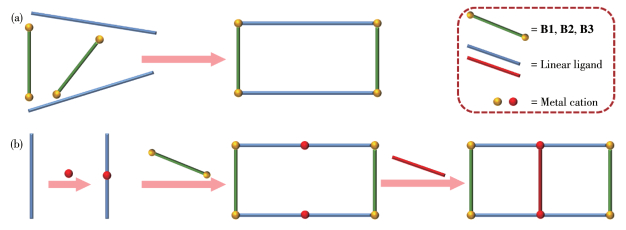
In this article, we chose to research some abnormal rings rather than regular cyclic compounds. We design supramolecular bridged cyclic compounds and spirocyclic cyclic compounds referring to the shape of organic bridged or spirocyclic molecules by coordination-driven self-assembly method featuring half-sandwich Cp*Rh building blocks. Through observing the self-assembly process of regular macrocycles in previous research (Fig. 2a), we found that if an extra arm could be inserted into the macrocycle as a 'bridge', extra coordinative sites were necessary for the linear ligand to immobilize extra metal ions. After the addition of the assistant bidentate ligand with the proper length to connect two extra metal ions, a supramolecular bridged cyclic compound was synthesized successfully as shown in Fig. 2b. Besides, a similar strategy could also be applied to construct supramolecular spirocyclic compounds featuring Cp*Rh building blocks. Subsequently, we start designing proper ligands and choosing proper building blocks to construct supramolecular bridged or spirocyclic compounds to demonstrate our strategy.
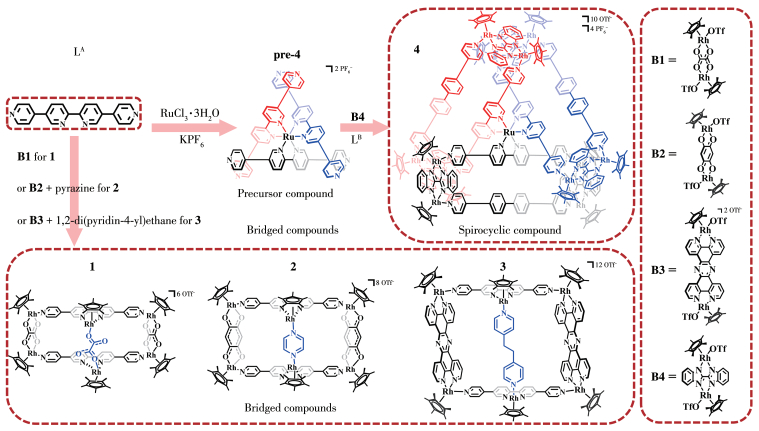
Compound (Cp*Rh(OTf)2)2[14], binuclear building blocks B1[15], B2[16], B3[17], B4[18] and rigid ligand LA[19], LB[20] were synthesized as the literature report, where B1=[(Cp*Rh)2(μ-η2-η2-C2O4)](OTf)2, OTf-=CF3SO3-, B2=[(Cp*Rh)2(dhbq)](OTf)2, dhbq=2,5-dihydroxy-1,4-benzoquinone, B3=[(Cp*Rh)2(tpphz)](OTf)4), tpphz= tetrapyrido[3,2-a∶2′,3′-c∶3″,2″-h∶2‴, 3‴-j]phenazine, B4=[(Cp*Rh)2(bibzim)](OTf)2, bibzim=2,2′-bisbenzimidazole, LA=3,3′-di(pyridin-4-yl)-2,2′-bipyridine, LB=4,4′-di(pyridin-4-yl)-1,1′-biphenyl (Scheme 1). Assistant ligand pyrazine and 1,2-di(pyridin-4-yl)ethane (bpea) were purchased in the common commercial way. Methanol (≥99.7%), diethyl ether (≥99.7%), and N,N-dimethylformamide (DMF, ≥99.5%) were directly used after purchase, and no more purified. Elemental analyses (C, H, N) were carried out on an Elemental Vario EL Ⅲ analyzer. NMR spectra (1H, 1H-1H COSY, and 1H DOSY) were recorded on Bruker AVANCE Ⅲ HD 400 MHz spectrometers at room temperature. Chemical shifts (δ) were reported relative to the residual solvent peak (δH=1.94 for CD3CN). X-ray intensities of the complexes were collected on a Bruker D8 Venture diffractometer with Cu Kα (λ=0.154 178 nm) or Ga Kα (λ=0.134 138 nm) using the SMART and SAINT programs. The structure was solved by direct methods and refined on F2 by full-matrix least-squares methods with SHELXTL-2018. In the structural refinement, except the partly occupied solvent molecules and the disordered parts in the cage, the other non-hydrogen atoms were refined anisotropically and hydrogen atoms within the ligand backbone were fixed geometrically at calculated distances and allowed to ride on the parent non-hydrogen atoms. The highly disordered state of the incorporated molecule solvents meant that lots of them could not be located, and hence in the final refinement, the electron density was treated with the SQUEEZE routine in the PLATON program package. The NMR spectra, ESI-MS data, and crystal data of the complexes can be found in the Supporting information.
Compound B1 (38.8 mg, 0.045 mmol) was dissolved into 6.0 mL methanol, followed by the addition of ligand LA (9.30 mg, 0.03 mmol). After stirring overnight, much precipitate was observed. Therefore, DMF (1.5 mL) was added into the self-assembly system, which improved solubility obviously after stirring for another 8 h. Orange solution was obtained after centrifugation. The solution was filtered through a filter membrane, and the filtrate was crystallized by diethyl ether diffusion to obtain the bridged cyclic compound 1, which was washed with diethyl ether and dried under a vacuum. Yield: 41.4 mg, 86%. 1H NMR (400 MHz, CD3CN): δ 8.99 (s, α-H in middle pyridyl, 4H), 8.63 (d, J=8.4 Hz, β-H in middle pyridyl, 4H), 8.56 (d, J=8.4 Hz, γ-H in middle pyridyl, 4H), 8.26 (d, J=5.7 Hz, α-H in terminal pyridyl, 8H), 7.80 (d, J=5.7 Hz, β-H in terminal pyridyl, 8H), 1.60-1.63 (90H, H of Cp*). Anal. Calcd. for C112H118O30N8S6F18Rh6(%): C 41.93, H 3.71, N 3.49; Found(%): C 41.77, H 4.06, N 3.63.
The (Cp*Rh(OTf)2)2 solution (1.5 mL, 0.01 mmol·mL-1) was mixed with ligand LA (9.30 mg, 0.03 mmol) and stirred for 2 h, followed by the addition of B2 solution (27.4 mg in 6.0 mL methanol, 0.03 mmol). After stirring for 5 h, a methanol solution of assistant ligand pyrazine (1.5 mL, 0.01 mmol·mL-1) was added into the turbid liquid and then DMF (1.0 mL) was added to improve solubility. After stirring overnight and centrifugation, the brown solution was filtered through a filter membrane, and the filtrate was crystallized by diethyl ether diffusion to obtain the bridged cyclic compound 2, which was washed with diethyl ether and dried under a vacuum. Yield: 43.7 mg, 81%. NMR (400 MHz, CD3CN): δ 8.8-9.5 (α-H in middle pyridyl, 4H), 8.73, 7.99(β-H in middle pyridyl, 4H), 8.67, 8.44(α-H in terminal pyridyl, 8H), 8.49(d, J=4.8Hz, H in pyrazine, 8H), 8.51, 7.97 (γ-H in middle pyridyl, 4H), 8.14, 7.88(β-H in terminal pyridyl, 8H), 5.66 (H in B2, 4H), 1.6-1.7(H in Cp*, 90H). Anal. Calcd. for C124H126O32N10S8 F24Rh6(%): C 41.39, H 3.53, N 3.89; Found(%): C 41.20, H 3.76, N 4.07.
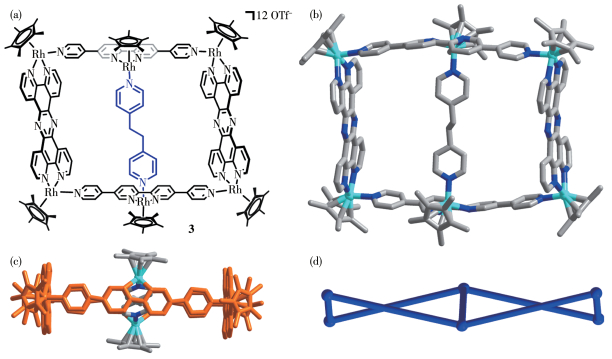
Bridged cyclic compound 3 was synthesized according to a similar procedure as compound 2 except that B2 was replaced by B3 (43.5 mg in 10.0 mL methanol, 0.03 mmol) and pyrazine was replaced by assistant ligand bpea (2.8 mg, 0.015 mmol). Yellow compound 3 was obtained after recrystallization. Yield: 55.2 mg, 77%. NMR (400 MHz, CD3CN): δ 10.1-10.4 (α-H of B3, 8H), 9.7-9.9 (γ-H of B3, 8H), 9.20, 9.04 (α-H in middle pyridyl, 4H), 8.71 (β-H of middle pyridyl, 4H), 8.69, 8.59 (α-H of terminal pyridyl, 8H), 8.61 (β-H of B3, 8H), 8.52 (γ-H in middle pyridyl, 4H), 8.43 (H in —CH2— of bpea, 4H), 7.96, 7.69 (α-H in pyridyl of bpea, 8H), 7.93, 7.84 (β-H of terminal pyridyl, 8H), 6.61, 6.56 (β-H in pyridyl of bpea, 8H), 1.3-1.8(H in Cp*, 90H). Anal. Calcd. for C172H154O36N22S12 F36Rh6(%): C 43.11, H 3.24, N 6.43; Found(%): C 43.29, H 3.58, N 6.26.
Pre-4 was a precursor compound of spirocyclic compound 4. It could be described as [Ru(LA)3](PF6)2. It was synthesized as the literature method[21]. pre-4 (6.61 mg, 0.005 mmol) was dissolved into acetonitrile (3.0 mL), which was poured into a solution of B4 (30.2 mg in 6.0 mL methanol, 0.03 mmol). After stirring for 5 h, assistant ligand LB (4.6 mg, 0.015 mmol) was added into the system before DMF (1.0 mL) was added to improve its solubility. After 8 h stirring and centrifugation, an orange-yellow solution was filtered through a filter membrane, and the filtrate was crystallized by diethyl ether diffusion to obtain the spirocyclic compound 4, which was washed with diethyl ether and dried under a vacuum. Yield: 32.7 mg, 79%. NMR (400 MHz, CD3CN): δ 8.54, 8.50, 8.29 (α-H of middle pyridyl, 4H), 8.07, 7.95 (α-H of pyridyl in LB, 8H), 8.01 (H of B4, 2H), 7.86 (H of B4, 2H), 7.71, 7.64 (α-H of terminal pyridyl in LA, 4H), 7.55, 7.37 (β-H of pyridyl in LB, 4H), 7.51 (H of B4, 2H), 7.44 (H of B4, 2H), 7.32 (γ-H of pyridyl in LA, 2H), 7.22, 7.02 (β-H of terminal pyridyl in LA, 4H), 7.20 (outer H of biphenyl in LB, 4H), 6.76, 6.68 (inner H of biphenyl in LB, 4H), 5.89 (β-H of pyridyl in LA, 2H), 1.1-2.1(H in Cp*, 60H). Anal. Calcd. for C340H318O30N42S10F54P4Rh12Ru(%): C 49.33, H 3.87, N 7.11; Found(%): C 49.09, H 4.20, N 6.94.
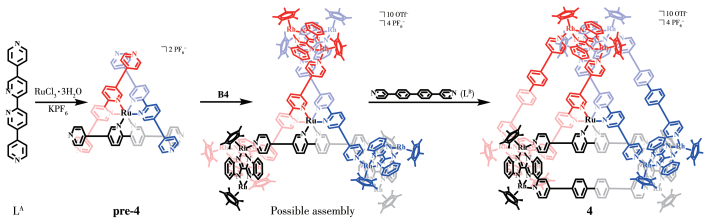
In our construction strategy mentioned above, extra coordinative sites were necessary for rigid ligands. Therefore, a 2,2′-bipyridyl group was inserted into a rigid ligand as a chelate site. After coupling with another two pyridin-4-yl groups, the main ligand LA was synthesized successfully, which was chosen to self-assemble with building blocks with different lengths including B1, B2, B3, and B4. In addition, another assistant ligand was also necessary to connect two extra metal ions, whose length should match the length of building blocks. By coordination-driven stepwise self-assembly method, supramolecular bridged and spirocyclic compounds were obtained as shown in Scheme 1.
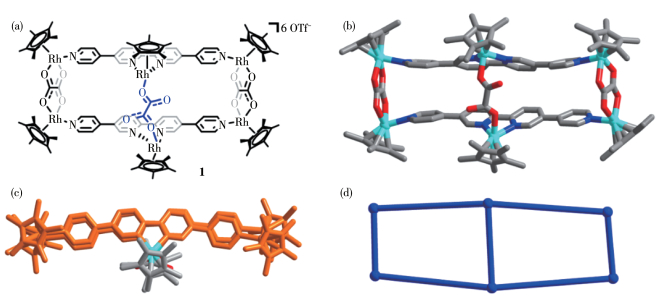
Firstly, building block B1 was chosen to assemble with LA. A bridged cyclic supramolecular compound 1 was obtained as shown in Fig. 3a. From its single crystal X-ray diffraction result (Fig. 3b), two extra Cp*Rh units, which belong to another B1 originally, are chelated by two 2,2′-bipyridyl in LA. The original tetradentate chelating ligand C2O42- changes to a bidentate coordinative ligand after revolving to connect two Cp*Rh units as a bridge. Therefore, a bridged cyclic compound 1 was synthesized successfully, composed of two B1 units, two main LA ligands, two extra Cp*Rh units, and an assistant ligand C2O42-. In addition, the location of two extra Cp*Rh was on the same side of ligand LA as shown in the top view of the crystal structure (Fig. 3c). Ball-and-stick model reminds us that compound 1 is indeed a bridged cyclic compound (Fig. 3d).
In the above description, compound 1 could be constructed by self-assembly of B1 and LA in a molar ratio of 3∶2. One of C2O42- loses its chelating tetradentate coordinative formation and uses bidentate coordinative formation, which has proper length matching the distance between two extra Cp*Rh units. However, the same situation did not happen when longer-length building block B2 was chosen. If the same ratio (nB2∶nLA=3∶2) was applied, no crystal could be obtained.
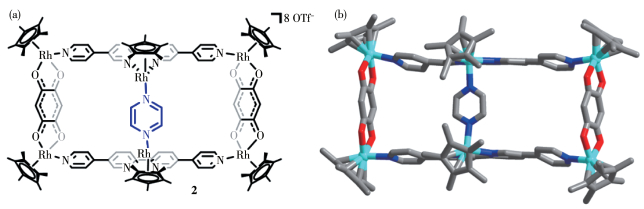
To synthesize a bridged cyclic compound by B2 and LA, a stepwise assembly strategy was applied. Firstly, [Cp*Rh(OTf)2]2 was mixed with LA at 1∶2 ratio to occupy chelating sites, followed by the addition of B2 (nB2∶nLA=2∶2). Eventually, pyrazine was added into the mixture as assistant ligand to connect two Cp*Rh unit (npyrazine∶nLA=1∶2), which constructed bridged cyclic compounds 2 successfully as shown in Fig. 4a.
The single crystal X-ray diffraction result reminds us that 2 is indeed a bridged cyclic compound (Fig. 4b). The length of pyrazine matches the distance between two extra Rh ions properly. Besides, we can observe that the location of two extra Cp*Rh is also at the same side of ligand LA from its crystal structure, which was similar to compound 1.
After compound 2 was synthesized, we continued extending the length of the building blocks. Therefore, building block B3 was chosen with a 1.286 nm length. Compound 3 was synthesized in the same procedure as that of compound 2 except different assistant ligand. In the case of B3 (1.286 nm) is much longer than B2 (0.799 nm), the assistant ligand should also be extended longer. Therefore, a flexible bidentate ligand bpea was chosen to connect two extra Rh ions as the assistant ligand.
A bridged cyclic compound 3 was obtained by the stepwise assemble method (Fig. 5a). Single crystal X-ray diffraction result reminds us compound 3 is also a bridged cyclic compound as shown in Fig. 5b. Different phenomenon is observed in its crystal structure that two extra Cp*Rh units locate at both side of LA when they are at same side in compounds 1 and 2 (compared Fig. 5c with Fig. 3c). Enough length and its flexibility might be reasons of this phenomenon. Ball-and-stick model of 3 also exhibited different sides of two extra Cp·Rh units (Fig. 5d).
In bridged cyclic compounds 1, 2, and 3, [(Cp*Rh)2 (assistant ligand)] is the bridge to connect two rings. If we expect to obtain spirocyclic compounds, only one atom can be shared by different rings, which are metal ions in general. However, the same Cp*Rh unit can not be the shared center as compounds 1, 2, and 3 do. The reason is that Cp*Rh has only three free coordination sites, which does not allow the existence of two or more chelating groups. Therefore, another connection center should be considered. We observed free Rh(Ⅲ), Ir(Ⅲ), and Ru(Ⅱ) ions without Cp* have six free coordination sites, which can be chelated exactly by three 2,2′-bipyridyl groups. Considering obstacles of reactivity between RhCl3/IrCl3 and 2,2′-bipyridyl groups, Ru(Ⅱ) ions were selected as the shared center.
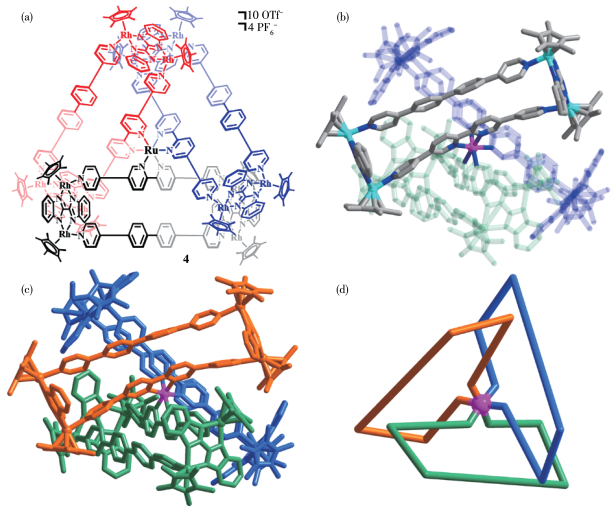
Although chelating reactivity between RuCl3 and LA is better than RhCl3/IrCl3, a high reaction temperature (180 ℃) is still acquired in the chelating procedure, which is much different from the following self-assembly process. Therefore, stepwise assembly is still necessary in the construction of this spirocyclic compound. The first step was the synthesis of pre-4 by the reaction of LA and RuCl3·3H2O in glycol under 180 ℃, in which Ru(Ⅲ) was reduced to Ru(Ⅱ) to obtain six free coordination sites. After the successful construction of pre-4, it was selected to assemble with building block B4 (6.0 Equiv. to pre-4). Followed by the addition of assistant ligand LB to occupy residual coordination sites, the spirocyclic compound 4 was obtained (Scheme 2). A situation should be explained that LA cannot become the assistant ligand because of its extra chelating sites which will continue coordinating with other ions and make the situation too complicated and unpredictable. Therefore, ligand LB (Scheme 2) was selected to be the assistant ligand due to its almost the same length as main ligand LA but no extra coordination sites.
Single crystal X-ray diffraction result reminds us of the successful construction of spirocyclic compound 4 (Fig. 6b), demonstrating the validity of our strategy shown in Scheme 2. From Fig. 6b, we can observe that each ring is made up of two different ligands (an LA and an LB), which profit from the stepwise assembly method. The LA arm links a Ru(Ⅱ) ion by its chelating sites with another two LA arms in different rings. The LB arm only plays a connection role to complete the formation of a rectangle ring. The Ru(Ⅱ) ion is the only connection between the three rings and the supramolecular spirocyclic compound 4 is synthesized successfully as we predicted. Due to the narrow space in each ring which is caused by the short length of the building block B4 (0.560 nm from Rh to Rh), three rings of 4 can not cross with each other (Fig. 6c). The simplified structure of 4 is more obvious (Fig. 6d), which exhibits topology of 4 is a supramolecular spirocyclic compound exactly.
Supramolecular macrocycles were synthesized by modeling organic cyclic compounds in the past few decades. In this work, we extended the research to synthesize supramolecular bridged compounds and spirocyclic compounds by coordination-driven chemical assembly method featuring half-sandwich Cp*Rh units. Through detailed observation of previous regular macrocycles, we guess the addition of extra chelating sites in rigid ligands contributed to these constructions. Therefore, a rigid ligand (LA) with an extra 2,2′-bipyridyl group was designed and chosen to assemble with different building blocks as the main ligand. Through stepwise assembly with building blocks and assistant ligand, three coordinative supramolecular bridged cyclic compounds (compounds 1-3) and one supramolecular spirocyclic (compound 4) were constructed successfully as we designed and predicted. This coordination-driven stepwise assemble strategy is particularly effective in the construction of these various supramolecular compounds, which is also significant in providing reference to synthesize more complicated compounds in the near future.
邢其毅, 裴伟伟, 徐瑞秋, 裴坚. 基础有机化学. 3版. 北京: 高等教育出版社, 2005: 42-46XING Q Y, PEI W W, XU R Q, PEI J. Basic organic chemistry. 3rd ed. Beijing: Higher Education Press, 2005: 42-46
Xia D Y, Wang P, Ji X F, Khashab N M, Sessler J L, Huang F H. Functional supramolecular polymeric networks: The marriage of covalent polymers and macrocycle-based host-guest interactions[J]. Chem. Rev., 2020, 120: 607-6123.
Aucagne V, Berná J, Crowley J D, Goldup S M, Hänni K D, Leigh D A, Lusby P J, Ronaldson V E, Slawin A M Z, Viterisi A, Walker D B. Catalytic "active-metal" template synthesis of[2]rotaxanes, [3]rotaxanes, and molecular shuttles, and some observations on the mechanism of the Cu(Ⅰ)-catalyzed azide-alkyne 1,3-cycloaddition[J]. J. Am. Chem. Soc., 2007, 129: 11950-11963. doi: 10.1021/ja073513f
Cai K, Mao H C, Liu W G, Qiu Y Y, Shi Y, Zhang L, Shen D K, Chen H L, Jiao Y, Wu H, Liu Z C, Feng Y N, Stern C L, Wasielewski M R, Goddard Ⅲ W A, Stoddart J F. Highly stable organic bisradicals protected by mechanical bonds[J]. J. Am. Chem. Soc., 2020, 142: 7190-7197. doi: 10.1021/jacs.0c01989
Gao W X, Feng H J, Guo B B, Lu Y, Jin G X. Coordination-directed construction of molecular links[J]. Chem. Rev., 2020, 120: 6288-6325. doi: 10.1021/acs.chemrev.0c00321
Fujita M, Tominaga M, Hori A, Therrien B. Coordination assemblies from a Pd(Ⅱ)-cornered square complex[J]. Acc. Chem. Res., 2005, 38: 369-378. doi: 10.1021/ar040153h
Kaim W, Schwederski B, Dogan A, Fiedler J, Kuehl C J, Stang P J. Metalla-supramolecular rectangles as electron reservoirs for multielectron reduction and oxidation[J]. Inorg. Chem., 2002, 41: 4025-4028. doi: 10.1021/ic020122n
Han Y F, Lin Y J, Jia W G, Jin G X. Synthesis, structure and electrochemical properties of molecular rectangles of half-sandwich iridium complexes containing the bridging chioranilate ligands[J]. Organometallics, 2008, 27: 4088-4097. doi: 10.1021/om800426e
Gao X, Cui Z, Shen Y R, Liu D, Lin Y J, Jin G X. Synthesis and near-infrared photothermal conversion of discrete supramolecular topologies featuring half-sandwich[Cp*Rh]units[J]. J. Am. Chem. Soc., 2021, 143: 17833-17842. doi: 10.1021/jacs.1c09333
Shen Y R, Gao X, Cui Z, Jin G X. Rational design and synthesis of interlocked [2]catenanes featuring half-sandwich Cp*Rh/Ir units and pyrene-based ligands[J]. Chin. J. Chem., 2021, 39: 3303-3308. doi: 10.1002/cjoc.202100546
Zhang H N, Lin Y J, Jin G X. Selective construction of very large stacking-interaction-induced molecular 818 metalla-knots and Borromean ring using curved dipyridyl ligands[J]. J. Am. Chem. Soc., 2021, 143: 1119-1125. doi: 10.1021/jacs.0c11925
Dang L L, Feng H J, Lin Y J, Jin G X. Self-assembly of molecular figure-eight knots induced by quadruple stacking interactions[J]. J. Am. Chem. Soc., 2020, 142: 18946-18954. doi: 10.1021/jacs.0c09162
Dang L L, Zhang T T, Chen T, Zhao Y, Gao X, Aznarez M, Ma L F, Jin G X. Selective synthesis and structural transformation of a 4-ravel containing four crossings and featuring Cp*Rh/Ir fragments[J]. Angew. Chem. Int. Ed., 2023, 62: e20230151.
Han Y F, Lin Y J, Weng L H, Berke H, Jin G X. Stepwise assembly of "organometallic boxes" with half-sandwich Ir, Rh and Ru fragments[J]. Chem. Commun., 2008, : 350-352.
Han Y F, Lin Y J, Jin G X. Template-controlled topochemical photodimerization based on "organometallic macrocycles" through single-crystal-to-single-crystal transformation[J]. Chem. Commun., 2008, : 1807-1809.
Han Y F, Jia W G, Lin Y J, Jin G X. Stepwise formation of molecular rectangular boxes of half-sandwich rhodium and ruthenium complexes containing bridging chloranilate ligands[J]. Organometallics, 2008, 27: 5002-5008. doi: 10.1021/om800490s
Zhang H N, Gao W X, Deng Y X, Lin Y J, Jin G X. Stacking-interaction-induced host-guest chemistry and Borromean rings based on a polypyridyl ligand[J]. Chem. Commun., 2018, 54: 1559-1562. doi: 10.1039/C7CC09448E
Wu T, Lin Y J, Jin G X. Stepwise formation of organometallic macrocycles and triangular prisms containing 2, 2'-bisbenzimidazole ligands[J]. Dalton Trans., 2013, 42: 82-88. doi: 10.1039/C2DT31387A
Iranmanesh H, Arachchige K S A, Bhadbhade M, Donald W A, Liew J A, Liu K T C, Luis E T, Moore E G, Price J R, Yan H, Yang J J, Beves J E. Chiral ruthenium(Ⅱ) complexes as supramolecular building blocks for heterometallic self-assembly[J]. Inorg. Chem., 2016, 55: 12737-12751. doi: 10.1021/acs.inorgchem.6b02007
Liu D, Lu Y, Lin Y J, Jin G X. Rational design and integrative assembly of heteromeric metalla[2]catenanes featuring Cp*Ir/Rh fragments[J]. Chem.-Eur. J., 2022, 28: e202104617. doi: 10.1002/chem.202104617
Hu C C, Chen Y Y. Chemoselective and fast decarboxylative allylation by photoredox catalysis under mild conditions[J]. Org. Chem. Front., 2015, 2: 1352-1355. doi: 10.1039/C5QO00187K

Figure 1 (a) Organic cyclic hydrocarbon compounds (left), bridged hydrocarbon compounds (middle), and spirocyclic hydrocarbon compounds (right); (b) Examples of supramolecular cyclic compounds

Figure 2 (a) Coordination-driven self-assembly strategy of supramolecular cyclic compounds; (b) Coordination-driven self-assembly strategy of supramolecular bridged compounds in this research

Scheme 1 Synthesis of organometallic supramolecular bridged compounds and spirocyclic compounds

Figure 3 (a) Chemical structure of bridged compound 1; (b) Crystal structure of 1; (c) Top view of 1; (d) Ball-and-stick model of 1

Figure 5 (a) Chemical structure of bridged compound 3; (b) Crystal structure of 3; (c) Top view of 3; (d) Ball-and-stick model of 3

 扫一扫看文章


扫一扫关注我们
 下载:
下载:
 下载:
下载:


