Table 1.
Crystallographic data for CPs 1 and 2

Fluorescence sensing on nitrobenzene of two-dimensional Zn-coordination polymers based on tricarboxylate isomers
Wan-Ting LIU , Xue YANG , Hong-Mei CHAI , Yi-Xia REN , Xiu-Fang HOU , Ji-Jiang WANG


Nitrobenzene has received increasing attention as a toxic substance in recent years, and it is mainly involved in the production process of various industries such as pharmaceuticals, pesticides, dyes, rubber, and spices. Nitrobenzene has high stability in water and its density is greater than water, it is easy to sink to the bottom and remain unchanged for a long time. Also because of its solubility in water, the resulting water pollution will last for a considerable period[1]. For humans, it mainly causes methemoglobinemia[2], and it can enter the environment in many ways and irritate skin, eyes, cardiovascular and central nervous systems[3]. In mild cases, people feel headache, dizziness, nausea, and breath-holding, and in severe cases, death. It can be seen that nitrobenzene is harmful to our environment, water bodies, soil, and the human body, and is closely related to our daily life. Therefore, the detection of nitrobenzene is of great significance for environmental quality monitoring, water quality monitoring, and safeguarding human life and health.
At present, the common methods for detecting nitrobenzene are gas chromatography (GC), high-performance liquid chromatography (HPLC), and cyclic voltammetry (CV)[4-6]. However, these methods have high instrument requirements and low detection sensitivity. Fluorescent sensing materials based on metal coordination polymers (CPs) have attracted wide attention from more and more researchers due to their simple preparation, low cost, high stability, and environmental friendliness[7-10]. Fluorescence recognition and sensing by metal CPs are used to detect or identify a species by its luminescent changing performance. The interactions between the CP and the detected or identified species include surface interactions, adsorption, host-guest interactions, and coordination with the ligand-unsaturated metal center[11]. Due to the presence of these interactions, when an excitation light of a certain wavelength is excited, it leads to an electron transfer or energy shift to the extent that the species is detected or identified, resulting in a significant change in luminescence, which enables fluorescence identification and sensing[12]. Fluorescent probes of Zn-based CPs have gained increasing attention due to their structural design capabilities, pore size maintainability, host-guest interactions, luminescence stability, and environmental friendliness[13-15]. Three Zn metal-organic frameworks were reported stable in aqueous solutions and had strong luminescence properties in the water, and could be used as luminescent sensors for detecting 2, 4, 6-trinitrophenol and Fe3+, with high sensitivity and selectivity[16]. A 1D zinc CP was synthesized and exhibited highly sensitive and selective fluorescence sensing properties for 2, 4, 6-trinitrophenol and fluridine[17]. Therefore, the synthesis of metal CP materials with good sensing performance, high linear correlation, fast response time, and stable structure is the best choice for ideal materials in the future.
The choice of organic ligands plays a crucial role in the construction of metal CPs. Aromatic tricarboxylic acids were usually used as the linker ligands[18]. A flexible ligand, 4-(3, 5-dicarboxy-phenoxy)benzoic acid, with three carboxylic acid groups and multiple coordination sites, has a rich coordination pattern and can be coordinated with metals to form CPs with rich structural features[19]. The linear bridging nitrogen-containing auxiliary ligands are frequently used in the construction strategy of metal CPs, which not only play the role of bridging metals but also can change the structure of CPs and are very important construction factors[20]. A new zinc CP using 1, 3, 5-tris(3-carboxy-triazole-methylene)-2, 4, 6-tritoluene is a promising fluorescent material for selective and sensitive detection of nitrobenzene with a detection limit of 10 mg·L-1 [21]. The application of Zn luminescent CPs for fluorescence detection means a positive impact on environmental protection monitoring and a bright future in the field of fluorescence.
Based on the above, using two isomers 5-((3-carboxyphenoxy) methyl) isophthalic acid (3-H3CIA) and 5-((4-carboxyphenoxy) methyl) isophthalic acid (4-H3CIA), and a long-chain bridging co-ligands (3-bibz), two Zn CPs 1 and 2 were designed and prepared. The structures of the CPs were investigated by single-crystal X-ray diffraction technique combined with infrared spectroscopy. Two CPs exhibit 2D networks based on tetra-nuclear (1) and tri-nuclear (2) building units due to the different coordination fashions of organic isomers. In addition, the thermal stability of the CPs was studied by the thermogravimetry analysis (TGA) technique, the crystal phase purity was determined by the powder X-ray diffraction (PXRD) technique, and their luminescence properties were investigated by solid-state fluorescence spectroscopy. To further exploit their fluorescence properties, sensing experiments on organic solvents were performed. Interestingly, both two CPs had sensitive detection for nitrobenzene as a result of complete fluorescence quenching, which indicates they might be excellent fluorescence sensors. The theoretical calculation method was used to discover the sensing mechanism of the two CPs on nitrobenzene, which is in accord with the experimental results.
All the chemical reagents used were purchased from the market and used directly for experiments without further treatment. A Flash2000 organic element analyzer was used for the elemental analysis of C, N, H, and O elements. PXRD was performed using an XRD-7000 X-ray powder diffractometer of Shimadzu with Cu Kα radiation (λ=0.154 06 nm, U=45 kV, I=40 mA, 2θ=5°-50°). TGA curves were recorded with STA449F3 from Sartorius of Germany. Fluorescence spectra were measured by a Hitachi F-7100 spectrometer for fluorescence intensity. Infrared spectra with pressed KBr pellets were recorded by a Nicolet Avatar 360 FT-IR spectrometer in a range of 4 000-400 cm-1 spectra.
ZnSO4·7H2O (0.032 g), 3-H3CIA (0.016 g), and 3-bibz (0.015 g) were dissolved in 3 mL of water. The solution was added 0.078 g of sodium acetate and 10 drops of isopropanol, then placed in a 25 mL reaction vessel and heated in a high-temperature oven at 160 ℃ for 72 h. The mixture was allowed to cool slowly until room temperature, then pale yellow block crystals were obtained, washed with ethanol and water, dried, and collected (Yield: 60% based on Zn). Anal. Calcd. for C60H48N8O16Zn4(%): C, 51.52; H, 3.46; N, 8.01. Found(%): C, 51.34; H, 3.51; N, 7.89. IR (KBr, cm-1): 3 435 (m), 3 126 (m), 1 620 (m), 1 566 (s), 1 527 (w), 1 440 (m), 1 371 (s), 1 234 (m).
Zn(NO3)2·6H2O (0.032 g), 4-H3CIA (0.016 g), and 3-bibz (0.017 g) were mixed successively in 4 mL of pure water. The solution was added 1 mL of isopropanol and 0.078 g of sodium acetate, then placed in a 25 mL reaction vessel and heated in a high-temperature oven at 160 ℃ for 72 h. The mixture was allowed to cool slowly until room temperature, then pale yellow block crystals were obtained, washed with ethanol and water, dried, and collected (Yield: 47% based on Zn). Anal. Calcd. for C30H26N4O9Zn2(%): C, 50.23; H, 3.65; N, 7.81. Found(%): C, 50.62; H, 3.28; N, 7.79. IR (KBr, cm-1): 3 522 (w), 3 365 (w), 1 604 (m), 1 560 (w), 1 377 (m), 1 240 (m).
Single crystals of 1 and 2 with suitable sizes were selected and single crystal X-ray diffraction data were collected on a Brucker SMART APEX CCD diffractometer in ω-scan using graphitic monochromatic Mo Kα radiation (λ=0.071 073 nm), and the full intensity data were corrected for LP factors and empirical absorption. These structures were solved by the direct method of SHELXS, and the non-hydrogen atomic coordinates and each anisotropic temperature factor were refined by the full matrix least squares method. Parts of H atoms on water were not added due to the weak diffraction points and parts of the carboxyl groups on 4-CIA3- ligands were positionally disordered in 2. The crystallographic data of the CPs are presented in Table 1, and the selected bond length and bond angle data are presented in Table S1 and S2 (Supporting information).
 下载:
导出CSV
下载:
导出CSV
| Parameter | 1 | 2 |
| Formula | C60H48N8O16Zn4 | C30H26N4O9Zn2 |
| Formula weight | 1 398.54 | 717.33 |
| Temperature / K | 296 | 296 |
| Crystal system | Triclinic | Orthorhombic |
| Space group | P1 | Pna21 |
| a / nm | 1.006 9(2) | 1.471 5(13) |
| b / nm | 1.322 2(3) | 0.966 7(8) |
| c / nm | 2.280 4(5) | 2.202 7(19) |
| α / (°) | 99.994(4) | |
| β / (°) | 97.982(4) | |
| γ / (°) | 92.351(3) | |
| V / nm-3 | 2.954 3(12) | 3.133 5(5) |
| Dc / (g·cm-3) | 1.572 | 1.518 |
| Z | 2 | 4 |
| F(000) | 1 424 | 1 460 |
| Reflection collected | 16 136 | 18 286 |
| Unique reflection | 11 441 (Rint=0.014 9) | 6 126 (Rint=0.014 8) |
| Observed reflection | 9 276 | 5 703 |
| Data, restraint, parameter | 11 441, 0, 801 | 6 126, 1, 414 |
| GOF | 1.029 | 1.087 |
| R1, wR2 [I > 2σ(I)] | 0.033 1, 0.080 0 | 0.026 8, 0.077 0 |
| R1, wR2 (all data) | 0.046 0, 0.088 2 | 0.029 8, 0.078 5 |
Fluorescence sensing experiments were performed at room temperature. Firstly, 30 mg powder of 1 or 2 was finely dispersed in 100 mL of distilled water, sonicated for 1 h, and let stand for 24 h. The supernatant was taken for use. Then 20 μL of a series of prepared organic solvents, including benzene (BEN), aniline (ANI), formaldehyde (FA), acetaldehyde (AH), propionaldehyde (PH), acetone (CP), nitrobenzene (NB), triethylamine (TEA), ethanol (EtOH), ethylenediamine (EDA), ethylbenzene (EB), acetonitrile (CH3CN), were added to 1 mL of the prepared supernatant, respectively. Finally, the fluorescence intensity of the mixture was measured.
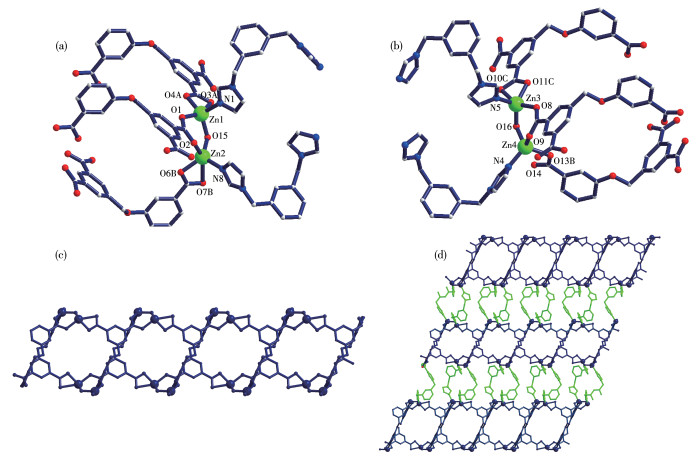
Single crystal X-ray diffraction result shows that CP 1 is a 2D structure based on ladder-like chains. There is four crystallographically independent zinc(Ⅱ) ions in 1. The central Zn1 ion lies in a five-coordinated quadrangular pyramid circumstance with three carboxylate oxygen atoms (O1, O3A, O4A) from two 3-CIA3- ligands, a nitrogen atom (N1) from one 3-bibz molecule, and an oxygen atom (O15) from a hydroxyl group (Fig. 1a). The coordination environments of Zn2 and Zn3 are similar to Zn1, all of which are linked to three oxygen atoms from two 3-CIA3- ligands, a nitrogen atom from one 3-bibz molecule, and one oxygen atom from one OH- group. Zn4 is attached to two oxygen atoms (O9 and O13D) from two 3-CIA3- ligands, a nitrogen atom (N4) from one 3-bibz auxiliary ligand, and an oxygen atom from a hydroxyl group (O16), forming a tetra-coordinated tetrahedron geometry (Fig. 1b). The Zn—O bond lengths range from 0.189 0 to 0.246 1 nm and the Zn—N bond scope is 0.198 9-0.202 3 nm. The O—Zn—O bond angles range from 57.99°-152.16°, and the O—Zn—N bond angles are 93.94°-120.43° (Table S1).
Symmetry codes: A: x-1, y, z; B:-x+2, -y+3, -z+1; C: x+1, y, z; D: -x, -y, -z.
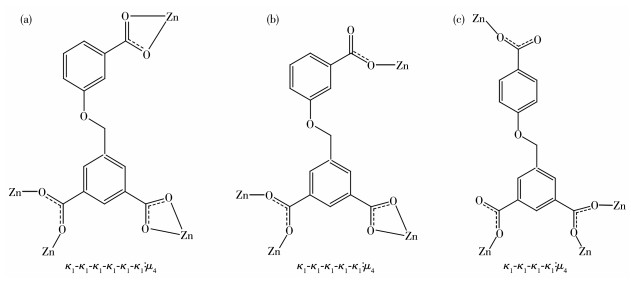
Four Zn atoms are connected by the 3-CIA3- ligands using two μ4 coordination modes (Scheme 1a and 1b) to form a tetra-nuclear metallic ring, resulting in a 1D ladder-like chain structure (Fig. 1c). The 1D structures are bridged by the 3-bibz ligands to form a 2D network (Fig. 1d).
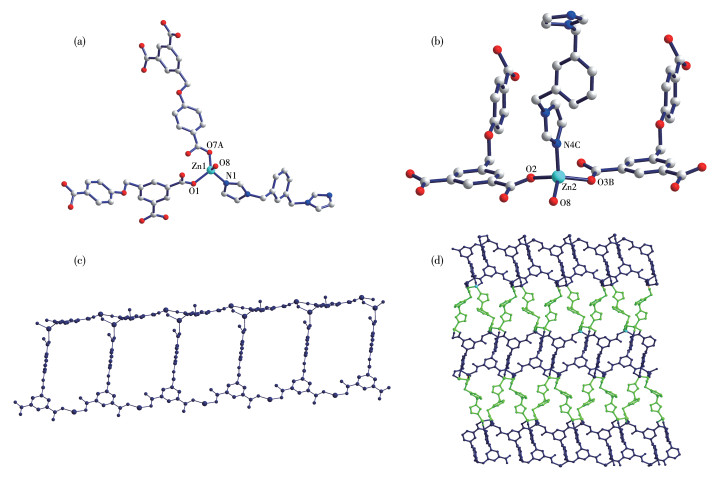
Structural analysis exhibits that CP 2 is a 2D network based on tri-nuclear metallic units. There are two crystallographically independent zinc(Ⅱ) ions in different coordination environments. Zn1 is coordinated to two oxygen atoms (O1 and O7A) from two 4-CIA3- ligands, one nitrogen atom (N1) of 3-bibz ligand, and one oxygen atom (O8) of one hydroxyl group, forming a tetra-coordinated tetrahedral conformation (Fig. 2a). The central ion Zn2 is surrounded with two oxygen atoms (O2 and O3B) of two 4-CIA3- ligands, one nitrogen atom (N4C) of a 3-bibz ligand, and one oxygen atom (O8) of a hydroxyl group, also forming a tetra-coordinated tetrahedron (Fig. 2b). The Zn—O/N bond lengths range from 0.191 1(3) to 0.202 2(3) nm. The scope of O—Zn—O/N bond angles is from 100.50(11)° to 121.47(10)° (Table S2).
Symmetry codes: A:-x+1, -y+2, z-0.5; B: x, y+1, z; C:-x-0.5, y+0.5, z-0.5.
Three Zn atoms in CP 2 are connected into a tri-nuclear metal ring through a T-shape 4-CIA3- ligand in a κ1-κ1-κ1-κ1∶μ4 coordination fashion (Scheme 1c), which is extended into a 1D ladder-like chain (Fig. 2c). The auxiliary N-containing ligand 3-bibz in 2 adopts the bridging mode to connect the adjacent 1D ladder-like chains to form a 2D network (Fig. 2d).
To study the thermal stability of the CPs, thermogravimetric experiments were performed from 30 to 900 ℃ in a nitrogen atmosphere (Fig.S1). It was shown that the weight-loss process of 1 proceeded in one step. It was a plateau of the stabilization stage of 1 from 30 to 293 ℃. Above 293 ℃ the skeleton started to collapse until 880 ℃. The thermal decomposition of 2 proceeded in one step, and the beginning stage was slow from 30 ℃. Above 306 ℃, complex 2 started to lose weight rapidly and the skeleton collapsed. The stability of 1 is higher than that of 2, which is accorded with their structure information.
From the PXRD patterns of the CPs, it can be seen that the diffraction peaks of CPs 1 and 2 were consistent with the peaks of the theoretical simulations (Fig.S2). So, the obtained powders are identical to the crystalline phases and belong to the same substance, and are of a purity that meets the test requirements and can be used in subsequent experiments.
To develop the luminescent properties of CPs 1 and 2, the solid-state fluorescence spectra were measured at room temperature (Fig.S3). It is found that 1 had the strongest emission peak at 481 nm when excited at 343 nm and 2 had the strongest emission peak at 477 nm (λex=394 nm), which can be attributed to the π*→π transition of the ligands.
To investigate the fluorescence properties of the CPs in an aqueous solution, the supernatant of CPs 1 or 2 was obtained. The fluorescence tests indicated that the strongest emission peak was observed at 343 nm for 1 (λex=294 nm) and 347 nm for 2 (λex=274 nm). Compared to the solid-state luminescence position of the CPs, the luminescence positions in aqueous solutions were both blue-shifted, which may be attributed to the effect of the solvent molecules on their luminescence[22].
Based on the excellent luminescence properties of 1 and 2, the fluorescence sensing properties were conducted for organic solvents. Twelve organic solvents (20 μL) were added to the supernatant of 1 mL of each of the CPs, respectively, and the fluorescence tests were performed. The results revealed that both CPs responded to nitrobenzene and exhibited complete fluorescence quenching (Fig. 3a and 3b).
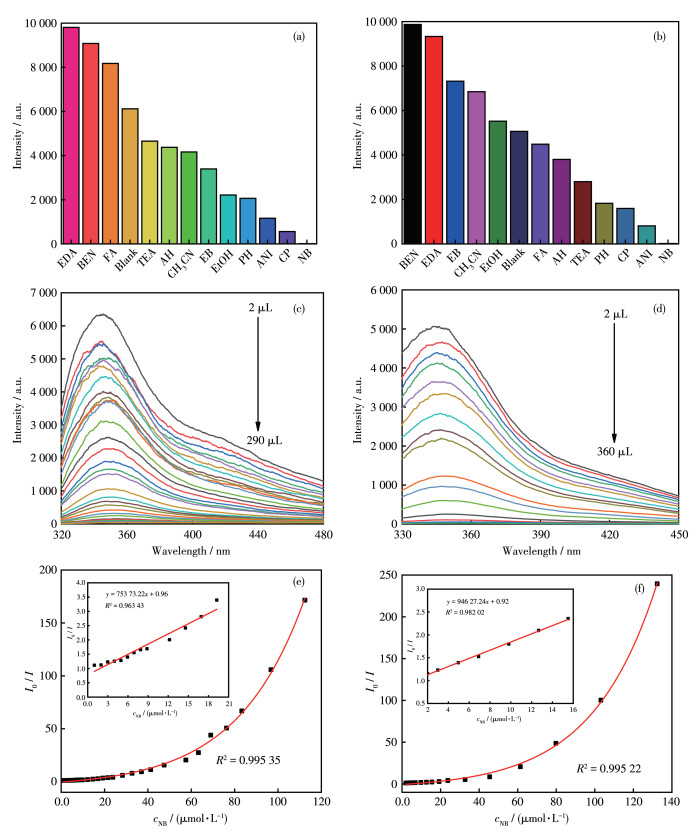
For an in-depth study on the quenching of nitrobenzene to the fluorescence, 1 and 2 were subjected to fluorescence quantification of nitrobenzene solution by adding nitrobenzene solution (c=0.5 mol·L-1) to 1 mL of the supernatant solution one by one until the fluorescence was completely quenching. It can be seen from Fig. 3c and 3d that the fluorescence intensity of all the supernatant solutions gradually decreased with the gradual increase in nitrobenzene concentration, and the whole titration region was consistent with the exponential function. They conformed to the functions I0/I=75 373.22cNB+0.96 (1) and I0/I=94 627.24cNB+0.92 (2) in the low concentration region (I0 and I denote the luminescence intensity of the suspension of the CPs before and after the addition of nitrobenzene, respectively), and linearity could be observed (R2=0.963 4 and R2=0.982 0). The detection limits (LOD) of the CPs for nitrobenzene were calculated to be 0.248 μmol·L-1 (1) and 0.309 μmol·L-1 (2), respectively, according to LOD=3σ/K (σ is the standard deviation and K is the slope of the calibration curve) (Fig. 3e and 3f).
To investigate the mechanism of fluorescence quenching of CPs for nitrobenzene, the PXRD technology and the theoretical calculations were tried to verify the mechanism. By comparing the PXRD patterns of the samples before and after being treated with nitrobenzene, it was found that for 1, the positions of the main peaks of the PXRD patterns were highly similar (Fig.S3a). So, it indicated that the skeletal structure did not collapse after being treated with nitrobenzene, that is, the skeleton collapse of 1 was not the cause of the fluorescence quenching. However, the PXRD patterns of 2 were more variable before and after being treated with nitrobenzene, and the skeleton collapse of 2 was one of the factors of fluorescence quenching (Fig.S3b).
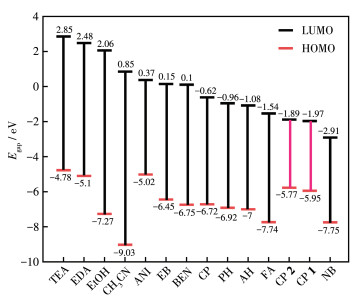
The HOMO and LUMO of the CPs and various organic solvents were calculated using density functional theory (Fig. 4). According to the calculated data, the LUMO energies of all organic solvents except nitrobenzene are higher than those of CPs 1 (-1.97 eV) and 2 (-1.89 eV), and only the LUMO energy of nitrobenzene (-2.91 eV) is lower than those of the CPs. The lower the LUMO energy of the analyte, the easier the leap of excited state electrons[23]. Therefore, the electron might transfer from the CPs to nitrobenzene and it is considered to be a photoinduced electron transfer (PET) effect resulting in fluorescence quenching when meeting nitrobenzene.
In this work, two zinc CPs had been successfully prepared hydrothermally, and structural analyses show that they are 2D structures based on tetra-nuclear (1) or tri-nuclear (2) building units, respectively. The fluorescence sensing response of the CPs to twelve organic solvents exhibits that both CPs have good selectivity for nitrobenzene and high sensitivity with low detection limits. Combined with the theoretical calculation method, the study of the fluorescence sensing mechanism of the CPs for nitrobenzene discovers that the photoinduced electron transfer (PET) effect might be the main reason for the fluorescence quenching of CPs by nitrobenzene. So, the two CPs as fluorescent probes can be used for the accurate, and stable detection of nitrobenzene, and have great application prospects in fluorescence sensing.
Thirumalraj B, Palanisamy S, Chen S M, Thangavelu K, Periakaruppan P, Liu X H. A simple electrochemical platform for detection of nitrobenzene in water samples using an alumina polished glassy carbon electrode[J]. J. Colloid Interface Sci., 2016, 475: 154-160. doi: 10.1016/j.jcis.2016.04.042
Wang G Y, Yang L L, Li Y, Song H, Ruan W J, Chang Z, Bu X H. A luminescent 2D coordination polymer for selective sensing of nitrobenzene[J]. Dalton Trans., 2013, 42(36): 12865-12868. doi: 10.1039/c3dt51450a
Wei Q K, Shi Z W. A fluorescent coordination polymer for selective sensing of hazardous nitrobenzene and dichromate anion[J]. Dyes Pigment., 2017, 139: 372-380. doi: 10.1016/j.dyepig.2016.12.039
Ebrahimzadeh H, Yamini Y, Kamarei F. Optimization of dispersive liquid-liquid microextraction combined with gas chromatography for the analysis of nitroaromatic compounds in water[J]. Talanta, 2009, 79(5): 1472-1477. doi: 10.1016/j.talanta.2009.06.022
Wang S P, Chen H J. Separation and determination of nitrobenzenes by micellar electrokinetic chromatography and high-performance liquid chromatography[J]. J. Chromatogr. A, 2002, 979(1/2): 439-446.
Liu J J, Guan Y F, Lin M J, Huang C C, Dai W X. Luminescent coordination polymer with conjugated Lewis acid sites for the detection of organic amines[J]. Cryst. Growth Des., 2015, 15(10): 5040-5046. doi: 10.1021/acs.cgd.5b01026
Li G P, Liu G, Li Y Z, Hou L, Wang Y Y, Zhu Z H. Uncommon pyrazoyl-carboxyl bifunctional ligand-based microporous lanthanide systems: Sorption and luminescent sensing properties[J]. Inorg. Chem., 2016, 55(8): 3952-3959. doi: 10.1021/acs.inorgchem.6b00217
Xu H, Cao C S, Zhao B. A water-stable lanthanide-organic framework as a recyclable luminescent probe for detecting pollutant phosphorus anions[J]. Chem. Commun., 2015, 51: 10280-10283. doi: 10.1039/C5CC02596F
Yan W, Zhang C L, Chen S G, Han L J, Zheng H G. Two lanthanide metal-organic frameworks as remarkably selective and sensitive bifunctional luminescence sensor for metal ions and small organic molecules[J]. ACS Appl. Mater. Interfaces, 2017, 9: 1629-1634. doi: 10.1021/acsami.6b14563
Yi F Y, Gu M, Wang S C, Zheng J Q, Pan L, Han L. A dual-functional luminescent MOF sensor for phenyl methanol molecule and Tb3+ cation[J]. Inorg. Chem., 2018, 57: 2654-2662. doi: 10.1021/acs.inorgchem.7b03053
Chen S S, Zhang Z Y, Liao R B, Zhao Y, Wang C, Qiao R, Liu Z D. A photoluminescent Cd(Ⅱ) coordination polymer with potential active sites exhibiting multiresponsive fluorescence sensing for trace amounts of NACs and Fe3+ and Al3+ ions[J]. Inorg. Chem., 2021, 60(7): 4945-4956. doi: 10.1021/acs.inorgchem.1c00022
Pan Y N, Wang J D, Guo X M, Liu X Y, Tang X L, Zhang H X. A new three-dimensional zinc-based metal-organic framework as a fluorescent sensor for detection of cadmium ion and nitrobenzene[J]. J. Colloid Interface Sci., 2018, 513: 418-426. doi: 10.1016/j.jcis.2017.11.034
Zhang Z J, Xiang S C, Rao X G, Zheng Q, Fronczek F R, Qian G D, Chen B L. A rod packing microporous metal-organic framework with open metal sites for selective guest sorption and sensing of nitrobenzene[J]. Chem. Commun., 2010, 46(38): 7205-7207. doi: 10.1039/c0cc01236j
Guo M, Sun Z M. Solvents control over the degree of interpenetration in metal-organic frameworks and their high sensitivities for detecting nitrobenzene at ppm level[J]. J. Mater. Chem., 2012, 22(31): 15939-15946. doi: 10.1039/c2jm32066e
Ma D X, Li B Y, Zhou X J, Zhou Q, Liu K, Zeng G, Li G H, Shi Z, Feng S H. A dual functional MOF as a luminescent sensor for quantitatively detecting the concentration of nitrobenzene and temperature[J]. Chem. Commun., 2013, 49(79): 8964-8966. doi: 10.1039/c3cc44546a
徐涵, 潘兆瑞, 亓昭鹏, 孙洁. 基于V型配体的三个荧光Zn-MOF对水溶液中2, 4, 6-三硝基苯酚和Fe3+的荧光传感[J]. 无机化学学报, 2022,38,(12): 2479-2490. doi: 10.11862/CJIC.2022.238XU H, PAN Z R, QI Z P, SUN J. Three luminescent Zn-MOFs based on V-shaped ligands for fluorescence sensing of 2, 4, 6-trinitrophenol and Fe3+ in aqueous solution[J]. Chinese J. Inorg. Chem., 2022, 38(12): 2479-2490. doi: 10.11862/CJIC.2022.238
刘满荣, 岳二林, 王记江, 朱汪传, 全航, 唐龙, 王潇, 侯向阳, 张玉琦. 基于一维锌(Ⅱ)配位聚合物的水中2, 4, 6-三硝基苯酚和氟啶胺的选择性检测[J]. 无机化学学报, 2023,39,(2): 375-384. LIU M R, YUE E L, WANG J J, ZHU W C, QUAN H, TANG L, WANG X, HOU X Y, ZHANG Y Q. Selective detection of 2, 4, 6-trinitrophenol and fluazinam in water based on a 1D Zn(Ⅱ) coordination polymer[J]. Chinese J. Inorg. Chem., 2023, 39(2): 375-384.
Chai H M, Ren Y X, He H B, Wang Z X, Zhang Y Z, Gao L J. A microporous Tb-MOF luminescent sensor based on a flexible tricarboxylate for highly sensitive detection of acetone and Fe3+ ions in aqueous and isopropanol[J]. J. Solid State Chem., 2019, 271: 162-167. doi: 10.1016/j.jssc.2018.12.048
Ren Y X, Yang X, Wang Z X, Chai H M, Zhang M L, Chen X L, Wang J J. Structural diversity and fluorescence properties of lead(Ⅱ) complexes based on a flexible tricarboxylate and two large conjugate N-donor ligands[J]. J. Solid State Chem., 2021, 294: 121875. doi: 10.1016/j.jssc.2020.121875
Yang X, Ren Y X, Hou X F, Wang Z X. A fluorescent 1, 4-bib-pillared Zn-MOF sensor for highly sensitive detection of Dy3+, nitrobenzene and aniline in aqueous solution[J]. J. Solid State Chem., 2021, 302: 122410. doi: 10.1016/j.jssc.2021.122410
Gan Y L, Huang K R, Li Y G, Qin D P, Zhang D M, Zong Z A, Cui L S. Synthesis, structure and fluorescent sensing for nitrobenzene of a Zn-based MOF[J]. J. Mol. Struct., 2021, 1223(1): 129-217.
Wang K, Zheng T F, Chen J L, Wen H R, Liu S J, Hu T L. A pH-stable TbⅢ-based metal-organic framework as a turn-on and blue-shift fluorescence sensor toward benzaldehyde and salicylaldehyde in aqueous solution[J]. Inorg. Chem., 2022, 61(40): 16177-16184. doi: 10.1021/acs.inorgchem.2c02763
Yan Y T, Liu J, Yang G P, Zhang F, Fan Y K, Zhang W Y, Wang Y Y. Highly selective luminescence sensing for the detection of nitrobenzene and Fe3+ by new Cd(Ⅱ)-based MOFs[J]. CrystEngComm, 2018, 20(4): 477-486. doi: 10.1039/C7CE01920C

Figure 1 (a) Coordination environment for Zn1 and Zn2 in 1; (b) Coordination environment of Zn3 and Zn4; (c) 1D ladder-like structure; (d) 2D network
Symmetry codes: A: x-1, y, z; B:-x+2, -y+3, -z+1; C: x+1, y, z; D: -x, -y, -z.

Figure 2 (a) Coordination environment of Zn1 of CP 2; (b) coordination environment of Zn2;(c) 1D ladder-like chain based on 4-CIA3- ligands; (d) 2D network bridging by 3-bibz ligands
Symmetry codes: A:-x+1, -y+2, z-0.5; B: x, y+1, z; C:-x-0.5, y+0.5, z-0.5.

Figure 3 Qualitative selection plots of 1 (a) and 2 (b) detecting organic solvents; Quantitative detection plots of 1 (c) and 2 (d) detecting nitrobenzene; Linear relationship plots for 1 (e) and 2 (f) detecting nitrobenzene

Figure 4 Energy orbitals diagrams (HOMO and LUMO) of the CPs and twelve organic solvents
Table 1. Crystallographic data for CPs 1 and 2
| Parameter | 1 | 2 |
| Formula | C60H48N8O16Zn4 | C30H26N4O9Zn2 |
| Formula weight | 1 398.54 | 717.33 |
| Temperature / K | 296 | 296 |
| Crystal system | Triclinic | Orthorhombic |
| Space group | P1 | Pna21 |
| a / nm | 1.006 9(2) | 1.471 5(13) |
| b / nm | 1.322 2(3) | 0.966 7(8) |
| c / nm | 2.280 4(5) | 2.202 7(19) |
| α / (°) | 99.994(4) | |
| β / (°) | 97.982(4) | |
| γ / (°) | 92.351(3) | |
| V / nm-3 | 2.954 3(12) | 3.133 5(5) |
| Dc / (g·cm-3) | 1.572 | 1.518 |
| Z | 2 | 4 |
| F(000) | 1 424 | 1 460 |
| Reflection collected | 16 136 | 18 286 |
| Unique reflection | 11 441 (Rint=0.014 9) | 6 126 (Rint=0.014 8) |
| Observed reflection | 9 276 | 5 703 |
| Data, restraint, parameter | 11 441, 0, 801 | 6 126, 1, 414 |
| GOF | 1.029 | 1.087 |
| R1, wR2 [I > 2σ(I)] | 0.033 1, 0.080 0 | 0.026 8, 0.077 0 |
| R1, wR2 (all data) | 0.046 0, 0.088 2 | 0.029 8, 0.078 5 |
 下载: 导出CSV

 扫一扫看文章


扫一扫关注我们