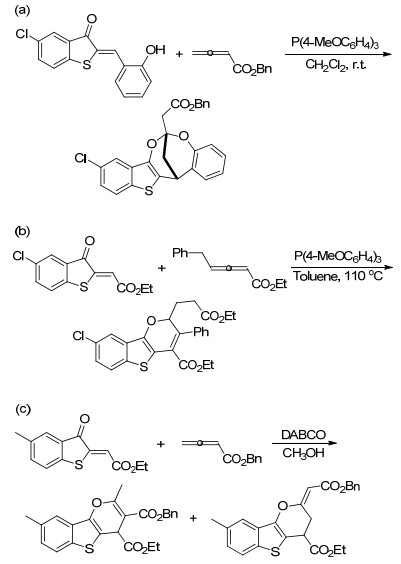
Scheme 1.
Domino reactions between thioaurones with allenoates


Benzothiophene-fused γ-pyran derivatives are important structural skeletons in biologically active compounds.[1] For example, some benzo[b]thieno[3, 2-b]pyran derivatives have pronounced anti-asthmatic activity.[2] This has motivated considerable efforts in exploring various strategies for their synthesis. Some reports include a C—H bond activation approach from benzothiophene and carboxylic acids as substrates.[3] In another report, 2, 3-substituted benzothiophene derivatives were converted into benzothiophene-fused pyran derivatives.[4] Although many methods have been described to synthesize these skeletons, there are only a few reports of the efficient synthesis of these target molecules using domino reaction.[5] We recently reported many domino reactions based on thioaurones. For example, the reaction of thioaurones bearing a hydroxyl group with allenoate gave benzothiophene-fused dioxabicyclo[3.3.1]nonane derivatives (Scheme 1a).[6] Moreover, when the thioaurone analogs reacted with γ-benzyl allenoates, a series of benzothieno[3, 2-b]pyran derivatives were obtained (Scheme 1b).[7] In line with our program aiming toward the development of domino reactions for the efficient construction of benzothiophene-fused heterocyclic compounds, [8] we reported a [4+2] pericyclic reaction between thioaurone analogs and non-substituted allenoate.[9~12] Two new types of benzothiophene-fused pyran derivatives were obtained (Scheme 1c).
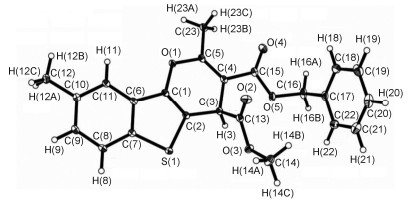
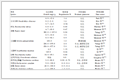
To optimize the reaction conditions, Reactions of methyl (Z)-2-(5-methyl-3-oxobenzo-[b]thiophen-2(3H)-ylidene) acetate (1a) with allenoate 2 was selected in the presence of DABCO (10 mol%) in CHCl3 at 60 ℃ for 2 h. The reaction proceeded smoothly and obtained the product 3a in 46% yield along with the product 4a in 15% yield (Table 1, Entry 1). The structure of 3a was determined using single-crystal X-ray diffraction (Figure 1), [13] NMR, and HRMS. The structure of 4a was determined using 2D-NMR. After confirming the structures of the two new products, the effect of the solvent on the yield and regioselectivity were then examined. From Entries 2~11, it was found that when MeOH was used as the solvent, the yield increased slightly and the ratio of 3a and 4a increased to 5:1 (Entry 2). However, when the reaction was carried out in EtOH, moderate yields and regioselectivity were observed (Entry 3). No improvement in yields was obtained when the reactions were carried out in the strong polar solvents of DMSO and DMF (Entries 4 and 5). When the reactions were performed in toluene or 1, 4-dioxane, only moderate yields and regioselectivity were obtained in both solvents (Entries 6 and 7). With THF as the solvent, the reaction proceeded smoothly to produce 3a and 4a in 62% yield with 1:1 regioselectivity (Entry 8). Therefore, MeOH was selected as the solvent and the effect of the catalysts was determined. When 4-dimethylaminopyridine (DMAP) was used as catalyst, the starting materials were consumed but a very complex mixture was obtained (Entry 9). Phosphines were also tested, but the reaction was still complex, such as PPh3 and nBu3P (Entries 10 and 11). Therefore, DABCO was selected as the catalyst.
 下载:
导出CSV
下载:
导出CSV
 | |||||
| Entrya | Solvent | Catalyst | Time/h | Yieldb/% | |
| 3a | 4a | ||||
| 1 | CHCl3 | DABCO | 2.0 | 46 | 15 |
| 2 | MeOH | DABCO | 2.2 | 64 | 13 |
| 3 | EtOH | DABCO | 2.0 | 32 | 32 |
| 4 | DMSO | DABCO | 1.2 | 21 | 3 |
| 5 | DMF | DABCO | 2.0 | 16 | 16 |
| 6 | Toluene | DABCO | 2.5 | 34 | 17 |
| 7 | 1, 4-Dioxane | DABCO | 2.2 | 34 | 17 |
| 8 | THF | DABCO | 2.2 | 31 | 31 |
| 9 | MeOH | DMAP | 3.0 | — | — |
| 10 | MeOH | PPh3 | 3.0 | — | — |
| 11 | MeOH | nBu3P | 3.0 | — | — |
| a Unless otherwise noted, reactions of 1a (0.2 mmol) with 2 (0.24 mmol) were performed in the presences of catalyst (0.1 equiv.) in 2 mL of solvent at 60 ℃. b Isolated yields. | |||||
Having established the optimal reaction conditions, we explored the substrate scope of the domino reactions with regard to the substitution at 1 (Table 2). The effect of the ester group (R2) was first examined when R1 was a methyl group at the C5 position. Substrate 1 bearing an ethyl ester gave 3b and 4b in 79% yield with a 2:1 regioselectivity. Similarly, benzyl-substituted substrate 1c led to the corresponding products 3c and 4c in 72% yield with 4:1 regioselectivity. When a halogen group was installed in the C5 position (R1), the corresponding products 3d~3f and 4d~4f were obtained in 49%~72% yields with 3:1~4:1 regioselectivity. When a methoxyl group was substituted at the C6 position (R1), the domino reaction produced the corresponding products 3g~3i and 4g~4i in 51%~74% yields with 2:1 to 9:1 regioselectivity. The non-substi- tuted substrates 1j~1l also reacted well regardless of the ester groups. In addition, substrates bearing benzyl groups were also suitable (1m and 1n), producing the corresponding products 3m and 3n in 53% and 67% yields. However, in these reactions, the regioselectivity of 3 and 4 is poor.
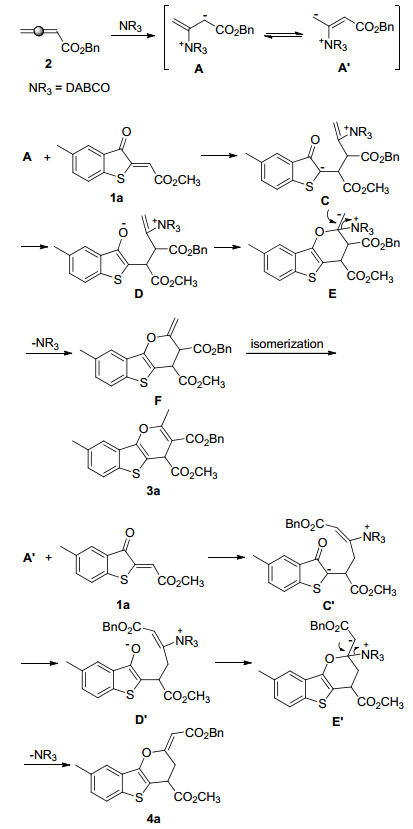
A mechanism for this domino reaction is proposed on the basis of previous reports in the literature (Scheme 2). The DABCO catalyst acts as a nucleophilic trigger and attacks the β carbon of the allenoate to produce intermediates A and A'. The allylic carbanion A binds to substrate 1a to produce intermediate C. Intermediate D, which is a resonance structure of C, undergoes an intramolecular umpolung addition from an oxygen anion to a γ carbon of the allenoate to produce intermediate E, which then becomes F via elimination of the DABCO catalyst. Finally, intermediate F isomerizes to 3a. Similarly, another intermediate A', produced by allenoate, attacks the double-bond position of substrate 1a to produce intermediate C'. D' is the resonance structure of C' and generates intermediate E' through an intramolecular addition reaction. With the departure of the catalyst (DABCO), product 4a is finally formed.
In conclusion, a novel DABCO-catalyzed [4+2] annu lation reaction between allenoate and 2-alkylidenebenzo- thiophene-3(2H)-ones has been developed. A number of functionalized benzothiophene-fused γ-pyran derivatives were formed in moderate yields. Further applications of this domino reaction in complex molecular syntheses are currently under study.
All reactions were performed under Ar atmosphere in oven dried glassware with magnetic stirring. Unless otherwise stated, all reagents were purchased from commercial suppliers and used without further purification. All solvents were purified and dried according to standard methods prior to use. All reactions were monitored by thin-layer chromatography (TLC) with silica gel-coated plates. Flash column chromatography was performed using 200~300 mesh silica gel. 1H NMR and 13C NMR spectra were recorded at ambient temperature on a Bruker 400 instruments. All spectra were referenced to CDCl3 (1H NMR δ 7.26 and 13C NMR δ 77.00. HRMS were obtained on a Waters Xevo Q-TOF MS in ESI mode. Melting points were measured on an RY-I apparatus and reported uncorrected. Substrates 1 were synthesized according to literature procedures.[8a]
Under the protection of argon, DABCO (0.02 mmol, 10 mmol%) and allenoate (0.24 mmol, 1.2 equiv.) were added to a suspension of thioaurone 1 (0.2 mmol, 1.0 equiv.) in MeOH (2 mL). The mixture was stirred for 3 h at 60 ℃. After the TLC detection reaction was completed, the reaction mixture was evaporated to remove the solvent and purified by flash silica gel column chromatography eluted with ethyl acetate/hexane (V:V=1:10) to provide pure samples 3 and 4.
3-Benzyl-4-methyl-2, 8-dimethyl-4H-benzo[4,5]thieno-[3, 2-b]pyran-3, 4-dicarboxylate (3a): Yellow solid, m.p. 123~124 ℃; 1H NMR (400 MHz, CDCl3) δ: 7.53~7.61 (m, 2H), 7.33~7.40 (m, 5H), 7.18 (d, J=8.2 Hz, 1H), 5.29 (d, J=12.3 Hz, 1H), 5.12 (d, J=12.3 Hz, 1H), 4.92 (s, 1H), 3.58 (s, 3H), 2.60 (s, 3H), 2.47 (s, 3H); 13C NMR (100 MHz, CDCl3) δ: 171.46, 166.38, 162.39, 140.42, 135.81, 134.57, 133.67, 129.68, 128.51, 128.51, 128.22, 128.20, 128.19, 127.24, 122.31, 119.95, 111.92, 99.51, 66.49, 52.40, 41.49, 21.38, 19.65; IR (KBr) v: 3031, 2958, 1751, 1715, 1640, 1595, 1454, 1436, 1358, 1310, 1232, 1200, 1172, 1059, 972, 809, 756, 699 cm-1. ESI-HRMS calcd for C23H20O5SNa [M+Na]+ 431.0924, found 431.0947.
3-Benzyl-4-ethyl-2, 8-dimethyl-4H-benzo[4,5]thieno-[3, 2-b]pyran-3, 4-dicarboxylate (3b): White solid, m.p. 85~86 ℃; 1H NMR (400 MHz, CDCl3) δ: 7.54~7.62 (m, 2H), 7.31~7.41 (m, 5H), 7.18 (d, J=9.6 Hz, 1H), 5.25 (d, J=12.4 Hz, 1H), 5.15 (d, J=12.4 Hz, 1H), 4.90 (s, 1H), 4.07~4.16 (m, 1H), 3.96~4.04 (m, 1H), 2.60 (s, 3H), 2.47 (s, 3H), 1.18 (t, J=7.2 Hz, 3H); 13C NMR (100 MHz, CDCl3) δ: 170.95, 166.43, 162.32, 140.37, 135.83, 134.51, 133.66, 129.70, 128.48, 128.15, 127.17, 122.28, 119.92, 112.06, 99.52, 66.47, 61.55, 41.61, 21.37, 19.62, 14.05; IR (KBr) v: 3063, 3033, 2985, 2961, 2883, 1748, 1713, 1639, 1595, 1455, 1359, 1329, 1306, 1252, 1231, 1204, 1182, 1088, 807, 773, 726, 691 cm-1; ESI-HRMS calcd for C24H22O5SNa [M+Na]+ 445.1080, found 445.1105.
Dibenzyl-2, 8-dimethyl-4H-benzo[4,5]thieno[3, 2-b]-py- ran-3, 4-dicarboxylate (3c): Yellow solid, m.p. 86~87 ℃; 1H NMR (400 MHz, CDCl3) δ: 7.54~7.61 (m, 2H), 7.27~7.37 (m, 10H), 7.18 (d, J=8.4 Hz, 1H), 5.05~5.13 (m, 3H), 4.93~4.98 (m, 2H), 2.60 (s, 3H), 2.47 (s, 3H); 13C NMR (100 MHz, CDCl3) δ: 170.87, 166.32, 162.47, 140.47, 135.80, 135.40, 134.54, 133.69, 129.65, 128.50, 128.44, 128.29, 128.22, 128.13, 127.23, 122.31, 119.95, 111.83, 99.43, 67.32, 66.41, 41.62, 21.37, 19.63; IR (KBr) v: 3033, 2952, 1748, 1694, 1649, 1454, 1377, 1305, 1253, 1199, 1166, 1089, 1071, 960, 752, 699 cm-1; ESI-HRMS calcd for C29H25O5S [M+H]+ 485.1417, found 485.1421.
3-Benzyl-4-ethyl-8-fluoro-2-methyl-4H-benzo[4,5]thieno-[3, 2-b]pyran-3, 4-dicarboxylate (3d): White solid, m.p. 139~140 ℃; 1H NMR (400 MHz, CDCl3) δ: 7.65 (dd, J=8.8, 4.4 Hz, 1H), 7.32~7.45 (m, 6H), 7.10 (m, 1H), 5.26 (d, J=12.4 Hz, 1H), 5.15 (d, J=12.4 Hz, 1H), 4.91 (s, 1H), 4.08~4.17 (m, 1H), 3.96~4.05 (m, 1H), 2.59 (s, 3H), 1.18 (t, J=7.0 Hz, 3H); 13C NMR (100 MHz, CDCl3) δ: 170.69, 166.27, 162.16, 160.94 (d, J=243.5 Hz), 140.42 (d, J=4.2 Hz), 135.75, 131.80, 130.50 (d, J=9.7 Hz), 128.52, 128.21, 124.02 (d, J=9.2 Hz), 114.49 (d, J=7.0 Hz), 114.20, 106.09 (d, J=24.3 Hz), 99.61, 66.59, 61.71, 41.66, 19.58, 14.06; IR (KBr) v: 3028, 2987, 2905, 1742, 1716, 1646, 1604, 1446, 1242, 1228, 1193, 1083, 1046, 961, 853, 817, 737 cm-1; ESI-HRMS calcd for C23H20F- O5S [M+H]+ 427.1010, found 427.1014.
3-Benzyl-4-ethyl-8-chloro-2-methyl-4H-benzo[4,5]thieno- [3, 2-b]pyran-3, 4-dicarboxylate (3e): White solid, m.p. 104~105 ℃; 1H NMR (400 MHz, CDCl3) δ: 7.72 (s, 1H), 7.62 (d, J=8.4 Hz, 1H), 7.27~7.42 (m, 6H), 5.26 (d, J=12.0 Hz, 1H), 5.15 (d, J=12.0 Hz, 1H), 4.90 (s, 1H), 3.96~4.16 (m, 2H), 2.59 (s, 3H), 1.18 (t, J=7.0 Hz, 3H); 13C NMR (100 MHz, CDCl3) δ: 170.60, 166.21, 162.09, 139.98, 135.72, 134.55, 131.08, 130.54, 128.51, 128.20, 125.94, 123.72, 119.82, 114.01, 99.62, 66.58, 61.71, 41.57, 19.54, 14.04; IR (KBr) v: 3080, 3009, 2981, 2938, 1742, 1711, 1638, 1595, 1436, 1353, 1326, 1303, 1247, 1227, 1190, 1085, 1071, 809, 744, 696 cm-1; ESI-HRMS calcd for C23H20ClO5S [M+H]+ 443.0714, found 443.0733.
3-Benzyl-4-ethyl-8-bromo-2-methyl-4H-benzo[4,5]thieno-[3, 2-b]pyran-3, 4-dicarboxylate (3f): Yellow solid, m.p. 106~107 ℃; 1H NMR (400 MHz, CDCl3) δ: 7.89 (s, 1H), 7.58 (d, J=8.4 Hz, 1H), 7.45 (dd, J=8.6, 1.8 Hz, 1H), 7.33~7.39 (m, 5H), 5.25 (d, J=12.4 Hz, 1H), 5.15 (d, J=12.4 Hz, 1H), 4.91 (s, 1H), 4.08~4.15 (m, 1H), 3.98~4.05 (m, 1H), 2.59 (s, 3H), 1.18 (t, J=7.2 Hz, 3H); 13C NMR (100 MHz, CDCl3) δ: 170.0 166.4, 162.3, 140.7, 136.5, 135.8, 129.5, 128.5, 128.2, 125.5, 124.6, 122.6, 120.0, 112.0, 99.6, 66.5, 61.6, 41.6, 19.6, 14.1; IR (KBr) v: 3064, 2980, 2901, 1740, 1715, 1642, 1599, 1430, 1349, 1249, 1226, 1189, 1162, 967, 808, 749, 695 cm-1; ESI-HRMS calcd for C23H20BrO5S [M+H]+ 487.0215, found 487.0235.
3-Benzyl-4-methyl-7-methoxy-2-methyl-4H-benzo[4,5]-thieno[3, 2-b]pyran-3, 4-dicarboxylate (3g): White solid, m.p. 141~142 ℃; 1H NMR (400 MHz, CDCl3) δ: 7.62 (d, J=8.8 Hz, 1H), 7.29~7.44 (m, 5H), 7.19 (d, J=2.4 Hz, 1H), 7.00 (dd, J=8.8, 2.0 Hz, 1H), 5.28 (d, J=12.4 Hz, 1H), 5.12 (d, J=12.0 Hz, 1H), 4.88 (s, 1H), 3.86 (s, 3H), 3.58 (s, 3H), 2.59 (s, 3H); 13C NMR (100 MHz, CDCl3) δ: 171.52, 166.40, 162.38, 158.29, 140.43, 138.07, 135.82, 128.51, 128.19, 123.45, 120.75, 114.48, 108.89, 105.46, 99.56, 66.48, 55.60, 52.37, 41.40, 19.65; IR (KBr) v: 3006, 1733, 1688, 1649, 1601, 1372, 1323, 1280, 1264, 1204, 1171, 1090, 1024, 856, 759, 699 cm-1; ESI-HRMS calcd for C23H20O6SNa [M+Na]+ 447.0873, found 447.0898.
3-Benzyl-4-ethyl-7-methoxy-2-methyl-4H-benzo[4,5]- thieno[3, 2-b]pyran-3, 4-dicarboxylate (3h): Red solid, m.p. 105~106 ℃; 1H NMR (400 MHz, CDCl3) δ: 7.62 (d, J=8.8 Hz, 1H), 7.32~7.39 (m, 5H), 7.19 (d, J=2.0 Hz, 1H), 7.00 (dd, J=8.8, 2.4 Hz, 1H), 5.25 (d, J=12.4 Hz, 1H), 5.14 (d, J=12.4 Hz, 1H), 4.86 (s, 1H), 4.08~4.17 (m, 1H), 3.95~4.04 (m, 1H), 3.86 (s, 3H), 2.59 (s, 3H), 1.18 (t, J=7.2 Hz, 3H); 13C NMR (100 MHz, CDCl3) δ: 171.02, 166.43, 162.32, 158.19, 140.34, 138.02, 135.80, 128.47, 128.13, 123.43, 120.70, 114.42, 108.98, 105.37, 99.51, 66.45, 61.51, 55.56, 41.48, 19.63, 14.06; IR (KBr) v: 3035, 2970, 2903, 1749, 1712, 1647, 1602, 1369, 1243, 1183, 1163, 1076, 1020, 825, 810, 697 cm-1; ESI-HRMS calcd for C24H22O6SNa [M+Na]+ 461.1029, found 461.1044.
Dibenzyl-7-methoxy-2-methyl-4H-benzo[4,5]thieno-[3, 2-b]pyran-3, 4-dicarboxylate (3i): Red solid, m.p. 54~55 ℃; 1H NMR (400 MHz, CDCl3) δ: 7.61 (d, J=8.8 Hz, 1H), 7.32~7.41 (m, 10H), 7.20 (d, J=2.4 Hz, 1H), 7.00 (dd, J=8.8, 2.0 Hz, 1H), 5.25 (d, J=12.4 Hz, 1H), 5.14 (d, J=12.4 Hz, 1H), 4.86 (s, 1H), 4.08~4.12 (m, 1H), 3.96~4.04 (m, 1H), 3.86 (s, 3H), 2.59 (s, 3H), 1.18 (t, J=7.2, Hz, 3H); 13C NMR (100 MHz, CDCl3) δ: 170.93, 166.34, 162.46, 158.27, 140.48, 138.09, 135.81, 135.43, 128.50, 128.44, 128.28, 128.22, 128.13, 123.42, 120.74, 114.47, 108.79, 105.45, 99.48, 67.28, 66.40, 55.59, 41.53, 19.63; IR (KBr) v: 2960, 2938, 2891, 1748, 1710, 1644, 1600, 1371, 1242, 1175, 1167, 1068, 1023, 743, 699 cm-1; ESI-HRMS calcd for C29H24O6SNa [M+Na]+ 523.1186, found 523.1192.
3-Benzyl-4-methyl-2-methyl-4H-benzo[4,5]thieno[3, 2- b]pyran-3, 4-dicarboxylate (3j): Red solid, m.p. 50~51 ℃; 1H NMR (400 MHz, CDCl3) δ: 7.70~7.78 (m, 2H), 7.31~7.42 (m, 7H), 5.29 (d, J=12.4 Hz, 1H), 5.12 (d, J=12.4 Hz, 1H), 4.94 (s, 1H), 3.59 (s, 3H), 2.61 (s, 3H); 13C NMR (100 MHz, CDCl3) δ: 171.39, 166.35, 162.39, 140.72, 136.49, 135.80, 129.46, 128.52, 128.24, 128.21, 125.53, 124.61, 122.68, 120.06, 111.84, 99.56, 66.52, 52.43, 41.45, 19.65; IR (KBr) v: 3030, 3008, 2951, 1747, 1720, 1645, 1605, 1434, 1373, 1332, 1247, 1228, 1178, 1166, 1083, 961, 762, 735 cm-1; ESI-HRMS calcd for C22H18O5SNa [M+Na]+ 417.0767, found 417.0778.
3-Benzyl-4-ethyl2-methyl-4H-benzo[4,5]thieno[3, 2-b]- pyran-3, 4-dicarboxylate (3k): White solid, m.p. 137~138 ℃; 1H NMR (400 MHz, CDCl3) δ: 7.71~7.78 (m, 2H), 7.32~7.42 (m, 7H), 5.23~5.30 (m, 1H), 5.11~5.18 (m, 1H), 4.92 (d, J=8.0 Hz, 1H), 3.84~4.27 (m, 2H), 2.61 (s, 3H), 1.18 (t, J=7.0 Hz, 3H); 13C NMR (100 MHz, CDCl3) δ: 170.89, 166.39, 162.30, 140.67, 136.49, 135.82, 129.49, 128.49, 128.16, 125.46, 124.56, 122.64, 120.03, 111.98, 99.57, 66.49, 61.59, 41.57, 19.61, 14.05; IR (KBr) v: 2980, 2936, 1740, 1718, 1645, 1604, 1456, 1373, 1332, 1300, 1229, 1188, 1081, 1021, 761, 738, 729 cm-1; ESI-HRMS calcd for C23H20O5SNa [M+Na]+ 431.0924, found 431.0941.
Dibenzyl-2-methyl-4H-benzo[4,5]thieno[3, 2-b]pyran- 3, 4-dicarboxylate; Black solid (3l): m.p. 60~61 ℃; 1H NMR (400 MHz, CDCl3) δ: 7.71~7.75 (m, 2H), 7.28~7.43 (m, 12H), 5.08~5.19 (m, 3H), 4.97~5.00 (m, 2H), 2.63 (s, 3H); 13C NMR (100 MHz, CDCl3) δ: 170.71, 166.17, 162.34, 140.66, 136.41, 135.73, 135.31, 129.34, 128.44, 128.38, 128.23, 128.17, 128.07, 125.43, 124.51, 122.58, 119.96, 111.67, 99.41, 67.27, 66.35, 41.51, 19.54; IR (KBr) v: 3032, 2963, 1749, 1719, 1643, 1597, 1454, 1373, 1301, 1253, 1227, 1181, 1165, 1079, 956, 941, 755, 700 cm-1; ESI-HRMS calcd for C28H22O5SNa [M+Na]+ 493.1080, found 493.1051.
Benzyl-8-chloro-2-methyl-4-phenyl-4H-benzo[4,5]thie- no[3, 2-b]pyran-3-carboxylate (3m): White solid, m.p. 123~124 ℃; 1H NMR (400 MHz, CDCl3) δ: 7.74 (d, J=2.0 Hz, 1H), 7.53 (d, J=8.4 Hz, 1H), 7.28 (m, 3H), 7.18~7.26 (m, 6H), 7.04~7.09 (m, 2H), 5.27 (s, 1H), 4.98~5.09 (m, 2H), 2.57 (s, 3H); 13C NMR (100 MHz, CDCl3) δ: 166.77, 160.13, 144.70, 138.47, 135.73, 134.71, 130.90, 128.62, 128.39, 128.11, 128.01, 127.52, 127.11, 125.39, 123.83, 121.77, 119.79, 104.22, 66.35, 40.74, 19.49; IR (KBr) v: 3062, 3028, 2950, 1716, 1638, 1597, 1455, 1434, 1351, 1315, 1250, 1225, 1084, 926, 804, 757, 701 cm-1; ESI-HRMS calcd for C26H19ClO3Na [M+Na]+ 469.0636, found 469.0658.
Benzyl-8-bromo-2-methyl-4-phenyl-4H-benzo[4,5]thie- no[3, 2-b]pyran-3-carboxylate (3n): White solid, m.p. 133~134 ℃; 1H NMR (400 MHz, CDCl3) δ: 7.90 (d, J=2.0 Hz, 1H), 7.48 (d, J=8.4 Hz, 1H), 7.38 (dd, J=8.6, 1.8 Hz, 1H), 7.28 (m, 3H), 7.18~7.26 (m, 5H), 7.06 (dd, J=6.4, 2.8 Hz, 2H), 5.27 (s, 1H), 4.98~5.09 (m, 2H), 2.57 (s, 3H); 13C NMR (100 MHz, CDCl3) δ: 166.77, 160.13, 144.69, 138.33, 135.72, 135.22, 131.25, 128.63, 128.40, 128.12, 128.02, 128.00, 127.53, 127.12, 124.12, 122.85, 121.61, 118.51, 104.22, 66.36, 40.70, 19.50; IR (KBr) v: 3081, 3029, 2922, 1705, 1634, 1590, 1455, 1349, 1317, 1252, 1226, 1075, 809, 744, 697 cm-1; ESI-HRMS calcd for C26H20BrO3S [M+H]+ 491.0311, found 491.0336.
Methyl-(E)-2-(2-(benzyloxy)-2-oxoethylidene)-8-meth- yl-3, 4-dihydro-2H-benzo[4,5]thieno[3, 2-b]pyran-4-carboxylate (4a): red solid, m.p. 111~112 ℃; 1H NMR (400 MHz, CDCl3) δ: 7.61 (d, J=8.4 Hz, 1H), 7.54 (s, 1H), 7.31~7.42 (m, 5H), 7.19 (d, J=8.4 Hz, 1H), 5.91 (s, 1H), 5.17~5.25 (m, 2H), 3.91~4.03(m, 2H), 3.76 (s, 3H), 3.62 (dd, J=15.4, 5.8 Hz, 1H), 2.47 (s, 3H); 13C NMR (100 MHz, CDCl3) δ: 170.82, 166.77, 164.85, 141.90, 136.26, 134.41, 133.78, 129.99, 128.51, 128.07, 127.23, 122.31, 119.84, 110.56, 100.68, 65.82, 52.62, 37.12, 25.53, 21.39; IR (KBr) v: 3037, 2963, 2868, 1743, 1707, 1653, 1449, 1352, 1250, 1214, 1121, 1062, 1024, 841, 801, 697 cm-1; ESI-HRMS calcd for C23H20O5SNa [M+Na]+ 431.0924, found 431.0940.
Ethyl-(E)-2-(2-(benzyloxy)-2-oxoethylidene)-8-methyl- 3, 4-dihydro-2H-benzo[4,5]thieno[3, 2-b]pyran-4-carboxylate (4b): Red solid, m.p. 101~102 ℃; 1H NMR (400 MHz, CDCl3) δ: 7.61 (d, J=8.4 Hz, 1H), 7.54 (s, 1H), 7.33~7.41 (m, 5H), 7.19 (d, J=8.8 Hz, 1H), 5.90 (s, 1H), 5.19~5.23 (m, 2H), 4.17~4.25 (m, 2H), 3.91~4.00 (m, 2H), 3.58~3.65 (m, 1H), 2.47 (s, 3H), 1.27 (t, J=7.2 Hz, 3H); 13C NMR (100 MHz, CDCl3) δ: 170.31, 166.81, 165.05, 141.87, 136.29, 134.39, 133.80, 130.04, 128.52, 128.07, 127.19, 122.32, 119.83, 110.78, 100.62, 65.81, 61.79, 37.34, 25.50, 21.39, 14.08; IR (KBr) v: 3034, 2962, 1732, 1709, 1656, 1450, 1376, 1351, 1247, 1213, 1122, 1021, 847, 803, 698 cm-1; SI-HRMS: calcd for C24H22O5SNa [M+Na]+ 445.1080, found 445.1075.
Benzyl-(E)-2-(2-(benzyloxy)-2-oxoethylidene)-8-meth- yl-3, 4-dihydro-2H-benzo[4,5]thieno[3, 2-b]pyran-4-carboxylate (4c): yellow solid, m.p. 96~97 ℃; 1H NMR (400 MHz, CDCl3) δ: 7.60 (d, J=8.4 Hz, 1H), 7.54 (s, 1H), 7.28~7.43 (m, 10H), 7.19 (d, J=7.2 Hz, 1H), 5.89 (s, 1H), 5.12~5.25 (m, 4H), 4.00~4.10 (m, 2H), 3.50~3.59 (m, 1H), 2.47 (s, 3H); 13C NMR (100 MHz, CDCl3) δ: 170.21, 166.75, 164.79, 141.97, 136.27, 135.20, 134.43, 133.79, 130.01, 128.55, 128.53, 128.38, 128.31, 128.08, 128.06, 127.25, 122.34, 119.88, 110.47, 100.75, 67.50, 65.81, 37.32, 25.46, 21.40; IR (KBr) v: 3032, 2961, 2923, 1740, 1713, 1655, 1450, 1349, 1276, 1255, 1199, 1121, 1048, 1022, 843, 757, 696 cm-1; ESI-HRMS calcd for C29H24O5SNa [M+Na]+ 507.1237, found 507.1255.
Ethyl-(E)-2-(2-(benzyloxy)-2-oxoethylidene)-8-fluoro- 3, 4-dihydro-2H-benzo[4,5]thieno[3, 2-b]pyran-4-carboxylate (4d): red solid, m.p. 128~129 ℃; 1H NMR (400 MHz, CDCl3) δ: 7.66 (dd, J=8.8, 4.4 Hz, 1H), 7.31~7.42 (m, 6H), 7.11 (m, 1H), 5.91 (s, 1H), 5.21 (d, J=3.2 Hz, 2H), 4.20~4.26 (m, 2H), 3.99 (t, J=6.4 Hz, 1H), 3.92 (dd, J=15.6, 6.8 Hz, 1H), 3.66 (dd, J=15.4, 5.8 Hz, 1H), 1.29 (t, J=7.2 Hz, 3H); 13C NMR (100 MHz, CDCl3) δ: 170.06, 166.69, 164.54, 160.84 (d, J=241.7 Hz), 141.88 (d, J=4.3 Hz), 136.18, 131.92, 130.77 (d, J=9.7 Hz), 130.83, 130.73, 128.54, 128.13, 128.09, 124.01 (d, J=9.2 Hz), 114.31 (d, J=25.2 Hz), 113.26, 105.93 (d, J=24.3 Hz), 101.06, 65.90, 61.94, 37.41, 25.38, 14.08; IR (KBr) v: 3088, 2961, 2923, 1740, 1709, 1650, 1459, 1448, 1379, 1347, 1196, 1122, 841, 822, 757, 698 cm-1; ESI-HRMS calcd for C23H19FO5SNa [M+Na]+ 449.0829, found 449.0835.
Ethyl-(E)-2-(2-(benzyloxy)-2-oxoethylidene)-8-chloro- 3, 4-dihydro-2H-benzo[4,5]thieno[3, 2-b]pyran-4-carboxylate (4e): Red solid, m.p. 132~133 ℃; 1H NMR (400 MHz, CDCl3) δ: 7.72 (d, J=1.6 Hz, 1H), 7.64 (d, J=8.4 Hz, 1H), 7.30~7.40 (m, 6H), 5.91 (s, 1H), 5.15~5.27 (m, 2H), 4.16~4.29 (m, 2H), 3.99 (t, J=6.4 Hz, 1H), 3.90 (dd, J=15.4, 6.6 Hz, 1H), 3.66 (dd, J=15.4, 5.8 Hz, 1H), 1.28 (t, J=7.0 Hz, 3H); 13C NMR (100 MHz, CDCl3) δ: 170.00, 166.65, 164.44, 141.52, 136.18, 134.72, 130.94, 128.55, 128.11, 125.93, 123.75, 119.77, 112.78, 101.15, 65.93, 61.98, 37.37, 25.36, 14.09; IR (KBr) v: 2961, 2921, 1740, 1709, 1651, 1448, 1436, 1380, 1344, 1258, 1168, 1125, 1049, 843, 817, 698 cm-1; ESI-HRMS calcd for C23H19ClO5SNa [M+Na]+ 465.0534, found 465.0551.
Ethyl-(E)-2-(2-(benzyloxy)-2-oxoethylidene)-8-bromo- 3, 4-dihydro-2H-benzo[4,5]thieno[3, 2-b]pyran-4-carboxylate (4f): Yellow solid, m.p. 131~133 ℃; 1H NMR (400 MHz, CDCl3) δ: 7.88 (d, J=2.0 Hz, 1H), 7.58 (d, J=8.8 Hz, 1H), 7.45 (dd, J=8.4, 2.0 Hz, 1H), 7.32~7.41 (m, 5H), 5.90 (s, 1H), 5.21 (d, J=3.2 Hz, 2H), 4.18~4.27 (m, 2H), 3.99 (t, J=6.4 Hz, 2H), 3.90 (dd, J=15.2, 6.8 Hz, 1H), 3.66 (dd, J=15.6, 6.0 Hz, 1H), 1.28 (t, J=7.0 Hz, 1H); 13C NMR (100 MHz, CDCl3) δ: 169.96, 166.61, 164.40, 141.37, 136.18, 135.21, 131.29, 128.53, 128.08, 124.00, 122.81, 118.53, 112.62, 101.15, 65.90, 61.96, 37.33, 25.34, 14.07; IR (KBr) v: 2961, 1739, 1709, 1651, 1448, 1380, 1343, 1334, 1298, 1257, 1167, 1124, 1048, 844, 698 cm-1; ESI-HRMS calcd for C23H19BrO5SNa [M+Na]+ 509.0029, found 509.0047.
Methyl-(E)-2-(2-(benzyloxy)-2-oxoethylidene)-7-me- thoxy-3, 4-dihydro-2H-benzo[4,5]thieno[3, 2-b]pyran-4-carboxylate (4g): Red solid, m.p. 131~132 ℃; 1H NMR (400 MHz, CDCl3) δ: 7.61 (d, J=8.8 Hz, 1H), 7.30~7.43 (m, 5H), 7.20 (d, J=2.0 Hz, 1H), 7.00 (dd, J=8.8, 2.4 Hz, 1H), 5.90 (s, 1H), 5.16~5.25 (m, 2H), 3.91~4.00 (m, 2H), 3.86 (s, 3H), 3.76 (s, 3H), 3.55 – 3.64 (m, 1H); 13C NMR (100 MHz, CDCl3) δ: 170.95, 166.77, 164.85, 158.31, 141.94, 138.19, 136.26, 128.51, 128.06, 123.79, 120.69, 114.40, 107.42, 105.41, 100.75, 65.83, 55.61, 52.60, 37.04, 25.51; IR (KBr) v: 2960, 2924, 1737, 1707, 1375, 1268, 1212, 1179, 1122, 1037, 854, 830, 698 cm-1; ESI-HRMS calcd for C23H20O6SNa [M+Na]+ 447.0873, found 447.0882.
Ethyl-(E)-2-(2-(benzyloxy)-2-oxoethylidene)-7-metho- xy-3, 4-dihydro-2H-benzo[4,5]thieno[3, 2-b]pyran-4-carboxylate (4h): Red solid, m.p. 92~93 ℃; 1H NMR (400 MHz, CDCl3) δ: 7.61 (d, J=8.8 Hz, 1H), 7.32~7.42 (m, 5H), 7.20 (d, J=2.4 Hz, 1H), 7.00 (dd, J=8.8, 2.0 Hz, 1H), 5.89 (s, 1H), 5.16~5.24 (m, 2H), 4.16~4.28 (m, 2H), 3.91~3.98 (m, 2H), 3.86 (s, 3H), 3.58 (dd, J=17.4, 7.8 Hz, 1H), 1.27 (t, J=7.0 Hz, 3H); 13C NMR (100 MHz, CDCl3) δ: 170.42, 166.79, 165.05, 158.28, 141.88, 138.18, 136.28, 128.51, 128.06, 123.83, 120.67, 114.38, 107.63, 105.41, 100.69, 65.81, 61.75, 55.61, 37.23, 25.46, 14.08; IR (KBr) v: 2957, 1741, 1707, 1655, 1604, 1367, 1352, 1266, 1173, 1128, 1036, 822, 699 cm-1; ESI-HRMS calcd for C24H22O6SNa [M+Na]+ 461.1029, found 461.1038.
Benzyl-(E)-2-(2-(benzyloxy)-2-oxoethylidene)-7-me- thoxy-3, 4-dihydro-2H-benzo[4,5]thieno[3, 2-b]pyran-4-carboxylate (4i): Red solid, m.p. 108~109 ℃; 1H NMR (400 MHz, CDCl3) δ: 7.61 (d, J=8.8 Hz, 1H), 7.32~7.41 (m, 10H), 7.20 (d, J=2.4 Hz, 1H), 6.97~7.02 (m, 1H), 5.88 (s, 1H), 5.11~5.23 (m, 4H), 3.98~4.10 (m, 2H), 3.86 (s, 3H), 3.53 (dd, J=15.1, 4.7 Hz, 1H); 13C NMR (100 MHz, CDCl3) δ: 170.32, 166.72, 164.79, 158.32, 141.99, 138.19, 136.26, 135.23, 128.54, 128.52, 128.36, 128.29, 128.07, 128.05, 123.79, 120.71, 114.42, 107.32, 105.43, 100.81, 67.46, 65.81, 55.62, 37.22, 25.42; IR (KBr) v: 3036, 2946, 1739, 1699, 1647, 1605, 1366, 1351, 1264, 1214, 1126, 1033, 854, 828, 725, 695 cm-1; ESI-HRMS calcd for C29H24O6SNa [M+Na]+ 523.1186, found 523.1205.
Methyl-(E)-2-(2-(benzyloxy)-2-oxoethylidene)-3, 4-di- hydro-2H-benzo[4,5]thieno[3, 2-b]pyran-4-carboxylate (4j): Red solid, m.p. 61~63 ℃; 1H NMR (400 MHz, CDCl3) δ: 7.72~7.76 (m, 2H), 7.31~7.42 (m, 7H), 5.92 (s, 1H), 5.16~5.25 (m, 2H), 3.92~4.05 (m, 2H), 3.77 (s, 3H), 3.63 (dd, J=15.4, 5.8 Hz, 1H); 13C NMR (101 MHz, CDCl3) δ: 170.81, 166.77, 164.73, 142.25, 136.63, 136.27, 129.81, 128.54, 128.09, 125.51, 124.49, 122.69, 120.00, 110.48, 100.88, 65.87, 52.67, 37.14, 25.54; IR (KBr) v: 2959, 2923, 1750, 1712, 1651, 1372, 1352, 1252, 1167, 1117, 1021, 971, 728, 696 cm-1; ESI-HRMS calcd for C22H18O5SNa [M+Na]+ 417.0767, found 417.0786.
Ethyl-(E)-2-(2-(benzyloxy)-2-oxoethylidene)-3, 4-dihydro-2H-benzo[4,5]thieno[3, 2-b]pyran-4-carboxylate (4k): White solid, m.p. 115~116 ℃; 1H NMR (400 MHz, CDCl3) δ: 7.71~7.77 (m, 2H), 7.30~7.42 (m, 7H), 5.92 (s, 1H), 5.15~5.26 (m, 2H), 4.17~4.31 (m, 2H), 3.92~4.04 (m, 2H), 3.62 (dd, J=14.8, 5.2 Hz, 1H), 1.28 (t, J=7.0 Hz, 3H); 13C NMR (100 MHz, CDCl3) δ: 170.25, 166.76, 164.90, 142.16, 136.59, 136.25, 129.80, 128.51, 128.07, 125.43, 124.43, 122.66, 119.95, 110.66, 100.77, 65.82, 61.83, 37.28, 25.45, 14.08; IR (KBr) v: 2961, 2920, 1738, 1709, 1645, 1372, 1256, 1176, 1122, 1046, 1022, 837, 696 cm-1; ESI-HRMS calcd for C23H20O5SNa [M+Na]+ 431.0924, found 431.0927.
Benzyl-(E)-2-(2-(benzyloxy)-2-oxoethylidene)-3, 4-dihy- dro-2H-benzo[4,5]thieno[3, 2-b]pyran-4-carboxylate (4l): Red solid, m.p. 93~94 ℃; 1H NMR (400 MHz, CDCl3) δ: 7.72~7.76 (m, 2H), 7.29~7.44 (m, 12H), 5.91 (s, 1H), 5.12~5.25 (m, 4H), 4.01~4.12 (m, 2H), 3.52~3.61 (m, 1H); 13C NMR (100 MHz, CDCl3) δ: 170.71, 166.17, 162.34, 140.66, 136.41, 135.73, 135.31, 129.34, 128.44, 128.38, 128.23, 128.17, 128.07, 125.43, 124.51, 122.58, 119.96, 111.67, 99.41, 67.27, 66.35, 41.51, 19.54; IR (KBr) v: 2963, 2923, 1741, 1711, 1653, 1372, 1352, 1277, 1256, 1199, 1171, 1121, 756, 696 cm-1; ESI-HRMS calcd for C28H22O5SNa [M+Na]+ 493.1080, found 493.1084.
Benzyl-(E)-2-(8-chloro-4-phenyl-3, 4-dihydro-2H-ben- zo[4,5]thieno[3, 2-b]pyran-2-ylidene)acetate (4m): White solid, m.p. 133~134 ℃; 1H NMR (400 MHz, CDCl3) δ: 7.75 (d, J=2.0 Hz, 1H), 7.60 (d, J=8.4 Hz, 1H), 7.27~7.40 (m, 9H), 7.19~7.28 (m, 2H), 5.88 (s, 1H), 5.09~5.18 (m, 2H), 4.30~4.35 (m, 1H), 3.90 (dd, J=15.2, 6.0 Hz, 1H), 3.61 (dd, J=15.2, 7.6 Hz, 1H); 13C NMR (100 MHz, CDCl3) δ: 166.64, 165.57, 141.27, 141.11, 136.19, 134.48, 131.24, 130.91, 128.81, 128.52, 128.08, 128.02, 127.64, 127.49, 125.54, 123.86, 120.05, 119.65, 100.71, 65.78, 37.67, 31.73; IR (KBr) v: 3063, 3031, 2962, 1708, 1654, 1448, 1432, 1379, 1342, 1171, 1122, 1076, 1019, 872, 842, 796, 695 cm-1; ESI-HRMS calcd for C26H19Cl- O3SNa [M+Na]+ 469.0636, found 469.0627.
Benzyl-(E)-2-(8-bromo-4-phenyl-3, 4-dihydro-2H-benzo- [4,5]thieno[3, 2-b]pyran-2-ylidene)acetate (4n): White solid, m.p. 133~134 ℃; 1H NMR (400 MHz, CDCl3) δ: 7.90 (d, J=2.0 Hz, 1H), 7.48 (d, J=8.4 Hz, 1H), 7.38 (dd, J=8.6, 1.8 Hz, 1H), 7.28 (m, 3H), 7.18~7.26 (m, 5H), 7.06 (dd, J=6.4, 2.8 Hz, 2H), 5.27 (s, 1H), 4.98~5.09 (m, 2H), 2.57 (s, 3H); 13C NMR (100 MHz, CDCl3) δ: 166.77, 160.13, 144.69, 138.33, 135.72, 135.22, 131.25, 128.63, 128.40, 128.12, 128.02, 128.00, 127.53, 127.12, 124.12, 122.85, 121.61, 118.51, 104.22, 66.36, 40.70, 19.50; IR (KBr) v: 3081, 3029, 2922, 1705, 1634, 1590, 1455, 1349, 1317, 1252, 1226, 1075, 809, 744, 697 cm-1; ESI-HRMS calcd for C26H20BrO3S [M+H]+ 491.0317, found 491.0336.
Supporting Information NMR spectra of all new compound (PDF) and crystallographic data for compound 3a (CIF). The Supporting Information is available free of charge via the Internet at http://sioc-journal.cn/.
(a) Scala, A.; Micale, N.; Piperno, A; Rescifina, A.; Schirmeister, T. Kesselring, J.; Grassi, G. RSC Adv. 2016, 6, 30628.
(b) Mishra, A.; Ma, C.-Q.; Bäuerle, P. Chem. Rev. 2009, 109, 1141.
(c) Rasmussen, S. C.; Evenson, S. J.; McCausland, C. B. Chem. Commun. 2015, 51, 4528.
(d) Gopalsamy, A.; Aplasca, A.; Ciszewski, G.; Park, K.; Ellingboe, J. W.; Orlowski, M.; Feld, B. Med. Chem. Lett. 2006, 16, 457.
(a) Wright, J. B.; Johnson, H. G. J. Med. Chem. 1973, 16, 861.
(b) Gabbutt, C. D.; Heoworth, J. D.; Heron, B. M.; Thomas, J. L. Chem. Commun. 1999, 541.
(a) Wang, Z.-G.; Yang, M.-F.; Yang, Y.-D. Org. Lett. 2018, 20, 3001.
(b) Tan, G.-Y.; You, Q.-L.; Lan, J.-B, You, J.-S. Angew. Chem., Int. Ed. 2018, 57, 6309.
(c) Qin, X.-R.; Li, X.-Y.; Huang, Q, Liu, H.; Wu, D.; Guo, Q.; Lan, J.-B.; Wang, R.-L.; You, J.-S. Angew. Chem. Int. Ed. 2015, 54, 7167.
Pradhan, T. K.; De, A. Tetrahedron Lett. 2005, 46, 1493. doi: 10.1016/j.tetlet.2005.01.038
(a) Caruana, L.; Forch, M.; Bernardi, L. Synlett. 2017, 28, 1530.
(b) Evans, C. S.; Davis, L. O. Molecules 2018, 23, 33.
(c) Chauhan, P.; Mahajan, S.; Enders, D. Acc. Chem. Res. 2017, 50, 2809.
(d) Volla, C. M.; Atodiresei, L.; Rueping, M. Chem. Rev. 2014, 114, 2390.
(e) Zheng, J.; He, M.; Xie, B.-H.; Yang, L.; Hu, Z.; Zhou, H.-B.; Dong, C. Org. Biomol. Chem. 2018, 16, 472.
Ma, S.; Yu, A.; Zhang, L.; Meng, X. J. Org. Chem. 2018, 83, 5410. doi: 10.1021/acs.joc.8b00145
Ma, S.; Yu, A.; Meng, X. Org. Biomol. Chem. 2018, 16, 2885. doi: 10.1039/C8OB00004B
(a) Jia, J.; Yu, A.; Ma, S.; Zhang, Y.; Li, K.; Meng, X. Org. Lett. 2017, 19, 6084.
(b) Zhang, Y.; Yu, A.; Jia, J.; Ma, S.; Li, K.; Wei, Y.; Meng, X. Chem. Commun. 2017, 53, 10672.
(c) Ding W.; Zhang, Y.; Yu, A.; Zhang, L.; Meng, X. J. Org. Chem. 2018, 83, 13821.
Allenoate as one carbon synthon:
(a) Meng, X.; Huang, Y.; Chen, R. Org. Lett. 2009, 11, 137.
(b) Xu, S.; Zhou, L.; Ma, R.; Song, H.; He, Z. Org. Lett. 2010, 12, 544.
Selected examples of allenoate as two carbon synthon:
(a) Gu, Y.; Li, F.; Hu, P.; Liao, D.; Tong, X. Org. Lett. 2015, 17, 1106.
(b) Yang, L.-J.; Li, S.; Wang, S.; Nie, J.; Ma, J.-A. J. Org. Chem. 2014, 79, 3547.
(c) Pei, C.-K.; Jiang, Y.; Wei, Y.; Shi, M. Angew. Chem., Int. Ed. 2012, 51, 11328.
(d) Liu, Y.; Du, Y.; Yu, A.; Qin, D.; Meng, X. Tetrahedron 2015, 71, 7706.
Selected reviews for allenoates:
(a) Li, Y.; Chen, X.; Chen, X.; Shen, X. Molecules 2018, 23, 3022.
(b) Chuang, S.-C.; Nallapati, B. S. Asian J. Org. Chem. 2018, 7, 1743.
(c) Wang, Q.-N.; Liu, Z. Q.; Lou, J, Yu, Z. Org. Lett. 2018, 20, 6007.
(d) Yu, Z.-Y.; Jin, Z.-C.; Duan, M, Bai, R.; Lu, Y.; Lan, Y. J. Org. Chem. 2018, 83, 9729.
(e) Vaishanv, N. K.; Gupta, A. K.; Kant, R.; Mohanan, K. J. Org. Chem. 2018, 83, 8759.
Selected examples of allenoate as four carbon synthon:
(a) Zhu, X.-F.; Lan, J.; Kwon, O. J. Am. Chem. Soc. 2003, 125, 4716.
(b) Villa, R. A.; Xu, Q.; Kwon, O. Org. Lett. 2012, 14, 4634.
(c) Wang, T.; Ye, S. Org. Lett. 2010, 12, 4168.
(d) Yuan, C.; Zhou, L.; Xia, M.; Sun, Z.; Wang, D.; Guo, H. Org. Lett. 2016, 18, 5644.
CCDC-1913056(3a) contain the supplementary crystallographic data for this paper. These data can be obtained free of charge from The Cambridge Crystallographic Data Centre via www.ccdc.cam.ac.uk/data_request/cif.
Table 1. Optimization of the domino reactiona
| |||||
| Entrya | Solvent | Catalyst | Time/h | Yieldb/% | |
| 3a | 4a | ||||
| 1 | CHCl3 | DABCO | 2.0 | 46 | 15 |
| 2 | MeOH | DABCO | 2.2 | 64 | 13 |
| 3 | EtOH | DABCO | 2.0 | 32 | 32 |
| 4 | DMSO | DABCO | 1.2 | 21 | 3 |
| 5 | DMF | DABCO | 2.0 | 16 | 16 |
| 6 | Toluene | DABCO | 2.5 | 34 | 17 |
| 7 | 1, 4-Dioxane | DABCO | 2.2 | 34 | 17 |
| 8 | THF | DABCO | 2.2 | 31 | 31 |
| 9 | MeOH | DMAP | 3.0 | — | — |
| 10 | MeOH | PPh3 | 3.0 | — | — |
| 11 | MeOH | nBu3P | 3.0 | — | — |
| a Unless otherwise noted, reactions of 1a (0.2 mmol) with 2 (0.24 mmol) were performed in the presences of catalyst (0.1 equiv.) in 2 mL of solvent at 60 ℃. b Isolated yields. | |||||
 下载: 导出CSV

 扫一扫看文章


扫一扫关注我们