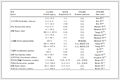
Table 1.
Optimization for iodination of benzyl alcohola


Organic halides are indispensable reagents in organic synthesis, which are often used in the carbon-carbon bonds and carbon-heteroatom bonds formation via coupling reactions and nucleophilic substitution reactions as well as free radical reactions.[1] Among organic halides, organic iodides are the most reactive, and in some cases exhibit unique reactivity.[2] Many methods have been developed for the preparation of the organic iodides. Classical methods such as Finkelstein reaction mainly employ conversion of organic chlorides or organic bromides to the organic iodides by treatment with sodium or potassium iodide or concentrated aqueous hydrogen halides.[3, 4] In addition, transformation of ethers or sulfonic ester into the corresponding iodides is also an alternative method for the generation of organic iodides.[5] Despite all this, most processes suffer from complicated multistep procedures or/and arduous separation of products from the reaction mixtures. Direct conversion of alcohols into the corresponding organic iodides provided a straightforward method. Recently, a number of reactions for the transformation of alcohols into organic iodides using a variety of reagent systems such as P4-I2,[6] Cl2SO-DMF-KI,[7] MgI2,[8] ClSiMe3-NaI,[9] BF3-Et2O-NaI,[10] and others[11] have been reported. Most of them suffered from one or other drawbacks, such as low yields, lengthy reaction times, use of expensive reagents, drastic reaction conditions, and tedious work-up procedures. Iodination utilizing a BH3/I2 system is an alternative way for iodination. Periasamy group found a amine-borane system in 1989 which is able to transform alcohols and carbonyl compounds to corresponding iodides while substrate scope was less explored.[12] Besides, Iglesias et al.[13] discovered that in similar ZnI2/NaCNBH3 system, iodides occurred as side products with limited yield. We now investigated an iodination method using the inexpensive, safe, and readily available reagent NaBH4 with I2 in 1, 4-dioxane, which transforms various alcohols into the corresponding organic iodides in high yields under mild condition.
The initial optimization studies were explored using benzyl alcohol 1a as a model substrate. The results are listed in Table 1. First, the reaction was treated in the 1, 4-dioxane solution using three equivalents of NaBH4 as reductant at 40 ℃ within 24 h, and benzyl iodide 2a was obtained in 49% yield (Table 1, Entry 1). To improve the yield, reaction temperature was examined (Entries 2~4), the best temperature for getting approving yield is 60 ℃ (Entry 3). Then, different solvents such as tetrahydrofuran (THF), acetonitrile, toluene, dichloroethane (DCE), and diethylene glycol dimethyl ether (DEGDME) were screened (Entries 2, 5~9), and poor yields were observed. The 1, 4-dioxane is a best solvent for this reaction (Entry 2). When different amount of NaBH4 was used (Entries 10, 11), to our delight, one equivalent of NaBH4 afforded 2a in 95% yield (Entry 11). In addition, the different iodine sources such as NaI, Bu4NI, and NIS were used (Entries 11~14), only I2 as iodine source provided an excellent yield (Entry 11). Finally, shortening the reaction time led to decrease in yield of 2a (Entry 15).
 下载:
导出CSV
下载:
导出CSV
 | |||||
| Entry | NaBH4/mmol | Iodine source | Temp./℃ | Solvent | Yieldb/% |
| 1 | 1.0 | I2 | 40 | 1, 4-Dioxane | 49 |
| 2 | 1.0 | I2 | 60 | 1, 4-Dioxane | 78 |
| 3 | 1.0 | I2 | 80 | 1, 4-Dioxane | 65 |
| 4 | 1.0 | I2 | 100 | 1, 4-Dioxane | 53 |
| 5 | 1.0 | I2 | 60 | THF | Trace |
| 6 | 1.0 | I2 | 60 | Acetonitrile | ND |
| 7 | 1.0 | I2 | 60 | Toluene | 45 |
| 8 | 1.0 | I2 | 60 | DCE | 56 |
| 9 | 1.0 | I2 | 60 | DEGDME | ND |
| 10 | 1.5 | I2 | 60 | 1, 4-Dioxane | 38 |
| 11 | 0.5 | I2 | 60 | 1, 4-Dioxane | 95 (90) |
| 12 | 0.5 | NaI | 60 | 1, 4-Dioxane | ND |
| 13 | 0.5 | Bu4NI | 60 | 1, 4-Dioxane | ND |
| 14 | 0.5 | NIS | 60 | 1, 4-Dioxane | 34 |
| 15c | 0.5 | I2 | 60 | 1, 4-Dioxane | 70 |
| 16d | 0.5 | I2 | 60 | 1, 4-Dioxane | 26 |
| a Reaction conditions: benzyl alcohol 1a (0.5 mmol), NaBH4, 1, 4-dioxane (1.0 mL), I2 (0.5 mmol), 24 h. b Yield determined by NMR using trichloroethylene as an internal standard, isolated yield is given in parenthesis. c 12 h. d NaBH4, and I2 were added in step 1 and benzyl alcohol in step 2. | |||||
With the optimized reaction conditions in hand, the scope of this iodination with various substituted benzyl alcohols was first investigated. The representative results are summarized in Table 2. The methodology worked well with ortho-, meta-, para-, and multi-substituted benzylic alcohols containing electron-donating or electron-withdrawing substituents furnishing excellent yields of products (Table 2, Entries 1~13). Naphthalen-2-ylmethanol (1n) also underwent smooth iodination to afford 2n under this reaction condition (Entry 14). To further extend a scope of the substrates, simple primary alcohols (1o~1r) were tried and the corresponding products (2o~2r) were obtained in high yields (Entries 15~18). Notably, 2-(4-(hydroxymethyl)-phenyl)ethan-1-ol (1s) was used and monoiodinated product 2s was observed with an excellent selectivity during intramolecular competition between benzylic and aliphatic alcohols (Entry 19). It is noteworthy that allylic alcohols such as (E)-3-phenylprop-2-en-1-ol and (E)-2-benzylidene-heptan-1-ol were employed and the reactions were found to be messy and formation of inseparable by-products. Furthermore, secondary alcohols such as 1-phenylethan-1-ol remained unreacted in this system, which may be attributed to steric hindrance. When pyridin-3-ylmethanol and thiophen-3-ylmethanol were treated under this reaction condition and desired products were not obtained.
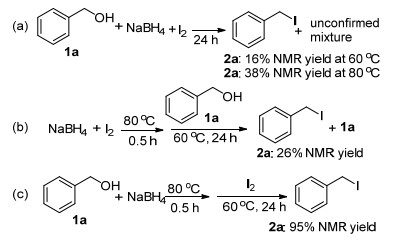
In order to clarify the reaction process, controlled experiments were conducted (Scheme 1). When benzyl alcohol 1a, NaBH4, and iodine were added together at the beginning of the reaction, benzyl iodide 2a is only obtained in 16% yield after 24 h at 60 ℃. Trace amount of benzyl alcohol 1a was detected in NMR with some unconfirmed mixture. Carrying out the reaction at 80 ℃ for 24 h increased the yield to 38% (Scheme 1, a). When NaBH4 and iodine were added together at the beginning, after heating at 80 ℃ for 0.5 h, benzyl alcohol 1a was then added and heated to 60 ℃ for 24 h to afford benzyl iodide 2a in 26% yield with some amount of benzyl alcohol 1a (48%) (Scheme 1, b), in this case, NaBH4 may be consumed by I2. While NaBH4 and benzyl alcohol 1a were added together at the beginning of the reaction and heated to 80 ℃ for 0.5 h in the first step, iodine was then added and the mixture of reaction was heated to 60 ℃ for 24 h to afford benzyl iodide 2a nearly in quantitative yield (Scheme 1c).
Based on the above experimental results on the reductive iodination of alcohol with NaBH4 in the presence of iodine, a plausible pathway is elucidated as shown in Scheme 2. First, alcohol 1 reacts with NaBH4 to form intermediate A with releasing H2. The intermediate A reacts with iodine to afford intermediate B and NaI, which undergo a replacement reaction to obtain organic iodine 2. This mechanism also explains why reaction with NaI as iodine source provided unsuccessful iodination.
In summary, we reported a method for the conversion of alcohols to their corresponding organic iodides under NaBH4/I2 system. In this system, a variety of alcohols could be turned into the desired organic iodides in moderate to excellent yields.
Under N2 atmosphere, an oven-dried 25 mL Schlenk tube was charged with NaBH4 (19 mg, 0.5 mmol), benzyl alcohols (0.5 mmol) and 1 mL of 1, 4-dioxane. The reaction mixture was stirred at 80 ℃ for 0.5 h. After cooling to room temperature, I2 (126.9 mg, 0.5 mmol) was added. Then the mixture was stirred at 60 ℃ for 24 h under N2 condition. After cooling to room temperature, 5 mL of distilled water was added to quench the reaction. The crude product was extracted by ethyl acetate (5 mL×3) and the combined organic phase was dried over anhydrous Na2SO4, followed by filtration and concentration by rotary evaporator. The residue was purified by silica gel to give the corresponding products.
Under N2 atmosphere, an oven-dried 25 mL Schlenk tube was charged with NaBH4 (38 mg, 1 mmol), alkyl alcohols (0.5 mmol) and 1 mL of 1, 4-dioxane. The reaction mixture was stirred at 80 ℃ for 0.5 h. After cooling to room temperature, I2 (126.9 mg, 0.5 mmol) was added. Then the mixture was stirred at 60 ℃ for 24 h under N2 condition. After cooling to room temperature, 5 mL distilled water was added to quench the reaction. The crude product was extracted by ethyl acetate (5 mL×3) and the combined organic phase was dried over anhydrous Na2SO4, followed by filtration and concentration by rotary evaporator. The residue was purified by silica gel to give the corresponding products.
(Iodomethyl) benzene (2a):[14] Colorless solid, 98.1 mg, yield 90%. m.p. (at r.t.=15 ℃) 21~23 ℃ (lit. 22~23 ℃); 1H NMR (CDCl3, 400 MHz) δ: 7.37 (d, J=6.90 Hz, 2H), 7.33~7.18 (m, 3H), 4.45 (s, 2H); 13C NMR (CDCl3, 101 MHz) δ: 139.4, 129.0, 128.9, 128.0, 5.9; GC-MS m/z: 218.
1-Iodo-4-(iodomethyl)benzene (2b):[15] White solid, 113.5 mg, yield 66%. m.p. 85~87 ℃ (lit. 85.5~86.5 ℃); 1H NMR (CDCl3, 400 MHz) δ: 7.61 (d, J=7.60 Hz, 2H), 7.11 (d, J=7.80 Hz, 2H), 4.37 (s, 2H); 13C NMR (CDCl3, 101 MHz) δ: 139.1, 138.1, 130.7, 93.5, 4.5; GC-MS m/z: 344.
1-Bromo-4-(iodomethyl)benzene (2c):[16] White solid, 78.7 mg, yield 53%. m.p. 58~59 ℃ (lit. 58~59 ℃); 1H NMR (CDCl3, 400 MHz) δ: 7.46~7.34 (m, 2H), 7.30~7.14 (m, 2H), 4.39 (s, 2H); 13C NMR (CDCl3, 101 MHz) δ: 138.5, 132.1, 130.5, 121.8, 4.4; GC-MS m/z: 296.
1-Chloro-4-(iodomethyl)benzene (2d):[14] White solid, 75.6 mg, yield 60%. m.p. 58~60 ℃ (lit. 60~61 ℃); 1H NMR (CDCl3, 400 MHz) δ: 7.28 (m, 4H), 4.41 (s, 2H); 13C NMR (CDCl3, 101 MHz) δ: 138.0, 133.8, 130.2, 129.2, 4.3; GC-MS m/z: 252.
1-Iodo-2-(iodomethyl)benzene (2e):[17] White solid, 159.9 mg, yield 93%. m.p. 72~73 ℃ (lit. 71~74 ℃); 1H NMR (CDCl3, 400 MHz) δ: 7.79 (dd, J=7.90, 1.20 Hz, 1H), 7.46 (dd, J=7.70, 1.60 Hz, 1H), 7.27 (td, J=7.50, 1.20 Hz, 1H), 6.91 (td, J=6.10, 1.20 Hz, 1H), 4.53 (s, 2H); 13C NMR (CDCl3, 101 MHz) δ: 141.5, 140.3, 129.9, 129.6, 129.1, 99.9, 12.4; GC-MS m/z: 344
1-Bromo-2-(iodomethyl)benzene (2f):[17] White solid, 93.5 mg, yield 63%. m.p. 42~44 ℃ (lit. 42~44 ℃); 1H NMR (CDCl3, 400 MHz) δ: 7.52 (d, J=8.00 Hz, 1H), 7.42 (d, J=7.60 Hz, 1H), 7.24 (t, J=7.50 Hz, 1H), 7.11 (t, J=7.70 Hz, 1H), 4.53 (s, 2H); 13C NMR (CDCl3, 101 MHz) δ: 138.4, 133.6, 130.7, 129.7, 128.1, 124.2, 6.0; GC-MS m/z: 296.
1-Chloro-2-(iodomethyl)benzene (2g):[14] White solid, 69.3 mg, Yield: 55%. m.p. 26~27 ℃ (lit. 26~28 ℃); 1H NMR (CDCl3, 400 MHz) δ: 7.43~7.37 (m, 1H), 7.36~7.30 (m, 1H), 7.23~7.16 (m, 2H), 4.52 (s, 2H); 13C NMR (CDCl3, 101 MHz) δ: 136.8, 133.9, 130.7, 130.3, 129.5, 127.4, 2.6; GC-MS m/z: 252.
1-(Iodomethyl)-4-methylbenzene (2h):[18] White solid, 107.8 mg, yield 93%. m.p. 46~47 ℃ (lit. 46~47 ℃); 1H NMR (CDCl3, 400 MHz) δ: 7.26 (d, J=8.10 Hz, 2H), 7.08 (d, J=7.90 Hz, 2H), 4.43 (s, 2H), 2.30 (s, 3H); 13C NMR (CDCl3, 101 MHz) δ: 137.9, 136.4, 129.6, 128.7, 21.4, 6.3; GC-MS m/z: 232.
1-(Iodomethyl)-2-methylbenzene (2i):[18] White solid, 67.3 mg, yield 58%. m.p. 33~34 ℃ (lit. 34~45 ℃); 1H NMR (CDCl3, 400 MHz) δ: 7.37~7.07 (m, 4H), 4.43 (s, 2H), 2.33 (s, 3H). 13C NMR (CDCl3, 101 MHz) δ: 137.1, 136.7, 131.0, 129.5, 128.6, 126.7, 19.0, 5.2; GC-MS m/z: 232.
1-(Iodomethyl)-4-(trifluoromethyl)benzene (2j):[14] White solid, 114.4 mg, yield 80%. m.p. 43~44 ℃ (lit. 44 ℃); 1H NMR (CDCl3, 400 MHz) δ: 7.55 (d, J=8.30 Hz, 2H), 7.47 (d, J=8.30 Hz, 2H), 4.45(s, 2H); 13C NMR (CDCl3, 101 MHz) δ: 143.5, 130.3, 129.9, 129.2, 126.0, 125.9, 125.4, 122.7, 3.4; GC-MS m/z: 286.
1-(Iodomethyl)-4-nitrobenzene (2k):[14] White solid, 59.2 mg, yield 45%. m.p. 125~127 ℃ (lit. 124~127 ℃); 1H NMR (CDCl3, 400 MHz) δ: 8.22~8.10 (m, 2H), 7.57~7.42 (m, 2H), 4.48 (s, 2H). 13C NMR (CDCl3, 101 MHz) δ: 147.4, 146.9, 129.7, 124.2, 2.2; GC-MS m/z: 263.
4-(Iodomethyl)-1, 2-dimethylbenzene (2l):[14] White solid, 110.7 mg, yield 90%, m.p. 44~45 ℃ (lit. 45~46 ℃); 1H NMR (CDCl3, 400 MHz) δ: 7.15 (s, 1H), 7.11 (d, J=7.80 Hz, 1H), 7.04 (d, J=7.70 Hz, 1H), 4.42 (s, 2H), 2.23 (s, 3H), 2.21 (s, 3H); 13C NMR (CDCl3, 101 MHz) δ: 137.2, 136.8, 136.7, 130.2, 130.1, 126.2, 19.8, 19.7, 6.6; GC-MS m/z: 246.
1, 2-Dichloro-4-(iodomethyl)benzene (2m):[14] White solid, 88.9 mg, yield 62%, m.p. 52~54 ℃ (lit. 52~53 ℃); 1H NMR (CDCl3, 400 MHz) δ: 7.45 (s, 1H), 7.35 (d, J=8.30 Hz, 1H), 7.18 (d, J=8.30 Hz, 1H), 4.35 (s, 2H); 13C NMR (CDCl3, 101 MHz) δ: 139.6, 132.7, 132.0, 130.9, 130.6, 128.2, 2.8; GC-MS m/z: 286.
2-(Iodomethyl)naphthalene (2n):[19] White solid, 104.5 mg, yield 78%. m.p. 76~77 ℃ (lit. 75~76 ℃); 1H NMR (CDCl3, 400 MHz) δ: 7.87~7.62 (m, 4H), 7.52~7.36 (m, 3H), 4.60 (s, 2H); 13C NMR (CDCl3, 101 MHz) δ: 136.7, 133.4, 132.9, 128.9, 127.9, 127.9, 127.1, 127.0, 126.6, 126.5, 6.7; GC-MS m/z: 268.
(3-Iodopropyl)benzene (2o):[20] Colorless liquid, 65.2 mg, yield 53%. 1H NMR (CDCl3, 400 MHz) δ: 7.29 (dd, J=11.30, 3.80 Hz, 2H), 7.21 (dd, J=12.50, 5.30 Hz, 3H), 3.16 (t, J=6.80 Hz, 2H), 2.72 (t, J=7.30 Hz, 2H), 2.17~2.07 (m, 2H); 13C NMR (CDCl3, 101 MHz) δ: 140.5, 128.7, 128.6, 126.3, 36.3, 35.0, 6.6; GC-MS m/z: 246.
(4-Iodobutyl)benzene (2p):[16] Yellow liquid, 78.0 mg, yield 60%. 1H NMR (CDCl3, 400 MHz) δ: 7.26 (t, J=7.50 Hz, 2H), 7.16 (t, J=8.50 Hz, 3H), 3.16 (t, J=6.90 Hz, 2H), 2.61 (t, J=7.50 Hz, 2H), 1.81 (dd, J=14.60, 6.90 Hz, 2H), 1.76~1.65 (m, 2H); 13C NMR (CDCl3, 101 MHz) δ: 141.8, 128.4, 126.0, 34.8, 33.0, 32.3, 6.9; GC-MS m/z: 260.
1-(Iodomethyl)-4-(3-iodopropyl)benzene (2q):[20] White solid, 96.5 mg, yield 50%, m.p. 58~60 ℃ (lit. 58~59 ℃); 1H NMR (CDCl3, 400 MHz) δ: 7.30 (d, J=7.80 Hz, 2H), 7.12 (d, J=7.90 Hz, 2H), 4.44 (s, 2H), 3.15 (t, J=6.80 Hz, 2H), 2.69 (t, J=7.30 Hz, 2H), 2.15~2.05 (m, 2H); 13C NMR (CDCl3, 101 MHz) δ: 140.4, 137.3, 129.2, 129.0, 36.0, 34.7, 6.4, 6.0; GC-MS m/z 386.
1-Iodooctane (2r):[21] Colorless liquid, 109.3 mg, yield 91%. 1H NMR (CDCl3, 400 MHz) δ: 3.18 (t, J=7.00 Hz, 2H), 1.90~1.69 (m, 2H), 1.46~1.15 (m, 10H), 0.88 (t, J=6.80 Hz, 3H); 13C NMR (CDCl3, 101 MHz) δ: 33.7, 31.9, 30.7, 29.2, 28.6, 22.8, 14.2, 7.4; GC-MS m/z: 240.
3-4-(Iodomethyl)phenyl)propan-1-ol (2s): White solid, 99.4 mg, yield 72%, m.p. 86~88 ℃ (lit. 87~89 ℃); 1H NMR (CDCl3, 400 MHz) δ: 7.30 (d, J=7.30 Hz, 2H), 7.13 (d, J=7.60 Hz, 2H), 4.45 (s, 2H), 3.67 (t, J=6.30 Hz, 2H), 2.71~2.64 (m, 2H), 1.91~1.83 (m, 2H), 1.42 (s, 1H); 13C NMR (CDCl3, 101 MHz) δ: 141.8, 136.9, 129.0, 128.9, 62.3, 34.1, 31.9, 6.2; GC-MS m/z: 276. HRMS (FAB-magnetic Sector) calcd for C10H13IO 276.0011, found 276.0014.
SupportingInformation General comments of reaction and copies of 1H NMR and 13C NMR spectra. The Supporting Information is available free of charge via the Internet at http://siocjournal.cn/.
(a) Chambers, R. D.; James, S. R. In Comprehensive Organic Chemistry, Vol. 1, Eds.: Barton, D. H. R.; Ollis, W. D., Pergamon Press, Oxford, 1979, p. 493.
(b) Hudlicky, T. In Chemistry of Functional Groups, Eds.: Patai, S.; Rapport, Z., Wiley, New York, 1983, (Suppl. D), p. 1021.
(c) Bohlmann, R. In Comprehensive Organic Synthesis, Vol. 6, Eds.: Trust, B. M.; Fleming, I., Pergamon Press, Oxford, 1991, p. 203.
(d) Kita, Y.; Matsugi, M. In Radicals in Organic Synthesis, Eds.: Renaud, P.; Sibi, M. P., Wiley-VCH, Weinheim, 2001, p. 1.
(e) Kita, Y.; Gotanda, K.; Sano, A.; Oka, M.; Murata, K.; Suemura, M.; Matsugi, M. Tetrahedron Lett. 1997, 38, 8345.
(f) Kita, Y.; Sano, A.; Yamaguchi, T.; Oka, M.; Gotanda, K.; Matsugi, M. Tetrahedron Lett. 1997, 38, 3549.
(g) Kita, Y.; Sano, A.; Yamaguchi, T.; Oka, M.; Gotanda, K.; Matsugi, M. J. Org. Chem. 1999, 64, 675.
(h) Kita, Y.; Nambu, H.; Ramesh, N. G.; Anilkumar, G.; Matsugi, M. Org. Lett. 2001, 3, 1157.
Villieras, J.; Bacquet, C.; Nonnat, J. F. Bull. Chem. Soc. Fr. 1975, 1997.
(a) Finkelstein, H. A. Ber. Dtsch. Chem. Ges. 1910, 43, 1528.
(b) Willy, W. E.; McKean, D. R.; Garcia, B. A. Bull. Chem. Soc. Jpn. 1976, 49, 1989.
Landini, D.; Albanese, O.; Mottadelli, S.; Penso. M. J. Chem. Soc., Perkin Trans. 1 1992, 2309.
(a) Firouzabadi, H.; Iranpoor, N.; Shaterian, H. Synlett 2000, 65.
(b) Aizpurua, J. M.; Cossio, F. P.; Palomo, C. J. Org. Chem. 1986, 51, 4941.
(c) Firouzabadi, H.; Iranpoor, N.; Hazarkhani, H. Tetrahedron Lett. 2002, 43, 7139.
(d) Liu, Y.; Xu, Y.; Jung, S. H.; Chae, J. Synlett 2012, 2663.
(e) Maloney, D. J.; Hecht, S. M. Org. Lett. 2005, 7, 4297.
Jung, M.E.; Omstein, P. L. Tetrahedron Lett. 1977, 31, 2651.
Fendez, I.; Garcia, B.; Munoz, S.; Pedro, J. R.; Salud, R. Synlett 1993, 489.
(b) Bandgar, B. P.; Bettigeri, S. V. Monatsh. Chem. 2004, 135, 1251.
Martinez, A. G.; Alvarez, R. M.; Vilar, E. T.; Fraile, A. G.; Bamica, J. O.; Hanack, M.; Subramanian, L. R. Tetrahedron Lett. 1987, 28, 6441. doi: 10.1016/S0040-4039(00)96882-5
Olah, G. A.; Narang, S. C.; Gupta, B. G. B.; Malhotra, R. J. Org. Chem. 1979, 44, 1247. doi: 10.1021/jo01322a012
(a) Mandal, A. K.; Mahajan, S. W. Tetrahedron Lett. 1985, 26, 3863.
(b) Vankar, Y. D.; Rao, C. T. Tetrahedron Lett. 1985, 26, 2717.
(a) Larock, R. C. In Comprehensive Organic Transformation, 2nd ed., Wiley VCH, New York, 1999, p. 695.
(b) Iranpoor, N.; Firouzabadi, H.; Jamalian, A.; Kazemi, F. Tetrahedron 2005, 61, 5699.
(c) Iranpoor, N.; Firouzabadi, H.; Gholinejad, M. Can. J. Chem. 2006, 84, 1006.
Reddy, C. K.; Periasamy, M. Tetrahedron Lett. 1989, 30, 5663. doi: 10.1016/S0040-4039(01)93826-2
Finkielsztein, L. M.; Aguirre, J. M.; Lantano, B.; Alesso, E. N.; Iglesias, G. Y. Synth. Commun. 2004, 34, 895. doi: 10.1081/SCC-120028362
Combe, S. H.; Hosseini, A.; Song, L-J.; Hausmann, H.; Schreiner, P. R. Org. Lett. 2017, 19, 6156. doi: 10.1021/acs.orglett.7b03034
Rafiee, M.; Wang, F.; Hruszkewycz, D. P.; Stahl, S. S. J. Am. Chem. Soc. 2018, 140, 22. doi: 10.1021/jacs.7b09744
Chen, J.; Lin, J.-H.; Xiao, J.-C. Org. Lett. 2018, 20, 3061. doi: 10.1021/acs.orglett.8b01058
Neuhaus, P.; Henkel, S.; Sander, W. Aust. J. Chem. 2010, 63, 1634. doi: 10.1071/CH10348
Artaryan, A.; Mardyukov, A.; Kulbitski, K.; Avigdori, I.; Nisnevich, G. A.; Schreiner, P. R.; Gandelman, M. J. Org. Chem. 2017, 82, 7093. doi: 10.1021/acs.joc.7b00557
Larsen, M. A.; Wilson, C. V.; Hartwig, J. F. J. Am. Chem. Soc. 2015, 137, 8633. doi: 10.1021/jacs.5b04899
Zhu, R.-Y.; He, J.; Wang, X.-C.; Yu, J.-Q. J. Am. Chem. Soc. 2014, 136, 13194. doi: 10.1021/ja508165a
Lee, C.-H.; Lee, S.-M.; Min, B.-H.; Kim, D.-S.; Jun, C.-H. Org. Lett. 2018, 20, 2468. doi: 10.1021/acs.orglett.8b00831
Table 1. Optimization for iodination of benzyl alcohola
| |||||
| Entry | NaBH4/mmol | Iodine source | Temp./℃ | Solvent | Yieldb/% |
| 1 | 1.0 | I2 | 40 | 1, 4-Dioxane | 49 |
| 2 | 1.0 | I2 | 60 | 1, 4-Dioxane | 78 |
| 3 | 1.0 | I2 | 80 | 1, 4-Dioxane | 65 |
| 4 | 1.0 | I2 | 100 | 1, 4-Dioxane | 53 |
| 5 | 1.0 | I2 | 60 | THF | Trace |
| 6 | 1.0 | I2 | 60 | Acetonitrile | ND |
| 7 | 1.0 | I2 | 60 | Toluene | 45 |
| 8 | 1.0 | I2 | 60 | DCE | 56 |
| 9 | 1.0 | I2 | 60 | DEGDME | ND |
| 10 | 1.5 | I2 | 60 | 1, 4-Dioxane | 38 |
| 11 | 0.5 | I2 | 60 | 1, 4-Dioxane | 95 (90) |
| 12 | 0.5 | NaI | 60 | 1, 4-Dioxane | ND |
| 13 | 0.5 | Bu4NI | 60 | 1, 4-Dioxane | ND |
| 14 | 0.5 | NIS | 60 | 1, 4-Dioxane | 34 |
| 15c | 0.5 | I2 | 60 | 1, 4-Dioxane | 70 |
| 16d | 0.5 | I2 | 60 | 1, 4-Dioxane | 26 |
| a Reaction conditions: benzyl alcohol 1a (0.5 mmol), NaBH4, 1, 4-dioxane (1.0 mL), I2 (0.5 mmol), 24 h. b Yield determined by NMR using trichloroethylene as an internal standard, isolated yield is given in parenthesis. c 12 h. d NaBH4, and I2 were added in step 1 and benzyl alcohol in step 2. | |||||
 下载: 导出CSV

 扫一扫看文章


扫一扫关注我们