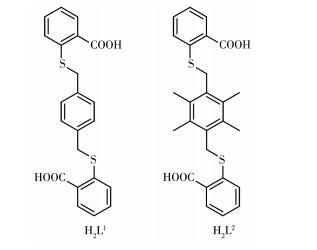
Scheme 1.
Structures of ligands H2L1 and H2L2

Synthesis, structural characterization, and fluorescence property of three coordination polymers with dicarboxylate ligands
Pei-Pei CUI , Yue SUN , Yi ZHA , Sheng-Nan LIU , Meng-Xin ZHANG , Ji-Yun CAO , Qi WANG , Xiao-Qing WANG


Coordination polymers (CPs) are metal-ligand compounds based on inorganic metal ions/metal clusters and organic ligands through coordination bonds to form 1D, 2D, and 3D extended structures[1-3]. As a new type of organic-inorganic hybrid material, it has potential applications in photoluminescence properties, magnetism, catalysis, humidity, and pH response[4-6]. Because the structures and properties of CPs mainly depend on the nature of building blocks, the choice of ligands is usually the first step in the design and synthesis of CPs. Among them, the ligand can be divided into rigid and flexible ones. Generally speaking, rigid ligands are more likely to promote the directional synthesis of the structure and function of CPs. Compared with rigid ligands, flexible ones with diverse configurations can exhibit different conformations during self-assembly, which makes it more difficult to predict the final structures[7-8]. Besides some structures that cannot be obtained through rigid ligands can be synthesized by flexible ones[9-10]. Due to the difficulty in predicting the structure and properties, the construction of complexes based on flexible ligands has attracted many researchers to study. Up to now, many CPs based on flexible ligands have been reported. Cao reported a dia-topology CP with ferroelectric and second-order nonlinear optical properties based on the flexible tetracarboxylate organic linker tetrakis[4-(carboxyphenyl)oxamethyl]methane acid and Zn(Ⅱ) ions[11]. Based on flexible carboxylate ligands with acylamide groups N, N′, N″-tris(isophthalyl)-1, 3, 5-benzenetricarboxamide, (5-(3, 5-dicarboxybenzamido)isophthalic acid, 5, 5′-(oxalyl bis (azanediyl))diisophthalic acid and 5-(5-((3, 5-dicarboxyphenyl)carbamoyl)pyridin-2-yl)isophthalic acid, several frameworks with high-uptake of CO2 were reported by Bai′s group[12-14].
Except for the nature of building blocks, inter-molecular non-covalent interactions are an important part of influencing the CPs′ structures and properties. Much more elaborate studies have been required because inter-molecular non-covalent interactions determine the fashion of molecular structure and packing in the solid state[15-17]. Inter-molecular non-covalent interactions mainly include van der Waals forces, hydrogen bonding, π…π stacking interaction, and so on. Among them, hydrogen bonds are an important research content and design method in the crystal engineering of CPs and appear to be very useful interactions as they typically have sufficient strength and directionality[18-20]. For example, hydrogen-bonding interactions between the guest ions in the channels and the —OH groups of the organic ligand are thought to reduce the vibrational movements of the channels and affect the quenching effect in luminescence[21]. As another example, hydrogen bonds can be achieved by bridging two ligands that are coordinated to a metal center to effectively lead to supramolecular bidentate ligands, leading to catalysts with superior properties in a variety of metal-catalyzed transformations[22].
In the past few years, our group has designed and synthesized a series of CPs based on flexible carboxylate ligands and hydrogen-bonding interactions are also frequently discussed[23-26]. Based on our previous works, in this study, we choose flexible dicarboxylic acids 2, 2′-(1, 4-phenylenebis(methylene))bis(sulfanediyl)dibenzoic acid (H2L1) and 2, 2′-(2, 3, 5, 6-tetramethyl-1, 4-phenylene)bis(methylene)bis(sulfanediyl) dibenzoic acid (H2L2) as ligands (Scheme 1). Three CPs have been synthesized and the formulas are {[Ni(L1)(H2O)4]·2H2O}n (1), [Zn(L1)(DMA)2]n (2), and [Co(L2)(DMF)2]n (3) (DMA=N, N-dimethylacetamide, DMF=N, N-dimethylformamide). The single-crystal X-ray diffraction analysis shows that the structures of 1-3 are 1D chains, which can form 3D frameworks by hydrogen bonding interaction. In 1-3, the conformation of the ligands are all in anti-conformation. In addition, the thermal stability and fluorescence properties of the complexes were investigated.
The ligands H2L1 and H2L2 were synthesized according to the procedure reported[27-28]. Other chemicals and solvents are commercially available of reagent grade and were used as received without further purification. Elemental analysis for C, H, N, and S was performed on a Perkin-Elmer 240C Elemental Analyzer. FTIR spectra were recorded in a range of 400-4 000 cm-1 on a Bruker Vector 22 FT-IR spectrophotometer using KBr pellets. At room temperature, powder X-ray diffraction (PXRD) measurements were performed on a Bruker D8 Advance X-ray diffractometer using Cu Kα radiation (λ=0.154 18 nm), in which the X-ray tube was operated at 40 kV and 40 mA (2θ=5°-50°). Thermogravimetric analysis (TGA) was performed on a simultaneous SDT 2960 thermal analyzer under N2 with a heating rate of 10 ℃·min-1 from 30 to 650 ℃. UV-Vis spectrum was obtained using the Shimadzu UV2700 spectrophotometer at room temperature. Solid-state fluorescence spectrum, the quantum yield, and fluorescence lifetime were obtained on Edinburgh FLS980 Series of fluorescence spectrometers.
A mixture of H2L1 (20.50 mg, 0.05 mmol), orotic acid (7.80 mg, 0.05 mmol), KOH (11.20 mg, 0.20 mmol), and 5.0 mL H2O was stirred for 0.5 h. Then Ni(NO3)2·6H2O (29.08 mg, 0.10 mmol) in 5.0 mL H2O was added. The resultant solution was sealed in a 20 mL bottle and heated at 90 ℃ for three days. After cooling to room temperature, a large amount of precipitation and a small amount of green block-shaped crystals of 1 were obtained. The yield of the crystals was 15%. Anal. Calcd. for C22H28O10S2Ni(%): C, 45.93; H, 4.91; N, 0; S, 11.15. Found(%): C, 46.03; H, 4.76; N, 0.12; S, 11.45. IR (KBr, cm-1): 1 660 (m), 1 599 (s), 1 530(m), 1 360(w), 1 320 (m), 1 063 (m), 1 018 (w), 859 (w), 828 (w), 776 (m), 655(m), 537 (w).
A mixture of ZnSO4·H2O (6.00 mg, 0.33 mmol) and H2L1 (9.00 mg, 0.022 mmol) was added in DMA/EtOH (1∶1, V/V, 10.0 mL). The resultant solution was sealed in a 20 mL bottle and heated at 90 ℃ for three days. After cooling to room temperature, colourless block-shaped crystals of 2 were obtained in a 45% yield. Anal. Calcd. for C30H34O6N2S2Zn(%): C, 55.59; H, 5.29; N, 4.32; S, 9.89. Found(%): C, 55.32; H, 5.71; N, 4.78; S, 10.12. IR (KBr, cm-1): 1 619 (s), 1 584 (m), 1 466 (w), 1 426 (m), 1 376 (m), 1 160 (m), 1 100 (m), 1 024 (w), 859 (m), 763 (w), 638 (w), 610 (w), 535 (w).
A mixture of Co(NO3)2·6H2O (29.10 mg, 0.10 mmol) and H2L2 (23.30 mg, 0.05 mmol) was added in DMF/EtOH/H2O (5∶2∶1, V/V, 10.0 mL). The resultant solution was sealed in a 20 mL bottle and heated at 90 ℃ for three days. After cooling to room temperature, red block-shaped crystals of 3 were obtained in 55% yield. Anal. Calcd. for C32H38O6N2S2Co(%): C, 57.39; H, 5.72; N, 4.18; S, 9.58. Found(%): C, 57.01; H, 5.95; N, 4.31; S, 10.06. IR (KBr, cm-1): 1 620 (s), 1 588 (m), 1 569 (m), 1 528(s), 1 416 (s), 1 377 (w), 1 105 (w), 1 058 (w), 866 (m), 810 (w), 753 (m), 716 (m), 677(w), 660 (w).
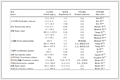
Diffraction data for 1-3 were collected on a Bruker Apex Ⅱ CCD with graphite monochromated Mo Kα radiation source (λ=0.071 073 nm) in φ-ω scan mode. The SAINT program was used for the integration of the diffraction data and the intensity correction for the Lorentz and polarization effects. The structures of 1-3 were solved by direct methods and all non-hydrogen atoms were refined anisotropically on F2 by the full-matrix least-squares technique using the SHELXL crystallographic software package. The riding model was used to refine the hydrogen atom isotropic in the computational position. Multi-scan absorption corrections were applied by using the SADABS program. For 1-3, the details of the crystal parameters, data collection, and refinements are summarized in Table 1. Selected bond lengths and angles for 1-3 are listed in Table S1 (Supporting information). The parameters of hydrogen bonds for 1-3 are listed in Table S2.
 下载:
导出CSV
下载:
导出CSV
| Parameter | 1 | 2 | 3 |
| Formula | C22H28O10S2Ni | C30H34N2O6S2Zn | C32H38N2O6S2Co |
| Formula weight | 575.27 | 648.08 | 669.69 |
| Crystal system | Triclinic | Monoclinic | Triclinic |
| Space group | P1 | C2/c | P1 |
| a/nm | 0.809 3(3) | 1.276 9(5) | 0.769 34(6) |
| b/nm | 1.802 6(8) | 0.936 7(5) | 0.871 29(8) |
| c/nm | 1.927 3(8) | 2.536 8(5) | 1.230 65(10) |
| α/(°) | 63.175(7) | 86.211(3) | |
| β/(°) | 82.759(7) | 101.252(5) | 88.486(3) |
| γ/(°) | 78.458(8) | 74.125(3) | |
| V/nm3 | 2.456 4(17) | 2.976(2) | 0.791 70(12) |
| Z | 4 | 4 | 1 |
| Dc/(g·cm-3) | 1.556 | 1.447 | 1.405 |
| μ/mm-1 | 1.014 | 1.011 | 0.720 |
| F(000) | 1 200 | 1 352 | 351 |
| Unique reflection | 7 029 | 3 382 | 2 774 |
| Obsd. reflection [I > 2σ(I)] | 9 905 | 9 719 | 5 773 |
| Number of parameters | 640 | 238 | 248 |
| GOF | 1.039 | 1.020 | 1.062 |
| Final R indices [I > 2σ(I)]* | R1=0.060 8, wR2=0.152 2 | R1=0.044 0, wR2=0.079 3 | R1=0.043 0, wR2=0.115 4 |
| R indices (all data) | R1=0.087 7, wR2=0.170 8 | R1=0.086 9, wR2=0.092 1 | R1=0.051 9, wR2=0.122 0 |
| Largest difference peak and hole/(e·nm-3) | 719 and -697 | 368 and -590 | 611 and -401 |
| * R1=∑||Fo|-|Fc||/∑|Fo|, wR2=[∑w(Fo2-Fc2)2]/∑w(Fo2)2]1/2. | |||
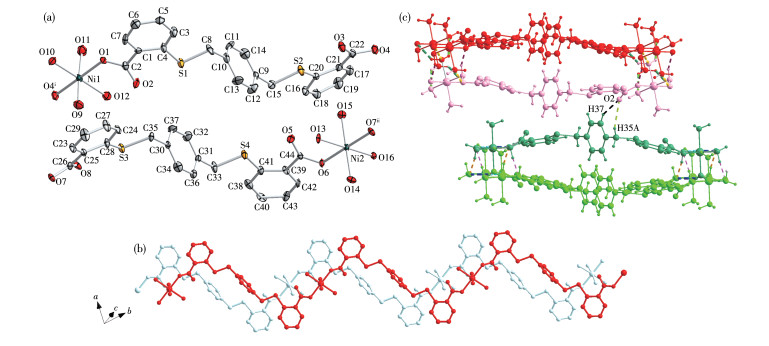
The crystal structure of complex 1 was determined by single-crystal X-ray diffraction analysis. Crystallographic analysis indicates that 1 is a triclinic complex crystallizing in the P1 space group. There are two Ni(Ⅱ) ions in the asymmetric unit and the coordination environment around Ni(Ⅱ) is the same. The coordination number of Ni(Ⅱ) is six and the coordination geometry of Ni(Ⅱ) is a distorted octahedron structure. Among them, four oxygen atoms from water molecules form a quadrilateral plane. In the trans axial positions, there are two oxygen atoms from (L1)2- ligands (Fig. 1a). Each Ni(Ⅱ) ion links two (L1)2- ligands, and each (L1)2- ligand links two Ni(Ⅱ) ions. Thus, the adjacent (L1)2- ligands by the coordination of carboxylate groups link together with Ni(Ⅱ) to form zigzag chains (Fig. 1b). In 1, there are many hydrogen bonding interactions. When discussing hydrogen bonding interactions, free water molecules have been omitted for clarity. Among them, the adjacent chains based on Ni1 can form 2D bilayer by intermolecular hydrogen bonding interactions, such as O10—H10A…O11, O10—H10B…O1, O11—H11A…O12, and O11—H11B…O4 (Fig.S1a). At the same time, the adjacent chains based on Ni2 also can form 2D bilayer by intermolecular hydrogen bonding interactions, mainly including O13—H13A…O7, O14—H14A…O6, O16—H16A…O6, O14—H14A…O16, and O14—H14B…O7 (Fig.S1b). The bilayers based on Ni1 and the bilayers based on Ni2 can form 3D framework by intermolecular hydrogen bonding interactions C35—H35A…O2 and C37—H37…O2 (Fig. 1c).
Symmetry codes: ⅰ-1+x, 1+y, z; ⅱ 1+x, -1+y, z.
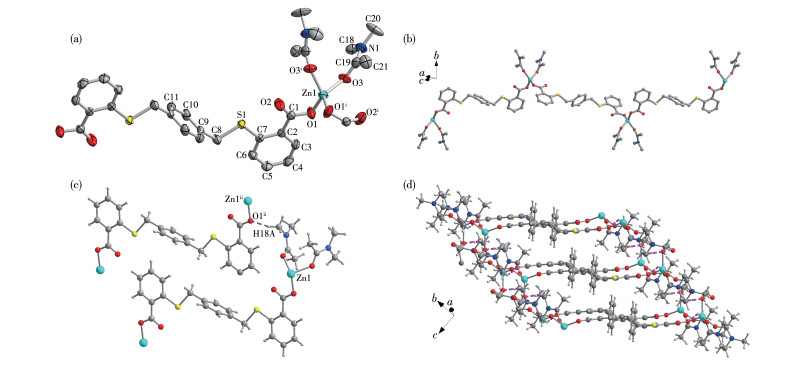
The structural analysis shows that complex 2 crystallizes in the monoclinic C2/c space group. The asymmetric unit of 2 consists of half Zn(Ⅱ) ion, half (L1)2- ligand, and one coordinated DMA molecule. The coordination number of Zn(Ⅱ) is four and the coordination geometry of Zn(Ⅱ) is a distorted tetrahedron occupied by O1, O1ⅰ, O3, and O3ⅰ (Fig. 2a). Among them, O1 comes from the carboxylate group of (L1)2- ligand and O3 comes from coordinated DMA molecule. Two carboxylate groups of one (L1)2- ligand link two adjacent Zn(Ⅱ) ions to form a chain (Fig. 2b). Intermolecular hydrogen bonding interaction also exists in 2. As shown in Fig. 2c and 2d, the adjacent chains can form a 3D framework by the H-bonding C18—H18A…O1.
Symmetry codes: ⅰ 1-x, y, 1/2-z; ⅱ-1/2+x, 1/2+y, z.
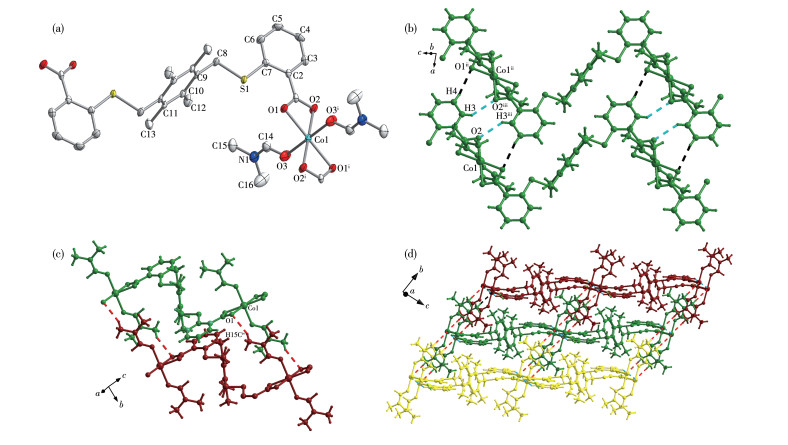
Crystallographic analysis indicates that complex 3 crystallizes in the triclinic P1 space group. In the structure of 3, the asymmetric unit consists of half Co(Ⅱ) ion, half (L2)2- ligand, and one coordinated DMF molecule, which is similar to 2. Different from 2, the coordination number of Co(Ⅱ) is six in 3. The coordination geometry of Co(Ⅱ) is a distorted octahedron structure occupied by two carboxylate groups and two DMF molecules (Fig. 3a). Four oxygen atoms of two carboxylate groups form a plane and two coordinated DMF molecules in the axial direction. Each Co(Ⅱ) ion links two (L2)2- ligands and each (L2)2- ligand link two Co(Ⅱ) ions. Thus, the adjacent (L2)2- ligands by the coordination of carboxylate groups link together with Co(Ⅱ) to form chains (Fig.S2). Like 1 and 2, intermolecular hydrogen bonding interactions also exist in 3. By intermolecular H-bonding interactions C4—H4…O1 and C3—H3…O2, the adjacent chains along the a- and c-axes can form 2D sheets (Fig. 3b). The adjacent sheets further form 3D framework by C15—H15C…O2 (Fig. 3c and 3d).
Symmetry codes: ⅰ-x, 2-y, 1-z; ⅱ 1+x, y, z; ⅲ 1-x, 2-y, 1-z; ⅳ x, 1+y, z.
Complexes 1-3 were synthesized and characterized based on the flexible dicarboxylate ligands H2L1 and H2L2. Although the synthesis conditions are different, each metal ion links two ligands and each ligand links two metal ions to form 1D chains in 1-3. Under the reaction conditions of 1, ZnSO4·H2O or Co(NO3)2·6H2O replaced Ni(NO3)2·6H2O, other things being equal, no crystals produced. In similar situations, Ni(NO3)2·6H2O or Co(NO3)2·6H2O replaced ZnSO4·H2O and Ni(NO3)2·6H2O or ZnSO4·H2O replaced Co(NO3)2·6H2O, there was still no crystal formation. When H2L1 and H2L2 replaced each other, no crystals were produced. In 1-3, the carboxylate groups of the corresponding ligands all lose hydrogen ions to coordinate with metal ions. The deprotonation of the carboxylic acids was confirmed by crystal structural analyses as described above as well as by IR spectra. In IR spectra, no obvious bands between 1 700 and 1 800 cm-1 were found (Fig.S3).
The thermal stability of CPs is important for their application research, so TGA curves of complexes 1-3 were measured in an N2 atmosphere from 30 to 650 ℃ (Fig. 4). The result analysis indicated that before 170 ℃ the weight loss of 1 was 17.9%, which is in accordance with the loss of free water molecules and coordinated water molecules (Calcd. 18.8%). Further weight loss was observed at about 320 ℃ owing to the decomposition of 1. For 2, there was little weight loss before 175 ℃ and it showed a weight loss of 26.0% before 230 ℃, which corresponds to the release of DMA molecules (Calcd. 26.5%). Over 285 ℃, 2 began to decompose. For 3, it had little weight loss before 200 ℃. Then there was a weightless platform until 270 ℃ and the weight loss was 21.4%, which is the same as the loss of coordinated DMF molecules (Calcd. 21.5%). Over 300 ℃, 3 began to decompose.
The phase purities of the bulk samples of 1-3 were investigated by PXRD at room temperature (Fig.S4). The measured PXRD patterns of the samples matched well with the simulated patterns, which indicates that the samples of complexes 1-3 are pure phase.
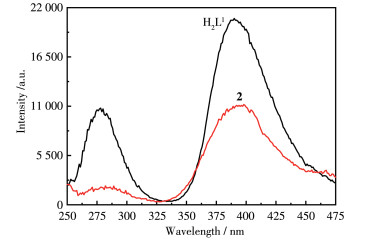
Due to the possible application of CPs based on d10 transition metal centers in luminescent sensors, photochemistry, and electroluminescent displays, the fluorescence property of CPs constructed from Zn(Ⅱ) and organic ligands has attracted much attention[29]. Thus, the solid-state fluorescence properties of H2L1 ligand and 2 were investigated at room temperature. The excitation and emission spectra of H2L1 and 2 were all measured. In the excitation spectrum, the strongest excitation peak was around 242 nm (Fig.S5). When the excitation wavelength was 242 nm, there were two emission peaks for H2L1 and 2. For H2L1, the smaller emission band was at ca. 276 nm, and the maximum emission band was at ca. 390 nm. For 2, the smaller emission band was at ca. 281 nm, and the maximum emission band was at ca. 395 nm (Fig. 5). Thus, the emission spectrum of 2 was similar to the free H2L1 ligand. So the emission of 2 can be assigned to an intraligand π→π* electronic transition. Compared to the free ligand H2L1, the emission maxima of 2 was a small amount of red-shift. The reason may be attributed to the deprotonation of H2L1 and the coordination of (L1)2- to Zn2+.
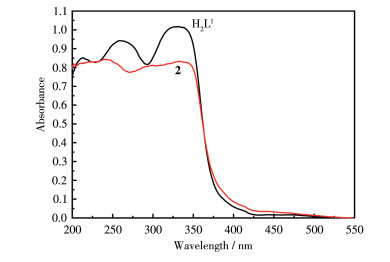
Furthermore, the solid-state UV-Vis spectra of H2L1 and 2 were investigated at room temperature. The results show that the absorption wavelength range of H2L1 and 2 was similar and they had absorption peaks between 200 and 420 nm, which indicates that H2L1 and 2 have good light absorption ability in the UV-Vis light region (Fig. 6). For H2L1, the maximum absorption band was at ca. 332 nm, which should be considered as π→π* electronic transition of the ligand. Compared with H2L1, the intensity of the maximum absorption peak of 2 was weaker, which may be caused by the deprotonation of H2L1 and the coordination between (L1)2- and Zn2+. For 2, at around 270 nm, the absorption peak weakened, which can be attributed to the coordination of (L1)2- to Zn2+ and the formation of Zn—O bonds[30-31].
Fluorescence lifetime was also measured at room temperature in the solid state (Fig.S6). The attenuation curves of H2L1 and 2 can be well fitted into the two- exponential function: R(t)=B1exp(-t/τ1)+B2exp(-t/τ2)[32-36]. Two time components were included, a fast decay (τ1) and a slower component (τ2). According to the mean lifetime equation: τm=B1τ1+B2τ2[32-33], the fluorescence lifetimes of H2L1 and 2 were calculated to be 1.18 and 3.65 ns, respectively, which indicates that the fluorescence lifetimes are very short.
Based on flexible dicarboxylate ligands 2, 2′-(1, 4-phenylenebis(methylene))bis(sulfanediyl)dibenzoic acid (H2L1) and 2, 2′-(2, 3, 5, 6-tetramethyl-1, 4-phenylene)bis(methylene)bis(sulfanediyl) dibenzoic acid (H2L2), {[Ni(L1)(H2O)4]·2H2O}n (1), [Zn(L1)(DMA)2]n (2) and [Co(L2)(DMF)2]n (3) were prepared under solvothermal conditions. The molecular structures of complexes 1-3 were established by single-crystal X-ray diffraction analyses. The ligands all display anti-conformation and 1-3 all have zigzag chain structures, which further form 3D frameworks by hydrogen bonding interaction. Solid-state photoluminescent measurements reveal that complex 2 manifests the characteristic emission bands of the H2L1 ligand.
Notash B, Rodbari M F, Gallo G, Dinnebier R. Humidity-induced structural transformation in pseudopolymorph coordination polymers[J]. Inorg. Chem., 2021, 60(12): 9212-9223. doi: 10.1021/acs.inorgchem.1c01360
Jin M, Ando R, Ito H. Distinct fold-mode formation of crystalline Cu(Ⅰ) helical coordination polymers with alternation of the solid-state emission using shape of the counter anions[J]. Inorg. Chem., 2022, 61(1): 3-9. doi: 10.1021/acs.inorgchem.1c02725
Thomas B, Chang B S, Chang J J, Thuo M, Rossini A J. Solid-state nuclear magnetic resonance spectroscopy-assisted structure determination of coordination polymers[J]. Chem. Mater., 2022, 34(17): 7678-7691. doi: 10.1021/acs.chemmater.2c00593
Leong W L, Vittal J J. One-dimensional coordination polymers: Complexity and diversity in structures, properties, and applications[J]. Chem. Rev., 2011, 111(2): 688-764. doi: 10.1021/cr100160e
Chakraborty G, Park I H, Medishetty R, Vittal J J. Two-dimensional metal-organic framework materials: Synthesis, structures, properties and applications[J]. Chem. Rev., 2021, 121(7): 3751-3891. doi: 10.1021/acs.chemrev.0c01049
Chakraborty C, Rana U, Moriyama S, Higuchi M. Multifunctional Pt(Ⅱ)-based metallo-supramolecular polymer with carboxylic acid groups: Electrochemical, mechanochemical, humidity, and pH response[J]. ACS Appl. Polym. Mater., 2020, 2(9): 4149-4159. doi: 10.1021/acsapm.0c00782
Lin Z J, Lü J, Hong M C, Cao R. Metal-organic frameworks based on flexible ligands (FL-MOFs): Structures and applications[J]. Chem. Soc. Rev., 2014, 43(16): 5867-5895. doi: 10.1039/C3CS60483G
Ji Z Y, Fan Y R, Wu M Y, Hong M C. A flexible microporous framework with temperature-dependent gate-opening behaviours for C2 gases[J]. Chem. Commun., 2021, 57(31): 3785-3788. doi: 10.1039/D1CC00014D
Lippert B, Sanz Miguel P J. Metallatriangles and metallasquares: The diversity behind structurally characterized examples and the crucial role of ligand symmetry[J]. Chem. Soc. Rev., 2011, 40(9): 4475-4487. doi: 10.1039/c1cs15090a
Chen K F, Mousavi S H, Singh R, Snurr R Q, Li G, Webley P A. Gating effect for gas adsorption in microporous materials-mechanisms and applications[J]. Chem. Soc. Rev., 2022, 51(3): 1139-1166. doi: 10.1039/D1CS00822F
Guo Z G, Cao R, Wang X, Li H F, Yuan W B, Wang G J, Wu H H, Li J. A multifunctional 3D ferroelectric and NLO-active porous metal-organic framework[J]. J. Am. Chem. Soc., 2009, 131(20): 6894-6895. doi: 10.1021/ja9000129
Zheng B S, Bai J F, Duan J G, Wojtas L, Zaworotko M J. Enhanced CO2 binding affinity of a high-uptake rht-type metal-organic framework decorated with acylamide groups[J]. J. Am. Chem. Soc., 2011, 133(4): 748-751. doi: 10.1021/ja110042b
Zhang M X, Zhou W, Pham T, Forrest K A, Liu W L, He Y B, Wu H, Yildirim T, Chen B L, Space B, Pan Y, Zaworotko M J, Bai J F. Fine tuning of MOF-505 analogues to reduce low-pressure methane uptake and enhance methane working capacity[J]. Angew.Chem. Int. Ed., 2017, 56(38): 11426-11430. doi: 10.1002/anie.201704974
Zhang M X, Forrest K A, Liu P H, Dang R, Cui H H, Qin G P, Pham T, Tang Y F, Wang S. Significantly enhanced carbon dioxide selective adsorption via gradual acylamide truncation in MOFs: Experimental and theoretical research[J]. Inorg. Chem., 2022, 61(49): 19944-19950. doi: 10.1021/acs.inorgchem.2c03217
Khan S, Frontera A, Matsuda R, Kitagawa S, Mir M H. Topochemical[2+2] cycloaddition in a two-dimensional metal-organic framework via SCSC transformation impacts halogen…halogen interactions[J]. Inorg. Chem., 2022, 61(7): 3029-3032. doi: 10.1021/acs.inorgchem.2c00128
Cui Y J, Yue Y F, Qian G D, Chen B L. Luminescent functional metal-organic frameworks[J]. Chem. Rev., 2012, 112(2): 1126-1162. doi: 10.1021/cr200101d
Biedermann F, Schneider H J. Experimental binding energies in supramolecular complexes[J]. Chem. Rev., 2016, 116(9): 5216-5300. doi: 10.1021/acs.chemrev.5b00583
Cui P P, Zhao Y, Lv G C, Liu Q, Zhao X L, Lu Y, Sun W Y. Synthesis, characterization and selective hysteretic sorption property of metal-organic frameworks with 3, 5-di(pyridine-4-yl)benzoate[J]. CrystEngComm, 2014, 16(28): 6300-6308. doi: 10.1039/c3ce42260g
崔培培, 赵越, 王鹏, 靳睿, 焦德杰, 张秀玲, 闫文宁. 三个金属-乳清酸配合物的合成、结构和氢键作用[J]. 无机化学学报, 2020,36,(9): 1774-1782. CUI P P, ZHAO Y, WANG P, JIN R, JIAO D J, ZHANG X L, YAN W N. Synthesis, structure and hydrogen-bonding interaction of three metal-orotic acid complexes[J]. Chinese J. Inorg. Chem., 2020, 36(9): 1774-1782.
Chen J S, Peng Q Y, Peng X W, Zhang H, Zeng H. Probing and manipulating noncovalent interactions in functional polymeric systems[J]. Chem. Rev., 2022, 122(18): 14594-14678. doi: 10.1021/acs.chemrev.2c00215
Wong K L, Law G L, Yang Y Y, Wong W T. A highly porous luminescent terbium-organic framework for reversible anion sensing[J]. Adv. Mater., 2006, 18(8): 1051-1054. doi: 10.1002/adma.200502138
Reek J N H, de Bruin B, Pullen S, Mooibroek T J, Kluwer A M, Caumes X. Transition metal catalysis controlled by hydrogen bonding in the second coordination sphere[J]. Chem. Rev., 2022, 122(14): 12308-12369. doi: 10.1021/acs.chemrev.1c00862
Cui P P, Wu J L, Zhao X L, Sun D, Zhang L L, Guo J, Sun D F. Two solvent-dependent zinc(Ⅱ) supramolecular isomers: Rare kgd and Lonsdaleite network topologies based on a tripodal flexible ligand[J]. Cryst Growth Des., 2011, 11(12): 5182-5187. doi: 10.1021/cg201181s
Cui P P, Dou J M, Sun D, Dai F N, Sun D F, Wu Q Y. Reaction vessel- and concentration-induced supramolecular isomerism in layered lanthanide-organic frameworks[J]. CrystEngComm, 2011, 13(23): 6968-6971. doi: 10.1039/c1ce05839h
Cui P P, Liu Y, Zhai H G, Zhu J P, Yan W N, Yang Y M. Two copper-organic frameworks constructed from the flexible dicarboxylic ligands[J]. Chin. J. Struc. Chem., 2020, 39(2): 368-374.
Cui P P, Fu A Y, Wang P. Topology and photoluminescence property of a neodymium-carboxylate coordination polymer based on tripodal flexible ligand[J]. Chin. J. Struct. Chem., 2016, 35(9): 1391-1398.
Yang C, Wong W T. Self-assembly of guanidinium hexagonal carboxylate: How many H-bonds and H-bonding pattern between ArCOO- and C(NH2)3?[J]. Chem. Lett., 2004, 33(7): 856-857. doi: 10.1246/cl.2004.856
Yang C, Wong W T, Chen X M, Cui Y D, Yang Y S. Star hexacarboxylate: synthesis, crystal structure and luminescent properties of its terbium complex[J]. Sci. China Ser. B-Chem., 2003, 46(6): 558-566. doi: 10.1360/03yb0050
Li Y W, Li J, Wan X Y, Sheng D F, Yan H, Zhang S S, Ma H Y, Wang S N, Li D C, Gao Z Y, Dou J M, Sun D. Nanocage-based N-rich metal-organic framework for luminescence sensing toward Fe3+ and Cu2+ ions[J]. Inorg. Chem., 2021, 60(2): 671-681. doi: 10.1021/acs.inorgchem.0c02629
张夏, 薛军儒, 何站, 张淑芳, 梁月, 秦大斌, 敬林海. 杂金属杯[4]配位聚合物的合成与表征[J]. 无机化学学报, 2017,33,(4): 673-678. ZHANG X, XUE J R, HE Z, ZHANG S F, LIANG Y, QIN D B, JING L H. Syntheses and characterization of metal hybrid calix[4]arene coordination polymers[J]. Chinese J. Inorg. Chem., 2017, 33(4): 673-678.
Mawai K, Nathani S, Roy P, Singh U P, Ghosh K. Combined experimental and theoretical studies on selective sensing of zinc and pyrophosphate ions by rational design of compartmental chemosensor probe: Dual sensing behaviour via secondary recognition approach and cell imaging studies[J]. Dalton Trans., 2018, 47: 6421-6434. doi: 10.1039/C8DT01016A
苑亚南, 王子璇, 王朝阳, 宋瑶瑶, 王庆伦, 杨春. 基于吡啶基三联吡啶配体的锌(Ⅱ)和镉(Ⅱ)配合物的晶体结构和荧光性质[J]. 无机化学学报, 2022,38,(9): 1878-1886. YUAN Y N, WANG Z X, WANG Z Y, SONG Y Y, WANG Q L, YANG C. Zinc(Ⅱ) and cadmium(Ⅱ) complexes derived from 4'-(2-pyridyl)-2, 2': 6', 2″-terpyridine: Crystal structures and fluorescence property[J]. Chinese J. Inorg. Chem., 2022, 38(9): 1878-1886.
崔华莉, 徐心悦, 刘文, 陈小莉, 杨华, 刘琳, 王记江. 多功能Zn(Ⅱ)金属有机骨架荧光传感器检测苯甲醛、四环素、2, 4, 6-三硝基苯甲酸、氟啶胺、Cr2O72-和Fe3+[J]. 无机化学学报, 2023,39,(7): 1389-1406. CUI H L, XU X Y, LIU W, CHEN X L, YANG H, LIU L, WANG J J. Multifunctional Zn(Ⅱ) metal-organic framework fluorescent sensor to detect C6H5CHO, tetracycline, 2, 4, 6-trinitrophenol, fluazinam, Cr2O72- and Fe3+[J]. Chinese J. Inorg. Chem., 2023, 39(7): 1389-1406.
Zhang F Y, Yang B, Mao X, Yang R X, Jiang L, Li Y J, Xiong J, Yang Y, He R X, Deng W Q, Han K L. Perovskite CH3NH3PbI3-xBrx single crystals with charge-carrier lifetimes exceeding 260 μs[J]. ACS Appl. Mater. Interfaces, 2017, 9(17): 14827-14832. doi: 10.1021/acsami.7b01696
Lu D F, Hong Z F, Xie J, Kong X J, Long L S, Zhang L S. High-nuclearity lanthanide-titanium oxo clusters as luminescent molecular thermometers with high quantum yields[J]. Inorg. Chem., 2017, 56(20): 12186-12192. doi: 10.1021/acs.inorgchem.7b01522
杨祥, 张明慧, 陈凯, 李然, 张修都. 基于含联吡啶配体和对苯二甲酸的Co(Ⅱ)基金属有机骨架的合成及作为荧光探针检测Fe(Ⅲ)[J]. 无机化学学报, 2023,39,(7): 1244-1252. YANG X, ZHANG M H, CHEN K, LI R, ZHANG X D. Co(Ⅱ)-based metal-organic frameworks containing bipyridyl ligands and terephthalic acid as fluorescent probes for Fe((Ⅲ)[J]. Chinese J. Inorg. Chem., 2023, 39(7): 1244-1252.

Figure 1 (a) Coordination environment around the Ni(Ⅱ) center in complex 1 with 50% thermal ellipsoid probability, where hydrogen atoms and free water molecules are omitted for clarity; (b) Zigzag chains in 1, where the light green chain based on Ni1 and the red chain based on Ni2; (c) 3D framework structure of 1 based on bilayers with short contact indicated by dashed lines (lime: C35—H35A…O2; black: C37—H37…O2)
Symmetry codes: ⅰ-1+x, 1+y, z; ⅱ 1+x, -1+y, z.

Figure 2 (a) Coordination environment around the Zn(Ⅱ) center in complex 2 with 50% thermal ellipsoid probability, where hydrogen atoms are omitted for clarity; (b) Chain structure in 2; (c) Hydrogen bonding interaction (C18—H18A…O1ⅱ) in 2 indicated by pink dashed lines; (d) 3D structure of 2 with intermolecular hydrogen bonding interaction indicated by dashed lines
Symmetry codes: ⅰ 1-x, y, 1/2-z; ⅱ-1/2+x, 1/2+y, z.

Figure 3 (a) Coordination environment of Co(Ⅱ) in complex 3 with ellipsoids drawn at 50% probability level, where hydrogen atoms are omitted for clarity; (b) Sheet structure of 3 based on C4—H4…O1 (black) and C3—H3…O2 (blue) indicated by dashed lines along the a- and c-axes; (c) Hydrogen bonding interaction (C15—H15C…O2) between sheets in 3 indicated by red dashed lines; (d) 3D structure of 3 with intermolecular hydrogen bonding interaction indicated by dashed lines (black: C4—H4…O1; blue: C3—H3…O2 and red: C15—H15C…O2)
Symmetry codes: ⅰ-x, 2-y, 1-z; ⅱ 1+x, y, z; ⅲ 1-x, 2-y, 1-z; ⅳ x, 1+y, z.
Table 1. Crystal data and structure refinements for complexes 1-3
| Parameter | 1 | 2 | 3 |
| Formula | C22H28O10S2Ni | C30H34N2O6S2Zn | C32H38N2O6S2Co |
| Formula weight | 575.27 | 648.08 | 669.69 |
| Crystal system | Triclinic | Monoclinic | Triclinic |
| Space group | P1 | C2/c | P1 |
| a/nm | 0.809 3(3) | 1.276 9(5) | 0.769 34(6) |
| b/nm | 1.802 6(8) | 0.936 7(5) | 0.871 29(8) |
| c/nm | 1.927 3(8) | 2.536 8(5) | 1.230 65(10) |
| α/(°) | 63.175(7) | 86.211(3) | |
| β/(°) | 82.759(7) | 101.252(5) | 88.486(3) |
| γ/(°) | 78.458(8) | 74.125(3) | |
| V/nm3 | 2.456 4(17) | 2.976(2) | 0.791 70(12) |
| Z | 4 | 4 | 1 |
| Dc/(g·cm-3) | 1.556 | 1.447 | 1.405 |
| μ/mm-1 | 1.014 | 1.011 | 0.720 |
| F(000) | 1 200 | 1 352 | 351 |
| Unique reflection | 7 029 | 3 382 | 2 774 |
| Obsd. reflection [I > 2σ(I)] | 9 905 | 9 719 | 5 773 |
| Number of parameters | 640 | 238 | 248 |
| GOF | 1.039 | 1.020 | 1.062 |
| Final R indices [I > 2σ(I)]* | R1=0.060 8, wR2=0.152 2 | R1=0.044 0, wR2=0.079 3 | R1=0.043 0, wR2=0.115 4 |
| R indices (all data) | R1=0.087 7, wR2=0.170 8 | R1=0.086 9, wR2=0.092 1 | R1=0.051 9, wR2=0.122 0 |
| Largest difference peak and hole/(e·nm-3) | 719 and -697 | 368 and -590 | 611 and -401 |
| * R1=∑||Fo|-|Fc||/∑|Fo|, wR2=[∑w(Fo2-Fc2)2]/∑w(Fo2)2]1/2. | |||
 下载: 导出CSV

 扫一扫看文章


扫一扫关注我们