Figure 1.
Structure of g-pyranone-fused pyrazole

Synthesis of 3-Phosphonyl Pyrano[3, 2-c]pyrazol-7(1H)-one
Bo Chen , Weishun Liu , Jianfang Zhang , Jiayi Liu , Guisheng Deng


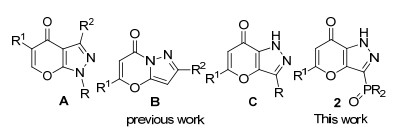
The pyrazole and γ-pyrone scaffolds are frequently-occurring motifs in many biologically active compounds.[1] In addition, their derivatives have found widespread applications in the fields of medicinal chemistry and synthetic chemistry.[2] According to the results disclosed in literature, [3] the incorporation of γ-pyrone ring motifs into the pyrazole skeleton can contribute to the biological activity of parent molcule. Pyrano[3, 2-c]pyrazol-7(1H)-one represents an unusual example of a γ-pyranone-fused pyrazole ring. However, the pyranopyrazole ring is rarely known, [4~6] and practical and effective synthetic protocols and guide-lines for their construction are extremely lack. The general method for preparing the known pyrano[3, 2-c]pyrazole skeleton (A) (Figure 1) relies on a two-step synthetic process, which Gelin et al.[5] have described. One-pot synthesis of 7H-pyrazolo[5, 1-b][1, 3]-oxazin-7-one (B) from pyrazolone and 2-propiolic acid has been disclosed.[4] Recently, we reported an elegant con-struct of pyrano[3, 2-c]pyrazol-7(1H)-one skeleton (C) (Figure 1).[7] The incorporation of a phosphonyl group on the pyrano[3, 2-c]pyrazol-7(1H)-one moiety at the position 3 of the core structure represents a novel substituted heterocyclic compound. Thus, the investigation on synthesizing them became our objective due to the wide application of phosphonate in pharmaceuticals[8] and inhibitors.[9]
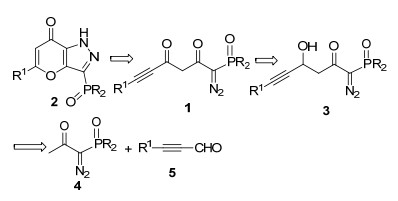
We proposed a three-step synthetic pathway, involving an aldol condensation-oxidation-cyclization sequence (Scheme 1). Synthesis of intermediates 3 and 1 has been outlined (see Supporting Information). In this protocol, the transformation of compound 1 to target molecular 2 is a key step. We conduct our investigation by optimizing the reaction conditions for this transformation.
First, dimethyl 1-diazo-2, 4-dioxo-6-phenylhex-5-ynyl phosphonate (1a) was treated in the presence of different bases in certain solvent at 25 ℃ (Table 1). To our delight, when employing LiOH as base in MeOH, the reaction proceeded smoothly to cleanly afford the expected product 2a in 70% yield (Table 1, Entry 1). This result encouraged us to further attempt the reaction optimization. For other strong bases such as NaOH, KOH, MeONa and t-BuOK, the product 2a was obtained in only 57%~78% yields (Table 1, Entries 2~5). After screening several weak bases such as K2CO3, pyridine, i-Pr2NEt, 1, 8-diazabicyclo-[5.4.0]undec-7-ene (DBU) and Et3N (TEA) (Table 1, Entries 6~10), we found that 3 equiv. of TEA afforded the best result (up to 99% yield) (Table 1, Entry 10). It was noteworthy that worse result was obtained when this reaction was carried out with a less loading of Et3N (1 or 2 equiv.) (Table 1, Entries 11~12), while increased loading of Et3N (up to 4 equiv.) did not perfect the process (Table 1, Entry 13).

 下载:
导出CSV
下载:
导出CSV
 |
||||
| Entry | Base (equiv.) | Reaction time/h | Solvent | Yieldb/% |
| 1 | LiOH (3) | 12 | MeOH | 70 |
| 2 | NaOH (3) | 12 | MeOH | 61 |
| 3 | KOH (3) | 10 | MeOH | 78 |
| 4 | MeONa (3) | 10 | MeOH | 70 |
| 5 | t-BuOK (3) | 10 | MeOH | 57 |
| 6 | K2CO3 (3) | 12 | MeOH | 67 |
| 7 | Pyridine (3) | 48 | MeOH | 54c, d |
| 8 | i-Pr2NEt (3) | 9 | MeOH | 78 |
| 9 | DBU (3) | 8 | MeOH | 93 |
| 10 | Et3N (3) | 8 | MeOH | 99 |
| 11 | Et3N (1) | 8 | MeOH | 81 |
| 12 | Et3N (2) | 8 | MeOH | 94 |
| 13 | Et3N (4) | 8 | MeOH | 99 |
| 14 | Et3N (3) | 9 | 1, 4-Dioxane | 93 |
| 15 | Et3N (3) | 10 | MeCN | 77 |
| 16 | Et3N (3) | 8 | DCM | 56c, d |
| 17 | Et3N (3) | 12 | DCE | 53c, d |
| 18 | Et3N (3) | 20 | DMF | 41c, d |
| 19 | Et3N (3) | 19 | DMSO | 50c, d |
| 20 | Et3N (3) | 23 | Toluene | 44c, d |
| 21 | Et3N (3) | 19 | THF | 47c, d |
| a Reaction conditions: 1-diazo-2, 4-dioxo-5-ynylphosphonate (1a) (0.2 mmol), solvent (3 mL), 25 ℃. b Isolated yield. c Unknown by-product was formed. d The starting material was recovered. | ||||
Next, the influence of solvent on the reaction was examined at 25 ℃ in the presence of TEA (3 equiv.). For 1, 4-dioxane and MeCN, clean reactions were carried out albeit with lower reactivity (Table 1, Entries 14 and 15). CH2Cl2 (DCM), C2H4Cl2 (DCE), N, N-dimethylformamide (DMF), dimethyl sulfoxide (DMSO), toluene and tetrahydrofuran (THF) gave the desired product 2a with lower reactivity and/or in low yields due to the formation of unknown by product and recovery of the raw material (Table 1, Entries 16~21). MeOH was found to be the best one among the tested solvents (Table 1, Entry 10). Therefore, the optimized reaction conditions are the following: Et3N (3 equiv.) in MeOH (Table 1, Entry 10).
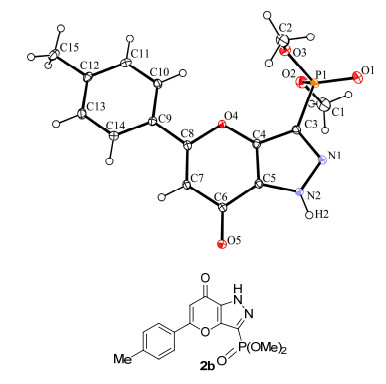
With the optimized conditions, we studied the scope of the new tandem reaction sequence (Table 2). In the case of R=OMe, the effect of the substituent R1 appended to the acetylenic moiety on the reaction was first exploited. For phenyl and alkylphenyl groups, the desired product was cleanly afforded in 95%~99% yields (Table 2, Entries 1~3). When R1 is a substituted aryl bearing a group, such as fluoro, chloro or methoxyl at the 4-position of benzene ring, the reaction was cleanly performed in a slightly higher reactivity (Table 2, Entries 4~6). For vinyl group, slightly lower yield was observed with the comparison of that being obtained in the case of R1=aryl group (Table 2, Entry 7). For an aromatic heterocyclic group, the desired product was also obtained not only in a relatively long time but also in very low yield (Table 2, Entry 8), and unreacted material can been recycled. For alkyl and cyclopropyl group, the reaction proceeded in excellent yield (up to 90%) (Table 2, Entries 10 and 11). Next, the effect of R1 on the reaction was investigated when R was changed from methoxyl group to phenyl group, and similar results were obtained (Table 2, Entries 12~19). However, the substituent Et3Si (R1) displayed a distinctly unfavorable effect on the reactivity (Table 2, Entries 9 and 19). Strangely, for substrate 1s, Et3Si group was present in product 2s, but the removal of Et3Si group occurred in the transformation of substrate 1i into product. The structure of product 2 was finally established by single-crystal X-ray diffraction analysis of products 2b (CCDC 1573359) (Figure 2).
下载:
导出CSV
 |
|||||
| Entry | R1/R (1) | Product 2 | t/h | Yieldb/% | |
| 1 | Ph/OMe (1a) | 2a | 8 | 99 | |
| 2 | p-MeC6H4/OMe (1b) | 2b | 15 | 95 | |
| 3 | p-PrnC6H4/OMe (1c) | 2c | 14 | 95 | |
| 4 | p-FC6H4/OMe (1d) | 2d | 12 | 93 | |
| 5 | p-ClC6H4/OMe (1e) | 2e | 11 | 91 | |
| 6 | p-MeOC6H4/OMe (1f) | 2f | 10 | 96 | |
| 7 | (E)-Cinnamenyl/OMe (1g) | 2g | 14 | 81 | |
| 8 | 3-Thienyl/OMe (1h) | 2h | 16 | 58 c | |
| 9 | Trietylsilyl/OMe (1i) | 2i (R 1=H) | 17 | 60 c | |
| 10 | n-Bu/OMe (1j) | 2j | 12 | 88 | |
| 11 | Cyclopropyl/OMe (1k) | 2k | 10 | 90 | |
| 12 | Ph/Ph (1l) | 2l | 12 | 85 | |
| 13 | p-MeC6H4/Ph (1m) | 2m | 10 | 86 | |
| 14 | p-PrnC6H4/Ph (1n) | 2n | 10 | 88 | |
| 15 | p-FC6H4/Ph (1o) | 2o | 11 | 82 | |
| 16 | p-ClC6H4/Ph (1p) | 2p | 11 | 84 | |
| 17 | n-Bu/Ph (1q) | 2q | 9 | 80 | |
| 18 | Cyclopropyl/Ph (1r) | 2r | 19 | 77 | |
| 19 | Et3Si/Ph (1s) | 2s | 17 | 48 c | |
| a Reaction conditions: substrate 1 (0.2 mmol), TEA (3.0 equiv.) in MeOH (3 mL) at 25 ℃. b Isolated yield by column chromatography. c The starting material was recovered. | |||||
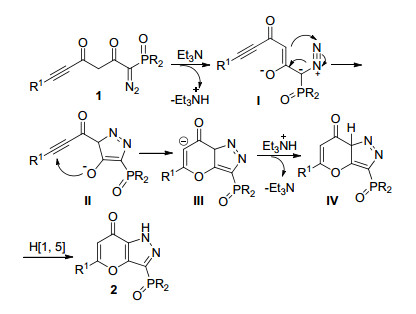
On the basis of these results, we conclude that the reaction might be conducted through a cascade 6-p electrocyclic ring closure-intramolecular Michael addition sequence (Scheme 2).[7] First, carbanion Ⅰ was generated by using TEA as base. The reaction might be initiated by 6-π electrocyclic ring closure[10] of the intermediate Ⅰ to give an enolate oxygen anion Ⅱ. Subsequent intramolecular Michael addition of the enolate oxygen anion Ⅱ to carbon-carbon triple bond resulted in the formation of carbanion Ⅲ. The protonation of Ⅲ provided the intermediate Ⅳ. Finally, [1, 5]-hydrogen migration of Ⅳ proceeded to afford product 2.
In summary, a concise construction of novel 3-phosphonyl pyrrolopyrazole skeleton has been presented for the first time. It has several advantages of mild reaction conditions, simple manipulation and 100% atom-economy from 1-diazo-2, 4-dioxo-5-ynylphosphonate 1.
All reagents were purchased from commercial suppliers (Energy Chemical and Tansoole) and they were used without further purification unless otherwise noted. Dry DCM and dry THF were obtained by treatment with CaH2 and sodium, respectively, and distilled prior to use. The compounds were analyzed by Thermo Science ISQGC-MS and isolated by column chromatography using a hexane-petroleum ether-ethyl acetate eluent. 1H NMR and 13C NMR spectra were recorded on a Bruker Avance-500 Spectrometer in CDCl3 or DMSO-d6 solution using tetramethylsilane as an internal standard. X-ray data were taken on a Rigaku Supernova diffractometer equipped with an EOS S2 CCD detector. HRMS were performed on a Thermo Scientific LTQ Qrbitrap XL mass spectrometer (ESI). Melting points were determined by using an Electrothermal Melting Point Apparatus YRT-3. For chromatographic purification, 200~300 mesh silica gel (Qingdao, China) was employed. For thin layer chromatography (TLC) analysis throughout this work, Merck 25 TLC aluminium sheets (silica gel 60 GF254, 0.25 mm) were used. Infrared spectra (IR) were recorded on a Bruker Vector 22 FT-IR spectrophotometer and are reported as wavelength numbers (cm-1).
General experimental information: A solution of compound 1a (0.2 mmol, 64 mg) in methanol (3 mL) was syringed into a stirring mixture of trimethylamine (TEA) (0.6 mmol, 61 mg) at 25 ℃. The reaction mixture was stirred for another 12 h and then quenched with saturated aqueous NH4Cl. The water layer was extracted with chloroform (30 mL×3). Collected organic layers were dried over Na2SO4, concentrated in vacuum and then purified by flash chromatography to afford product.
Dimethyl (7-oxo-5-phenyl-1, 7-dihydropyrano[3, 2-c]-pyrazol-3-yl)phosphonate (2a): Pale solid (60 mg, yield 94%). Rf=0.3 [V(CH2Cl2):V(EtOAc)=1:2]. m.p. 191~192 ℃; 1H NMR (500 MHz, DMSO-d6) δ: 15.11 (br, 1H), 8.02~8.00 (m, 2H), 7.60~7.59 (m, 3H), 7.08 (s, 1H), 3.84 (s, 3H), 3.81 (s, 3H); 13C NMR (125.8 MHz, DMSO-d6) δ: 169.44, 162.99, 148.52, 148.38, 132.11, 131.15, 129.58, 129.36, 126.68, 108.77, 53.84 (d, JC-P=5.4 Hz), 53.80 (d, JC-P=5.4 Hz); IR (KBr) ν: 3627, 3065, 2957, 1896, 1653, 1546, 1454, 1401, 1331, 1261, 1164, 1032, 908, 842, 767, 675, 628, 563 cm-1. HRMS (ESI) calcd for C14H14N2O5P (M+H)+ 321.0634, found 321.0634.
Dimethyl (7-oxo-5-(p-tolyl)-1, 7-dihydropyrano[3, 2-c]-pyrazol-3-yl)phosphonate (2b): Pale solid (63 mg, yield 95%). Rf=0.3 [V(CH2Cl2):V(EtOAc)=1:2]; m.p. 192~193 ℃; 1H NMR (500 MHz, DMSO-d6) δ: 15.19 (br, 1H), 7.82 (d, J=7.5 Hz, 2H), 7.32 (d, J=7.5 Hz, 2H), 6.92 (s, 1H), 3.82 (d, J=11.4 Hz, 6H), 2.33 (s, 3H); 13C NMR (125.8 MHz, DMSO-d6) δ: 169.87, 163.24, 148.42, 148.28, 142.49, 131.79, 130.20, 128.29, 126.61, 108.03, 53.85, 53.80, 21.38; IR (KBr) ν: 3420, 2957, 2923, 1652, 1557, 1537, 1459, 1264, 1027, 824, 760 cm-1. HRMS (ESI) calcd for C15H16N2O5P (M+H)+ 335.0791, found 335.0791.
Dimethyl(7-oxo-5-(4-propylphenyl)-1, 7-dihydropyrano-[3, 2-c]pyrazol-3-yl)phosphonate (2c): Pale solid (69 mg, yield 95%). Rf=0.3 [V(CH2Cl2):V(EtOAc)=1:2]. m.p. 186~187 ℃; 1H NMR (500 MHz, CDCl3) δ: 14.36 (br, 1H), 7.84 (d, J=8.0 Hz, 2H), 7.31 (d, J=8.0 Hz, 2H), 6.90 (s, 1H), 3.97 (s, 3H), 3.95 (s, 3H), 2.66 (t, J=7.5 Hz, 2H), 1.69~1.65 (m, 2H), 0.95 (t, J=7.5 Hz, 3H); 13C NMR (125.8 MHz, CDCl3) δ: 170.42, 164.87, 149.15, 149.01, 147.44, 129.33, 128.79, 128.25, 126.60, 107.78, 53.79 (d, JC-P=5.9 Hz), 53.74 (d, JC-P=5.9 Hz), 37.87, 24.17, 13.71. IR (KBr) ν: 3620, 3057, 2956, 1896, 1707, 1642, 1547, 1459, 1426, 1329, 1265, 1218, 1160, 1012, 911, 842, 805, 763, 675, 540 cm-1. HRMS (ESI) calcd for C17H20N2O5P (M+H)+ 363.1104, found 363.1104.
Dimthyl(5-(4-fluorophenyl)-7-oxo-1, 7-dihydropyrano[3, 2-c]pyrazol-3-yl)phosphonate (2d): Pale solid (62 mg, yield 91%). Rf=0.3 [V(CH2Cl2):V(EtOAc)=1:2]. m.p. 210~212 ℃; 1H NMR (500 MHz, DMSO-d6) δ: 15.04 (br, 1H), 8.01 (s, 2H), 7.36 (s, 2H), 7.00 (s, 1H), 3.84 (s, 3H), 3.82 (s, 3H); 13C NMR (125.8 MHz, DMSO-d6) δ: 169.75, 164.49 (d, JC-F=249.2 Hz), 161.98, 148.46, 148.32, 129.33, 129.26, 127.73, 116.70 (d, JC-F=21.9 Hz), 108.69, 53.81 (d, JC-P=5.2 Hz), 53.76 (d, JC-P=5.2 Hz); IR (KBr) ν: 3621, 2954, 1640, 1744, 1532, 1511, 1459, 1423, 1328, 1229, 1159, 999, 906, 838, 798, 752, 668, 570, 533 cm-1. HRMS (ESI) calcd for C14H13FN2O5P (M+H)+ 339.0540, found 339.0540.
Dimthyl(5-(4-chlorophenyl)-7-oxo-1, 7-dihydropyrano-[3, 2-c]pyrazol-3-yl)phosphonate (2e): Pale solid (66 mg, yield 93%). Rf=0.3 [V(CH2Cl2):V(EtOAc)=1:2]. m.p. 201~203 ℃; 1H NMR (500 MHz, DMSO-d6) δ: 15.11 (br, 1H), 8.02 (d, J=8.7 Hz, 2H), 7.66 (d, J=8.7 Hz, 2H), 7.12 (s, 1H), 3.82 (s, 3H), 3.79 (s, 3H); 13C NMR (125.8 MHz, DMSO-d6) δ: 169.31, 161.80, 148.50, 148.35, 137.04, 130.15, 129.79, 128.53, 126.98, 109.21, 53.84 (d, JC-P=5.6 Hz), 53.79 (d, JC-P=5.6 Hz); IR (KBr) ν: 3642, 3051, 2951, 2840, 1692, 1639, 1548, 1458, 1410, 1387, 1258, 1218, 1188, 1090, 1046, 1003, 907, 870, 830, 767, 677, 543 cm-1. HRMS (ESI) calcd for C14H13ClN2O5P (M+H)+ 355.0245, found 355.0245.
Dimethyl(5-(4-methoxyphenyl)-7-oxo-1, 7-dihydropy-rano[3, 2-c]pyrazol-3-yl)phosphonate (2f): Pale solid (67 mg, yield 96%). Rf=0.3 [V(CH2Cl2):V(EtOAc)=1:2]. m.p. 194~195 ℃; 1H NMR (500 MHz, DMSO-d6) δ: 15.05 (br, 1H), 7.96 (d, J=8.8 Hz, 2H), 7.12 (d, J=8.8 Hz, 2H), 6.96 (s, 1H), 3.85 (s, 3H), 3.83 (s, 3H), 3.81 (s, 3H); 13C NMR (125.8 MHz, DMSO-d6) δ: 163.14, 162.56, 148.38, 148.24, 128.59, 123.36, 115.17, 107.24, 55.98, 53.81 (d, JC-P=5.6 Hz), 53.76 (d, JC-P=5.6 Hz); IR (KBr) ν: 3621, 2957, 2846, 1896, 1741, 1633, 1600, 1545, 1506, 1460, 1431, 1298, 1255, 1219, 1175, 1072, 1012, 908, 833, 796, 667, 589, 531 cm-1. HRMS (ESI) calcd for C15H16N2O6P (M+H)+ 351.0740, found 351.0740.
(E)-Dimethyl (7-oxo-5-styryl-1, 7-dihydropyrano[3, 2-c]-pyrazol-3-yl)phosphonate (2g): Pale solid (56 mg, yield 81%). Rf=0.4 [V(EtOAc):V(MeOH)=10:1]. m.p. 239~240 ℃; 1H NMR (500 MHz, DMSO-d6) δ: 15.03 (br, 1H), 7.68 (d, J=7.2 Hz, 2H), 7.49~7.40 (m, 4H), 7.28 (d, J=16.2 Hz, 1H), 6.53 (s, 1H), 3.84 (d, J=11.5 Hz, 6H); 13C NMR (125.8 MHz, DMSO-d6) δ: 169.39, 162.12, 148.19, 148.05, 136.53, 135.17, 130.25, 129.97, 129.40, 128.19, 120.69, 111.91, 53.85, 53.80; IR (KBr) ν: 3506, 3447, 3383, 1633, 1559, 1384, 1216, 1189, 1133, 1049, 1015, 690, 565 cm-1. HRMS (ESI) calcd for C16H16N2O5P (M+H)+ 347.0791, found 347.0791.
Dimethyl (7-oxo-5-(thiophen-3-yl)-1, 7-dihydropyrano-[3, 2-c]pyrazol-3-yl)phosphonate (2h): Pale solid (38 mg, yield 58%). Rf=0.4 [V(EtOAc):V(MeOH)=10:1]. m.p. 185~186 ℃; 1H NMR (500 MHz, DMSO-d6) δ: 15.10 (br, 1H), 8.26 (s, 1H), 7.74~7.73 (m, 1H), 7.67 (d, J=5.0 Hz, 1H), 6.95 (s, 1H), 3.84 (d, J=11.4 Hz, 6H); 13C NMR (125.8 MHz, DMSO-d6) δ: 169.67, 159.59, 148.15, 148.01, 133.52, 129.02, 128.49, 128.39, 125.86, 108.31, 53.85, 53.81; IR (KBr) ν: 3673, 2956, 1651, 1598, 1555, 1457, 1419, 1317, 1253, 1034, 863, 843, 798, 570 cm-1. HRMS (ESI) calcd for C12H12N2O5PS (M+H)+ 327.0199, found 327.0198.
Dimethyl (7-oxo-1, 7-dihydropyrano[3, 2-c]pyrzol-3-yl)-phosphonate (2i): Pale solid (29 mg, yield 60%). Rf=0.4 [V(EtOAc):V(MeOH)=10:1]. m.p. 161~162 ℃; 1H NMR (500 MHz, DMSO-d6) δ: 15.02 (br, 1H), 8.27 (d, J=5.9 Hz, 1H), 6.38 (d, J=5.9 Hz, 1H), 3.78 (d, J=11.4 Hz, 6H); 13C NMR (125.8 MHz, DMSO-d6) δ: 169.16, 156.57, 148.59, 148.45, 130.49, 113.70, 53.72, 53.67; IR (KBr) ν: 3650, 2956, 1519, 1459, 1248, 1025, 832, 763, 652 cm-1. HRMS (ESI) calcd for C8H10N2O5P (M+H)+245.0321, found 245.0321.
Dimethyl (5-butyl-7-oxo-1, 7-dihydropyrano[3, 2-c]pyra-zol-3-yl)phosphonate (2j): Pale solid (53 mg, yield 88%). Rf=0.3 [V(CH2Cl2):V(EtOAc)=1:2]. m.p. 175~177 ℃; 1H NMR (500 MHz, DMSO-d6) δ: 14.99 (br, 1H), 6.26 (s, 1H), 3.78 (s, 6H), 2.69 (s, 2H), 1.64 (s, 2H), 1.35 (s, 2H), 0.90 (s, 3H); 13C NMR (125.8 MHz, DMSO-d6) δ: 170.07, 148.67, 148.53, 129.64, 126.63, 110.73, 53.72, 53.67, 32.97, 29.07, 21.84, 13.88; IR (KBr) ν: 3508, 3447, 3378, 1652, 1384, 1216, 1190, 1133, 1049, 689, 565, 524 cm-1. HRMS (ESI) calcd for C12H18N2O5P (M+H)+301.0947, found 301.0947.
Dimethyl (5-cyclopropyl-7-oxo-1, 7-dihydropyrano[3, 2-c]pyrazol-3-yl)phosphonate (2k): Pale solid (51 mg, yield 90%). Rf=0.3 [V(CH2Cl2):V(EtOAc)=1:2]. m.p. 172~173 ℃; 1H NMR (500 MHz, DMSO-d6) δ: 14.92 (br, 1H), 6.34 (s, 1H), 3.76 (d, J=11.4 Hz, 6H), 2.15~2.12 (m, 1H), 1.12~1.05 (m, 4H); 13C NMR (125.8 MHz, DMSO-d6) δ: 170.46, 168.83, 148.09, 147.95, 129.78, 108.63, 53.70, 53.66, 14.10, 9.23. IR (KBr) ν: 3432, 3000, 2915, 1651, 1599, 1558, 1533, 1437, 1407, 1333, 1252, 1029, 948, 840, 764, 667, 584 cm-1. HRMS (ESI) calcd for C11H14N2O5P (M+H)+ 285.0634, found 285.0634.
3-(Diphenylphosphoryl)-5-phenylpyrano[3, 2-c]pyrazol-7(1H)-one (2l): Yellow solid (70 mg, yield 85%). Rf=0.5 [V(EtOAc):V(MeOH)=10:1]. m.p. 219~220 ℃; 1H NMR (500 MHz, DMSO-d6) δ: 15.13 (br, 1H), 7.90~7.87 (m, 4H), 7.70~7.67 (m, 2H), 7.61~7.59 (m, 4H), 7.51~7.49 (m, 1H), 7.41~7.38 (m, 4H), 7.04 (s, 1H); 13C NMR (125.8 MHz, DMSO-d6) δ: 169.51, 162.62, 148.72 (d, JC-P=13.5 Hz), 132.83, 132.13, 131.94 (d, JC-P=10.0 Hz), 131.70, 131.33, 130.65 (d, JC-P=148.2 Hz), 130.84, 129.30 (d, JC-P=14.0 Hz), 126.52, 125.95, 108.55. IR (KBr): 3420, 2956, 2926, 2854, 1652, 1491, 1452, 1438, 1328, 1288, 1201, 1164, 1121, 1099, 1027, 997, 908, 757, 704, 661, 626, 551, 528 cm-1. HRMS (ESI) calcd for C24H18N2-O3P (M+H)+ 413.1049, found 413.1047.
3-(Diphenylphosphoryl)-5-(p-tolyl)pyrano[3, 2-c]pyra-zol-7(1H)-one (2m): Yellow solid (73 mg, yield 86%). Rf=0.5 [V(EtOAc):V(MeOH)=10:1]. m.p. 234~235 ℃; 1H NMR (500 MHz, DMSO-d6) δ: 15.05 (br, 1H), 7.89~7.83 (m, 3H), 7.79~7.75 (m, 1H), 7.71~7.68 (m, 2H), 7.62~7.55 (m, 4H), 7.32~7.22 (m, 4H), 6.99 (s, 1H), 2.35 (s, 3H); 13C NMR (125.8 MHz, DMSO-d6) δ: 162.85, 142.44, 132.26 (d, JC-P=121.7 Hz), 132.75, 131.92 (d, JC-P=10.0 Hz), 131.70, 131.28 (d, JC-P=10.0 Hz), 130.16, 129.97, 129.42, 129.28 (d, JC-P=12.0 Hz), 128.06, 126.47, 107.85, 21.41; IR (KBr) ν: 3650, 2956, 2925, 2853, 1651, 1540, 1508, 1458, 1397, 1285, 1165, 1121, 1027, 1002, 827, 762, 634, 548 cm-1. HRMS (ESI) calcd for C25H20N2O3P (M+H)+ 427.1206, found 427.1205.
3-(Diphenylphosphoryl)-5-(4-propylphenyl)pyrano[3, 2-c]pyrazol-7(1H)-one (2n): Yellow solid (80 mg, yield 88%). Rf=0.5 (EtOAc). m.p. 236~238 ℃; 1H NMR (500 MHz, DMSO-d6) δ: 15.13 (br, 1H), 7.89~7.85 (m, 4H), 7.70~7.60 (m, 6H), 7.32 (d, J=7.8 Hz, 2H), 7.21 (d, J=7.8 Hz, 2H), 6.96 (s, 1H), 2.57 (t, J=7.2 Hz, 2H), 1.59~1.55 (m, 2H), 0.87 (t, J=7.2 Hz, 3H); 13C NMR (125.8 MHz, DMSO-d6) δ: 169.46, 162.94, 148.77 (d, JC-P=13.7 Hz), 146.76, 133.57, 132.78, 131.93 (d, JC-P=10.0 Hz), 131.32, 131.24 (d, JC-P=139.6 Hz), 130.12, 129.22 (d, JC-P=12.9 Hz), 128.25, 126.46, 107.89, 37.38, 24.05, 13.93; IR (KBr) ν: 3510, 3054, 2957, 2928, 2868, 1652, 1555, 1528, 1438, 1292, 1121, 1024, 999, 909, 727, 703, 550, 529 cm-1. HRMS (ESI) calcd for C27H24N2O3P (M+H)+ 455.1519, found 455.1518.
3-(Diphenylphosphoryl)-5-(4-fluorophenyl)pyrano[3, 2-c]pyrazol-7(1H)-one (2o): Yellow solid (71 mg, yield 82%). Rf=0.5 [V(EtOAc):V(MeOH)=8:1]. m.p. 248~250 ℃; 1H NMR (500 MHz, DMSO-d6) δ: 15.11 (br, 1H), 7.89~7.85 (m, 4H), 7.71~7.68 (m, 2H), 7.62~7.59 (m, 4H), 7.47~7.46 (m, 2H), 7.27 (t, J=8.8 Hz, 2H), 7.03 (s, 1H); 13C NMR (125.8 MHz, DMSO-d6) δ: 169.42, 164.48 (d, JC-F=249.3 Hz), 161.66, 148.68 (d, JC-F=14.6 Hz), 133.69, 132.85, 131.94 (d, JC-F=10.0 Hz), 129.96, 129.29 (d, JC-P=12.2 Hz), 129.15 (d, JC-P=9.0 Hz), 127.43, 116.47 (d, JC-F=21.9 Hz), 108.49; IR (KBr) ν: 3650, 2959, 1640, 1594, 1546, 1524, 1485, 1452, 1412, 1282, 1259, 1188, 1120, 1094, 1038, 1013, 909, 860, 835, 728, 703, 691, 670 cm-1. HRMS (ESI) calcd for C24H17FN2O3P (M+H)+ 431.0955, found 431.0955.
5-(4-Chlorophenyl)-3-(diphenylphosphoryl)pyrano[3, 2-c]pyrazol-7(1H)-one (2p): Pale solid (75 mg, yield 84%). Rf=0.4 [V(EtOAc):V(MeOH)=10:1]. m.p. 240~242 ℃; 1H NMR (500 MHz, DMSO-d6) δ: 15.11 (br, 1H), 7.89~7.85 (m, 4H), 7.71~7.69 (m, 2H), 7.62~7.61 (m, 4H), 7.50~7.48 (m, 2H), 7.42~7.40 (m, 2H), 7.06 (s, 1H); 13C NMR (125.8 MHz, DMSO-d6) δ: 169.37, 161.42, 148.68 (d, JC-P=12.5 Hz), 137.02, 133.77, 132.84, 132.54 (d, JC-P=109.0 Hz), 131.94 (d, JC-P=10.2 Hz), 129.96, 129.81, 129.48, 129.28 (d, JC-P=12.2 Hz), 128.30, 108.97; IR (KBr) ν: 3649, 2957, 1632, 1594, 1546, 1529, 1487, 1452, 1415, 1282, 1259, 1188, 1120, 1094, 1038, 1013, 909, 870, 835, 729, 703, 691, 670 cm-1. HRMS (ESI) calcd for C24H17ClN2O3P (M+H)+ 447.0659, found 447.0659.
5-Butyl-3-(diphenylphosphoryl)pyrano[3, 2-c]pyrazol-7(1H)-one (2q): Yellow solid (63 mg, yield 80%). Rf=0.5 [V(EtOAc):V(MeOH)=10:1]. m.p. 173~175 ℃; 1H NMR (500 MHz, DMSO-d6) δ: 15.02 (br, 1H), 7.81~7.77 (m, 4H), 7.64~7.54 (m, 6H), 6.21 (s, 1H), 2.42 (t, J=7.5 Hz, 2H), 1.27~1.19 (m, 2H), 1.16~1.09 (m, 2H), 0.76 (t, J=7.5 Hz, 3H); 13C NMR (125.8 MHz, DMSO-d6) δ: 169.62, 149.02 (d, JC-P=14.0 Hz), 132.40 (d, JC-P=109.0 Hz), 132.73, 132.71, 131.81 (d, JC-P=10.0 Hz), 129.33, 129.11 (d, JC-P=12.2 Hz), 128.81, 110.80, 32.91, 28.76, 21.76, 13.90; IR (KBr) ν: 3055, 2958, 2928, 2869, 1656, 1558, 1526, 1438, 1399, 1330, 1260, 1199, 1169, 1121, 1100, 1025, 941, 756, 727, 704, 562, 527 cm-1. HRMS (ESI) calcd for C22H22N2O3P (M+H)+ 393.1362, found 393.1362.
5-Cyclopropyl-3-(diphenylphosphoryl)pyrano[3, 2-c]pyr-azol-7(1H)-one (2r): Yellow solid (58 mg, yield 77%). Rf=0.6 [V(EtOAc):V(MeOH)=10:1]. m.p. 200~201 ℃; 1H NMR (500 MHz, DMSO-d6) δ: 14.94 (br, 1H), 7.80~7.77 (m, 4H), 7.65~7.58 (m, 6H), 6.32 (s, 1H), 1.93 (s, 1H), 0.85 (s, 7.65~7.63 (m, 2H), 7.57~7.54 (m, 4H), 6.44 (s, 1H), 0.79 (t, J=8.0 Hz, 9H), 0.56 (q, J=8.0 Hz, 16.0 Hz, 6H); 13C NMR (125.8 MHz, DMSO-d6) δ: 174.83, 167.78, 132.64, 132.47 (d, JC-P=109.0 Hz), 131.72 (d, JC-P=10.0 Hz), 131.28 (d, JC-P=12.0 Hz), 130.27, 129.35 (d, JC-P=12.0 Hz), 129.11 (d, JC-P=12.2 Hz), 121.77, 7.24, 1.94; IR (KBr) ν: 3418, 2956, 2875, 1655, 1518, 1438, 1271, 1200, 1120, 1052, 1026, 1006, 825, 749, 727, 702, 653, 552, 527 cm-1. HRMS (ESI) calcd for C24H28N2O3PSi (M+H)+ 451.1601, found 451.1601.
Supporting Information NMR spectra of all compounds and HRMS spectra of compounds 2. The Supporting Information is available free of charge via the Internet at http://sioc-journal.cn.
For pyrazole see: (a) Harit, T. ; Bellaouchi, R. ; Mokhtari, C. ; Bali, B. E. ; Asehraou, A. ; Malek, F. Tetrahedron 2017, 73, 5138.
(b) Linda, G. E. ; Moub, T. -C. ; Tamborinid, L. ; Pompere, M. G. ; Michelid, C. D. ; Contid, P. ; Pintof, A. ; Hansena, K. B. Proc. Natl. Acad. Sci. U. S. A. 2017, 114, E6942.
(c) Zhang, X. -X. ; Jin, H. ; Deng, Y. -J. ; Gao, X. -H. ; Li, Y. ; Zhao, Y. -T. ; Tao, K. ; Hou, T. -P. Chin. Chem. Lett. 2017, 28, 1731. For pyrone see:
(d) Koyama, T. ; Kawazoe, Y. ; Iwasaki, A. ; Ohno, O. ; Suenaga, K. ; Uemura, D. J. Antibiot. 2016, 69, SI: 348.
(e) Bertin, M. J. ; Demirkiran, O. ; Navarro, G. ; Moss, N. A. ; Lee, J. ; Goldgof, G. ; Vigil, M. E. ; Winzeler, E. A. ; Valeriote, F. A. ; Gerwick, W. H. Phytochemistry 2016, 122, 113.
For pyrazole see: (a) Park, B. -J. ; El-Gamal, M. I. ; Lee, W. -S. ; Shin, J. -S. ; Yoo, K. H. ; Lee, K. -T. ; Oh, C. -H. Med. Chem. Res. 2017, 26, 2161. For γ-pyrone see:
(b) Obydennov, D. L. ; Khammatova, L. R. ; Sosnovskikh, V. Y. Mendeleev Commun. 2017, 27, 172.
(c) Ghasemi, Z. ; Mejarshin, F. P. ; Fathi, Z. ; Shahrisa, A. Monatsh. Chem. 2016, 147, 1107.
(a) Puerta, D. T. ; Mongan, J. ; Tran, B. L. ; McCammon, J. A. ; Cohen, S. M. J. Am. Chem. Soc. 2005, 127, 14148.
(b) Pinto, M. M. M. ; Sousa, M. E. ; Nascimento, M. S. J. Curr. Med. Chem. 2005, 12, 2517.
(c) Morisaki, K. ; Ozaki, S. Chem. Pharm. Bull. 1996, 44, 1647.
(d) Garey, D. M. ; Ramirez, L. ; Gonzales, S. ; Wertsching, A. ; Tith, S. ; Keefe, K. ; Pena, M. R. J. Org. Chem. 1996, 61, 4853.
(e) Pantsar, T. ; Singha, P. ; Nevalainen, T. J. ; Koshevoy, I. ; Leppä nen, J. ; Poso, A. ; Niskanen, J. M. A. ; Pasonen-Seppä nen, S. ; Savinainen, J. R. ; Laitinen, T. ; Laitinen, J. T. Eur. J. Pharm. Sci. 2017, 107, 97.
Üçüncü, M.; Cantürk, C.; Karakuş, E.; Zeybek, H.; Bozkay, U.; Soydaş, E.; Şahin, E.; Emrullahoğlu, M. Org. Biomol. Chem. 2016, 14, 7490. doi: 10.1039/C6OB01099G
Gelin, S.; Changtegrel, B.; Nadi, A. I. J. Org. Chem. 1983, 48, 4078. doi: 10.1021/jo00170a041
(a) Venkatesham, A. ; Rao, R. S. ; Nagaiah, K. ; Yadav, J. S. ; RoopaJones, G. ; Basha, S. J. ; Sridhard, B. ; Addlagatta, A. Med. Chem. Commun. 2012, 3, 652.
(b) Gorja, D. R. ; Batchu, V. R. ; Ettam, A. ; Pal, B. M. J. Org. Chem. 2009, 5, 64.
(c) Kaur, R. ; Taheam, N. ; Sharma, A. K. ; Kharb, R. Res. J. Pharm., Biol. Chem. Sci. 2013, 4, 79.
(d) Lu, S. ; Tian, J. ; Sun, W. ; Meng, J. ; Wang, X. ; Fu, X. ; Wang, A. ; Lai, D. ; Liu, Y. ; Zhou, L. Molecules 2014, 19, 7169.
Deng, G.; Wang, F.; Lu, S.; Cheng, B. Org. Lett. 2015, 17, 4651. doi: 10.1021/acs.orglett.5b02369
(a) Lange, R. ; Heine, R. ; Knapp, R. ; de Klerk, J. M. H. ; Bloemendal, H. J. ; Hendrikse, N. H. Bone 2016, 91, 159.
(b) Zhao, D. ; Wang, R. Chem. Soc. Rev. 2012, 41, 2095.
(c) Pradere, U. ; Garnier-Amblard, E. C. ; Coats, S. J. ; Amblard, F. ; R. Schinazi, F. Chem. Rev. 2014, 114, 9154.
(d) Lange, R. ; ter Heine, R. ; Knapp, R. ; de Klerk, J. M. H. ; Bloemendal, H. J. ; Hendrikse, H. N. Bone 2017, 105, 315.
(a) Spacek, P. ; Keough, D. T. ; Chavchich, M. ; Dracinsky, M. ; Janeba, Z. ; Naesens, L. ; Edstein, M. D. ; Guddat, L. W. ; Hockova, D. Bioorg. Med. Chem. 2017, 25, 4008.
(b) Lan, X. ; Xie, D. ; Yin, L. ; Wang, Z. ; Chen, J. ; Zhang, A. ; Song, B. ; Hu, D. Bioorg. Med. Chem. Lett. 2017, 27, 4270.
(c) Skorenski, M. ; Pachota, M. ; Pyrc, K. ; Sienczyk, M. ; Oleksyszyn, J. Antivir. Res. 2017, 144, 286.
(d) Veleti, K. ; Petit, C. ; Ronning, D. R. ; Sucheck, S. J. Org. Biomol. Chem. 2017, 15, 3884.
Babinski, D. J.; Aguilar, H. R.; Still, R.; Frantz, D. E. J. Org. Chem. 2011, 76, 5915. doi: 10.1021/jo201042c

Scheme 1 Retrosynthetic approach for the preparation of 3-phosphonyl pyrano[3, 2-c]pyrazol-7(1H)-one (2)
Table 1. Base and solvent screening for dimethyl 7-oxo-5-phenyl-1, 7-dihydropyrano[3, 2-c]pyrazol-3-ylphosphonate (2a) from dimethyl 1-diazo-2, 4-dioxo-6-phenylhex-5-ynylphosphon-ate (1a) a
| |
||||
| Entry | Base (equiv.) | Reaction time/h | Solvent | Yieldb/% |
| 1 | LiOH (3) | 12 | MeOH | 70 |
| 2 | NaOH (3) | 12 | MeOH | 61 |
| 3 | KOH (3) | 10 | MeOH | 78 |
| 4 | MeONa (3) | 10 | MeOH | 70 |
| 5 | t-BuOK (3) | 10 | MeOH | 57 |
| 6 | K2CO3 (3) | 12 | MeOH | 67 |
| 7 | Pyridine (3) | 48 | MeOH | 54c, d |
| 8 | i-Pr2NEt (3) | 9 | MeOH | 78 |
| 9 | DBU (3) | 8 | MeOH | 93 |
| 10 | Et3N (3) | 8 | MeOH | 99 |
| 11 | Et3N (1) | 8 | MeOH | 81 |
| 12 | Et3N (2) | 8 | MeOH | 94 |
| 13 | Et3N (4) | 8 | MeOH | 99 |
| 14 | Et3N (3) | 9 | 1, 4-Dioxane | 93 |
| 15 | Et3N (3) | 10 | MeCN | 77 |
| 16 | Et3N (3) | 8 | DCM | 56c, d |
| 17 | Et3N (3) | 12 | DCE | 53c, d |
| 18 | Et3N (3) | 20 | DMF | 41c, d |
| 19 | Et3N (3) | 19 | DMSO | 50c, d |
| 20 | Et3N (3) | 23 | Toluene | 44c, d |
| 21 | Et3N (3) | 19 | THF | 47c, d |
| a Reaction conditions: 1-diazo-2, 4-dioxo-5-ynylphosphonate (1a) (0.2 mmol), solvent (3 mL), 25 ℃. b Isolated yield. c Unknown by-product was formed. d The starting material was recovered. | ||||
 下载: 导出CSV
Table 2. Scope of the cascade reaction of substrate 1a
| |
|||||
| Entry | R1/R (1) | Product 2 | t/h | Yieldb/% | |
| 1 | Ph/OMe (1a) | 2a | 8 | 99 | |
| 2 | p-MeC6H4/OMe (1b) | 2b | 15 | 95 | |
| 3 | p-PrnC6H4/OMe (1c) | 2c | 14 | 95 | |
| 4 | p-FC6H4/OMe (1d) | 2d | 12 | 93 | |
| 5 | p-ClC6H4/OMe (1e) | 2e | 11 | 91 | |
| 6 | p-MeOC6H4/OMe (1f) | 2f | 10 | 96 | |
| 7 | (E)-Cinnamenyl/OMe (1g) | 2g | 14 | 81 | |
| 8 | 3-Thienyl/OMe (1h) | 2h | 16 | 58 c | |
| 9 | Trietylsilyl/OMe (1i) | 2i (R 1=H) | 17 | 60 c | |
| 10 | n-Bu/OMe (1j) | 2j | 12 | 88 | |
| 11 | Cyclopropyl/OMe (1k) | 2k | 10 | 90 | |
| 12 | Ph/Ph (1l) | 2l | 12 | 85 | |
| 13 | p-MeC6H4/Ph (1m) | 2m | 10 | 86 | |
| 14 | p-PrnC6H4/Ph (1n) | 2n | 10 | 88 | |
| 15 | p-FC6H4/Ph (1o) | 2o | 11 | 82 | |
| 16 | p-ClC6H4/Ph (1p) | 2p | 11 | 84 | |
| 17 | n-Bu/Ph (1q) | 2q | 9 | 80 | |
| 18 | Cyclopropyl/Ph (1r) | 2r | 19 | 77 | |
| 19 | Et3Si/Ph (1s) | 2s | 17 | 48 c | |
| a Reaction conditions: substrate 1 (0.2 mmol), TEA (3.0 equiv.) in MeOH (3 mL) at 25 ℃. b Isolated yield by column chromatography. c The starting material was recovered. | |||||
下载: 导出CSV

 扫一扫看文章


扫一扫关注我们