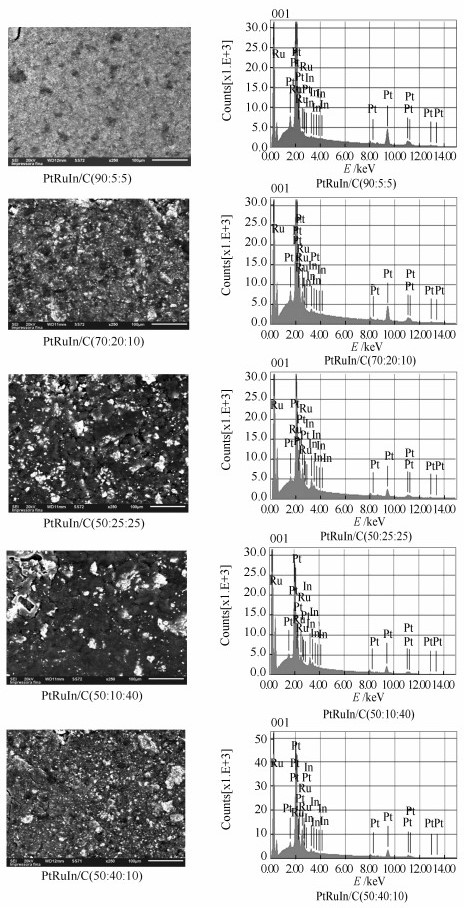
Figure 1.
Typical SEM images of the PtRuIn/C electrocatalysts prepared by borohydride reduction process and their typical EDX spectra

Methanol oxidation in acidic and alkaline electrolytes using PtRuIn/C electrocatalysts prepared by borohydride reduction process
M. C. L. Santos , J. Nandenha , J. M. S. Ayoub , M. H. M. T. Assumpção , A. O. Neto


The increase in energy demand and environmental problems regarding fossil fuels have mobilized the humanity in searching for cleaning and renewable energy sources, and fuel cells have been considered as one of the most promising sources for application in portable, vehicles and stationary devices[1-4]. In the development of low temperature fuel cells, it has been proposed the use of organic molecules such as methanol, ethanol and formic acid. However the use of methanol has been considered a promising system for energy conversion due to its high energy density (702.32 kJ/mol), abundance combustible and low cost of production[5-7]. Platinum (Pt) is often used as an electrocatalyst for methanol oxidation. However Pt electrocatalysts can be contaminated by CO species that are originated from the dissociation of methanol. These species are strongly adsorbed on Pt active sites causing the deactivation of Pt electrocatalysts. Then, it is necessary to modify the vicinity of Pt atoms by adding other elements[8-10].
PtIn/C electrocatalysts prepared by Veizaga et al[5]favored an easier CO oxidation to CO2 (CO stripping measurements) and a higher electrocatalytic activity determined in direct methanol fuel cell (DMFC) in comparison with pure Pt. The high catalytic activity of PtIn electrocatalysts was due to the presence of small particle sizes with a narrow distribution and to geometric effects related to a probable decoration of In around the small Pt particles. Pt electrocatalysts with some metals, such as Ru, Sn, Pd, Au have been extensively investigated to improve CO tolerance and catalytic activity toward methanol oxidation[11-14]. However, PtRu bimetallic nanomaterials are recognized as the best-performing CO-poisoning-tolerant electrocatalysts to date and this behavior can be explained by the bifunctional mechanism[15].
Recently, Dermeci[16]suggested by theoretical studies considering methanol oxidation reaction (MOR), that the incorporation of a third metal to PtRu could be the best way to improve activity in comparison to PtRu/C electrocatalysts. Zhu et al[17]showed that PtSnIn ternary electrocatalysts had an enhanced activity for ethanol oxidation when compared to PtSn or PtIn binary electrocatalysts. The enhanced in the ethanol oxidation activity for ternary electrocatalysts was attributed to the electronic effect.
Usually, the methanol oxidation is studied in acidic electrolyte, however, with the development of membranes and alkaline ionomers, new studies have been proposed on alkaline electrolytes. Santasalo-aarnio et al[18] prepared PtRu electrocatalysts for studies in acidic and alkaline electrolytes. The authors showed that PtRu electrocatalyst exhibited an increase in current and power densities toward methanol oxidation in alkaline electrolyte due to the enhanced kinetics reaction.
In this context, the aim of this work was to prepare PtRuIn/C electrocatalysts by sodium borohydride reduction process, in different Pt:Ru:In atomic ratios, toward methanol oxidation in acidic and alkaline electrolytes. This work includes not only electrochemical experiments but also single-cell experiments as already proposed by Hou et al[19].
Pt/C, PtRu/C (50:50), PtIn/C (50:50) and PtRuIn/C with different atomic ratios (90:5:5, 70:20:10, 50:40:10, 50:25:25 and 50:10:40) electrocatalysts were prepared by borohydride reduction process with 20% of metal loading, as already reported before[4, 10]. In the borohydride method, the support was firstly dispersed in an isopropyl alcohol/water solution (50/50, v/v) under stirring, and the metal sources were added and placed in an ultrasonic bath for 5 min. Then, a solution of sodium borohydride was added into 0.1 mol/L KOH in one portion under stirring, and the resulting solution maintained for more 15 min. After that, the resultant mixture was filtered, the solids washed and then dried at 70 ℃ for 2 h.
All PtRuIn/C electrocatalysts were prepared using H2PtCl6·6H2O (chloroplatinic acid, Aldrich), RuCl3·xH2O (ruthenium chloride hydrate-Aldrich) and InCl3·xH2O (indium chloride hydrate-Aldrich) as metal sources, sodium borohydride (Aldrich) as reducing agent and Carbon Vulcan XC72 as support.
The prepared electrocatalysts were characterized by X-ray diffraction using a Rigaku diffractometer, model Miniflex Ⅱ, with Cu Kα radiation source(λ=0.15406 nm) and the diffractograms recorded in the range of 2θ = 20° to 90°, with a step size of 0.05° and a scan time of 2 s per step. The atomic ratios were obtained by energy-dispersive X-ray analysis using a scanning electron microscope Phillips XL30, working at 20 kV and equipped with EDAX DX4 microanalyzer. The electrocatalysts prepared were also characterized by transmission electron microscopy using a JEOL JEM-2100 electron microscope, operated at 200 kV, where the distribution and the size of the nanoparticles in the support were determined by measuring 120 particles from 10 micrographs.
The electrocatalytic activity toward methanol oxidation were performed by cyclic voltammetry and chronoamperometry experiments in an Autolab 302N potentiostat, at 25 ℃ in a 0.5 mol/L H2SO4 solution for acidic electrolyte, while alkaline experiments were performed in 1.0 mol/L KOH solution. The work electrode was prepared in the form of thin porous coating technique[20]. The chronoamperometry (amperometric curves) was recorded in KOH electrolyte containing methanol, at -0.35 V, for 1800 s (alkaline media), while for acidic media the experiment was conducted at 0.5 V, for 1800 s. The cyclic voltammetry experiments were done at a scan rate of 10 mV/s in 1.0 mol/L KOH solution or 0.5 mol/L H2SO4 with the presence or absence of 1.0 mol/L of methanol saturated with N2. For acidic medium, it was utilized a hydrogen reference electrode, graphite as work electrode and a counter electrode of Pt wire, while in alkaline experiments it was used KOH solution, Ag/AgCl (3.0 mol/L KCl) as reference electrode, a counter electrode of Pt and a work electrode. In all experiments, the current values for cyclic voltammetry and chronoamperometry studies were normalized per gram of platinum, considering that methanol adsorption and dehydrogenation occur only on platinum sites at room temperature[4].
Direct alkaline or acidic methanol fuel cells experiments were performed in a single cell with 5 cm2 of area, using Pt/C, PtRu/C (50:50), PtIn/C (50:50) and PtRuIn/C electrocatalysts with different atomic ratios, as anodes. The anodes electrodes were prepared with 1 mg of Pt loading by cm2, while cathode electrode was prepared with Pt/C BASF (1 mg of Pt loading by cm2).
The MEAS were prepared with hot pressure on both sides of a Nafion® 117 membrane or Nafion® 117 membrane doped with KOH, at 125 ℃ for 2 min, under a pressure of 225 kgf/cm2.
The polarization curves in acidic electrolyte were obtained using a potentiostat/galvanostat, where methanol 2.0 mol/L was delivered at 1.0 mL/min, the oxygen flow was regulated at 150 mL/min, the temperature was set to 80 ℃ for the fuel cell and 85 ℃ for the oxygen humidifier[4, 10]. The polarization curves in alkaline electrolyte were obtained using 1.0 mol/L KOH + 1.0 mol/L methanol as fuel delivered at 1.0 mL/min, where the temperature was set to 80 ℃ for the fuel cell[10].
SEM, EDX and TEM characterizations were used in order to investigate the morphology of the Pt/C, PtRu/C and PtRuIn/C electrocatalysts prepared with different atomic ratios. However a direct evaluation of the nanoparticle size is not possible for these prepared electrocatalysts, because the nanoparticles appear to be agglomerated for the SEM images[21]. Figure 1 shows a typical SEM image of the PtRuIn/C electrocatalysts prepared with different atomic ratios and a typical EDX spectrum of supported. EDX data show that some Pt:Ru:In atomic ratios of the obtained electrocatalysts are not close to the nominal atomic ratios used during the synthesis (Table 1). These discrepancies could be associated with a limitation of the EDS technique.

 下载:
导出CSV
下载:
导出CSV
| Eletrocatalyst | EDX results (molar ratio) |
| Pt/C | |
| PtRu/C (50:50) | 62:38 |
| PtIn/C (50:50) | 58:42 |
| PtRuIn/C (50:40:10) | 63:31:06 |
| PtRuIn/C (50:10:40) | 71:13:16 |
| PtRuIn/C (50:25:25) | 61:23:16 |
| PtRuIn/C (70:20:10) | 80:16:04 |
| PtRuIn/C (90:5:5) | 93:5:2 |
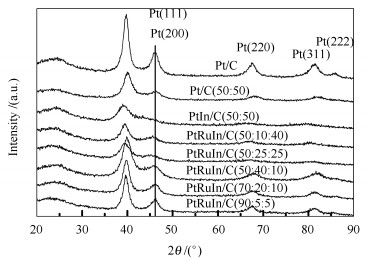
XRD patterns of Pt/C, PtRu/C and PtRuIn/C electrocatalysts prepared with different atomic ratios are shown in Figure 2. For all prepared electrocatalysts, it is observed peaks at approximately 2θ ≈ 40°, 47°, 68°, 82° and 87°, which are associated with (111), (200), (220), and (311) planes of the Pt face-centered cubic (fcc) structure and a broad peak at about 25° associated with the Carbon Vulcan XC72 support. In PtRu/C and PtRuIn/C electrocatalysts, there are also observed shifts in 2θ values in comparison to Pt/C electrocatalysts, which are associated with the formation of Pt alloys. The formations of PtRu/C and PtRuIn/C alloys are also confirmed by crystal lattice parameter values obtained by XRD. Lattice parameter values of PtRu/C and PtRuIn/C are between 0.388-0.393 nm (Table 2), and Pt/C is 0.392 nm[10]. The presences of ruthenium or indium hydroxides are not observed in the diffractograms, which indicate that they could have an amorphous structure. Furthermore, the mean crystallite sizes determined using Scherrer equations[10] are in the range of 2-6 nm (Table 2).
 下载:
导出CSV
下载:
导出CSV
| Material | Average crystallite size d/nm | Lattice parameter values /nm |
| Pt/C | 5 | 0.392 |
| PtRu/C (50:50) | 6 | 0.388 |
| PtIn/C (50:50) | 3 | 0.398 |
| PtRuIn/C (50:10:40) | 3 | 0.396 |
| PtRuIn/C (50:25:25) | 2 | 0.397 |
| PtRuIn/C (50:40:10) | 3 | 0.390 |
| PtRuIn/C (70:20:10) | 4 | 0.392 |
| PtRuIn/C (90:5:5) | 5 | 0.393 |
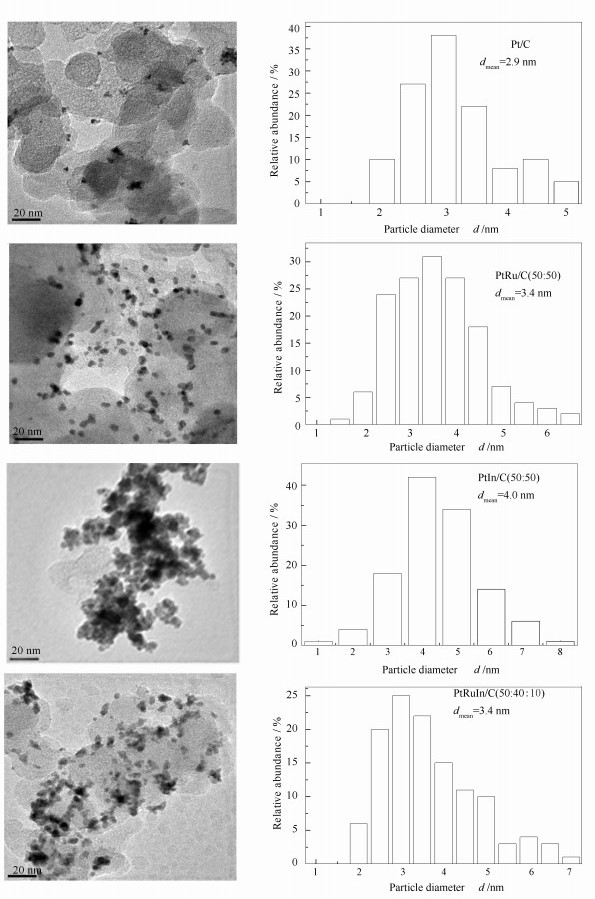
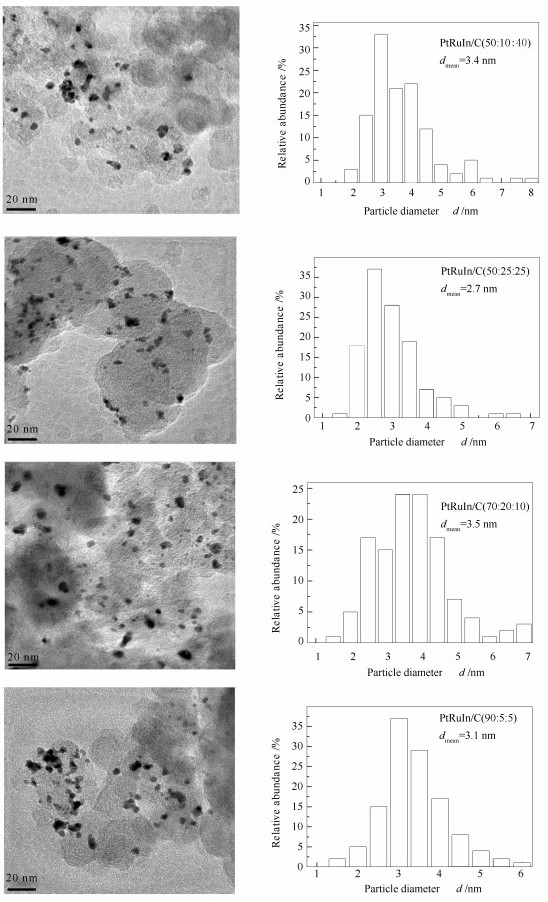
The micrographs and histograms of the nanoparticle size distribution obtained by TEM for Pt/C, PtIn/C (50:50), PtRu/C (50:50) and PtRuIn/C with different atomic ratios electrocatalysts are illustrated in Figures 3 and 4. The mean diameters of the nanoparticles for PtRuIn/C electrocatalysts are in the range of 2.7-3.5 nm, while for Pt/C, PtIn/C (50:50) and PtRu/C (50:50) are 2.9, 3.4 and 4.0 nm, respectively. All prepared electrocatalysts show a good distribution of the nanoparticles on the carbon support. The Pt/C nanoparticles are smaller than the obtained for PtIn/C (50:50), PtRu/C (50:50) and PtRuIn/C with different atomic ratios. However, the morphologies are not significantly changed. TEM results for Pt/C, PtIn/C (50:50) and PtRu/C (50:50) electrocatalysts are in accordance with Santos et al[4, 5, 10].
Cyclic voltammograms in absence of methanol for Pt/C, PtRu/C (50:50), PtIn/C (50:50) and PtRuIn/C with different ratios electrocatalysts in acidic and alkaline electrolytes are shown in Figure 5. PtRuIn/C with different atomic ratios electrocatalysts show that the hydrogen adsorption region is reduced by the presence of Ru and In when compared to Pt/C (Figure 5(a)). PtRu/C (50:50) and all PtRuIn/C electrocatalysts show an increase in the current values in potential region (0.4-0.8 V) in relation to Pt/C (50:50). This effect has been attributed to the formation of ruthenium or indium oxide species. It is important to point out that the presences of these species are of extreme importance for methanol oxidation[22]. PtRu/C and all PtRuIn/C with different atomic ratios do not show a well-defined hydrogen oxidation region (-0.85 to-0.60 V versus Ag/AgCl 3.0 mol/L KCl) in comparison to pure platinum (Figure 5(b)). The current densities in the double layer region of PtRu/C and PtRuIn/C electrocatalysts are larger than that of Pt/C. This result is similar to the observed in acidic electrolyte. The formation of ruthenium and indium oxides species is favored in alkaline electrolyte in comparison with acidic electrolyte studies. The presence of large amounts of oxides species is observed for all PtRuIn/C in potential of -0.3 V in anodic scan, except for PtRuIn/C (70:20:10). However, a reduction of these oxides is observed in cathodic scan.
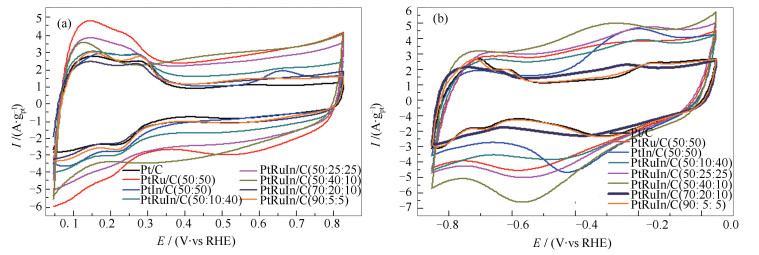
Figure 6(a) shows the CV of Pt/C, PtRu/C, PtIn/C and PtRuIn/C with different atomic ratios in the presence of 0.5 mol/L H2SO4 + 1.0 mol/L methanol, while alkaline studies are accomplished in the presence of 1.0 mol/L methanol+1.0 mol/L KOH solutions (Figure 6(b)).
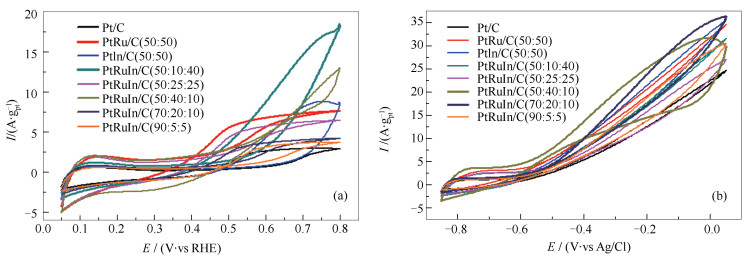
PtRu/C (50:50) electrocatalyst shows the best electrocatalytic activity toward methanol oxidation (acidic electrolyte) in the potential of 0.5 V, while PtRuIn/C (50:10:40) is more active for potentials above 0.6 V. In alkaline electrolyte, the methanol oxidation starts at a potential of about -0.67 V for PtRuIn/C (50:40:10) and around -0.55 V and -0.60 V for Pt/C and PtRu/C(50:50), respectively.
PtRuIn/C (50:40:10) electrocatalyst also shows the best electrocatalytic activity toward methanol oxidation when compared with other prepared PtRu/C. The addition of Ru and In to Pt results in an increase of the activity when compared to pure Pt. This effect could be explained by the oxy-hydroxy interactions that occur in the catalytic layer and the electronic effect associated with the formation of Pt alloy. The current values are higher in alkaline medium when compared to acidic medium. This effect could be associated with the presence of oxygen species from ruthenium or indium oxides and KOH solutions, since these species favor the oxidation of poisoning intermediates[4].
The chronoamperometry curves for Pt/C, PtRu/C (50:50), PtIn/C (50:50) and PtRuIn/C electrocatalysts, in the presence of 0.5 mol/L H2SO4 + 1 mol/L methanol and applied potential of 0.5 V for 30 min or 1.0 mol/L KOH+ 1 mol/L methanol with applied potential of -0.35 V for 30 min, are illustrated in Figure 7.
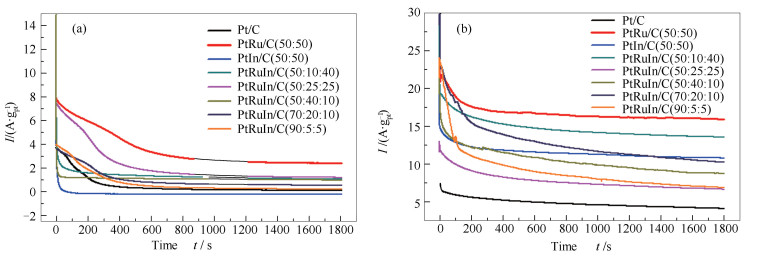
PtRu/C (50:50) is more active than Pt/C, PtIn/C and all PtRuIn/C prepared with different atomic ratios for methanol oxidation in both electrolytes. However, all PtRuIn/C are more active than Pt/C and PtIn/C, for methanol oxidation in acidic electrolyte and PtRuIn/C (50:10:40) in alkaline electrolyte. The current values observed in alkaline medium for PtRuIn/C are higher than in acidic medium and these results suggest that PtRuIn/C is an appropriated material to be studied in alkaline fuel cell. The chronoamperometry results are in disagreement with cyclic voltammetry, however, for a better understanding, studies using direct methanol fuel cell and considering methanol oxidation mechanism, in both electrolytes, are necessary. In this work, we decided to present methanol fuel cell tests in order to confirm the beneficial effect of adding Ru and In to Pt.
Figure 8 shows the performances of direct methanol fuel cell or direct alkaline methanol fuel cell with Pt/C, PtRu/C PtIn/C, and PtRuIn/C prepared with different atomic ratios as anodes. PtRuIn/C (50:25:25) electrocatalyst is more active than Pt/C and PtRu/C (50:50). These results are in disagreement with chronoamperommetry results. Power density value for PtRuIn/C (50:25:25) are similar in both electrolytes, however, the best performance of PtRuIn/C for direct methanol fuel cell could be associated with the improvement of kinetics reaction with the temperature, besides the bifunctional mechanism and electronic effect. The studies in direct methanol fuel cell show beneficial effect of indium and ruthenium addition to platinum.
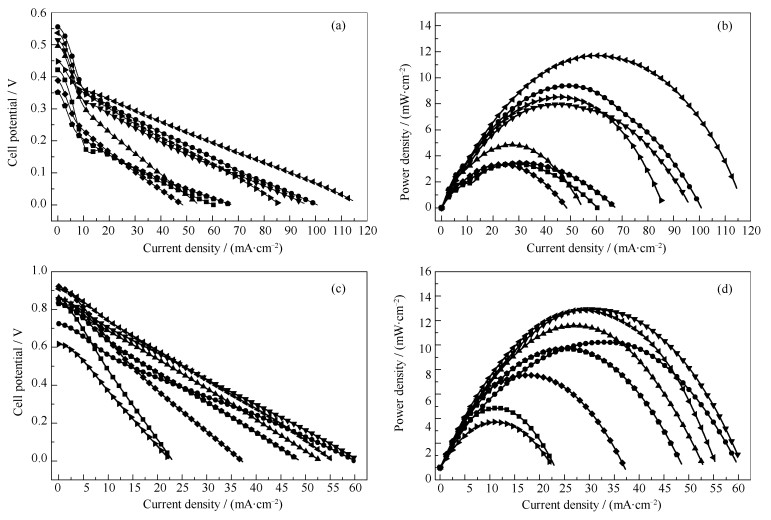
■:Pt/C; ●:PtRu/C(50:50); ▲:PtIn/C(50:50); ▼:PtRuIn/C(50:10:40); ◀:PtRuIn/C(50:25:25); ▶:PtRuIn/C(50:40:10); ◆:PtRuIn/C(70:20:10);
The sodium borohydride reduction method is an efficient process to obtain PtRuIn/C for methanol oxidation in alkaline and acidic electrolytes. XRD of PtRu/C and PtRuIn/C electrocatalysts show five peaks, which are associated with the face-centered cubic (fcc) structure characteristic of Pt alloys. XRD of PtRu/C and PtRuIn/C electrocatalysts also show a 2θ peak shift to higher values in comparison with Pt/C electrocatalysts which could be associated to the Pt alloys formation.
PtRu/C exhibits superior performance for methanol oxidation (chronoamperommetry) in both electrolytes when compared to Pt/C, however, direct methanol fuel cells are more representative. The highest catalytic activity of PtRu/C could be related to the combination of the bifunctional mechanism and the electronic effect. The current values obtained for PtRu/C and PtRuIn/C in alkaline electrolyte are higher than those in acidic electrolyte, indicating that studies in alkaline fuel cells are appropriated and promising for these electrocatalysts.
Experiments in direct methanol fuel cells show that the power density values obtained for PtRuIn/C (50:25:25) are higher than the obtained for PtRu/C and Pt/C, however, for PtRuIn/C (50:25:25) the current values are similar in both electrolytes. The best performance obtained with PtRuIn/C in direct methanol fuel cell could be associated with the kinetics reaction improvement and also by the temperature.
Further research is necessary to investigate the mechanisms of methanol oxidation in alkaline and acidic electrolytes using PtRuIn/C electrocatalysts and to investigate the surface of these materials through XPS analysis.
GERALDES A N, DA SILVA D F, DA SILVA J C M, DE SA O A, SPINACE E V, NETO A O, DOS SANTOS M C. Palladium and palladium-tin supported on multi wall carbon nanotubes or carbon for alkaline direct ethanol fuel cell[J]. J Power Sources, 2015, 275(2): 189-199.
BROUZGOU A, SONG S Q, TSIAKARAS P. Low and non-platinum electrocatalysts for PEMFCs:Current status, challenges and prospects[J]. Appl Catal B:Environ, 2012, 127(1): 371-388.
SHEN S Y, ZHAO T S, XU J B, LI S Y. Synthesis of PdNi catalysts for the oxidation of ethanol in alkaline direct ethanol fuel cells[J]. J Power Sources, 2010, 195(4): 1001-1006. doi: 10.1016/j.jpowsour.2009.08.079
SANTOS M C L, DUTRA R M, RIBEIRO V A, SPINACÉ E V, NETO A O. Preparation of PtRu/C electrocatalysts by borohydride reduction for methanol oxidation in acidic and alkaline medium[J]. Int J Electrochem Sci, 2017, 12(5): 3549-3560.
VEIZAGA N S, PAGANIN V A, ROCHA T A, SCELZA O A, DE MIGUEL S R, GONZALEZ E R. Development of PtGe and PtIn anodic catalysts supported on carbonaceous materials for DMFC[J]. Int J Hydrogen Energy, 2014, 39(16): 8728-8737. doi: 10.1016/j.ijhydene.2013.12.041
IWASITA T. Handbook of Fuel Cells (Vol. 2)[M]. Chichester UK:Wiley, 2003.
MULLER J, FRANK G, COLBOW K, WILKINSON D. Handbook of Fuel Cells (Vol. 4)[M]. Chichester UK:Wiley, 2003.
NETO A O, BRANDALISE M, DIAS R R, AYOUB J M S, SILVA A C, PENTEADO J C, LINARDI M, SPINACé E V. The performance of Pt nanoparticles supported on Sb2O5SnO2, on carbon and on physical mixtures of Sb2O5.SnO2 and carbon for ethanol electro-oxidation[J]. Int J Hydrogen Energy, 2010, 35(17): 9177-9181. doi: 10.1016/j.ijhydene.2010.06.028
ARICÒ A S, SRINIVASAN S, ANTONUCCI V. DMFCs:From fundamental aspects to technology development[J]. Fuel Cells, 2001, 1(2): 133-161. doi: 10.1002/(ISSN)1615-6854
SANTOS M L C, OTTONI C A, DE SOUZA R F B, DA SILVA S G, ASSUMPÇÃO M H M T, SPINACé E V, NETO A O. Methanol oxidation in alkaline medium using PtIn/C electrocatalysts[J]. Electrocatal, 2016, 7(6): 445-450. doi: 10.1007/s12678-016-0324-z
FRELINK T, VISSCHER W, VANVEEN J A R. The effect of Sn on Pt/C catalysts for the methanol electro-oxidation[J]. Electrochim Acta, 1994, 39(11/12): 1871-1875.
FRELINK T, VISSCHER W, COX A P, VANVEEN J A R. Ellipsometry and dems study of the electrooxidation of methanol at Pt and Ru-and Sn-promoted Pt[J]. Electrochim Acta, 1995, 40(10): 1537-1543. doi: 10.1016/0013-4686(95)00034-C
GURAU B, VISWANATHAN R, LIU R X, LAFRENZ T J, LEY K L, SMOTKIN E S, REDDINGTON E, SAPIENZA A, CHAN B C, MALLOUK T S, SARANGAPANI S. Structural and electrochemical characterization of binary, ternary, and quaternary platinum alloy catalysts for methanol electro-oxidation[J]. J Phys Chem B, 1998, 102(49): 9997-10003. doi: 10.1021/jp982887f
XIE J, ZHANG Q, GU L, XU S, WANG P, LIU J, DING Y, YAO Y F, NAN C, ZHAO M, YOU Y, ZOU Z. Ruthenium-platinum core-shell nanocatalysts with substantially enhanced activity and durability towards methanol oxidation[J]. Nano Energy, 2016, 21(3): 247-257.
HUANG L, ZHANG X, WANG Q, HAN Y, FANG Y, DONG S. Shape-control of Pt-Ru nanocrystals:Tuning surface structure for enhanced electrocatalytic methanol oxidation[J]. J Am Chem Soc, 2018, 140(3): 1142-1147. doi: 10.1021/jacs.7b12353
DEMIRCI U B. Theoretical means for searching bimetallic alloys as anode electrocatalysts for direct liquid-feed fuel cells[J]. J Power Sources, 2007, 173(1): 11-18. doi: 10.1016/j.jpowsour.2007.04.069
ZHU M, SUN G, YAN S, LI H, XIN Q. Preparation, structural characterization, and activity for ethanol oxidation of carbon-supported PtSnIn catalyst[J]. Energy Fuels, 2009, 23(1): 403-407. doi: 10.1021/ef800726b
SANTASALO-AARNIO A, TUOMI S, JALKANEN K, KONTTURI K, KALLIO T. The correlation of electrochemical and fuel cell results for alcohol oxidation in acidic and alkaline media[J]. Electrochim Acta, 2013, 87(1): 730-738.
HOU H, WANG S, JIN Q W, JIANG L, SUN L, JIANG G. KOH modified Nafion112 membrane for high performance alkaline direct ethanol fuel cell[J]. Int J Hydrogen Energy, 2011, 36(8): 5104-5109. doi: 10.1016/j.ijhydene.2010.12.093
FONTES E H, DA SILVA S G, SPINACE E V, NETO A O, DE SOUZA R F B. In situ ATR-FTIR studies of ethanol electro-oxidation in alkaline medium on PtRh/C electrocatalyst prepared by an alcohol reduction process[J]. Electrocatal, 2016, 7(4): 297-304. doi: 10.1007/s12678-016-0308-z
ROYCHOWDHURY C, MATSUMOTO F, ZELDOVICH V B, WARREN S C, MUTOLO P F, BALLESTEROS M J, WIESNER J, ABRUÑA H D, DISALVO F J. Synthesis, characterization, and electrocatalytic activity of PtBi and PtPb nanoparticles prepared by borohydride reduction in methanol[J]. Chem Mater, 2006, 18(14): 3365-3372. doi: 10.1021/cm060480e
DA SILVA S G, SILVA J C M, BUZZO G S, DE SOUZA R F B, SPINACé E V, NETO A O, ASSUMPÇÃO M H M T. Electrochemical and fuel cell evaluation of PtAu/C electrocatalysts for ethanol electro-oxidation in alkaline media[J]. Int J Hydrogen Energy, 2014, 39(19): 10121-10127. doi: 10.1016/j.ijhydene.2014.04.169

Figure 1 Typical SEM images of the PtRuIn/C electrocatalysts prepared by borohydride reduction process and their typical EDX spectra

Figure 2 X-ray diffractograms of the Pt/C, PtIn/C, PtRu/C and PtRuIn/C electrocatalysts prepared by borohydride reduction process

Figure 3 TEM images and histograms of the particle size distribution to Pt/C, PtRu/C (50:50), PtIn/C (50:50) and PtRuIn/C (50:40:10) electrocatalysts

Figure 4 TEM images and histograms of the particle size distribution of PtRuIn/C (50:10:40), PtRuIn/C (50:25:25), PtRuIn/C (70:20:10) and PtRuIn/C (90:5:5) electrocatalysts

Figure 5 Cyclic voltammograms of Pt/C, PtRu/C (50:50), PtIn/C (50:50) and PtRuIn/C electrocatalysts in (a) 0.5 mol/L H2SO4 and (b)1 mol/L KOH solution with a scan rate of 10 mV/s at 25 ℃

Figure 6 Cyclic voltammograms of Pt/C, PtRu/C (50:50), PtIn/C (50:50) and PtRuIn/C with different atomic ratios electrocatalysts in the presence of (a)0.5 mol/L H2SO4 + 1 mol/L methanol solution or (b)1 mol/L KOH + 1 mol/L methanol with a scan rate of 10 mV/s at 25 ℃

Figure 7 Chronoamperometry curves in the presence of 0.5 mol/L H2SO4 + 1.0 mol/L methanol at 0.5 V in 30 min (a) or 1 mol/L KOH + 1 mol/L methanol at -0.35 V in 30 min(b)for Pt/C, PtRu/C (50:50), PtIn/C (50:50) and PtRuIn/C electrocatalysts at 25 ℃

Figure 8 Polarization curves (a) and power density curves (b) in a 5 cm2 DMFC at 80 ℃ using Pt/C, PtRu/C, PtIn/C and PtRuIn/C electrocatalysts as anode catalysts (1 mg (Pt) /cm2) and Pt/C BASF as the cathode catalyst (1 mg (Pt) /cm2), Nafion 117 was used as the membrane. Methanol 2 mol/L with 1.0 mL/min flux and oxygen pressure (0.2 MPa). (c)I-V polarization curves and the (d) power density curves at 80 ℃ of a 5 cm2 DAMFC using Pt/C, PtRu/C, PtIn/C and PRuIn/C electrocatalysts anodes (1 mg (Pt) /cm2 catalyst loading) and Pt/C BASF electrocatalyst cathode (1 mg (Pt) /cm2 catalyst loading with 20% Pt loading on carbon), Nafion 117 membrane treated with KOH, 1.0 mol/L KOH + 1.0 mol/L methanol was used as fuel
■:Pt/C; ●:PtRu/C(50:50); ▲:PtIn/C(50:50); ▼:PtRuIn/C(50:10:40); ◀:PtRuIn/C(50:25:25); ▶:PtRuIn/C(50:40:10); ◆:PtRuIn/C(70:20:10);
Table 1. Pt:Ru, Pt:In and Pt:Ru:In atomic ratios of the prepared electrocatalysts
| Eletrocatalyst | EDX results (molar ratio) |
| Pt/C | |
| PtRu/C (50:50) | 62:38 |
| PtIn/C (50:50) | 58:42 |
| PtRuIn/C (50:40:10) | 63:31:06 |
| PtRuIn/C (50:10:40) | 71:13:16 |
| PtRuIn/C (50:25:25) | 61:23:16 |
| PtRuIn/C (70:20:10) | 80:16:04 |
| PtRuIn/C (90:5:5) | 93:5:2 |
 下载: 导出CSV
Table 2. The average crystallite size and lattice parameter values for Pt/C, PtRu/C, PtIn/C and PtRuIn/C prepared with different atomic ratios
| Material | Average crystallite size d/nm | Lattice parameter values /nm |
| Pt/C | 5 | 0.392 |
| PtRu/C (50:50) | 6 | 0.388 |
| PtIn/C (50:50) | 3 | 0.398 |
| PtRuIn/C (50:10:40) | 3 | 0.396 |
| PtRuIn/C (50:25:25) | 2 | 0.397 |
| PtRuIn/C (50:40:10) | 3 | 0.390 |
| PtRuIn/C (70:20:10) | 4 | 0.392 |
| PtRuIn/C (90:5:5) | 5 | 0.393 |
下载: 导出CSV

 扫一扫看文章


扫一扫关注我们