

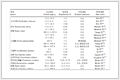
 Table 1.
Crystallographic data for compounds 1 and 2
Table 1.
Crystallographic data for compounds 1 and 2
Citation:
XU Han, ZHENG He-Gen. Syntheses, Crystal Structures and Properties of Two Cobalt (Ⅱ) Complexes Based on 4, 4′-Bis (imidazol-l-yl)-diphenyl Thioether[J]. Chinese Journal of Inorganic Chemistry,
2016, 32(1): 184-190.
doi:
10.11862/CJIC.2016.016

两个基于4, 4′-二 (1-咪唑基) 苯硫醚的钴-髤配合物的合成、晶体结构及性质
摘要:
以4, 4′-二 (1-咪唑基) 苯硫醚 (BIDPT), 4, 4′-联苯醚二甲酸 (H2oba), 对苯二甲酸 (p-H2bdc) 和Co (NO3)2·6H2O为原料, 用溶剂热法合成了2个配位聚合物{[Co (BIDPT)(oba)(H2O)2]}n (1) 和{[Co (BIDPT)(p-bdc)]·H2O}n (2), 利用X射线单晶衍射、红外、元素分析、热重分析和X射线粉末衍射对其进行了表征.结果表明, 配位聚合物1为单斜晶系, P2/c空间群, 配位聚合物2为三斜晶系, P1空间群.配位聚合物1和2为二维层状结构, 二维结构通过分子间氢键形成了三维网络结构.研究了室温下它们的光学性质.
-
关键词:
- 钴 (Ⅱ) 配位聚合物
- / 晶体结构
- / 光学性质
- / 合成
English
Syntheses, Crystal Structures and Properties of Two Cobalt (Ⅱ) Complexes Based on 4, 4′-Bis (imidazol-l-yl)-diphenyl Thioether
Abstract:
Two coordination polymers {[Co (BIDPT)(oba)(H2O)2]}n (1) and {[Co (BIDPT)(p-bdc)]·H2O}n (2) were synthesized by hydrothermal method using 4, 4′-bis (imidazol-l-yl) diphenyl thioether (BIDPT), 4, 4′-oxydibenzoic acid (H2oba), terephthalic acid (p-H2bdc) and Co (NO3)2·6H2O. The complexes were characterized by FT-IR, elemental analysis, thermogravimetric analysis (TGA), powder X-ray diffraction (PXRD) and their crystal structures were determined by single-crystal X-ray diffraction. Structural analyses reveal that complex 1 crystallizes in the monoclinic system, space group P2/c. Complex 2 crystallizes in the triclinic system, space group P1. Complexes 1 and 2 exhibit a two-dimensional (2D) corrugated layer structures. Through intermolecular hydrogen bonding, the two compounds are assembled into 3D supramolecular structures. Ultraviolet spectroscopy studies revealed that the two compounds exhibit ultraviolet adsorption in the solid state at room temperature. CCDC: 1058936, 1; 1420850, 2.
-
Key words:
- Co (Ⅱ) coordination polymer
- / crystal structure
- / optical property
- / synthesis
-
0 Introduction
In recent years, metal-organic frameworks (MOFs) have attracted intensive attention not only due to their topological varieties but also because of their potential application as functional materials in the areas of separation [1-2], gas adsorption [3], photolumines-cence [4], molecular magnetism [5-6], catalysis [7-8], and so on. Coordination polymers based on N-donor and polycarboxylate ligands have received considerable attention because they can incorporate virtues of different functional groups and it is easier to get architecture controlled by changing one of the above two kinds of ligands [9]. To date, however, how to ratio-nally design and synthesize MOFs with the desired structures and properties is still a challenge because the formation of MOFs may be easily affected by many factors. Generally, the structure and topology of coordination polymer generated from transition-metal "nodes" and organic "spacers" can be controlled by selection of ligands, solvents, pH value, metal ions, metal-to-ligand ratios, reaction temperature, counter ions and so forth [10].
Several N-donor ligands have been widely employed to construct coordination polymers with fascinating architectures and interesting properties [11-12]. Among the N-donor ligands, multidentate ligands with imidazole groups have attracted great interest. Excellent coordination ability and free rotation of the imidazole ring in multidentate ligands meet the requirement of coordination geometries of metal ions in the assembly process. Until now, a great number of ingenious MOFs have been designed based on imid-azole ligands [13-14]. We recently designed and synthes-ized 4, 4′-bis (imidazol-l-yl) diphenyl thioether (BIDPT), which is a V-shaped imidazole ligand that can be regarded as a half-flexible ligand.
Considering that the nitrogen-containing ligands are neutral, we need carboxylate co-ligands to charge-balance metal cations. Besides, the co-ligands can also serve as cross-linkers to obtain more intriguing architectures. Herein, two carboxylate ligands, namely H2oba and p-H2bdc, were introduced to react with BIDPT ligand and cobalt nitrate. Then two new complexes, {[Co (BIDPT)(oba)(H2O)2]}n (1) and {[Co (BIDPT)(p-bdc)]·H2O}n (2), were obtained. In addition, we systematically described the syntheses, structures, XRD, and the thermal stabilities in details, and also the UV-Vis properties of 1 and 2 were discussed.
1 Experimental
1.1 Materials and measurement
All the chemicals except the ligand BIDPT were commercially purchased and used without further purification. The ligand BIDPT was synthesized according to literature method [15]. Elemental analyses of C, H and N were performed on a Elementar Vario MICRO Elemental Analyzer. Fourier transformed Infrared (FTIR) spectra were obtained on a Bruker Vector 22 FTIR spectrophotometer by using KBr pellets. Thermogravimetrical analyses (TGA) were performed on a Perkin-Elmer thermal analyzer under nitrogen with a heating rate of 10 ℃·min-1. Powder X-ray diffraction (PXRD) patterns were collected in the 2θ range of 5°~50° with a scan speed of 0.1°·s-1 on a Bruker D8 Advance instrument using a Cu Kα radia-tion (λ=0.154 056 nm) at room temperature. Solid-state UV-Vis diffuse reflectance spectra were obtained at room temperature using Shimadzu UV-3600 double monochromator spectrophotometer, and BaSO4 was used as a 100% reflectance standard for all materials.
1.2 Synthesis of complexes
{[Co (BIDPT)(oba)(H2O)2]}n (1): A mixture of Co (NO3)2 ·6H2O (29.1 mg, 0.1 mmol), H2oba (25.8 mg, 0.1mmol) and BIDPT (34.0 mg, 0.1 mmol) was dissolved in 6 mL of DMF/H2O (3:3, V/V). The final mixture was placed in a Parr Teflon-lined stainless steel vessel (15 mL) under autogenous pressure and heated at 95 ℃ for three days. Pink block crystals were obtained. The yield of the reaction was ca. 63% based on BIDPT ligand. Anal. Calcd. for C32H26Co N4O7S (%): C, 57.35; H, 3.88; N, 8.36. Found (%): C, 57.32; H, 3.85; N, 8.40. IR (KBr, cm-1): 3 411(m), 1 553(s), 1 537(s), 1 511(s), 1 379(s), 1 300(w), 1 243(s), 1 238(m), 1 157(w), 1 059(w), 1 013(w), 824(m), 786(w), 653(w), 622(w), 524(w).
{[Co (BIDPT)(p-bdc)]·H2O}n (2): A mixture of Co (NO3)2·6H2O (29.1 mg, 0.1 mmol), p-H2bdc (16.6 mg, 0.1 mmol) and BIDPT (34.0 mg, 0.1 mmol) was dissolved in 4 mL of DMF/H2O (1:3, V/V). The final mixture was placed in a Parr Teflon-lined stainless steel vessel (15 mL) under autogenous pressure and heated at 95 ℃ for three days. Dark purple block crystals were collected. The yield of the reaction was ca. 60% based on BIDPT ligand. Anal. Calcd. for C26H20CoN4O5S (%): C, 55.77; H, 3.57; N, 10.01. Found (%): C, 55.72; H, 3.61; N, 10.05. IR (KBr, cm-1): 3 436(s), 3 097(s), 1 594(m), 1 509(s), 1 480(s), 1 415(m), 1 302(s), 1 255(s), 1 194(m), 1 126(w), 1 053(s), 959(m), 903(w), 830(s), 739(m), 722(m), 656(m), 545(w), 522(w), 505(w).
1.3 Single crystal X-ray crystallography
The suitable crystals of compounds 1 and 2 were selected for single-crystal X-ray diffraction. The data collections were carried out on a Bruker Smart Apex Ⅱ CCD diffraction (λ=0.071 03 nm).The diffraction data were integrated using SAINT programe [16], which was also used for the intensity correction for the Lorentz and polarization effects. Semiempirical absorption corrections were applied using SADABS program [17]. The structures were solved by direct methods, and all of the non-hydrogen atoms were refined anisotropically on F2 by the full-matrix least-squares technique using SHELXL-97 crystallographic software package [18]. The hydrogen atoms except those of water molecules were generated geometrically and refined isotropically using the riding model. The details of the crystal parameters, data collection, and refinements for the complexes are listed in Table 1, and selected bond lengths and angles are summarized in Table 2.
Table 1.
Crystallographic data for compounds 1 and 2
 Table 1. Crystallographic data for compounds 1 and 2
Table 2.
Selected bond distances (nm) and bond angles (°) of compounds 1 and 2
Table 1. Crystallographic data for compounds 1 and 2
Table 2.
Selected bond distances (nm) and bond angles (°) of compounds 1 and 2
 Table 2. Selected bond distances (nm) and bond angles (°) of compounds 1 and 2
CCDC: 1058936, 1; 1420850, 2.
2 Results and discussion
2.1 Structure description
2.2 Thermal stability and powder X-ray diffraction (PXRD)
To confirm the phase purity of compounds 1 and 2, the powder X-ray diffraction (PXRD) patterns were recorded for 1~2, and they were comparable to the corresponding simulated patterns calculated from the single-crystal diffraction data (Fig. 9), indicating a pure phase of each bulky sample.
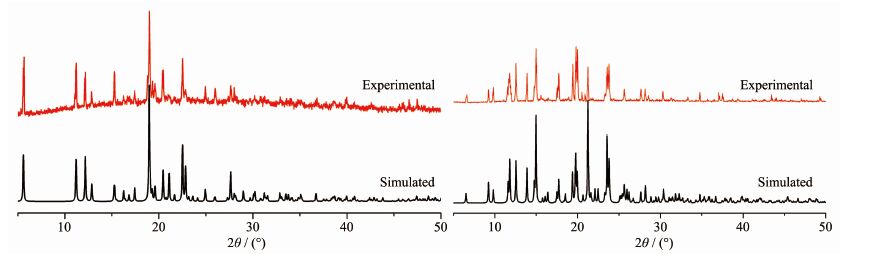 Figure 9.
PXRD patterns of compounds 1 (left) and 2 (right)
Figure 9.
PXRD patterns of compounds 1 (left) and 2 (right)
In order to better understand the thermal stability of compounds 1 and 2, their thermal decomposition behavior was investigated from 25 to 750 ℃ under nitrogen atmosphere (Fig. 10). The TGA curve of 1 indicates no obvious weight loss from 25 to 220 ℃, suggesting that the framework is thermally stable. Then there is a weight loss of 5.50% from 220 to 260 ℃, corresponding to the loss of two coordinated water molecules (Calcd. 5.38%). The TG curve presents a platform and the framework starts to decompose at 360 ℃. The TGA of complex 2 shows a weight loss of 3.50% (Calcd. 3.22%) ranging from 120 to 160 ℃, which is corresponding to the departure of lattice water, and the solvent-free framework begins to collapse at 270 ℃.
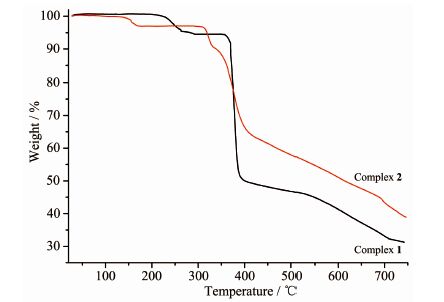 Figure 10.
TG curves of complexes 1 and 2
Figure 10.
TG curves of complexes 1 and 2
2.3 UV-Visible spectra
The UV-Vis absorption spectra of BIDPT, H2oba, p-H2bdc, and complexes 1 and 2 were carried out at room temperature (Fig. 11). Complexes 1 and 2 exhibit a narrow adsorption band in the range of 200~380 nm, which can be ascribed to π-π* transitions of the ligands. Besides these absorption bands of complexes 1 and 2, we observe two additional peaks at 530 nm (4T1g(F)→4T2g(P)) with a shoulder at 580 nm assigned to the 4T1g(F)→4T1g(P) transition. The higher energy bands can be considered as metal-to-ligand charge-transfer (MLCT) transitions. The lower energy band can be attributed to the spin-allowed d-d electronic transitions of the d7 (Co2+) cation.
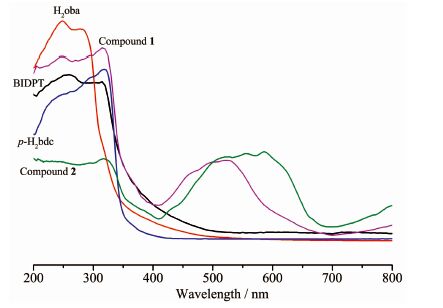 Figure 11.
UV-Vis absorbance spectra of the ligands and complexes
Figure 11.
UV-Vis absorbance spectra of the ligands and complexes
2.1.2 Crystal structure analysis of {[Co (BIDPT) (p-bdc)]·H2O}n (2)
The result of X-ray diffraction analysis reveals that complex 2 is a quasi parallel polycatenated 2D+2D→2D framework based on an undulated {44·62} sql square layer. It crystallizes in the triclinic crystal system with the space group of P1. As shown in Fig. 5, the asymmetric unit contains one crystallographically independent Co (Ⅱ) cation, one BIDPT ligand, one p-bdc ligand and one lattice water molecule. The Co (Ⅱ) cation locates in a {CoN2O2} distorted tetrahedral geometry made up of two N atoms from two BIDPT ligands and two carboxylate oxygen atoms from two p-bdc ligands. The bond distances around the Co (Ⅱ) cation are normal. As depicted in Fig. 6, each BIDPT ligand bridges the adjacent Co (Ⅱ) cations to yield one infinite 1D linear chain with a Co…Co distance of 1.563 5 nm and a Co…Co…Co angle of 180.00°. The other infinite 1D linear chain with a Co…Co distance of 1.099 6 nm and a Co…Co…Co angle of 180.00° is generated by p-bdc ligands and the Co (Ⅱ) cations. Then, the two types of 1D chain are linked to generate a 2D network by sharing the Co (Ⅱ) cations. From a topological view point, the Co (Ⅱ) cations can be considered as a 4-connected nodes. In order to present the real interpenetration of the complex, BIDPT and p-bdc ligands can be simplified as linkers. So, the whole structure can be simplified to a sql network. It is interesting that the adjacent 2D networks are packed as a quasi parallel 2D+2D→2D network, as depicted in Fig. 7. Further, the 2D networks are held together via O-H…O interaction to generate 3D extended supramolecular framework (Fig. 8).
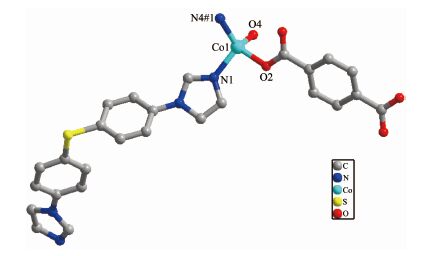 Figure 5.
Coordination environment of the Co (Ⅱ) cation in 2
Figure 5.
Coordination environment of the Co (Ⅱ) cation in 2
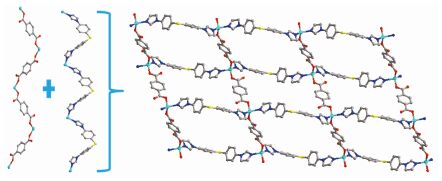 Figure 6.
Left: an infinite 1D chain formed by Co (Ⅱ) cation and p-bdc ligand; Middle: an infinite 1D linear chain constructed from the BIDPT and the Co (Ⅱ) cations; Right: 2D network of 2
Figure 6.
Left: an infinite 1D chain formed by Co (Ⅱ) cation and p-bdc ligand; Middle: an infinite 1D linear chain constructed from the BIDPT and the Co (Ⅱ) cations; Right: 2D network of 2
 Figure 7.
Parallel interpenetrated architecture of 2D+2D→2D network (left) and topological representation of the sql net of 2 (right)
Figure 7.
Parallel interpenetrated architecture of 2D+2D→2D network (left) and topological representation of the sql net of 2 (right)
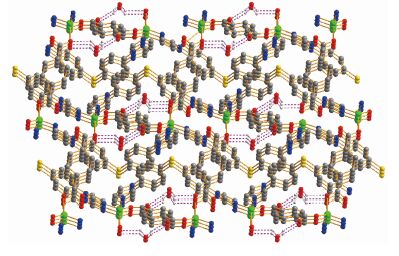 Figure 8.
Schematic representation of the 3D framework of 2
Figure 8.
Schematic representation of the 3D framework of 2
2.1.1 Crystal structure analysis of {[Co (BIDPT)(oba) (H2O)2]}n(1)
Complex 1 crystallizes in the monoclinic crystal system with P2/c space group. The asymmetric unit consists of one Co atom, one BIDPT ligand, one com-pletely deprotonated oba2- ligand, and two coordinated water molecules. As shown in Fig. 1, each Co (Ⅱ) atom is surrounded by two nitrogen atoms from two BIDPT ligands, two carboxylate oxygen atoms from two oba2- ligands and two oxygen donors from two coordinated water molecules to adopt an octahedral geometry. The axial positions of the octahedron are occupied by N (1) and N (1)#1 with an N (1)-Co (1)-N (1)#1 angle of 180°. The bond distances of Co-N are 0.211 7(3) nm. Four O atoms (O (3), O (3)#1, O (1W), O (1W)#1) lie in the equatorial plane. The distances of Co-O bonds are from 0.206 6(2) to 0.216 5(3) nm. The bond angles of N-Co-O are in the range of 89.11(1)°~180.00(3)°. The bond angles of O (3)-Co (1)-O (3)#1 and O (1W)-Co (1)-O (1W)#1 are 180.00°. It is noteworthy that both BIDPT and oba2- ligands link the Co (Ⅱ) cations to form zigzag chains with Co…Co…Co angles of 180.00°. The combination of the two kinds of 1D chain generates the 2D structure (Fig. 2). To better understand the structure of complex 2, the topological analysis approach was employed. The Co (Ⅱ) cations can be regarded as 4-connected nodes, and all the organic ligands are considered as linkers, the framework of complex 1 can be simplified to an sql net with the point symbol of {44·62} (Fig. 3). Further, the 2D network are held together in a parallel …ABAB… fashion via O-H…O interaction (O1W-H1WA…O2#1, O1W-H1WA…O2#2) to generate 3D extended supramolecular framework (Fig. 4).
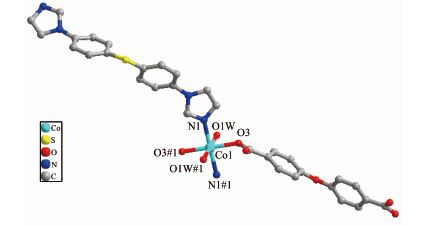 Figure 1.
Coordination environment of the Co (Ⅱ) cation in 1
Figure 1.
Coordination environment of the Co (Ⅱ) cation in 1
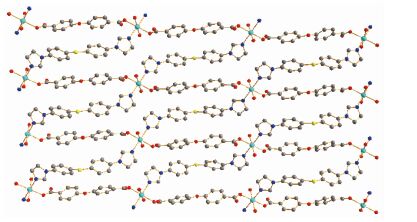 Figure 2.
2D network of complex 1
Figure 2.
2D network of complex 1
 Figure 3.
Schematic view of sql topology of 1
Figure 3.
Schematic view of sql topology of 1
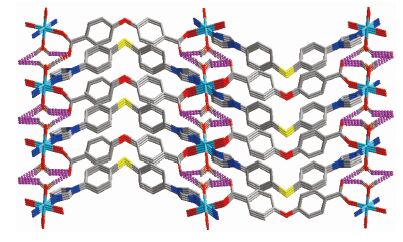 Figure 4.
Schematic representation of the 3D framework of 1
Figure 4.
Schematic representation of the 3D framework of 1
3 Conclusions
In summary, by using the V-shaped ligand, 4, 4′-bis (imidazol-l-yl) diphenyl thioether (BIDPT), and two kinds of dicarboxylates, we have synthesized two new coordination polymers. Complex 1 is a 2D-spl network. Complex 2 display an interesting 2D+2D→2D parallel polycatenation. Complexes 1 and 2 are further extended into the 3D framework via O-H…O hydrogen bonds. The results imply that the combina-tion of a V-shaped N-donor ligand with different dicarboxylate can construct complexes with novel stru-ctures and special properties. Furthermore, the UV-Vis absorption spectra and optical band gaps of 1 and 2 show that these complexes can be employed as potential semiconductive materials.
-
-
[1]
Luo X Z, Jia X J, Deng J H, et al. J. Am. Chem. Soc., 2013, 135:11684-11687 doi: 10.1021/ja403002m
-
[2]
Li P, He Y, Guang J, et al. J. Am. Chem. Soc., 2014, 136: 547-549 doi: 10.1021/ja4129795
-
[3]
O′Keeffe M, Yaghi O M. Chem. Rev., 2012, 112:675-702 doi: 10.1021/cr200205j
-
[4]
Liu X G, Wang H, Chen B, et al. Chem. Commun., 2015, 51: 1677-1680 doi: 10.1039/C4CC08945F
-
[5]
Keene T D, Murphy M J, Price J R, et al. Dalton Trans., 2014, 43:14766-14771 doi: 10.1039/C4DT02205J
-
[6]
Chen L, Wang J, Wei J M, et al. J. Am. Chem. Soc., 2014, 136:12213-12216 doi: 10.1021/ja5051605
-
[7]
Wang L H, Zeng Y, Shen A G, et al. Chem. Commun., 2015, 51:2052-2055 doi: 10.1039/C4CC08089K
-
[8]
Roberts J M, Fini B M, Sarjeant A A, et al. J. Am. Chem. Soc., 2012, 134:3334-3337 doi: 10.1021/ja2108118
-
[9]
Liang X Q, Zhou X H, Chen C, et al. Cryst. Growth Des., 2009, 9:1041-1053 doi: 10.1021/cg8008859
-
[10]
Shiga T, Okawa H, Kitagawa S, et al. J. Am. Chem. Soc., 2006, 128:16426-16427 doi: 10.1021/ja066434x
-
[11]
Qin L, Ju Z M, Wang Z J, et al. Cryst. Growth Des., 2014, 14:2742-2746 doi: 10.1021/cg500269h
-
[12]
Qin L, Zheng M X, Guo Z J. Chem. Commun., 2015, 51: 2447-2449 doi: 10.1039/C4CC08763A
-
[13]
Zhang C L, Li Y L, Wang T, et al. Chem. Commun., 2015, 51:8338-8341 doi: 10.1039/C5CC01072A
-
[14]
Shi Z Q, Guo Z J, Zheng H G. Chem. Commun., 2015, 51: 8300-8303 doi: 10.1039/C5CC00987A
-
[15]
Hu J S, Shang Y J, Yao X Q, et al. Cryst. Growth Des., 2010, 10:4135-4142 doi: 10.1021/cg1008208
-
[16]
SMART and SAINT, Siemens Analytical X-ray Instrument Inc. , Madison, WI, 1996.
-
[17]
Sheldrick G M. SADABS: An Empirical Absorption Correction Program, Bruker Analytical X-ray System, Madison, WI, 1996.
-
[18]
Sheldrick G M. SHELXL-97, Program for the Refinement of Crystal Structure, Universirty of Göttingen, Germany, 1997.
-
[1]
-

Figure 1 Coordination environment of the Co (Ⅱ) cation in 1
All hydrogen atoms were omitted for clarity; Symmetry codes: #1:-x, -y+2, -z+2

Figure 4 Schematic representation of the 3D framework of 1
O-H…O hydrogen bonds are highlighted in dashed lines

Figure 5 Coordination environment of the Co (Ⅱ) cation in 2
All hydrogen atoms were omitted for clarity; Symmetry codes: #1: x-1, y, z+1

Figure 6 Left: an infinite 1D chain formed by Co (Ⅱ) cation and p-bdc ligand; Middle: an infinite 1D linear chain constructed from the BIDPT and the Co (Ⅱ) cations; Right: 2D network of 2

Figure 7 Parallel interpenetrated architecture of 2D+2D→2D network (left) and topological representation of the sql net of 2 (right)

Figure 8 Schematic representation of the 3D framework of 2
O-H…O hydrogen bonds are highlighted in dashed lines
-


 下载:
下载:


 扫一扫看文章
计量
- PDF下载量: 1
- 文章访问数: 856
- HTML全文浏览量: 73
 下载:
下载:

