

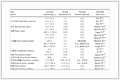
 Table 1.
Crystal data and structure refinement for 1 and 2
Table 1.
Crystal data and structure refinement for 1 and 2
Citation:
LIU Guang-Xiang. Syntheses, Crystal Structures and Luminescent Properties of Zinc (Ⅱ) and Cadmium (Ⅱ) Coordination Polymers Constructed by Aromatic Carboxylates and 1, 3, 5-Tris (imidazol-1-yl) benzene[J]. Chinese Journal of Inorganic Chemistry,
2016, 32(1): 175-183.
doi:
10.11862/CJIC.2016.024

由芳香羧酸和1, 3, 5-三咪唑基苯为配体构筑的锌、镉配合物的合成、结构和荧光性质
摘要:
通过水热法得到了2个配位聚合物{[Zn (timb)(BTEC)0.5]·H2O}n(1) 和{[Cd (timb)(DPA)]·H2O}n(2)(timb=1, 3, 5-三咪唑基苯, H4BTEC=均苯四甲酸, H2DPA=2, 2-联苯二甲酸), 对它们进行了元素分析、红外光谱分析, 并利用X射线衍射测定了它们的单晶结构.配合物1属于三斜晶系, P1空间群.配合物2属于单斜晶系, C2/c空间群.配合物1拥有一个不寻常的三维框架结构, 其拓扑为 (4.63·86)2(42·84)(63)2; 而配合物2具有一维单层纳米管结构.结果说明了金属离子和有机羧酸配体在配合物组装过程中起着非常重要的作用.此外, 在室温下对2个配合物进行了荧光性质分析.
English
Syntheses, Crystal Structures and Luminescent Properties of Zinc (Ⅱ) and Cadmium (Ⅱ) Coordination Polymers Constructed by Aromatic Carboxylates and 1, 3, 5-Tris (imidazol-1-yl) benzene
Abstract:
Two coordination polymers, namely {[Zn (timb)(BTEC)0.5]·H2O}n (1) and {[Cd (timb)(DPA)] ·H2O}n (2), have been obtained by the reaction of metal salt (zinc nitrate or cadmium nitrate), 1, 3, 5-tris (imidazol-1-yl) benzene (timb) with two aromatic carboxylic acids, 1, 2, 4, 5-benzenetetracarboxylic acid (H4BTEC) and diphenic acid (H2DPA). They were characterized by IR spectroscopy, elemental analysis and single-crystal X-ray diffraction. Complex 1 crystallizes in triclinic, space group P1 with a=0.991 32(9) nm, b=1.018 23(10) nm, c=1.112 45(11) nm, α=81.479 0(10)°, β=65.613 0(10)°, γ=62.318 0(10)°. Complex 2 belongs to monoclinic, space group C2/c with a=2.633 0(2) nm, b=0.841 96(8) nm, c=2.353 5(2) nm, β=98.027 0(10)°. Structural analyses reveal that complex 1 exhibits a novel three-dimensional (3D) (3, 4, 5)-connected framework with an unusual (4.63·86)2(42·84)(63)2 topology, whereas complex 2 possesses a one-dimensional (1D) single-wall metal-organic nanotube based on double helical chains. The results show that the nature of metal ions and the carboxylic building blocks play an important role in the formation of complexes with diverse structures. The luminescent properties of two complexes have also been investigated. CCDC: 1422833, 1; 1422832, 2.
-
Key words:
- coordination polymer
- / tris (imidazole) ligands
- / polycarboxylate
- / crystal structure
- / luminescence
-
0 Introduction
The field of coordination polymers (CPs) material has undergone flourishing development in the past few years. The unique features of this type of materials, such as tunable structures, diversiform topologies, as well as potential applications in many useful areas, have made it a hot research topic for the scientist worldwide, especially for those who work in the field of crystal engineering [1-8]. In general, the applications of CPs are directly related to their structural features. Therefore, the development of new synthetic strategies to achieve CPs with targeted structures and properties has become a great challenge. Although porous CPs can be synthesized using multidentate ligands, their final structural topologies are highly influenced by several factors, including metal-ligand ratio, pH value, solvent, temperature, as well as the oxidation state of the metal ion [9-13]. In particular, the rational selection of organic ligands or co-ligands according to their lengths, rigidities, coordination modes and functional groups provides a possibility for the assembly of structurally controllable CPs [14-17].
Among the various types of organic ligands, imidazole and its derivatives are often employed to fabricate CPs because of their strong coordination abilities and relatively versatile coordination geometries [18-21]. The rigid tripodal ligand 1, 3, 5-tris (imidazol-1-yl) benzene (timb) has previously been justified as an efficient and versatile organic building unit for construction of coordination architectures [22-25]. For timb, the three imidazole groups can rotate with different dihedral angles so as to satisfy the demands of the coordination environments of the central metals in the assembly processes, producing favored arrangements with beautiful architectures [26-27]. More importantly, recent studies indicate that utilizing mixed ligands is an effective route to construct intriguing CPs with attractive topological structures [28-31]. Such a dual-ligand strategy offers great promise for the construction of target frameworks with high complexities due to the presence of distinct donors which can coordinate with metal centers through different coordination modes. With a view to develop possible synthetic strategies, the employment of mixed N-and O-donor ligands would be a feasible method to build coordination architectures with interesting topologies and remarkable functionalities [32-36]. As is known, polycarboxylate ligands are excellent co-ligands for the construction of highly connected, different dimensional frameworks due to their versatile bridging modes. However, investigation of the timb-carboxylate mixed-ligand system remains largely unexplored. Thus, the development of comprehensive research on this topic is necessary. Considering all of the above-mentioned, we chose timb and two co-ligands, 1, 2, 4, 5-benzenetetracarboxylic acid (H4BTEC) and diphenic acid (H2DPA) to prepare CPs, and obtained two new coordination polymers with intriguing structures, namely, {[Zn (timb)(BTEC)0.5]·H2O}n (1) and {[Cd (timb)(DPA)]·H2O}n (2). Herein, we report their syntheses, crystal structures and luminescent properties.
1 Experimental
1.1 Materials and general methods
All the reagents and solvents for syntheses and analyses were purchased from Sigma or TCI and employed as received without further purification. The timb ligand was synthesized according to the reported method [37]. Elemental analyses (C, H and N) were performed on a Vario EL III elemental analyzer. Infrared spectra were performed on a Nicolet AVATAR-360 spectrophotometer with KBr pellets in the 4 000~400 cm-1 region. The luminescent spectra for the powdered solid samples were measured at room temperature on a Horiba FluoroMax-4P-TCSPC fluorescence spectrophotometer with a xenon arc lamp as the light source. In the measurements of emission and excitation spectra the pass width is 5 nm. All the measurements were carried out under the same experimental conditions.
1.2 Synthesis of {[Zn (timb)(BTEC)0.5]·H2O}n (1)
A mixture containing Zn (NO3)2·6H2O (59.5 mg, 0.2 mmol), H4BTEC (25.4 mg, 0.1 mmol), timb (55.2 mg, 0.2 mmol) and LiOH·H2O (16.8 mg, 0.4 mmol) in 15 mL of deionized water was sealed in a 25 mL Teflon lined stainless steel container and heated at 140 ℃ for 3 days. Colorless block crystals of 1 were collected by filtration and washed with water and ethanol several times with a yield of 41% based on timb ligand. Anal. Calcd. for C20H15N6O5Zn (%): C, 49.55; H, 3.12; N, 17.34. Found (%): C, 49.52; H, 3.13; N, 17.35. IR spectrum (cm-1): 3 481(br), 3 185 (w), 1 612 (s), 1 563 (s), 1 519 (s), 1 421 (m), 1 389 (s), 1 319 (m), 1 264 (m), 1 109 (m), 1 077 (s), 1 021 (m), 982 (m), 823 (m), 756 (m), 657 (m), 586 (w).
1.3 Synthesis of {[Cd (timb)(DPA)]·H2O}n (2)
Complex 2 was prepared by a process similar to that yielding complex 1 by using Cd (NO3)2·4H2O (30.8 mg, 0.1 mmol), H2DPA (24.2 mg, 0.1 mmol), timb (27.6 mg, 0.1 mmol) and LiOH·H2O (8.4 mg, 0.2 mmol) in 15 mL of deionized water. Colorless platy crystals of 2 were collected by filtration and washed with water and ethanol several times with a yield of 53% based on timb ligand. Anal. Calcd. for C29H22N6O5Cd (%): C, 53.84; H, 3.43; N, 12.99. Found (%): C, 53.82; H, 3.44; N, 12.98. IR spectrum (cm-1): 3 450 (br), 3 130 (w), 1 559 (s), 1 521 (s), 1 444 (s), 1386 (s), 1 240 (w), 1 169 (m), 1 079 (m), 931 (w), 822 (w), 766 (m), 653 (w), 556 (w).
1.4 X-ray crystallography
Two single crystals with dimensions of 0.22 mm×0.16 mm×0.14 mm for 1 and 0.26 mm×0.22 mm×0.12 mm for 2 were mounted on glass fibers for measurement, respectively. X-ray diffraction intensity data were collected on a Bruker APEX Ⅱ CCD diffractometer equipped with a graphite-monochromatic Mo-Kα radiation (λ=0.071 073 nm) using the φ-ω scan mode at 293(2) K. Data reduction and empirical absorption correction were performed using the SAINT and SADABS program [38], respectively. The structures were solved by the direct method using SHELXS-97 [39] and refined by full-matrix least squares on F2 using SHELXL-97 [40]. All of the non-hydrogen atoms were refined anisotropically. The hydrogen atoms of the organic ligands were refined as rigid groups. The hydrogen atoms of the solvent water molecules were located from difference Fourier maps, then restrained at fixed positions and refined isotropically. The details of the crystal parameters, data collection and refinement for 1 and 2 are summarized in Table 1, and selected bond lengths and angles with their estimated standard deviations are listed in Table 2.
Table 1.
Crystal data and structure refinement for 1 and 2
 Table 1. Crystal data and structure refinement for 1 and 2
Table 2.
Selected bond lengths (nm) and angles (°) for 1 and 2
Table 1. Crystal data and structure refinement for 1 and 2
Table 2.
Selected bond lengths (nm) and angles (°) for 1 and 2
 Table 2. Selected bond lengths (nm) and angles (°) for 1 and 2
CCDC: 1422833, 1; 1422832, 2.
2 Results and discussion
2.1 Crystal structure description
The single-crystal diffraction analysis indicates that complex 1 crystallized in a triclinic manner with space group P1. There are one Zn (Ⅱ) ion, one timb ligand, half of BTEC ligand lying on inversion center, and one lattice water molecule in one asymmetric unit of 1. The coordination environment around the Zn (Ⅱ) ion is exhibited in Fig. 1 along with the atom numbering scheme. Each Zn (Ⅱ) ion is six-coordinated by three oxygen atoms from two different BTEC2-anions and three nitrogen atoms from three individual timb ligands to form a distorted octahedral geometry and its basal plane is occupied by three oxygen atoms, O2, O3iii and O4iii, and one nitrogen atom, N5ii, while the apical position is occupied by two nitrogen atoms (N1 and N3i). The Zn-O bond lengths are in the range of 0.206 5(3)~0.224 4(3) nm, and the Zn-N bond lengths are 0.211 6(3)~0.213 4(3) nm. The coordination angles around Zn ion are in the range of 59.01(10)~178.76(12)°.
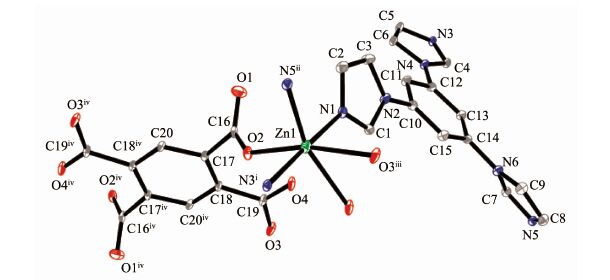 Figure 1.
Coordination environment of Zn (Ⅱ) in complex 1 with thermal ellipsoids at 30% probability
Figure 1.
Coordination environment of Zn (Ⅱ) in complex 1 with thermal ellipsoids at 30% probability
Each timb ligand in turn connects three Zn (Ⅱ) ions which form a triangle with edge lengths (Zn…Zn) of 1.018 2, 1.144 4 and 1.320 7 nm, respectively. The three imidazolyl rings are inclined to the phenyl ring with angles of 9.93(1)°, 33.52(1)° and 35.22(1)°, respectively. As shown in Fig. 2, each Zn (Ⅱ) ion connects three timb ligands and each timb ligand connects three Zn (Ⅱ) ions, such a coordination mode makes the complex a 2D network with honeycomb structure, and a schematic drawing is shown in Fig. 3. BTEC4- anions adopt monodentate and bidentate chelate coordination modes and connect the Zn-timb layers as pillars to generate a 3D structure (Fig. 4). If the Zn (Ⅱ) ion is considered as a five-connected node (connecting to two BTEC4- anions and three timb ligands), the timb ligand can be considered as a three-connected node (connecting to three Zn (Ⅱ) ions), and the BTEC4- ligand can be considered as a four-connected node (connecting to four Zn (Ⅱ) ions). The structure of 1 can be classified as a rare trinodal (3, 4, 5)-connected (4.63·86)2(42·84)(63)2 topology (Fig. 5). As far as we know, this topology has not previously been reported in the literature. In order to minimize the space void and stabilize the framework, the potential void cavities are occupied by the uncoordinated water molecules.
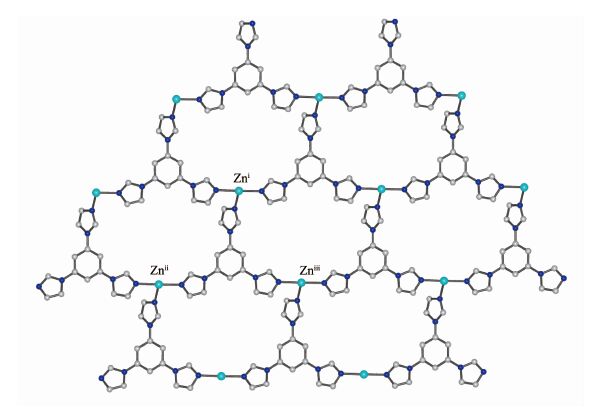 Figure 2.
Ball-stick representation of the Zn-timb sheet in 1
Figure 2.
Ball-stick representation of the Zn-timb sheet in 1
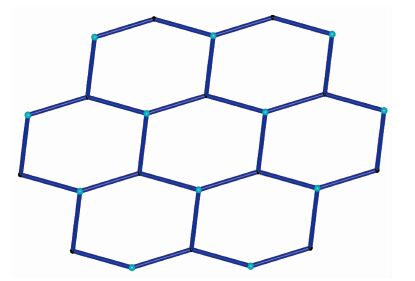 Figure 3.
Schematic representation of the 2D (6, 3) framework of 1
Figure 3.
Schematic representation of the 2D (6, 3) framework of 1
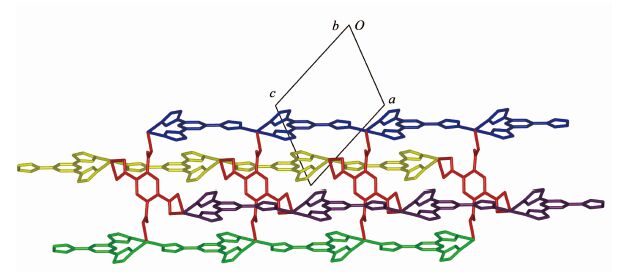 Figure 4.
Stick representation of a 3D structure of 1 along the b-axis
Figure 4.
Stick representation of a 3D structure of 1 along the b-axis
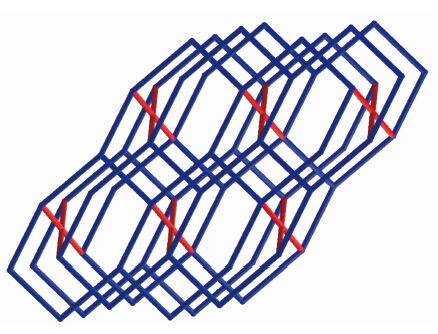 Figure 5.
Schematic view of the (4.63·86)2(42·84)(63) topology of 1
Figure 5.
Schematic view of the (4.63·86)2(42·84)(63) topology of 1
X-ray single-crystal diffraction analysis reveals that 2 is an independent 1D single-wall metal-organic nanotube. It crystallizes in the monoclinic crystal system with space group of C2/c. The asymmetric unit consists of one Cd (Ⅱ) ion, one timb ligand, one DPA dianion, and one uncoordinated water molecule. As depicted in Fig. 6, each Cd (Ⅱ) ion is six-coordinated by two nitrogen atoms from two timb ligands and four oxygen atoms from two carboxylate groups of two DPA anions in a distorted octahedral coordination environment. Its basal plane is occupied by two oxygen atoms from two different DPA ligands (O1 and O4i) and two nitrogen atoms from two individual timb ligands (N1 and N3ii), while the apical position is occupied by two oxygen atoms (O2 and O3i). The Cd-O bond lengths are in the range of 0.223 8(4)~0.261 2(4) nm, and the Cd-N bond lengths are 0.225 5(2)~0.226 6(3) nm. The coordination angles around Cd ion are in the range of 52.49(12)°~159.46(12)°.
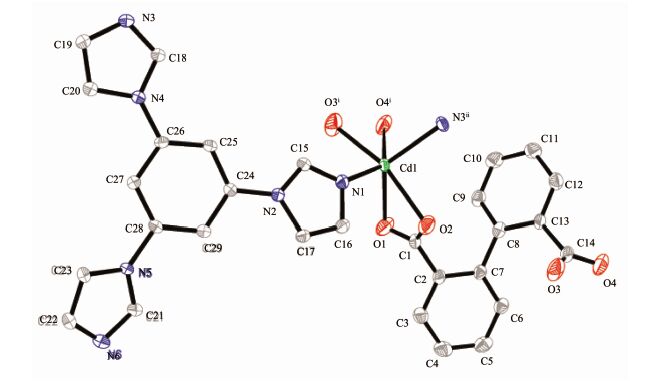 Figure 6.
Coordination environments of the Cd (Ⅱ) atoms in 2 with the ellipsoids drawn at the 30% probability level
Figure 6.
Coordination environments of the Cd (Ⅱ) atoms in 2 with the ellipsoids drawn at the 30% probability level
It is noteworthy that the timb ligand coordinates with two, rather than three like in 1, Cd (Ⅱ) ions using two of its three imidazole groups, and the third one with N6 did not participate in the coordination, which has been observed previously [27]. Three dihedral angles formed between the central phenyl ring and three terminal imidazole groups are 20.63(1)°, 34.72(1)°, and 5.26(1)°, respectively. The timb ligand acts as bidentate bridging ligand to bind two Cd (Ⅱ) atoms to form double helical chains (Fig. 7). Both helical pitches are 1.683 9 nm. Two carboxylate groups of DPA are arranged in the opposite sites relative to the central phenyl ring, giving an anti-conformation, which link the Cd-timb helical chains generate an open-ended, hollow single-wall metal-organic nanotube (Fig. 8) with the interior cross section size of ca. 0.589 nm×0.669 nm. The interior of the single-wall metal-organic nanotube is occupied by the uncoordinated water molecules. The neighboring single-wall metal-organic nanotubes are all held together by weak π…π stacking interaction (0.404 9(1) nm) between imidazole and phenyl ring of timb and nonclassical C-H…O hydrogen bonds to form a 3D supramolecular framework.
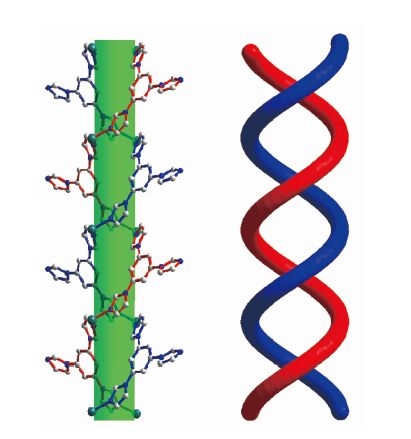 Figure 7.
View of the 1D infinite double helical chains along the b-axis formed by timb and Cd (Ⅱ) ions
Figure 7.
View of the 1D infinite double helical chains along the b-axis formed by timb and Cd (Ⅱ) ions
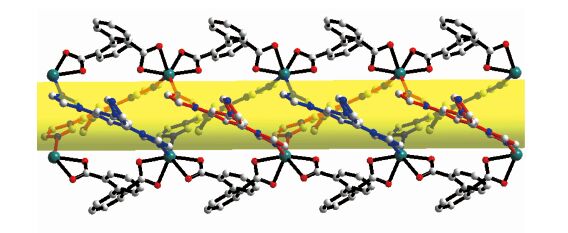 Figure 8.
Ball-and-stick representations of 1D single-wall metal-organic nanotube
Figure 8.
Ball-and-stick representations of 1D single-wall metal-organic nanotube
2.2 FTIR spectra
FTIR spectra revealed valuable information about the coordination modes of H4BTEC and H2DPA. The IR spectra of 1 and 2 show the absence of the characteristic bands at around 1 700 cm-1 attributed to the protonated carboxylate group, which indicates that the complete deprotonation of H4BTEC and H2DPA upon reaction with metal ion. The difference between asymmetric and symmetric carbonyl stretching frequencies (Δν=νasym-νsym) was used to fetch information on the metal-carboxylate binding modes. Complex 1 showed two pairs of νasym and νsym frequencies at 1 612, 1 421 (Δν=191 cm-1) and 1 563, 1 389 cm-1(Δν=174 cm-1) for the carbonyl functionality indicating two coordination modes as observed in the crystal structure. Complex 2 showed a pairs of νasym and νsym frequencies at 1 559, 1 386 cm-1(Δν=173 cm-1) corresponding to the carbonyl functionality of dicarboxylate ligand indicating a symmetric bis (monodentate) coordination mode. OH stretching broad bands at 3 481 cm-1 for 1 and 3 450 cm-1 for 2 are attributable to the coordinated lattice water. The bands in the region of 640~1 250 cm-1 are attributed to the-CH-in-plane or out-of-plane bend, ring breathing, and ring deformation absorptions of benzene ring. The IR spectra also exhibit the chara-cteristic peaks of imidazole groups at ca. 1 520 cm-1 [41].
2.3 Luminescent properties
The luminescence properties of coordination polymers with d10 metal centers and π-conjugated organic linkers have attracted intense interest due to their potential applications in chemical optical sensors and light-emitting devices [42-44]. Solid state photolumine-scent properties of 1 and 2, as well as those of the free ligands, were examined at ambient temperature. The free timb ligand displays photoluminescence with an emission maximum at 404 nm (λex=340 nm), which is in accordance with previous reports [45]. Upon compl-exation of the organic ligands with Zn (Ⅱ)/Cd (Ⅱ) ions, intense blue emissions are observed at 408 nm for 1, and 425 nm for 2 under excitation at 340 nm, as depicted in Fig. 9. Since Zn (Ⅱ)/Cd (Ⅱ) ions are difficult to oxidize or reduce due to their d10 configurations, the emissions of complexes 1 and 2 are neither metal-to-ligand charge transfer (MLCT) nor ligand-to-metal charge transfer (LMCT) in nature. Thus, they may be assigned to being characteristic of intraligand charge transfer, as reported for other Zn (Ⅱ)/Cd (Ⅱ) CPs cons-tructed from mixed N-donor and O-donor ligands [46-47]. The maximum emission peak of 1 is similar to that of the free timb ligand and the emission band of 2 is relatively red-shifted (17 nm). The differences in the emission behaviors of 1 and 2 probably derive from their distinct metal centers and varied polycarboxylate co-ligands, which may affect the rigidity of the solid-state crystal packing and further influence their luminescence emission bands.
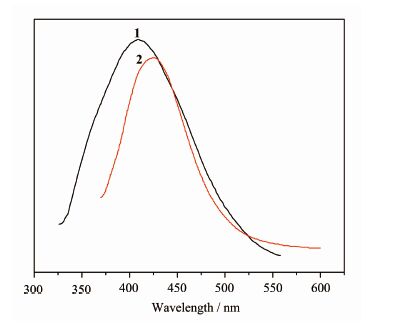 Figure 9.
Solid-state photoluminescent spectra of complexes 1 and 2
Figure 9.
Solid-state photoluminescent spectra of complexes 1 and 2
-
-
[1]
Du M, Li C P, Chen M, et al. J. Am. Chem. Soc., 2014, 136: 10906-10909 doi: 10.1021/ja506357n
-
[2]
Long J R, Yaghi O M. Chem. Soc. Rev., 2009, 38:1213-1214 doi: 10.1039/b903811f
-
[3]
Liu C S, Yang X G, Hu M, et al. Chem. Commun., 2012, 48: 7459-7461 doi: 10.1039/c2cc31905e
-
[4]
Chen L, Chen Q, Wu M, et al. Acc. Chem. Res., 2015, 48: 201-210 doi: 10.1021/ar5003076
-
[5]
Liu K, Shi W, Cheng P. Coord. Chem. Rev., 2015, 289-290: 74-122 doi: 10.1016/j.ccr.2014.10.004
-
[6]
Zhou H C, Kitagawa S. Chem. Soc. Rev., 2014, 43:5415-5418 doi: 10.1039/C4CS90059F
-
[7]
Du M, Li C P, Liu C S, et al. Coord. Chem. Rev., 2013, 257: 1282-1305 doi: 10.1016/j.ccr.2012.10.002
-
[8]
Zhou H C, Long J R, Yaghi O M. Chem. Rev., 2012, 112: 673-674 doi: 10.1021/cr300014x
-
[9]
Guo X M, Guo H D, Zou H Y, et al. CrystEngComm, 2013, 15:9112-9120 doi: 10.1039/c3ce41623b
-
[10]
Zhao F H, Jing S, Che Y X, et al. CrystEngComm, 2012, 14: 4478-4485 doi: 10.1039/c2ce25272d
-
[11]
Shen L, Gray D, Masel R I, et al. CrystEngComm, 2012, 14: 5145-5147 doi: 10.1039/c2ce25780g
-
[12]
Stock N, Biswas S. Chem. Rev., 2012, 112:933-969 doi: 10.1021/cr200304e
-
[13]
Guo H D, Guo X M, Zou H Y, et al. CrystEngComm, 2014, 16:7459-7468 doi: 10.1039/C4CE00664J
-
[14]
Zhou K, Jiang F L, Chen L, et al. Chem. Commun., 2012, 48:12168-12170 doi: 10.1039/c2cc36270h
-
[15]
Hu F L, Wang S L, Wu B, et al. CrystEngComm, 2014, 16: 6354-6363 doi: 10.1039/c3ce42545b
-
[16]
Pan M, Su C Y. CrystEngComm, 2014, 16:7847-7859 doi: 10.1039/C4CE00616J
-
[17]
Ding J G, Yin C, Zheng L Y, et al. RSC Adv., 2014, 4: 24594-24600 doi: 10.1039/c4ra02291b
-
[18]
Yao X Q, Pan Z R, Hu J S, et al. Chem. Commun., 2011, 47:10049-10051 doi: 10.1039/c1cc12691a
-
[19]
Li S, Sun W, Wang K, et al. Inorg. Chem., 2014, 53:4541-4547 doi: 10.1021/ic500224m
-
[20]
Tian Y Q, Zhao Y M, Chen Z X, et al. Chem. Eur. J., 2007, 13:4146-4154 doi: 10.1002/(ISSN)1521-3765
-
[21]
Phan A, Doonan C J, Uribe-Romo F J, et al. Acc. Chem. Res., 2010, 43:58-67 doi: 10.1021/ar900116g
-
[22]
Mukherjee S, Samanta D, Mukherjee P S. Cryst. Growth Des., 2013, 13:5335-5343 doi: 10.1021/cg4011967
-
[23]
Xu Z Z, Sheng T L, Wang Y L, et al. CrystEngComm, 2015, 17:2004-2012 doi: 10.1039/C4CE02551B
-
[24]
Wang H, Yi F Y, Dang S, et al. Cryst. Growth Des., 2014, 14:147-156 doi: 10.1021/cg4013334
-
[25]
Hua J A, Zhao Y, Liu Q, et al. CrystEngComm, 2014, 16: 7536-7546 doi: 10.1039/C4CE00835A
-
[26]
Wang L, Yan Z H, Xiao Z, et al. CrystEngComm, 2013, 15:5552-5560 doi: 10.1039/c3ce40273h
-
[27]
Sun D, Yan Z H, Blatov V A, et al. Cryst. Growth Des., 2013, 13:1277-1289 doi: 10.1021/cg3017358
-
[28]
Hauptvogel I M, Bon V, Grünker R, et al. Dalton Trans., 2012, 41:4172-4179 doi: 10.1039/c2dt12072k
-
[29]
Kim D, Lah M S. CrystEngComm, 2013, 15:9491-9498 doi: 10.1039/c3ce40929e
-
[30]
Cao T, Peng Y, Liu T, et al. CrystEngComm, 2014, 16: 10658-10673 doi: 10.1039/C4CE01356E
-
[31]
Li Y W, Li D C, Xu J, et al. Dalton Trans., 2014, 43:15708-15712 doi: 10.1039/C4DT02321H
-
[32]
Jiang H L, Tatsu Y, Lu Z H, et al. J. Am. Chem. Soc., 2010, 132:5586-5587 doi: 10.1021/ja101541s
-
[33]
Liu X M, Lin R B, Zhang J P, et al. Inorg. Chem., 2012, 51: 5686-5692 doi: 10.1021/ic300097y
-
[34]
Han L W, Lu J, Lin Z J, et al. CrystEngComm, 2014, 16: 1749-1754 doi: 10.1039/c3ce42110d
-
[35]
Kongpatpanich K, Horike S, Sugimoto M, et al. Chem. Commun., 2014, 50:2292-2294 doi: 10.1039/c3cc47954d
-
[36]
Das M C, Guo Q, He Y, et al. J. Am. Chem. Soc., 2012, 134:8703-8710 doi: 10.1021/ja302380x
-
[37]
Zhao W, Song Y, Okamura T A, et al. Inorg. Chem., 2005, 44:3330-3336 doi: 10.1021/ic048816e
-
[38]
Sheldrick G M. SADABS, Program for Empirical Absorption Correction of Area Detector Data, University of Göttingen, Germany, 1996.
-
[39]
Sheldrick G M. SHELXS-97, Program for Crystal Structure Solution, University of Göttingen, Germany, 1997.
-
[40]
Sheldrick G M. SHELXL-97, Program for the Refinement of Crystal Structure, University of Göttingen, Germany, 1997.
-
[41]
Nakamoto K. Infrared and Raman Spectra of Inorganic and Coordinated Compounds. 5th Ed. New York: Wiley & Sons, 1997.
-
[42]
Zhang S R, Du D Y, Qin J S, et al. Chem. Eur. J., 2014, 20: 3589-3594 doi: 10.1002/chem.v20.13
-
[43]
Zhang M, Feng G, Song Z, et al. J. Am. Chem. Soc., 2014, 136:7241-7244 doi: 10.1021/ja502643p
-
[44]
Zhou X, Li P, Shi Z, et al. Inorg. Chem., 2012, 51:9226-9231 doi: 10.1021/ic300661c
-
[45]
Li L, Fan J, Okamura T A, et al. Supramol. Chem., 2004, 16: 361-370 doi: 10.1080/10610270410001713286
-
[46]
Coropceanu E B, Croitor L, Siminel A V, et al. Polyhedron, 2014, 75:73-80 doi: 10.1016/j.poly.2014.03.008
-
[47]
Sie M J, Chang Y J, Cheng P W, et al. CrystEngComm, 2012, 14:5505-5516 doi: 10.1039/c2ce25202c
-
[1]
-

Figure 1 Coordination environment of Zn (Ⅱ) in complex 1 with thermal ellipsoids at 30% probability
Hydrogen atoms and lattice water molecule are omitted for clarity; Symmetry code: i x+1, y-1, z-1; ii x+1, y, z-1; iii-x+2, -y, -z+1; iv 3-x, -y, 1-z

Figure 2 Ball-stick representation of the Zn-timb sheet in 1
Symmetry code: ⅰ x, y, z; ⅱ x+1, y, z-1; ⅲ x, y+1, z

Figure 6 Coordination environments of the Cd (Ⅱ) atoms in 2 with the ellipsoids drawn at the 30% probability level
Hydrogen atoms and lattice water molecule were omitted for clarity; Symmetry code: ⅰ x, y+1, z; ⅱ-x, y-1, -z+1/2

Figure 7 View of the 1D infinite double helical chains along the b-axis formed by timb and Cd (Ⅱ) ions
-


 下载:
下载:


 扫一扫看文章
计量
- PDF下载量: 0
- 文章访问数: 1052
- HTML全文浏览量: 126
 下载:
下载:

