

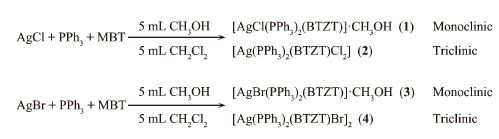
 Figure Scheme 1.
Routine of synthesis for complexes 1~4
Figure Scheme 1.
Routine of synthesis for complexes 1~4
Citation:
LI Zhong-Feng, ZHANG Zhen-Wei, CUI Yang-Zhe, LIU Min, YANG Yu-Ping, JIN Qiong-Hua. Syntheses, Characterizations and Crystal Structures of Two Kinds of Silver (Ⅰ) Complexes Derived from Thiol Ligand[J]. Chinese Journal of Inorganic Chemistry,
2016, 32(1): 139-144.
doi:
10.11862/CJIC.2016.023

两种基于硫醇配体的银 (Ⅰ) 配合物的合成、表征和晶体结构
摘要:
通过AgCl、PPh3和MBT以1:2:1的物质的量之比反应得到2种不同的配合物[AgCl (PPh3)2(BTZT)]·CH3OH (1) 和[AgCl (PPh3)2 (BTZT)]2 (2)(PPh3=三苯基膦; MBT=2-巯基苯并噻唑; BTZT=苯并噻唑-2-硫酮)(其中2已报道).配合物[AgBr (PPh3)2(BTZT)]·CH3OH (3) 和[AgBr (PPh3)2(BTZT)]2 (4) 改用AgBr以相似的反应获得 (其中4已报道).通过红外光谱、元素分析、核磁共振氢谱、X射线单晶衍射、荧光光谱对配合物1和3进行了分析和表征.我们发现在不同的化学环境中, MBT配体可以转化为BTZT配体, 原因是其具有化学活性基团.荧光光谱表明1和3的发射峰均源于配体中的π-π*跃迁.
English
Syntheses, Characterizations and Crystal Structures of Two Kinds of Silver (Ⅰ) Complexes Derived from Thiol Ligand
Abstract:
Two kinds of complexes [AgCl (PPh3)2(BTZT)]·CH3OH (1) and [AgCl (PPh3)2(BTZT)]2 (2) were obtained by the reaction of AgCl, PPh3, and MBT in 1:2:1 molar ratio (PPh3=triphenylphosphine; MBT=2-mercaptobenzo-thiazole BTZT=benzothiazoline-2-thione) (2 has been reported). [AgBr (PPh3)2(BTZT)]·CH3OH (3) and [AgBr (PPh3)2(BTZT)]2 (4) were prepared in a manner similar to 1 and 2 using AgBr (4 has been reported). Complexes 1 and 3 have been characterized by IR, elemental analysis, 1H NMR spectroscopy, fluorescence spectrum and single-crystal X-ray diffraction. The MBT ligand can transform into the BTZT ligand in different chemical environment because of its chemically active groups. The luminescent spectra show that emission peaks of 1 and 3 are assigned to the ligand centered π-π* transition. CCDC: 1407305, 1; 1407306, 3.
-
Key words:
- triphenylphosphine
- / 2-mercaptobenzothiazole
- / benzothiazoline-2-thione
- / complex
-
0 Introduction
Currently, quite a few novel coordination compl-exes are reported [1-2]. With the rapid development of coordination complexes, complexes with closed-shell d10 metals have attracted considerable attention due to important applications in catalysis [3-4] and biochemis-try [5-6]. In particular, complexes bearing the Ag-S bond have raised continuously increasing interest, owing to their use in pharmacology [7] and thin films [8], as well as glass and ceramic technology [9]. In coordination chem-istry, it is one of the most interesting phenomena that two or more stable products are synthesized by the same reactions. The success of designed synthesis and separation of materials still look upon as something of challenge [10-11].
Herein, we set out to design, prepare, and characterize silver (Ⅰ) complexes of silver halides AgX (X=Cl, Br), using same phosphine moieties and taking into account the coordination versatility of the thiol ligand (Scheme 1), namely [AgCl (PPh3)2(BTZT)]·CH3OH (1), [AgCl (PPh3)2(BTZT)]2 (2) [12], and [AgBr (PPh3)2(BTZT)]·CH3OH (3), [AgBr (PPh3)2(BTZT)]2 (4) [13] (PPh3=triphenylphosphine; BTZT=benzothiazoline-2-thione). The BTZT ligand was transformed from MBT ligand in different chemical environment because of chemically active groups of MBT (MBT=2-mercaptob-enzothiazole) [14]. Complexes 1 and 3 have been synth-esized and characterized by IR, elemental analysis, 1H NMR spectroscopy and single-crystal X-ray diffraction.
Figure Scheme 1.
Routine of synthesis for complexes 1~4
1 Experimental
1.1 Materials and measurements
All chemical reagents are commercially available and used without furthermore treatment. FT-IR spectra (KBr pellets) were measured on a Perkin-Elmer Infrared spectrometer. C, H and N elemental analysis were carried out on an ElementarVario MICRO CUBE (Germany) elemental analyzer. 1H NMR was recorded at room temperature with a Bruker DPX 600 spectrometer.
1.2 Synthesis of [AgCl (PPh3)2(BTZT)]·CH3OH (1)
A mixture of AgCl (0.2 mmol, 0.0291g), PPh3 (0.4 mmol, 0.104 9 g) and MBT (0.2 mmol, 0.033 3 g) were dissolved in a mixture of CH3OH (5 mL) and CH2Cl2 (5 mL), stirred for 6 h and filtered. Colorless crystal 1 was obtained from the filtrate after standing at the room temperature for several days. Yield: 56%. Element analysis Calcd. for C44H39AgClNOP2S2(%): C, 60.89; H, 4.50; N, 1.61; Found (%): C, 61.08; H, 4.39; N, 1.52. IR data (KBr pellets, cm-1): 3 418w, 3 049w, 2 937w, 2 815w, 1 598w, 1 583w, 1 495m, 1 478m, 1 432 s, 1 328m, 1 092m, 1 077w, 1 028m, 1 012w, 743s, 693s, 604w, 512m. 1H NMR (600 MHz, CDCl3, 298 K): δ 7.51~7.23(m, CHbenzene).
1.3 Synthesis of [AgBr (PPh3)2(BTZT)]CH3OH (3)
Complex 3 was prepared in a manner similar to that described for 1, using AgBr (0.2 mmol, 0.037 0 g), PPh3 (0.4 mmol, 0.104 8 g) and MBT (0.2 mmol, 0.033 2 g) as starting materials. Yield: 51%. Element analysis Calcd. for C44H39AgBrNOP2S2(%): C, 57.92; H, 4.27; N, 1.53. Found (%): C, 57.81; H, 4.02; N, 1.46. IR data (KBr pellets, cm-1): 3 434w, 3 052w, 3 001w, 2 935w, 2 875w, 2 825w, 1 596w, 1 492m, 1 478m, 1 432s, 1 323m, 1 093m, 1 076w, 1 030m, 1 012w, 996w, 743s, 694s, 606w, 513m. 1H NMR (600 MHz, CDCl3, 298 K): δ 7.51~7.23(m, CHbenzene).
1.4 Structure determination
Single crystals of the title complexes were mounted on a Bruker Smart 1000 CCD diffractometer equipped with a graphite-monochromated Mo Kα (λ=0.071 073 nm) radiation at 298 K. Semi-empirical absorption corrections were applied using SADABS program [15a]. All the structures were solved by direct methods using SHELXS program of the SHELXTL-97 package and refined with SHELXL-97 [15b]. Metal atom centers were located from the E-maps and other non-hydrogen atoms were located in successive difference Fourier syntheses. The final refinements were performed by full matrix least-squares methods with anisotropic thermal parameters for non-hydrogen atoms on F 2. The hydrogen atoms were generated geometri-cally and refined with displacement parameters riding on the concerned atoms.
Crystallographic data and experimental details for structural analysis are summarized in Table 1, and selected bond lengths and angles of complexes 1 and 3 are summarized in Table 2. The bond lengths and angles of hydrogen bonds of complexes 1 and 3 are listed in Table 3.
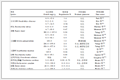 Table 1.
Crystallographic data for complexes 1 and 3
Table 1.
Crystallographic data for complexes 1 and 3
 Table 1. Crystallographic data for complexes 1 and 3
Table 2.
Selected bond distances (nm) and bond angles (°) for complexes 1 and 3
Table 1. Crystallographic data for complexes 1 and 3
Table 2.
Selected bond distances (nm) and bond angles (°) for complexes 1 and 3
 Table 2. Selected bond distances (nm) and bond angles (°) for complexes 1 and 3
Table 3.
Hydrogen bonds of complexes 1 and 3
Table 2. Selected bond distances (nm) and bond angles (°) for complexes 1 and 3
Table 3.
Hydrogen bonds of complexes 1 and 3
 Table 3. Hydrogen bonds of complexes 1 and 3
CCDC: 1407305, 1; 1407306, 3.
2 Results and discussion
2.1 Synthesis of complexes
As is known to all, many factors can influence the structures of the compounds, such as temperature, solvent and molar ratio of the starting materials. We obtain two kinds of complexes 1 and 2 by the reactions of AgCl, PPh3, and BTZT in 1: 2: 1 molar ratio in mixed solvent (CH3OH/CH2Cl2). Complex 1 crystallizes in the monoclinic system with space group P21/n, while 2 [12] crystallizes in the triclinic system with space group P1.
3 and 4 were obtained by the reactions of AgBr with PPh3 in the presence of 2-mercaptobenzothiazole (MBT) in 1: 2: 1 molar ratio in mixed solvent (CH3OH/CH2Cl2). 3 crystallizes in the monoclinic system with space group P21/n, while 4 [13] crystallizes in the triclinic system with space group P1.
Complexes 2 and 4 were synthesized in winter, but 1 and 3 were obtained in summer. So we think that the temperature of volatilization may influence the structures of the compounds.
2.2 Infrared spectroscopy
The infrared spectra of complexes 1 and 3 show the absorption around 1 459~1 495 cm-1 due to C-C stretch vibration of the phenyl rings and the middle absorption around 3 049 or 3 052 cm-1 is caused by C-H vibration of the phenyl rings. The C-H out-of-plane bending vibrations of the phenyl rings are found around 743 and 694 cm-1. The absorption of the N-H stretch vibration is in the range of 3 418~3 434 cm-1.The C=N bond vibration is found in 1 432 cm-1.
2.3 Description of the crystal structure
Single-crystal X-ray diffraction analysis of 1 reveals the Ag (Ⅰ) metal adopts four-coordinated mode, which is bonded to two P atoms from two PPh3 ligands, one chlorine atom and one S atom from the C=S fragment of the BTZT ligand peripherally establishing a distorted tetrahedral geometry about the metal. In particular, the complex 2 contains two same moieties in each asymmetric unit [12].
In complex 1 (Fig. 1), the Ag-P bond distance is sim-ilar to that in previous literature. The Ag-Cl bond dist-ance is comparable with those observed in related com-plexes [AgCl (κ1-S-C3H5NS (NeMe))(PPh3)2] (0.257 0(1) nm) [16] and [AgCl (κ1-S-C3H5NS (NePrn)(PPh3)2)] (0.257 51(5) nm) [16]. The Ag-S bond distance is longer than that found in [Ag (imdt) Cl]n [17] (0.248 66(14) nm), but it is shorter than that of complex 2 [12]. The angles around the Ag atom are in the range of 100.50(3)°~129.27(3)°. The Cl-Ag-S bond angle is smaller than that of [AgCl (TPP)2(MTZD)] (102.68(3)°) and {[AgCl (TPP)2(MBZT)]·(MBZT)·2(toluene)} (104.91(4)°) [18].
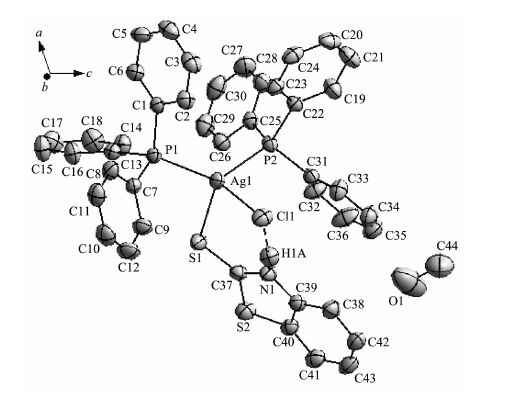 Figure 1.
Perspective view of complex 1 with thermal ellipsoids drawn at the 30% probability level
Figure 1.
Perspective view of complex 1 with thermal ellipsoids drawn at the 30% probability level
Moreover, intramolecular N-H…Cl hydrogen bonds are observed (N…Cl 0.311 6(3) nm, N-H…Cl 170.0°) in the complex 1. The main structure of 1 links free CH3OH by hydrogen bonding interactions.
In complex 3 (Fig. 2), the angles around the Ag atom are in the range of 101.13(4)°~129.04(5)°.The coordination geometry around each Ag atom indicates a distorted tetrahedron. The Ag-P bond length is typical Ag-P distance [19]. The Ag-Br distance is found in good agreement with the reported values [16, 20], but is longer than those of complex 4. The Ag-S bond length is longer than that observed in [Ag2(μ-S-pySH)2(PPh3)2 Br2] (0.260 8(1) nm) [14]. The P-Ag-P bond angle is all longer than those in another similar complex [21]. Moreover, intramolecular N-H…Br hydrogen bonds are observed (N…Br 0.326 9(5) nm, N-H…Br 169.2°) in the complex 3. The main structure of 3 links free CH3OH by hydrogen bonding interactions. The O-H…Br hydrogen bond to link free CH3OH and NO3- anion is observed (O…Br 0.332 9(7) nm, O-H…Br 171.2°) in the complex 3.
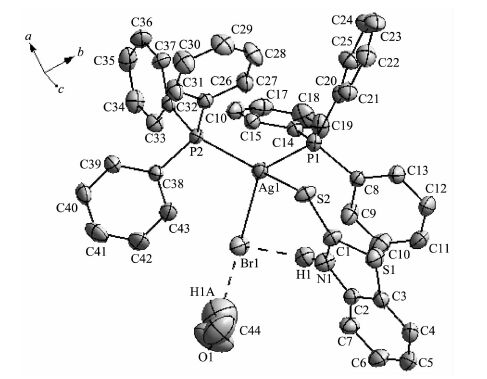 Figure 2.
Perspective view of complex 3 with thermal ellipsoids drawn at the 30% probability level
Figure 2.
Perspective view of complex 3 with thermal ellipsoids drawn at the 30% probability level
Compared to complex 3, the complex 4 contains two same structures in each asymmetric unit. Each Ag atom adopts four-coordinated mode, which is coor-dinated with two P atoms from two PPh3, one Br atom and one S atom from benzothiazoline-2-thione ligand (BTZT).
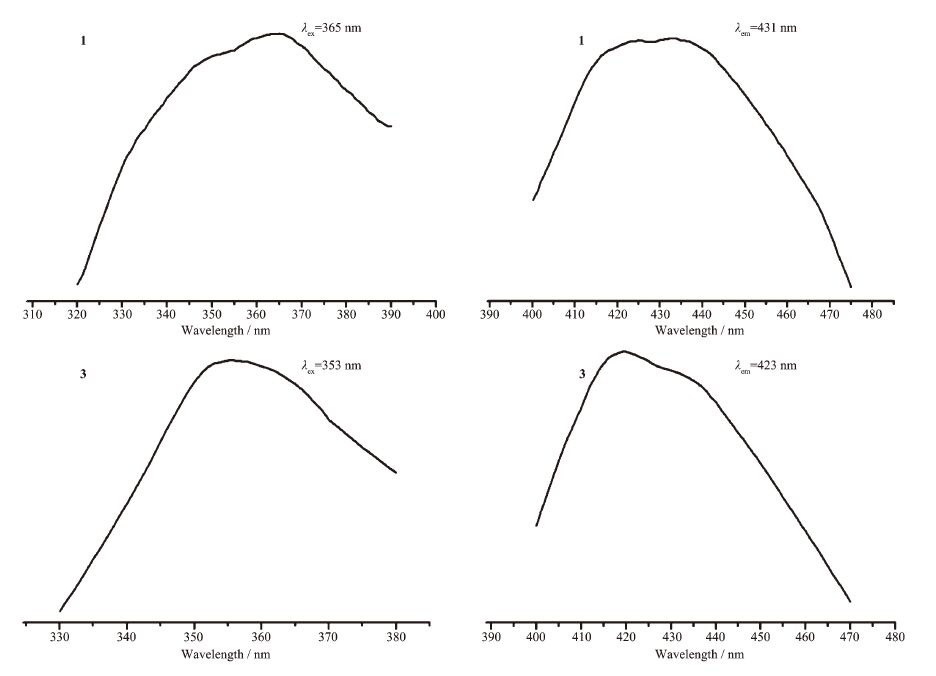 Figure 3.
Solid-state excitation and emission spectra of 1 and 3 at 298 K
Figure 3.
Solid-state excitation and emission spectra of 1 and 3 at 298 K
2.4 Fluorescence spectra
The luminescent excitation and emission spectra of complexes 1, 3 and MBT ligand in the solid state at room temperature are obtained. The emission peak of PPh3 is at 402 nm (λex=372 nm) [19]. In the fluore-scence emission spectrum of MBT ligand, the emission peak is found at 419 nm (λex=342 nm). When excited at 365 nm, a fluorescence emission peak of complex 1 is found at 431 nm. The complex 3 exhibits fluorescence signal centered at 423 nm with an excitation maximum at 353 nm. The red-shift of emission peaks of 1 and 3 are derived from ligand-centered π-π* transition.
3 Conclusions
In summary, two kinds of silver (Ⅰ) halide com-plexes based on triphenylphosphine and benzothia-zoline-2-thione, [AgCl (PPh3)2(BTZT)]·CH3OH (1), and [AgBr (PPh3)2(BTZT)]·CH3OH (3), were synthesized and characterized by IR, elemental analysis, 1H NMR spectroscopy, luminescent spectra and single-crystal X-ray diffraction. However, by the same reactions two different products 2 (The reaction condition was same as 1) and 4 (The reaction condition was same as 3) were synthesized. Single-crystal X-ray diffraction analysis reveals that 1 and 3 crystallize in the monoclinic system with space group P21/n, while 2 and 4 crystallize in the triclinic system with space group P1. The luminescent spectra show that 1 and 3 emission peaks were assigned to the ligand centered π-π* transition.
-
-
[1]
Rajput G, Yadav M K, Drew M G B, et al. Inorg. Chem., 2015, 54:25722579
-
[2]
Lee E, Park K M, Ikeda M, et al. Inorg. Chem., 2015, 54: 5372-5383 doi: 10.1021/acs.inorgchem.5b00422
-
[3]
Liu H Y, Ji S J, Hao Y H. Z. Anorg. Allg. Chem., 2014, 640: 2595-2599 doi: 10.1002/zaac.v640.12/13
-
[4]
Geng J C, Qin L, Du X, et al. Z. Anorg. Allg. Chem., 2012, 638:1233-1238 doi: 10.1002/zaac.v638.7/8
-
[5]
Banti C N, Kyros L, Geromichalos G D, et al. Eur. J. Med. Chem., 2014, 77:388-399 doi: 10.1016/j.ejmech.2014.03.028
-
[6]
Tsukihara T, Aoyama H, Yamashita E, et al. Science, 1995, 269:1069-1074 doi: 10.1126/science.7652554
-
[7]
Sutton B M, McGusty E, Walz D T, et al. J. Med. Chem., 1972, 15:1095-1098 doi: 10.1021/jm00281a001
-
[8]
Bain C D, Whitesides G M. Angew. Chem., Int. Ed., 1989, 28:506-512 doi: 10.1002/(ISSN)1521-3773
-
[9]
Dash K C, Schmidbaur H. Met. Ions Biol. Syst., 1982, 14: 179-205
-
[10]
Zeidan T A, Trotta J T, Chiarella R A, et al. Cryst. Growth Des., 2013, 13:2036-2046 doi: 10.1021/cg400104v
-
[11]
Kumalah S A, Holman K T. Inorg. Chem., 2009, 48:6860-6872 doi: 10.1021/ic900816h
-
[12]
李中峰, 张彦茹, 崔洋哲.无机化学学报, 2015, 31(8):1637-1643 http://www.wjhxxb.cn/wjhxxbcn/ch/reader/view_abstract.aspx?file_no=20150824&flag=1LI Zhong-Feng, ZHANG Yan-Ru, CUI Yang-Zhe, et al. Chinese J. Inorg. Chem., 2015, 31(8):1637-1643 http://www.wjhxxb.cn/wjhxxbcn/ch/reader/view_abstract.aspx?file_no=20150824&flag=1
-
[13]
崔洋哲, 耿文筱, 仇启明.无机化学学报, 2015, 31(6):1224-1230 http://www.wjhxxb.cn/wjhxxbcn/ch/reader/view_abstract.aspx?file_no=20150623&flag=1CUI Yang-Zhe, GENG Wen-Xiao, QIU Qi-Ming, et al. Chinese J. Inorg. Chem., 2015, 31(6):1224-1230 http://www.wjhxxb.cn/wjhxxbcn/ch/reader/view_abstract.aspx?file_no=20150623&flag=1
-
[14]
Lobana T S, Sharma R, Butcher R J. Polyhedron, 2008, 27: 1375-1380 doi: 10.1016/j.poly.2008.01.008
-
[15]
(a) Sheldrick G M. SADABS, University of Göttingen, Germany, 1996. (b) Sheldrick G M. SHELXS-97 and SHELXL-97, University of G?ttingen, G?ttingen, Germany, 1997.
-
[16]
Lobana T S, Sultana R, Butcher R J, et al. J. Organomet. Chem., 2013, 745-746:460-469 doi: 10.1016/j.jorganchem.2013.08.020
-
[17]
Zhu Q L, Huang R D, Xu Y Q, et al. J. Coord. Chem., 2009, 62:2656-2664 doi: 10.1080/00958970902874268
-
[18]
Kyros L, Banti C N, Kourkoumelis N, et al. J. Biol. Inorg. Chem., 2014, 19:449-464 doi: 10.1007/s00775-014-1089-6
-
[19]
Huang X, Li Z F, Qiu Q M, et al. Polyhedron, 2013, 65:129-135 doi: 10.1016/j.poly.2013.08.018
-
[20]
Lobana T S, Kumari P, Kaur I, et al. J. Coord. Chem., 2012, 65:1750-1764 doi: 10.1080/00958972.2012.680211
-
[21]
Lobana T S, Sultana R, Butcher R J, et al. Z. Anorg. Allg. Chem., 2014, 640:1688-1695 doi: 10.1002/zaac.201400064
-
[1]
-

Figure 1 Perspective view of complex 1 with thermal ellipsoids drawn at the 30% probability level
A part of hydrogen atoms are omitted for clarity

Figure 2 Perspective view of complex 3 with thermal ellipsoids drawn at the 30% probability level
A part of hydrogen atoms are omitted for clarity
-


 下载:
下载:


 扫一扫看文章
计量
- PDF下载量: 0
- 文章访问数: 969
- HTML全文浏览量: 99
 下载:
下载:

