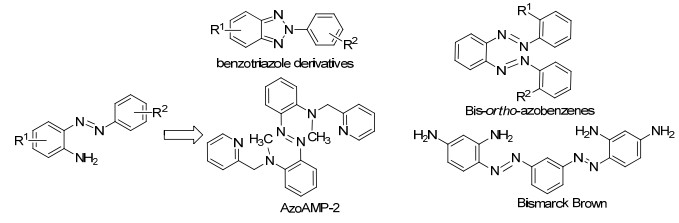
Figure 1.
Some representative compounds of O-aminoazobenzene

Palladium-Catalyzed Direct o-Nitrification of Azobenzenes with Co(NO3)2·6H2O via C-H Activation
Shaofan Wang , Qipeng Zhao , Guodong Wang , Kai Wang , Chengcai Xia


Aromatic nitro compounds are important intermediates which have been used in the synthesize of dynamites, engineering plastics, dyes, pharmaceuticals and perfumes.[1] The traditional routes of nitration reaction usually use HNO3 or HNO3/H2SO4 as nitrification reagent. But these reaction conditions are harsh and have many serious problems of environmental pollution. Hence, more attention have been attracted in developing methods to perform nitration under milder conditions, for example, the iso-nitration of many arylboronic acids, [2] carboxylic acids, [3] aryl halides and pseudohalides.[4] In the past decade, C—H functionalization has emerged as a powerful tool for regioselective formation of C—C, C—O, C—N and C—halogen bonds. Most importantly, developments of new strategies for the direct C—H nitration have attract more attention. Palladium and copper salts have been shown to be effective catalysts for this C—H activated nitration. AgNO3[5] and t-butyl nitrite[6] are good nitro source but the price is high. Recently, many significant progress has been made in nitrification reagents such as NO2, [7] bismuth nitrate[8] and Fe(NO3)3•9H2O.[9]
Azobenzenes have attracted much interest due to their applications as pharmaceuticals, [10] liquid crystals, [11] molecular switches, [12] femtosecond fluorescence.[13] Among these, the 2-(phenyldiazenyl)aniline scaffold is an important motif found in a variety of compounds, including dyes, [14] chiroptical molecular switches, [15] pharmaceutical drugs, [16] photochemical materials[17] and functional materials such as azobenzene-functionalized PVAms.[18] Many representative compounds of 2-(phenyldiazenyl)aniline are shown in Figure 1. In addition, the 2-nitroaniline also is key fine chemical intermediates for the generation of many valuable compounds, such as 1, 2-diamines[19] and benzimidazoles.[20] In recent years, various nitrating agents, such as t-BuONO[6b, 6c] and NO2, [7] have been utilized in regioselective nitration of azobenzenes. But, direct o-nitrification of azobenzenes with cobalt nitrate (Co(NO3)2•6H2O) has not been reported. As part of our continuing efforts on the C—X bonds formation, [21] herein we disclose a highly practical procedure to build C-2 nitro of aromatic azo compounds in one step fromazobenzenes with cobalt nitrate via C—H activation. Also, it is an important method to synthesize 2-nitroaniline or 2-aminoaniline by hydrolysis reaction of the above product.
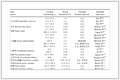
We initiated our investigation on the model reaction of 1, 2-di-p-tolyldiazene (1a) with Co(NO3)2•6H2O to optimize the reaction parameters (Table 1). To our delight, the o-nitrification took place in the presence of Pd(OAc)2 (10 mol%) and K2S2O8 in dichloroethane (DCE) under N2 for 12 h, the desired product was acquired in 93% yield (Entry 1, Table 1). Thus, Cu(OAc)2, Pd(CH3CN)2Cl2, PdCl2, Pd, Pd(PPh3)2Cl2 and Pd(PPh3)4 were tested to catalyze this reaction, in which Pd(OAc)2 gave the best result (Entries 1~7, Table 1). Secondly, the effects of oxidants were examined. It was found that dicumyl peroxide (DCP) could give moderate yield of 2a (Entry 12, Table 1) while other oxidants, such as tert-butyl peroxybenzoate (TBPB), tert-butyl hydroperoxide (TBHB) and di-t-butyl peroxide (DTBP), showed low efficiency (Entries 9~11, Table 1). Without oxidants, the reaction could not take place at all (Entry 8, Table 1). DCE was found to be a more effective solvent compared to tetrahydrofuran (THF), N, N-dimethyl- formamide (DMF), 1, 4-dioxane, toluene and dimethyl sulfoxide (DMSO) (Entries 13~16, Table 1), although toluene provided relatively 60% yield (Entry 17, Table 1). Then, a series of nitrites were surveyed, and Co(NO3)2 was proven to be the best choice (Entries 18~26, Table 1). Subsequently, when the catalyst loading was reduced to 5 mol%, the yield decreased to 82% (Entry 27, Table 1). The increase of the amount of Co(NO3)2 beyond 2 equiv. did not affect the outcome of the reaction (Entry 28, Table 1). When the temperature was reduced to 100 ℃ or increased to 120 ℃, the yield decreased to 77% and 81% (Entries 29, 30, Table 1). Finally, shortening or delaying the reaction times decreased the yield of 2a (Entries 1, 31, 32, Table 1). Control experiments revealed that the presence of air had no adverse effect on the reaction outcome (Entry 33, Table 1). From the results shown above, the optimized nitration conditions were identified as follows: 1a (0.5 mmol), Co(NO3)2•6H2O (1.2 equiv.), K2S2O8 (1.2 equiv.), 10 mol% of Pd(OAc)2 as the catalyst, and DCE (2.0 mL) as the solvent, at 110 ℃ under an N2 atmosphere for 12 h.
 下载:
导出CSV
下载:
导出CSV
 |
|||||
| Entry | Catalyst | Oxidant | Nitro source | Solvent | Yieldb/% |
| 1 | Pd(OAc)2 | K2S2O8 | Co(NO3)2•6H2O | DCE | 93 |
| 2 | Cu(OAc)2 | K2S2O8 | Co(NO3)2•6H2O | DCE | n.r. |
| 3 | Pd(CH3CN)2Cl2 | K2S2O8 | Co(NO3)2•6H2O | DCE | 41 |
| 4 | PdCl2 | K2S2O8 | Co(NO3)2•6H2O | DCE | 25 |
| 5 | Pd/C (10%) | K2S2O8 | Co(NO3)2•6H2O | DCE | 71 |
| 6 | Pd(Ph3P)2Cl2 | K2S2O8 | Co(NO3)2•6H2O | DCE | 75 |
| 7 | Pd(Ph3P)4 | K2S2O8 | Co(NO3)2•6H2O | DCE | 69 |
| 8 | Pd(OAc)2 | — | Co(NO3)2•6H2O | DCE | n.r. |
| 9 | Pd(OAc)2 | TBPB | Co(NO3)2•6H2O | DCE | 35 |
| 10 | Pd(OAc)2 | TBHP | Co(NO3)2•6H2O | DCE | 15 |
| 11 | Pd(OAc)2 | DTBP | Co(NO3)2•6H2O | DCE | 25 |
| 12 | Pd(OAc)2 | DCP | Co(NO3)2•6H2O | DCE | 65 |
| 13 | Pd(OAc)2 | K2S2O8 | Co(NO3)2•6H2O | THF | Trace |
| 14 | Pd(OAc)2 | K2S2O8 | Co(NO3)2•6H2O | DMF | Trace |
| 15 | Pd(OAc)2 | K2S2O8 | Co(NO3)2•6H2O | 1, 4-Dioxane | 10 |
| 16 | Pd(OAc)2 | K2S2O8 | Co(NO3)2•6H2O | DMSO | Trace |
| 17 | Pd(OAc)2 | K2S2O8 | Co(NO3)2•6H2O | Toluene | 60 |
| 18 | Pd(OAc)2 | K2S2O8 | Ca(NO3)2 | DCE | 23 |
| 19 | Pd(OAc)2 | K2S2O8 | Fe(NO3)2 | DCE | 57 |
| 20 | Pd(OAc)2 | K2S2O8 | Fe(NO3)3 | DCE | 29 |
| 21 | Pd(OAc)2 | K2S2O8 | NaNO2 | DCE | Trace |
| 22 | Pd(OAc)2 | K2S2O8 | KNO3 | DCE | Trace |
| 23 | Pd(OAc)2 | K2S2O8 | AgNO2 | DCE | 78 |
| 24 | Pd(OAc)2 | K2S2O8 | Fe(NO3)3•9H2O | DCE | 36 |
| 25 | Pd(OAc)2 | K2S2O8 | Bi(NO3)3 | DCE | 70 |
| 26 | Pd(OAc)2 | K2S2O8 | Cu(NO3)2 | DCE | 43 |
| 27 | Pd(OAc)2 | K2S2O8 | Co(NO3)2•6H2O | DCE | 82c |
| 28 | Pd(OAc)2 | K2S2O8 | Co(NO3)2•6H2O | DCE | 93d |
| 29 | Pd(OAc)2 | K2S2O8 | Co(NO3)2•6H2O | DCE | 77e |
| 30 | Pd(OAc)2 | K2S2O8 | Co(NO3)2•6H2O | DCE | 81f |
| 31 | Pd(OAc)2 | K2S2O8 | Co(NO3)2•6H2O | DCE | 67g |
| 32 | Pd(OAc)2 | K2S2O8 | Co(NO3)2•6H2O | DCE | 89h |
| 33 | Pd(OAc)2 | K2S2O8 | Co(NO3)2•6H2O | DCE | 81i |
| a Reaction conditions: 1a (0.5 mmol), nitro source (1.2 equiv.), K2S2O8 (1.2 equiv.), catalyst (10 mol%) and solvent (2.0 mL) under N2 atmosphere at 110 ℃ for 12 h, unless otherwise noted. b Isolated yields. c Pd(OAc)2 (5 mol%). d 2 equiv. of Co(NO3)2•6H2O was used. e 100 ℃. f 120 ℃. g 8 h. h 24 h. i Air atmosphere. | |||||
The representative results of the nitration of various azobenzenes with Co(NO3)2•6H2O under the influence of K2S2O8 in DCE at 110 ℃ for 12 h were summarized in Table 2. A series of azobenzenes were allowed to react with Co(NO3)2, affording the corresponding 2-nitro aromatic azo compounds in moderate to good yields. (E)-1, 2-Di-p-tol- yldiazene (1a) reacted with Co(NO3)2•6H2O under these conditions to give (E)-1-(4-methyl-2-nitrophenyl)-2-(p- tolyl)diazene (2a) in 93% yield. Similarly, such as (E)-1, 2-bis(4-ethylphenyl)diazene, (E)-1, 2-bis(4-isopropyl- phenyl)diazene, (E)-1, 2-diphenyldiazene, (E)-1, 2-bis(4- methoxyphenyl)diazene also gave good yields (2b, 2c, 2d, 2e). However, (E)-1, 2-bis(4-chlorophenyl)diazene, (E)-dimethyl azobenzene-4, 4'-dicarboxylate which substituted with electron-withdrawing group afforded lower yields (2f, 2g). Surprisingly, meta-substituted azobenzenes showed excellent regioselectivity towards C—H nitration under the reaction conditions (2h, 2i). Also, the azobenzene with two electron-donating groups (CH3) gave moderate yield (2j). Meanwhile, 1, 2-bis(2-chlorophenyl)diazene, the ortho-substituted azobenzene afforded a lower yield because of electron-withdrawing and the steric effect (2k). Additionally, the reactions of unsymmetrical azobenzenes also proceeded smoothly and gave the products in good yields (2l, 2m) which could be determined by 1H NMR. Next, (E)-4-((4-aminophenyl)diazenyl)phenol and (E)-4-(phenyldiazenyl)aniline can not be nitrified under this reaction condition (2n, 2o). Furthermore, other directing group such as 2-phenylpyridine was also nitrified (2p).
下载:
导出CSV
 |
 |
| a Conditions: 1 (0.5 mmol), K2S2O8 (1.2 equiv.), Co(NO3)2•6H2O (1.2 equiv.), Pd(OAc)2 (10 mol%) and solvent (2.0 mL) under N2 atmosphere at 110 ℃ for 12 h. The yields are of the isolated products. |
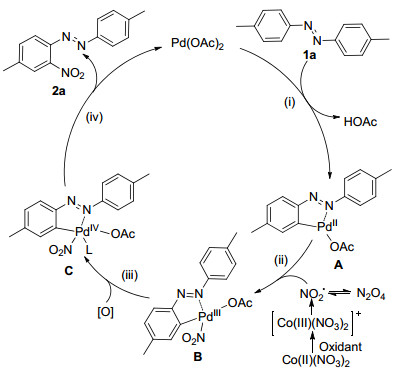
On the basis of previous related studies and reported literature, [2b, 5d, 6b, 6c, 7] a catalytic cycle of this Pd-catalyzed direct ortho nitration of azobenzenes with Co(NO3)2•6H2O via C—H activation was illustrated in Scheme 1. In step (ⅰ), the coordination of azo in azobenzene (1a) with Pd(OAc)2 forms a cyclopalladated intermediate A. In step (ⅱ), oxidative addition of active radicals NO2 to A provides Pd(Ⅲ) species B by K2S4O8. In step (ⅲ), the Pd(Ⅲ) species B are oxidized to form Pd(Ⅳ) intermediate C. In step (ⅳ), C—N bond formation afford the final product 2a via reductive elimination of C with regeneration of Pd(Ⅱ) to start the next cycle.
In summary, we have developed a simple method for direct o-nitration of azoarenes with Co(NO3)2•6H2O via C(sp2)—H activation. The reaction proceeds under mild conditions and shows a broad substrate scope. It provides a convenient method to synthesize o-nitroazobenzenes. And we can also get o-aminoazobenzene, 2-nitroaniline and 2-aminoaniline by reduction or hydrolysis reaction of the above product.
1H NMR, 13C NMR spectra were recorded on a 500 MHz spectrometer in CDCl3 with shifts referenced to SiMe4. IR spectra were recorded on an FTIR spectrophotometer. Melting points were determined by using a local hot-stage melting point apparatus and were uncorrected. Mass spectra were recorded on LC-MS and on HRMS (ESI-TOF analyzer) equipment. All reactions were run under air atmosphere in Schlenk tubes. DCE, THF, DMF, 1, 4-dioxane, toluene and DMSO analytical grade were not distilled before use. Commercial K2S2O8 and azobenzenes were used without purification.
Azoic compounds (0.5 mmol), Co(NO3)2•6H2O (1.2 equiv.), K2S2O8 (1.2 equiv.), Pd(OAc)2 (10 mol%) in DCE (2 mL) were mixed and vigorously stirred under atmosphere at 110 ℃ for 12 h. After cooled down to room temperature and concentrated in vacuum, the residue was purified by flash chromatography on a short silica gel to afford corresponding product.
(E)-1-(4-Methyl-2-nitrophenyl)-2-(p-tolyl)diazene (2a): Orange-red solid, 93% yield. m.p. 93.2~95.2 ℃ (lit.[7] 89~91 ℃); 1H NMR (500 MHz, CDCl3) δ: 7.73 (d, J=8.2 Hz, 2H), 7.60 (s, 1H), 7.52 (d, J=8.2 Hz, 1H), 7.36 (d, J=8.0 Hz, 1H), 7.22 (d, J=8.0 Hz, 2H), 2.40 (s, 3H), 2.35 (s, 3H); 13C NMR (126 MHz, CDCl3) δ: 149.63, 146.70, 142.15, 141.85, 140.37, 132.46, 128.83, 123.08, 122.51, 117.07, 20.57, 20.18; HRMS (ESI+) calcd for C14H14N3O2 [M+H]+ 256.1081, found 256.1083.
(E)-1-(4-Ethyl-2-nitrophenyl)-2-(4-ethylphenyl)diazene (2b): Orange-red solid, 83% yield. m.p. 121.3~123.3 ℃. 1H NMR (500 MHz, CDCl3) δ: 7.86~7.82 (m, 2H), 7.73~7.69 (m, 1H), 7.63~7.60 (m, 1H), 7.47 (dd, J=8.2, 1.8 Hz, 1H), 7.33 (d, J=8.4 Hz, 2H), 2.78 (dd, J=10.0, 5.3 Hz, 2H), 2.72 (dd, J=9.5, 5.7 Hz, 2H), 1.31~1.27 (m, 6H); 13C NMR (126 MHz, CDCl3) δ: 150.85, 149.11, 147.81, 147.57, 143.41, 132.38, 128.68, 123.66, 122.99, 118.23, 28.93, 28.50, 15.34, 14.99; HRMS (ESI+) calcd for C16H18N3O2 [M+H]+ 284.1394, found 284.1391.
(E)-1-(4-Isopropyl-2-nitrophenyl)-2-(4-isopropylphenyl)- diazene (2c): Brown-red liquid, 84% yield. 1H NMR (500 MHz, CDCl3) δ: 7.87~7.84 (m, 2H), 7.74 (d, J=1.8 Hz, 1H), 7.63~7.61 (m, 1H), 7.51 (dd, J=8.3, 1.8 Hz, 1H), 7.38~7.36 (m, 2H), 3.06~2.98 (m, 2H), 1.33~1.31 (m, 6H), 1.29 (d, J=6.9 Hz, 6H); 13C NMR (126 MHz, CDCl3) δ: 153.65, 152.19, 150.95, 147.77, 143.58, 131.10, 127.26, 123.68, 121.70, 118.31, 34.25, 33.99, 23.79, 23.59; HRMS (ESI+) calcd for C18H22N3O2 [M+H]+ 312.1707, found 312.1703.
(E)-1-(2-Nitrophenyl)-2-phenyldiazene (2d): Orange-red solid, 87% yield. m.p. 61~63 ℃ (lit.[7] 67~68 ℃); 1H NMR (500 MHz, CDCl3) δ: 7.85~7.79 (m, 3H), 7.55 (d, J=3.9 Hz, 2H), 7.46~7.41 (m, 4H); 13C NMR (126 MHz, CDCl3) δ: 151.37, 146.45, 144.40, 132.02, 131.27, 129.38, 128.20, 122.99, 122.57, 117.39; HRMS (ESI+) calcd for C12H10N3O2 [M+H]+ 228.0768, found 228.0763.
(E)-1-(4-Methoxy-2-nitrophenyl)-2-(4-methoxyphenyl)- diazene (2e): Brown-red solid, 76% yield. m.p. 82~84 ℃ (lit.[7] 86~88 ℃); 1H NMR (500 MHz, CDCl3) δ: 7.81 (dd, J=9.5, 2.5 Hz, 2H), 7.71~7.68 (m, 1H), 7.24 (d, J=2.7 Hz, 1H), 7.07 (dd, J=9.0, 2.7 Hz, 1H), 6.92 (dd, J=9.4, 2.4 Hz, 2H), 3.85 (s, 3H), 3.81 (d, J=2.2 Hz, 3H); 13C NMR (126 MHz, CDCl3) δ: 161.66, 159.77, 145.94, 137.71, 124.36, 120.90, 120.51, 118.39, 117.86, 113.30, 107.04, 93.72, 55.14, 54.61; HRMS (ESI+) calcd for C14H14N3O4 [M+H]+ 288.0979, found 288.0977.
(E)-1-(4-Chloro-2-nitrophenyl)-2-(4-chlorophenyl)- diazene (2f): Orange-red solid, 73% yield. m.p. 112.6~114.6 ℃ (lit.[6c] 108~109 ℃); 1H NMR (500 MHz, CDCl3) δ: 7.80 (t, J=6.6 Hz, 1H), 7.78~7.72 (m, 2H), 7.58 (dd, J=9.4, 4.8 Hz, 1H), 7.56~7.51 (m, 1H), 7.43~7.36 (m, 2H); 13C NMR (126 MHz, CDCl3) δ: 150.63, 148.10, 143.21, 138.83, 136.70, 133.09, 129.63, 124.95, 124.18, 119.47; HRMS (ESI+) calcd for C12H8Cl2N3O2 [M+H]+ 295.9988, found 295.9985.
Methyl (E)-4-((4-(methoxycarbonyl)phenyl)diazenyl)-3- nitrobenzoate (2g): Orange-red solid, 71% yield. m.p. 156~158 ℃; 1H NMR (500 MHz, CDCl3) δ: 8.62 (s, 1H), 8.35 (d, J=8.1 Hz, 1H), 8.21 (d, J=8.4 Hz, 2H), 7.99 (d, J=8.3 Hz, 2H), 7.70 (d, J=8.3 Hz, 1H), 4.01 (s, 3H), 3.97 (s, 3H); 13C NMR (126 MHz, CDCl3) δ: 166.15, 164.42, 154.62, 147.81, 134.13, 133.49, 132.50, 130.78, 125.63, 123.63, 122.98, 118.73, 53.00, 52.52; HRMS (ESI+) calcd for C16H14N3O6 [M+H]+ 344.0877, found 344.0875.
(E)-1-(5-Methyl-2-nitrophenyl)-2-(m-tolyl)diazene (2h): Brown-red liquid, 86% yield. 1H NMR (500 MHz, CDCl3) δ: 7.86 (d, J=8.2 Hz, 1H), 7.73 (dd, J=5.5, 5.0 Hz, 2H), 7.42~7.39 (m, 1H), 7.36 (s, 1H), 7.34~7.31 (m, 2H), 2.48 (s, 3H), 2.44 (d, J=6.4 Hz, 3H); 13C NMR (126 MHz, CDCl3) δ: 152.59, 146.06, 144.66, 139.22, 133.00, 130.60, 129.04, 124.30, 123.52, 121.33, 118.66, 114.77, 21.58, 21.32; HRMS (ESI+) calcd for C14H14N3O2 [M+H]+ 256.1081, found 256.1085.
(E)-1-(5-Chloro-2-nitrophenyl)-2-(3-chlorophenyl)- diazene (2i): Orange-red solid, 84% yield. m.p. 135~137 ℃ (lit.[7] 138~140 ℃).1H NMR (500 MHz, CDCl3) δ: 7.97~7.90 (m, 1H), 7.90~7.85 (m, 1H), 7.84 (dt, J=7.5, 1.5 Hz, 1H), 7.64~7.58 (m, 1H), 7.57~7.53 (m, 1H), 7.52 (dt, J=7.9, 1.6 Hz, 1H), 7.48 (t, J=7.5 Hz, 1H); 13C NMR (126 MHz, CDCl3) δ: 151.85, 144.89, 144.62, 138.56, 134.43, 131.49, 129.47, 129.35, 124.57, 121.94, 121.89, 117.45; HRMS (ESI+) calcd for C12H8Cl2N3O2 [M+H]+ 295.9988, found 295.9983.
(E)-1-(3, 5-Dimethyl-2-nitrophenyl)-2-(3, 5-dimethyl- phenyl)diazene (2j): Orange-red solid, 83% yield. m.p. 119~121 ℃ (lit.[6b] 102~104 ℃); 1H NMR (500 MHz, CDCl3) δ: 7.42 (d, J=14.7 Hz, 2H), 7.35 (s, 1H), 7.08 (s, 1H), 7.05 (s, 1H), 2.33~2.29 (m, 12H); 13C NMR (126 MHz, CDCl3) δ: 151.51, 147.26, 142.26, 139.79, 137.82, 132.85, 132.55, 129.09, 120.25, 113.99, 20.29, 20.16, 15.80. HRMS (ESI+) calcd for C16H18N3O2 [M+H]+ 284.3383, found 284.3385.
(E)-1-(2-Chloro-6-nitrophenyl)-2-(2-chlorophenyl)diazene (2k): Orange-red solid, 68% yield. m.p. 96~98 ℃ (lit.[6b] 89~91 ℃); 1H NMR (500 MHz, CDCl3) δ: 7.80 (dd, J=8.1, 1.2 Hz, 1H), 7.75 (ddd, J=8.1, 2.7, 1.4 Hz, 2H), 7.59 (dd, J=8.0, 1.2 Hz, 1H), 7.51~7.45 (m, 2H), 7.40~7.36 (m, 1H); 13C NMR (126 MHz, CDCl3) δ: 148.67, 144.61, 142.60, 136.63, 134.46, 133.68, 130.99, 130.39, 129.19, 127.44, 123.42, 117.86; HRMS (ESI+) calcd for C12H8Cl2N3O2 [M+H]+ 295.9988, found 295.9981.
(E)-1-(4-Methoxyphenyl)-2-(2-nitrophenyl)diazene (2l): Orange-red solid, 68% yield. m.p. 76~78 ℃ (lit.[22] 77~79 ℃). 1H NMR (500 MHz, CDCl3) δ: 7.93 (d, J=9.0 Hz, 2H), 7.89 (dd, J=8.1, 0.8 Hz, 1H), 7.66 (dd, J=9.1, 1.6 Hz, 2H), 7.55~7.51 (m, 1H), 7.01 (d, J=9.0 Hz, 2H), 3.90 (s, 3H); 13C NMR (126 MHz, CDCl3) δ: 163.16, 147.01, 145.56, 132.91, 129.77, 125.78, 123.96, 118.50, 114.40, 108.19, 55.68; HRMS (ESI+) calcd for C13H12N3O3 [M+ H]+ 258.0873, found 258.0875.
(E)-1-(4-Methoxy-2-nitrophenyl)-2-(3-methyl-6-nitro- phenyl)diazene (2m): Orange-red solid, 71% yield. m.p. 168~170 ℃; 1H NMR (500 MHz, CDCl3) δ: 7.82 (d, J=8.4 Hz, 1H), 7.70 (d, J=9.0 Hz, 1H), 7.33~7.31 (m, 3H), 7.12 (dd, J=9.0, 2.7 Hz, 1H), 3.89 (s, 3H), 2.43 (s, 3H); 13C NMR (126 MHz, CDCl3) δ: 162.25, 150.98, 145.07, 138.69, 131.46, 125.70, 125.41, 124.35, 120.02, 119.09, 118.67, 108.56, 56.36, 21.68; HRMS (ESI+) calcd for C14H13N4O5 [M+H]+ 317.0881, found 317.0885.
2-(2-Nitrophenyl)pyridine (2p): Light yellow solid, 49% yield. m.p. 41~43 ℃ (lit.[6c] 35~36 ℃); 1H NMR (500 MHz, CDCl3) δ: 8.65 (d, J=4.4 Hz, 1H), 7.90 (dd, J=8.1, 1.0 Hz, 1H), 7.80 (td, J=7.7, 1.8 Hz, 1H), 7.68~7.64 (m, 1H), 7.62 (dd, J=7.7, 1.5 Hz, 1H), 7.56~7.53 (m, 1H), 7.48 (d, J=7.8 Hz, 1H), 7.32 (dd, J=7.6, 4.9 Hz, 1H); 13C NMR (126 MHz, CDCl3) δ: 155.44, 149.60, 149.28, 136.94, 135.21, 132.41, 131.26, 129.24, 124.41, 122.94, 122.72. HRMS (ESI+) calcd for C11H9N2O2 [M+H]+ 201.0659, found 201.0655.
Supporting Information Detailed experimental procedures, characterization data, 1H NMR and 13C NMR spectra of the products. The Supporting Information is available free of charge via the Internet at http://sioc-journal.cn.
(a) Ballini, R. ; Barboni, L. ; Fringuelli, F. ; Palmieri, A. ; Pizzo F. ; Vaccaro, L. Green Chem. 2007, 9, 823.
(b) Papadopoulou, M. V. ; Trunz, B. B. ; Bloomer, W. D. ; McKenzie, C. ; Wilkinson, S. R. ; Prasittichai, C. ; Brun, R. ; Kaiser, M. ; Torreele, E. J. Med. Chem. 2011, 54, 8214.
(c) Hou, W. D. ; Wei, Q. ; Liu, G. S. ; Chen, J. ; Guo, J. ; Peng, Y. G. Org. Lett. 2015, 17, 4870.
(a) Prakash, G. K. S. ; Panja, C. ; Mathew, T. ; Surampudi, V. ; Petasis, N. A. ; Olah, G. A. Org. Lett. 2004, 6, 2205.
(b) Manna, S. ; Maity, S. ; Rana, S. ; Agasti, S. ; Maiti, D. Org. Lett. 2012, 14, 1736.
Natarajan, P.; Chaudhary, R.; Venugopalan, P. J. Org. Chem. 2015, 80, 10498. doi: 10.1021/acs.joc.5b02133
(a) Fors, B. P. ; Buchwald, S. L. J. Am. Chem. Soc. 2009, 131, 12898.
(b) Yan, G. B. ; Yang, M. H. Org. Biomol. Chem. 2013, 11, 2554.
(a) Liu, Y. K. ; Lou, S. J. ; Xu, D. Q. ; Xu, Z. Y. Chem. -Eur. J. 2010, 16, 13590.
(b) Zhang, L. ; Liu, Z. H. ; Li, H. Q. ; Fang, G. C. ; Barry, B. D. ; Belay, T. A. ; Bi, X. H. ; Liu, Q. Org. Lett. 2011, 13, 6536.
(c) Zhang, W. ; Lou, S. J. ; Liu, Y. K. ; Xu, Z. Y. J. Org. Chem. 2013, 78, 5932.
(d) Katayev, D. ; Pfister, K. F. ; Wendling, T. ; Gooßen, L. J. Chem. -Eur. J. 2014, 20, 9902.
(a) Kilpatrick, B. ; Heller, M. ; Arns, S. Chem. Commun. 2013, 49, 514.
(b) Majhi, B. ; Kundu, D. ; Ahammed, S. ; Ranu, B. C. Chem. -Eur. J. 2014, 20, 9862.
(c) Liang, Y. F. ; Li, X. Y. ; Wang, X. Y. ; Yan, Y. P. ; Feng, P. ; Jiao, N. ACS Catal. 2015, 5, 1956.
(d) Zhang, W. ; Ren, S. B. ; Zhang, J. ; Liu, Y. K. J. Org. Chem. 2015, 80, 5973.
Dong, J. W.; Jin, B.; Sun, P. P. Org. Lett. 2014, 16, 4540. doi: 10.1021/ol502090n
Lu, Y.; Li, Y. M.; Zhang, R.; Jin, K.; Duan, C. Y. Tetrahedron 2013, 69, 9422. doi: 10.1016/j.tet.2013.08.076
Sadhu, P.; Alla, S. K.; Punniyamurthy, T. J. Org. Chem. 2015, 80, 8245. doi: 10.1021/acs.joc.5b01021
(a) Banghart, M. R. ; Mourot, A. ; Fortin, D. L. ; Yao, J. Z. ; Kramer, R. H. ; Trauner, D. Angew. Chem., Int. Ed. 2009, 48, 9097.
(b) Takahashi, H. T. ; Ishioka, T. ; Koiso, Y. ; Sodeoka, M. ; Hashimoto, Y. Biol. Pharm. Bull. 2000, 23, 1387.
Roy, D.; Fragiadakis, D.; Roland, C. M.; Dabrowski, R.; Dziaduszek J.; Urban, S. J. Chem. Phys. 2014, 140, 530.
(a) Ferri, V. ; Elbing, M. ; Pace, G. ; Dickey, M. D. ; Zharnikov, M. ; Samor, P. ; Mayor, M. ; Rampi, M. A. Angew. Chem., Int. Ed. 2008, 47, 3407.
(b) Puntoriero, F. ; Ceroni, P. ; Balzani, Vi. ; Bergamini, G. ; Vögtle, F. J. Am. Chem. Soc. 2007, 129, 10714.
Chang, C. W.; Lu, Y. C.; Wang, T. T.; Diau, E. W. G. J. Am. Chem. Soc. 2004, 126, 10109. doi: 10.1021/ja049215p
(a) Zarei, A. ; Hajipour, A. R. ; Khazdooz, L. ; Mirjalili, B. F. ; Chermahini, A. N. Dyes Pigm. 2009, 81, 240.
(b) Bafana, A. ; Devi, S. S. ; Chakrabarti, T. Environ. Rev. 2011, 19, 350.
Feringa, B. L.; Delden, R. A. V.; Koumura, N.; Geertsema, E. M. Chem. Rev. 2000, 100, 1789. doi: 10.1021/cr9900228
(a) Jones, P. ; Altamura, S. ; Boueres, J. ; Ferrigno, F. ; Fonsi, M. ; Giomini, C. ; Lamartina, S. ; Monteagudo, E. ; Ontoria, J. M. ; Orsale, M. V. ; Palumbi, M. C. ; Pesci, S. ; Roscilli, G. ; Scarpelli, R. ; Fademrecht, C. S. ; Toniatti, C. ; Rowley, M. J. Med. Chem. 2009, 52, 7170.
(b) Loddo, R. ; Novelli, F. ; Sparatore, A. ; Tasso, B. ; Tonelli, M. ; Boido, V. ; Sparatore, F. ; Collu, G. ; Delogu, I. ; Giliberti, G. ; Colla, P. L. Bioorg. Med. Chem. 2015, 23, 7024.
(c) Nykaza, T. V. ; Harrison, T. S. ; Ghosh, A. ; Putnik, R. A. ; Radosevich, A. T. J. Am. Chem. Soc. 2017, 139, 6839.
(a) Bellotto, S. ; Reuter, R. ; Heinis, C. ; Wegner, H. A. J. Org. Chem. 2011, 76, 9826.
(b) Bandara, H. M. D. ; Friss, T. R. ; Enriquez, M. M. ; Isley, W. ; Incarvito, C. ; Frank, H. A. ; Gascon, J. ; Burdette, S. C. J. Org. Chem. 2010, 75, 4817.
Hofmann, K.; Brumm, S.; Mende, C.; Nagel, K.; Seifert, A.; Roth, I.; Schaarschmidt, D.; Lang, H.; Spange, S. New J. Chem. 2012, 36, 1655. doi: 10.1039/c2nj40313g
(a) Cantillo, D. ; Baghbanzadeh, M. ; Kappe, C. O. Angew. Chem., Int. Ed. 2012, 51, 10190.
(b) Shi, Q. ; Lu, R. ; Jin, K. ; Zhang, Z. ; Zhao, D. Green Chem. 2006, 8, 868.
(c) Vass, A. ; Dudas, J. ; Toth, J. ; Varma, R. S. Tetrahedron Lett. 2001, 42, 5347.
(a) Nguyen, T. B. ; Ermolenko, L. ; Al-Mourabit, A. J. Am. Chem. Soc. 2012, 135, 118.
(b) Kim, J. ; Kim, J. ; Lee, H. ; Lee, B. M. ; Kim, B. H. Tetrahedron 2011, 67, 8027.
(a) Xia, C. C. ; Wei, Z. J. ; Yang, Y. ; Yu, W. B. ; Liao, H. X. ; Shen, C. ; Zhang, P. F. Chem. -Asian J. 2016, 11, 360.
(b) Shen, H. Y. ; Shen, C. ; Wang, A. M. ; Zhang, P. F. Catal. Sci. Technol. 2015, 5, 2065.
(c) Xia, C. C. ; Wei, Z. J. ; Shen, C. ; Xu, J. ; Yang, Y. ; Su, W. K. ; Zhang, P. F. RSC Adv. 2015, 5, 52588.
(d) Xia, C. C. ; Wang, K. ; Xu, J. ; Wei, Z. J. ; Shen, C. ; Duan, G. Y. ; Zhu, Q. ; Zhang, P. F. RSC Adv. 2016, 6, 37173.
(e) Xia, C. C. ; Wang, K. ; Xu, J. ; Shen, C. ; Sun, D. ; Li, H. S. ; Wang, G. D. ; Zhang, P. F. Org. Biomol. Chem. 2017, 15, 531.
(f) Fu, X. P. ; Wei, Z. J. ; Xia, C. C. ; Shen, C. ; Xu, J. ; Yang, Y. ; Wang, K. ; Zhang, P. F. Catal. Lett. 2017, 147, 400.
Rosevear, J.; Wilshire, J. F. K. Aust. J. Chem. 1987, 40, 1663. doi: 10.1071/CH9871663
Table 1. Optimization of reaction conditionsa
|
|
|||||
| Entry | Catalyst | Oxidant | Nitro source | Solvent | Yieldb/% |
| 1 | Pd(OAc)2 | K2S2O8 | Co(NO3)2•6H2O | DCE | 93 |
| 2 | Cu(OAc)2 | K2S2O8 | Co(NO3)2•6H2O | DCE | n.r. |
| 3 | Pd(CH3CN)2Cl2 | K2S2O8 | Co(NO3)2•6H2O | DCE | 41 |
| 4 | PdCl2 | K2S2O8 | Co(NO3)2•6H2O | DCE | 25 |
| 5 | Pd/C (10%) | K2S2O8 | Co(NO3)2•6H2O | DCE | 71 |
| 6 | Pd(Ph3P)2Cl2 | K2S2O8 | Co(NO3)2•6H2O | DCE | 75 |
| 7 | Pd(Ph3P)4 | K2S2O8 | Co(NO3)2•6H2O | DCE | 69 |
| 8 | Pd(OAc)2 | — | Co(NO3)2•6H2O | DCE | n.r. |
| 9 | Pd(OAc)2 | TBPB | Co(NO3)2•6H2O | DCE | 35 |
| 10 | Pd(OAc)2 | TBHP | Co(NO3)2•6H2O | DCE | 15 |
| 11 | Pd(OAc)2 | DTBP | Co(NO3)2•6H2O | DCE | 25 |
| 12 | Pd(OAc)2 | DCP | Co(NO3)2•6H2O | DCE | 65 |
| 13 | Pd(OAc)2 | K2S2O8 | Co(NO3)2•6H2O | THF | Trace |
| 14 | Pd(OAc)2 | K2S2O8 | Co(NO3)2•6H2O | DMF | Trace |
| 15 | Pd(OAc)2 | K2S2O8 | Co(NO3)2•6H2O | 1, 4-Dioxane | 10 |
| 16 | Pd(OAc)2 | K2S2O8 | Co(NO3)2•6H2O | DMSO | Trace |
| 17 | Pd(OAc)2 | K2S2O8 | Co(NO3)2•6H2O | Toluene | 60 |
| 18 | Pd(OAc)2 | K2S2O8 | Ca(NO3)2 | DCE | 23 |
| 19 | Pd(OAc)2 | K2S2O8 | Fe(NO3)2 | DCE | 57 |
| 20 | Pd(OAc)2 | K2S2O8 | Fe(NO3)3 | DCE | 29 |
| 21 | Pd(OAc)2 | K2S2O8 | NaNO2 | DCE | Trace |
| 22 | Pd(OAc)2 | K2S2O8 | KNO3 | DCE | Trace |
| 23 | Pd(OAc)2 | K2S2O8 | AgNO2 | DCE | 78 |
| 24 | Pd(OAc)2 | K2S2O8 | Fe(NO3)3•9H2O | DCE | 36 |
| 25 | Pd(OAc)2 | K2S2O8 | Bi(NO3)3 | DCE | 70 |
| 26 | Pd(OAc)2 | K2S2O8 | Cu(NO3)2 | DCE | 43 |
| 27 | Pd(OAc)2 | K2S2O8 | Co(NO3)2•6H2O | DCE | 82c |
| 28 | Pd(OAc)2 | K2S2O8 | Co(NO3)2•6H2O | DCE | 93d |
| 29 | Pd(OAc)2 | K2S2O8 | Co(NO3)2•6H2O | DCE | 77e |
| 30 | Pd(OAc)2 | K2S2O8 | Co(NO3)2•6H2O | DCE | 81f |
| 31 | Pd(OAc)2 | K2S2O8 | Co(NO3)2•6H2O | DCE | 67g |
| 32 | Pd(OAc)2 | K2S2O8 | Co(NO3)2•6H2O | DCE | 89h |
| 33 | Pd(OAc)2 | K2S2O8 | Co(NO3)2•6H2O | DCE | 81i |
| a Reaction conditions: 1a (0.5 mmol), nitro source (1.2 equiv.), K2S2O8 (1.2 equiv.), catalyst (10 mol%) and solvent (2.0 mL) under N2 atmosphere at 110 ℃ for 12 h, unless otherwise noted. b Isolated yields. c Pd(OAc)2 (5 mol%). d 2 equiv. of Co(NO3)2•6H2O was used. e 100 ℃. f 120 ℃. g 8 h. h 24 h. i Air atmosphere. | |||||
 下载: 导出CSV
Table 2. Substrate scopea
|
|
|
| a Conditions: 1 (0.5 mmol), K2S2O8 (1.2 equiv.), Co(NO3)2•6H2O (1.2 equiv.), Pd(OAc)2 (10 mol%) and solvent (2.0 mL) under N2 atmosphere at 110 ℃ for 12 h. The yields are of the isolated products. |
下载: 导出CSV

 扫一扫看文章


扫一扫关注我们