
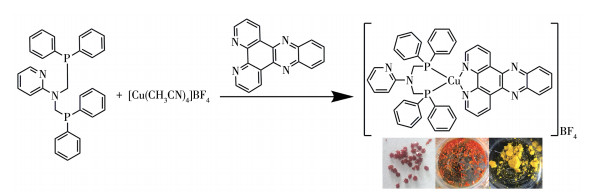
图 1.
配合物的合成路线
Figure 1.
Synthesis route of the complexes


过去几十年以来,过渡金属配合物的发光性能研究取得了长足的进展,人们对配合物发光性质的研究越来越多。ⅠB族金属配合物因其结构和功能的多样性及其在光、电化学和分离、吸附、催化等领域所具有的应用前景而备受青睐。特别是相较于储量有限、价格昂贵的铱、铂等贵金属,ⅠB族金属储量高、价格低廉,且ⅠB族的金属配合物具有优异的光物理性能。研究表明,基于卤素的亚铜簇对环境温度和压力敏感,是一种优秀的热致变色发光和力致变色发光材料[1]。Cu(Ⅰ)可以与含氮或膦的配体结合,形成稳定的四面体构型的配合物。Cu(Ⅰ)具有较低的氧化电势,其配合物的发射主要来自金属-配体电荷转移(MLCT)跃迁[2]。
Cu(Ⅰ)配合物丰富多样,对于[Cu(N, P)]+/[Cu(N, P)]0型Cu(Ⅰ)配合物的研究,主要集中于设计具有较大空间位阻的配体,通过减弱因MLCT跃迁引起的姜- 泰勒效应以提升发光性能[3-4]。双膦螯合配体的引入稳定了配合物的配位结构,降低了因溶剂参与配位造成的发光猝灭,进而提升了量子产率以及电荷转移跃迁寿命[1-5]。以上这些工作,对丰富发光Cu(Ⅰ)性能的研究及为应用于有机发光二极管(OLEDs)器件打下基础。
太赫兹(THz,1 THz=1012 Hz)波是指频率范围为0.1~10 THz的电磁波,其能量介于微波和红外光之间。在化学领域,太赫兹光谱为我们提供了比中红外更敏感的、强有力的研究工具。太赫兹吸收光谱的测量范围为0.04~4 kJ·mol-1,弱作用力的强度与太赫兹光谱可测量范围部分匹配,因此太赫兹光谱可用于研究分子间作用力[6-9]。在之前的研究中,我们发现太赫兹时域光谱(THz-TDS)可用于定性理解配合物的C—H…π、π…π作用力[10-13]。作为我们之前工作的延续,本研究中会使用太赫兹光谱对新化合物进行测定,同时也会促进太赫兹技术广泛地运用于化学及其交叉学科的理论研究和实际应用领域。
我们以2-(N,N-双(二苯基膦基甲基))胺基吡啶(bdppmapy)为膦配体、二吡啶并[3,2-a∶2′,3′-c]吩嗪(dppz)为氮配体,合成了3个[Cu(dppz)(bdppmapy)]BF4类Cu(Ⅰ)配合物,即[Cu(dppz)(bdppmapy)]2(BF4)2·H2O (CuBF4-1)、[Cu(dppz)(bdppmapy)]BF4 (CuBF4-2)和[Cu(dppz)(bdppmapy)]BF4 (CuBF4-3),并发现了单晶到单晶转化的现象。合成得到的配合物CuBF4-1和CuBF4-3只存在溶剂分子的不同,其对应发光性能却表现出明显的差异。研究结果表明,溶剂分子的存在会影响到配合物的空间堆积结构,进而影响配合物的发光性能[14-22]。最后,对相关配合物进行了光物理性能测试,得到了溶剂分子对这类配合物结构和光物理性质的影响规律。
元素分析(C、H、N)通过Flash EA1112元素分析仪进行测定。IR使用Brucker EQUINOX 55-FT光谱仪在4 000~400 cm-1波长范围内采用无水溴化钾压片测定。使用DMSO-d6(δ=2.5)作为溶剂,在VNMRS-600波谱仪上测得核磁共振氢谱,在VNMRS-600波谱仪上测得核磁共振磷谱,其中31P谱以85%的磷酸(δ=0)作为参考内标。在Bruker-D8 ADVANCE衍射仪上,使用Cu Kα(λ=0.154 18 nm)在40 kV、40 mA条件下获得粉末X射线衍射(PXRD)数据,扫描范围为5°~50°,扫速为10 (°)·min-1。热重分析(TGA)使用日本岛津DTG-60A/60AH热重仪进行,在氮气气氛中,测试温度以10 ℃·min-1的速度从25 ℃增加到800 ℃。荧光激发和发射光谱在日立F-4600分光光度计上测得。UV-Vis吸收光谱在UV-2550分光光度计上测量。在FLS-1000稳态/瞬态光谱仪上测量光致发光量子产率(PLQY)和荧光寿命。太赫兹吸收光谱通过太赫兹时域装置记录,其基于光电导开关,可用于远红外光源的产生和光电晶体的检测。样品的制备是将样品和聚乙烯的混合粉末压成1 mm薄片,为避免水蒸气对测试的影响,检测是在氮气气氛下进行的。有效光谱范围为0.2~3 THz(6.6~99 cm-1)。
主要试剂有铜盐[Cu(CH3CN)4]BF4、膦配体bdppmapy、氮配体dppz,溶剂:甲醇和二氯甲烷,以上化学试剂均采用市售分析纯,溶剂未作进一步纯化处理。配合物的合成路线如图 1所示。
将[Cu(CH3CN)4]BF4(0.031 5 g,0.1 mmol)和bdppmapy(0.049 1 g,0.1 mmol)加入5 mL甲醇和5 mL二氯甲烷的混合溶剂中,常温搅拌30 min后加入dppz(0.028 2 g,0.1 mmol),搅拌6 h,过滤,缓慢挥发几天后得到晶体。有趣的是,在合成过程中,共得到3种不同性质的晶体:CuBF4-1、CuBF4-2和CuBF4-3,其中CuBF4-3结构最为稳定。晶体生长过程中,同一样品随着时间的推移,可以明显发现颜色从红色到橙红色,对应晶体从CuBF4-1到CuBF4-2的转化,这是由于CuBF4-1的双核结构脱去溶剂,变为单晶结构;再由橙红色到黄色的转变,对应CuBF4-2到CuBF4-3的转化过程(图 1),这是晶体的堆积结构变化导致的。CuBF4-2最不稳定,存在时间最短,较难收集。将晶体用无水乙醚清洗后收集。
CuBF4-1晶体产率:0.061 g(65.4%)。配合物元素分析按C98H78B2Cu2F8N12OP4的计算值(%):C,63.14;N,9.02;H,4.22。实验值(%):C,63.13;N,9.01;H,4.10。红外数据(KBr,cm-1):3 447(w),3 053(w),1 593(s),1 475(s),1 436(s),1 382(w),1 358(m),1 313(w),1 280(w),1 225(m),1 058(s),854(m),819(w),765(m),737(s),696(s),617(w),578(w),498(w),480(w),427(w)。1H NMR(600 MHz,DMSO-d6,298 K):δ 9.65(d,J=8.0 Hz,4H),8.71(d,J=4.7 Hz,4H),8.42(dd,J=6.3,3.4 Hz,4H),8.10(dd,J=6.4,3.3 Hz,4H),8.05(dd,J=8.1,4.9 Hz,4H),7.88(dd,J=5.0,1.3 Hz,2H),7.50~7.44(m,16H),7.41(t,J=7.4 Hz,8H),7.31(t,J=7.5 Hz,16H),7.12(dt,J=18.5,5.8 Hz,2H),6.58(dd,J=7.1,5.1 Hz,2H),6.20(d,J=8.6 Hz,2H),5.30(s,8H)。31P NMR(243 MHz,DMSO-d6):δ -13.21。
CuBF4-2红外数据(KBr,cm-1):3 435(w),3 054(w),1 593m,1 476(s),1 437(s),1 381(w),1 358(m),1 314(w),1 280(w),1 224(w),1 162(w),1 059(s),854(m),818(m),765(m),738(s),697(m),617(w),576(w),498(w),479(m),426(w)。1H NMR(600 MHz,DMSO-d6,298 K):δ 9.64(d,J=8.1 Hz,2H),8.71(d,J=4.7 Hz,2H),8.40(dt,J=6.3,3.2 Hz,2H),8.09(dd,J=6.5,3.3 Hz,2H),8.05(dd,J=8.1,4.9 Hz,2H),7.88(dd,J=5.0,1.3 Hz,1H),7.47(ddd,J=8.1,6.5,3.1 Hz,8H),7.41(t,J=7.4 Hz,4H),7.31(t,J=7.5 Hz,8H),7.13(ddd,J=8.9,7.3,2.0 Hz,1H),6.58(dd,J=7.1,5.1 Hz,1H),6.20(d,J=8.6 Hz, 1H), 5.30(s,4H)。31P NMR(243 MHz,DMSO):δ -13.22。
CuBF4-3晶体产率:0.062g(67.2%)。配合物元素分析按C49H38CuN6P2BF4的计算值(%):C,63.75;N,9.10;H,4.15。实验值(%):C,63.72;N,9.11;H,4.10。红外数据(cm-1,KBr压片):3 434(w),3 052(w),1 592(m),1 476(s),1 438(m),1 359(w),1 281(w),1 224(w),1 051(s),840(w),817(w),766(m),735(m),695(m),618(w),503(w),469(w),427(w)。1H NMR(600 MHz,DMSO-d6):δ 9.65(d,J=8.0 Hz,2H),8.71(d,J=4.6 Hz,2H),8.41(dd,J=6.1,3.3 Hz,2H),8.10(dd,J=6.3,3.2 Hz,2H),8.05(dd,J=8.1,4.9 Hz,2H),7.88(dd,J=5.0,1.4 Hz,1H),7.47(ddd,J=8.1,6.4,3.0 Hz,8H),7.41(t,J=7.4 Hz,4H),7.31(t,J=7.5 Hz,8H),7.13(ddd,J=8.9,7.3,2.0 Hz,1H),6.58(dd,J=7.1,5.1 Hz,1H),6.20(d,J=8.6 Hz, 1H), 5.30(s, 4H)。31P NMR(243 MHz, DMSO):δ -13.22。
选取配合物CuBF4-1(尺寸:0.34 mm×0.3 mm×0.28 mm)、CuBF4-3(尺寸:0.4 mm×0.38 mm×0.07 mm)的透明、无裂纹的块状单晶,在Bruker SMART CCD单晶X射线衍射仪上用石墨单色器单色化的Cu Kα(λ=0.154 18 nm)/Mo Kα(λ=0.071 073 nm) 辐射,以φ-ω的扫描方式收集衍射点,并使用SADABS程序通过半经验方法校正所有数据。使用Olex2程序完成结构的解析和精修[23-25]。通过全矩阵最小二乘法对F 2上非氢原子的各向异性热参数进行最终优化,其余氢原子通过理论计算最终确定其坐标。相关晶体学数据及部分键长、键角数据分别汇总于表 1、表 2中。
 下载:
导出CSV
下载:
导出CSV
| Parameter | CuBF4-1 | CuBF4-3 |
| Formula | C98H78B2Cu2F8N12OP4 | C49H38CuN6P2BF4 |
| Formula weight | 1 864.35 | 923.14 |
| T / K | 293(2) | 117(2) |
| Crystal system | Trigonal | Monoclinic |
| Space group | R3 | P21/c |
| a / nm | 4.921 79(3) | 1.589 63(11) |
| b / nm | 4.921 79(3) | 1.338 10(7) |
| c / nm | 2.081 56(2) | 2.020 14(10) |
| β / (°) | 101.975(6) | |
| V / nm3 | 4.366 82(7) | 4.203 5(4) |
| Z | 18 | 4 |
| Dc / (g·cm-3) | 1.275 | 1.459 |
| F(000) | 17 208 | 1 896 |
| Goodness-of-fit on F 2 | 1.020 | 1.043 |
| Rint | 0.022 8 | 0.060 2 |
| R1 [I > 2σ(I)]a | 0.052 4 | 0.051 4 |
| wR2 [I > 2σ(I)]b | 0.157 6 | 0.098 4 |
| R1 (all data) | 0.056 8 | 0.080 2 |
| wR2 (all data) | 0.161 7 | 0.113 4 |
|
|
||
下载:
导出CSV
| CuBF4-1 | |||||
| Cu1—N3 | 0.207 19(19) | Cu1—N4 | 0.207 85(19) | Cu1—P2 | 0.223 97(7) |
| Cu1—P1 | 0.226 56(7) | Cu2—N10 | 0.204 6(2) | Cu2—N9 | 0.206 71(19) |
| Cu2—P3 | 0.223 97(7) | Cu2—P4 | 0.224 02(7) | ||
| N3—Cu1—N4 | 80.48(7) | N3—Cu1—P2 | 113.08(6) | N4—Cu1—P2 | 127.80(6) |
| N3—Cu1—P1 | 111.66(6) | N4—Cu1—P1 | 115.93(6) | P2—Cu1—P1 | 105.35(3) |
| N10—Cu2—N9 | 81.24(8) | N10—Cu2—P3 | 112.69(6) | N10—Cu2—P4 | 119.39(6) |
| N9—Cu2—P4 | 110.24(6) | N9—Cu2—P3 | 130.89(6) | P3—Cu2—P4 | 102.87(3) |
| CuBF4-3 | |||||
| Cu1—P1 | 0.222 53(9) | Cu1—P2 | 0.223 49(9) | Cu1—N3 | 0.204 2(3) |
| Cu1—N4 | 0.206 8(2) | ||||
| P1—Cu1—P2 | 107.02(3) | N3—Cu1—P1 | 111.93(7) | N3—Cu1—P2 | 112.53(7) |
| N3—Cu1—N4 | 81.08(10) | N4—Cu1—P1 | 124.00(7) | N4—Cu1—P2 | 117.60(7) |
单晶X射线衍射分析表明,配合物CuBF4-1和CuBF4-3中均含有[Cu(N^N)(P^P)]+阳离子。以Cu(Ⅰ)为中心,氮、膦配体分别以螯合的方式进行配位,BF4-作为抗衡阴离子(图 2)。配合物CuBF4-1属于三方晶系,R3空间群,配合物CuBF4-3属于单斜晶系P21/c空间群。配合物CuBF4-1中Cu—P和Cu—N键长范围分别为0.223 97(7)~0.226 56(7) nm和0.204 6(2)~0.207 85(19) nm。键角:∠P—Cu—P=102.87(3)°~105.35(3)°,∠N—Cu—N=80.48(3)°~81.24(8)°,∠P—Cu—N=110.24(6)°~130.89(6)°。配合物CuBF4-3中Cu—P和Cu—N键长范围分别为0.222 53(9)~ 0.223 49(9) nm和0.204 2(3)~0.206 8(2) nm。键角:∠P—Cu—P=107.02(3)°,∠N—Cu—N=81.08(10)°,∠P—Cu—N=111.93(7)°~124.00(7)°。键长和键角均在Cu(Ⅰ)配合物的正常范围,与之前研究的[Cu(N^N)(P^P)]+体系相比没有明显的差异,均表现出扭曲的四面体几何构型[26-27]。通过比较键角可以看出,虽然配合物CuBF4-1和CuBF4-3有着相同的配体以及配位模式,2种晶体的键长键角并非保持一致,其空间堆积模式也存在着明显的差异。
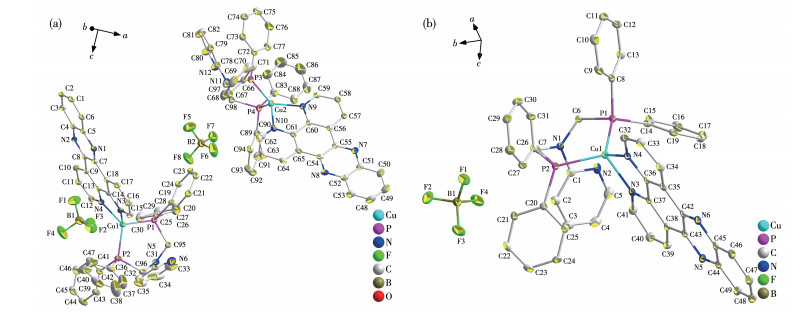
Hydrogen atoms and solvent molecules are omitted for clarity; Thermal ellipsoids are drawn at the 30% probability level.
使用Platon程序处理单晶数据得到各个配合物中C—H…π、π…π、C—H…F等弱作用力的具体信息(表 3和4)。这些作用力的存在,使配合物构建成不同的堆积结构。在配合物CuBF4-1的堆积结构中(图 3a),4个Cu(Ⅰ)配合物分子通过9种π…π和3种C—H…π作用力形成一个小单元:Cg(3)…Cg(3) 0.356 39 nm、Cg(15)…Cg(5) 0.355 56 nm、Cg(15)…Cg(8) 0.376 77 nm、Cg(16)…Cg(3) 0.345 56 nm、Cg(16)…Cg(7) 0.345 08 nm、Cg(19)…Cg(5) 0.373 21 nm、Cg(20)…Cg(3) 0.351 86 nm、Cg(20)…Cg(8) 0.355 86 nm、Cg(20)… Cg(18) 0.366 46 nm;C2…Cg(9) 0.271 nm(C2—H2B…Cg(9))、C17…Cg(21) 0.275 nm(C17—H17A…Cg(21))、C32…Cg(12) 0.284 nm(C32—H32…Cg(12))。每个小单元又由5种C—H…F、1种C—H…π和1种π…π作用力连接形成二维平面结构(图 3b):C12…F2 0.236 nm(C12—H12A…F2)、C47…F2 0.252 nm(C47—H47A…F2)、C62…F6 0.237 nm(C62—H62A…F6)、C95…F3 0.248 nm(C95—H95B…F3)、C96…F3 0.247 nm(C96—H96A…F3);C80…Cg(24) 0.253 nm(C80—H80A…Cg(24));Cg(18)…Cg(20) 0.366 5 nm。不同于配合物CuBF4-1,在配合物CuBF4-3中,2种C—H…π作用力连接相邻的2个C(Ⅰ)配合物分子形成一维链状结构(图 4a):C6…Cg(6) 0.293 nm(C6—H6B… Cg(6))、C24…Cg(8) 0.282 nm(C24—H24…Cg(8))。沿c轴方向,通过1种C—H…π和3种C—H…F作用力形成二维结构(图 4b):C28…Cg(9) 0.291 nm(C28—H28…Cg(9));C10…F1 0.251 nm(C10—H10…F1)、C30…F2 0.25 nm(C30—H30…F2)、C48…F4 0.251 nm(C48—H48…F4)。
下载:
导出CSV
| Complex | C—H…Cg | Cg | d(H…Cg) / nm | ∠C—H…Cg / (°) |
| CuBF4-1 | C2—H2B…Cg(9)ⅰ | C19-C24 | 0.271 | 140 |
| C17—H17A…Cg(21)ⅱ | C66-C71 | 0.275 | 150 | |
| C32—H32…Cg(12)ⅲ | C42-C47 | 0.284 | 150 | |
| C80—H80A…Cg(24)ⅳ | C89-C94 | 0.253 | 167 | |
| CuBF4-3 | C6—H6B…Cg(6)v | N5-C42-C43-C44-C45-N6 | 0.293 | 114 |
| C24—H24…Cg(8)ⅵ | C14-C19 | 0.282 | 160 | |
| C28—H28…Cg(9)ⅰ | C20-C24 | 0.291 | 150 | |
| Symmetry codes: ⅰ 1-x, 1-y, 1-z; ⅱ2/3-x+y, 4/3-x, 1/3+z; ⅲ x, y, z; ⅳ 1/3+x-y, -1/3+x, 2/3-z for CuBF4-1; ⅰ 1-x, 1-y, 1-z; ⅴ x, 1/2-y, -1/2+z; ⅵ x, 1/2-y, 1/2+z; for CuBF4-3. | ||||
下载:
导出CSV
| Complex | D—H…A | d(H…A) / nm | ∠D—H…A / (°) |
| CuBF4-1 | C12—H12A…F2 | 0.236 | 167 |
| C47—H47A…F2 | 0.252 | 123 | |
| C62—H62A…F6 | 0.237 | 135 | |
| C95—H95B…F3ⅶ | 0.248 | 154 | |
| C96—H96A…F3ⅶ | 0.247 | 146 | |
| CuBF4-3 | C10—H10…F1ⅷ | 0.251 | 166 |
| C30—H30…F2ⅷ | 0.250 | 155 | |
| C48—H48…F4ⅵ | 0.251 | 126 | |
| Symmetry codes: ⅶ 1/3+y, 2/3-x+y, 5/3-z for CuBF4-1; ⅵ x, 1/2-y, 1/2+z; ⅷ 1-x, -1/2+y, 1/2-z for CuBF4-3. | |||
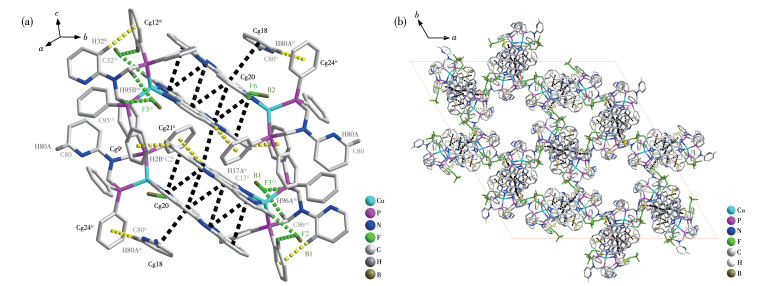
Some hydrogen atoms and benzene rings are omitted for clarity; Symmetry codes: ⅰ 1-x, 1-y, 1-z; ⅱ 2/3-x+y, 4/3-x, 1/3+z; ⅲ x, y, z; ⅳ 1/3+x-y, -1/3+x, 2/3-z; ⅶ 1/3+y, 2/3-x+y, 5/3-z.
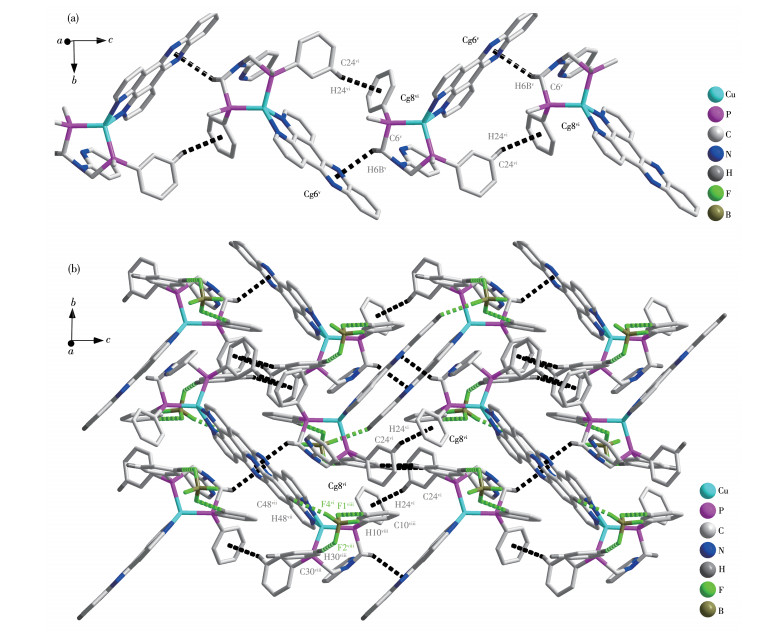
Symmetry codes: ⅰ 1-x, 1-y, 1-z; ⅴ x, 1/2-y, -1/2+z; ⅵ x, 1/2-y, 1/2+z; ⅷ 1-x, -1/2+y, 1/2-z.
配合物CuBF4-1、CuBF4-2和CuBF4-3的结构通过红外、1H/31P NMR波谱、PXRD分析证实,元素分析与其化学式一致。3个配合物的红外光谱在3 054、1 592和1 482 cm-1处的峰归因于bdppmapy的苯基的伸缩振动,在1 061 cm-1处的强吸收峰为BF4-的特征峰。配合物的1H NMR中在δ=7.50~7.31的位置出现苯环的信号峰,在δ=7.88~6.20的位置出现吡啶的信号峰,在δ=5.30的位置出现亚甲基的信号峰。除此之外,还有氮配体所体现的信号峰(dppz,δ=9.65~8.05)。3个配合物的31P NMR谱表明,2个PPh2基团在与中心金属配位后,bdppmapy中P的化学位移为-13.21~-13.22,较未参与配位的配体的化学位移(23.5)发生了移动。
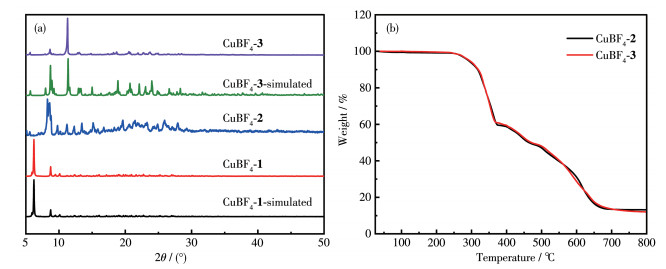
如图 5a所示,配合物CuBF4-1和CuBF4-3的PXRD图的衍射峰与其单晶X射线衍射数据生成的模拟结果很好地匹配,说明配合物均为纯相。在配合物CuBF4-1到CuBF4-2的晶型转化过程中,对应的PXRD数据发生明显的变化。这种显著的变化与溶剂分子的脱除相关,溶剂的去除使得配合物的结构发生坍塌,在PXRD图上表现出明显的变化。在配合物CuBF4-2到CuBF4-3的晶型转化过程中,对应的PXRD数据整体变化不明显,只有个别衍射峰的消失与移动,且TGA数据差别不明显(图 5b),可见配合物CuBF4-2到CuBF4-3的变化过程中并未导致结构的塌陷,只是改变了配合物的堆积模式,此结论也可通过后文的测试验证,且这种现象与文献中的报道相一致[28]。
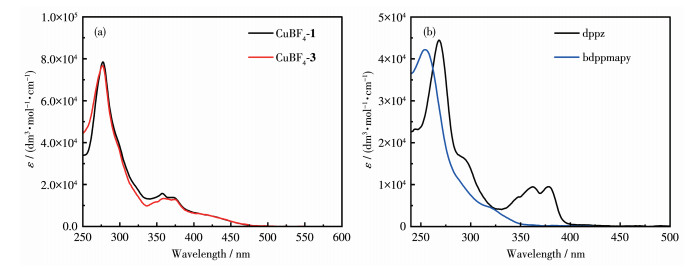
室温下,用二氯甲烷作溶剂,分别配制浓度为5.0 μmol·L-1的配合物的稀溶液,并进行紫外可见吸收光谱测试。紫外可见吸收光谱表明,配合物CuBF4-1和CuBF4-3分别在250~300 nm和330~380 nm之间存在强吸收峰(图 6a),与2个配体在240~300 nm之间所展现出的吸收峰基本保持一致(图 6b),这可归因于以配体为中心的π-π*的跃迁。配合物CuBF4-1和CuBF4-3在330~380 nm之间存在强吸收峰,与配体dppz的紫外可见吸收峰一致(330~390 nm),这可归因于配体dppz分子内的π-π*跃迁。除此之外,在400 nm之后出现相对较弱的宽吸收峰,这可归因于金属到配体的电荷跃迁,这符合Cu(Ⅰ)配合物的典型发光机理。
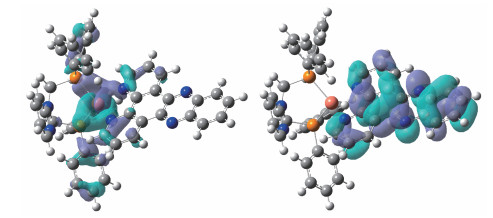
为了进一步探究配合物的发光机理,采用含时密度泛函理论(TDDFT)方法,选择Gaussian03程序中的B3LYP泛函和6-31G*基组,计算了配合物的光谱[29-32]。由于配合物CuBF4-1和CuBF4-3的阳离子部分具有相同的化学结构,因此只需计算其中一个,即可绘制出轨道能级分布图。以配合物CuBF4-3为例,与大多数Cu(Ⅰ)配合物一致,CuBF4-3表现出MLCT激发特征,其中HOMO主要分布在铜原子和磷原子的原子轨道上,LUMO主要位于氮配体的p轨道上(图 7)。因此,这一结果可有效地证明配合物发射机理为MLCT特征,轨道电子各部分占比及相关计算信息见表 5和6。
 下载:
导出CSV
下载:
导出CSV
| Orbit of [Cu(bdppmapy)(dppz)]+ | Composition / % | |||
| Cu | Fused ring | C5N2H4 | Phosphine ligand | |
| HOMO-2 | 52.85 | 21.50 | 0.88 | 24.77 |
| LUMO | 0.35 | 97.98 | 0.03 | 1.64 |
下载:
导出CSV
| Energy / eV | λ / nm | Vibration intensity | Transition | Contribution / % |
| 4.367 0 | 283.91(absorption) | 0.690 9 | HOMO-17→LUMO | 4.31 |
| HOMO-8→LUMO | 9.95 | |||
| HOMO-8→LUMO+2 | 3.06 | |||
| HOMO-7→LUMO | 5.51 | |||
| HOMO-7→LUMO+2 | 2.45 | |||
| HOMO-6→LUMO | 2.81 | |||
| HOMO-6→LUMO+2 | 2.47 | |||
| HOMO-5→LUMO+2 | 2.75 | |||
| HOMO-4→LUMO+2 | 43.60 | |||
| HOMO→LUMO+6 | 5.80 | |||
| 2.714 8 | 456.70(emission) | 0.036 3 | HOMO-2←LUMO | 87.16 |
| HOMO-2←LUMO+1 | 10.50 |
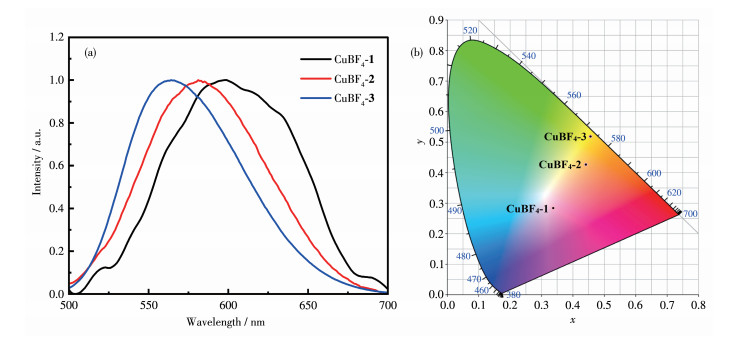
室温下对3个配合物的光物理性质进行了测试(图 8和表 7)。在371 nm的最佳激发波长下其最大发射波长分别为598 nm(136 a.u.)、581 nm(413.6 a.u.)和564 nm(5 228 a.u.),其相对应的色坐标分别为:(0.337 5, 0.283 6)、(0.441 9, 0.426 8)和(0.456 4, 0.519 3)。从荧光光谱图中可以看出,从配合物CuBF4-1到配合物CuBF4-3,发射峰表现出明显的蓝移以及发光强度明显增强的现象。
 下载:
导出CSV
下载:
导出CSV
| Complex | UV-Vis absorption | Solid fluorescence | ||||||
| λmaxa / nm | ε / (dm3·mol-1·cm-1) | λemb / nm | τavc / μs | Фd | kre / s-1 | knrf / s-1 | ||
| CuBF4-1 | 277, 358, 410 | 78 826, 16 073, 5 911 | 598 | — | — | |||
| CuBF4-2 | 581 | 0.76 | 0.05 | 6.6×10⁴ | 1.3×10⁵ | |||
| CuBF4-3 | 277, 358, 410 | 77 340, 13 760, 5 952 | 564 | 9.7 | 0.16 | 1.6×10⁴ | 8.7×10⁴ | |
|
a The spectra were measured at 5.0 μmol·L-1 in dichloromethane solvent; b At the optimal excitation wavelength of 371 nm, the maximum emission of the complexes at 298 K; c |
||||||||
为了进一步探索其光物理性质,我们对这3个配合物分别进行了室温荧光量子产率以及寿命的测试。配合物CuBF4-1未测得量子产率和寿命。CuBF4-2和CuBF4-3的荧光量子产率分别为0.05和0.16,寿命分别为0.76和9.7 μs。可以看出,虽然这3个配合物主体结构相同,但是由于溶剂分子以及堆积方式的不同而表现出不同的光物理性质。在配合物CuBF4-1中含有一个水分子,相比较而言,配合物CuBF4-3中不存在溶剂分子,但其光物理性质最好。一方面,游离的溶剂分子的存在会影响配合物激发态的稳定性,导致激发态变形,不利于辐射跃迁,进而降低配合物的量子效率。另一方面,具有网状结构的配合物CuBF4-1容易受到外界环境的影响而使堆积结构发生变化,进而对配合物的发光产生影响。对应地,在不含有溶剂分子的配合物CuBF4-3中表现出较高的荧光量子产率。基于以上现象,我们认为在这种体系中,溶剂分子的存在不利于光物理性质的提升。
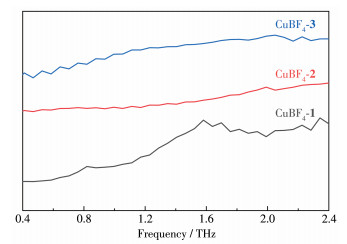
太赫兹具有特异性,不同配合物中含有的弱作用力的不同,太赫兹吸收光谱中会表现出不同的吸收峰。图 9展示了配合物CuBF4-1、CuBF4-2和CuBF4-3的太赫兹谱图。配合物中溶剂分子的参与会对配合物的空间堆积产生影响,这种弱作用力不同引起的差异在太赫兹谱图中存在明显的区别。在配合物CuBF4-1中,在1.6 THz附近可以看到明显的吸收峰,这可能与配合物CuBF4-1中丰富的弱作用力相关联。在配合物CuBF4-3中,晶体数据中含有的弱作用力较少,在太赫兹谱图中吸收峰表现不明显。由此可见,太赫兹谱图在表征配合物中弱作用力有一定的作用,具体的归属还需相关理论计算相辅助,本工作不再深入探讨。
选用bdppmapy为膦配体、dppz为氮配体、[Cu(CH3CN)4]BF4为铜盐进行反应,合成了3种[Cu(dppz)(bdppmapy)]BF4型配合物,其中2种是因溶剂分子的差异而不同的晶体。这种Cu(Ⅰ)配合物展现出单晶到单晶转化过程的现象。通过一系列测试手段对配合物进行结构和性能表征,探究了溶剂分子的存在对配合物结构和光物理性能的影响。配合物中游离的溶剂分子的存在会影响配合物激发态的稳定性,导致激发态变形,不利于辐射跃迁,进而降低配合物的量子效率。另一方面,具有网状结构的配合物CuBF4-1容易受到外界环境的影响而使堆积结构发生变化,进而对配合物的发光产生影响。通过比较配合物发光性质的差异,得到了溶剂分子对配合物结构和光物理性质的影响规律。
Rader R A, McMillin D R, Buckner M T, Matthews T G, Casadonte D J, Lengel R K, Whittaker S B, Darmon L M, Lytle F E. Photostudies of[Cu(bpy)(PPh3)2]+, [Cu(phen)(PPh3)2]+, and[Cu(dmp)(PPh3)2]+ in solution and in rigid, low-temperature glasses. Simultaneous multiple emissions from intraligand and charge-transfer states[J]. J. Am. Chem. Soc., 1981, 103(19): 5906-5912. doi: 10.1021/ja00409a048
Casadonte D J, McMillin D R. Dual emissions from Cu(dmp)(PR3)2+ systems in a rigid glass: Influence of the phosphine donor strength[J]. Inorg. Chem., 1987, 26(23): 3950-3952. doi: 10.1021/ic00270a025
Cuttell D G, Kuang S M, Fanwick P E, McMillin D R, Walton R A. Simple Cu(Ⅰ) complexes with unprecedented excited-state lifetimes[J]. J. Am. Chem. Soc., 2002, 124(1): 6-7. doi: 10.1021/ja012247h
Yersin H, Czerwieniec R, Shafikov M Z, Suleymanova A F. TADF material design: Photophysical background and case studies focusing on CuⅠ and AgⅠ complexes[J]. ChemPhysChem, 2017, 18: 3508-3535. doi: 10.1002/cphc.201700872
Kuang S M, Cuttell D G, McMillin D R, Fanwick P E, Walton R A. Synthesis and structural characterization of Cu(Ⅰ) and Ni(Ⅱ) complexes that contain the bis[2-(diphenylphosphino)phenyl]ether ligand. Novel emission properties for the Cu(Ⅰ) species[J]. Inorg. Chem., 2002, 41(12): 3313-3322. doi: 10.1021/ic0201809
Zaczek A J, Korter T M. Polymorphism in cis-trans muconic acid crystals and the role of C—H…O hydrogen bonds[J]. Cryst. Growth Des., 2017, 17(8): 4458-4466. doi: 10.1021/acs.cgd.7b00854
Andersen J, Heimdal J, Nelander B, Wugt Larsen R. Competition between weak OH…π and CH…O hydrogen bonds: THz spectroscopy of the C2H2—H2O and C2H4—H2O complexes[J]. J. Chem. Phys., 2017, 146(19): 194302. doi: 10.1063/1.4983293
Kleist E M, Koch Dandolo C L, Guillet J P, Mounaix P, Korter T M. Terahertz spectroscopy and quantum mechanical simulations of crystalline copper-containing historical pigments[J]. J. Phys. Chem. A, 2019, 123(6): 1225-1232. doi: 10.1021/acs.jpca.8b11676
Rexrode N R, Orien J, King M D. Effects of solvent stabilization on pharmaceutical crystallization: Investigating conformational polymorphism of probucol using combined solid-state density functional theory, molecular dynamics, and terahertz spectroscopy[J]. J. Phys. Chem. A, 2019, 123(32): 6937-6947. doi: 10.1021/acs.jpca.9b00792
Zhu N, Wang G, Lin S, Li Z F, Xin X L, Yang Y P, Liu M, Jin Q H. New discovery in crystallography: Correlation of terahertz time- domain spectra with crystal structures and photoluminescence properties of mononuclear/binuclear diimine-Cu(Ⅰ)-phosphine complexes[J]. CrystEngComm, 2019, 21(29): 4275-4288. doi: 10.1039/C9CE00729F
Pan X, Kuang X N, Zhu N, Wang G, Yang Y P, Liu J M, Li Z F, Xin X L, Han H L, Jin Q H, Ren Z G, Zhang J W. Terahertz time-domain absorption spectra of Cu(Ⅰ) complexes bearing tetraphosphine ligands: The bridge between the C—H…π and π-π interactions and photoluminescence properties[J]. Dalton Trans., 2020, 49(42): 14941-14950. doi: 10.1039/D0DT02542A
Sun Z Z, Zhu N, Pan X, Wang G, Li Z F, Xin X L, Han H L, Feng Y B, Jin Q H, Yang Y P, Yang W. A new application of terahertz time-domain absorption spectra in luminescent complexes: Characterization of the C—H…π weak interactions in Cu(Ⅰ) complexes[J]. Dalton Trans., 2021, 50(29): 10214-10224. doi: 10.1039/D1DT01023A
Pan X, Li Z X, Wang G, Yang Y P, Xin X L, Han H L, Liu J M, Jin Q H, Yan D P. Excellent blue emissive neutral Cu(Ⅰ) complexes: Structural analysis, thermochromic luminescent properties, and terahertz spectrum research[J]. Cryst. Growth Des., 2021, 21(11): 6425-6436. doi: 10.1021/acs.cgd.1c00884
Chen X W, Yuan H L, He L H, Chen J L, Liu S J, Wen H R, Zhou G J, Wang J Y, Wong W Y. A sublimable dinuclear cuprous complex showing selective luminescence vapochromism in the crystalline state[J]. Inorg. Chem., 2019, 58(21): 14478-14489. doi: 10.1021/acs.inorgchem.9b01972
Sandroni M, Kayanuma M, Rebarz M, Akdas-Kilig H, Pellegrin Y, Blart E, Bozec H L, Daniel C, Odobel F. Heteroleptic diimine copper(Ⅰ) complexes with large extinction coefficients: Synthesis, quantum chemistry calculations and physico-chemical properties[J]. Dalton Trans., 2013, 42(40): 14628-14638. doi: 10.1039/c3dt51288f
Keller S, Constable E C, Housecroft C E, Neuburger M, Prescimone A, Longo G, Pertegás A, Sessolo M, Bolink H J. [Cu(bpy)(P.P)]+ containing light-emitting electrochemical cells: Improving performance through simple substitution[J]. Dalton Trans., 2014, 43(44): 16593-16596. doi: 10.1039/C4DT02847C
Linfoot C L, Leitl M J, Richardson P, Richardson P, Rausch A F, Chepelin O, White F J, Yersin H, Robertson N. Thermally activated delayed fluorescence (TADF) and enhancing photoluminescence quantum yields of[CuⅠ(diimine)(diphosphine)]+ complexes-photophysical, structural, and computational studies[J]. Inorg. Chem., 2014, 53(20): 10854-10861. doi: 10.1021/ic500889s
Brunner F, Martinez-Sarti L, Keller S, Keller S, Pertegás A, Prescimone A, Constable E C, Bolink H J, Housecroft C E. Peripheral halo-functionalization in [Cu(N.N)(P.P)]+ emitters: Influence on the performances of light-emitting electrochemical cells[J]. Dalton Trans., 2016, 45(38): 15180-15192. doi: 10.1039/C6DT02665F
Zhang F L, Guan Y Q, Chen X L, Wang S S, Liang D, Feng Y F, Chen S F, Li S Z, Zhang F Q, Lu C Z, Gao G X, Zhai B. Syntheses, photoluminescence, and electroluminescence of a series of sublimable bipolar cationic cuprous complexes with thermally activated delayed fluorescence[J]. Inorg. Chem., 2017, 56(7): 3742-3753. doi: 10.1021/acs.inorgchem.6b01847
Fresta E, Volpi G, Milanesio M, Garino C, Barolo Claudia, Costa R D. Novel ligand and device designs for stable light-emitting electrochemical cells based on heteroleptic copper(Ⅰ) complexes[J]. Inorg. Chem., 2018, 57(16): 10469-10479. doi: 10.1021/acs.inorgchem.8b01914
Minozzi C, Caron A, Grenier-Petel J C, Santandrea J, Collins S K. Heteroleptic copper(Ⅰ)-based complexes for photocatalysis: Combinatorial assembly, discovery, and optimization[J]. Angew. Chem. Int. Ed., 2018, 57(19): 5477-5481. doi: 10.1002/anie.201800144
Fresta E, Weber M D, Fernandez-Cestau J, Costa R D. White light-emitting electrochemical cells based on deep-red Cu(Ⅰ) complexes[J]. Adv. Opt. Mater., 2019, 7(23): 1900830. doi: 10.1002/adom.201900830
Bruker. SMART and SAINT, Madison Wisconsin, Simens Analytical X-ray Instrument Inc., 1996.
Sheldrick G M. SHELXTL NT Ver. 5.1. University of Göttingen, Germany, 1997.
Sheldrick G M. SHELXTL-97 and SHELXL-97. University of Göttingen, Germany, 1997.
Sun Z Z, Zhu N, Pan X, Hu F Z, Wang G, Yang Y P, Qiu Q M, Li Z F, Xin X L, Liu J M, Li X Q, Jin Q H, Ren Z G, Zhou Q L. Designing luminescent diimine-Cu(Ⅰ)-phosphine complexes by tuning N-ligand and counteranions: Correlation of weak interactions, luminescence and THz absorption spectra[J]. CrystEngComm, 2022, 24: 1258-1266. doi: 10.1039/D1CE01574E
Li Z X, Sun Z Z, Wang G, Yang W, Han H L, Yang Y P, Li Z F, Dai L X, Yao Y S, Jin Q H. Study on the luminescence properties of ionic[Cu(N.N)(P.P)]+ complexes: Influence of ligands, counteranions and weak interactions[J]. CrystEngComm, 2022, 24: 7739-7750. doi: 10.1039/D2CE01177H
Küchle W, Dolg M, Stoll H, Preuss H. J. Chem. Phys. , 1994, 100(10): 7535-7542 doi: 10.1063/1.466847
Becke A D. Density-functional thermochemistry. Ⅲ. The role of exact exchange[J]. J. Chem. Phys., 1993, 122(98): 5648-5652.
Dreuw A, Head-Gordon M. Single-reference ab initio methods for the calculation of excited states of large molecules[J]. Chem. Rev., 2005, 105: 4009-4037. doi: 10.1021/cr0505627
Hanwell M D, Curtis D E, Lonie D C, Vandermeersch T, Zurek E, Hutchison G R. Avogadro: An advanced semantic chemical editor, visualization, and analysis platform[J]. J. Cheminformatics, 2012, 4: 17. doi: 10.1186/1758-2946-4-17
Frisch M J, Trucks G W, Schlegel H B, Scuceria G E. Gaussian 03. Wallingford, CT, Gaussian, Inc., 2003.

图 2 配合物CuBF4-1和CuBF4-3的单晶结构示意图
Figure 2 Single crystal structure diagrams of complexes CuBF4-1 and CuBF4-3
Hydrogen atoms and solvent molecules are omitted for clarity; Thermal ellipsoids are drawn at the 30% probability level.

图 3 配合物CuBF4-1的空间堆积结构: (a) 每个小单元包含的弱作用力类型; (b) 6个连续的小单元通过π…π、C—H…π和C—H…F作用力沿c轴方向形成的三维孔状结构
Figure 3 Spatial stacking structure of complex CuBF4-1: (a) the type of weak force contained in each small unit; (b) a 3D pore-like structure formed by six continuous small units along the c-axis through π…π, C—H…π, and C—H…F forces
Some hydrogen atoms and benzene rings are omitted for clarity; Symmetry codes: ⅰ 1-x, 1-y, 1-z; ⅱ 2/3-x+y, 4/3-x, 1/3+z; ⅲ x, y, z; ⅳ 1/3+x-y, -1/3+x, 2/3-z; ⅶ 1/3+y, 2/3-x+y, 5/3-z.

图 4 配合物CuBF4-3的空间堆积结构: (a) 两种C—H…π作用力沿c轴方向连接相邻的两个Cu(Ⅰ)一维链状结构; (b) 一种C—H…π和三种C—H…F作用力形成的二维平面结构
Figure 4 Spatial packing structure of complex CuBF4-3: (a) 1D chain structure formed by two C—H…π forces connecting two adjacent Cu(Ⅰ) molecules along the c-axis; (b) 2D planar structure formed by one C—H…π and three C—H…F forces
Symmetry codes: ⅰ 1-x, 1-y, 1-z; ⅴ x, 1/2-y, -1/2+z; ⅵ x, 1/2-y, 1/2+z; ⅷ 1-x, -1/2+y, 1/2-z.

图 5 三种配合物的PXRD图; (b) CuBF4-2和CuBF4-3的TG曲线
Figure 5 (a) PXRD patterns of the three complexes; (b) TG curves of CuBF4-2 and CuBF4-3

图 6 室温下(a) 配合物CuBF4-1、CuBF4-3和(b) 配体的紫外可见吸收光谱
Figure 6 a) UV-Vis absorption spectra of complexes CuBF4-1, CuBF4-3 and (b) the ligands at room temperature

图 7 配合物CuBF4-3的HOMO (左)与LUMO (右)能级分布图
Figure 7 Energy level distribution of HOMO (left) and LUMO (right) of complex CuBF4-3

图 8 配合物的(a) 荧光光谱图和(b) 色坐标
Figure 8 Fluorescence spectra and (b) color coordinates of the complexes

图 9 配合物CuBF4-1、CuBF4-2和CuBF4-3的太赫兹谱图
Figure 9 THz spectra of complexes CuBF4-1, CuBF4-2, and CuBF4-3
表 1 配合物CuBF4-1和CuBF4-3的晶体学数据
Table 1. Crystallographic data of complexes CuBF4-1 and CuBF4-3
| Parameter | CuBF4-1 | CuBF4-3 |
| Formula | C98H78B2Cu2F8N12OP4 | C49H38CuN6P2BF4 |
| Formula weight | 1 864.35 | 923.14 |
| T / K | 293(2) | 117(2) |
| Crystal system | Trigonal | Monoclinic |
| Space group | R3 | P21/c |
| a / nm | 4.921 79(3) | 1.589 63(11) |
| b / nm | 4.921 79(3) | 1.338 10(7) |
| c / nm | 2.081 56(2) | 2.020 14(10) |
| β / (°) | 101.975(6) | |
| V / nm3 | 4.366 82(7) | 4.203 5(4) |
| Z | 18 | 4 |
| Dc / (g·cm-3) | 1.275 | 1.459 |
| F(000) | 17 208 | 1 896 |
| Goodness-of-fit on F 2 | 1.020 | 1.043 |
| Rint | 0.022 8 | 0.060 2 |
| R1 [I > 2σ(I)]a | 0.052 4 | 0.051 4 |
| wR2 [I > 2σ(I)]b | 0.157 6 | 0.098 4 |
| R1 (all data) | 0.056 8 | 0.080 2 |
| wR2 (all data) | 0.161 7 | 0.113 4 |
|
|
||
 下载: 导出CSV
表 2 配合物CuBF4-1和CuBF4-3的部分键长(nm)和键角(°)
Table 2. Selected bond lengths (nm) and bond angles (°) for complexes CuBF4-1 and CuBF4-3
| CuBF4-1 | |||||
| Cu1—N3 | 0.207 19(19) | Cu1—N4 | 0.207 85(19) | Cu1—P2 | 0.223 97(7) |
| Cu1—P1 | 0.226 56(7) | Cu2—N10 | 0.204 6(2) | Cu2—N9 | 0.206 71(19) |
| Cu2—P3 | 0.223 97(7) | Cu2—P4 | 0.224 02(7) | ||
| N3—Cu1—N4 | 80.48(7) | N3—Cu1—P2 | 113.08(6) | N4—Cu1—P2 | 127.80(6) |
| N3—Cu1—P1 | 111.66(6) | N4—Cu1—P1 | 115.93(6) | P2—Cu1—P1 | 105.35(3) |
| N10—Cu2—N9 | 81.24(8) | N10—Cu2—P3 | 112.69(6) | N10—Cu2—P4 | 119.39(6) |
| N9—Cu2—P4 | 110.24(6) | N9—Cu2—P3 | 130.89(6) | P3—Cu2—P4 | 102.87(3) |
| CuBF4-3 | |||||
| Cu1—P1 | 0.222 53(9) | Cu1—P2 | 0.223 49(9) | Cu1—N3 | 0.204 2(3) |
| Cu1—N4 | 0.206 8(2) | ||||
| P1—Cu1—P2 | 107.02(3) | N3—Cu1—P1 | 111.93(7) | N3—Cu1—P2 | 112.53(7) |
| N3—Cu1—N4 | 81.08(10) | N4—Cu1—P1 | 124.00(7) | N4—Cu1—P2 | 117.60(7) |
下载: 导出CSV
表 3 配合物CuBF4-1和CuBF4-3中的C—H…π作用
Table 3. C—H…π interactions in complexes CuBF4-1 and CuBF4-3
| Complex | C—H…Cg | Cg | d(H…Cg) / nm | ∠C—H…Cg / (°) |
| CuBF4-1 | C2—H2B…Cg(9)ⅰ | C19-C24 | 0.271 | 140 |
| C17—H17A…Cg(21)ⅱ | C66-C71 | 0.275 | 150 | |
| C32—H32…Cg(12)ⅲ | C42-C47 | 0.284 | 150 | |
| C80—H80A…Cg(24)ⅳ | C89-C94 | 0.253 | 167 | |
| CuBF4-3 | C6—H6B…Cg(6)v | N5-C42-C43-C44-C45-N6 | 0.293 | 114 |
| C24—H24…Cg(8)ⅵ | C14-C19 | 0.282 | 160 | |
| C28—H28…Cg(9)ⅰ | C20-C24 | 0.291 | 150 | |
| Symmetry codes: ⅰ 1-x, 1-y, 1-z; ⅱ2/3-x+y, 4/3-x, 1/3+z; ⅲ x, y, z; ⅳ 1/3+x-y, -1/3+x, 2/3-z for CuBF4-1; ⅰ 1-x, 1-y, 1-z; ⅴ x, 1/2-y, -1/2+z; ⅵ x, 1/2-y, 1/2+z; for CuBF4-3. | ||||
下载: 导出CSV
表 4 配合物CuBF4-1和CuBF4-3中的氢键
Table 4. Hydrogen bonding in complexes CuBF4-1 and CuBF4-3
| Complex | D—H…A | d(H…A) / nm | ∠D—H…A / (°) |
| CuBF4-1 | C12—H12A…F2 | 0.236 | 167 |
| C47—H47A…F2 | 0.252 | 123 | |
| C62—H62A…F6 | 0.237 | 135 | |
| C95—H95B…F3ⅶ | 0.248 | 154 | |
| C96—H96A…F3ⅶ | 0.247 | 146 | |
| CuBF4-3 | C10—H10…F1ⅷ | 0.251 | 166 |
| C30—H30…F2ⅷ | 0.250 | 155 | |
| C48—H48…F4ⅵ | 0.251 | 126 | |
| Symmetry codes: ⅶ 1/3+y, 2/3-x+y, 5/3-z for CuBF4-1; ⅵ x, 1/2-y, 1/2+z; ⅷ 1-x, -1/2+y, 1/2-z for CuBF4-3. | |||
下载: 导出CSV
表 5 优化后的S0结构中配合物CuBF4-3的S1态HOMO和LUMO的组成
Table 5. Composition of S1 state HOMO and LUMO of complex CuBF4-3 in the optimized S0 structure
| Orbit of [Cu(bdppmapy)(dppz)]+ | Composition / % | |||
| Cu | Fused ring | C5N2H4 | Phosphine ligand | |
| HOMO-2 | 52.85 | 21.50 | 0.88 | 24.77 |
| LUMO | 0.35 | 97.98 | 0.03 | 1.64 |
下载: 导出CSV
表 6 配合物CuBF4-3的能量、振动强度和跃迁时的主要贡献
Table 6. Energy, vibration intensity, and main contributions during the transition of complex CuBF4-3
| Energy / eV | λ / nm | Vibration intensity | Transition | Contribution / % |
| 4.367 0 | 283.91(absorption) | 0.690 9 | HOMO-17→LUMO | 4.31 |
| HOMO-8→LUMO | 9.95 | |||
| HOMO-8→LUMO+2 | 3.06 | |||
| HOMO-7→LUMO | 5.51 | |||
| HOMO-7→LUMO+2 | 2.45 | |||
| HOMO-6→LUMO | 2.81 | |||
| HOMO-6→LUMO+2 | 2.47 | |||
| HOMO-5→LUMO+2 | 2.75 | |||
| HOMO-4→LUMO+2 | 43.60 | |||
| HOMO→LUMO+6 | 5.80 | |||
| 2.714 8 | 456.70(emission) | 0.036 3 | HOMO-2←LUMO | 87.16 |
| HOMO-2←LUMO+1 | 10.50 |
下载: 导出CSV
表 7 配合物的光物理数据
Table 7. Photophysical data of the complexes
| Complex | UV-Vis absorption | Solid fluorescence | ||||||
| λmaxa / nm | ε / (dm3·mol-1·cm-1) | λemb / nm | τavc / μs | Фd | kre / s-1 | knrf / s-1 | ||
| CuBF4-1 | 277, 358, 410 | 78 826, 16 073, 5 911 | 598 | — | — | |||
| CuBF4-2 | 581 | 0.76 | 0.05 | 6.6×10⁴ | 1.3×10⁵ | |||
| CuBF4-3 | 277, 358, 410 | 77 340, 13 760, 5 952 | 564 | 9.7 | 0.16 | 1.6×10⁴ | 8.7×10⁴ | |
|
a The spectra were measured at 5.0 μmol·L-1 in dichloromethane solvent; b At the optimal excitation wavelength of 371 nm, the maximum emission of the complexes at 298 K; c |
||||||||
下载: 导出CSV

 扫一扫看文章


扫一扫关注我们
