
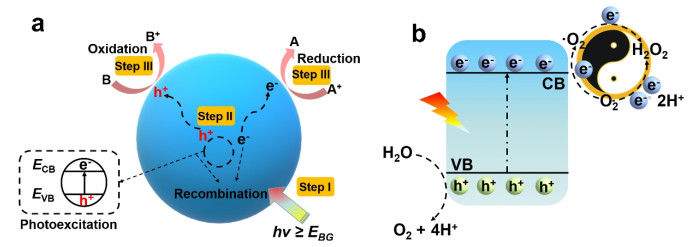
Figure 1.
(a) Photoexcitation and charge decay pathway. (b) Mechanism diagram of the photocatalytic production of H2O2.[1]


Hydrogen peroxide (H2O2) has received much attention as a promising highly efficient and environmentally benign oxidant, which is widely used in organic synthesis, wastewater treatment and energy field. Especially, H2O2 is completely soluble in water and easy to transport, making it an ideal energy carrier to replace H2. To date, the traditional methods of producing H2O2 mainly include anthraquinone oxidation and direct synthesis from H2 and O2. However, the above methods still need to input high energy, produce environmentally harmful substances and have explosion risk, which hinder their practical applications. Conversely, H2O2 production by photocatalytic two-electron O2 reduction process (2e- ORR) has attracted much attention due to its simple mechanism (Figure 1a), eco-friendliness and low-cost. It is verified that 2e- ORR process consists of a sequential two-step single-electron reduction or a one-step two-electron reduction (Figure 1b).[1] So far, various photocatalysts have been researched for H2O2 production, such as TiO2 and metal organic frameworks. In particular, polymeric carbon nitride (PCN) has been regarded as a promising 2e- ORR photocatalyst by virtue of its high stability, unique structure and excellent electronic property.[2] However, the efficiency of PCN for H2O2 production is still greatly limited by its poor activity and 2e- ORR selectivity.
Note that the alkali metal doped PCN can effectively improve interlayer charge transfer. In addition, the diffusion distance at which electron migration from the bulk to the surface of PCN is shortened by its ultrathin structure, thus enhancing the photocatalytic activity of H2O2 production. Nevertheless, the strong π-π interaction can cause the ultrathin PCN to restack and agglomerate during the stripping process, which severely reduces the availability of active sites. It is an effective strategy for the construction of quasi-homogeneous system with abundant edge active sites to increase the number of surface active sites, improve the adsorption and activation ability of O2, and promote 2e- ORR selectivity.[3] Recently, writing in Angewandte Chemie International Edition, Ao and colleagues reported that a quasi-homogeneous photocatalytic system for the efficient generation of H2O2 was constructed by using iodide ions as invisible inhibitors to interrupt PCN (TP-PCN) polymerization.
The quasi-homogeneous system with a fragmented as well as ultrathin structure of TP-PCN exposes rich marginal active sites (cyano and hydroxyl group, Figure 2a). As a result, compared with PCN, the rich edge active sites of TP-PCN highly improve the separation efficiency of charge carriers. Besides, the abundance of marginal active sites also highly promotes the ability of O2 adsorption and the selectivity of 2e- ORR. More importantly, the electrons of TP-PCN in β spin-orbital can transfer directly to the π* orbital of O2, thus promoting the activation of O2 (Figure 2b). That is to say, the quasi-homogeneous system possesses high dispersion and hydrophilicity, which determines the concentration of surface-active sites. Small size and ultra-thin structure are conducive to expose abundant edge active sites. The O2 adsorption capacity of different positions is investigated by density functional theory (DFT). The results show that finding the edge active sites (-C≡N and -OH) is more favorable to improving the O2 adsorption capacity and reducing the reaction energy barrier of H2O2 formation.
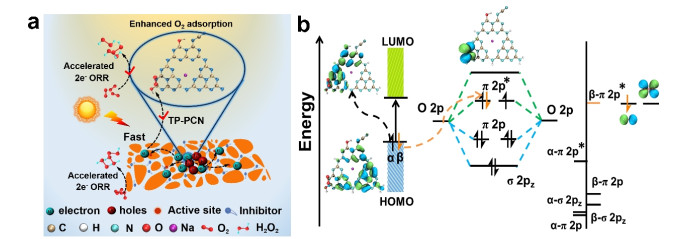
In summary, experimental and calculational results confirm that the obtained quasi-homogeneous photocatalytic system significantly improves the photocatalytic H2O2 production activity. The excellent photocatalytic H2O2 production activity is mainly due to the small size and ultrathin structure, which significantly improves the separation/transfer efficiency of charge carriers. In addition, enhancing the adsorption and activation capacity of O2 and promoting the selectivity of 2e- ORR are important for highly efficient H2O2 production. Overall, the current work provides new insights into the establishment of a new method for building high-performance PCN with abundant edge active sites for quasi-homogeneous photocatalytic H2O2 production.
Hou, H. L.; Zeng, X. K.; Zhang, X. W. Production of hydrogen peroxide by photocatalytic processes. Angew. Chem. Int. Ed. 2020, 59, 17356-17376. doi: 10.1002/anie.201911609
Wu, Y.; Chen, J.; Che, H. N.; Gao, X.; Ao, Y. H.; Wang, P. F. Boosting 2e− oxygen reduction reaction in garland carbon nitride with carbon defects for high-efficient photocatalysis-self-Fenton degradation of 2, 4-dichlorophenol. Appl. Catal. B: Environ. 2022, 307, 121185. doi: 10.1016/j.apcatb.2022.121185
Che, H. N.; Gao, X.; Chen, J.; Hou, J.; Ao, Y. H.; Wang, P. F. Iodide-induced fragmentation of polymerized hydrophilic carbon nitride for high-performance quasi-homogeneous photocatalytic H2O2 production. Angew. Chem. Int. Ed. 2021, 60, 25546-25550.

Figure 1 (a) Photoexcitation and charge decay pathway. (b) Mechanism diagram of the photocatalytic production of H2O2.[1]

 扫一扫看文章


扫一扫关注我们
 DownLoad:
 下载:
下载:
