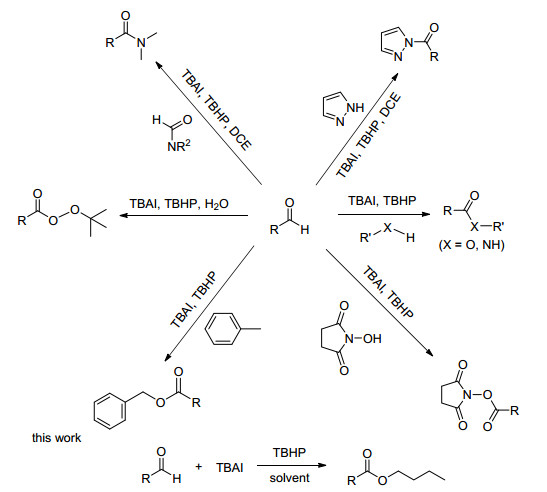
Scheme 1.
"TBAI-TBHP" catalyzed reaction of aldehydes


Quaternary ammonium salts were commonly used as phase transfer catalysts[1] and additives[2] to promote the organic reaction. But in fact, a quaternary ammonium salt is one of the most common N-containing substrates in organic synthesis because of its active C—N bond.[3] Catalyzed by transition metal catalysts the quaternary ammonium salts could be applied to Kumada-Corriu cross-coupling, [4] Suzuki cross-coupling, [5] Negishi cross-coupling, [6] and Buchwald-Hartwig amination.[7] But in the absence of transition metal, the C—N bond cleavage of quaternary ammonium salts is still a challenging work.
The development of metal-free protocols in coupling processes can indeed be considered a significant step forward towards advanced greener synthetic methodologies in organic synthesis. Presently, nBu4NI (TBAI) in combination with the oxidant tert-butyl hydroperoxide (TBHP), as an environmentally friendly and mild metal free catalyst, was proved to be very efficient in various types of oxidative transformations.[8] In this catalytic system, the aldehyde was found to be used as elegant acylating reagent because of its active C—H bond. In 2011, Wan et al.[9] reported the first example of TBAI-catalyzed tert-butyl peresters synthesis directly from aldehydes and TBHP in H2O. Catalyzed by "TBAI-TBHP", aldehydes could be coupled with N, N-disubstituted formamides, [10] azoles, [11] alcohols, [12] amines, [12] N-hydroxyimides[13] and alkylarenes[14] to form amides or esters (Scheme 1). In all of the above reactions, the TBAI plays a role of iodide ion donor for decomposing TBHP to generate tert-butoxy radical, but the quaternary ammonium cation part is not involved in these reactions.
Esters and their derivatives are substantial products or intermediates in the chemical and pharmaceutical industries.[15] Esterification of carboxylic acid or carboxylic acid derivatives with alcohols is perhaps the most commonly utilized method for the synthesis of esters.[15] Herein we report the first example of metal-free esterification reaction using quaternary ammonium salts as carbon sources for synthesis of esters. A broad scope of aldehydes or carboxylic acids performed the esterification reactions with quaternary ammonium salts to synthesize the corresponding esters. The mechanism study indicates that the C—N bond cleavage of quaternary ammonium salt affords the alkyl halide which is served as the alkyl source of product and tertiary amine which is served as catalyst.
Our initial investigation focused on the reaction of 4-cyanobenzaldehyde (1a) and TBAI (2a). Selected results were summarized in Table 1. We are pleased to find that using TBHP as oxidant, the desired product n-butyl 4-cyanobenzoate (3aa) was obtained in 71% yield after refluxing in PhCl (Entry 1). Other peroxides, such as peroxyacetic acid (PAA), tert-butyl peroxybenzoate (TBPB), di-tert-butyl peroxide (TBP), benzoyl peroxide (BP) and H2O2 were also effective for this reaction, but let to a lower yields of ester 3aa (Entries 2~6). It was noteworthy that no desired ester 3aa was obtained without any oxidant, suggesting the importance of the oxidant (Entry 7). The disappointing results were obtained by swi-tching to other solvents, such as toluene, N, N-dimethyl-formamide (DMF), H2O and dimethyl sulfoxide (DMSO) (Entries 8~11). In addition, the temperature variation could obviously affect the catalytic performance, both a decrease and increase (110 and 140 ℃) reduced the yield of 3aa (Entries 12, 13). When the reaction temperature decreased to 100 ℃, only trace amount of 3aa was isolated (Entry 14). This indicated that the C—N bond cleavage of nBu4NI needs higher temperature.
 下载:
导出CSV
下载:
导出CSV
 |
||||
| Entry | Peroxide | Solvent | Temp./℃ | Yieldb/% |
| 1 | TBHP | PhCl | 120 | 71 |
| 2 | PAA | PhCl | 120 | 55 |
| 3 | TBPB | PhCl | 120 | 40 |
| 4 | TBP | PhCl | 120 | 44 |
| 5 | BP | PhCl | 120 | 25 |
| 6 | H2O2 | PhCl | 120 | 18 |
| 7 | — | PhCl | 120 | 0 |
| 8 | TBHP | Toluene | 120 | Trace |
| 9 | TBHP | DMF | 120 | 0 |
| 10 | TBHP | H2O | 120 | 0 |
| 11 | TBHP | DMSO | 120 | 0 |
| 12 | TBHP | PhCl | 140 | 59 |
| 13 | TBHP | PhCl | 110 | 15 |
| 14 | TBHP | PhCl | 100 | Trace |
| a Reaction conditions: 1a (0.2 mmol), 2a (2 equiv.), peroxide (3.5 equiv.), solvent (2 mL), air, 24 h. b Isolated yield. | ||||
To define the scope of the oxidative esterification reaction, we applied this process to a series of aldehydes as shown in Table 2. The benzaldehydes with electron-with-drawing (Cl, Br, NO2, CF3) and electron-donating (Me, OMe) groups all worked well with TBAI, affording the desired esters in 36%~76% yields, respectively. Compari-son of 4-nitrobenzaldehyde (1f) with 2-nitro-benzaldehyde (1g) shows that steric hindrance might play a role in the reaction. Naphthaldehyde (1j) as well as benzaldehyde derivatives performed the oxidative esterification reaction to give the corresponding ester 3ja albeit in comparatively lower yield. Using furan-2-carbaldehyde (1k) and thiophene-2-carbaldehyde (1l) as heteroaromatic aldehydes resulted in desired heteroaromatic esters in moderate yields. To our delight, unsaturated aliphatic aldehyde 1m could also undergo the oxidative esterification smoothly to give fatty acid ester 3ma in 66% yield.
下载:
导出CSV
 |
 |
| a Reaction conditions: 1 (0.2 mmol), 2a (0.4 mmol), TBHP (3.5 equiv.), PhCl (2 mL), air, 24 h. b Isolated yield. |
To demonstrate the synthetic utility of the method, other quaternary ammonium salts were used instead of TBAI to react with 4-cyanobenzaldehyde (1a). As shown in Table 3, tetrabutylammonium bromide, tetrabutylammonium chloride and tetrabutylammonium acetate performed this oxidative esterification reaction to afford the same product as TBAI in 32%~65% yields (Entries 1~3). Obviously, with the strengthening of ionic bond, the C—N bond cleavage becoming much more difficult. When benzyltributylammonium bromide (2f) and benzyltriethylammonium bromide (2g) were used to react with 1a, benzyl 4-cyanobenzoate (3af) was exclusively obtained without other esters (Entries 5, 6). These results indicated that the oxidative esterification reaction has excellent regioselectivity for benzyl quaternary ammonium salts. Not only that, the benzyltriethylammonium bromide (2g) showed the higher activity than TBAI for this reaction and gave the best yield. Likewise, the benzyltriethylammonium bromide (2g) could react with benzaldehyde and 3-phenyl propionaldehyde smoothly to give desired products (Entries 7, 8). In addition, when the didodecyldimethylammonium bromide (2h) was used as substrate, two kinds of esters were isolated and the proportion of methyl 4-cyanobenzoate (3ah') was larger than dodecyl 4-cyanobenzoate (3ah) (Entry 9). This shows that the oxidative esterification reaction has poorer regioselectivity for different alkyl group of quaternary ammonium salts.
下载:
导出CSV
 |
||||
| Entry | Aldehyde | Quaternary ammonium salt | Product | Yieldb/% |
| 1 | 1a |  |
3aa | 65 |
| 2 | 1a |  |
3aa | 34 |
| 3 | 1a |  |
3aa | 32 |
| 4 | 1a |  |
 |
64 |
| 5 | 1a |  |
 |
34 |
| 6 | 1a |  |
3af | 81 |
| 7 |  |
2g |  |
71 |
| 8 |  |
2g |  |
34 |
| 9 | 1a |  |
 |
19 41 |
| a Reaction conditions: 1 (0.2 mmol), 2 (0.4 mmol), TBHP (3.5 equiv.), PhCl (2 mL), air, 24 h. b Isolated yield. | ||||
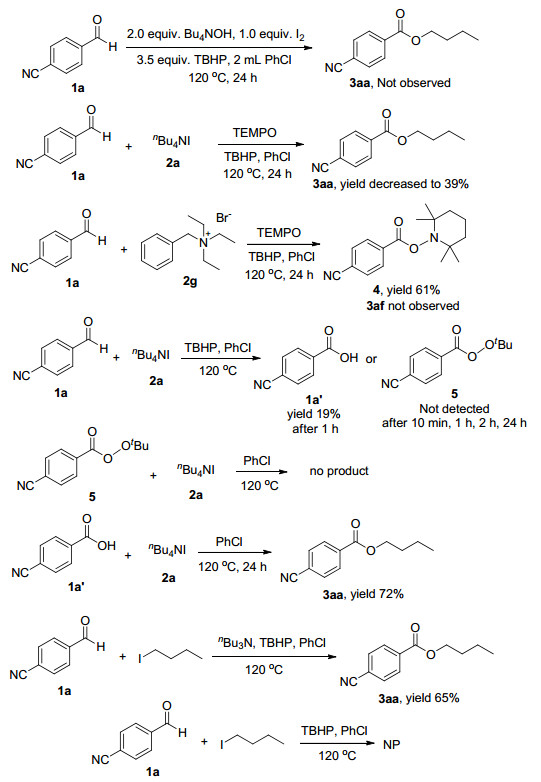
To get a better understanding about the esterification of quaternary ammonium salts, further control experiments have been performed (Scheme 2). From the mechanistic point of view, its oxidizing capacities generally fall into two categories: the first involves the in situ generated tertbutoxy radical; the second involves the hypervalent iodine species [Bu4N]+[IO]- and [Bu4N]+[IO2]-.[8a] We first investigated whether in situ generated hypoiodite ([IO]-) was the catalytic species.[9, 14] In the presence of stoichiometric amount of Bu4NOH and I2 ([Bu4N]+[IO]- generated in situ), no desired ester was observed. Therefore, the hypoiodite is not the actual catalytic species in the present oxidative esterification and the butyl group of 3aa was not come from C—N cleavage of hypoiodite. The addition of 2, 2, 6, 6-tetra-methyl piperidinooxy (TEMPO) in model reaction prevented the reaction and the yield of product 3aa decreased to 39%. When TEMPO was added in reaction of 1a with 2g, the formation of 3af was not observed. Instead, 2, 2, 6, 6-tetramethylpiperidin-1-yl 4-cyanobenzoate (4) generated from the coupling of acyl radical and TEMPO was obtained in 61% yield. This result suggested that an acyl radical intermediate was involved in the present catalytic cycle. According to the Wan's work, [9] tert-butyl peresters may be the key intermediate in the formation of 3aa, because of the very similar reaction conditions. But tert-butyl 4-cyano-benzoperoxoate (5) was not observed after reaction 10 min, 1 h, 2 h, 24 h, instead, 4-cyanobenzoic acid (1a') was obtained in 19% yield after reaction 1 h. And 4-cyanobenzoic acid (1a') could directly react with 2a to give 3aa in 72% yield whereas tert-butyl 4-cyanobenzo-peroxoate (5) could not. These results suggesting that 4-cyanobenzoic acid (1a') is most likely a key intermediate for the present transformation and only the oxidation step which aldehyde convert to carboxylic acid is involved in free radical process.
To identify the byproduct formed by the cleavage of the C—N bond of quaternary ammonium salt, the reaction solution of 1a with 2a was detected with gas chromatography-mass (GCMS) after the end of reaction. The GCMS data showed that along with the desired product 3aa, 1-iodobutane and tributylamine were detected. This indicated that the C—N bond cleavage of quaternary ammonium salt affords the 1-iodobutane and tertiary amine in this reaction and the 1-iodobutane is served as the alkyl source of product. To prove this viewpoint, 1-iodobutane and tributylamine were used instead of TBAI in model reaction and desired ester 3aa was isolated in 65% yield. But without tributylamine, no desired ester was observed. These results confirmed that TBAI affords the alkyl halide which is served as the alkyl source of product and tertiary amine which is served as catalyst.
Aim to confirm the speculation and extend the synthetic utility of the esterification, a variety of carboxylic acids were used to directly react with quaternary ammonium salts in PhCl without TBHP. As shown in Table 4, every carboxylic acid, including aromatic carboxylic acids, heteroaromatic carboxylic acids and aliphatic carboxylic acids, reacts with TBAI (2a) or benzyltriethylammonium bromide (2g) to give the corresponding esters in 51%~90% yields (Entries 1~12). Compared with corresponding aldehydes, most of carboxylic acids afford higher yield of esters without peroxides. Therefore, the esterification of carboxylic acids with quaternary ammonium salts is more efficient and practical.
下载:
导出CSV
 |
||||
| Entry | Carboxylic acid | Quaternary ammonium salt | Product | Yieldb/% |
| 1 |  |
2a | 3fa | 78 |
| 2 |  |
2a | 3ca | 64 |
| 3 |  |
2a |  |
75 |
| 4 |  |
2a | 3ma | 59 |
| 5 |  |
2a | 3la | 62 |
| 6 |  |
2a |  |
57 |
| 7 |  |
2a |  |
51 |
| 8 |  |
2g |  |
90 |
| 9 |  |
2g | 3ng | 86 |
| 10 |  |
2g | 3og | 61 |
| 11 |  |
2g |  |
66 |
| 12 |  |
2g |  |
65 |
| a Reaction conditions: 1' (0.2 mmol), 2 (0.4 mmol), PhCl (2 mL), air, 24 h. b Isolated yield. | ||||
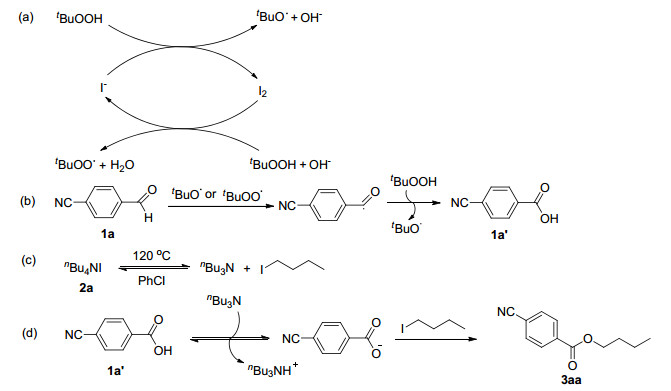
On the basis of above experimental results and previous publications, a plausible reaction mechanism is presented in Scheme 3. Initially, tert-butoxyl radical and tert-butyl-peroxy radical are generated through the reaction of tBuOOH under the promotion of nBu4NI (2a) (Scheme 3, a).[10] Then, tert-butoxyl radical or tert-butylperoxy radical abstracts a hydrogen from 1a to form an acyl radical. The in situ formed acyl radical reacts with tBuOOH to generate 1a' and tert-butoxyl radical (Scheme 3, b). On the other hand, nBu4NI (2a) decomposes to 1-iodobutane and nBu3N via C—N bond cleavage under the high temperature condition or solvent effect (Scheme 3, c). Under the reaction conditions, nBu3N serves as useful base in the deprotonation of the carboxylic acid (1a'), and the carboxylate anion[16] and the generated carboxylate anion undergoes a nucleophilic substitution with 1-iodobutane to afford 3aa (Scheme 3, d).
In summary, we developed the first example of metal-free C—N cleavage reaction of quaternary ammonium salts for the synthesis of broad scope of esters. Different from other reported "TBAI-TBHP" catalytic reactions, TBAI is served as not only iodide ion donor but also alkyl source to involve in the esterification reaction. Using quaternary ammonium salts as carbon sources, a broad scope of aldehydes and carboxylic acids perform the esterification reactions to synthesize the corresponding esters in yields up to 90%. This study opens the door to metal-free C—N cleavage reaction of quaternary ammonium salts. Ongoing work seeks to gain further insights into the mechanism of this reaction.
The reaction was conducted in a 35 mL of oven-dried reaction tube. The oxidative esterification of 4-cyano-benzaldehyde (1a) with TBAI (2a) was used as the model reaction. In a typical reaction, 4-cyanobenzaldehyde (26.2 mg, 0.20 mmol), TBAI (147.7 mg, 0.4 mmol), TBHP (100 µL, 0.7 mmol) and PhCl (2.0 mL) were added into the reaction tube. The reaction mixture was stirred at 120 ℃ for 24 h in an oil bath. After being cooled to room temperature, the reaction solution was evaporated in vacuo. The residue was purified by flash column chromatography (silica gel, V(ethylacetate):V(petroleum ether)=1:5~1:10 as an eluent) to afford the desired ester 3.
The reaction was conducted in a 35 mL of oven-dried reaction tube. The reaction of 4-cyanobenzoic acid (1a') with TBAI (2a) was used as the model reaction. In typical reaction, 4-cyanobenzoic acid (29.4 mg, 0.2 mmol), TBAI (147.7 mg, 0.4 mmol) and PhCl (2.0 mL) were added into the reaction tube. The reaction mixture was stirred at 120 ℃ for 24 h in an oil bath. After being cooled to room temperature, the reaction solution was evaporated in vacuo. The residue was purified by flash column chromatography [silica gel, V(ethylacetate):V(petroleum ether)=1:5~1:10 as an eluent] to afford the desired ester 3.
Butyl 4-cyanobenzoate (3aa):[17] Yield 71% (28.8 mg). 1H NMR (500 MHz, CDCl3) δ: 8.20~8.09 (m, 2H), 7.84~7.68 (m, 2H), 4.36 (t, J=6.6 Hz, 2H), 1.83~1.71 (m, 2H), 1.53~1.41 (m, 2H), 0.98 (t, J=7.4 Hz, 3H); 13C NMR (126 MHz, CDCl3) δ: 165.0, 134.3, 132.2, 130.1, 118.0, 116.3, 65.7, 30.6, 19.2, 13.7.
Butyl 4-chlorobenzoate (3ba):[17] Yield 64% (27.1 mg). 1H NMR (500 MHz, CDCl3) δ: 8.05~7.88 (m, 2H), 7.53~7.34 (m, 2H), 4.32 (t, J=6.6 Hz, 2H), 1.84~1.67 (m, 2H), 1.53~1.39 (m, 2H), 0.98 (t, J=7.4 Hz, 3H); 13C NMR (126 MHz, CDCl3) δ: 165.8, 139.2, 130.9, 128.9, 128.7, 65.1, 30.7, 19.3, 13.8.
Butyl 4-bromobenzoate (3ca):[17] Yield 36% (18.4 mg). 1H NMR (500 MHz, CDCl3) δ: 7.90 (d, J=8.5 Hz, 2H), 7.58 (d, J=8.5 Hz, 2H), 4.32 (t, J=6.6 Hz, 2H), 1.82~1.68 (m, 2H), 1.55~1.39 (m, 2H), 0.98 (t, J=7.4 Hz, 3H); 13C NMR (126 MHz, CDCl3) δ: 166.0, 131.7, 131.1, 129.4, 127.9, 65.1, 30.7, 19.3, 13.8.
Butyl 4-methoxybenzoate (3da):[18] Yield 68% (28.3 mg). 1H NMR (500 MHz, CDCl3) δ: 8.09~7.94 (m, 2H), 6.97~6.83 (m, 2H), 4.29 (t, J=6.6 Hz, 2H), 3.86 (s, 3H), 1.79~1.66 (m, 2H), 1.52~1.41 (m, 2H), 0.98 (t, J=7.4 Hz, 3H); 13C NMR (126 MHz, CDCl3) δ: 166.5, 163.3, 131.5, 123.0, 113.6, 64.5, 55.4, 30.9, 19.3, 13.8.
Butyl 4-methylbenzoate (3ea):[17] Yield 43% (16.5 mg). 1H NMR (500 MHz, CDCl3) δ: 7.94 (d, J=8.2 Hz, 2H), 7.24 (d, J=8.0 Hz, 2H), 4.31 (t, J=6.6 Hz, 2H), 2.41 (s, 3H), 1.81~1.68 (m, 2H), 1.56~1.41 (m, 2H), 0.98 (t, J=7.4 Hz, 3H); 13C NMR (126 MHz, CDCl3) δ: 166.8, 143.4, 129.6, 129.0, 127.8, 64.7, 30.8, 21.7, 19.3, 13.8.
Butyl 4-nitrobenzoate (3fa):[17] Yield 76% (33.9 mg). 1H NMR (500 MHz, CDCl3) δ: 8.31~8.24 (m, 1H), 8.23~8.17 (m, 2H), 4.38 (t, J=6.7 Hz, 2H), 1.85~1.70 (m, 2H), 1.56~1.38 (m, 2H), 0.99 (t, J=7.4 Hz, 3H); 13C NMR (126 MHz, CDCl3) δ: 164.8, 150.5, 135.9, 130.7, 123.5, 65.8, 30.6, 19.2, 13.7.
Butyl 2-nitrobenzoate (3ga):[19] Yield 45% (20.1 mg). 1H NMR (500 MHz, CDCl3) δ: 7.90 (dd, J=7.9, 1.0 Hz, 1H), 7.75 (dd, J=7.5, 1.5 Hz, 1H), 7.68 (td, J=7.5, 1.2 Hz, 1H), 7.63 (td, J=7.7, 1.5 Hz, 1H), 4.34 (t, J=6.7 Hz, 2H), 1.77~1.66 (m, 2H), 1.49~1.37 (m, 2H), 0.96 (t, J=7.4 Hz, 3H); 13C NMR (126 MHz, CDCl3) δ: 165.5, 148.3, 132.8, 131.7, 129.9, 127.9, 123.9, 66.4, 30.3, 19.1, 13.7.
Butyl 2, 4-dinitrobenzoate (3ha):[20] Yield 38% (20.4 mg). 1H NMR (500 MHz, CDCl3) δ: 8.78 (d, J=2.1 Hz, 1H), 8.53 (dd, J=8.4, 2.2 Hz, 1H), 7.95 (d, J=8.4 Hz, 1H), 4.39 (t, J=6.7 Hz, 2H), 1.79~1.67 (m, 2H), 1.51~1.35 (m, 2H), 0.97 (t, J=7.4 Hz, 3H); 13C NMR (126 MHz, CDCl3) δ: 163.8, 148.91, 133.1, 131.3, 127.4, 119.6, 67.3, 30.2, 19.0, 13.6.
Butyl 2-(trifluoromethyl)benzoate (3ia):[21] Yield 53% (26.1 mg). 1H NMR (500 MHz, CDCl3) δ: 7.83~7.69 (m, 2H), 7.67~7.53 (m, 2H), 4.34 (t, J=6.7 Hz, 2H), 1.81~1.68 (m, 2H), 1.53~1.40 (m, 2H), 0.97 (t, J=7.4 Hz, 3H); 13C NMR (126 MHz, CDCl3) δ: 167.1, 131.7, 131.6, 131.0, 130.1, 128.8, 128.5, 126.6 (q, JC-F=21.5 Hz), 124.5, 122.3, 66.0, 30.4, 19.1, 13.7.
Butyl 2-naphthoate (3ja):[17] Yield 37% (16.9 mg). 1H NMR (500 MHz, CDCl3) δ: 8.61 (s, 1H), 8.07 (dd, J=8.6, 1.5 Hz, 1H), 7.97 (d, J=8.1 Hz, 1H), 7.89 (d, J=8.5 Hz, 2H), 7.62~7.58 (m, 1H), 7.58~7.51 (m, 1H), 4.40 (t, J=6.6 Hz, 2H), 1.85~1.76 (m, 2H), 1.59~1.47 (m, 2H), 1.02 (t, J=7.4 Hz, 3H); 13C NMR (126 MHz, CDCl3) δ: 166.9, 135.5, 132.5, 130.9, 129.4, 128.2, 128.1, 127.8, 127.8, 126.6, 125.3, 65.0, 30.9, 19.3, 13.8.
Butyl furan-2-carboxylate (3ka):[18] Yield 41% (13.8 mg). 1H NMR (500 MHz, CDCl3) δ: 7.58 (d, J=0.7 Hz, 1H), 7.17 (d, J=3.5 Hz, 1H), 6.51 (dd, J=3.4, 1.7 Hz, 1H), 4.31 (t, J=6.7 Hz, 2H), 1.80~1.68 (m, 2H), 1.51~1.38 (m, 2H), 0.97 (t, J=7.4 Hz, 3H); 13C NMR (126 MHz, CDCl3) δ: 158.9, 146.2, 144.9, 117.7, 111.8, 64.8, 30.7, 19.2, 13.7.
Butyl thiophene-2-carboxylate (3la):[18] Yield 67% (24.7 mg). 1H NMR (500 MHz, CDCl3) δ: 7.82 (dd, J=3.7, 1.2 Hz, 1H), 7.56 (dd, J=5.0, 1.2 Hz, 1H), 7.12 (dd, J=4.9, 3.8 Hz, 1H), 4.32 (t, J=6.6 Hz, 2H), 1.83~1.69 (m, 2H), 1.55~1.42 (m, 2H), 1.00 (t, J=7.4 Hz, 3H); 13C NMR (126 MHz, CDCl3) δ: 162.4, 134.1, 133.2, 132.2, 127.7, 65.0, 30.8, 19.2, 13.8.
Butyl cinnamate (3ma):[22] Yield 66% (26.9 mg). 1H NMR (500 MHz, CDCl3) δ: 7.71 (d, J=16.0 Hz, 1H), 7.61~7.49 (m, 2H), 7.44~7.36 (m, 3H), 6.47 (d, J=16.0 Hz, 1H), 4.24 (t, J=6.7 Hz, 2H), 1.76~1.68 (m, 2H), 1.52~1.41 (m, 2H), 0.99 (t, J=7.4 Hz, 3H); 13C NMR (126 MHz, CDCl3) δ: 167.1, 144.6, 134.5, 130.2, 128.9, 128.1, 118.3, 64.5, 30.8, 19.2, 13.8.
Propyl 4-cyanobenzoate (3ae):[23] Yield 64% (24.2 mg). 1H NMR (500 MHz, CDCl3) δ: 8.16 (d, J=8.4 Hz, 2H), 7.76 (d, J=8.4 Hz, 2H), 4.33 (t, J=6.7 Hz, 2H), 1.87~1.76 (m, 2H), 1.05 (t, J=7.4 Hz, 3H); 13C NMR (126 MHz, CDCl3) δ: 165.0, 134.3, 132.2 (2C), 130.1 (2C), 118.0, 116.3, 67.3, 22.0, 10.5.
Benzyl 4-cyanobenzoate (3af):[24] Yield 34% (16.1 mg). 1H NMR (500 MHz, CDCl3) δ: 8.20~8.12 (m, 2H), 7.78~7.69 (m, 2H), 7.48~7.34 (m, 5H), 5.40 (s, 2H); 13C NMR (126 MHz, CDCl3) δ: 164.8, 135.3, 133.9, 132.3 (2C), 130.2 (2C), 128.8 (2C), 128.6, 128.4 (2C), 118.0, 116.5, 67.5.
Benzyl benzoate (3ng):[24] Yield 71% (30.1 mg). 1H NMR (500 MHz, CDCl3) δ: 8.11 (d, J=7.3 Hz, 2H), 7.62~7.54 (m, 1H), 7.51~7.33 (m, 7H), 5.39 (s, 2H); 13C NMR (126 MHz, CDCl3) δ: 166.5, 136.1, 133.1, 130.2, 129.7 (2C), 128.6 (2C), 128.4 (2C), 128.3, 128.2 (2C), 66.7.
Benzyl 3-phenylpropanoate (3og):[25] Yield 34% (16.3 mg). 1H NMR (500 MHz, CDCl3) δ: 7.41~7.27 (m, 7H), 7.25~7.14 (m, 3H), 5.14 (s, 2H), 3.00 (t, J=7.8 Hz, 2H), 2.71 (t, J=7.8 Hz, 2H); 13C NMR (151 MHz, CDCl3) δ: 172.8, 140.4, 135.9, 128.6, 128.6, 128.5, 128.3, 128.3, 126.3, 66.3, 35.9, 31.0.
Dodecyl 4-cyanobenzoate (3ah):[26] Yield 19% (11.9 mg). 1H NMR (500 MHz, CDCl3) δ: 8.14 (d, J=8.1 Hz, 2H), 7.75 (d, J=8.2 Hz, 2H), 4.35 (t, J=6.7 Hz, 2H), 1.85~1.72 (m, 2H), 1.43~1.22 (m, 18H), 0.88 (t, J=6.8 Hz, 3H).
Methyl 4-cyanobenzoate (3ah'):[27] Yield 41% (13.2 mg). 1H NMR (500 MHz, CDCl3) δ: 8.15 (d, J=8.3 Hz, 2H), 7.75 (d, J=8.3 Hz, 2H), 3.97 (s, 3H); 13C NMR (126 MHz, CDCl3) δ: 165.5, 133.9, 132.3, 130.1, 118.0, 116.4, 52.8.
Butyl 1-naphthoate (3p'a):[18] Yield 75% (34.2 mg). 1H NMR (500 MHz, CDCl3) δ: 8.94 (d, J=8.7 Hz, 1H), 8.20 (dd, J=7.3, 1.2 Hz, 1H), 8.02 (d, J=8.2 Hz, 1H), 7.89 (d, J=8.1 Hz, 1H), 7.69~7.58 (m, 1H), 7.58~7.45 (m, 2H), 4.44 (t, J=6.7 Hz, 2H), 1.91~1.72 (m, 2H), 1.62~1.42 (m, 2H), 1.03 (t, J=7.4 Hz, 3H); 13C NMR (151 MHz, CDCl3) δ: 166.5, 132.7, 132.0, 130.2, 128.8, 127.3, 126.5, 126.3, 124.9, 124.7, 123.3, 63.8, 29.7, 18.2, 12.6.
Butyl pyrazine-2-carboxylate (3q'a):[28] Yield 57% (20.5 mg). 1H NMR (500 MHz, CDCl3) δ: 9.29 (d, J=1.4 Hz, 1H), 8.85~8.62 (m, 2H), 4.44 (t, J=6.8 Hz, 2H), 1.89~1.69 (m, 2H), 1.57~1.42 (m, 2H), 0.97 (t, J=7.4 Hz, 3H); 13C NMR (151 MHz, CDCl3) δ: 161.6, 145.2, 143.8, 142.1, 141.3, 63.8, 28.2, 16.7, 11.3.
Butyl picolinate (3r'a):[18] Yield 51% (18.3 mg). 1H NMR (500 MHz, CDCl3) δ: 8.89~8.68 (m, 1H), 8.13 (d, J=7.8 Hz, 1H), 7.84 (td, J=7.7, 1.7 Hz, 1H), 7.56~7.41 (m, 1H), 4.42 (t, J=6.9 Hz, 2H), 1.90~1.71 (m, 2H), 1.55~1.38 (m, 2H), 0.97 (t, J=7.4 Hz, 3H); 13C NMR (151 MHz, CDCl3) δ: 163.0, 147.6, 146.0, 134.8, 124.6, 122.9, 63.6, 28.5, 16.9, 11.5.
Benzyl 4-methylbenzoate (3e'g):[24] Yield 90% (40.7 mg). 1H NMR (600 MHz, CDCl3) δ: 8.02 (d, J=8.2 Hz, 2H), 7.49 (d, J=7.2 Hz, 2H), 7.45~7.41 (m, 2H), 7.40~7.35 (m, 1H), 7.30~7.25 (m, 2H), 5.40 (s, 2H), 2.44 (s, 3H); 13C NMR (151 MHz, CDCl3) δ: 166.5, 143.8, 136.3, 129.8, 129.1, 128.6, 128.2, 128.2, 127.5, 66.5, 21.7.
Benzyl 1H-indole-2-carboxylate (3s'g):[29] Yield 66% (33.2 mg). 1H NMR (600 MHz, CDCl3) δ: 9.22 (s, 1H), 7.71 (d, J=8.0 Hz, 1H), 7.49 (d, J=7.5 Hz, 2H), 7.47~7.36 (m, 4H), 7.36~7.30 (m, 2H), 7.18 (t, J=7.5 Hz, 1H), 5.44 (s, 2H); 13C NMR (151 MHz, CDCl3) δ: 162.0, 137.1, 135.8, 128.7, 128.5, 128.3, 127.5, 127.1, 125.6, 122.7, 120.9, 112.0, 109.3, 66.7.
Benzyl 2-(1H-indol-3-yl)acetate (3t'g):[30] Yield 65% (34.5 mg). 1H NMR (600 MHz, CDCl3) δ: 8.11 (s, 1H), 7.63 (d, J=7.9 Hz, 1H), 7.42~7.30 (m, 6H), 7.23 (t, J=7.5 Hz, 1H), 7.16 (t, J=7.4 Hz, 1H), 7.10 (s, 1H), 5.19 (s, 2H), 3.86 (s, 2H); 13C NMR (151 MHz, CDCl3) δ: 171.2, 135.3, 135.1, 127.7, 127.4, 127.3, 126.4, 122.4, 121.3, 118.8, 118.0, 110.4, 107.4, 65.8, 30.5.
2, 2, 6, 6-Tetramethylpiperidin-1-yl 4-cyanobenzoate (4):[18] 1H NMR (500 MHz, CDCl3) δ: 8.18 (d, J=8.3 Hz, 2H), 7.79 (d, J=8.3 Hz, 2H), 1.82~1.65 (m, 3H), 1.62 (dd, J=8.8, 3.9 Hz, 2H), 1.52~1.43 (m, 1H), 1.29 (s, 6H), 1.12 (s, 6H).
Supporting Information The GCMS analysis of reactions of 1a with 2a, characterization data for the products, 1H NMR and 13C NMR spectra of the products. This material is available free of charge via the Internet at http://siocjournal.cn/.
(a) Cassar, L. ; Foa, M. ; Gardano, A. J. Organomet. Chem. 1976, 121, C55.
(b) Bhardwaj, M. ; Sahi, S. ; Mahajan, H. ; Paul, S. ; Clark, J. H. J. Mol. Catal. A: Chem. 2015, 408, 48.
(c) Zhang, J. T. ; Li, D. Y. ; Chen, H. ; Wang, B. J. ; Liu, Z. X. ; Zhang, Y. H. Adv. Synth. Catal. 2016, 358, 792.
(a) Wang, X. ; Zhu, L. Z. ; Chen, S. H. ; Xu, X. H. ; Au, C. T. ; Qiu, R. Org. Lett. 2015, 17, 5228.
(b) Lin, C. L. ; Li, D. ; Wang, Y. B. ; Yao, J. Z. ; Zhang, Y. H. Org. Lett. 2015, 17, 1328.
(c) Fabrizi, G. ; Goggiamani, A. ; Sferrazza, A. ; Cacchi, S. Angew. Chem. , Int. Ed. 2010, 49, 4067.
(d) Thirupathi, N. ; Puri, S. ; Reddy, T. J. ; Sridhar, B. ; Reddya, M. S. Adv. Synth. Catal. 2016, 358, 303.
(e) Xu, P. ; Han, F. S. ; Wang, Y. H. Adv. Synth. Catal. 2015, 357, 3441.
(f) Gadge, S. T. ; Khedkar, M. V. ; Lanke, S. R. ; Bhanage, B. M. Adv. Synth. Catal. 2012, 354, 2049.
(a) Hirao, T. ; Yamada, N. ; Ohshiro, Y. ; Agawa, T. J. Organomet. Chem. 1982, 236, 409.
(b) Hosomi, A. ; Hoashi, K. ; Kohra, S. ; Tominaga, Y. ; Otaka, K. ; Sakurai, H. J. Chem. Soc. , Chem. Commun. 1987, 570.
(c) Bao, H. ; Qi, X. ; Tambar, U. K. J. Am. Chem. Soc. 2011, 133, 1206.
(a) Wenkert, E. ; Han, A. -L. ; Jenny, C. -J. J. Chem. Soc. , Chem. Commun. 1988, 975.
(b) Reeves, J. T. ; Fandrick, D. R. ; Tan, Z. ; Song, J. J. ; Lee, H. ; Yee, N. K. ; Senanayake, C. H. Org. Lett. 2010, 12, 4388.
(c) Guo, W. -J. ; Wang, Z. -X. Tetrahedron 2013, 69, 9580.
(a) Blakey, S. B. ; MacMillan, D. W. C. J. Am. Chem. Soc. 2003, 125, 6046.
(b) Maity, P. ; Shacklady-McAtee, D. M. ; Yap, G. P. A. ; Sirianni, E. R. ; Watson, M. P. J. Am. Chem. Soc. 2013, 135, 280.
(a) Xie, L. -G. ; Wang, Z. -X. Angew. Chem. , Int. Ed. 2011, 50, 4901.
(b) Zhang, X. -Q. ; Wang, Z. -X. J. Org. Chem. 2012, 77, 3658.
Zhang, X. Q.; Wang, Z.-X. Org. Biomol. Chem. 2014, 12, 1448. doi: 10.1039/c3ob41989d
(a) Uyanik, M. ; Ishihara, K. ChemCatChem 2012, 4, 177.
(b) Xue, Q. C. ; Xie, J. ; Li, H. M. ; Cheng, Y. X. ; Zhu, C. J. Chem. Commun. 2013, 49, 3700.
(c) Zhao, D. ; Wang, T. ; Shen, Q. ; Li, J. X. Chem. Commun. 2014, 50, 4302.
(d) Wei, W. ; Zhang, C. ; Xu, Y. ; Wan, X. B. Chem. Commun. 2011, 47, 10827.
(e) Liu, L. H. ; Yun, L. ; Wang, Z. K. ; Fu, X. F. ; Yan, C. H. Tetrahedron Lett. 2013, 54, 5383.
(f) Li, D. J. ; Yang, T. H. ; Su, H. L. ; Yu, W. Adv. Synth. Catal. 2015, 357, 2529.
(g) Hao, W. J. ; Du, Y. ; Wang, D. ; Jiang, B. ; Gao, Q. ; Tu, S. J. ; Li, G. G. Org. Lett. 2016, 18, 1884.
(h) Zhang, H. ; Dong, D. Q. ; Hao, S. H. ; Wang, Z. L. RSC Adv. 2016, 6, 8465.
(i) Sun, J. W. ; Wang, Y. ; Pan, Y. J. Org. Chem. 2015, 80, 8945.
(j) Uyanik, M. ; Okamoto, H. ; Yasui, T. ; Ishihara, K. Science 2010, 328, 1376.
(k) Kim, H. J. ; Kim, J. ; Cho, S. H. ; Chang, S. J. Am. Chem. Soc. 2011, 133, 16382.
(l) Rao, H. ; Ma, X. ; Liu, Q. ; Li, Z. ; Cao, S. ; Li, C. -J. Adv. Synth. Catal. 2013, 355, 2191.
Wei, W.; Zhang, C.; Xu, Y.; Wan, X. Chem. Commun. 2011, 47, 10827. doi: 10.1039/c1cc14602e
Liu, Z.; Zhang, J.; Chen, S.; Shi, E.; Xu, Y.; Wan, X. Angew. Chem., Int. Ed. 2012, 51, 3231. doi: 10.1002/anie.v51.13
Zhao, J.; Li, P.; Xia, C.; Li, F. Chem. Commun. 2014, 50, 4751. doi: 10.1039/c4cc01587h
Deshidi, R.; Rizvi, M. A.; Shah, B. A. RSC Adv. 2015, 5, 90521. doi: 10.1039/C5RA17425B
Tan, B.; Toda, N.; Barbas, C. F. Angew. Chem., Int. Ed. 2012, 51, 12538. doi: 10.1002/anie.201205921
Huang, J.; Li, L.; Li, H.; Husan, E.; Wang, P.; Wang, B. Chem. Commun. 2012, 48, 10204. doi: 10.1039/c2cc35450k
(a) Fox, S. C. ; Li, B. ; Xu, D. ; Edgar, K. J. Biomacromolecules 2011, 12, 1956.
(b) Otera, J. ; Nishikido, J. Esterification, Methods, Reactions, and Applications, 2nd ed., Wiley-VCH, Weinheim, 2010.
(c) Otera, J. Chem. Rev. 1993, 93, 1449.
(d) Swamy, K. C. K. ; Kumar, N. N. B. ; Balaraman, E. ; Kumar, K. V. P. P. Chem. Rev. 2009, 109, 2551.
Kouichi, M.; Hayato, S.; Yu, M.; Kazuaki, S.; Fumi, H.; Yuki, Y.; Hirotsugu, M.; Keiji, N.; Shigenori, K. J. Oleo Sci. 2014, 63, 539. doi: 10.5650/jos.ess13199
Kong, W.; Li, B.; Xu, X.; Song, Q. J. Org. Chem. 2016, 81, 8436. doi: 10.1021/acs.joc.6b01594
Wang, Q.; Wang, Z.; Xu, Y.; Zhang, X.; Fan, X. Asian J. Org. Chem. 2016, 5, 1304. doi: 10.1002/ajoc.v5.11
Nulty, J.; Nair, J. J.; Sliwinski, M.; Robertson, A. J. Tetrahedron Lett. 2009, 50, 2342. doi: 10.1016/j.tetlet.2009.02.200
Blanc, P. Y.; Perret, A.; Teppa, F. Helv. Chim. Acta 1964, 47, 567. doi: 10.1002/hlca.19640470224
Nishii, Y.; Akiyama, S.; Kita, Y.; Mashima, K. Synlett 2015, 26, 1831. doi: 10.1055/s-00000083
Tahmasbi, B.; Ghorbani-Choghamarani, A. Catal. Lett. 2017, 147, 649. doi: 10.1007/s10562-016-1927-y
Cho, C. S.; Kim, D. T.; Choi, H.; Kim, T.; Shim, S. C. Bull. Korean Chem. Soc. 2002, 23, 539. doi: 10.5012/bkcs.2002.23.4.539
Lu, B.; Zhu, F.; Sun, H.; Shen, Q. Org. Lett. 2017, 19, 1132. doi: 10.1021/acs.orglett.7b00148
Gaspa, S.; Porcheddu, A.; De Luca, L. Org. Lett. 2015, 17, 3666. doi: 10.1021/acs.orglett.5b01579
Subrao, M.; Potukuchi, D. M.; Ramachandra, G.; Bhagavath, P.; Bhat, S. G.; Maddasani, S. Beilstein J. Org. Chem. 2015, 11, 233. doi: 10.3762/bjoc.11.26
Liu, H.; Eisen, M. S. Organometallics 2017, 36, 1461. doi: 10.1021/acs.organomet.7b00101
Beller, M.; Magerlein, W.; Indolese, A. F.; Fischer, C. Synthesis 2001, 1098.
Zhu, Z.; Yuan, J.; Zhou, Y.; Qin, Y.; Xu, J.; Peng, Y. Eur. J. Org. Chem. 2014, 2014, 511.
Bhandari, K. S.; Snieckus, V. Can. J. Chem. 1971, 49, 2354. doi: 10.1139/v71-380
Table 1. Optimization of the reaction conditionsa
|
||||
| Entry | Peroxide | Solvent | Temp./℃ | Yieldb/% |
| 1 | TBHP | PhCl | 120 | 71 |
| 2 | PAA | PhCl | 120 | 55 |
| 3 | TBPB | PhCl | 120 | 40 |
| 4 | TBP | PhCl | 120 | 44 |
| 5 | BP | PhCl | 120 | 25 |
| 6 | H2O2 | PhCl | 120 | 18 |
| 7 | — | PhCl | 120 | 0 |
| 8 | TBHP | Toluene | 120 | Trace |
| 9 | TBHP | DMF | 120 | 0 |
| 10 | TBHP | H2O | 120 | 0 |
| 11 | TBHP | DMSO | 120 | 0 |
| 12 | TBHP | PhCl | 140 | 59 |
| 13 | TBHP | PhCl | 110 | 15 |
| 14 | TBHP | PhCl | 100 | Trace |
| a Reaction conditions: 1a (0.2 mmol), 2a (2 equiv.), peroxide (3.5 equiv.), solvent (2 mL), air, 24 h. b Isolated yield. | ||||
 下载: 导出CSV
Table 2. Autocatalytic esterification of versatile aldehydes 1 with nBu4NI (2a)a
|
|
| a Reaction conditions: 1 (0.2 mmol), 2a (0.4 mmol), TBHP (3.5 equiv.), PhCl (2 mL), air, 24 h. b Isolated yield. |
下载: 导出CSV
Table 3. Screening quaternary ammonium salts scopea
|
||||
| Entry | Aldehyde | Quaternary ammonium salt | Product | Yieldb/% |
| 1 | 1a | |
3aa | 65 |
| 2 | 1a | |
3aa | 34 |
| 3 | 1a | |
3aa | 32 |
| 4 | 1a | |
|
64 |
| 5 | 1a | |
|
34 |
| 6 | 1a | |
3af | 81 |
| 7 | |
2g | |
71 |
| 8 | |
2g | |
34 |
| 9 | 1a | |
|
19 41 |
| a Reaction conditions: 1 (0.2 mmol), 2 (0.4 mmol), TBHP (3.5 equiv.), PhCl (2 mL), air, 24 h. b Isolated yield. | ||||
下载: 导出CSV
Table 4. Esterification of carboxylic acid with TBAIa
|
||||
| Entry | Carboxylic acid | Quaternary ammonium salt | Product | Yieldb/% |
| 1 | |
2a | 3fa | 78 |
| 2 | |
2a | 3ca | 64 |
| 3 | |
2a | |
75 |
| 4 | |
2a | 3ma | 59 |
| 5 | |
2a | 3la | 62 |
| 6 | |
2a | |
57 |
| 7 | |
2a | |
51 |
| 8 | |
2g | |
90 |
| 9 | |
2g | 3ng | 86 |
| 10 | |
2g | 3og | 61 |
| 11 | |
2g | |
66 |
| 12 | |
2g | |
65 |
| a Reaction conditions: 1' (0.2 mmol), 2 (0.4 mmol), PhCl (2 mL), air, 24 h. b Isolated yield. | ||||
下载: 导出CSV

 扫一扫看文章


扫一扫关注我们