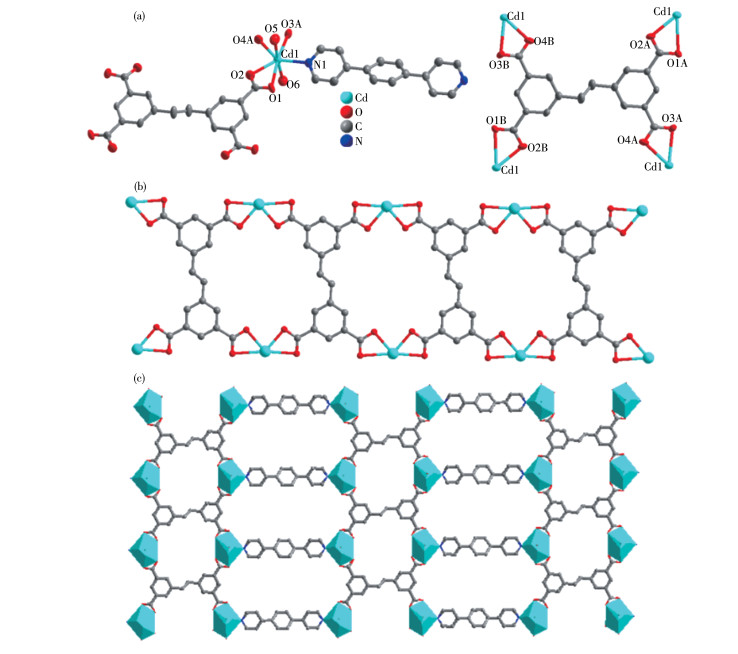
Figure 1.
(a) Ellipsoid diagram of molecular structure with 50% ellipsoid probability; (b) 1D chain structure; (c) 2D framework
Symmetry codes: A: x, 1+y, z; B: 1-x, 1-y, -z

A Highly Stable Cd(Ⅱ) Coordination Polymer for Detection of Roxithromycin and B4O72-
Ji-Jiang WANG , Lao-Bang WANG , Er-Lin YUE , Jin-Feng LI , Chao BAI , Long TANG , Xiao WANG , Xiang-Yang HOU , Yu-Qi ZHANG


Roxithromycin (ROX) is a semi-synthetic antibiotic containing 14 -membered macrolides, which can be used to treat inflammatory diseases caused by a variety of pathogen infections, and its antibacterial effect in the body is stronger than that of erythromycin[1]. ROX has the advantages of rapid absorption, elimination of long half - life, and a good therapeutic effect on fungi, such as Streptococcus and Corynebacterium. However, the abuse or irregular use of macrolide antibiotics may cause gastrointestinal discomfort, allergic reactions, liver and kidney damage, and other diseases[2]. Therefore, it is very urgent and important to find an efficient detection method for ROX. Boron is an essential element in the human body and is indispensable in many parts of the body, especially bones. Boron is generally present in the human body in the form of boric acid. However, boron is a limited element, and the content in the body should not be too much. Studies have shown that abnormal boric acid content can cause adverse reactions such as anorexia, vomiting, and diarrhea[3]. Even ingesting small amounts of boron can cause poisoning due to slow excretion. Borax (Na2B4O7·10H2O) is also a form of boron and is a very important chemical raw material that is widely used in industry and consumer products. Because it exists in food and some consumer products, long-term consumption or use of such products will lead to the accumulation of borax in the body, which is harmful to various organs of the human body[4]. Therefore, the detection of borate content is very important.
Coordination polymers (CPs) are organic-inorganic hybrid materials composed of inorganic metal centers and organic ligands[5-6]. Due to the diversity of metal and organic ligands, or the introduction of two or more metal and organic ligands at the same time, the structure of CPs is more diverse[7-9]. CPs have attracted the attention of more and more researchers due to their structural diversity, high porosity, tunable functions, and large specific surface area[10-15]. CPs are widely used in gas storage, bioimaging, adsorption, drug delivery, and sensing due to their excellent chemical properties[16-18]. In particular, fluorescent materials based on CPs are more favored by researchers due to their high selectivity, low detection limit, high sensitivity, good recovery performance, and short response time[19-20]. For instance, Zhang et al. synthesized a Zn (Ⅱ) - based CP with high selectivity and sensitivity for Ni2+ and PO43- [21]. A complex that can detect oridazole antibiotics and nitrophenol with low detection limits was reported by Li et al[22].
In this work, we constructed a Cd (Ⅱ) CP, [Cd2(L) (bpb)(H2O)4]·0.5H4L (1) (H4L=1, 1'-ethylbiphenyl-3, 3', 5, 5' - tetracarboxylic acid, bpb=1, 4 - di(pyridin - 4 - yl) benzene). 1 exhibited excellent stability in different organic solvents and water and high selectivity and sensitivity to ROX and B4O72-. Furthermore, 1 was a reusable material with good recyclability. The possible mechanism of fluorescence quenching is also discussed in detail in the article. Finally, the detection of ROX and B4O72- in Yanhe River water indicated the actual availability of complex 1. To our knowledge, this is the first complex that can detect ROX. This is of great significance for the new fluorescent probe in future research.
The chemicals used were all commercially available and could be used without further purification. Powder X-ray diffraction (PXRD) patterns were recorded with a Bruker D8ADVANCE diffractometer operating at 40 kV and 40 mA using Cu Kα radiation (λ = 0.154 18 nm) at a scanning rate of 8 (°)·min-1 from 5° to 50°. Fluorescence experiments were carried out on a Hitachi F-7100 Fluorescence Spectrophotometer. Thermogravimetric analysis (TGA) was performed on a NETZSCH STA 449F5 thermal analyzer.
A solid mixture of Cd(NO3)2·4H2O (0.1 mmol, 0.030 8 g), H4L (0.05 mmol, 0.017 9 g), and bpb (0.05 mmol, 0.011 6 g) was dissolved in the mixed solvent of DMF (3 mL), H2O (3 mL), and HNO3 (0.1 mL, 6 mol· L-1). The mixed solution was placed in a 10 mL inner glass bottle and reacted at 95 ℃ for three days. Finally, colorless crystals were obtained. Yield: 57% (based on Cd). Anal. Calcd. for C43H37Cd2N2O16(%): C, 48.60; H, 3.52; N, 2.64. Found(%): C, 48.32; H, 3.62; N, 2.87.
Single crystal data of 1 were collected on a Bruker SMART APEX-Ⅱ diffractometer (Mo Kα radiation and λ =0.071 073 nm). The crystal structures were solved using direct methods and then refined by the full matrix least-squares techniques on F2 using SHELXL[23-24]. All non - hydrogen atoms were refined anisotropically. Hydrogen atoms were obtained by geometric calculation. All calculations were performed using the SHELXTL program. Partial data for crystals are given in Table S1 and S2 (Supporting information).
CCDC: 2162322.
Complex 1 crystallizes in the triclinic P1 space group. The asymmetric unit of 1 includes two Cd2+ ions, one and a half L4- anions, one bpb molecule, four coordinated H 2O molecules, and a half free H4L molecule. Every Cd2+ ion is seven - coordinated by four O atoms (O1, O2, O3A, O4A) from two L4- anions, two oxygen atoms (O5, O6) from two coordinated water molecules, and one N atom (N1) from one bpb molecule (Fig. 1a). In complex 1, the H4L ligand is completely deprotonated and the coordination mode is μ4 - η2∶η2∶η2∶η2 (Fig. 1a). Adjacent Cd(Ⅱ) ions are connected by O atoms in L4- to form a 1D chain structure (Fig. 1b). Then 1D chains are linked by bpb ligands to form 2D framework (Fig. 1c).
Symmetry codes: A: x, 1+y, z; B: 1-x, 1-y, -z
TGA was performed to explore the stability of 1. The weight loss of 1 was 8.52% below 100 ℃ (Fig.S1), which can be regarded as the loss of coordinated water molecules (Calcd. 6.78%) and release of lattice H2O. The second weight loss in 350-450 ℃ should be due to the loss of free carboxylic acid ligands in the pores. In the 450-800 ℃ range, the skeleton collapsed and disintegrated. The residual (36.79%) after 800 ℃ is attributed to CdO (Calcd. 36.25%). The PXRD pattern of 1 was almost identical to the simulated, implying the pure phase of 1 (Fig.S2). The skeleton was unchanged when 1 was immersed in acidic and basic aqueous solutions (pH=2.0 and 12.6) for 24 h, indicating that 1 had good acid and alkali resistance (Fig.S3). 1 could keep the original skeleton in an organic solvent for seven days and could be stable in boiling water for 30 days, which further showed the chemical stability of 1 (Fig. S4). Finally, the persistent luminescence ability of 1 in deionized water was tested. As shown in Fig. S5, after seven consecutive days, the fluorescence still maintained its original relative intensity, indicating its durability and application potential.
The photoluminescence of H4L and 1 in the solid state was investigated (Fig. S6). H4L had an emission peak at 400 nm (λex=310 nm), corresponding to a stronger emission peak at 444 nm (λex=362 nm). The emission peak of 1 was stronger than that of the ligand, which may be due to coordination interactions[25]. The emission spectrum of 1 has a partial redshift, which may be caused by the charge transfer between H4L and Cd2+ [26].
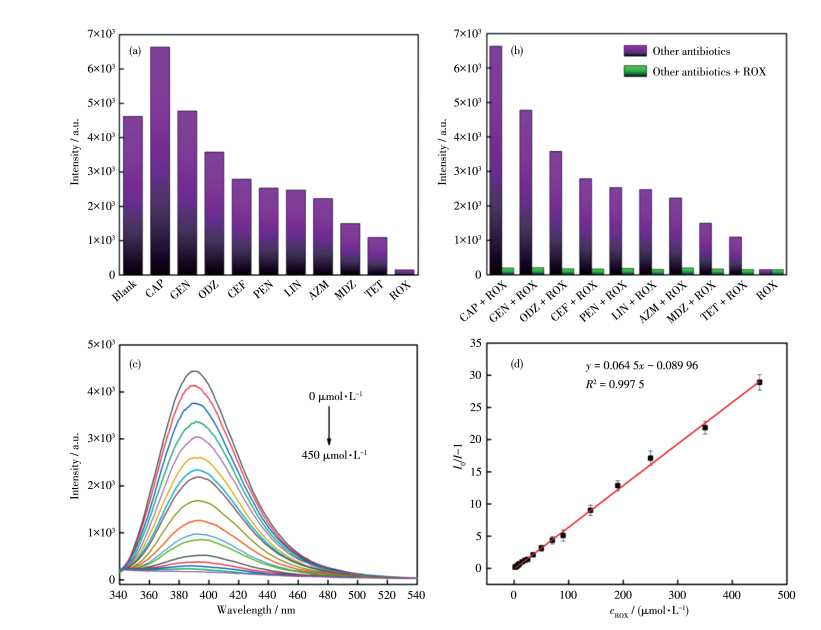
Complex 1 is a very promising sensing material due to its excellent water stability and luminescence properties. Therefore, the luminescence sensing of 1 for different antibiotics was investigated, including penicillin sodium (PEN), tetracycline (TET), ROX, metronidazole (MDZ), azithromycin (AZM), chloramphenicol (CAP), gentamicin sulfate (GEN), ornidazole (ODZ), lincomycin hydrochloride (LIN), cefixime (CEF). As shown in Fig. 2a, the fluorescence of 1 was almost completely quenched when ROX was added. The other antibiotics mixed into the suspension of 1 had a small effect on the luminescence intensity of 1. Next, the effect of adding ROX on the fluorescence intensity in the presence of other antibiotics was tested. It can be seen from Fig. 2b that in the presence of other antibiotics, the addition of ROX could still greatly quench the fluorescence of 1, showing that it was an excellent ROX sensor. Then, concentration gradient experiments were carried out to study the quenching situation in detail (Fig. 2c). When the concentration of ROX was 450 µmol·L-1, the fluorescence was almost quenched by 97.0%. And the plot of I0/I-1 vs cROX exhibited a linear relationship over the entire concentration range (Fig. 2d). This phenomenon was rarely seen in previously reported articles. The detection limit (LOD) was 0.21 µmol·L-1 according to LOD=3σ/k[27-29], where σ is the standard deviation of blank measurement; k is the slope. Then, we investigated the change in fluorescence intensity over time with the addition of ROX. When a 450 µmol·L-1 ROX solution was added, the fluorescence intensity was almost completely quenched, and the fluorescence hardly changed after 20 s (Fig.S7a). Finally, the cycling experiment was carried out, and it was found that the fluorescence could still recover to the original intensity after four cycles, indicating that 1 was a very potential ROX sensor (Fig. S7b). As far as we know, this should be the first complex that can detect ROX. This is of great significance for the new fluorescent probe in future research.
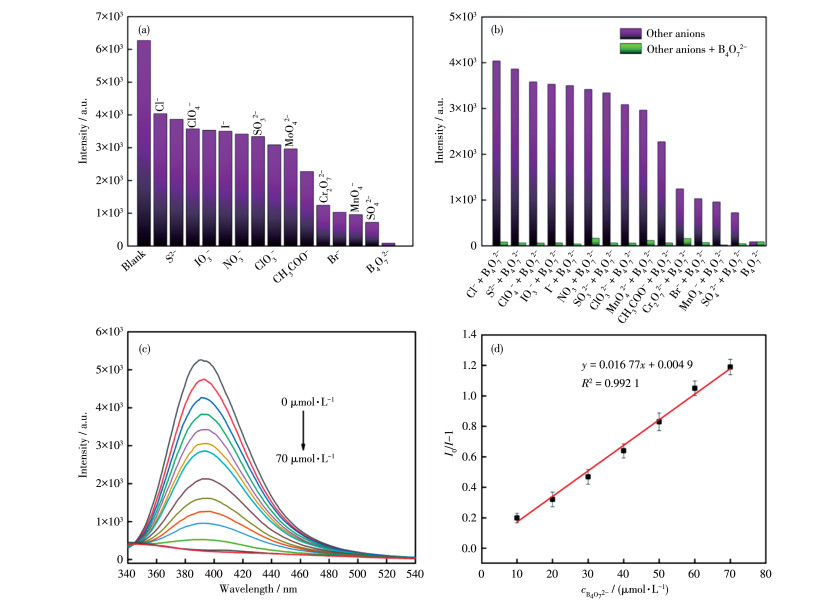
The luminescence sensing of 1 for different inorganic anions was investigated, including Cl-, S2-, ClO4-, IO3-, I-, NO3-, ClO3-, MoO42-, CH3COO-, Cr2O42-, Br-, MnO4-, SO42-, B4O72-. As shown in Fig. 3a, the fluores cence of 1 was almost completely quenched when B4O72- was added, while the other inorganic anions mixed into the suspension of 1 had a small effect on the luminescence intensity. Next, the effect of adding B4O72- on the fluorescence intensity in the presence of other inorganic anions was tested. It can be seen from Fig. 3b that in the presence of other inorganic anions, the addition of B4O72- could still greatly quench the fluorescence intensity of 1, showing that it was an excellent B4O72- sensor. Then, concentration gradient experiments were carried out in order to study the quenching situation detailedly (Fig. 3c). When the concentration of B4O72- was 70 µmol·L-1, the fluorescence was almost quenched by 97.2%. And the plot of I0/I-1 vs cB4O72- exhibited a linear relationship in the low concentration range (Fig. 3d). The LOD was 1.59 µmol·L-1. Then, we investigated the change in fluorescence intensity over time with the addition of B4O72-. It was found that when 70 µmol·L-1 was added, the fluorescence intensity was almost completely quenched, and the fluorescence hardly changed after 20 s (Fig. S8a). Finally, the cycling experiment was carried out, and it was found that the fluorescence could still recover to the original intensity after four cycles, indicating that 1 was a very potential B4O72- sensor (Fig.S8b).
To explore the possible mechanism of fluorescence quenching, the following experiments were carried out. First, the samples after fluorescence sensing were tested by XRD, and it was found that the peak positions were almost consistent with the peak positions of the crystal simulation (Fig.S2), indicating that the crystal structure was intact. Therefore, the collapse of the crystal framework was not the cause of fluorescence quenching. The emission spectrum of 1 had little overlap with the UV-Vis spectrum of ROX and B4O72-, implying that the reason for fluorescence quenching should not be caused by energy transfer (Fig. S9) [30]. Then, it is found that the LUMO level (-0.69 eV) of ROX was higher than 1, indicating that the electron of 1 cannot be transferred to ROX basically (Fig.S9) [30-32]. Finally, the emission of 1 was almost invisible after the addition of ROX, indicating that the internal filtering effect plays an important role in the detection of ROX and B4O72- by complex 1. This explains the process of ROX and B4O72- quenching the fluorescence of complex 1[30].
We tested ROX and borate in Yanhe River water to demonstrate the practical usability of the method. As shown in Table 1 and 2, the estimated recoveries of ROX and B4O72- at different concentrations were obtained, ranging from 98.7% to 102% and 103% to 108%. The relative standard deviation (RSD) values were 1.8%-2.3% and 1.4%-2.1% respectively, meaning the reliability and practicality of 1 to detect ROX and B4O72- in real samples.
 下载:
导出CSV
| Spiked/(µmol·L-1) | Detected/(µmol·L-1) | RSD*/% | Recovery/% |
| 0 | Not detected | — | — |
| 20 | 20.4 | 1.8 | 102 |
| 30 | 29.6 | 1.7 | 98.7 |
| 50 | 51.3 | 2.3 | 101 |
| *n=3. | |||
下载:
导出CSV
| Spiked/(µmol·L-1) | Detected/(µmol·L-1) | RSD*/% | Recovery/% |
| 0 | Not detected | — | — |
| 5 | 5.4 | 1.4 | 108 |
| 20 | 20.9 | 2.1 | 104 |
| 30 | 30.8 | 1.9 | 103 |
In summary, a cadmium coordination polymer was synthesized with high selectivity and sensitivity for the detection of ROX and B4O72-. The sensing mechanism is discussed in detail. Finally, it can also detect ROX and B4O72- in real Yanhe River water samples through standard recovery experiments. This experiment provides a promising fluorescent sensor for the detection of ROX and B4O72-. To our knowledge, this sample is the first complex that can detect ROX.
Conflicts of interest: The authors declare no competing financial interest.
Supporting information is available at http://www.wjhxxb.cn
Zhang X, Gu S Q, Ding Y. Simultaneous Detection of Roxithromycin and Dopamine Using a Sensor Platform Based on Poly(sulfosalicylic acid) and Its Application in Human Serum Studies[J]. Anal. Methods, 2014, 6: 3316-3321. doi: 10.1039/C4AY00009A
García-Mayor M A, Gallego-Picó A, Garcinuño R M, Fernández-Hernando P, Durand-Alegría J S. Matrix Solid-Phase Dispersion Method for the Determination of Macrolide Antibiotics in Sheep's Milk[J]. Food Chem., 2012, 34: 553-558.
Fail P A, Chapin P E, Price C J. General, Reproductive, Developmental, and Endocrine Toxicity of Boronated Compounds[J]. Reprod. Toxico., 1998, 12: 1-18. doi: 10.1016/S0890-6238(97)00095-6
Pongsavee M. Effect of Borax on Immune Cell Proliferation and Sister Chromatid Exchange in Human Chromosomes[J]. J. Occup. Med. Toxicol., 2009, 4: 27. doi: 10.1186/1745-6673-4-27
Rowsell J L, Yaghi O M. Metal-Organic Frameworks: A New Class of Porous Materials[J]. Microporous Mesoporous Mater., 2004, 73: 3-14. doi: 10.1016/j.micromeso.2004.03.034
Furukawa H, Cordova K E, O'Keeffe M, Yaghi O M. The Chemistry and Applications of Metal-Organic Frameworks[J]. Science, 2013, 341: 1230444. doi: 10.1126/science.1230444
Meek S T, Greathouse J A, Allendorf M D. Metal-Organic Frameworks: A Rapidly Growing Class of Versatile Nanoporous Materials[J]. Adv. Mater., 2011, 23: 249-267. doi: 10.1002/adma.201002854
Cui Y J, Li B, He H J, Zhou W, Chen B L, Qian G D. Metal-Organic Frameworks as Platforms for Functional Materials[J]. Acc. Chem. Res., 2016, 49: 483-493. doi: 10.1021/acs.accounts.5b00530
Abednatanzi S, Derakhshandeh P G, Depauw H, Coudert F X, Vrielinck H, Leus K. Mixed-Metal Metal-Organic Frameworks[J]. Chem. Soc. Rev., 2019, 48: 2535-2565. doi: 10.1039/C8CS00337H
Lu W G, Wei Z W, Gu Z Y, Liu T F, Park J, Tian J, Zhang M W, Zhang Q, Gentle T, Bosch M, Zhou H C. Tuning the Structure and Function of Metal-Organic Frameworks via Linker Design[J]. Chem. Soc. Rev., 2014, 43: 5561-5593. doi: 10.1039/C4CS00003J
Zhou H C, Kitagawa S. Metal-Organic Frameworks (MOFs)[J]. Chem. Soc. Rev., 2017, 43: 5415-5418.
Lin C H, Zou Z F, Lei Z W, Wang L, Song Y H. Fluorescent Metal-Organic Frameworks MIL-101(Al)-NH2 for Rapid and Sensitive Detection of Ellagic Acid[J]. Spectroc. Acta Pt. A-Molec. Biomolec. Spectr., 2020, 242: 118739. doi: 10.1016/j.saa.2020.118739
Wang F, Tian F K, Deng Y X, Yang L L, Zhang H H, Zhao D S, Li B, Zhang X T, Fan L M. Cluster-Based Multifunctional Copper (Ⅱ) Organic Framework as a Photocatalyst in the Degradation of Organic Dye and as an Electrocatalyst for Overall Water Splitting[J]. Cryst. Growth Des., 2021, 21: 4242-4248. doi: 10.1021/acs.cgd.1c00479
Fan L M, Wang F, Zhao D S, Peng Y X, Deng Y X, Luo Y W, Zhang X T. A Self-Penetrating and Chemically Stable Zinc (Ⅱ)-Organic Framework as Multi-responsive Chemo-Sensor to Detect Pesticide and Antibiotics in Water[J]. Appl. Organomet. Chem., 2020, 34: 5960.
Deng C L, Sun C F, Wang Z, Tao Y W, Chen Y L, Lin J Q, Luo G G, Lin B Z, Sun D, Zheng L S. Sodalite-Type Silver Orthophosphate Cluster in a Globular Silver Nanocluster[J]. Angew. Chem. Int. Ed., 2020, 59: 12659-12663. doi: 10.1002/anie.202003143
Zheng B S, Huang L, Gao X Y, Shen S S, Cao H F, Hang C, Zeng W J, Wang Z X. A Highly Porous Acylamide Decorated MOF-505 Analogue Exhibiting High and Selective CO2 Gas Uptake Capability[J]. CrystEngComm, 2018, 20: 1874-1881. doi: 10.1039/C8CE00103K
Liu S, Bai J L, Huo Y P, Ning B A, Peng Y, Li S, Han D P, Kang W J, Gao Z X. A Zirconium-Porphyrin MOF-Based Ratiometric Fluorescent Biosensor for Rapid and Ultrasensitive Detection of Chloramphenicol[J]. Biosens. Bioelectron., 2020, 149: 111801. doi: 10.1016/j.bios.2019.111801
Xu Y X, Li Q, Xue H G, Pang H. Metal-Organic Frameworks for Direct Electrochemical Applications[J]. Coord. Chem. Rev., 2018, 376: 292-318. doi: 10.1016/j.ccr.2018.08.010
Wang X Q, Feng D D, Tang J, Zhao Y D, Li J, Yang J, Kim C K, Su F. A Water-Stable Zinc(Ⅱ)-Organic Framework as a Multiresponsive Luminescent Sensor for Toxic Heavy Metal Cations, Oxyanions and Organochlorine Pesticides in Aqueous Solution[J]. Dalton Trans., 2019, 48: 16776-16785. doi: 10.1039/C9DT03195B
Wang L, Yao Z Q, Ren G L, Han S Q, Hu T L, Bu X H. A Luminescent Metal-Organic Framework for Selective Sensing of Fe3+ with Excellent Recyclability[J]. Inorg. Chem. Commun., 2016, 65: 9-12. doi: 10.1016/j.inoche.2016.01.004
Qin B W, Zhang X Y, Zhang J P. A New Multifunctional Zinc-Organic Framework with Rare Interpenetrated Tripillared-Bilayers as a Luminescent Probe for Detecting Ni2+ and PO43- in Water[J]. Cryst. Growth Des., 2020, 20: 5120-5128. doi: 10.1021/acs.cgd.0c00308
Han M L, Wen G X, Dong W W, Zhou Z H, Wu Y P, Zhao J, Li D S, Ma L F, Bu X H. A Heterometallic Sodium-Europium-Cluster-Based Metal-Organic Framework as a Versatile and Water-Stable Chemosensor for Antibiotics and Explosives[J]. J. Mater. Chem. C, 2017, 5: 8469-8474. doi: 10.1039/C7TC02885G
Sheldrick G M. SHELXL-2014, Program for the Crystal Structure Refinement. University of Göttingen, Germany, 2014.
Sheldrick G M. SHELXS-2014, Program for the Crystal Structure Solution. University of Göttingen, Germany, 2014.
Gogia A, Mandal S K. A Rational Design and Green Synthesis of 3D Metal Organic Frameworks Containing a Rigid Heterocyclic Nitrogen-Rich Dicarboxylate: Structural Diversity, CO2 Sorption and Selective Sensing of 2, 4, 6-TNP in Water[J]. Dalton Trans., 2019, 48: 2388-2398. doi: 10.1039/C8DT04474K
Liu T Y, Qu X L, Zhang Y, Yan B. A Stable Cd (Ⅱ)-Based Metal-Organic Framework: Synthesis, Structure, and Its Eu3+ Functionalization for Ratiometric Sensing on the Biomarker 2-(2-Methoxyethoxy) Acetic Acid[J]. Inorg. Chem., 2021, 60: 8613-8620. doi: 10.1021/acs.inorgchem.1c00589
Gao R C, Guo F S, Bai N N, Wu Y L, Yang F, Liang J Y, Li Z J, Wang Y Y. Two 3D Isostructural Ln(Ⅲ)-MOFs: Displaying the Slow Magnetic Relaxation and Luminescence Properties in Detection of Nitrobenzene and Cr2O72-[J]. Inorg. Chem., 2016, 55: 11323-11330. doi: 10.1021/acs.inorgchem.6b01899
Xu H, Cao C S, Zhao B A. A Water-Stable Lanthanide-Organic Framework as a Recyclable Luminescent Probe for Detecting Pollutant Phosphorus Anions[J]. Chem. Commun., 2015, 51: 10280-10283. doi: 10.1039/C5CC02596F
Qu K G, Wang J S, Ren J S, Qu X G. Carbon Dots Prepared by Hydrothermal Treatment of Dopamine as an Effective Fluorescent Sensing Platform for the Label-Free Detection of Iron (Ⅲ) Ions and Dopamine[J]. Chem. Eur. J., 2019, 19: 7243-7249.
Yu M K, Xie Y, Wang X Y, Li Y X, Li G M. Highly Water-Stable Dye@Ln-MOFs for Sensitive and Selective Detection toward Antibiotics in Water[J]. ACS Appl. Mater. Interfaces, 2019, 11: 21201-21210. doi: 10.1021/acsami.9b05815
Fan C B, Zhang X, Li N N, Xu C G, Wu R X, Zhu B, Zhang G L, Bi S Y, Fan Y H. Zn-MOFs Based Luminescent Sensors for Selective and Highly Sensitive Detection of Fe3+ and Tetracycline Antibiotic[J]. J. Pharmaceut. Biomed., 2020, 188: 113444. doi: 10.1016/j.jpba.2020.113444
Qin G X, Wang J, Li L, Yuan F F, Zha Q Q, Bai W B, Ni Y H. Highly Water-Stable Cd-MOF/Tb3+ Ultrathin Fluorescence Nanosheets for Ultrasensitive and Selective Detection of Cefixime[J]. Talanta, 2021, 221: 121421. doi: 10.1016/j.talanta.2020.121421

Figure 1 (a) Ellipsoid diagram of molecular structure with 50% ellipsoid probability; (b) 1D chain structure; (c) 2D framework
Symmetry codes: A: x, 1+y, z; B: 1-x, 1-y, -z

Figure 2 (a) Fluorescence intensities of different antibiotics added to the suspension of 1; (b) Luminescence intensity of 1 in the presence of different antibiotics with the addition of ROX; (c) Emission spectra of 1 dispersed in the ROX solutions with different concentrations; (d) Plot of I0/I-1 vs cROX for 1 in a concentration range of 0-450 µmol·L-1

Figure 3 (a) Fluorescence intensities of different inorganic anions added to the suspension of 1; (b) Luminescence intensity of 1 with the addition of B4O72- in the presence of different inorganic anions; (c) Emission spectra of 1 upon the gradual addition of B4O72-; (d) Plot of I0/I-1 vs cB4O72- for 1 in a concentration range of 0-70 µmol·L-1
Table 1. Recovery test of ROX spiked in Yanhe River water samples
| Spiked/(µmol·L-1) | Detected/(µmol·L-1) | RSD*/% | Recovery/% |
| 0 | Not detected | — | — |
| 20 | 20.4 | 1.8 | 102 |
| 30 | 29.6 | 1.7 | 98.7 |
| 50 | 51.3 | 2.3 | 101 |
| *n=3. | |||
 下载: 导出CSV
Table 2. Recovery test of B4O72- spiked in Yanhe River water samples
| Spiked/(µmol·L-1) | Detected/(µmol·L-1) | RSD*/% | Recovery/% |
| 0 | Not detected | — | — |
| 5 | 5.4 | 1.4 | 108 |
| 20 | 20.9 | 2.1 | 104 |
| 30 | 30.8 | 1.9 | 103 |
下载: 导出CSV

 扫一扫看文章


扫一扫关注我们