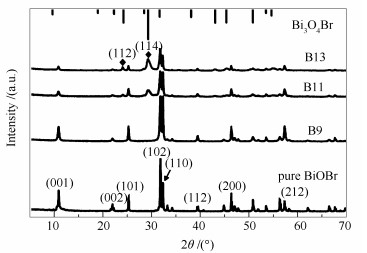
Figure 1.
XRD patterns of the synthesized samples

Effect of hydrothermal pH value on composition and morphology of bismuth oxybromide and their photocatalytic performance
Hong-guang ZHANG , Wen-tai WANG , Li-juan FENG , Chun-hu LI , Liang WANG


For decades, photocatalysis technique have attracted tremendous attention in solving the energy crisis and environmental pollution[1, 2]. Photocatalyst plays a crucial role during the process of photocatalysis. Unfortunately, the classical and most widely used photocatalysts of TiO2 can only utilize 4% of the whole solar spectrum[3]. As the alternative photocatalysts to TiO2, bismuth oxyhalides (BiOX, X = Cl, Br or I) have recently attracted great interest for their unique layer structure and appropriate band gaps[4]. In such unique structures of BiOX, [Bi2O2]2+ slabs are interleaved by double slabs of halogen atoms, forming an internal static electric field due to non-uniform charge distribution perpendicular to each layer, which is beneficial for facilitating the separation of photo-generated carriers[5]. Among BiOX compounds, BiOBr with high stability and suitable band gap has received particular attention to be an efficient photocatalyst for organic pollutant decomposition[6].
Up to now, series of synthesis methods have been exploited to prepare bismuth oxybromide, such as hydrothermal process[7], hydrolytic process[8] and precipitation process[9], and hydrothermal process was usually used to prepare bismuth oxybromide. In hydrothermal process, hydrothermal pH value had a considerable influence on the morphologies of bismuth oxybromide[10]. Structure-performance study of semiconductor photocatalysts can provide theoretical guidance for fabricating photocatalysts with high photoactivity[11]. Various morphologies of BiOBr had been synthesized, such as hollow microspheres[12], flower-like structure[13] and nanosheets[14]. Li et al[15] realized these BiOBr samples had similar micro-flower morphology in the pH range of 7 to 2, but the crystal size increased from 14.84 to 15.10 nm. Hou's group[16] explored the synthesis pH value effect on the (001) and (010) facet exposure of BiOBr through adjustment pH value from 4 to 7. Lu et al[17] found that BiOBr obtained at pH =7 exhibited the highest photocatalytic activity, whose rate constant was about 2.9, 1.9 and 1.5 times higher than those of BiOBr samples prepared at pH=1, 3 and 5. Much more attention had been paid to the H+ effect on the layered structure of BiOBr in the acidity condition, and the alkalization method was the most extensively employed for dehalogenation. However, few study explored the procedure of OH- replacing lattice halogen atoms between [Bi2O2]2+ and halogen interlayers in the alkalinity conditions.
In this work, a series of bismuth oxybromide were synthesized via a hydrothermal route at different pH value conditions(pH=1, 9, 11, 13). The structure, composition, morphology, optical properties of the as-prepared samples were investigated by various characterization techniques. The influences of pH value on the morphological evolution and optical properties of bismuth oxybromide were discussed. The photocatalytic activities of synthesized samples were evaluated by the degradation of RhB, MO and phenol under the visible light irradiation, and the reasonable formation process of the BiOBr was proposed.
All chemicals were of analytical grade and used without further purification. Bismuth nitrate pentahydrate (Bi(NO3)3·5H2O, AR), potassium bromide (KBr, AR), ethanol (AR) and sodium hydroxide (NaOH, AR) were purchased from Sinopharm Chemical Reagent Co., Ltd. (Shanghai, China). RhB was analytical pure and used without further purification. Deionized water (>18 MΩ) was used for solution preparation.
The samples were prepared via a one-step hydrothermal synthesis method. In a typical process, Bi(NO3)3·5H2O and KBr were dissolved in 40 mL of deionized water with vigorously stirring for 30 min at the room temperature, then the NaOH solution (2 mol/L) was added dropwise into the previous suspension with stirring to adjust the pH value (pH = 9, 11, 13). The suspension was transferred into a 100 mL Teflon-lined autoclave after vigorous stirring for 30 min, and was heated to 160 ℃ for 16 h. Subsequently, the autoclave was cooled to room temperature naturally. The obtained samples were taken out, filtered and washed with ethanol three times and then dried at 60 ℃ overnight. The synthesized samples were defined as B9, B11 and B13 according to the pH value, respectively. The synthesis method of pure BiOBr was the same as method above, merely without NaOH adjusting the pH value of solution (pH = 1).
The phase composition of the synthesized photocatalyst samples was characterized on an X-ray diffractometer (XRD, Bruker D8 Advance with Cu Kα (λ = 0.154 nm) radiation at 40 kV and 30 mA with the 2θ ranging from 5° to 80°. The X-ray photoelectron spectroscopic (XPS) analysis was carried out on a Thermo ESCALAB 250X (America) electron spectrometer with an Al Kα (hv=1486.6 eV) X-ray source. The microstructure and morphology of photocatalyst samples were determined by scanning electron microscopy (SEM, S-4800), transmission electron microscopy (TEM, JEM-2100). UV-vis diffusion reflectance spectra (DRS) were obtained on a UV-vis spectrophotometer (UV-3600, Shimadzu, Japan) with BaSO4 as a reflectance standard. The photoluminescence (PL) spectroscopy was measured with a Varian Cary-Eclipse 500 fluorescence spectrophotometer at room temperature.
Photocatalytic performances in the degradation of RhB, MO and phenol were evaluated under visible light irradiation. A 300 W Xe lamp with 420 nm cut off filter was used as a visible light source and the actual light intensity was 64 mW/cm2. The experiments were performed at 25 ℃ as follows: 0.1 g of sample was added into 100 mL of RhB, MO, phenol solution (C0 = 10 mg/L), the distance between the bottom of the lamp and the top of the solution was 20 cm. Before irradiation, the suspension was stirred for 30 min in dark to establish of adsorption-desorption equilibrium. At given time intervals, approximate 4 mL solution was taken and centrifuged to remove the residual catalysts, the concentration of RhB, MO in the solution was determined by the UV-vis spectroscopy at its characteristic wavelength (λRhB = 554 nm, λMO = 464 nm).
The phenol concentration was determined using a HPLC system (UV-230II), which was equipped with a UV detector and a C18 reversed phase column (4.6 mm × 250 mm, Sinochrom ODS-BP), and it operated at 25 ℃. The detecting wavelength was set at 270 nm. The mobile phase comprised water and methanol (75:25 (volume ratio)) at a flow rate of 1.0 mL/min.
The degradation ratio of organic pollutant was calculated by the followed equation (Eq.(1)):
|
$ \eta = \left( {1 - \frac{{{C_t}}}{{{C_0}}}} \right) \times 100\% $ |
(1) |
Where η is the degradation ratio of organic pollutant; Ct and C0 are the residual concentration and initial concentration of organic pollutant at time of t and 0, respectively.
The crystal phase of the synthesized samples was characterized by XRD. As shown in Figure 1, all diffraction peaks of pure BiOBr and B9 can be indexed to tetragonal BiOBr phase (JCPDS #09-0393)[18]. No diffraction peaks of other impurities are detected, which indicates the high purity of the fabricated BiOBr. With the increase of the hydrothermal pH value, the diffraction peaks of BiOBr become weakened, the diffraction pattern of B11 and B13 matches well with the standard card of Bi3O4Br phase (JCPDS #37-0700)[19, 20]. This result indicates that high hydrothermal pH value is beneficial to the formation of Bi3O4Br.
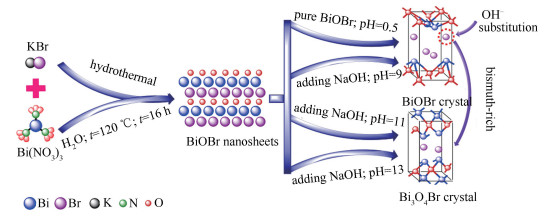
The formation mechanism of bismuth oxybromide is illustrated in Figure 2, and the formation process are described as followed equations (Eqs. (2)-(4)):
|
$ {\rm{B}}{{\rm{i}}^{3 + }} + 3{\rm{O}}{{\rm{H}}^ - } \to {\rm{Bi}}{({\rm{OH}})_3}({\rm{s}}) $ |
(2) |
|
$ 2{\rm{Bi}}{({\rm{OH}})_3}({\rm{s}}) + {\rm{B}}{{\rm{r}}^ - } \to {\rm{BiOBr}}({\rm{s}}) + {{\rm{H}}_2}{\rm{O}} + {\rm{O}}{{\rm{H}}^ - } $ |
(3) |
|
$ 3{\rm{BiOBr}}({\rm{s}}) + 2{\rm{O}}{{\rm{H}}^ - } \to {\rm{B}}{{\rm{i}}_3}{{\rm{O}}_4}{\rm{Br}}({\rm{s}}) + 2{\rm{B}}{{\rm{r}}^ - } + {{\rm{H}}_2}{\rm{O}} $ |
(4) |
The equations indicate that BiOBr is formed at the beginning of reaction. As the hydrothermal pH value increases, Bi3O4Br product is formed. The formation mechanism is in agreement with XRD analysis. The result reveals that excessive OH- can promote the formation of Bi3O4Br[15].
XPS analysis was used further to investigate the chemical composition and surface chemical states of B9 (Figure 3).
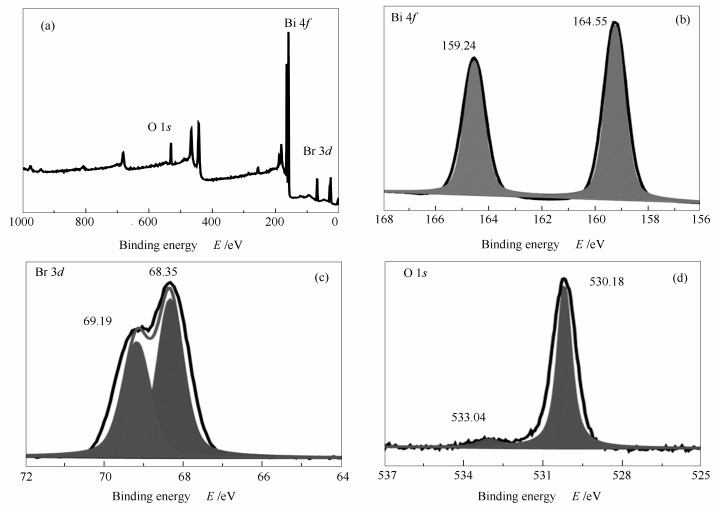
All signals of Bi, O and Br are detected in the survey spectrum of B9 (Figure 3(a)), Two symmetric peaks at 159.24 and 164.55 eV in the high-resolution Bi 4f are indexed to Bi 4f7/2 and Bi 4f5/2 (Figure 3(b)), demonstrating that the main chemical states of the bismuth elements in catalysts are Bi3+ oxidation state for Bi3+-O bond[21]. Figure 3(c) exhibits the binding energy of Br 3d orbital. Two peaks located at 68.35 and 69.19 eV are attributed to Br 3d5/2 and Br 3d3/2[22]. Two peaks in O 1s spectrum centered at 530.18 and 533.04 eV imply that there are two kinds of oxygen species (Figure 3(b)), which are attributed to the Bi-O bond in [Bi2O2]2+ slabs and hydroxyl group on catalysts surface[23].
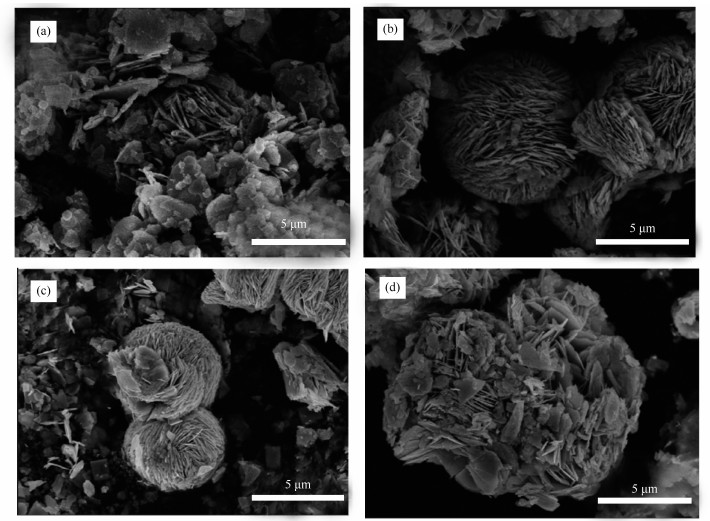
The morphology of the synthesized samples was investigated by the SEM. The SEM image of pure BiOBr is shown in Figure 4(a).
It is seen that pure BiOBr is composed of a large quantity of uniform sheets, and the average thickness of these sheets is about 30 nm. B9, B11 and B13 have the similar hierarchical nanosheets morphology, and the two-dimensional nanosheets have clear edges and flower-like shape microspheres. Typically, the B9 sample is composed of microspheres with diameter of 2.0-4.0 μm and thickness of 27-44 nm. The result reveals that high hydrothermal pH value is good for the nanosheets to assembled to form micro-flower morphology.
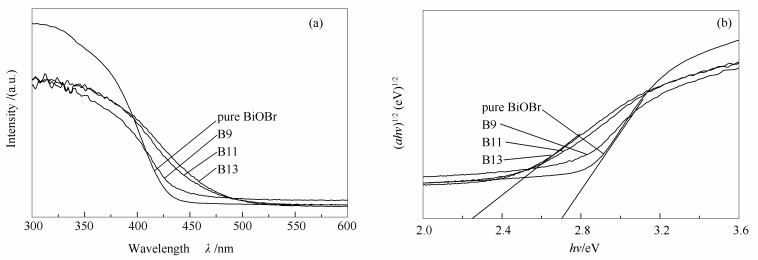
The band gap of photocatalysts plays dominant role in photocatalytic activity. The UV-vis diffuse reflectance spectra (DRS) of the synthesized samples are shown in Figure 5(a). The absorption edge of pure BiOBr, B9, B11 and B13 are approximate 445, 463, 505 and 522 nm. The band gap energy of the synthesized samples can be calculated by the followed equation (Eq. (5)):
|
$ \alpha hv = A{\left( {hv - {E_g}} \right)^2} $ |
(5) |
Where α, h, v, Eg and A are the absorption coefficient, Planck constant, light frequency, band gap energy and a constant, respectively.
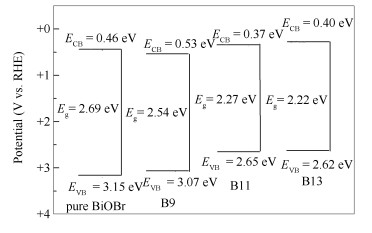
The band gap energies (Eg) of synthesized samples can be estimated by means of tangent line of curve from a plot of (αhv)1/2 versus energy (hv). In Figure 5(b), the Eg values of pure BiOBr, B9, B11 and B13 are 2.69, 2.54, 2.27 and 2.22 eV, respectively. With the hydrothermal pH value increase, the band gaps of the samples gradually become narrow.
The band position is also important for the photocatalytic activity. ECB and EVB of synthesized samples at the point of zero charge can be calculated according to empirical equations (Eqs. (6) and (7)):
|
$ {{E_{{\rm{CB}}}} = \chi - {E_{\rm{c}}} - 0.5{E_{\rm{g}}}} $ |
(6) |
|
$ {{E_{{\rm{VB}}}} = {E_{{\rm{CB}}}} + {E_{\rm{g}}}} $ |
(7) |
Where ECB is the CB edge position; EVB is the VB edge position; χ is the absolute electronegativity of the semiconductor, which is the geometric mean of the electronegativity of the constituent atoms; Ec is the energy of free electrons on the hydrogen scale (Ec = 4.5 eV); and Eg is the band gap energy of the semiconductor. Band structure alignments were summarized in Figure 6.
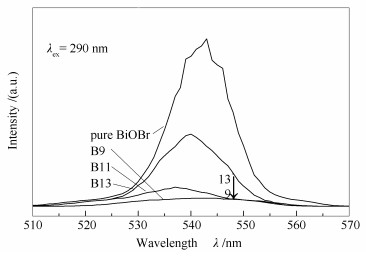
The photoluminescence (PL) spectroscopy was used for exploring the separation performance of the photogenerated electrons and holes in the semiconductor. As shown in Figure 7, the PL spectra of synthesized samples were measured with excitation wavelength of 290 nm. It can be seen that the PL intensity of various samples decrease in the order of pure BiOBr > B13 > B11 > B9. It reveals that the recombination rate of photogenerated charges in B9 is lowest. With the hydrothermal pH value increase, the recombination rate of photoinduced charges gradually increases.
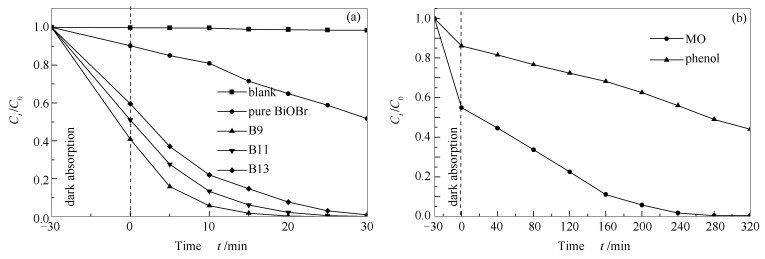
The photocatalytic performances of synthesized samples were evaluated by the photocatalytic degradation of RhB (10 mg/L) under the visible light. The results are presented in the Figure 8(a). It can be seen that no obvious photolysis of RhB is detected in the absences of photocatalysts after visible light irradiation over 30 min, and the RhB degradation rates of pure BiOBr, B9, B11 and B13 are 48.3%, 100%, 99.8% and 98.9%, respectively. The degradation rate of B9 is the highest, and the RhB can be completely removed in 25 min. The degradation of MO and phenol in the presence of B9 under visible-light was also investigated and the results are shown in Figure 8(b). The degradation rate of MO reaches 99% after 280 min, and 55% for phenol.
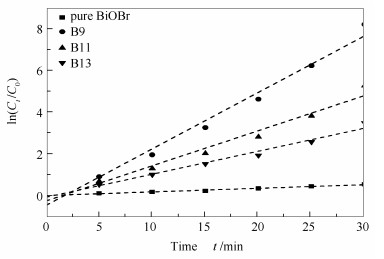
To quantify the photocatalytic performance of these samples, the pseudo-first order model is explored by the followed equation (Eq. (8)):
|
$ \ln \left( {\frac{{{C_t}}}{{{C_0}}}} \right) = kt $ |
(8) |
Where k is the pseudo-first order reaction rate constant; Ct and C0 are the concentration of RhB at time of t and 0, respectively.
As depicted in Figure 9, ln (
Based on the above results analysis, the enhanced photocatalytic activity can be explained as follows: firstly, micro-flower morphology can provide better absorption property and more active sites for reaction; secondly, the excellent photocatalytic performance of B9 is attributed to its narrow band gap and the low recombination of photogenerated charge carriers, which enables to harvest light more efficiently.
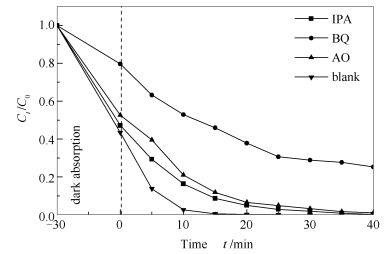
In order to explore the active species generated over B9, the trapping experiments were carried out through adding the isopropanol (IPA, a quencher of ·OH), ammonium oxalate (AO, a quencher of h+) and benzoquinone (BQ, a quencher of ·O2-) into the RhB solution, respectively. As shown in Figure 10, the photodegradation of RhB is significantly inhibited by the addition of BQ. The results suggest that ·O2- is main active species during the photocatalytic process. The role of the active species for RhB photodagradation is showed as follows: ·O2- > h+ > ·OH. The result is consistent with the previously reported data[24].
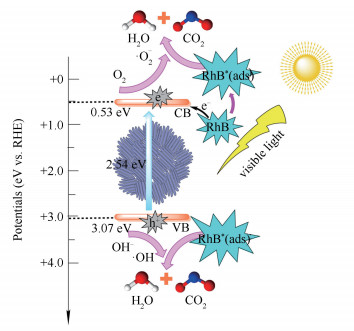
Based on the above results, a reasonable photodegradation mechanism of RhB is proposed. As shown in Figure 11, the calculated ECB of synthesized photocatalysts is more positive than the standard redox potential of O2/·O2- (-0.28 V vs NHE).
Consequently, it is impossible for the photoinduced electrons on the conduction band to react with O2 to produce ·O2- radicals. It is deduced that RhB absorbs visible photons energy and occurrs dye-sensitized degradation, resulting in transforming as excited electronic state RhB*, and then the RhB* injects electrons to conduction band of photocatalysts, which is scavenged by O2 to form ·O2- radicals. Finally, the process of N-de-ethylation of RhB occurs via the oxidation of ·O2- radicals[24].
Due to the EVB of photocatalysts is more positive than the standard redox potentials of both ·OH/H2O(+2.27 V vs NHE) and ·OH/OH- (+1.99 V vs/NHE), the holes on the surface can react with adsorbed H2O to form a spot of ·OH radicals. These radicals (·OH, ·O2- and h+) with strong oxidization property will react with RhB.
In summary, a series of bismuth oxybromide photocatalysts were prepared at different pH values of hydrothermal reaction. The hydrothermal pH value plays a crucial role in the morphology and composition of the products. The flower-like B9 exhibits an improved photocatalytic activity for RhB degradation under visible light. The enhanced activity of B9 can be attributed to its narrow band gap and the low recombination of photogenerated charge carriers. The trapping experiment results show that ·O2- is the main active species in the decomposition of RhB. As a result, it has great potential as an efficient and stable visible-light-driven photocatalyst for the purification of wastewater and other pollutants in the future.
WANG H, YONG D Y, CHEN S C, JIANG S L, ZHANG X D, SHAO W, ZHANG Q, YAN W S, PAN B C, XIE Y. Oxygen-vacancy-mediated exciton dissociation in BiOBr for boosting charge-carrier-involved molecular oxygen activation[J]. J Am Chem Soc, 2018, 140(5): 1760-1766. doi: 10.1021/jacs.7b10997
YU X, SHI J J, WANG L, WANG W T, BIAN J J, FENG L J, LI C H. A novel AuNPs-loaded MoS2/RGO composite for efficient hydrogen evolution under visible light[J]. Mater Lett, 2016, 182: 125-128. doi: 10.1016/j.matlet.2016.06.095
YUE D T, ZHANG T Y, KAN M, QIAN X F, ZHAO Y X. Highly photocatalytic active thiomolybdate [Mo3S13] 2-clusters/BiOBr nanocomposite with enhanced sulfur tolerance[J]. Appl Catal B:Environ, 2016, 183: 1-7. doi: 10.1016/j.apcatb.2015.10.020
ZHAO K, ZHANG L Z, WANG J J, LI Q X, HE W W, YIN J J. Surface structure-dependent molecular oxygen activation of BiOCl single-crystalline nanosheets[J]. J Am Chem Soc, 2013, 135(42): 15750-15753. doi: 10.1021/ja4092903
LIAO C X, MA Z J, CHEN X F, HE X, QIU J R. Controlled synthesis of bismuth oxyiodide toward optimization ofphotocatalytic performance[J]. Appl Surf Sci, 2016, 387: 1247-1256. doi: 10.1016/j.apsusc.2016.06.140
GUO W, QIN Q, GENG L, WANG D, GUO Y H, YANG Y X. Morphology-controlled preparation and plasmon-enhanced photocatalytic activity of Pt-BiOBr heterostructures[J]. J Hazard Mater, 2016, 308: 374-385. doi: 10.1016/j.jhazmat.2016.01.077
LIU X Q, CAI L. Novel indirect Z-scheme photocatalyst of Ag nanoparticles and polymer polypyrrole co-modified BiOBr for photocatalytic decomposition of organic pollutants[J]. Appl Surf Sci, 2018, 445: 242-254. doi: 10.1016/j.apsusc.2018.03.178
YU Z Y, DETLEF B, RALF D, SONG L, LU L Q. Photocatalytic degradation of azo dyes by BiOX(X=Cl, Br)[J]. J Mol Catal A:Chem, 2012, 365: 1-7. doi: 10.1016/j.molcata.2012.07.001
XU J, LI L, GUO C S, ZHANG Y, WANG S F. Removal of benzotriazole from solution by BiOBr photocatalysis under simulated solar irradiation[J]. Chem Eng J, 2013, 221: 230-237. doi: 10.1016/j.cej.2013.01.081
YE L Q, SU Y R, JIN X L, XIE H Q, CAO F P, GUO Z. Which affect the photoreactivity of BiOBr single-crystalline nanosheets with different hydrothermal pH value:Size or facet?[J]. Appl Surf Sci, 2014, 311: 585-863.
YU H G, LRIE H S, HASHIMOTO K. Conduction band energy level control of titanium dioxide:Toward an efficient visible-light-sensitive photocatalyst[J]. J Am Chem Soc, 2010, 132: 6898-6899. doi: 10.1021/ja101714s
WANG H T, SHI M S, YANG H F, CHANG N, ZHANG H, LIU Y P, LU M C, AO D, CHU D Q. Template-free synthesis of nanosliced BiOBr hollow microspheres with high surface area and efficient photocatalytic activity[J]. Mater Lett, 2018, 222: 164-167. doi: 10.1016/j.matlet.2018.03.179
DI J, XIA J X, JI M X, WANG B, YIN S, ZHANG Q, CHEN Z G, LI H M. Advanced photocatalytic performance of graphene-like BN modified BiOBr flower-like materials for the removal of pollutants and mechanism insight[J]. Appl Catal B:Environ, 2016, 183: 254-262. doi: 10.1016/j.apcatb.2015.10.036
MENG X C, LI Z Z, CHEN J, XIE H W, ZHANG Z S. Enhanced visible light-induced photocatalytic activity of surface-modified BiOBr with Pd nanoparticles[J]. Appl Surf Sci, 2018, 433: 76-87. doi: 10.1016/j.apsusc.2017.09.103
LI R P, REN H J, MA W H, HONG S M, WU L, HUANG Y P. Synthesis of BiOBr microspheres with ethanol as self-template and solvent with controllable morphology and photocatalytic activity[J]. Catal Commun, 2018, 106: 1-5. doi: 10.1016/j.catcom.2017.11.015
LI H P, HU T X, LI J Q, SONG S, DU N, ZHANG R J, HOU W G. Thickness-dependent photocatalytic activity of bismuth oxybromide nanosheets with highly exposed (010) facets[J]. Appl Catal B:Environ, 2016, 182: 431-438. doi: 10.1016/j.apcatb.2015.09.050
LU L, ZHOU M Y, YIN L, ZHOU G W, JIANG T, WAN X K, SHI H X. Tuning the physicochemical property of BiOBr via pH adjustment:Towards an efficient photocatalyst for degradation of bisphenol A[J]. J Mol Catal A:Chem, 2016, 423: 379-385. doi: 10.1016/j.molcata.2016.07.017
WANG L, JIA T F, LI C H, FENG L J. Hydrothermal synthesis of BiOBr/semi-coke composite as anemerging photo-catalyst for nitrogen monoxide oxidation undervisible light[J]. Catal Today, 2016, 264: 257-260. doi: 10.1016/j.cattod.2015.07.008
WANG J L, YU Y, ZHANG L Z. Highly efficient photocatalytic removal of sodium pentachlorophenate with Bi3O4 Br under visible light[J]. Appl Catal B:Environ, 2013, 136/137: 112-211. doi: 10.1016/j.apcatb.2013.02.009
LIU X Z, JIANG X L, CHEN Z Q, YU J X, HE Y M. Preparation of Bi3O4 Br/BiOCl composite via ion-etching method and its excellent photocatalytic activity[J]. Mater Lett, 2018, 210: 194-198. doi: 10.1016/j.matlet.2017.08.134
YU X, WU P W, QI C X, SHI J J, FENG L J, LI C H, WANG L. Ternary-component reduced graphene oxide aerogel constructed by g- C 3N4/BiOBr heterojunction and graphene oxide with enhanced photocatalytic performance[J]. J Alloys Compd, 2017, 729: 162-170. doi: 10.1016/j.jallcom.2017.09.175
HU T P, YANG Y, DAI K, ZHANG J F, LIANG C H. A novel Z-scheme Bi2MoO6/BiOBr photocatalyst for enhanced photocatalytic activity under visible light irradiation[J]. Appl Surf Sci, 2018, 456: 473-481. doi: 10.1016/j.apsusc.2018.06.186
YU X, SHI J J, FENG L J, LI C H, WANG L. A three-dimensional BiOBr/RGO heterostructural aerogel with enhanced and selective photocatalytic properties under visible light[J]. Appl Surf Sci, 2017, 396: 1775-1782. doi: 10.1016/j.apsusc.2016.11.219
HAN Q F, ZHANG K K, ZHANG J, GONG S, WANG X, ZHU J W. Effect of the counter ions on composition and morphology of bismuth oxyhalides and their photocatalytic performance[J]. Chem Eng J, 2016, 299: 217-226. doi: 10.1016/j.cej.2016.04.048

Figure 3 Survey XPS spectrum (a), high-resolution XPS spectra of Bi 4f (b), Br 3d (c) and O 1s (d) for samples

Figure 5 UV-vis diffuse reflectance spectra (a) and plot of (αhv)1/2 versus photon energy (hv) curves of synthesized samples (b)

Figure 8 Photocatalytic property of synthesized samples in degradation of RhB(a); photodegradation of MO and phenol over B9 (b)

Figure 10 Photocatalytic degradation of RhB over B9 in the presence of different radicals scavengers

 扫一扫看文章


扫一扫关注我们
 下载:

 下载:


