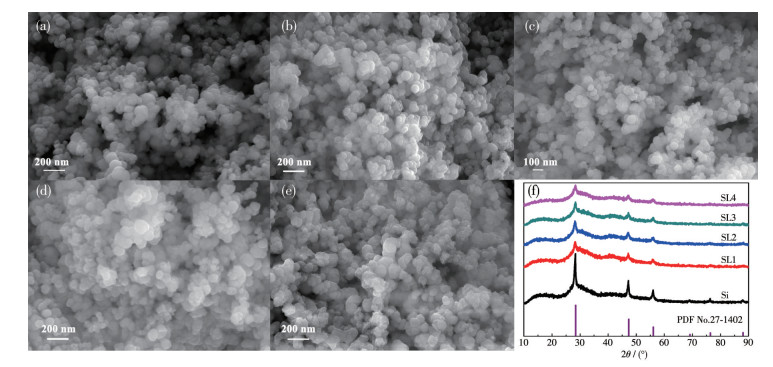
Figure 1.
SEM images of Si (a), SL1 (b), SL2 (c), SL3 (d), and SL4 (e); XRD patterns of Si, SL1, SL2, SL3, and SL4 (f)

Facile Synthesis of Si@LiAlO2 Nanocomposites as Anode for Lithium-Ion Battery
Song QIU , Wen-Ning YAN , Li WANG , Lian-Shan ZHANG , Chao CHEN , Li-Juan MU , Shi-Gang MU


Lithium-ion batteries are widely used in electronic products. With the development of electric vehicles and clean energy, higher requirements are put forward for the energy storage capacity and cycle life of lithiumion batteries. Due to the limitation of lithium storage capacity of traditional graphite materials for anodes, the research focus shifted to other materials with a high capacity[1-2]. Graphite materials have the advantages of excellent electrical conductivity, low cost, high content, and small volume change, but have poor rate performance, low cycle life, and unacceptable safety, which restrict large - scale applications, especially in electric vehicles. Transition metal oxides have a high reversible capacity, good safety, and high power density[3]. And Ti - based negative electrodes, have advantages in lifetime and safety characteristics[4-5]. These materials have poor electrical conductivity, which attracts researchers to improve through doping, compositing, and other methods. Si-based anode materials have been extensively studied due to their very high theoretical capacity (4 200 mAh·g-1) [6-7]. As an anode material, Si has some defects, such as poor conductivity, large volume expansion (ca. 300%) in the process of lithium insertion and lithium removal, and poor stability of solid electrolyte interphase (SEI) film on Si surface[8-9].
Generally, anode materials can be classified into three different types according to their reaction mechanisms, including intercalation mechanism, conversion reaction, and alloying reaction. Intercalation anode materials include graphite carbon materials, nongraphite carbon, doping type carbon, titanium dioxide, and lithium titanate[10]. Conversion type anode materials include transition metal oxides, transition metal nitride, and transition metal sulfides[11]. And alloying type anode materials include Si, Ge, Sn, Sb, Ca, Mg, and other alkaline earth metals. Si reacts with Li+ to form LixSi alloy and forms Li4.4Si when fully lithiated with large volume expansion. At present, the properties of Si materials are mainly improved from two aspects: controlled morphology and composite. In terms of controlling the morphology of Si, Si materials with 0D[12], 1D[13], 2D[14], and 3D[15] structures are prepared. In the aspect of composite, carbon material with better conductivity is the main way of composite[6-7, 12, 15-18]. Coating Al2O3 is one of the ways to improve cyclic stability[19-21]. Liu et al. prepared LiNi0.6Co0.2Mn0.2O2 positive lithiumion battery material with Al2O3 coating and LiAlO2 coating, and the test analysis showed that LiAlO2 coating was more conducive to improving the cyclic stability and rate performance of active substances than Al2O3 coating[21]. This is because LiAlO2 coating can not only form SEI film that can conduct lithium ions, improve or replace the unstable SEI film on the material surface, but also play the role of general coating material[21-24].
Herein, we prepared LiAlO2 coated Si nanoparticles (Si@LiAlO2) using the solvothermal method followed by heat treatment. The Si@LiAlO2 anode had excellent electrochemical performance, which presents a specific capacity of 364.1 mAh·g-1 at a current density of 100 mA·g-1 after 100 cycles.
The Si@LiAlO2 anode material was prepared using the solvothermal method and heat treatment. In a typical synthesis process, 0.6 g ethyl acetoacetate, 0.05 g aluminum isopropoxide (AIP), 0.01 g lithium methoxide (LiOMe), 0.1 g Si nanoparticles, and 0.3 g deionized water were added into 30 mL ethanol seriatim and stirred for 2 h. Then the mixture was transferred into a Teflon-lined autoclave and maintained at 160 ℃ for 4 h. The precursor was obtained by washing with ethanol and drying at 60 ℃. The Si@LiAlO2 nanocomposite was prepared through heat treatment at 400 ℃ for 2 h with a heating rate of 5 ℃·min-1 in the Ar atmosphere. Other samples were also prepared by use of the same procedure except for the amount of AIP and LiOMe. The samples SL1, SL2, SL3, and SL4 correspond to 0.025 g AIP and 0.005 g LiOMe, 0.050 g AIP and 0.010 g LiOMe, 0.100 g AIP and 0.020 g LiOMe, 0.150 g AIP and 0.030 g LiOMe, respectively. The Si nanoparticles untreated were labeled as Si.
The phases of the samples were obtained by X-ray diffraction (XRD, D8 ADVANCE) test, which was equipped with a Cu Kα radiation source (λ =0.154 18 nm, 40 kV, 40 mA) in a 2θ range of 10°-90° with a step size of 0.02°. The morphology, microstructure, lattice structure, and thickness of LiAlO2 coating were observed by transmission electron microscopy (TEM, JEM-3010) operating at an accelerating voltage of 300 kV and field emission scanning electron microscopy (SEM, ZEISS MERLIN Compact) with an accelerating voltage of 10 kV. The elemental composition, elemental binding state, and doping amount of LiAlO2 coating were determined by X-ray photoelectron spectroscopy (XPS, Escalab 250Xi) with a standard Al Kα source (1 486.6 eV).
The CR2032 coin cells were assembled in a glove box filled with argon atmosphere. Li plates and polypropylene 2500 were used as the counter electrode and separator, respectively. The slurry consisted of the active materials (Si, SL1, SL2, SL3, and SL4), super P, and binder (mass ratio of sodium carboxymethyl cellulose to styrene - butadiene rubber was 1∶1) with the mass ratio of 8∶1∶1. The slurry was bladed on Cu foil and with an active material mass loading of ca. 2 mg· cm-2. The electrolyte was 1 mol·L-1 LiPF6 in ethylene carbonate (EC) +dimethyl carbonate (DMC) +ethylene methyl carbonate (EMC) (1∶1∶1, V/V) with 5% fluoroethylene carbonate (FEC). The cyclic voltammetry (CV) at a sweep rate of 0.2 mV·s-1 from 0.05-3 V and electrochemical impedance spectra (EIS) measurement with the amplitude voltage of 10 mV and frequency region in 0.01 Hz-100 kHz were performed on an electrochemical workstation (IviumStat). Galvanostatic discharge/charge and rate tests were performed in the voltage range from 0.02 to 3 V on a LAND CT2001A battery test system.
Fig. 1a-1e show the SEM images of Si, SL1, SL2, SL3, and SL4. The Si nanoparticles were 50-100 nm in size and severely agglomerated. The structure and size of the samples changed a little before and after coating LiAlO2. However, for SL4, there was an obvious floccule on the surface of Si nanoparticles, which proved that LiAlO2 was successfully coated. Fig. 1f presents the lattice fringes of Si for all samples without other diffraction peaks[16, 25]. This may be because the coating is in an amorphous state or a small amount that cannot be detected by XRD. And there was a wide hump in the range of 15°-25° (2θ) for every sample, which could be contributed to the amorphous Si or SiOx phase[26].
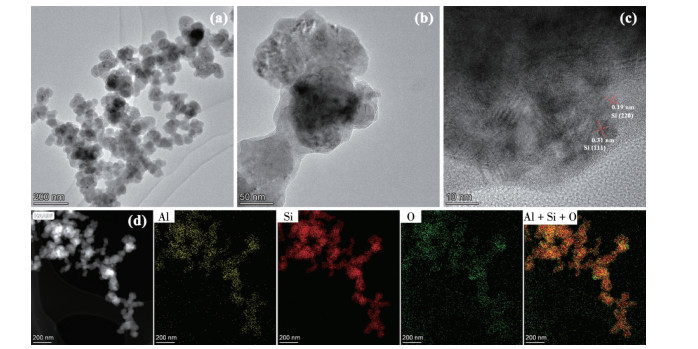
The TEM images of SL2 are shown in Fig. 2a-2c. The Si nanoparticles form a dendritic structure with openings and channels between the dendrites. The dendritic structure facilitates the diffusion of Li+ ions into the Si nanoparticles. Meanwhile, these voids and openings help buffer volume changes during charging and discharging. Fig. 2c displays lattice spacing of 0.19 and 0.31 nm, respectively, correlating well with (220) and (111) planes of Si[27-28]. Fig. 2d shows the element distribution of SL2 by STEM-XEDS (scanning transmission electron microscopy-X-ray energy-dispersive spectroscopy) which can be more sensitive than SEM-EDS. The element Al and Si were distributed very evenly in SL2 with the dendritic structure. It is proved that the coated LiAlO2 is uniform on the surface of Si nanoparticles.
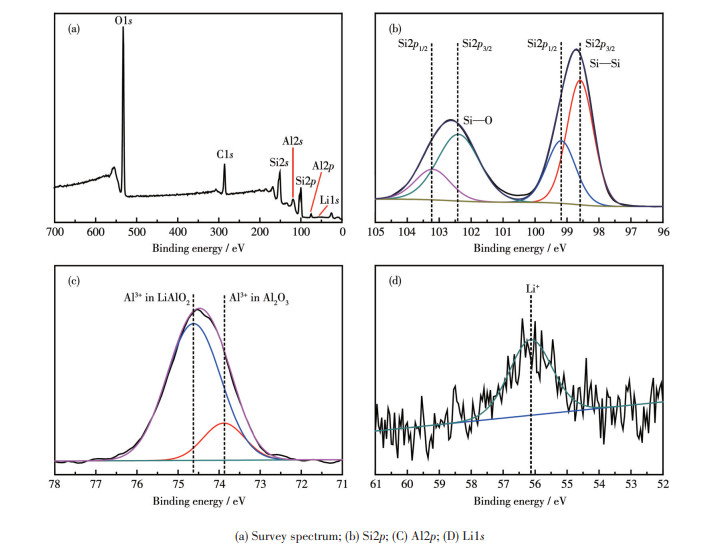
The XPS spectra and fitting results of SL2 are shown in Fig. 3. In the original XPS survey spectra (Fig. 3a), we can observe the peaks for the O, Si, Al, and Li binding energies of SL2. In Fig. 3b, the peaks for the Si2p binding energy appeared at 98.6 and 99.2 eV can be indexed to Si—Si bond, and the peaks at 102.4 and 103.2 eV respond to Si—O bond[29-30]. Due to the high activity of nano - silicon, partial oxidation occurs on the surface. In the Al2p spectra (Fig. 3c), the peak of binding energy appeared at 74.6 eV indicating the formation of LiAlO2 following the reports that the Al2p spectrum of LiAlO2 appears at higher binding energy compared with that of Al2O3 (73.9 eV) [21, 31]. In Fig. 3d, the peaks for the Li1s binding energy appeared at 56.1 eV, indicating that the oxidation state of Li is +1[31]. The results of XPS spectra directly proved the successful coating of LiAlO2.
The CV curves of SL1 are shown in Fig. 4a. In the first discharge curve, the peaks at around 1.6 and 0.5 V can be attributed to the decomposition of electrolytes and the formation of SEI film, which disappeared in the subsequent cycles[30]. The cathodic peak at 0.1 V is corresponding to the formation of LixSi. The anodic peak at around 0.5 V is related to the de-alloying process of LixSi.
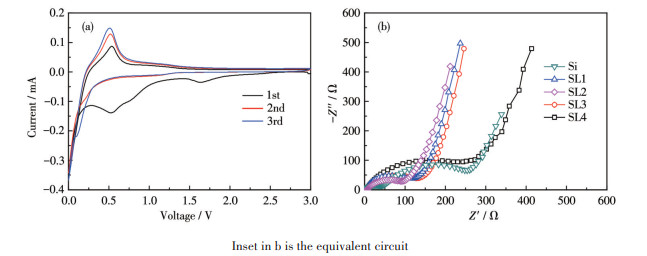
The Nyquist plot of each cell collected from the 3rd charged state is shown in Fig. 4b. And the reasonable equivalent circuit was used to fit the impedance spectra (inset of Fig. 4b), in which the Re, Rsf, and Rct are ionic resistance of the electrolyte, surface film resistance, and charge transfer resistance, Zw is the Warburg impedance, CPE is the double layer capacitance, respectively[32]. The Re+Rsf+Rct values of Si, SL1, SL2, SL3, and SL4 electrodes after three cycles were ca. 261, 127, 102, 145, and 277 Ω, respectively. The measured results indicate that a proper amount of LiAlO2 coating can improve the electrical conductivity and charge transfer. In the low - frequency region, the slopes of the inclined line for SL1, SL2, SL3, and SL4 were larger than that of Si, suggesting that the lithiumion diffusion ability of these LiAlO2 coated samples is superior to Si.
The galvanostatic charge - discharge curves of Si, SL2, and SL4 in the potential range from 0.02 to 1.5 V vs Li+/Li reference electrode at the current density of 100 mA·g-1 are shown in Fig. 5. In the first discharge curve of Si (Fig. 5a), a slash from 1.0 to 0.2 V can be attributed to the formation of SEI and the reduction of amorphous SiOx[33-34]. And two platforms around 0.2 and 0.1 V are related to the lithiation of amorphous Si and crystalline Si[35], respectively. In the first charge curve of Si, there is one slant plateau at about 0.42 V, which can be attributed to the de-alloying process of LixSi[36]. The first discharge- charge curves for SL2 and SL4 in Fig. 5b and 5c are similar to that for Si. The specific capacity of the samples reduced with the discharge charge cycling, indicating the smashed and loss of electrical contact of Si nanoparticles with the copper foil, due to the huge volume change.
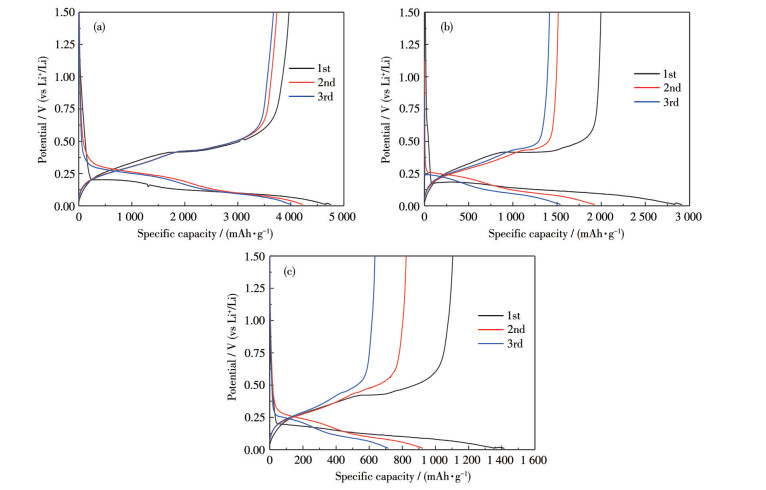
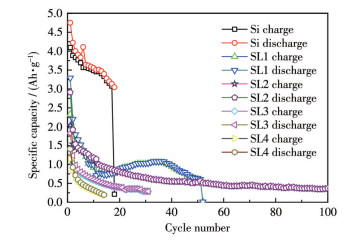
Fig. 6 shows the cycling performance of Si, SL1, SL2, SL3, and SL4 at current densities of 100 mA·g-1. The first discharge and charge-specific capacities of Si were 4 752.5 and 4 094.9 mAh·g-1 with a Coulombic efficiency of 86.2%. The reversible capacity decreased rapidly and decreased to 3 133.5 mAh·g-1 after 17 cycles. In the following cycle, the charge capacity was only 212.2 mAh·g-1 and can´t keep charging, which indicates the spalling damage of the Si electrode. It may be that the electrode cannot withstand repeated volume changes and the material spalling phenomenon occurs. For the SL1 electrode, the first discharge and charge capacities were 3 292.1 and 2 327.7 mAh·g-1 with a Coulombic efficiency of 70.7%. The reversible capacity experienced a process of first decreasing, then increasing, and then decreasing. After 51 cycles, the SL1 electrode was also peeling off. The SL2 electrode exhibited initial discharge-charge capacities of 2 908.9 and 2 033.4 mAh·g-1, respectively, with a Coulombic efficiency of 69.9%. The Coulombic efficiency of the 2nd and 3rd cycles were 80.2% and 94.1%, respectively. Then the Coulombic efficiency reached above 99%. The SL2 electrode delivered the reversible capacity of 364.1 mAh·g-1 after 100 cycles. Both SL3 and SL4 had less cyclic capacity than SL2 for the corresponding number of cycles, indicating poor cyclic performance. The LiAlO2 coating limits the charge and discharges reaction of Si and the volume changes of Si and improved cycle stability at the expense of capacity. The results show that a certain amount of LiAlO2 coating can improve the cyclic stability of the electrode.
In this paper, we have successfully synthesized the nanocomposites of LiAlO2-coated Si nanoparticles. The Si@LiAlO2 nanocomposite has a dendritic structure with openings and channels between the dendrites, which can improve the cycling performance as anode material for LIBs. The Si@LiAlO2 electrode delivered the reversible capacity of 364.1 mAh·g-1 after 100 cycles at a current density of 100 mA·g-1. The cycling performance was better than pure Si nanoparticles, indicating that a certain amount of LiAlO2 coating can improve the cyclic stability of the electrode.
Yang Y H, Liu S, Bian X F, Feng J K, An Y L, Yuan C. Morphology- and Porosity-Tunable Synthesis of 3D-Nanoporous SiGe Alloy as High-Performance Lithium-Ion Battery Anode[J]. ACS Nano, 2018, 12(3): 2900-2908. doi: 10.1021/acsnano.8b00426
Zhang S J, Qin Z L, Hou Z G, Ye J J, Xu Z B, Qian Y T. Large-Scale Preparation of Black Phosphorus by Molten Salt Method for Energy Storage[J]. ChemPhysMater, 2022, 1(1): 1-5. doi: 10.1016/j.chphma.2021.09.005
Yi T F, Shi L N, Han X, Wang F F, Zhu Y R, Xie Y. Approaching High-Performance Lithium Storage Materials by Constructing Hierar-chical CoNiO2@CeO2 Nanosheets[J]. Energy Environ. Mater., 2021, 4(4): 586-595. doi: 10.1002/eem2.12140
Yi T F, Mei J, Peng P P, Luo S H. Facile Synthesis of Polypyrrole-Modified Li5Cr7Ti6O25 with Improved Rate Performance as Negative Electrode Material for Li-Ion Batteries[J]. Composites Part B, 2019, 167: 566-572. doi: 10.1016/j.compositesb.2019.03.032
Yi T F, Xie Y, Zhu Y R, Zhu R S, Shen H Y. Structural and Thermo-dynamic Stability of Li4Ti5O12 Anode Material for Lithium-Ion Bat-tery[J]. J. Power Sources, 2013, 222: 448-454. doi: 10.1016/j.jpowsour.2012.09.020
Fu L L, Xu A D, Song Y, Ju J H, Sun H, Yan Y R, Wu S P. Pinecone-like Silicon@Carbon Microspheres Covered by Al2O3 Nano-petals for Lithium-Ion Battery Anode under High Temperature[J]. Electrochim. Acta, 2021, 387: 138461. doi: 10.1016/j.electacta.2021.138461
Song C S, Zhao B X, Chen S Y, Ma J Y, Du H B. Nickel-Assisted One-Pot Preparation of Graphenic Carbon Matrices Embedded with Silicon Nanoparticles as Anode Materials for Lithium Ion Batteries[J]. Carbon, 2021, 179: 266-274. doi: 10.1016/j.carbon.2021.04.042
Zhang X, Ju Z Y, Zhu Y, Takeuchi K J, Takeuchi E S, Marschilok A C, Yu G H. Multiscale Understanding and Architecture Design of High Energy/Power Lithium-Ion Battery Electrodes[J]. Adv. Energy Mater., 2020, 11(2): 2000808.
Wang J Y, Liao L, Lee H R, Shi F F, Huang W, Zhao J, Pei A, Tang J, Zheng X L, Chen W, Cui Y. Surface-Engineered Mesoporous Silicon Microparticles as High-Coulombic-Efficiency Anodes for Lithium-Ion Batteries[J]. Nano Energy, 2019, 61: 404-410. doi: 10.1016/j.nanoen.2019.04.070
Peng P P, Wu Y R, Li X Z, Zhang J H, Li Y W, Cui P, Yi T F. Toward Superior Lithium/Sodium Storage Performance: Design and Construction of Novel TiO2-Based Anode Materials[J]. Rare Met., 2021, 40: 3049-3075. doi: 10.1007/s12598-021-01742-z
Yi T F, Pan J J, Wei T T, Li Y W, Cao G Z. NiCo2S4-Based Nanocom-posites for Energy Storage in Supercapacitors and Batteries[J]. Nano Today, 2020, 33: 100894. doi: 10.1016/j.nantod.2020.100894
Lee D H, Shim H W, Kim D W. Facile Synthesis of Heterogeneous Ni-Si@C Nanocomposites as High Performance Anodes for Li-Ion Batteries[J]. Electrochim. Acta, 2014, 146: 60-67. doi: 10.1016/j.electacta.2014.08.103
Zhang C J, Gu L, Kaskhedikar N, Cui G L, Maier J. Preparation of Silicon@Silicon Oxide Core-Shell Nanowires from a Silica Precursor toward a High Energy Density Li-Ion Battery Anode[J]. ACS Appl. Mater. Interfaces, 2013, 5(23): 12340-12345. doi: 10.1021/am402930b
Kim W S, Hwa Y, Shin J H, Yang M, Sohn H J, Hong S H. Scalable Synthesis of Silicon Nanosheets from Sand as an Anode for Li-Ion Batteries[J]. Nanoscale, 2014, 6(8): 4297-4302. doi: 10.1039/c3nr05354g
An W L, He P, Xiao C M, Guo E M, Pang C L, He X Q, Ren J G, Yuan G H, Du N, Yang D R. Hierarchical Carbon Shell Compositing Microscale Silicon Skeleton as High-Performance Anodes for Lithium-Ion Batteries[J]. ACS Appl. Energy Mater., 2021, 4(5): 4976-4985. doi: 10.1021/acsaem.1c00529
Shi J, Jiang X S, Sun J F, Ban B Y, Li J W, Chen J. Recycled Silicon-Based Anodes with Three-Dimensional Hierarchical Porous Carbon Framework Synthesized by a Self-Assembly CaCO3 Template Meth-od for Lithium Ion Battery[J]. J. Alloy. Compd., 2021, 858: 157703. doi: 10.1016/j.jallcom.2020.157703
Liu F, Liu Y X, Wang E Y, Ruan J J, Chen S M. Double-Buffer Silicon-Carbon Anode Material by a Dynamic Self-Assembly Process for Lithium-Ion Batteries[J]. Electrochim. Acta, 2021, 393: 139041. doi: 10.1016/j.electacta.2021.139041
Liu R P, Shen C, Dong Y, Qin J L, Wang Q, Iocozzia J, Zhao S Q, Yuan K J, Han C P, Li B H, Lin Z Q. Sandwich-like CNTs/Si/C Nanotubes as High Performance Anode Materials for Lithium-Ion Batteries[J]. J. Mater. Chem. A, 2018, 6(30): 14797-14804. doi: 10.1039/C8TA04686G
Lotfabad E M, Kalisvaart P, Kohandehghan A, Cui K, Kupsta M, Farbod B, Mitlin D. Si Nanotubes ALD Coated with TiO2, TiN or Al2O3 as High Performance Lithium Ion Battery Anodes[J]. J. Mater. Chem. A, 2014, 2(8): 2504-2516. doi: 10.1039/C3TA14302C
Ye J C, An Y H, Heo T W, Biener M M, Nikolic R J, Tang M, Jiang H, Wang Y M. Enhanced Lithiation and Fracture Behavior of Silicon Mesoscale Pillars via Atomic Layer Coatings and Geometry Design[J]. J. Power Sources, 2014, 248: 447-456. doi: 10.1016/j.jpowsour.2013.09.097
Liu W, Li X F, Xiong D B, Hao Y C, Li J W, Kou H R, Yan B, Li D J, Lu S G, Koo A, Adair K, Sun X L. Significantly Improving Cycling Performance of Cathodes in Lithium Ion Batteries: The Effect of Al2O3 and LiAlO2 Coatings on LiNi0.6Co0.2Mn0.2O2[J]. Nano Energy, 2018, 44: 111-120. doi: 10.1016/j.nanoen.2017.11.010
Ai Q, Li D P, Guo J G, Hou G M, Sun Q, Sun Q D, Xu X Y, Zhai W, Zhang L, Feng J K, Si P C, Lou J, Ci L J. Artificial Solid Electrolyte Interphase Coating to Reduce Lithium Trapping in Silicon Anode for High Performance Lithium-Ion Batteries[J]. Adv. Mater. Interfaces, 2019, 6(21): 1901187. doi: 10.1002/admi.201901187
Wu Y, Li Y F, Wang L Y, Bai Y J, Zhao Z Y, Yin L W, Li H. Enhancing the Li-Ion Storage Performance of Graphite Anode Mate-rial Modified by LiAlO2[J]. Electrochim. Acta, 2017, 235: 463-470. doi: 10.1016/j.electacta.2017.03.129
Fang Z K, Zhu Y R, Yi T F, Xie Y. Li4Ti5O12-LiAlO2 Composite as High Performance Anode Material for Lithium-Ion Battery[J]. ACS Sustainable Chem. Eng., 2016, 4(4): 1994-2003. doi: 10.1021/acssuschemeng.5b01271
Huang S Y, Qin X, Miao X Y, Xu X R, Lei C R, Wei T Y. Novel Core-Dual Shell Si@MoO2@C Nanoparticles as Improved Anode Materials for Lithium-Ion Batteries[J]. ChemElectroChem, 2021, 8(4): 675-680. doi: 10.1002/celc.202001401
Nie P, Le Z Y, Chen G, Liu D, Liu X Y, Wu H B, Xu P C, Li X R, Liu F, Chang L M, Zhang X G, Lu Y F. Graphene Caging Silicon Par-ticles for High-Performance Lithium-Ion Batteries[J]. Small, 2018, 14(25): 1800635. doi: 10.1002/smll.201800635
Liu X Y, Shen C, Lu J, Liu G F, Jiang Y, Gao Y, Li W R, Zhao B, Zhang J J. Graphene Bubble Film Encapsulated Si@C Hollow Spheres as a Durable Anode Material for Lithium Storage[J]. Electrochim. Acta, 2020, 361: 137074. doi: 10.1016/j.electacta.2020.137074
Kamali A R, Kim H K, Kim K B, Kumar V R, Fray D J. Large Scale Green Production of Ultra-High Capacity Anode Consisting of Gra-phene Encapsulated Silicon Nanoparticles[J]. J. Mater. Chem. A, 2017, 5(36): 19126-19135.
Dong H, Fu X L, Wang J, Wang P, Ding H, Song R, Wang S M, Li R R, Li S Y. In-Situ Construction of Porous Si@C Composites with LiCl Template to Provide Silicon Anode Expansion Buffer[J]. Carbon, 2021, 173: 687-695.
Wei Q, Chen Y M, Hong X J, Song C L, Yang Y, Si L P, Zhang M, Cai Y P. Novel Bread-like Nitrogen-Doped Carbon Anchored Nano-Silicon as High-Stable Anode for Lithium-Ion Batteries[J]. Appl. Surf. Sci., 2020, 511: 145609.
Yi T F, Li Y, Fang Z K, Cui P, Luo S H, Xie Y. Improving the Cycling Stability and Rate Capability of LiMn0.5Fe0.5PO4/C Nanorod as Cathode Materials by LiAlO2 Modification[J]. J. Materiomics, 2020, 6(1): 33-44.
Qiu S, Lu G X, Liu J R, Lyu H L, Hu C X, Li B, Yan X R, Guo J, Guo Z H. Enhanced Electrochemical Performances of MoO2 Nanoparticles Composited with Carbon Nanotubes for Lithium-Ion Battery Anodes[J]. RSC Adv., 2015, 5(106): 87286-87294.
Luo Z, Xu Y, Gong C R, Zheng Y Q, Zhou Z X, Yu L M. An Ultravio-let Curable Silicon/Graphite Electrode Binder for Long-Cycling Lith-ium Ion Batteries[J]. J. Power Sources, 2021, 485: 229348.
Lin L D, Xu X N, Chu C X, Majeed M K, Yang J. Mesoporous Amor-phous Silicon: A Simple Synthesis of a High-Rate and Long-Life Anode Material for Lithium-Ion Batteries[J]. Angew. Chem. Int. Ed., 2016, 55(45): 14063-14066.
Epur R, Ramanathan M, Beck F R, Manivannan A, Kumta P N. Elec-trodeposition of Amorphous Silicon Anode for Lithium Ion Batteries[J]. Mater. Sci. Eng. B, 2012, 177(14): 1157-1162.
Wang Z G, Zheng B, Liu H, Zhang C, Wu F F, Luo H Y, Yu P. One-Step Synthesis of Nanoporous Silicon@Graphitized Carbon Compos-ite and Its Superior Lithium Storage Properties[J]. J. Alloy. Compd., 2021, 861: 157955.

Figure 1 SEM images of Si (a), SL1 (b), SL2 (c), SL3 (d), and SL4 (e); XRD patterns of Si, SL1, SL2, SL3, and SL4 (f)

Figure 2 (a‐c) TEM images and (d) element distribution mapping images for Al, Si, O, Al+Si+O by STEM-XEDS of SL2

Figure 4 CV curves of SL1 (a) and Nyquist plots collected from the 3rd charged states of Si, SL1, SL2, SL3, and SL4 (b)

Figure 5 Galvanostatic charge‐discharge curves of the 1st, 2nd, and 3rd cycles for (a) Si, (b) SL2, and (c) SL4

 扫一扫看文章


扫一扫关注我们
 下载:
下载:
 下载:
下载:

