Scheme1.
Diverse reaction patterns via the RC process


The cycloaddition reaction represents one of the indispensable methods to construct cyclic scaffolds in organic synthesis. For decades, a variety of methods, such as conventional [2+2], [3+2], [3+3], [4+2] pericyclic or formal cycloadditions, have been extensively explored.[1] Among them, the [6+2] cycloaddition reaction based on fulvenes to produce fused bi- or tri-cyclic skeletons has attracted special attention since the pioneering work of Houk.[2] Recently, we also reported an amine catalyzed asymmetric [6+2] cycloaddition reaction of α'-alkylidene- 2-cyclopentenones by in situ generating 4-aminofulvene intermediates.[3] Nevertheless, some significant substrate limitations were observed in the above strategies.
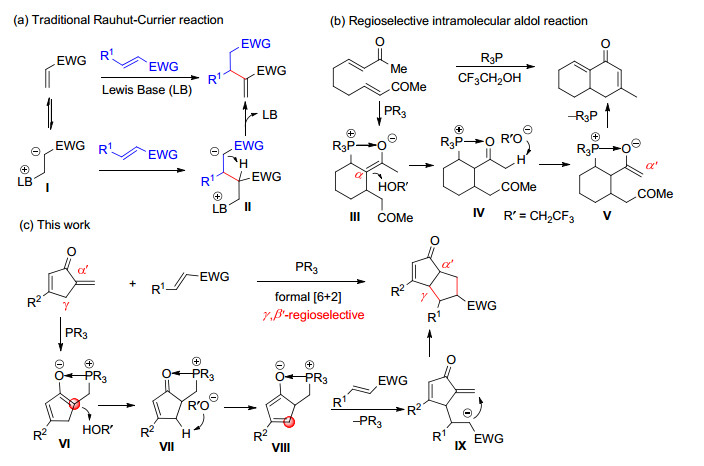
The Rauhut-Currier (RC) reaction, as a powerful and economic protocol to construct C—C bond between activated olefins, also has aroused widespread attention, whereas the chemoselectivity represents one of the long-standing challenges in this field.[4] Meanwhile, according to the well-established catalytic cycle, a normal RC-type reaction can not proceed by using the activated olefins with an α-substitution, because the regeneration of Lewis base catalyst relies on an elimination process involving proton transfer (Scheme 1a, Ⅱ). However, the activated olefins still can form zwitterionic enolates with suitable Lewis bases. In 2006, Schaus et al.[5] reported the dimerization reaction of α-substituted 1, 4-dien-3-ones to deliver a variety of bicyclo[3.2.1]octenones through cascade [4+2] cycloaddition/Wittig reaction in the presence of phosphine. In addition, we[6] also disclosed a phosphinemediated interrupted Morita-Baylis-Hillman reaction and some unexpected cascade processes of 3-olefinic oxindoles. However, stoichiometric phosphine substances were generally required due to the generation of phosphine oxides.
In 2005, The Roush group[7] reported a phosphine-cata- lyzed intramolecular aldol reaction of unsaturated 1, 5- diketones. It was proposed that the coulombic interaction between the phosphonium unit and the adjacent carbonyl in intermediate Ⅳ, generated from the RC intermediate Ⅲ via protonation, could increase the acidity of the α'-proton, thus the reactive site was transferred from α-site to less sterically hindered α'-site to furnish the high regioselectivity of intramolecular aldol reaction. Trifluoroethanol (TFE) was found to be crucial for the success of the reaction (Scheme 1b).[7] Based on the above considerations, we envisaged that the α'-methylene-2-cyclopen- tenone would be attacked by a tertiary phosphine to generate the zwitterionic intermediate Ⅵ. It was hypothesized that the acidity of the γ-CH of the similarly protonated intermediate Ⅶ would be significantly enhanced, thus leading to the formation of the intermediate Ⅷ via deprotonation. As a result, the reactive site would be shifted from α'-site to remote γ-site, and a cascade RC-type reaction/phosphine elimination/anti-Baldwin cyclization (5-endo-trig)[8] would furnish a formal [6+2] cycloaddition process accordingly (Scheme 1c).
The initial investigation began with the reaction of α'-methylene-β-phenylcyclopent-2-en-1-one (1a)[9] and 2- benzylidene-1, 3-indanedione (2a)[10] in TFE using nBu3P as the catalyst. To our delight, the corresponding formal [6+2] cycloaddition product 3a was obtained in 50% yield (Table 1, Entry 1). Then a few phosphine catalysts were investigated. Me3P gave the product in 36% yield (Table 1, Entry 2), and a better yield was obtained with Cy3P (Table 1, Entry 3). Nevertheless, inferior results were generally delivered with phosphines with diverse aromatic groups (Table 1, Entries 4~8). Solvent screenings (Table 1, Entries 9~14) indicated that TFE was also crucial for the observed reaction, but the reaction did not work in hexafluoroisopropanol (HFIP, Table 1, Entry 15). These results are consistent with the Roush's work and demonstrate that TFE could facilitate the migration of proton, thus enabling the switch of reactive sites.[7] Finally, it was found that much shorter time was required by conducting the reaction with higher loadings of Cy3P and at higher temperature, though the same yield for product 3a was obtained (Table 1, Entry 16). Moreover, a racemic bifunctional phosphine C5 was found to be a superior catalyst, giving 3a in an excellent yield (Table 1, Entry 17).

 下载:
导出CSV
下载:
导出CSV
 |
||||
| Entry | Cat. | Solvent | T/℃ | Yieldb/% |
| 1 | nBu3P | TFE | 40 | 53 |
| 2 | Me3P | TFE | 40 | 36 |
| 3 | Cy3P | TFE | 40 | 56 |
| 4 | PPh3 | TFE | 40 | 45 |
| 5 | C1 | TFE | 40 | 47 |
| 6 | C2 | TFE | 40 | 48 |
| 7 | C3 | TFE | 40 | 49 |
| 8 | C4 | TFE | 40 | 30 |
| 9 | Cy3P | toluene | 40 | trace |
| 10 | Cy3P | MeCN | 40 | NR |
| 11 | Cy3P | CHCl3 | 40 | NR |
| 12 | Cy3P | THF | 40 | NR |
| 13 | Cy3P | MeOH | 40 | 32 |
| 14 | Cy3P | iPrOH | 40 | NR |
| 15 | Cy3P | HFIP | 40 | NR |
| 16c | Cy3P | TFE | 60 | 56d |
| 17c | C5 | TFE | 60 | 92d |
| a Unless otherwise noted, the reactions were carried out with 2a (0.05 mmol), 1a (0.1 mmol), phosphine (20 mol%) in solvent (0.25 mL) at 40 ℃ for 48 h under Ar. b Yield of isolated product; dr (> 19:1) determined by 1H NMR analysis. c Catalyst (30 mol%) was used. d For 12 h. | ||||
|
|
Considering the ready availability of catalyst, the generality of this formal [6+2] cycloaddition reaction with a variety of substrates was investigated under the catalysis of commercial Cy3P. The results are summarized in Table 2. Firstly, 2-alkylidene-1, 3-indanediones 2 with diversely substituted aromatic and heteroaromatic rings were investigated in the reactions with dienone 1a, and the corresponding cycloadducts 3b~3k were generally produced in fair to good yields with exclusive diastereoselectivity (Table 2, Entries 2~11). Moreover, an array of dienones 1 with various β-aryl groups were tested in the reactions with acceptor 2a, and similar results were afforded for the products 3l~3s (Table 2, Entries 12~19). Unfortunately, it was found that the dienones 1 bearing either a β-methyl or β-H substituent showed inert reactivity with 2a under the current catalytic conditions. Furthermore, bifunctional C5 was also employed as the catalyst in some cases, and most of them provided higher yields (Table 2, data in parentheses).
下载:
导出CSV
 |
||||
| Entry | R1 | R2 | 3 | Yieldb/% |
| 1 | Ph | Ph | 3a | 56c(92) |
| 2 | Ph | 4-FC6H4 | 3b | 45 (64) |
| 3 | Ph | 4-ClC6H4 | 3c | 70 |
| 4 | Ph | 4-BrC6H4 | 3d | 55 (54) |
| 5 | Ph | 2-MeC6H4 | 3e | 50 (76) |
| 6 | Ph | 3-MeC6H4 | 3f | 69 (66) |
| 7 | Ph | 4-MeC6H4 | 3g | 57 |
| 8 | Ph | 4-tBuC6H4 | 3h | 48 (54) |
| 9 | Ph | 3-MeOC6H4 | 3i | 44 (59) |
| 10 | Ph | 4-MeOC6H4 | 3j | 75 |
| 11 | Ph | 2-Furyl | 3k | 60 (62) |
| 12 | 4-FC6H4 | Ph | 3l | 76 (79) |
| 13 | 3, 5-(CF3)2C6H3 | Ph | 3m | 48 |
| 14 | 3-MeC6H4 | Ph | 3n | 57 |
| 15 | 4-MeC6H4 | Ph | 3o | 59 (69) |
| 16 | 3, 5-(CH3)2C6H3 | Ph | 3p | 59 (78) |
| 17 | 3-MeOC6H4 | Ph | 3q | 62 (79) |
| 18 | 4-MeOC6H4 | Ph | 3r | 50 |
| 19 | 2-Naphthyl | Ph | 3s | 55 (79) |
| aUnless otherwise noted, the reactions were carried out with 2 (0.1 mmol), 1 (0.2 mmol), Cy3P (30 mol%) in TFE (0.5 mL) at 60 ℃ for 12~48 h under Ar. bYield of the isolated product [data in parentheses were obtained with C5 (30 mol%)]; dr (> 19:1) determined by 1H NMR analysis. cThe relative configuration of racemic 3a was determined by X-ray analysis (CCDC 1905888). The other products were assigned by analogy. | ||||
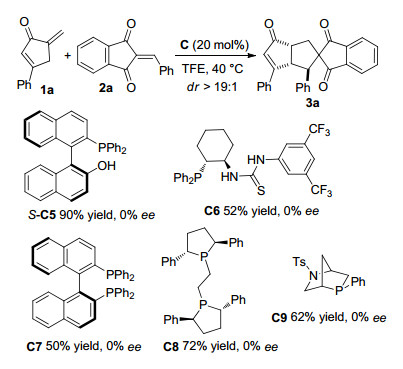
The potential asymmetric formal [6+2] cycloaddition reaction of dienone 1a and acceptor 2a was also explored. As outlined in Scheme 2, the chiral phosphine S-C5 failed to provide any enantiocontrol, though an excellent yield for the cycloadduct 3a could be attained. In addition, the chiral bifunctional phosphine C6 exhibited moderate catalytic activity in TFE, but no enantioselectivity could be induced either. Similarly, moderate to good yields without enantiocontrol were obtained in the presence of chiral phosphines C7~C9. Moreover, very poor conversions were still observed by replacing TFE with other solvents, such as toluene, MeCN, CHCl3 and THF. It was proposed that the γ-reactive site is far from the chiral catalyst, which may make the stereocontrol quite difficult. On the other hand, TFE would also seriously affect the potential concerted hydrogen bonding interaction between the chiral catalyst and substrates. As a result, the development of an asymmetric [6+2] cycloaddition reaction still remained to be explored.
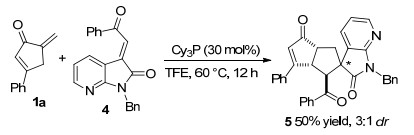
In addition, more electrophiles were explored. Fortunately, the desired product 5 could be generated by using 3-olefinic-7-azaoxindole 4 as the electrophile, albeit in fair yield and diastereoselectivity (Scheme 3).
A highly γ, β'-regioselective formal [6+2] cycloaddition reaction between α'-methylene-2-cyclopentenones and 2-alkylidene-1, 3-indanediones catalyzed by a tertiary phosphine was successfully developed. This reaction relied on forming zwitterionic dienolate species via proton transfer, proceeding in a γ-regioselective Rauhut-Currier-type reaction followed by an intramolecular Michael addition process. This method provided a facile and economic protocol to construct fused bicyclic frameworks incorporating a spiro-1, 3-indanedione motif in fair to good yields with exclusive diastereoselectivity, which may find further application in organic synthesis. This work also expanded the reaction mode of enone substrates bearing α-substitutions under phosphine catalysis. Further investigation in this field, especially developing asymmetric reactions, is under way in our laboratory.
NMR data were obtained for 1H at 400 MHz or 600 MHz, and for 13C at 100 MHz or 150 MHz. Chemical shifts were reported from tetramethylsilane with the solvent resonance as the internal standard in CDCl3 solution. ESI HRMS was recorded on a Waters SYNAPT G2. Column chromatography was performed on silica gel (200~300 mesh) eluting with ethyl acetate and petroleum ether. TLC was performed on glass-backed silica plates. UV light, I2, and solution of potassium permanganate were used to visualize products or starting materials. All chemicals were used without purification as commercially available unless otherwise noted. Petroleum ether and ethyl acetate (EtOAc) were distilled. THF was freshly distilled from sodium/benzophenone before use. Experiments involving moisture and/or air sensitive components were performed under a positive pressure of argon in oven-dried glassware equipped with a rubber septum inlet. Dried solvents and liquid reagents were transferred by oven-dried syringes. 2-Alkylidene-1, 3-indanediones 2 were synthesized following the literature procedures.[10]
To a mixture of β-phenylcyclopent-2-en-1-one (1.87 g, 11.8 mmol) and paraformaldehyde (0.71 g, 23.6 mmol) in dry toluene (100 mL) was added (iPr)2H2N+CF3COO- (2.54 g, 11.8 mmol) and trifluoroacetic acid (0.13 mL, 1.18 mmol). The reaction mixture was stirred at 80 ℃ for 2 h. The mixture became clear and was cooled down to room temperature. Then more paraformaldehyde (0.71 g, 23.6 mmol) was added. The mixture was stirred at 80 ℃ for another 6 h. The mixture was concentrated in vacuo and purified by flash column chromatography on silica gel eluting with EtOAc/petroleum ether (V:V=1:10) to give 5-methylene-3- phenylcyclopent-2-en-1-one (1a):[9] yellow solid, 1.20 g, 59.0% yield. m.p. 137~139 ℃; 1H NMR (400 MHz, CDCl3) δ: 7.72~7.62 (m, 2H), 7.52~7.4 (m, 3H), 6.79 (s, 1H), 6.15 (s, 1H), 5.51 (s, 1H), 3.65 (s, 2H); 13C NMR (150 MHz, CDCl3) δ: 195.7, 167.9, 142.3, 131.5, 129.05, 128.9, 126.9, 116.5, 34.0.
5-Methylene-2-cyclopentenone 1 (0.2 mmol), 2-alkyli- dene-1, 3-indanedione 2 (0.1 mmol), and phosphine Cy3P (8.4 mg, 0.03 mmol; or C5, 13.6 mg, 0.03 mmol) were dissolved in TFE (0.5 mL). Then the mixture was stirred at 60 ℃ under Ar for the indicated time (12~48 h). After completion, it was concentrated and purified by flash chromatography on silica gel eluting with EtOAc/petroleum (V:V=1:3~1:5) ether to give the product 3.
1', 6'-Diphenyl-1', 3', 3a', 6a'-tetrahydro-4'H-spiro[indene-2, 2'-pentalene]-1, 3, 4'-trione (3a): White solid, 23.0 mg, 56% yield (with C5, 37.2 mg, 92% yield). m.p. 155~159 ℃; 1H NMR (600 MHz, CDCl3) δ: 7.81 (d, J=7.8 Hz, 1H), 7.75 (d, J=7.2 Hz, 1H), 7.72~7.64 (m, 2H), 7.22~7.14 (m, 3H), 7.04 (d, J=7.6 Hz, 2H), 7.10~6.94 (m, 5H), 6.34 (s, 1H), 4.78~4.69 (m, 1H), 3.88 (td, J=9.8, 7.2 Hz, 1H), 3.40 (d, J=9.8 Hz, 1H), 2.40 (dd, J=13.2, 9.6 Hz, 1H), 2.28 (dd, J=13.2, 9.6 Hz, 1H); 13C NMR (100 MHz, CDCl3) δ: 208.9, 203.2, 200.4, 176.5, 141.5, 136.7, 135.8, 135.6, 132.7, 130.6, 128.4, 128.3, 128.0, 128.0, 127.9, 127.4, 126.0, 123.1, 123.1, 69.3, 58.0, 52.7, 51.6, 34.3; HRMS calcd for C28H20O3Na [M+Na]+ 427.1305, found 427.1317.
1'-(4-Fluorophenyl)-6'-phenyl-1', 3', 3a', 6a'-tetrahydro-4'H-spiro[indene-2, 2'-pentalene]-1, 3, 4'-trione (3b): Pale yellow solid, 19.0 mg, 45% yield (with C5, 27.3 mg, 64% yield). m.p. 177~179 ℃; 1H NMR (400 MHz, CDCl3) δ: 7.85 (dd, J=6.4, 1.6 Hz, 1H), 7.78 (dd, J=6.4, 1.2 Hz, 1H), 7.76~7.69 (m, 2H), 7.22 (t, J=7.6 Hz, 1H), 7.19~7.13 (m, 2H), 7.08 (t, J=7.6 Hz, 2H), 7.01~6.91 (m, 2H), 6.68 (t, J=8.8 Hz, 2H), 6.33 (d, J=1.2 Hz, 1H), 4.69 (t, J=8.0 Hz, 1H), 3.86 (td, J=9.6, 7.2 Hz, 1H), 3.38 (d, J=10.0 Hz, 1H), 2.39 (dd, J=13.6, 9.6 Hz, 1H), 2.26 (dd, J=13.6, 9.6 Hz, 1H); 13C NMR (150 MHz, CDCl3) δ: 208.7, 203.0, 200.3, 176.3, 161.9 (JCF1=245.4 Hz), 141.5, 141.4, 136.1, 135.9, 132.7, 132.6, 132.5, 130.8, 130.0, 130.0 (JCF3=8.1 Hz), 127.9, 126.1, 123.2, 115.3 (JCF2=21.5 Hz), 69.2, 57.1, 52.9, 51.5, 34.4; HRMS calcd for C28H19FO3Na [M+Na]+ 445.1210, found 445.1212.
1'-(4-Chlorophenyl)-6'-phenyl-1', 3', 3a', 6a'-tetrahydro-4'H-spiro[indene-2, 2'-pentalene]-1, 3, 4'-trione (3c): Pale yellow semi-solid, 30.4 mg, 70% yield; 1H NMR (600 MHz, CDCl3) δ: 7.84 (d, J=7.8 Hz, 1H), 7.78 (d, J=7.2 Hz, 1H), 7.76~7.67 (m, 2H), 7.23 (t, J=7.2 Hz, 1H), 7.19~7.12 (m, 2H), 7.08 (d, J=7.8 Hz, 2H), 7.01~6.90 (m, 4H), 6.32 (s, 1H), 4.74~4.65 (m, 1H), 3.84 (td, J=9.6, 7.2 Hz, 1H), 3.37 (d, J=9.6 Hz, 1H), 2.38 (dd, J=13.8, 9.6 Hz, 1H), 2.25 (dd, J=13.8, 9.6 Hz, 1H); 13C NMR (100 MHz, CDCl3) δ: 208.6, 202.8, 200.2, 176.2, 141.5, 141.4, 136.1, 136.0, 135.5, 133.3, 132.7, 130.9, 129.8, 128.6, 128.2, 127.9, 126.2, 123.3, 123.2, 69.1, 57.0, 52.87, 51.5, 34.7; HRMS calcd for C28H19ClO3Na [M+Na]+ 461.0915 (35Cl), 463.0885 (37Cl), found 461.0916 (35Cl), 463.0910 (37Cl).
1'-(4-Bromophenyl)-6'-phenyl-1', 3', 3a', 6a'-tetrahydro-4'H-spiro[indene-2, 2'-pentalene]-1, 3, 4'-trione (3d): Pale yellow solid, 26.5 mg, 55% yield (with C5, 26.2 mg, 54% yield). m.p. 222~224 ℃; 1H NMR (400 MHz, CDCl3) δ: 7.89 (dd, J=6.8, 1.6 Hz, 1H), 7.82 (dd, J=6.8, 2.0 Hz 1H), 7.76~7.70 (m, 2H), 7.30~7.20 (m, 1H), 7.19~7.05 (m, 6H), 6.88 (d, J=8.4 Hz, 2H), 6.33 (s, 1H), 4.72~4.63 (m, 1H), 3.85 (td, J=9.6, 7.2 Hz, 1H), 3.36 (d, J=10.0 Hz, 1H), 2.39 (dd, J=13.6, 9.6 Hz, 1H), 2.25 (dd, J=13.6, 9.6 Hz, 1H); 13C NMR (100 MHz, CDCl3) δ: 208.6, 200.2, 202.8, 176.2, 141.5, 141.4, 136.2, 136.0, 132.7, 131.5, 130.9, 130.2, 128.2, 127.9, 126.2, 123.3, 123.3, 121.4, 69.0, 57.0, 52.9, 51.5, 34.8; HRMS calcd for C28H19Br- O3Na [M+Na]+ 505.0410 (79Br), 507.0389 (81Br), found 505.0407 (79Br), 507.0409 (81Br).
6'-Phenyl-1'-(o-tolyl)-1', 3', 3a', 6a'-tetrahydro-4'H-spiro-[indene-2, 2'-pentalene]-1, 3, 4'-trione (3e): White solid, 21.2 mg, 50% yield (with C5, 32.0 mg, 76% yield). m.p. 200~203 ℃; 1H NMR (400 MHz, CDCl3) δ: 7.85 (d, J=7.6 Hz, 1H), 7.74 (d, J=7.6 Hz, 1H), 7.72~7.64 (m, 2H), 7.45 (d, J=8.0 Hz, 1H), 7.20~7.14 (m, 1H), 7.11~7.05 (m, 2H), 7.06~6.95 (m, 3H), 6.90~6.81 (m, 1H), 6.62 (d, J=7.2 Hz, 1H), 6.33 (s, 1H), 4.67~4.53 (m, 1H), 3.88 (td, J=9.6, 7.6 Hz, 1H), 3.76 (d, J=9.6 Hz, 1H), 2.40 (dd, J=13.2, 9.6 Hz, 1H), 2.29 (dd, J=13.2, 9.6 Hz, 1H), 1.58 (s, 3H); 13C NMR (150 MHz, CDCl3) δ: 209.1, 203.6, 200.6, 176.7, 141.8, 141.4, 137.1, 135.9, 135.7, 135.6, 132.6, 130.7, 130.4, 128.0, 127.8, 127.3, 127.0, 126.2, 125.7, 123.1, 123.1, 68.9, 54.7, 52.4, 51.6, 34.7, 19.2; HRMS calcd for C29H22O3Na [M+Na]+ 441.1461, found 441.1460.
6'-Phenyl-1'-(m-tolyl)-1', 3', 3a', 6a'-tetrahydro-4'H-spiro[indene-2, 2'-pentalene]-1, 3, 4' (3f): Pale yellow solid, 29.0 mg, 69% yield (with C5, 27.6 mg, 66% yield). m.p. 162~164 ℃; 1H NMR (400 MHz, CDCl3) δ: 7.85~7.80 (m, 1H), 7.79~7.74 (m, 1H), 7.65~7.72 (m, 2H), 7.21 (d, J=7.4 Hz, 1H), 7.18~7.14 (m, 2H), 7.04 (dd, J=8.4, 7.2 Hz, 2H), 6.91~6.80 (m, 2H), 6.75 (dd, J=7.2, 1.6, 1H), 6.71 (s, 1H), 6.34 (d, J=1.2 Hz, 1H), 4.67~4.72 (m, 1H), 3.87 (td, J=9.6, 7.2 Hz, 1H), 3.35 (d, J=9.6 Hz, 1H), 2.39 (dd, J=13.2, 9.6 Hz, 1H), 2.27 (dd, J=13.2, 9.6 Hz, 1H), 2.06 (s, 3H); 13C NMR (100 MHz, CDCl3) δ: 209.1, 203.1, 200.5, 176.6, 141.6, 141.5, 137.9, 136.7, 135.8, 135.6, 132.8, 130.7, 129.4, 128.3, 128.1, 128.0, 126.0, 125.3, 123.1, 123.0, 69.3, 58.2, 52.9, 51.7, 34.3, 21.1; HRMS calcd for C29H22O3Na [M+Na]+ 441.1461, found 441.1462.
6'-Phenyl-1'-(p-tolyl)-1', 3', 3a', 6a'-tetrahydro-4'H-spiro[indene-2, 2'-pentalene]-1, 3, 4'-trione (3g): Pale yellow semi- solid, 23.7 mg, 57% yield; 1H NMR (400 MHz, CDCl3) δ: 7.81 (d, J=6.8 Hz, 1H), 7.78~7.74 (m, 1H), 7.74~7.65 (m, 2H), 7.22~7.12 (m, 3H), 7.02 (t, J=8.0 Hz, 2H), 6.85 (d, J=7.6 Hz, 2H), 6.76 (d, J=7.6 Hz, 2H), 6.33 (d, J=1.2 Hz, 1H), 4.73~4.63 (m, 1H), 3.85 (dd, J=9.6, 7.2 Hz, 1H), 3.36 (d, J=9.6 Hz, 1H), 2.36 (dd, J=13.2, 9.6 Hz, 1H), 2.24 (dd, J=13.2, 9.6 Hz, 1H), 2.10 (s, 3H). 13C NMR (150 MHz, CDCl3) δ: 209.1, 203.1, 200.6, 176.6, 141.6, 136.9, 135.8, 135.6, 133.6, 132.7, 130.6, 129.0, 128.3, 128.0, 128.0, 126.0, 123.1, 123.1, 69.3, 57.6, 52.8, 51.6, 34.4, 20.9; HRMS calcd for C29H22O3Na [M+Na]+ 441.1461, found 441.1459.
1'-(4-(tert-Butyl)phenyl)-6'-phenyl-1', 3', 3a', 6a'-tetrahydro-4'H-spiro[indene-2, 2'-pentalene]-1, 3, 4'-trione (3h): Yellow solid, 22.0 mg, 48% yield (with C5, 24.8 mg, 54% yield). m.p. 242~244 ℃; 1H NMR (400 MHz, CDCl3) δ: 7.84 (dd, J=6.4, 1.2 Hz, 1H), 7.77 (dd, J=6.0, 1.2 Hz, 1H), 7.85~7.68 (m, 2H), 7.19~7.12 (m, 3H), 7.03~6.94 (m, 4H), 6.88 (d, J=8.3 Hz, 2H), 6.37~6.29 (m, 1H), 4.81~4.62 (m, 1H), 3.85 (td, J=9.6, 7.2 Hz, 1H), 3.36 (d, J=9.6 Hz, 1H), 2.39(dd, J=13.6, 9.6 Hz, 1H), 2.37 (dd, J=13.6, 9.6 Hz, 1H), 1.13 (s, 9H); 13C NMR (100 MHz, CDCl3) δ: 209.2, 203.3, 200.5, 176.6, 150.4, 141.7, 141.6, 135.7, 135.5, 133.6, 132.7, 130.6, 128.2, 128.0, 123.0, 125.9, 125.2, 123.1, 69.3, 57.8, 53.1, 51.6, 34.4, 34.3, 31.1; HRMS calcd for C32H28O3Na [M+Na]+ 483.1931, found 483.1942.
1'-(3-Methoxyphenyl)-6'-phenyl-1', 3', 3a', 6a'-tetrahydro-4'H-spiro[indene-2, 2'-pentalene]-1, 3, 4'-trione (3i): Pale yellow semi-solid, 19.0 mg, 44% yield (with C5, 25.2 mg, 59% yield); 1H NMR (400 MHz, CDCl3) δ: 7.84 (dd, J=8.0, 1.2 Hz, 1H), 7.77 (dd, J=6.4, 1.2 Hz, 1H), 7.857.68 (m, 2H), 7.25~7.17 (m, 3H), 7.06 (dd, J=8.4, 7.2 Hz, 2H), 6.90 (t, J=8.4 Hz, 1H), 6.61 (d, J=7.6 Hz, 1H), 6.54~6.46 (m, 2H), 6.35 (d, J=1.2 Hz, 1H), 4.74~4.65 (m, 1H), 3.88 (td, J=9.6, 7.6 Hz, 1H), 3.58 (s, 3H), 3.36 (d, J=9.6 Hz, 1H), 2.39 (dd, J=13.6, 9.6 Hz, 1H), 2.26 (dd, J=13.6, 9.6 Hz, 1H); 13C NMR (100 MHz, CDCl3) δ: 208.9, 203.1, 200.4, 176.5, 159.4, 141.6, 138.4, 135.9, 135.7, 132.8, 130.7, 129.4, 128.1, 128.0, 126.0, 123.1, 123.1, 120.8, 113.9, 113.4, 69.2, 58.1, 55.1, 52.9, 51.6, 34.4; HRMS calcd for C29H22O4Na [M+Na]+ 457.1410, found 457.1412.
1'-(4-Methoxyphenyl)-6'-phenyl-1', 3', 3a', 6a'-tetrahydro-4'H-spiro[indene-2, 2'-pentalene]-1, 3, 4'-trione (3j): Yellow solid, 32.7 mg, 75% yield. m.p. 173~175 ℃; 1H NMR (400 MHz, CDCl3) δ: 7.81 (dd, J=6.8, 1.6 Hz, 1H), 7.75 (dd, J=6.8, 1.6 Hz, 1H), 7.65~7.73 (m, 2H), 7.25~7.13 (m, 3H), 7.06 (d, J=7.6 Hz, 2H), 6.89 (d, J=8.4 Hz, 2H), 6.50 (d, J=8.8 Hz, 2H), 6.32 (d, J=1.2 Hz, 1H), 4.80~4.59 (m, 1H), 3.84 (td, J=9.6, 7.6 Hz, 1H), 3.61 (s, 3H), 3.36 (d, J=9.6 Hz, 1H), 2.36 (dd, J=13.6, 9.6 Hz, 1H), 2.24 (dd, J=13.6, 9.6 Hz, 1H); 13C NMR (100 MHz, CDCl3) δ: 209.0, 203.3, 200.7, 176.6, 158.7, 141.6, 141.6, 135.9, 135.7, 132.8, 130.7, 129.5, 128.8, 128.1, 128.0, 126.0, 123.1, 123.1, 113.7, 69.3, 57.3, 55.1, 52.9, 51.6, 34.4; HRMS calcd for C29H22ONa [M+Na]+ 457.1410, found 457.1408.
1'-(Furan-3-yl)-6'-phenyl-1', 3', 3a', 6a'-tetrahydro-4'H-spiro[indene-2, 2'-pentalene]-1, 3, 4'-trione (3k): White solid, 23.7 mg, 60% yield (with C5, 24.6 mg, 62% yield); 1H NMR (400 MHz, CDCl3) δ: 7.91 (dd, J=6.8, 2.0 Hz, 1H), 7.81 (dd, J=6.4, 2.0 Hz, 1H), 7.79~7.72 (m, 2H), 7.31~7.24 (m, 3H), 7.17 (d, J=7.6 Hz, 2H), 7.08 (d, J=2.0 Hz, 1H), 6.74 (s, 1H), 6.33~6.25 (m, 1H), 6.21 (d, J=2.0 Hz, 1H), 4.61~4.48 (m, 1H), 3.77 (td, J=9.6, 7.2 Hz, 1H), 3.30 (d, J=9.6 Hz, 1H), 2.34 (dd, J=13.6, 9.6 Hz, 1H), 2.22 (dd, J=13.6, 9.6 Hz, 1H); 13C NMR (100 MHz, CDCl3) δ: 208.9, 203.3, 200.4, 176.2, 143.3, 141.7, 141.6, 140.6, 136.0, 135.9, 132.9, 131.0, 128.1, 128.0, 126.1, 123.3, 123.2, 121.2, 109.5, 68.3, 52.9, 51.5, 48.0, 34.0; HRMS calcd for C26H18O4Na [M+Na]+ 417.1097, found 417.1094.
6'-(4-Fluorophenyl)-1'-phenyl-1', 3', 3a', 6a'-tetrahydro-4'H-spiro[indene-2, 2'-pentalene]-1, 3, 4'-trione (3l): White solid, 32.4 mg, 76% yield (with C5, 28.4mg, 79% yield). m.p. 211~213 ℃; 1H NMR (400 MHz, CDCl3) δ: 7.85~7.80 (m, 1H), 7.78~7.74 (m, 1H), 7.73~7.64 (m, 2H), 7.19~7.12 (m, 2H), 7.03~6.95 (m, 5H), 6.75~6.65 (m, 2H), 6.30 (d, J=1.2 Hz, 1H), 4.71~4.67 (m, 1H), 3.87 (td, J=9.6, 7.2 Hz, 1H), 3.37 (d, J=9.6 Hz, 1H), 2.40 (dd, J=13.2, 9.6 Hz, 1H), 2.27 (dd, J=13.2, 9.6 Hz, 1H); 13C NMR (100 MHz, CDCl3) δ: 208.7, 203.0, 200.4, 175.1, 164.0 (d, JCF1=251.1 Hz), 141.6, 141.5, 136.7, 135.9, 135.7, 130.0 (d, JCF3=8.6 Hz), 128.9, 128.9, 128.5, 128.4, 127.6, 125.8, 123.1, 115.3 (d, JCF2=21.6 Hz), 69.2, 58.0, 52.9, 51.6, 34.4; HRMS calcd for C28H19FO3Na [M+Na]+ 445.1210, found 445.1208.
6'-(3, 5-Bis(trifluoromethyl)phenyl)-1'-phenyl-1', 3', 3a', 6a'-tetrahydro-4'H-spiro[indene-2, 2'-pentalene]-1, 3, 4'-trione (3m): White solid, 25.8 mg, 48% yield. m.p. 162~166 ℃; 1H NMR (600 MHz, CDCl3) δ: 7.82 (d, J=7.8 Hz, 1H), 7.76 (d, J=7.8 Hz, 1H), 7.74~7.65 (m, 3H), 7.62 (s, 2H), 7.26 (s, 1H), 6.98 (s, 4H), 6.46 (s, 1H), 4.83~4.75 (m, 1H), 3.92 (td, J=9.6, 7.8 Hz, 1H), 3.37 (d, J=9.6 Hz, 1H), 2.41 (dd, J=13.2, 9.6 Hz, 1H), 2.29 (dd, J=13.2, 9.6 Hz, 1H); 13C NMR (100 MHz, CDCl3) δ: 208.0, 202.8, 200.0, 172.3, 141.5, 141.5, 136.0, 135.9, 135.6, 135.0, 131.8 (q, JCF2=33.6), 128.8, 128.8, 128.0, 127.9, 127.6, 123.9 (q, JCF3=5.7), 123.2, 122.6 (q, JCF1=217.5), 69.1, 57.9, 52.7, 51.7, 34.1; HRMS calcd for C30H18F6O3Na [M+Na]+ 563.1052, found 563.1058.
1'-Phenyl-6'-(m-tolyl)-1', 3', 3a', 6a'-tetrahydro-4'H-spiro-[indene-2, 2'-pentalene]-1, 3, 4'-trione (3n): White semi- solid, 23.6 mg, 56% yield; 1H NMR (400 MHz, CDCl3) δ: 7.82 (dd, J=7.6, 1.6 Hz, 1H), 7.76 (dd, J=7.6, 1.6 Hz, 1H), 7.73~7.64 (m, 2H), 7.18~7.07 (m, 1H), 7.03~6.97 (m, 7H), 6.84 (s, 1H), 6.35 (d, J=1.2 Hz, 1H), 4.75~4.65 (m, 1H), 3.88 (td, J=9.6, 7.2 Hz, 1H), 3.40 (d, J=9.6 Hz, 1H), 2.39 (dd, J=13.6, 9.6 Hz, 1H), 2.26 (dd, J=13.6, 9.6 Hz, 1H), 1.95 (s, 3H); 13C NMR (100 MHz, CDCl3) δ: 209.0, 203.1, 200.5, 176.6, 141.6, 137.8, 137.1, 135.9, 135.7, 132.5, 131.5, 129.1, 128.5, 128.4, 128.1, 127.4, 125.7, 125.2, 123.1, 123.1, 69.3, 58.0, 52.8, 51.7, 34.5, 20.9; HRMS calcd for C29H22O3Na [M+Na]+ 441.1461, found 441.1463.
1'-Phenyl-6'-(p-tolyl)-1', 3', 3a', 6a'-tetrahydro-4'H-spiro[indene-2, 2'-pentalene]-1, 3, 4'-trione (3o): White solid, 24.8 mg, 59% yield (with C5, 29.0 mg, 69% yield). m.p. 230~234 ℃; 1H NMR (400 MHz, CDCl3) δ: 7.81~7.79 (m 1H), 7.78~7.74 (m, 1H), 7.73~7.64 (m, 2H), 7.06 (dd, J=6.4, 1.6 Hz, 2H), 6.93~6.91 (m, 5H), 6.84 (d, J=8.0 Hz, 2H), 6.33 (d, J=1.2 Hz, 1H), 4.73~7.68 (m, 1H), 3.87 (td, J=9.6, 7.2 Hz, 1H), 3.41 (d, J=9.6 Hz, 1H), 2.39 (dd, J=13.6, 9.6 Hz, 1H), 2.27 (dd, J=13.6, 9.6 Hz, 1H), 2.22 (s, 3H); 13C NMR (100 MHz, CDCl3) δ: 208.9, 203.1, 200.6, 176.4, 141.6, 141.3, 136.9, 135.8, 135.6, 129.9, 128.9, 128.5, 128.4, 128.1, 127.4, 125.2, 123.1, 123.1, 69.4, 58.1, 52.6, 51.7, 34.4, 21.4; HRMS calcd for C29H22O3Na [M+Na]+ 441.1461, found 441.1453.
6'-(3, 5-Dimethylphenyl)-1'-phenyl-1', 3', 3a', 6a'-tetrahydro-4'H-spiro[indene-2, 2'-pentalene]-1, 3, 4'-trione (3p): White solid, 25.4 mg, 59% yield (with C5, 29.3 mg, 78% yield). m.p. 194~196 ℃; 1H NMR (400 MHz, CDCl3) δ: 7.77~7.72 (m, 1H), 7.71~7.66 (m, 1H), 7.66~7.56 (m, 2H), 6.99~6.89 (m, 5H), 6.76 (s, 1H), 6.71 (s, 2H), 6.27 (d, J=1.2 Hz, 1H), 4.63~4.59 (m, 1H), 3.81 (td, J=9.6, 7.6 Hz, 1H), 3.32 (d, J=9.6 Hz, 1H), 2.30 (dd, J=13.6, 9.6 Hz, 1H), 2.17 (dd, J=13.6, 9.6 Hz, 1H), 1.92 (s, 6H); 13C NMR (150 MHz, CDCl3) δ: 208.9, 203.0, 200.5, 176.8, 141.5, 137.7, 137.2, 135.8, 135.6, 132.5, 132.3, 128.6, 128.3, 127.4, 126.2, 125.3, 123.1, 123.0, 69.3, 57.9, 52.89, 51.6, 34.5, 20.8; HRMS calcd for C30H24O3Na [M+Na]+ 455.1618, found 455.1622.
6'-(3-Methoxyphenyl)-1'-phenyl-1', 3', 3a', 6a'-tetrahydro-4'H-spiro[indene-2, 2'-pentalene]-1, 3, 4'-trione (3q): White semi-solid, 27.1 mg, 62% yield (with C5, 34.4 mg, 79% yield); 1H NMR (400 MHz, CDCl3) δ: 7.81~7.78 (m, 1H), 7.78~7.75 (m, 1H), 7.74~7.65 (m, 2H), 7.05~6.94 (m, 6H), 6.92~6.85 (m, 1H), 6.78~6.75 (m, 1H), 6.65~6.67 (m, 1H), 6.35 (d, J=1.2 Hz, 1H), 4.73~4.68 (m, 1H), 3.91 (td, J=9.6, 7.2 Hz, 1H), 3.45 (d, J=9.6 Hz, 1H), 3.39 (s, 3H), 2.39 (dd, J=13.2, 9.6 Hz, 1H), 2.26 (dd, J=13.2, 9.6 Hz, 1H); 13C NMR (150 MHz, CDCl3) δ: 208.8, 202.9, 200.5, 176.4, 159.2, 141.5, 137.0, 135.8, 135.7, 134.1, 129.2, 128.5, 128.3, 127.4, 126.4, 123.1, 120.6, 117.6, 112.3, 69.4, 57.7, 54.9, 52.6, 51.8, 34.4; HRMS calcd. for C29H22O4Na [M+Na]+ 457.1410, found 457.1411.
6'-(4-Methoxyphenyl)-1'-phenyl-1', 3', 3a', 6a'-tetrahydro-4'H-spiro[indene-2, 2'-pentalene]-1, 3, 4'-trione (3r): White semi-solid, 21.5 mg, 50% yield; 1H NMR (400 MHz, CDCl3) δ: 7.84~7.80 (m, 1H), 7.79~7.75 (m, 1H), 7.73~7.64 (m, 2H), 7.15~7.09 (m, 2H), 7.05~6.95 (m, 5H), 6.59~6.49 (m, 2H), 6.27 (d, J=1.2 Hz, 1H), 4.72~4.63 (m, 1H), 3.93~3.83 (m, 1H), 3.70 (s, 3H), 3.41 (d, J=9.6 Hz, 1H), 2.39 (dd, J=13.4, 9.6 Hz, 1H), 2.27 (dd, J=13.4, 9.6 Hz, 1H); 13C NMR (150 MHz, CDCl3) δ: 208.8, 203.1, 200.6, 176.0, 161.6, 141.5, 137.0, 135.8, 135.6, 129.9, 128.6, 128.5, 128.4, 127.4, 125.2, 124.0, 123.1, 123.1, 113.5, 69.3, 58.1, 55.2, 52.6, 51.7, 34.5; HRMS calcd for C26H18O4Na [M+Na]+ 417.1097, found 417.1094.
6'-(Naphthalen-2-yl)-1'-phenyl-1', 3', 3a', 6a'-tetrahydro-4'H-spiro[indene-2, 2'-pentalene]-1, 3, 4'-trione (3s): White solid, 25.1 mg, 55% yield (with C5, 30.6 mg, 79 % yield). m.p. 205~207 ℃; 1H NMR (400 MHz, CDCl3) δ: 7.86~7.82 (m, 1H), 7.77~7.74 (m, 1H), 7.73~7.62 (m, 4H), 7.54 (dd, J=8.8, 2.0 Hz, 1H), 7.44~7.40 (m, 1H), 7.32~7.28 (m, 2H), 7.09~7.05 (m, 3H), 7.03~7.03 (m, 3H), 6.52 (d, J=1.2 Hz, 1H), 4.84~4.80 (m, 1H), 3.96 (td, J=9.6, 7.2 Hz, 1H), 3.50 (d, J=9.6 Hz, 1H), 2.44 (dd, J=13.6, 9.6 Hz, 1H), 2.31 (dd, J=13.6, 9.6 Hz, 1H); 13C NMR (100 MHz, CDCl3) δ: 208.9, 203.1, 200.6, 175.7, 141.6, 141.5, 137.4, 135.9, 135.7, 134.2, 132.4, 129.7, 129.5, 128.8, 128.7, 128.6, 128.0, 127.6, 127.6, 127.4, 126.4, 126.1, 124.6, 123.2, 123.1, 69.4, 57.9, 52.8, 51.9, 34.7; HRMS calcd for C32H22O3Na [M+Na]+ 477.1461, found 477.1473.
1-Benzoyl-1'-benzyl-6-phenyl-1, 3, 3a, 6a-tetrahydro-4H- spiro[pentalene-2, 3'-pyrrolo[2, 3-b]pyridine]-2', 4(1'H)-dio-ne (5): White solid, 24.8 mg, 50% yield. m.p. 210~213 ℃; 3:1 dr; 1H NMR (400 MHz, CDCl3) δ (major): 8.09 (dd, J=5.4, 1.6 Hz, 1H), 7.56~7.49 (m, 3H), 7.39~7.28 (m, 3H), 7.24~7.18 (m, 2H), 7.17~7.03 (m, 8H), 6.97 (dd, J=7.4, 5.3 Hz, 1H), 6.44 (d, J=1.7 Hz, 1H), 5.17 (td, J=7.2, 1.6 Hz, 1H), 4.55 (d, J=14.8 Hz, 1H), 4.43 (d, J=14.8 Hz, 1H), 4.31 (d, J=7.2 Hz, 1H), 3.58 (m, 1H), 2.46 (dd, J=13.0, 10.6 Hz, 1H), 2.27 (dd, J=13.0, 8.8 Hz, 1H); δ (minor): 8.02 (dd, J=5.4, 1.6 Hz, 1H), 7.48~7.39 (m, 3H), 7.39~7.28 (m, 3H), 7.24~7.18 (m, 2H), 7.17~7.03 (m, 8H), 6.69~6.62 (m, 1H), 6.53 (d, J=1.5 Hz, 1H), 5.06~4.98 (m, 3H), 4.47 (d, J=8.8 Hz, 1H), 3.80 (dt, J=10.0, 7.8 Hz, 1H), 2.80 (dd, J=13.5, 8.0 Hz, 1H), 2.39 (dd, J=13.6, 9.8 Hz, 1H); 13C NMR (100 MHz, CDCl3) δ (major): 207.1, 198.2, 176.2, 175.8, 155.0, 147.6, 136.3, 135.8, 133.44, 132.9, 132.5, 131.3, 129.00, 128.4, 128.3, 127.9, 127.9, 127.8, 127.4, 127.2, 126.37, 123.8, 118.3, 61.3, 56.7, 51.4, 48.9, 42.7, 39.9; δ (minor): 208.8, 199.1, 179.3, 171.1, 156.0, 147.6, 137.8, 136.6, 133.5, 133.3, 132.8, 130.9, 128.8, 128.7, 128.6, 128.1, 128.1, 127.7, 127.5, 127.2, 121.8, 118.5, 60.6, 53.4, 52.0, 51.8, 50.6, 34.7; HRMS calcd for C34H26N2O3Na [M+Na]+ 533.1836, found 533.1837.
Supporting Information More condition screenings, NMR spectra of compounds 3a~3s and 5 as well as the X-ray data for racemic product 3a. The supporting information is available free of charge via the Internet at http://sioc-journal.cn/.
(a) Moyano, A.; Rios, R. Chem. Rev. 2011, 111, 4703.
(b) Volla, C. M. R.; Atodiresei, I.; Rueping, M. Chem. Rev. 2014, 114, 2390.
(c) Ishihara, K.; Nakano, K. J. Am. Chem. Soc. 2007, 129, 8930.
(d) Davis, R. L.; Jø rgensen, K. A. J. Am. Chem. Soc. 2012, 134, 2543.
(e) Talavera, G.; Reyes, E.; Vicario, J. L.; Carrillo, L. Angew. Chem., Int. Ed. 2012, 51, 4104.
(f) Akula, P. S.; Hong, B.-C.; Lee, G.-H. Org. Lett. 2018, 20, 7835.
(g) Lou, Y.-P.; Zheng, C.-W.; Pan, R.-M.; Jin, Q.-W.; Zhao, G.; Li, Z. Org. Lett. 2015, 17, 688.
(h) Yuan, Z.; Wei, W.; Lin, A.; Yao, H. Org. Lett. 2016, 18, 3370.
(i) Sun, X. -X.; Li, C.; He, Y.-Y.; Zhu, Z.-Q.; Mei, G.-J.; Shi, F. Adv. Synth. Catal. 2017, 359, 2660.
(j) Yang, S.; Lu, D.-F.; Huo, H.-R.; Luo, F.; Gong, Y.-F. Org. Lett. 2018, 20, 6943.
(k) Huo, H.-R.; A, R.-N.; Gong, Y.-F. J. Org. Chem. 2019, 84, 2093.
(l) Yao, W.; Dou, X.; Lu, Y. J. Am. Chem. Soc. 2015, 137, 54.
(m) Zhou, R.; Xiao, W.; Yin, X.; Chen, Y.-C. Acta Chim. Sinica 2014, 72, 862(in Chinese).
(周容, 肖微, 尹祥, 陈应春, 化学学报, 2014, 72, 862.)
(a) Wu, T.-C.; Houk, K. N. J. Am. Chem. Soc. 1985, 107, 5308.
(b) Hong, B.-C.; Shr, Y.-J.; Wu, J.-L.; Gupta, A. K.; Lin, K.-J. Org. Lett. 2002, 4, 2249.
(c) Hayashi, Y.; Gotoh, H.; Honma, M.; Sankar, K.; Kumar, I.; Ishikawa, H.; Konno, K.; Yui, H.; Tsuzuki, S.; Uchimaru, T. J. Am. Chem. Soc. 2011, 133, 20175.
(d) Bertuzzi, G.; Thø gersen, M. K.; Giardinetti, M.; Vidal-Albalat, A.; Simon, A.; Houk, K. N.; Jø rgensen, K. A. J. Am. Chem. Soc. 2019, 141, 3288.
Zhou, Z.; Wang, Z.-X.; Zhou, Y.-C.; Xiao, W.; Ouyang, Q.; Du, W.; Chen, Y.-C. Nat. Chem. 2017, 9, 590. doi: 10.1038/nchem.2698
(a) Carrie, E. A.; Alpay, D.; Scott, J. M. Tetrahedron 2009, 65, 4069.
(b) Kishor C. B. RSC Adv. 2015, 5, 75923.
(c) Xie, P.-Z.; Huang, Y. Eur. J. Org. Chem. 2013, 6213.
(d) Ni, H.-Z.; Chan, W.-L.; Lu. Y.-X. Chem. Rev. 2018, 118, 9344.
(e) Fan, Y.-C.; Ohyun K. Chem. Commun. 2013, 49, 11588.
(f) Methot, J. L.; Roush, W. R. Adv. Synth. Catal. 2004, 346, 1035.
(g) Gong, J.-J.; Li, T.-Z.; Pan, K.; Wu, X.-Y. Chem. Commun. 2011, 47, 1491.
(h) Takizawa, S.; Nguyen, T. M.; Grossmann, A.; Enders, D.; Sasai, H. Angew. Chem., Int. Ed. 2012, 51, 5423.
(i) Su, X.; Zhou, W.; Li, Y.-Y.; Zhang, J.-L. Angew. Chem., Int. Ed. 2015, 54, 6874.
(j) Zhang, X.-Z.; Gan, K.-J.; Liu, X.-X.; Deng, Y.-H.; Wang, F.-X.; Yu, K.-Y.; Zhang, J.; Fan, C.-A. Org. Lett. 2017, 19, 3207.
(k) Jin, Z.; Yang, R.; Du, Y.; Tivari, B.; Ganguly, R.; Chi, Y. R. Org. Lett. 2012, 14, 3226.
(l) Shi, Z.; Yu, P.; Loh, T. P.; Zhong, G.-F. Angew. Chem., Int. Ed. 2012, 51, 7825.
(m) Dong, X.; Liang, L.; Li, E.; Huang, Y. Angew. Chem., Int. Ed. 2015, 54, 1621.
(n) Zhou, W.; Su, X.; Tao, M.; Zhu, C.; Zhao, Q.; Zhang, J.-L. Angew. Chem., Int. Ed. 2015, 54, 14853.
(o) Li, S.; Liu, Y.; Huang, B.; Zhou, T.; Tao, H.; Xiao, Y.; Liu, L.; Zhang, J.-L. ACS Catal. 2017, 7, 2805.
(p) Qin, C.; Liu, Y.; Yu, Y.; Fu, Y.; Li, H.; Wang, W. Org. Lett. 2018, 20, 1304.
(q) Wu, X.; Zhou L.; Maiti, R.; Mou, C.; Pan, L.; Chi, Y. R. Angew. Chem., Int. Ed. 2019, 58, 477.
(r) Zhou, W.; Gao, L.-H.; Tao, M.-N.; Su, X.; Zhao, Q.-J.; Zhang, J.-L. Acta Chim. Sinica 2016, 74, 800(in Chinese).
(周伟, 高利华, 陶梦娜, 张俊良, 化学学报, 2016, 74, 800.)
McDougal, N. T.; Schaus, S. E. Angew. Chem., Int. Ed. 2006, 45, 3117. doi: 10.1002/anie.200600126
(a) Gu, J.; Xiao, B.-X.; Chen, Y.-R.; Li, Q.-Z.; Ouyang, Q.; Du, W.; Chen, Y.-C. Org. Lett. 2018, 20, 2088.
(b) Gu, J.; Xiao, B.-X.; Ouyang, Q.; Du, W.; Chen, Y.-C. Chin. J. Chem. 2019, 37, 155.
Thalji, R. K.; Roush, W. R. J. Am. Chem. Soc. 2005, 127, 16778. doi: 10.1021/ja054085l
(a) Johnston, C. P.; Kothari, A.; Sergeieva, T.; Okovytyy, S. I.; Jackson, K. E.; Paton, R. S.; Smith, M. D. Nat. Chem. 2015, 7, 171.
(b) Chatgilialoglu, C.; Ferreri, C.; Guerra, M.; Timokhin, V.; Froudakis, G.; Gimisis, T. J. Am. Chem. Soc. 2002, 124, 10765.
(c) Caldwell, J. J.; Craig, D. Angew. Chem., Int. Ed. 2007, 46, 2631.
(d) Auvray, P.; Knochel, P.; Normant, J. F. Tetrahedron Lett. 1985, 26, 4455.
(a) Brenninger, C.; Pöthig, A.; Bach, T. Angew. Chem., Int. Ed. 2017, 56, 4337.
(b) Wenkert, E.; Schorp, M. K. J. Org. Chem. 1994, 59, 1943.
(c) Fu, X.; Zhang, S.; Yin, J.; McAllister, T. L.; Jiang, S. A.; Tann, C.-H.; Thiruvengadam, T. K.; Zhang, F. Tetrahedron Lett. 2002, 43, 573.
(d) Bugarin, A.; Jones, K. D.; Connell, B. T. Chem. Commun. 2010, 46, 1715.
(a) Lee, C.-J.; Sheu, C.-C; Tasi, C.-C.; Wu, Z.-Z.; Lin, W. Chem. Commun. 2014, 50, 5304.
(b) Hassanein, A. Z. Synth. Commun. 2000, 30, 3883.
Table 1. Optimization conditions of the phosphine-catalyzed formal [6+2] cycloadditiona
|
||||
| Entry | Cat. | Solvent | T/℃ | Yieldb/% |
| 1 | nBu3P | TFE | 40 | 53 |
| 2 | Me3P | TFE | 40 | 36 |
| 3 | Cy3P | TFE | 40 | 56 |
| 4 | PPh3 | TFE | 40 | 45 |
| 5 | C1 | TFE | 40 | 47 |
| 6 | C2 | TFE | 40 | 48 |
| 7 | C3 | TFE | 40 | 49 |
| 8 | C4 | TFE | 40 | 30 |
| 9 | Cy3P | toluene | 40 | trace |
| 10 | Cy3P | MeCN | 40 | NR |
| 11 | Cy3P | CHCl3 | 40 | NR |
| 12 | Cy3P | THF | 40 | NR |
| 13 | Cy3P | MeOH | 40 | 32 |
| 14 | Cy3P | iPrOH | 40 | NR |
| 15 | Cy3P | HFIP | 40 | NR |
| 16c | Cy3P | TFE | 60 | 56d |
| 17c | C5 | TFE | 60 | 92d |
| a Unless otherwise noted, the reactions were carried out with 2a (0.05 mmol), 1a (0.1 mmol), phosphine (20 mol%) in solvent (0.25 mL) at 40 ℃ for 48 h under Ar. b Yield of isolated product; dr (> 19:1) determined by 1H NMR analysis. c Catalyst (30 mol%) was used. d For 12 h. | ||||
 下载: 导出CSV
Table 2. Substrate scope of the phosphine-catalyzed formal [6+2] cycloaddition reactiona
|
||||
| Entry | R1 | R2 | 3 | Yieldb/% |
| 1 | Ph | Ph | 3a | 56c(92) |
| 2 | Ph | 4-FC6H4 | 3b | 45 (64) |
| 3 | Ph | 4-ClC6H4 | 3c | 70 |
| 4 | Ph | 4-BrC6H4 | 3d | 55 (54) |
| 5 | Ph | 2-MeC6H4 | 3e | 50 (76) |
| 6 | Ph | 3-MeC6H4 | 3f | 69 (66) |
| 7 | Ph | 4-MeC6H4 | 3g | 57 |
| 8 | Ph | 4-tBuC6H4 | 3h | 48 (54) |
| 9 | Ph | 3-MeOC6H4 | 3i | 44 (59) |
| 10 | Ph | 4-MeOC6H4 | 3j | 75 |
| 11 | Ph | 2-Furyl | 3k | 60 (62) |
| 12 | 4-FC6H4 | Ph | 3l | 76 (79) |
| 13 | 3, 5-(CF3)2C6H3 | Ph | 3m | 48 |
| 14 | 3-MeC6H4 | Ph | 3n | 57 |
| 15 | 4-MeC6H4 | Ph | 3o | 59 (69) |
| 16 | 3, 5-(CH3)2C6H3 | Ph | 3p | 59 (78) |
| 17 | 3-MeOC6H4 | Ph | 3q | 62 (79) |
| 18 | 4-MeOC6H4 | Ph | 3r | 50 |
| 19 | 2-Naphthyl | Ph | 3s | 55 (79) |
| aUnless otherwise noted, the reactions were carried out with 2 (0.1 mmol), 1 (0.2 mmol), Cy3P (30 mol%) in TFE (0.5 mL) at 60 ℃ for 12~48 h under Ar. bYield of the isolated product [data in parentheses were obtained with C5 (30 mol%)]; dr (> 19:1) determined by 1H NMR analysis. cThe relative configuration of racemic 3a was determined by X-ray analysis (CCDC 1905888). The other products were assigned by analogy. | ||||
下载: 导出CSV

 扫一扫看文章


扫一扫关注我们