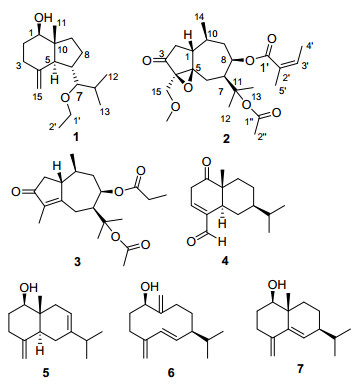
Figure 1.
Structures of compounds 1~7

Two New Sesquterpenoids from Fructus Carotae
Lei Cheng , Guiyuan Liu , Yinchi Pan , Maosheng Zhang , Shiji Xiao


Traditional Chinese medicine, Fructus carotae, it's the ripe fruit of plant Daucus carota(umbelliferae). This plant is widely distributed in Jiangsu, Hubei, Sichuan, Zhejiang, Anhui and Guizhou provinces of China.[1] It has been used as a herbal medicine for the treatment of ancylostomiasis, dropsy, chronic kidney diseases and bladder afflictions.[2] Modern pharmacological research displays that Fructus carotae has the activities of insecticidal, antibacterial, antidiarrheal and anti-inflammatory.[3-5] Previous phyto- chemical investigations on the Fructus carotae indicated the presence of flavonoids, [6] coumarins and sesquter- penoids.[7, 8] As part of an ongoing research program to isolate and determine structures of secondary metabolites from traditional Chinese medicine, [9] we sequentially performed a phytochemical study on Fructus carotae.[10] As a result, two new sesquterpenoids and five known analogues were obtained (Figure 1). Their structures were identified as 7-ethoxy-4(15)-oppositen-1β-ol (1), 11-acet- oxy-8β-ange- loyloxy-15-methoxy-4α, 5α-epoxyarbutane-3-one (2), 11- acetoxy-8β-propionyl-4-guaien-3-one (3), [11] 1-oxo-5α, 7αH-eudesma-3-en-15-al (4), [12] 1β-hydroxy-4(15), 7-eude- smadiene (5), [13] 1β-hydroxy-4(15), 5E, 10(14)-germacra- triene (6), [14] and 1β-hydroxy-4(15), 5-eudesmadiene (7).[14] Compounds 3, 4, 6 and 7 were isolated from the Daucus for the first time, and compound 5 was isolated from this plant for the first time.
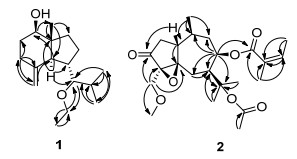
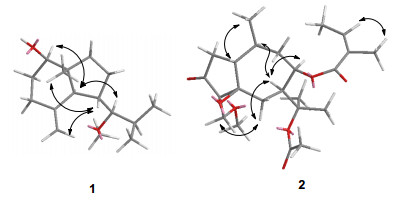
Compound 1 was obtained as a colorless oil. The molecular formula C17H30O2 was established by HR-ESIMS (m/z 267.23183 [M+H]+), indicating three degrees of unsaturations. The IR spectrum showed absorption band due to hydroxyl group (3395 cm-1). The 1H NMR spectrum (Table 1) showed the presence of four methyl signals at δH 0.63 (s, 3H), 0.92 (d, J=6.7 Hz, 3H), 0.87 (d, J=6.7 Hz, 3H), and 1.04 (t, J=7.0 Hz, 3H), an exocyclic methylene group at δH 4.77 (br s, 1H) and 4.83 (br s, 1H)[15], an oxygenated methyne proton signal at δH 3.54 (dd, J=11.3 Hz, 4.8 Hz, 1H), an oxygenated methylene proton signal at δH 3.40 (m, 2H). The 13C NMR and heteronuclear single quantum correlation (HSQC) spectra showed 17 carbon resonances due to two olefinic carbon signals at δC 145.8, 107.5, two oxygenated tertiary carbons at δC 89.4, 79.4, an oxygenated secondary carbon at δC 68.0, three tertiary carbons at δC 55.5, 39.4, 31.5, four secondary carbon at δC 32.1, 35.1, 26.5, 37.3, and four methyl carbon signals at δC 12.5, 15.7, 16.4, 21.0. The 1H NMR and 13C NMR spectra were very similar to those of 7-methoxy-4(15)-oppositen- 1β-ol[16] except for the replacement of the methoxy group by the ethoxy group at C-7. The structure of compound 1 was further confirmed by 2D NMR. The heteronuclear multiple-bond correlations (HMBC) of H-7 to C-1', H-1' to C-7, H-1' to C-2' established the ethoxy group located at C-7. In its nuclear overhauser effect spectroscopy (NOESY), the cross-peaks of H-1/H-5 and H-6/H-11 confirmed the relative configuration of 1-OH (cis) with 11-Me, 11-Me(trans) with H-5. Accordingly, the structure of compound 1 was established and named as 7-ethoxy- 4(15)-oppositen-1β-ol.

 下载:
导出CSV
下载:
导出CSV
| No. | 1 | 2 | |||
| δH (J in Hz) | δC | δH (J in Hz) | δC | ||
| 1 | 3.54 (dd, 11.3, 4.8) | 79.4 | 2.14 (overlapped) | 45.5 | |
| 2 | 1.44 (m), 1.75 (m) | 32.1 | 2.14 (overlapped) | 37.7 | |
| 3 | 2.27 (m), 2.02 (m) | 35.1 | 209.4 | ||
| 4 | 145.8 | 68.3 | |||
| 5 | 1.80 (m) | 55.5 | 73.3 | ||
| 6 | 2.36 (m) | 39.4 | 2.44 (dd, 14.3, 11.5) β, 1.75 (d, 14.3) α | 26.4 | |
| 7 | 2.82 (dd, 8.1, 3.6) | 89.4 | 2.81 (br d, 11.5) | 45.3 | |
| 8 | 1.33 (m), 1.83 (m) | 26.5 | 5.57 (m) | 70.3 | |
| 9 | 1.65 (m), 1.31 (m) | 37.3 | 1.51 (overlapped), 2.28 (ddd, 15.4, 6.8, 4.4) | 42.3 | |
| 10 | 49.6 | 2.01 (m) | 30.6 | ||
| 11 | 1.77 (m) | 31.5 | 84.2 | ||
| 12 | 0.92 (d, 6.7) | 16.4 | 1.44 (s) | 24.6 | |
| 13 | 0.87 (d, 6.7) | 21.0 | 1.40 (s) | 24.8 | |
| 14 | 0.63 (s) | 12.5 | 0.88 (d, 6.7) | 21.6 | |
| 15 | 4.77 (br. s), 4.83 (br s) | 107.5 | 3.93 (d, 11.3), 3.61 (d, 11.3) | 66.0 | |
| 1' | 3.40 (m) | 68.0 | 166.9 | ||
| 2' | 1.04 (t, 7.0) | 15.7 | 127.8 | ||
| 3' | 6.08 (q, 7.1) | 139.2 | |||
| 4' | 2.00 (d, 7.1) | 16.0 | |||
| 5' | 1.87 (s) | 20.9 | |||
| 1" | 170.5 | ||||
| 2" | 1.96 (s) | 22.7 | |||
| 15-OCH3 | 3.39 (s) | 60.0 | |||
Compound 2 was obtained as a colorless oil, with the molecular formula of C23H34O7, which was deduced by HR-ESIMS (m/z 440.26428 [M+NH4]+), with seven double bond equivalents. The IR spectrum showed absorption band due to carbonyl group (1734 cm-1). The 1H NMR (Table 1) indicated six methyl group signals at δH 0.87 (d, J=6.7 Hz, 3H), 2.00 (d, J=7.1 Hz, 3H), 1.87 (s, 3H), 1.40 (s, 3H), 1.44 (s, 3H), 1.96 (s, 3H), a methoxy group signal at δH 3.39 (s, 3H), an oxygenated methyne proton signal at δH 5.57 (m, 1H), an oxygenated methylene proton signal at 3.93, 3.61 (each d, J=11.3 Hz, 1H), an olefinic proton signal at δH 6.08 (q, J=7.1 Hz, 1H). The 13C NMR and HSQC spectra showed 23 carbon resonances due to three carbonyl signals at δC 209.4, 170.5, 166.9, two olefinic carbon signals at δC 127.8, 139.2, three oxygenated quaternary carbons at δC 84.2, 73.3, 68.3, an oxygenated tertiary carbon at δC 70.3, an oxygenated secondary carbon at δC 66.0, a methoxy carbon at δC 60.0, three tertiary carbons at δC 45.5, 45.3, 30.6, three secondary carbon at δC 37.7, 26.4, 42.3, and six methyl carbon signals at δC 24.8, 24.6, 22.7, 21.6, 20.9, 16.0. These NMR data above indicated that compound 2 has an arbutane skeleton with angeloyloxy and acetoxy.[10] Detailed analysis of the NMR and HSQC spectra suggested that the structure of compound 2 was very similar to those of torilin[17] except for the replacement of the double bond by the epoxy group at C-4 and C-5. The HMBC correlations of OMe to C-15 showed the methoxy group located at C-15. The HMBC correlations of H-15 to C-4, H-2 to C-4, H-2 to C-5, H-7 to C-5, H-6 to C-5, established the presence of epoxy group at C-4 and C-5. In its NOESY experiment, the cross-peaks of H-15/Hα-6, Hα-6/H-7, and H-7/H-8 displayed that epoxy group and angeloyloxy group existed in the same face of the molecule. The NOESY correlations of H-1/H-14 and H-7/H-10 suggested that H-1, 14-Me and the substitutional group of C-7 were in the same face of the molecule. Therefore, the structure of compound 2 was unambiguously established as 11-acetoxy-8β-angeloyloxy-15-methoxy- 4α, 5α-epoxyarbutane-3-one.
Seven compounds were obtained from the Chinese traditional medicine, Fructus carotae. Compounds 1 and 2 were new sesquterpenoids compounds, compounds 4~7 were eudesmane sesquterpenoids, compounds 3, 4, 6 and 7 were isolated from the Daucus for the first time, compound 5 was isolated from this plant for the first time.
IR spectra were measured on an FTIR-850 spectrometer (KBr) (Perkin-Elmer, Waltham, USA). 1D NMR and 2D NMR spectra were recorded on an Agilent DD2400-MR instrument using TMS as the internal reference. HR-ESIMS were measured on a MicrO TOF-Q Ⅱ mass spectrometer (Bruker, Karlsruhe, Germany). Column chromatography was performed using 300~400 mesh silica gel (Qingdao Marine Chemical Inc., Qingdao, China). Semi-preparative HPLC was performed on LC3000 system (Beijing Chuang Xing Tong Heng Science and Technology Co., Ltd., Beijing, China) equipped with ODS column (5 μm, i.d. 10 mm×250 mm) (YMC, Kyoto, Japan).
Fructus carotae was collected from medicinal materials market in July 2016, and identified as the ripe fruit of plant Daucus carota by associate professor Nie (Zunyi Medical University). A voucher specimen (No. 20151108) was deposited with the Herbarium of the School of Pharmacy, Zunyi Medical Universty.
The air-dried Fructus carotae (5.0 kg) were extraction with 95% ethanol (25 L) for four times, the ethanol extract was evaporated under reduced pressure to obtain a crude extract (420 g), which was further suspended in water and extracted with petroleum ether, EtOAc and n-BuOH, successively. The EtOAc extract (30 g) was subjected to silica gel column chromatography (80 mm×600 mm, 400 g, 300~400 mesh), eluted with a gradient of petroleum ether-EtOAc to yield 6 fractions (Fr.1~Fr.6). Fr.1 was subjected to silica gel column chromatography (80 mm×600 mm, 180 g, 300~400 mesh), eluted with a gradient of petroleum ether-EtOAc to yield 8 subfractions (Fr.1.1~Fr.1.8). Fr.1.1 was purified by semi-preparative HPLC with acetonitrile-H2O (V:V=98:2) to yield 4 fractions (Fr.1.1.1~Fr.1.1.4). Fr.1.1.4 was further purified by semi-preparative HPLC with MeOH-H2O (V:V=75:25, 5.0 mL/min, 230 nm) to afford compound 1 (Rt=17.9 min, 10.6 mg). Fr.1.1.3 was purified by semi-preparative HPLC with acetonitrile-H2O (V:V=98:2, 2.0 mL/min, 230 nm) to afford compound 6 (Rt=7.5 min, 110 mg). Fr.1.1.2 was further purified by semi-preparative HPLC with MeOH-H2O (V:V=72:28, 4 mL/min, 230 nm) to afford compound 4 (Rt=13.0 min, 50 mg). Fr.1.4 was further purified by semi-preparative HPLC with acetonitrile-H2O (V:V=90:10, 4 ml/min, 230 nm) to afford compound 5 (Rt=15.7 min, 40 mg). Fr.1.5 was isolated by SephadexLH-20 column chromatography (MeOH) to afford 6 fractions (Fr.1.5.1~Fr.1.5.6). Fr.1.5.2 was purified by semi-preparative HPLC with MeOH-H2O (V:V=89:11) to give 3 subfractions (Fr.1.5.2A~Fr.1.5.2C). Fr.1.5.2C was purified by semi-preparative HPLC with MeOH-H2O (V:V=89:11, 4.0 mL/min, 230 nm) to afford compound 7 (Rt=22.3 min, 80 mg). Fr.3 was isolated by Sephadex LH-20 (MeOH) to give 2 fractions (Fr.3.1~Fr.3.2). Fr.3.1 was purified by semi-preparative HPLC with MeOH-H2O (V:V=80:20) to give 6 subfractions (Fr.3.1A~Fr.3.1.F). Fr.3.1B was further purified by semi-preparative HPLC with MeOH-H2O (V:V=70:30, , 5 mL/min, 230 nm) to afford compound 3 (Rt=38.9 min, 13 mg). Fr.3.1D was further purified by semi-preparative HPLC with MeOH-H2O (V:V=85:15, 4 mL/min, 230 nm) to afford compound 2 (Rt=17.4 min, 7.1 mg).
7-Ethoxy-4(15)-oppositen-1β-ol (1): colorless oil; [α]D20-85 (c 0.04, MeOH); 1H NMR and 13C NMR data, see Table 1; IR (KBr) νmax: 3395, 2925, 1460, 1377, 1080, 1019, 888 cm-1; HR-ESI-MS calcd for C17H31O2 [M+H]+ 267.2318, found 267.2319.
11-Acetoxy-8β-angeloyloxy-15-methoxy-4α, 5α-epoxy- arbutane-3-one (2): colorless oil; [α]D20 -82 (c 0.04, MeOH); UV (MeOH) λmax [lg ε/(L·mol-1·cm-1)] 209 (1.82) nm; 1H NMR and 13C NMR data see Table 1; IR (KBr)νmax: 2928, 1734, 1459, 1369, 1233, 1120, 607 cm-1; HR-ESI-MS calcd for C23H38O7N [M+NH4]+ 440.2643, found 440.2643.
Supporting Information 1D NMR and 2D NMR spectra of compounds 1 and 2. These materials can be downloaded for free from our website (http://sioc-journal.cn/).
中国科学院中国植物志编辑委员, 中国植物志, 第55卷, 科学出版社, 北京, 1992, p. 223.Chinese Flora Editorial Board of Chinese Academy of Sciences Flora of China, Vol. 55, Science Press, Beijing, 1992, p. 223 (in Chinese).
张卉, 高建华, 孟林, 天津医科大学学报, 2004, 10, 492. doi: 10.3969/j.issn.1006-8147.2004.04.003Zhang, H.; Gao, J. H.; Meng, L. J. Tianjin Med. Univ. 2004, 10, 492 (in Chinese). doi: 10.3969/j.issn.1006-8147.2004.04.003
Yang, R. L.; Yan, Z. H.; Lu, Y. J. Agric. Food Chem. 2008, 56, 3024. doi: 10.1021/jf7036517
Pant, B.; Manandhar, S. Tumori 2010, 5, 461.
Tavares, A. C.; Gonçalves, M. J.; Cavaleiro, C. J. Ethnopharmacol. 2008, 19, 129. http://med.wanfangdata.com.cn/Paper/Detail?id=PeriodicalPaper_JJ028957970
Gebhardt, Y.; Witte, S.; Forkmann, G. Phytochemistry 2005, 66, 1273. doi: 10.1016/j.phytochem.2005.03.030
Fu, H. W.; Zhang, L.; Yi, T.; Feng, Y. L.; Tian, J. K. Biochem. Syst. Ecol. 2010, 38, 309. doi: 10.1016/j.bse.2009.12.017
Fu, Z. Z.; Han, H. T.; Liu, N.; Xu, X. B.; Zhu, W.; Gong, M. H.; Zhang, L.; Tian, J. K. Phytochem. Lett. 2015, 14, 35. doi: 10.1016/j.phytol.2015.08.016
肖世基, 史大斌, 袁泽利, 陈永正, 张茂生, 有机化学, 2016, 36, 1686. http://kns.cnki.net/KCMS/detail/detail.aspx?filename=yjhu201607027&dbname=CJFD&dbcode=CJFQXiao, S. J.; Shi, D. B.; Yuan, Z. L.; Chen, Y. Z.; Zhang, M. S.; Ding, L. S.; Zhou, Y. Chin. J. Org. Chem. 2016, 36, 1686 (in Chinese). http://kns.cnki.net/KCMS/detail/detail.aspx?filename=yjhu201607027&dbname=CJFD&dbcode=CJFQ
刘贵园, 温楠, 张茂生, 徐应淑, 付少彬, 肖世基, 药学学报, 2017, 52, 1146. http://kns.cnki.net/KCMS/detail/detail.aspx?filename=yxxb201707018&dbname=CJFD&dbcode=CJFQLiu, G. Y.; Wen, N.; Zhang, M. S.; Xu, Y. S.; Fu, S. B.; Xiao, S. J. Acta Pharm. Sinica 2017, 52, 1146 (in Chinese). http://kns.cnki.net/KCMS/detail/detail.aspx?filename=yxxb201707018&dbname=CJFD&dbcode=CJFQ
Lee, I. K.; Lee, J. H.; Hwang, E. I.; Yun, B. S. Chem. Pharm. Bull. 2008, 56, 1483. doi: 10.1248/cpb.56.1483
Gao, X.; Deng, X. H. J. Chem. Res. 2009, 7, 457. http://kns.cnki.net/KCMS/detail/detail.aspx?filename=yxxb201707018&dbname=CJFD&dbcode=CJFQ
Sun, Z. H.; Chen, B.; Zhang, S.; Hu, C. Q. J. Nat. Prod. 2004, 67, 1975. doi: 10.1021/np049866z
Brown, G. D.; Liang, G. Y.; Sy, L. K. Phytochemistry 2003, 64, 303. doi: 10.1016/S0031-9422(03)00294-2
Xiao, S. J.; Chen, F.; Ding, L. S.; Zhou, Y. Chin. J. Nat. Med. 2015, 13, 65. doi: 10.1111/bph.13536%4010.1111/%28ISSN%291476-5381.IUPHARReviews
Yang, M. C.; Lee, K. H.; Kim, K. H.; Choi, S. U.; Lee, K. R. Arch. Pharmacal. Res. 2007, 30, 1067. doi: 10.1007/BF02980239
Kwak, Y. G.; Kim, D. K.; Ma, T. Z.; Park, S. A.; Park, H.; Jung, Y. H.; Yoo, D. J.; Eun, J. S. Arch. Pharmacal Res. 2006, 29, 834. doi: 10.1007/BF02973902
Table 1. 1H NMR and 13C NMR (400/100 MHz, CDCl3) data of compounds 1 and 2
| No. | 1 | 2 | |||
| δH (J in Hz) | δC | δH (J in Hz) | δC | ||
| 1 | 3.54 (dd, 11.3, 4.8) | 79.4 | 2.14 (overlapped) | 45.5 | |
| 2 | 1.44 (m), 1.75 (m) | 32.1 | 2.14 (overlapped) | 37.7 | |
| 3 | 2.27 (m), 2.02 (m) | 35.1 | 209.4 | ||
| 4 | 145.8 | 68.3 | |||
| 5 | 1.80 (m) | 55.5 | 73.3 | ||
| 6 | 2.36 (m) | 39.4 | 2.44 (dd, 14.3, 11.5) β, 1.75 (d, 14.3) α | 26.4 | |
| 7 | 2.82 (dd, 8.1, 3.6) | 89.4 | 2.81 (br d, 11.5) | 45.3 | |
| 8 | 1.33 (m), 1.83 (m) | 26.5 | 5.57 (m) | 70.3 | |
| 9 | 1.65 (m), 1.31 (m) | 37.3 | 1.51 (overlapped), 2.28 (ddd, 15.4, 6.8, 4.4) | 42.3 | |
| 10 | 49.6 | 2.01 (m) | 30.6 | ||
| 11 | 1.77 (m) | 31.5 | 84.2 | ||
| 12 | 0.92 (d, 6.7) | 16.4 | 1.44 (s) | 24.6 | |
| 13 | 0.87 (d, 6.7) | 21.0 | 1.40 (s) | 24.8 | |
| 14 | 0.63 (s) | 12.5 | 0.88 (d, 6.7) | 21.6 | |
| 15 | 4.77 (br. s), 4.83 (br s) | 107.5 | 3.93 (d, 11.3), 3.61 (d, 11.3) | 66.0 | |
| 1' | 3.40 (m) | 68.0 | 166.9 | ||
| 2' | 1.04 (t, 7.0) | 15.7 | 127.8 | ||
| 3' | 6.08 (q, 7.1) | 139.2 | |||
| 4' | 2.00 (d, 7.1) | 16.0 | |||
| 5' | 1.87 (s) | 20.9 | |||
| 1" | 170.5 | ||||
| 2" | 1.96 (s) | 22.7 | |||
| 15-OCH3 | 3.39 (s) | 60.0 | |||
 下载: 导出CSV

 扫一扫看文章


扫一扫关注我们