

Figure Scheme 1. Proposed catalytic cycle for aerobic dehydrogenation of 4-piperidones and 2, 3-dihydro-4-quinolones 1


2, 3-Dihydro-4-pyridones are a key class of N-containing heterocycles frequently employed as intermediates to build a number of biologically important N-heterocyclic compounds.[1] As their analogues, 4-quinolones not only can be used as precursors for diverse bioactive molecules, [2] but also are main frameworks of several compounds with particular pharmaceutical values.[3] Dehydrogenation of 4-piperidones have been demonstrated as a direct method to access 2, 3-dihydro-4-pyridones.[4] For example, Nicolaou and co-workers[4a, 4b] introduced IBX·MPO as an effective dehydrogenation reagent for 4-piperidones to afford 2, 3-dihydro-4-pyridones. The Stahl group[4c] realized a dehydrogenation by applying Pd (DMSO)2(TFA)2 as a catalyst and molecular oxygen as the oxidant. These methods suffer from stoichiometric amount of dehydrogenation reagent or expensive transition metal. In a few two-step strategies, stoichiometric amount of unsustainable oxidant (mCPBA[4d]) or toxic bromination reagent (Br2[1a, 1d]) is often necessary. To date, more synthetic methods have been documented for 4-quinolones, [5] including the condensation of anilines with Meldrum's acid and trimethyl orthoformates, [6] the Camps cyclization, [2d, 7] copper-[8] and palladium-catalyzed[9] amidation of aryl halides, etc.[2d, 10] However, the inconvenient multi-step process and harsh reaction conditions represent their limitations. Meanwhile, to our knowledge, no example has been described to concurrently facilitate the synthesis of both 2, 3-dihydro-4-pyridones and 4-quinolones.
In the past few years, visible light photocatalysis as a green and sustainable protocol has been appreciated as a powerful tool in organic synthesis.[11] We recently reported dicyanopyrazine-derived chromophore (DPZ) as a new type of metal-free photocatalyst that facilitated a series of transformations with high efficiency.[12] In these works, we have shown that the activated DPZ* [Et(S*/S·−)=0.91 V vs SCE in CH2Cl2] can oxidize N-aryl-substituted tertiary amines through single electron transfer (SET). Therefore, N-aryl-substituted 4-piperidones and 2, 3-dihydro-4-quinolones 1 [e.g. compound 1a: Ered 1/2=0.96 V vs SCE in CH3CN] should have a thermodynamically feasible transformation to generate R3N+· (2) when in the presence of DPZ*. The species 2 could further react with O2−· species to generate iminium 3 (Scheme 1). In the presence of HOO− or a suitable base, the deprotonation of α-H of ketone seems feasible, thus leading to 2, 3-dihydro-4-pyridones or 4-quinolones 4.[12b] Accordingly, we were intrigued to investigate visible light photocatalytic aerobic dehydrogenation of 4-piperidones and 2, 3-dihydro-4-quinolones with DPZ as the catalyst, which would provide a highly atom-economic and direct approach to access these valuable N-containing entities. Two major challenges, that are the unknown reactivity and the elusive chemoselectivity for the probably generated amides[11a] as the side products, should remain in this desired task.
Figure Scheme 1. Proposed catalytic cycle for aerobic dehydrogenation of 4-piperidones and 2, 3-dihydro-4-quinolones 1
Our study was initiated with the model reaction of N-phenyl-substituted 4-piperidone 1a in the presence of 0.5 mol% of DPZ at 25 ℃ under irradiation from a 3 W blue LED (λ=450~455 nm) and ambient atmosphere (Table 1). The reaction was first carried out in toluene as the solvent (Entry 1). It was found that the reaction was finished after 12 h, and to our delight, the desired dehydrogenation product 4a could be obtained in 31% yield. It is worth mentioning that no amide was found in the reaction mixture while several unknown by-products were observed. A screening of solvents (Entries 2~6) proved that CH3CN was the best, providing 4a in 45% yield within 0.8 h (Entry 4). The effect of additive was subsequently evaluated (Entries 7~13). When 0.5 equiv. of KH2PO4 was used, the yield was decreased to 30% (Entry 7). In contrast, the basic K2HPO4 was found to slightly improve the yield to 48% (Entry 8), demonstrating that the basic conditions would benefit the chemoselectivity. In this context, K2CO3 and NaOH with stronger basicity were examined (Entries 9, 10), but the yield was deteriorated, especially for NaOH (Entry 10). A variety of organic bases were also tested (Entries 11~13). We were pleased to find that Et3N could promote the yield to 62% (Entry 11). When the amount of Et3N was decreased to 0.25 equiv., the reaction could be finished in 0.5 h, and provided 4a in 67% yield (Entry 14). Lower or higher amount of Et3N were found to give lower yields (Entries 15, 16). We also anticipated improving the chemoselectivity through modulating the reaction temperature. However, only 56% yield of 4a was obtained when the reaction was performed at 10 ℃ (Entry 17). The best catalyst loading of DPZ was demonstrated as 0.5 mol% since no better result could be attained whatever 0.25 mol% or 1.0 mol% of DPZ was used (Entries 18, 19). The reaction became very sluggish when in the absence of DPZ, and only trace 4a was detected after 24 h through TLC analysis (Entry 20). Moreover, no reaction was observed in the presence of DPZ but without light (Entry 21). These results revealed that photoactivation in the presence of both light and the photocatalyst DPZ is indispensable for the photocatalytic dehydrogenation to occur. Notably, a series of common used transition-metal and organic photocatalysts, such as Ru (bpy)3Cl2, rose Bengal (RB), eosin Y (EY) and rhodanmine B, have also been examined under the established reaction conditions, but no better result could be achieved.[13]
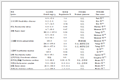 Table1.
Optimization of reaction conditionsa
Table1.
Optimization of reaction conditionsa
 | |||
| Entry | Conditions | tb/h | Yieldc/% |
| 1 | toluene | 12.0 | 31 |
| 2 | CH2Cl2 | 12.0 | Ttrace |
| 3 | THF | 5.0 | 25 |
| 4 | CH3CN | 0.8 | 45 |
| 5 | DMF | 3.0 | 38 |
| 6 | EtOH | 5.0 | 32 |
| 7 | CH3CN, KH2PO4 (0.5 equiv.) | 0.8 | 30 |
| 8 | CH3CN, K2HPO4 (0.5 equiv.) | 0.8 | 48 |
| 9 | CH3CN, K2CO3 (0.5 equiv.) | 0.8 | 40 |
| 10 | CH3CN, NaOH (0.5 equiv.) | 0.8 | 25 |
| 11 | CH3CN, Et3N (0.5 equiv.) | 0.8 | 62 |
| 12 | CH3CN, TMG (0.5 equiv.) | 1.2 | 50 |
| 13 | CH3CN, DMAP (0.5 equiv.) | 0.5 | 52 |
| 14 | CH3CN, Et3N (0.25 equiv.) | 0.5 | 67 |
| 15 | CH3CN, Et3N (0.10 equiv.) | 1.0 | 58 |
| 16 | CH3CN, Et3N (1.0 equiv.) | 0.6 | 58 |
| 17 | CH3CN, Et3N (1.00 equiv), 10 ℃ | 0.5 | 56 |
| 18 | DPZ (0.25 mol%), CH3CN, Et3N (0.25 equiv.) | 0.5 | 46 |
| 19 | DPZ (1.0 mol%), CH3CN, Et3N (0.25 equiv.) | 0.5 | 52 |
| 20 | No DPZ, CH3CN, Et3N (0.25 equiv.) | 24 | Trace |
| 21 | No light, CH3CN, Et3N (0.25 equiv.) | 24 | N.R. |
| a0.05 mmol scale; bThe reaction time was determined by the complete consumption of 1a. cIsolated yield. | |||
With the optimal dehydrogenation conditions in hand, we next sought to evaluate the scope of N-aryl-substituted 4-piperidones and 2, 3-dihydro-4-quinolones (Scheme 2). A series of N-aryl substituted 4-piperidones were first subjected to the reaction conditions (4a~4k). It was observed that the reactions were finished in 35 min, affording the corresponding 2, 3-dihydro-4-pyridones 4a~4k in moderate yields except of 4i, of which N-aryl group contains a strong electron-withdrawing nitro substituent on its para-position. Subsequently, N-aryl-substituted 2, 3-dihydro-4-quinolones were attempted, and the desired 4-quinolones 4l~4o also could be obtained in 57%~69% yields within 35 min.

Figure Scheme 2. Investigation of substrate scope. 0.1 mmol scale, isolated yield
As depicted in our proposed catalytic cycle for this reaction (Scheme 1), H2O2 should be a reasonable by-product. Therefore, we attempted to examine the existence of H2O2 in the aerobic dehydrogenation of 1a. An iodide test (KI in glacial acetic acid) was performed, and a color change to dark red robustly supported the presence of H2O2 in the crude reaction mixture.[13]
To verify the synthetic value of this work, we next performed the dehydrogenation reaction of 1a on a 1.0 mmol scale (Eq. 1). It was found that the reaction was finished after 8 h, affording 4a in 58% yield. In order to enhance the reaction rate, we attempted the reaction under oxygen atmosphere, although no obvious improvement was observed when the reaction was conducted on a 0.1 mmol scale. We were pleased to find that the reaction could be finished within 2 h, and 4a was obtained in 63% yield.
In summary, we have developed the first visible light photocatalytic aerobic dehydrogenation of 4-piperidones and 2, 3-dihydro-4-quinolones by utilizing DPZ as the photocatalyst. The current method provides a direct, sustainable and highly atom-economic approach to build two kinds of biologically important N-containing heterocycles, i.e. 2, 3-dihydro-4-pyridones and 4-quinolones, with satisfactory results. The employment of DPZ in visible light photocatalysis, especially for the synthesis of significant N-heterocyclic compounds, is in progress in our laboratory.
For selected examples, see: (a) Kozikowski, A. P.; Park, P.-U. J. Org. Chem. 1990, 55, 4668; (b) Shintani, R.; Hayashi, T. Nat. Protoc. 2007, 2, 2903; (c) Jagt, R. B. C.; de Vries, J. G.; Feringa, B. L.; Minnaard, A. J. Org. Lett. 2005, 7, 2433; (d) Ye, X. M.; Konradi, A. W.; Smith, J.; Xu, Y.-Z.; Dressen, D.; Garofalo, A. W.; Marugg, J.; Sham, H. L.; Truong, A. P.; Jagodzinski, J.; Pleiss, M.; Zhang, H.; Goldbach, E.; Sauer, J.-M.; Brigham, E.; Bova, M.; Basi, G. S. 2010, 20, 2195; (e) Gordeev, M. F.; Yuan, Z. Y. J. Med. Chem. 2014, 57, 4487.
For selected examples, see: (a) Huang, X.; Liu, Z.J. Org. Chem. 2002, 67, 6731; (b) Shintani, R.; Yamagami, T.; Kimura, T.; Hayashi, T. Org. Lett. 2005, 7, 5317; (c) Biswas, K.; Peterkin, T. A. N.; Bryan, M. C.; Arik, L.; Arik, L.; Lehto, S. G.; Sun, H.; Hsieh, F.-Y.; Xu, C.; Fremeau, R. T.; Allen, J. R. J. Med. Chem. 2011, 54, 7232; (d) Brouwer, C.; Jenko, K.; Zoghbi, S. S.; Innis, R. B.; Pike, V. W. J. Med. Chem. 2014, 57, 6240; (e) Bichovski, P.; Haas, T. M.; Kratzert, D.; Streuff, J. Chem. Eur. J. 2015, 21, 2339; (f) Liu, J.; Li, Z.; Tong, P.; Xie, Z.; Zhang, Y.; Li, Y. J. Org. Chem. 2015, 80, 1632.
(a) Cecchetti, V.; Parolin, C.; Moro, S.; Pecere, T.; Filipponi, E.; Calistri, A.; Tabarrini, O.; Gatto, B.; Palumbo, M.; Fravolini, A.; Palu, G. J. Am. Chem. Soc. 2000, 43, 3799; (b) Wang, S.; Lin, J.; He, P.; Zuo, J.; Long, Y. Acta Chim. Sinica 2014, 72, 906 (王沈丰, 林建平, 何佩岚, 左建平, 龙亚秋, 化学学报, 2014, 72, 906.); (c) Enoki, Y.; Ishima, Y.; Tanaka, R.; Sato, K.; Kimachi, K.; Shirai, T.; Watanabe, H.; Chuang, V. T. G.; Fujiwara, Y.; Takeya, M.; Otagiri, M.; Maruyama, T. Plos One 2015, DOI:10.1371/journal.pone.0130248.
(a) Nicolaou, K. C.; Montagnon, T.; Baran, P. S. Angew. Chem., Int. Ed. 2002, 41, 993; (b) Šebesta, R.; Pizzuti, M. G.; Boersma, A. J.; Minnaard, A. J.; Feringa, B. L. Chem. Commun. 2005, 1711; (c) Diao, T.; Stahl, S. S. J. Am. Chem. Soc. 2011, 133, 14566; (d) Kuehne, M. E.; Muth, R. S. J. Org. Chem. 1991, 56, 2701; (e) Niphaki, M. J.; Turunen, B. J.; Georg, G. I. J. Org. Chem. 2010, 75, 6793.
For a selected review, see:Kouznetsov, V. V.; Méndez, L. Y. V.; Gómez, M. M. Curr. Org. Chem. 2005, 9, 141.
For selected examples, see: (a) Werner, W. Tetrahedron 1969, 25, 255; (b) Chen, B.; Huang, X.; Wang, J. Synthesis 1987, 482; (c) Madrid, P. B.; Sherrill, J.; Liou, A. P.; Weisman, J. L.; Derisi, J. L.; Guy, R. K. Bioorg. Med. Chem. Lett. 2005, 15, 1015.
Camps, R. Chem. Ber. 1899, 32, 3228. doi: 10.1002/(ISSN)1099-0682
For selected examples, see: (a) Klapars, A.; Antilla, J. C.; Huang, X.; Buchwald, S. L. J. Am. Chem. Soc. 2002, 124, 7421; (b) Strieter, E. R.; Blackmond, D. G.; Buchwald, S. L. J. Am. Chem. Soc. 2005, 127, 4120.
For selected examples, see: (a) Yin, J.; Buchwald, S. L. Org. Lett. 2000, 2, 1101; (b) Ikawa, T.; Barder, T. E.; Biscoe, M. R.; Buchwald, S. L. J. Am. Chem. Soc. 2007, 129, 13001.
(a) Tois, J.; Vahermo, M.; Koskinen, A. Tetrahedron Lett. 2005, 46, 735; (b) Huang, J.; Chen, Y.; King, A. O.; Dilmeghani, M.; Larsen, R. D.; Faul, M. M. Org. Lett. 2008, 10, 2609; (c) Ward, T. R.; Turunen, B. J.; Haack, T.; Neuenswander, B.; Shadrick, W.; Georg, G. I. Tetrahedron Lett. 2009, 50, 6494; (d) Mphahlele, M. J. J. Heterocycl. Chem. 2010, 47, 1; (e) Lange, J.; Bissember, A. C.; Banwell, M. G.; Cade, I. A.Aust. J. Chem. 2011, 64, 454.
For selected recent reviews, see: (a) Prier, C. K.; Rankic, D. A.; MacMillan, D. W. C. Chem. Rev. 2013, 113, 5322; (b) Zhao, J.; Wu, W.; Sun, J.; Guo, S. Chem. Soc. Rev. 2013, 42, 5323; (c) Lang, X.; Chen, X.; Zhao, J. Chem. Soc. Rev. 2014, 43, 473; (d) Nicewicz, D. A.; Nguyen, T. M. ACS Catal. 2014, 4, 355; (e) Schultz, D. M.; Yoon, T. P. Science 2014, 343, 985; (f) Xuan, J.; Zhang, Z.-G.; Xiao, W.-J.Angew. Chem., Int. Ed. 2015, 54, 15632; (g) Beatty, J. W.; Stephenson, C. R. J. Acc. Chem. Res. 2015, 48, 1474; (h) Wei, G.; Basheer, C.; Tan, C.-H.; Jiang, Z. Tetrahedron Lett. 2016, 57, 3801.
(a) Zhao, Y.; Zhang, C.; Chin, K. F.; Pytela, O.; Wei, G.; Liu, H.; Bureš, F.; Jiang, Z. RSC Adv. 2014, 4, 30062; (b) Liu, X.; Ye, X.; Bureš, F.; Liu, H.; Jiang, Z. Angew. Chem., Int. Ed. 2015, 54, 11443. (c) Wei, G.; Zhang, C.; Bureš, F.; Ye, X.; Tan, C.-H.; Jiang, Z. ACS Catal. 2016, 6, 3708; (d) Zhang, C.; Li, S.; Bureš, F.; Lee, R.; Ye, X.; Jiang, Z. ACS Catal. 2016, 6, 6853.
See the supporting information for details.

Scheme 1 Proposed catalytic cycle for aerobic dehydrogenation of 4-piperidones and 2, 3-dihydro-4-quinolones 1
Table 1. Optimization of reaction conditionsa
| | |||
| Entry | Conditions | tb/h | Yieldc/% |
| 1 | toluene | 12.0 | 31 |
| 2 | CH2Cl2 | 12.0 | Ttrace |
| 3 | THF | 5.0 | 25 |
| 4 | CH3CN | 0.8 | 45 |
| 5 | DMF | 3.0 | 38 |
| 6 | EtOH | 5.0 | 32 |
| 7 | CH3CN, KH2PO4 (0.5 equiv.) | 0.8 | 30 |
| 8 | CH3CN, K2HPO4 (0.5 equiv.) | 0.8 | 48 |
| 9 | CH3CN, K2CO3 (0.5 equiv.) | 0.8 | 40 |
| 10 | CH3CN, NaOH (0.5 equiv.) | 0.8 | 25 |
| 11 | CH3CN, Et3N (0.5 equiv.) | 0.8 | 62 |
| 12 | CH3CN, TMG (0.5 equiv.) | 1.2 | 50 |
| 13 | CH3CN, DMAP (0.5 equiv.) | 0.5 | 52 |
| 14 | CH3CN, Et3N (0.25 equiv.) | 0.5 | 67 |
| 15 | CH3CN, Et3N (0.10 equiv.) | 1.0 | 58 |
| 16 | CH3CN, Et3N (1.0 equiv.) | 0.6 | 58 |
| 17 | CH3CN, Et3N (1.00 equiv), 10 ℃ | 0.5 | 56 |
| 18 | DPZ (0.25 mol%), CH3CN, Et3N (0.25 equiv.) | 0.5 | 46 |
| 19 | DPZ (1.0 mol%), CH3CN, Et3N (0.25 equiv.) | 0.5 | 52 |
| 20 | No DPZ, CH3CN, Et3N (0.25 equiv.) | 24 | Trace |
| 21 | No light, CH3CN, Et3N (0.25 equiv.) | 24 | N.R. |
| a0.05 mmol scale; bThe reaction time was determined by the complete consumption of 1a. cIsolated yield. | |||
 下载: 导出CSV

 扫一扫看文章


扫一扫关注我们

 下载:
下载: