

Figure Scheme 1. Trifluoromethylation of internal olefinic C-H bonds


The trifluoromethylation of organic molecules is of significant importance in the field of pharmaceuticals, agrochemicals, and advanced materials[1] owing to the incorporation of CF3 moiety into compounds resulted in enhanced properties such as lipophilicity, metabolic stability, bioavailability, and binding selectivity.[2] Among which, for example, Panomifene[3] exhibits antie-strogenic and tumorinhibiting activities superior to those of tamoxifen when used for the clinical treatment of breast cancer. Therefore a variety of methods have been reported to form C-CF3 bonds, [4]including forming C-CF3 bonds on C=O, [5] C=N, [6] or C=C, [7, 8]with cross-coupling the trifluoromethyl reagents and prefunctionalized aromatics, [9] or other methods.[10] The trifluoromethylated olefins are generally derived from the reaction of prefunctionalized olefins with trifluoromethylating reagents, [11] as well as adding trifluoromethylating reagents to terminal alkynes, [12]or from other indirect routes.[13]Owing to its low reactivity, direct olefinic C-H trifluoromethylation still remains as an interesting topic and a few methods were developed up to now by transition-metal-catalyzed[14] and metal free[15]means, wherein quinones, [16a, 16b] uracil, [16c] and terminal olefins[16d~16h]were utilized as starting materials.[17, 18]Hence, introducing new protocols for trifluoromethylation of olefinic C-H bonds are still demanded and continue to draw the attention of the synthetic community.
Literatures were documented that α-oxoketene dithioacetals, strongly electron-donating moieties and easily cleaved, possess unique features when serving as versatile reagents[19] in the synthesis of heterocycles[20] and aromatic compounds, [21] as well as odorless thiol equivalent compounds.[22] Therefore its preparation and transformation has attracted particular interests from the realm of organic synthesis and among which the trifluoromethylation reaction has been realized by metal-free or CuⅡ-catalyzed conditions.[7, 8, 23]
Recently, visible-light-mediated radical functionali-zation of olefins to introduce the trifluoromethyl group has been shown to be a feasible and efficient method.[16g, 16h]Yet trifluoromethylation of the internal olefin remains an elusive goal. As α-oxoketene dithioacetals are polar functionalized alkenes, we therefore envisioned that internal olefins can be tuned to become highly polarized by attaching to such strongly electron-donating group, and those modified internal olefins can be utilized as backbones to prepare multi-substituted trifluoromethylated olefins under photocatalytic conditions. Herein, we report a conceptually new approach to the trifluoromethylation of α-oxoketene dithioacetals via visible light photoredox catalysis (Scheme 1).
Figure Scheme 1. Trifluoromethylation of internal olefinic C-H bonds
We commenced our investigation with α-oxoketene dithioacetal 1a as a model substrate. Treating 1a with Togni's reagent 4a, fac-[Ir (ppy)3] and K2CO3in DMSO, the trifluoromethylated α-oxoketene dithioacetal was obtained in good yield within 39 h under 5 W Blue LEDs at room temperature (Table 1, Entry 1). With the promising initial result, we continued to optimize the reaction conditions. First, different photocatalysts were evaluated (Table 1, Entries 3 and 4). We were pleased to find that Ru (bpy)3Cl2was more effective to the reaction. Next, we examined the effect of other parameters on the reaction, including solvent, base, the stoichiometry of Togni's reagent and atmosphere (Table 1, Entries 5~18). In addition, control experiment showed that the visible light was required for the transformation (Table 1, Entry 2).
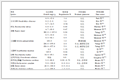 Table1.
Screening of reaction conditionsa
Table1.
Screening of reaction conditionsa
 | |||||
| Entry | PC (mol%) | Base | 4a/equiv. | Solvent | Yieldb/% |
| 1 | 5a(5.0) | Na2CO3 | 3 | DMSO | 70c |
| 2 | 5a(5.0) | Na2CO3 | 3 | DMSO | 0d |
| 3 | 5b(5.0) | Na2CO3 | 3 | DMSO | 78 |
| 4 | 5c(5.0) | Na2CO3 | 3 | DMSO | 87c, 92 |
| 5 | 5c(5.0) | Na2CO3 | 3 | DMSO | 58e |
| 6 | 5c(5.0) | Na2CO3 | 2 | DMSO | 91 |
| 7 | 5c (5.0) | Na2CO3 | 1.5 | DMSO | 87c, 92 |
| 8 | 5c(5.0) | Na2CO3 | 1.5 | CH3OH | 58 |
| 9 | 5c(5.0) | Na2CO3 | 1.5 | DMF | 62 |
| 10 | 5c(5.0) | Na2CO3 | 1.5 | CH2Cl2 | 41 |
| 11 | 5c(5.0) | Na2CO3 | 1.5 | CH3CN | trace |
| 12 | 5c(5.0) | Na2CO3 | 1.5 | toluene | 49 |
| 13 | 5c(5.0) | - | 1.5 | DMSO | 90 |
| 14 | 5c(5.0) | KH2PO4 | 1.5 | DMSO | 72 |
| 15 | 5c(5.0) | KF | 1.5 | DMSO | 90 |
| 16 | 5c(5.0) | DBU | 1.5 | DMSO | 76 |
| 17 | 5c(1.0) | Na2CO3 | 1.5 | DMSO | 70 |
| 18 | 5c(2.0) | Na2CO3 | 1.5 | DMSO | 81 |
| aConditions: 1a (0.1 mmol), N2 atmosphere. bThe yield was determined by gas chromatography. cIsolated Yield.dNo light.eUnder air. | |||||
With the optimized conditions in hand, a variety of α-oxoketene dithioacetals were prepared and then sub-jected to the reaction conditions. The results were listed in Scheme 2. Substrates bearing different groups, including methoxy, chloro, bromo, and fluoro groups at para, orthoor meta position of aromatic ring, were tolerant on the reaction conditions to provide corresponding products (Scheme 2, 2a~2n). When the aromatic ring connecting to carbonyl group was changed to methyl, the substrate was still suitable for the reaction, giving the desired ketene dithioacetals 2oin 58% yield. By changing the dithioalkyl moiety to -S (CH2)3S-, we noticed that the corresponding substrate exhibited lower reactivity to form the target product 2s(40%). And to our surprise, the acyclic dimethylthio analogue of 1 reacted smoothly with Togni's reagent to afford product 2r in 90% yield.

Figure Scheme 2. Trifluoromethylation of α-oxoketene dithioacetalsa, b
On comparison with previous documents, [8, 23] visible-light photoredox catalytic reactions showed more extensive substrate scope, better efficiency and mild reaction condition. Moreover, the trifluoromethylation of 2-thienoyl and furoyl substrates could undergo successfully to afford both mono-and di-trifluoromethylation products (Scheme 2, 2p, 2p', and 2q, 2q') under standard conditions. Based on that, we anticipated controlling the scale of Togni's reagent should produce different ratios of mono-and di-trifluoromethylation products. As showed in Table 2, when the Togni's reagent increased to 3 equiv., the di-trifluoromethylation products could be obtained as the single or major products (Table 2, Entries 3 and 6).
Table2.
mono-and di-trifluoromethylation of the heterocyclic substratesa, b
 | ||||
| Entry | R | Togni’ reagent/equiv. | 2Yieldb/% | 2'Yieldb/% |
| 1 | O | 1.0 | 43 | 13 |
| 2 | O | 1.5 | 27 | 29 |
| 3 | O | 3.0 | 0 | 72 |
| 4 | S | 1.0 | 75 | 10 |
| 5 | S | 1.5 | 58 | 29 |
| 6 | S | 3.0 | 40 | 44 |
| aConditions: 1 (0.1 mmol), Ru (bpy)3Cl2 (5% mmol), Na2CO3 (3 mmol), in DMSO, N2atmosphere. bIsolated yield. | ||||
In addition, the scope was extended to the bromination reaction by changing the Togni's reagent to CBr4. The reaction proceeded smoothly and the brominated α-oxoketene dithioacetals was obtained in 79% isolated yield (Scheme 3).

Figure Scheme 3. Bromination of1a
A plausible reaction pathway for the trifluoromethylation of α-oxoketene dithioacetals was proposed as shown in Scheme 4. Once activated by visible light, Ru (bpy)32+ reached to the excited state Ru (bpy)32+* which then would readily be oxidized by Togni's reagent 4ato produce Ru (bpy)33+, while CF3radical was released simultaneously. In succession, addition of CF3 radical to substrate 1delivered the trifluoromethylated secondary carbon radical intermediate A. Afterwards, the single-electron oxidation of Aoccurred to form the carbon center cation intermediate B, which then produce the desired product 2 by deprotonation.

Figure Scheme 4. Proposed possible mechanism for the trifluoromethylation of α-oxoketene dithioacetals
During our investigation, to test the potential application of this protocol, a gram-scale reaction of 1a was carried out under standard reaction conditions and the desired product was obtained in 82% yield (Eq. 1).
In conclusion, we have developed a visible-light-induced trifluoromethylation of α-oxoketene dithioacetals under mild conditions. This approach features not only in exhibiting high efficiency but also in expanding the substrate scope that is difficult to access with known methods.
Kirsch, P. Modern Fluoro-Organic Chemistry, Wiley-VCH, Weinheim, 2004.
(a) Müller, K.; Faeh, C.; Diederich, F. Science 2007, 317, 1881. (b) O'Hagan, D. Chem. Soc. Rev. 2008, 37, 308. (c) Purser, S.; Moore, P. R.; Swallow, S.; Gouverneur, V. Chem. Soc. Rev. 2008, 37, 320. (d) Furuya, T.; Kamlet, A. S.; Ritter, T. Nature 2011, 473, 470.
Liu, Y. X.; Shimizu, M.; Hiyama, T. Angew. Chem., Int. Ed. 2004, 43, 879. doi: 10.1002/(ISSN)1521-3773
(a) Liang, T.; Neumann, C. N.; Ritter, T. Angew. Chem., Int. Ed. 2013, 52, 8214.(b) Charpentier, J.; Früh, N.; Togni, A. Chem. Rev. 2015, 115, 650. (c) Alonso, C.; Marigorta, E. M.; Rubiales, G.; Palacios, F. Chem. Rev. 2015, 115, 1847. (d) Zeng, T.; Xuan, J.; Chen, J.; Lu, L.; Xiao, W. Imag. Sci. Photochem. 2014, 32, 415. (e) Peng, R.; Yang, B.; Chen, Z.; Xu, L.; Wang, S. Chin. J. Org. Chem. 2014, 34, 980. (彭蕊, 杨彬淼, 陈志敏, 徐力, 王少华, 有机化学, 2014, 34, 980.) (f) Wang, G.; He, X.; Dai, J.; Xu, H. Chin. J. Org. Chem. 2014, 34, 837. (王光祖, 赫侠平, 戴建军, 许华建, 有机化学, 2014, 34, 837.) (g) Zhang, Q.; Jin, C.; Zhang, Y. Chin. J. Org. Chem. 2014, 34, 662. (张霁, 金传飞, 张英俊, 有机化学, 2014, 34, 662.) (h) He, Z.; Huang, Y.; Francis, V. Acta Chim. Sinica 2013, 71, 700. (何展荣, 黄毅勇, Francis, V.化学学报, 2013, 71, 700.)
Sanhueza, I. A.; Bonney, K. J.; Nielsen, M. C.; Schoenebeck, F. J. Org. Chem. 2013, 78, 7749. doi: 10.1021/jo401099e
Zhang, Y. Q.; Liu, J. D.; Xu, H. Org. Biomol. Chem. 2013, 11, 6242. doi: 10.1039/c3ob41283k
For selected recent reports on addition of CF3 reagents to alkenes, see: (a) Zhu, R.; Buchwald, S. L. J. Am. Chem. Soc. 2012, 134, 12462. (b) Egami, H.; Shimizu, R.; Kawamura, S.; Sodeoka, M. Angew. Chem., Int. Ed. 2013, 52, 4000. (c) Deb, A.; Manna, S.; Modak, A.; Patra, T.; Maity, S.; Maiti, D. Angew. Chem. Int. Ed. 2013, 52, 9747. (d) Wang, X.; Ye, Y. X.; Zhang, S. N.; Feng, J. J.; Xu, Y.; Zhang, Y.; Wang, J. B. J. Am. Chem. Soc. 2011, 133, 16410.
Mao, Z. F.; Huang, F.; Yu, H. F.; Chen, J. P.; Yu. Z. K.; Xu, Z. Q. Chem. Eur. J. 2014, 20, 3439. doi: 10.1002/chem.v20.12
For selected recent reports on the trifluoromethylation of aromatics, see: (a) Ye, Y. D.; Sanford, M. S. J. Am. Chem. Soc. 2012, 134, 9034. (b) Zeng, Y. W.; Zhang, L. J.; Zhao, Y. C.; Ni, C. F.; Zhao, J. W.; Hu, J. B. J. Am. Chem. Soc. 2013, 135, 2955. (c) Wang, X.; Xu, Y.; Mo, F. Y.; Ji, G.; Qiu, D.; Feng, J. J.; Ye, Y. X.; Zhang, S. N.; Zhang, Y.; Wang, J. B. J. Am. Chem. Soc. 2013, 135, 10330.(d) Hafner, A.; Bräse, S. Angew. Chem., Int. Ed. 2012, 51, 3713.
For selected recent examples, see: (a) Hu, M. Y.; Ni, C. F.; Hu, J. B. J. Am. Chem. Soc. 2012, 134, 15257. (b) Novk, P.; Lishchynskyi, A.; Grushin, V. V. J. Am. Chem. Soc. 2012, 134, 16167. (c) Shimizu, R.; Egami, H.; Hamashima, Y.; Sodeoka, M. Angew. Chem., Int. Ed. 2012, 51, 4577.(d) Niedermann, K.; Früh, N.; Senn, R.; Czarniecki, B.; Verel, R.; Togni, A. Angew. Chem., Int. Ed. 2012, 51, 6511. (e) Li, Z.; Gevorgyan, V. Angew. Chem., Int. Ed. 2012, 51, 1225.
For Selected recent reports, see: (a) He, Z.; Luo, T.; Hu, M. Y.; Cao, Y. J.; Hu, J. B. Angew. Chem., Int. Ed. 2012, 51, 3944. (b) Li, Y.; Wu, L. P.; Neumann, H.; Beller, M. Chem. Commun. 2013, 49, 2628.
Janson, P. G.; Ghoneim, I.; Ilchenko, N. O.; Szab, K. J. Org. Lett. 2012, 14, 2882. doi: 10.1021/ol3011419
Omote, M.; Tanaka, M.; Ikeda, A.; Nomura, S.; Tarui, A.; Sato, K.; Ando, A. Org. Lett. 2012, 14, 2286. doi: 10.1021/ol300670n
For selected recent examples of transition-metal-catalyzed (hetero) arene C-H Trifluoromethylation, see: (a) Zhang, X.-G.; Dai, H.-X.; Wasa, M.; Yu, J.-Q. J. Am. Chem. Soc. 2012, 134, 11948. (b) Seo, S.; Taylor, J. B.; Greaney, M. F. Chem. Commun. 2013, 49, 6385. (c) Chu, L. L.; Qing, F.-L. J. Am. Chem. Soc. 2012, 134, 1298. (d) Mejia, E.; Togni, A. ACS Catal. 2012, 2, 521. (e) Ji, Y. L.; Brueckl, T.; Baxter, R. D.; Fujiwara, Y.; Seiple, I. B.; Su, S.; Blackmond, D. G.; Baran, P. S. Proc. Natl. Acad. Sci. USA 2011, 108, 14411. (f) Ye, Y. D.; Lee, S. H.; Sanford, M. S. Org. Lett. 2011, 13, 5464. (g) Mu, X.; Chen, S. J.; Zhen, X. L.; Liu, G. S. Chem. Eur. J. 2011, 17, 6039. (h) Wang, X. S.; Truesdale, L.; Yu, J.-Q. J. Am. Chem. Soc. 2010, 132, 3648.
(a) Yang, Y. D.; Iwamoto, K.; Tokunaga, E.; Shibata, N. Chem. Commun. 2013, 49, 5510. (b) Wu, X. Y.; Chu, L. L.; Qing, F.-L. Tetrahedron Lett. 2013, 54, 249.
(a) Ilchenko, N. O.; Janson, P. G.; Szab, K. J. Chem. Commun. 2013, 49, 6614. (b) Wang, X.; Ye, Y. X.; Ji, G. J.; Xu, Y.; Zhang, S. N.; Feng, J. J.; Zhang, Y.; Wang, J. B. Org. Lett. 2013, 15, 3730. (c) Uraguchi, D.; Yamamoto, K.; Ohtsuka, Y.; Tokuhisa, K.; Yamakawa, T. Appl. Catal. A 2008, 342, 137. (d) Feng, C.; Loh, T.-P. Chem. Sci. 2012, 3, 3458. (e) Feng, C.; Loh, T.-P. Angew. Chem., Int. Ed. 2013, 52, 12414. (f) Besset, T.; Cahard, D.; Pannecoucke, X. J. Org. Chem. 2014, 79, 413. (g) Jiang, H.; Huang, C. M.; Guo, J. J.; Zeng, C. Q.; Zhang, Y.; Yu, S. Y. Chem. Eur. J. 2012, 18, 15158. (h) Iqbal, N.; Choi, S.; Kim, E.; Cho, E. J. J. Org. Chem. 2012, 77, 11383. (i) Yasu, Y.; Koike, T.; Akita, M. Angew. Chem., Int. Ed. 2012, 51, 9567.
(a) Yu, H. F.; Yu, Z. K. Angew. Chem., Int. Ed. 2009, 48, 2929. (b) Yu, H. F.; Jin, W. W.; Sun, C. L.; Chen, J. P.; Du, W. M.; He, S. B.; Yu, Z. K. Angew. Chem., Int. Ed. 2010, 49, 5792. (c) Pan, L.; Bi, X. H.; Liu, Q. Chem. Soc. Rev. 2013, 42, 1251.
Wang, L. D.; He, W.; Yu, Z. K. Chem. Soc. Rev. 2013, 42, 599. doi: 10.1039/C2CS35323G
Junjappa, H.; Ila, H.; Asokan, C. V. Tetrahedron 1990, 46, 5423. doi: 10.1016/S0040-4020(01)87748-6
Selected recent reports:(a) Fu, Z. Q.; Wang, M.; Ma, Y. H.; Liu, Q.; Liu, J. J. Org. Chem. 2008, 73, 7625. (b) Misra, N. C.; Panda, K.; Ila, H.; Junjappa, H. J. Org. Chem. 2007, 72, 1246. (c) Rao, H. S. P.; Sivakumar, S. J. Org. Chem. 2006, 71, 8715.
Selected recent reports:(a) Hu, J. L.; Zhang, Q.; Yuan, H. J.; Liu, Q. J. Org. Chem. 2008, 73, 2442. (b) Bi, X. H.; Dong, D. W.; Liu, Q.; Pan, W.; Zhao, L.; Li, B. J. Am. Chem. Soc. 2005, 127, 4578. (c) Sundaram, G. S. M.; Venkatesh, C.; Kumar, U. K. S.; Ila, H.; Junjappa, H. J. Org. Chem. 2004, 69, 5760.
Selected recent reports:(a) Yu, H. F.; Dong, D. W.; Ouyang, Y.; Wang, Y.; Liu, Q. Synlett 2007, 151. (b) Dong, D. W.; Ouyang, Y.; Yu, H. F.; Liu, Q.; Liu, J.; Wang, M.; Zhu, J. J. Org. Chem. 2005, 70, 4535.
Xu, C.; Liu, J. X.; Ming, W. B.; Liu, Y. J.; Liu, J.; Wang, M.; Liu, Q. Chem. Eur. J. 2013, 19, 9104. doi: 10.1002/chem.v19.28

Scheme 2 Trifluoromethylation of α-oxoketene dithioacetalsa, b
aConditions: 1 (0.1 mmol), Togni’s reagent (0.15 mmol), Ru (bpy)3Cl2(5% mmol), Na2CO3 (3 mmol), in DMSO, N2 atmosphere. bIsolated yield.

Scheme 4 Proposed possible mechanism for the trifluoromethylation of α-oxoketene dithioacetals
Table 1. Screening of reaction conditionsa
| | |||||
| Entry | PC (mol%) | Base | 4a/equiv. | Solvent | Yieldb/% |
| 1 | 5a(5.0) | Na2CO3 | 3 | DMSO | 70c |
| 2 | 5a(5.0) | Na2CO3 | 3 | DMSO | 0d |
| 3 | 5b(5.0) | Na2CO3 | 3 | DMSO | 78 |
| 4 | 5c(5.0) | Na2CO3 | 3 | DMSO | 87c, 92 |
| 5 | 5c(5.0) | Na2CO3 | 3 | DMSO | 58e |
| 6 | 5c(5.0) | Na2CO3 | 2 | DMSO | 91 |
| 7 | 5c (5.0) | Na2CO3 | 1.5 | DMSO | 87c, 92 |
| 8 | 5c(5.0) | Na2CO3 | 1.5 | CH3OH | 58 |
| 9 | 5c(5.0) | Na2CO3 | 1.5 | DMF | 62 |
| 10 | 5c(5.0) | Na2CO3 | 1.5 | CH2Cl2 | 41 |
| 11 | 5c(5.0) | Na2CO3 | 1.5 | CH3CN | trace |
| 12 | 5c(5.0) | Na2CO3 | 1.5 | toluene | 49 |
| 13 | 5c(5.0) | - | 1.5 | DMSO | 90 |
| 14 | 5c(5.0) | KH2PO4 | 1.5 | DMSO | 72 |
| 15 | 5c(5.0) | KF | 1.5 | DMSO | 90 |
| 16 | 5c(5.0) | DBU | 1.5 | DMSO | 76 |
| 17 | 5c(1.0) | Na2CO3 | 1.5 | DMSO | 70 |
| 18 | 5c(2.0) | Na2CO3 | 1.5 | DMSO | 81 |
| aConditions: 1a (0.1 mmol), N2 atmosphere. bThe yield was determined by gas chromatography. cIsolated Yield.dNo light.eUnder air. | |||||
 下载: 导出CSV
Table 2. mono-and di-trifluoromethylation of the heterocyclic substratesa, b
| ||||
| Entry | R | Togni’ reagent/equiv. | 2Yieldb/% | 2'Yieldb/% |
| 1 | O | 1.0 | 43 | 13 |
| 2 | O | 1.5 | 27 | 29 |
| 3 | O | 3.0 | 0 | 72 |
| 4 | S | 1.0 | 75 | 10 |
| 5 | S | 1.5 | 58 | 29 |
| 6 | S | 3.0 | 40 | 44 |
| aConditions: 1 (0.1 mmol), Ru (bpy)3Cl2 (5% mmol), Na2CO3 (3 mmol), in DMSO, N2atmosphere. bIsolated yield. | ||||
下载: 导出CSV

 扫一扫看文章


扫一扫关注我们


 下载:
下载: