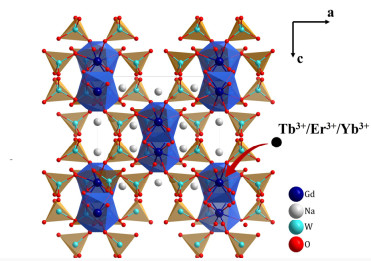
Figure 1.
A view of the structure unit of the NGW crystal

Color-tunable Upconversion Properties of Tb3+/Er3+/Yb3+ Tri-doped Na5Gd(WO4)4 Crystals
Geng XUE , Xin CHEN , Chuan-Xin ZHENG , Guo-Qiang WANG , Ling-Yun LI


Optical thermometers based on rare earth ion-doped upconversion (UC) phosphors have been given more attention due to their excitation in the near-infrared (NIR) region and suitable two thermally coupled energy levels (TCLs)[1-3]. Generally, the TCLs could be found in many rare earth ions, such as Er3+ (4S3/2, 2H11/2), Ho3+ (5F2, 3/3K8, 4F1/5G6), Tm3+ (3F2, 3, 3H4), etc[4-6]. Among them, the temperature sensors based on the green upconversion (UC) emission from TCLs of 2H11/2 and 4S3/2 of Er3+ ions have gained wide attention. And the Yb3+ ion is usually combined and used as a sensitizer to enhance UC efficiency. Although several methods have been reported by researchers to enhance the sensitivity of Er3+-doped systems, most Er3+-doped materials are still suffering from low sensing sensitivity[7, 8].
The Tb3+/Yb3+ codoped system deserves special attention due to its good performance in the UC processes[9, 10]. The Tb3+ ion exhibits high quantum efficiencies for luminescence due to the large energy gap between the 7FJ ground state and the 5D4 excited state, which results in the lack of multiphonon relaxation of the 5D4 excited state and the high usage of this ion as a dopant in efficient phosphors[11, 12]. But the Tb3+/Yb3+ codoped system shows poor thermal performance, which is the emission intensities that are decreased fast as the temperature increases. Therefore, the introduction of Er3+ in Tb3+/Yb3+ codoped system may be a valid strategy to improve sensitivity.
According to the consideration stated above, herein Tb3+/Yb3+ co-doped and Er3+/Tb3+/Yb3+ tridoped NGW phosphors are directionally synthesized. The Na5Gd(WO4)4 (NGW) crystal is a member of Na5RE(WO4)4 (RE = Y, La, Eu, Lu) family, which were first reported by L. G. Sillén, et al, and have been considered to be efficient luminescent host lattices[13-16]. The crystal structure of NGW crystal was determined by Wang[17]. NGW crystal is related to the scheelite structure of CaWO4 and the Gd site symmetry is the same as the cationic site symmetry in CaWO4 (S4)[18]. In addition, the metal-to-metal intervalence charge transfer (IVCT) processes between lanthanide (Tb3+) and d0 electron configured transition metal ions (W6+) in oxide crystals have been demonstrated to be an effective pathway to excite the corresponding lanthanide ions.
In the present work, we report the synthesis of Tb3+/Yb3+ co-doped and Er3+/Tb3+/Yb3+ tri-doped NGW phosphors using conventional high temperature solid state reaction process for the first time. The color-tunable emission in NGW: Er3+/Tb3+/Yb3+ phosphors by the modulation of temperature was realized for the first time. In summary, the Er3+/Tb3+/Yb3+ tri-doped NGW phosphors show wide-range-tunable blue-green and yellow-green emissions under 980 nm excited, which would provide a new strategy to design novel optical temperature sensing materials.
Tb3+/Yb3+ co-doped and Tb3+/Er3+/Yb3+ tri-doped NGW polycrystalline powder samples were synthesized by means of the solid-state reaction method. The raw materials were Na2CO3 (A.R. (Analytical Reagent)), Gd2O3 (99.99%), WO3 (A.R.), and the doping concentrations of Tb4O7 (99.99%), Er2O3 (99.99%) and Yb2O3 (99.99%) are 5%, 0.1% and 10% of Gd3+, respectively. The stoichiometric amount of raw materials was thoroughly mixed by ground in an agate mortar. The mixture of starting materials was then transferred to crucibles and had been subsequently heated at 973 K for 24 h in air atmosphere. As the muffle furnace was cooled to room temperature naturally, and the final products were collected and ground to powder for further characterization.
Phase purity of the synthesized powders was checked by the X-ray powder diffraction (XRD), which was carried out in an angular range 15o < 2θ < 65o using Ni-filtered CuKα radiation on a Rigaku MiniFlex Ⅱ diffractometer working in Bragg-Brentano (θ/2θ) geometry. The measured X-ray powder diffraction patterns of the Tb3+/Yb3+ co-doped and Tb3+/Er3+/Yb3+ tri-doped NGW were in accordance with the simulated ones calculated from the single crystal data[17].
Photoluminescence excitation (PLE) and photoluminescence (PL) spectra were recorded by a spectrometer (FLS980, Edinburgh Instruments) equipped with both continuous (450 W) and pulsed xenon lamps as the light source and a Hamamatsu R955 photomultiplier tube (PMT) as the detector. UC luminescence spectra were measured upon 980 nm NIR excitation from a continuous-wave diode laser. The temperature related spectra measurements were performed on a temperature controlling stage (THMS 600). The temperature stabilization time was 90 s with a temperature tolerance set to ±5 K.
The crystallographic analyses in ref. [17] manifested that NGW crystallizes in the tetragonal system with space group I41/a (No. 88). The lattice parameters are: a = 11.4937(1), b = 11.4937(1), c = 11.3998(3) Å, V = 1505.97(5) Å3 and Z = 4. In the refined structure as plotted in Fig. 1, the crystalline structure is constituted by completely isolated WO4 tetrahedra and Na+/Gd3+ cations, which are residing between the WO4 tetrahedra for charge balance.
The XRD measurements for all samples were carried out at room temperature. The XRD patterns of samples NGW: Tb3+/Yb3+, NGW: Tb3+/Er3+/Yb3+ and the calculated XRD pattern of NGW are shown in Fig. 2. All peaks of XRD for the synthesized samples matched well with the XRD pattern for pure NGW, which was calculated by Diamond program from the crystal parameters of NGW, while no other peaks can be observed[17]. The results of XRD analysis confirmed that doping of Tb3+/Er3+/Yb3+ ions did not generate obvious distortion in the host structure. Furthermore, based on the effective ionic radii of cations reported by Shannon, as the ionic radius of Gd3+ (N = 8, 1.06 Å) is close to that of Tb3+ (N = 8, 1.04 Å), Er3+ (N = 8, 1.00 Å) and Yb3+ (N = 8, 0.98 Å), the Tb3+/Er3+/Yb3+ ions are expected to occupy the Gd3+ sites[19].
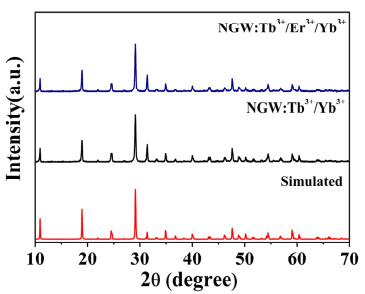
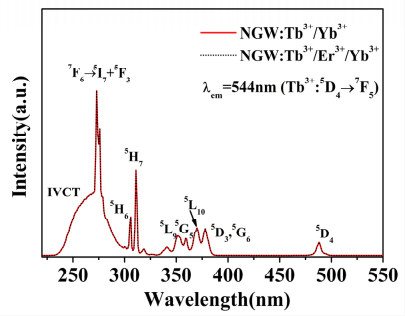
Fig. 3 shows the PLE spectra of NGW: Tb3+/Yb3+ and NGW: Tb3+/Er3+/Yb3+ in a range of 220~550 nm, monitored at 544 nm (Tb3+: 5D4 → 7F5). In Fig. 3, the broad excitation band located around 250 nm in both spectra is 4f8 → 4f75d1 transition of Tb3+ ions and Tb3+~W6+ intervalence charge transfer (IVCT) states[20]. The remaining excitation peaks with narrow character appear in the range of 270~500 nm that are associated with typical intra-4f forbidden transitions of the Tb3+ ions, which are attributed to the 7F6 → 5I7 + 5F3 (273 nm), 7F6 → 5H6 (305 nm), 7F6 → 5H7 (311 nm), 7F6 → 5D0 (318 nm), 7F6 → 5L6-8, 5G2 (340 nm), 7F6 → 5L9 (352 nm), 7F6 → 5G5 (359 nm), 7F6 → 5L10 (369 nm), 7F6 → 5D3, 5G6 (378 nm) and 7F6 → 5D4 (488 nm) transitions[21]. Moreover, both spectra are almost the same, which indicate that the multiplet 5D4 of Tb3+ in both NGW: Tb3+/Yb3+ and NGW: Tb3+/Er3+/Yb3+ could be excited by 4f8 → 4f75d1 transition, IVCT bands and intra-4f forbidden transitions of the Tb3+ ions, and unchanged by the introduction of Er3+ ions.
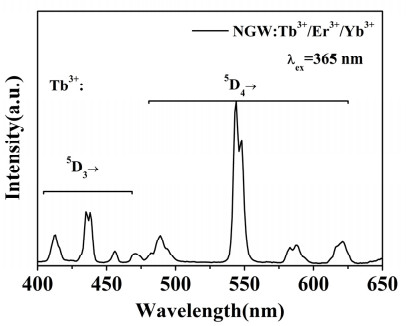
The PL spectra of NGW: Tb3+/Er3+/Yb3+ measured under 365 nm excitation at 300 K are illustrated in Fig. 4. It can be observed intuitively that NGW: Tb3+/Er3+/Yb3+ demonstrates a typical green emission. The luminescence signals in the range of 400~640 nm are attributed to the characteristic 5D3 → 7Fj (j = 4, 5, 6) and 5D4 → 7Fj (j = 3, 4, 5) transitions of Tb3+. Among these peaks, that corresponding to the 5D4→7F5 transition at 545 nm (green emission) which shows maximum luminescence intensity is the most prominent transition in all emission spectra. As in the schematic configurational coordinate diagram of Tb3+ and Yb3+ ions shown in Fig. 5, when the sample is excited by 365 nm, corresponding to 7F6→5D3 transition, the populations at 5D3 levels are relaxed to the 5D4 level via multiphonon relaxations and cross relaxation. From the emission spectra in Fig. 4, the obvious emissions from 5D3 and 5D4 levels indicate these two relaxation pathways are efficient.
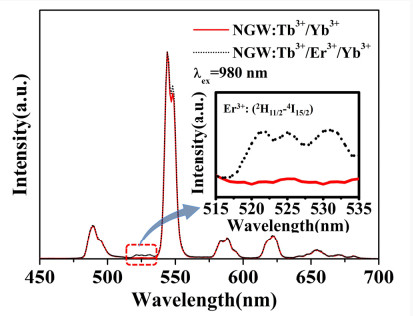
The UC emission spectra of NGW: Tb3+/ Yb3+ and NGW: Tb3+/Er3+/Yb3+ samples are shown in Fig. 5. Under 980 nm NIR laser excitation, typical blue (485 nm), green (545 nm), yellow (585 nm) and red (621 nm) emissions attributed to Tb3+: 5D4→7Fj (j = 6, 5, 4, 3) transitions are easily detected in both samples. Besides, we observed that NGW: Tb3+/ Er3+/Yb3+ shows weak luminescent around 525 nm, which can be ascribed to the Er3+ (2H11/2 → 4I15/2). The emissions of Tb3+ ions are much stronger than the emissions of Er3+ due to the much higher concentration of Tb3+ ions than the Er3+ ions. The energy level diagram of Tb3+/Er3+/Yb3+ tri-doped system and possible UC pathways populating the emitting states were schematically illustrated in Fig.6. Under 980 nm laser excitation, the ground state absorption (GSA) of Yb3+ion: 2F7/2 → 2F5/2 and Er3+ ion: 4I15/2 → 4I11/2 take place by absorbing NIR photons. Usually, the population at the excited level 4I11/2 mainly occurs through an efficient energy transfer (ET) from Yb3+ to Er3+: Yb3+ (2F5/2) + Er3+ (4I15/2) → Yb3+ (2F7/2) + Er3+ (4I11/2) because of the lager absorption cross section of Yb3+ than that of Er3+. For the green emission bands around 525 and 545 nm from 2H11/2, 4S3/2 → 4I15/2 radiative transitions, the metastable 2H11/2 and 4S3/2 levels are populated by nonradiative (NR) transition from upper level 4F7/2. The excited state of 4F7/2 could be populated through the ET process: Yb3+ (2F5/2) + Er3+ (4I11/2) → Yb3+ (2F7/2) + Er3+ (4F7/2) or excited state absorption (ESA): Er3+ (4I11/2) → Er3+ (4F7/2). For the red emission band from the 4F9/2 → 4I15/2 transition, the population of levels 4F9/2 could be realized through the NR from the 4S3/2 level, and the ET process: Yb3+ (2F5/2) + Er3+ (4I13/2) → Yb3+ (2F7/2) + Er3+ (4F9/2) or ESA: Er3+ (4I13/2) → Er3+ (4F9/2) in which the 4I13/2 level was populated through a 4I11/2 → 4I13/2 NR process.
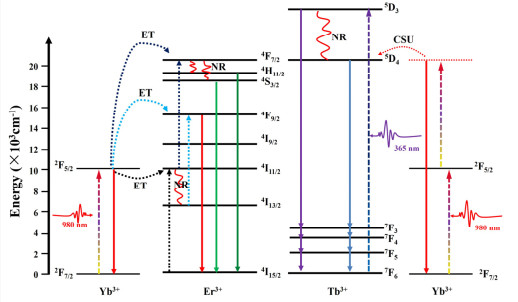
Besides, the Tb3+ ions have no excited states resonant with the Yb3+ transition 2F7/2 → 2F5/2 in the IR region, so it is generally assumed that the ET from Yb3+ to Tb3+ is a phonon-assisted cooperative sensitization process, where the energy of a pair of excited Yb3+ is transferred simultaneously to an adjacent Tb3+ (process CSU)[22, 23]. Once Tb3+ is excited to 5D4, it can be further excited to higher states through the absorption of a pump photon (excited-state absorption, ESA) or through ET from a third Yb3+ (ETU), but the absence of the emissions from 5D3 indicates that the relaxation of higher states would not populate 5D3 and might be through IVCT (Tb3+−W6+) to 5D4.
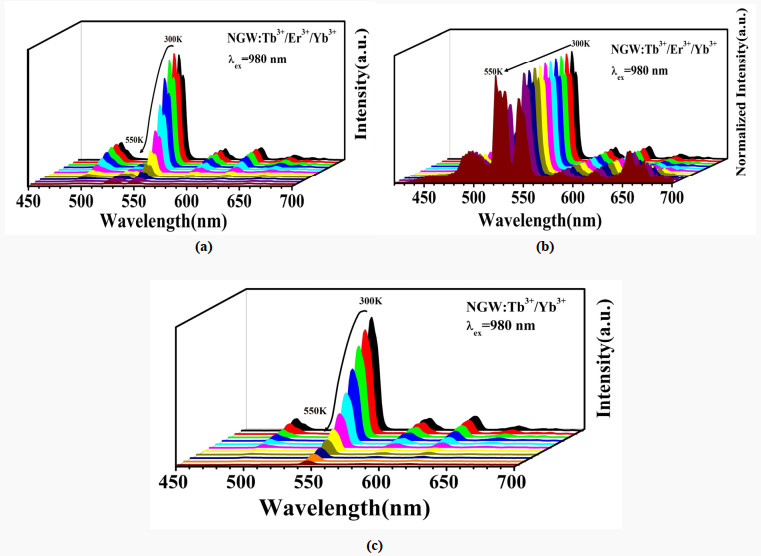
Fig. 7 presents the UC emission spectra of NGW: Tb3+/Er3+/Yb3+ and NGW: Tb3+/Yb3+ by exciting at 980 nm under different temperature. It can be noticed the transition intensity of Tb3+ shows a continuous decrease as the temperature rises, but the green transition intensities of Er3+ exhibit some difference. Fig. 8 depicts the normalized intensities of 525 nm emission by Er3+ (2H11/2 → 4I15/2), the Tb3+ 5D4 → 7Fj (j = 6, 5, 4, 3) transitions (490, 545, 586, 621 nm), and the overlapping 657 nm emission by Er3+ (4F9/2→4I15/2) and Tb3+ (5D4 → 7F/2) as a function of the absolute temperature. It can be noticed that the 525 nm (Er3+: 2H11/2 → 4I15/2) one has been largely enhanced with increasing temperature, which is due to the population of TCLs (2H11/2 and 4S3/2) abide by the Boltzmann distribution law. With the increase of internal temperature, enhanced lattice vibrations promote the nonradiative relaxation rate between two closely spaced energy levels, which keeps them quasi-thermal balanced. For Er3+ ions, the ΔE between 2H11/2 and 4S3/2 is about 800 cm−1. The small energy gap leads to the fact that the 2H11/2 level can be easily thermally populated from the 4S3/2 level.
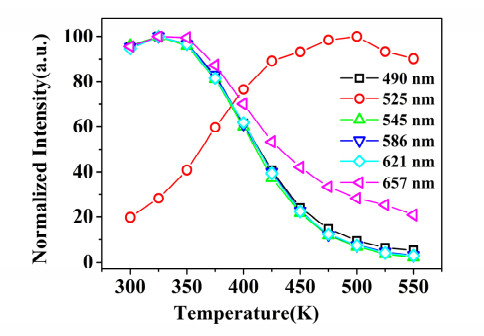
Besides, the thermal quenching mechanism of Tb3+ emissions has been researched, which is explained by thermally promoted crossover from the emitting 5D4 level to the IVCT state and followed by feeding to ground states in a nonradiative way with raising the temperature[10, 24].
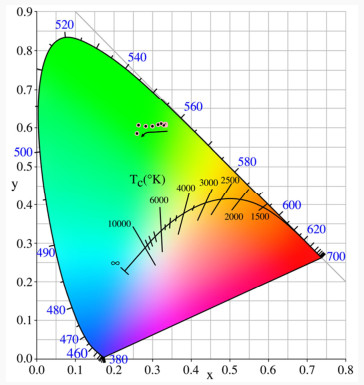
In order to evaluate the colorimetric performance of the phosphors, the chromaticity coordinates for NGW: Tb3+/Er3+/Tb3+ were calculated on the basis of Commission International de L'Eclairage (CIE) 1931 color-matching functions. The chromaticity coordinates of NGW: Tb3+/Er3+/Tb3+ at various temperature under 980 nm excitation are listed in Table 1. The chromaticity coordinates are with slight variations around (0.334, 0.609) when the temperature is lower than 375 K. With the increase of temperature, the chromaticity coordinates change from (0.334, 0.609) at 375 K to (0.260, 0.585) at 550 K, and the changes of x and y values of CIE coordinate result in the color of photoluminescence changing from yellow-green to blue-green (Fig. 9). The results demonstrated that NGW: Tb3+/Er3+/Tb3+ phosphor may be used as optical temperature sensing materials.

 DownLoad:
CSV
DownLoad:
CSV
| Temperature (K) | CIE | |
| x | y | |
| 300 | 0.334 | 0.606 |
| 325 | 0.334 | 0.609 |
| 350 | 0.334 | 0.609 |
| 375 | 0.332 | 0.609 |
| 400 | 0.329 | 0.607 |
| 425 | 0.323 | 0.607 |
| 450 | 0.314 | 0.606 |
| 475 | 0.300 | 0.604 |
| 500 | 0.283 | 0.604 |
| 525 | 0.263 | 0.606 |
| 550 | 0.260 | 0.585 |
In summary, novel phosphors NGW with dopant Tb3+/Yb3+ and Tb3+/Er3+/Yb3+ have been successfully synthesized by the solid-state reaction method. Base on the TCL (2H11/2 and 4S3/2) of the Er3+ ion, the relative emission intensities are strongly temperature dependent. The introduction of Er3+ was used to modify the chromaticity coordinates for NGW: Tb3+/Yb3+, then providing a good color tunable property, which induces the shift of emission color from yellow-green to green for NGW: Tb3+/Er3+/Yb3+ as the temperature increases. All the results indicate that the NGW: Tb3+/Er3+/Yb3+ phosphor may be used as optical temperature sensing materials.
Dong, B.; Cao, B. S.; He, Y. Y.; Liu, Z.; Li, Z. P.; Feng, Z. Q. Temperature sensing and in vivo imaging by molybdenum sensitized visible upconversion luminescence of rare-earth oxides. Adv. Mater. 2012, 24, 1987-1993. doi: 10.1002/adma.201200431
Wang, X. D.; Wolfbeis, O. S.; Meier, R. J. Luminescent probes and sensors for temperature. Chem. Soc. Rev. 2013, 42, 7834-7869. doi: 10.1039/c3cs60102a
McLaurin, E. J.; Bradshaw, L. R.; Gamelin, D. R. Dual-emitting nanoscale temperature sensors. Chem. Mater. 2013, 25, 1283-1292. doi: 10.1021/cm304034s
Alencar, M. A. R. C.; Maciel, G. S.; de Araújo, C. B.; Patra, A. Er3+-doped BaTiO3 nanocrystals for thermometry: influence of nanoenvironment on the sensitivity of a fluorescence based temperature sensor. Appl. Phys. Lett. 2004, 84, 4753-4755. doi: 10.1063/1.1760882
Xu, W.; Gao, X. Y.; Zheng, L. J.; Zhang, Z. G.; Cao, W. W. Shortwavelength upconversion emissions in Ho3+/Yb3+ codoped glass ceramic and the optical thermometry behavior. Opt. Express 2012, 20, 18127-18137. doi: 10.1364/OE.20.018127
Xing, L. L.; Yang, W. Q.; Ma, D. C.; Wang, R. Effect of crystallinity on the optical thermometry sensitivity of Tm3+/Yb3+ codoped LiNbO3 crystal. Sens. Actuators B 2015, 221, 458-462. doi: 10.1016/j.snb.2015.06.132
Mahata, M. K.; Koppe, T.; Mondal, T.; Brusewitz, C.; Kumar, K.; Rai, V. K.; Hofsäss, H.; Vetter, U. Incorporation of Zn2+ Ions into BaTiO3: Er3+/Yb3+ nanophosphor: an effective way to enhance upconversion, defect luminescence and temperature sensing. Phys. Chem. Chem. Phys. 2015, 17, 20741-20753. doi: 10.1039/C5CP01874A
Liu, S.; Ming, H.; Cui, J.; Liu, S.; You, W.; Ye, X.; Yang, Y.; Nie, H.; Wang, R. Color-tunable upconversion luminescence and multiple temperature sensing and optical heating properties of Ba3Y4O9: Er3+/Yb3+ phosphors. J. Phys. Chem. C 2018, 122, 16289-16303. doi: 10.1021/acs.jpcc.8b04180
Grzyb, T.; Gruszeczka, A.; Wigluszb, R. J.; Lis, S. The effects of down- and up-conversion on dual-mode green luminescence from Yb3+- and Tb3+-doped LaPO4 nanocrystals. J. Mater. Chem. C 2013, 1, 5410-5418. doi: 10.1039/c3tc31100g
Wang, G. Q.; Li, L. Y.; Feng, Y. N.; Yu, H.; Zheng, X. H. Tb3+- and Yb3+-doped novel KBaLu(MoO4)3 crystals with disordered chained structure showing down- and up-conversion luminescence. CrystEngComm. 2018, 20, 3657-3665. doi: 10.1039/C8CE00461G
Geng, D.; Li, G.; Shang, M.; Yang, D.; Zhang, Y.; Cheng, Z.; Lin, J. Color tuning via energy transfer in Sr3In(PO4)3: Ce3+/Tb3+/Mn2+ phosphors. J. Mater. Chem. C 2012, 22, 14262-14271. doi: 10.1039/c2jm32392c
Sun, J.; Lai, J.; Xia, Z.; Zhang, X.; Liu, H.; Du, H. Luminescence properties and energy transfer in Ba2Y(BO3)2Cl: Ce3+, Tb3+ phosphors. Appl. Phys. B 2012, 107, 827-831. doi: 10.1007/s00340-012-4961-5
Sillén, L. G.; Sundvall, H. Double molybdates and tungstates of alkali metals with lanthanum or bismuth. Ark. Kemi Mineral Geol. 1943, A17, 1-18.
Hong, H. Y. P.; Dwight, K. Crystal structure and fluorescence lifetime of a laser material NdNa5(WO4)4. Mat. Res. Bull. 1974, 9, 775-780. doi: 10.1016/0025-5408(74)90112-3
Pan, J.; Yau, L.; Chen, L.; Zhao, G.; Zhou, G.; Guo, C. Studies on spectra properties of Na5Eu(WO4)4 luminescent crystal. J. Lumin. 1988, 40, 856-857.
Huang, D.; Zhou, Y.; Xu, W.; Yang, Z.; Liu, Z.; Hong, M.; Lin, Y.; Yu, J. Photoluminescence properties of M3+ (M3+ = Bi3+, Sm3+) activated Na5Eu(WO4)4 red-emitting phosphors for white LEDs. J. Alloys Compd. 2013, 554, 312-318. doi: 10.1016/j.jallcom.2012.11.172
Wang, G. Q.; Lin, Y. P.; Ye, R.; Feng, Y. N.; Li, L. Y. Pr3+ and Tb3+ coactivated Na5Gd(WO4)4 showing tunable luminescence with high thermostability via modulation of excitation and temperature. J. Alloys Compd. 2019, 779, 41-48. doi: 10.1016/j.jallcom.2018.11.223
Perets, S.; Tseitlin, M.; Shneck, R. Z.; Mogilyanski, D.; Kimmel, G.; Burshtein, Z. Sodium gadolinium tungstate NaGd(WO4)2: growth, crystallography, and some physical properties. J. Cryst. Growth 2007, 305, 257-264. doi: 10.1016/j.jcrysgro.2007.03.058
Shannon, R. D. T.; Prewitt, C. T. Effective ionic radii in oxides and fluorides. Acta Crystallogr. B 1969, 25, 925-946. doi: 10.1107/S0567740869003220
Cavalli, E.; Boutinaud, P.; Mahiou, R.; Bettinelli, M.; Dorenbos, P. Luminescence dynamics in Tb3+-doped CaWO4 and CaMoO4 crystals. Inorg. Chem. 2010, 49, 4916-4921. doi: 10.1021/ic902445c
Annadurai, G.; Jayachandiran, M.; Kennedy, S. M. M.; Sivakumar, V. Synthesis and photoluminescence properties of Ba2CaZn2Si6O17: Tb3+ green phosphor. Mat. Sci. Eng. B 2016, 208, 47-52. doi: 10.1016/j.mseb.2016.02.008
Auzel, F. Upconversion processes in coupled ion systems. J. Lumin. 1990, 45, 341-345. doi: 10.1016/0022-2313(90)90189-I
Salley, G. M.; Valiente, R.; Guedel, H. U. Luminescence upconversion mechanisms in Yb3+–Tb3+ systems. J. Lumin. 2001, s94-95, 305-309.
Gao, Y.; Huang, F.; Lin, H.; Zhou, J.; Xu, J.; Wang, Y. A novel optical thermometry strategy based on diverse thermal response from two intervalence charge transfer states. Adv. Funct. Mater. 2016, 26, 3139-3145. doi: 10.1002/adfm.201505332

Figure 2 XRD patterns of the Tb3+/Yb3+ co-doped and Tb3+/Er3+/Yb3+ tri-doped NGW samples and simulated X-ray powder diffraction patterns of NGW crystal

Figure 6 Schematic energy level diagram of Tb3+/Er3+/Yb3+ as well as the possible energy transfer mechanisms involved in the DC and UC processes under excitation of 365 and 980 nm, respectively

Figure 7 Temperature dependence of photoluminescence intensities for NGW: Tb3+/Er3+/Yb3+ (a) and the corresponding normalized spectra (b), and NGW: Tb3+/Yb3+ (c) under 980 nm excitation

Figure 9 CIE 1931 chromaticity diagram of NGW: Tb3+/Er3+/Yb3+ at various temperature under 980 nm excitation
Table 1. Chromaticity Coordinates of NGW: Tb3+/Er3+/Yb3+ at Various Temperature under 980 nm Excitation
| Temperature (K) | CIE | |
| x | y | |
| 300 | 0.334 | 0.606 |
| 325 | 0.334 | 0.609 |
| 350 | 0.334 | 0.609 |
| 375 | 0.332 | 0.609 |
| 400 | 0.329 | 0.607 |
| 425 | 0.323 | 0.607 |
| 450 | 0.314 | 0.606 |
| 475 | 0.300 | 0.604 |
| 500 | 0.283 | 0.604 |
| 525 | 0.263 | 0.606 |
| 550 | 0.260 | 0.585 |
 下载: 导出CSV

 扫一扫看文章


扫一扫关注我们


