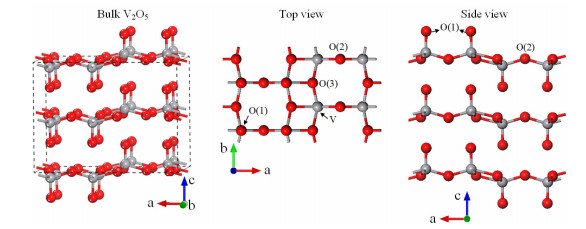
Figure 1.
Crystal structure of V2O (Red and grey spheres are O and V atoms, respectively)

Insights into the H2O/V2O5 Interface Structure for Optimizing Water-splitting
Bing-Kai ZHANG , Zeng-Zhu LI , Qiong LI , Zhan LIN , Jing LIU , Feng PAN


Water (H2O) is one of the most studied adsorbates on well-defined metal oxide single crystal samples. The adsorption of H2O at solid surfaces shows a variety of applications in electrochemistry (The formation of water molecules near a metal electrode plays a key role in electrochemical reactions) and in heterogeneous catalysis[1-3]. It has been generally accepted that the interaction of H2O with metal oxide surfaces has important consequences on their catalytic behaviors. The adsorption of H2O on a metal oxide surface may result in different adsorption modes, or combinations of them, depending on the measurement temperature, the intrinsic reactivity of the surface, and the number of oxygen-vacancy sites on the surface.
Vanadium pentoxide (V2O5) is an important transition metal oxide and has been widely used as electrode materials for rechargeable aqueous Zn-ion battery and catalysts in many industrial applications[4-6]. Since Zn-ion storage and heterogeneous catalytic reactions take place in aqueous solutions or in a humid environment, it is significant to understand the interaction mechanisms of H2O on V2O5. Meanwhile, in the application of photocatalysis, water not only provides the reaction environment but also is the key participant, as it can decompose to produce hydrogen, oxygen, and hydroxyl radicals. Therefore, a detailed investigation of H2O adsorption and dissociation on V2O5 surfaces is also very important, which can help to elucidate the mechanism of catalytic processes occurring on V2O5 catalyst.
Experimental studies based on Fourier transform infrared (FTIR) spectroscopy showed that H2O is adsorbed on unsupported V2O5 and surface metal centers acting as Lewis acids are the favorable sites[7, 8]. Costa et al. observed that water is molecularly adsorbed on V2O5(001) based on the observation of the ambient atomic force microscopy on V2O5(001) surface[9]. Moshfegh et al. have carried out temperature programmed desorption (TPD) studies and found that H2O adsorbs dissociatively on the V2O5 surface through the action of two neighboring vanadium sites of -V5+-O-V4+[10]. The analyis results of some important reactions show that the structures of surface V2O5/supports are generally altered in the presence of water, and water effect is connected with the formation of the Brönsted acids V-OH. Sadovskaya et al.[11] and Lee et al.[12] proposed that the lattice oxygen of surface vanadia species VOx undergoes isotope exchange with that of adsorbed water rather than gas-phase oxygen. Recently, Ma et al.[13] have studied the reactions of vanadium oxide cluster cations with heavy water (D2O) in a fast flow reactor. Their results suggested that (V2O5)1-3+ clusters are reactive toward water resulting in (V2O5)1-3D+ and (V2O5)1-3D2O+ through the deuterium atom abstraction and adsorption reactions. The work of Goclon et al. showed that under low value of the oxygen partial pressure conditions, the V2O5 phase is unstable and may form oxygen-vacancy surface that is more active than stoichiometric V2O5 surface[14].
Compared to experimental works, the computational chemistry methodologies have been used to give further insight into the structural, electronic, magnetic and catalytic properties of the V2O5 surfaces, but the theoretical studies for H2O/V2O5 interfaces and H2O/V2O5 interactions are relatively limited. Yin et al.[15] and Witko et al.[16] studied the adsorption and dissociation of water at low-index V2O5 surfaces by cluster models. However, they did not study the water monolayers with V2O5 and a systematical investigation of adsorption and dissociation of water on different V2O5 surfaces including oxygen-vacancy surface by periodic density functional theory. In this study, the first-principles calculations based on density functional theory and the periodic slab models are used to investigate water monolayers with V2O5 and single-molecule adsorption and dissociation at three low-index surfaces ((001), (010) and (100)) of V2O5 and oxygen-vacancy V2O5(001) surface.
Geometry optimizations and density of states calculations were performed using the Cambridge Serial Total Energy package (CASTEP)[17]. CASTEP is a first principles density functional theory plane wave pseudopotential simulation code. The calculations were performed in the frame of the generalized gradient approximation (GGA, Perdew-Burke-Enzerhoff (PBE)) for the exchange and correlation effects[18, 19]. Ultrasoft pseudopotentials corresponding to the optimization scheme of Vanderbilt were employed[20]. Surfaces were simulated by slabs separated by a vacuum region (14 Å). The cutoff energy is 380 eV. The number of k-points for Brillouin-Zone integration (BZ) was chosen according to the Monkhorst-Pack scheme[21]. For bulk V2O5, a 5 × 5 × 5 k-points mesh was used, whereas for the supercells representing (001), (010), (100) and defective surfaces 4 × 4 × 1 grids were applied. All atoms in the three surfaces were allowed to relax. The convergence criteria for the structure optimization and energy calculation were set to (a) a SCF tolerance of 2.0 × 10⁻⁶ eV/atom, (b) an energy tolerance of 2.0 × 10⁻⁵ eV/atom, (c) a maximum force tolerance of 0.05 eV/Å, and (d) a maximum displacement tolerance of 0.002 Å. Spin-polarized calculations were also included in the DFT investigations. We have considered the effect of Hubbard U on the adsorption energies of water on V2O5(001) surface, and found that the effect is small (less than 1 kJ/mol), so the Hubbard U parameter was not included in the calculations.
V2O5 is a layerlike material with a no-covalent interaction between layers, making it easy for cleavage along the (001) plane, as shown in Fig. 1. V2O5 is an orthorhombic lattice (space group Pmmn) and its optimized unit cell parameters (a = 11.512, b = 3.564, c = 4.368 Å) are within +0.2%, +0.1% and –2.8% errors, respectively of the experimental determined lattice constants[22], suggesting that the calculations are reliable. Three possible low-index surfaces of V2O5, namely the (010), (001) and (100), are shown in Fig. 2. In this work, two layers of V2O5 are used in the (001), (100), (010) and oxygenvacancy (001) surfaces.
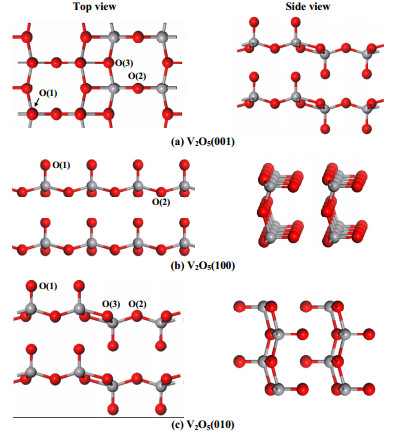
There are three types of oxygen atoms differing by their coordination number with the vanadium atoms: (ⅰ) singly coordinated terminal oxygen, O(1), which is a vanadyl oxygen (V=O); (ⅱ) two-coordinated oxygen, O(2); and (ⅲ) three-coordinated oxygen, O(3). The O(2) and O(3) bridge two and three vanadium atoms, respectively.
For the adsorption of water molecule, 5-fold coordinated vanadium atoms and the surface oxygen atoms are the active sites. 5-Fold coordinated vanadium atoms are considered as Lewis acid site, which can interact with oxygen atom (Ow) of water with free electron pairs. Oxygen atoms at the surface can interact with hydrogen atoms of water through hydrogen bonds. For the adsorption of H2O, both vanadium and oxygen sites of V2O5 surfaces are considered.
The adsorption energy (Eads) has been calculated according to the expression:
|
|
(1) |
where E(adsorbate-substrate) is the total energy of the adsorbate/substrate system, Eadsorbate is the total energy of the isolated adsorbate at its equilibrium geometry, and Esubstrate is the total energy of the substrate. A negative Eads value corresponds to a stable adsorbate/ substrate system.
All transition states (TSs) are located by using the complete LST/QST method[23-25]. It starts with linear synchronous transit (LST) maximization, followed by energy minimization in directions conjugated to the reaction pathway. These approximated TS are then used to perform quadratic synchronous transit (QST) maximization. From that point, another conjugate gradient minimization is performed. The cycle is repeated until a stationary point is located. A transition state is identified when (1) the forces on the atoms vanish and (2) the energy is a maximum along the reaction coordinate but a minimum with respect to all of the other degrees of freedom. The energy barrier is the energy difference between the transition state (TS) and the intermediate (IM).
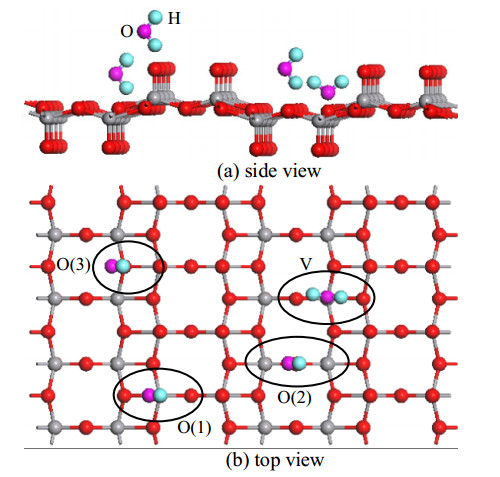
Firstly, the adsorption of H2O on the V2O5(001) surface was considered since the V2O5(001) surface is the thermodynamically most stable[26]. H2O is initially placed on different adsorption sites, i.e., O(1), O(2), O(3) and V on the V2O5 surface, as shown in Fig. 3. In the calculation process, all possible adsorption orientations were considered including parallel and vertical (O-down and H-down modes) to get all possible adsorption models for water on surfaces. The final stable configurations are obtained on the surface for each parallel and vertical orientations. The calculated adsorption energies and bond lengths for stable configurations are listed in Table 1.

 DownLoad:
CSV
DownLoad:
CSV
| Sites | Eads (kJ/mol) | Rsurface-H2O (Å) | ROw-H (Å) | θH-Ow-H (°) | QH2O (e) | Msurface-H2O |
| O(1) | –15.60 | 2.231 | 0.978/0.978 | 106.8 | 0.01 | 0.03 |
| O(2) | –14.33 | 2.240 | 0.978/0.976 | 105.9 | 0.00 | 0.02 |
| O(3) | –8.01 | 3.010 | 0.981/0.981 | 105.2 | 0.00 | 0.00 |
| V | –14.53 | 2.674 | 0.980/0.980 | 107.1 | 0.02 | 0.04 |
| Eads denotes adsorption energies. R is bond length. For O(1), O(2), and O(3) sites, the Rsurface-H2O means the distance between surface O atoms and H atom of H2O. For V site, the Rsurface-H2O stands for the distance between surface V atoms and Ow atom of H2O. ROw-H represtents the two bond lengthes of adsorbed H2O. Q shows charge transfer from H2O to surface. And M denotes the bond population. | ||||||
The adsorption energies are in the range of –8.01 to –15.60 kJ/mol, and adsorption abilities decrease in the order of O(1) > V ≈ O(2) > O(3). The surface-H2O distances are changing from 2.231 to 3.010 Å. The highest adsorption energy of H2O calculated was –15.60 kJ/mol, which constitutes a weak interaction. The O(3) site is inactive with adsorption energy of –8.01 kJ/mol, which is different and is roughly 7.39 kJ/mol. The adsorption mechanism of H2O on stoichiometric V2O5(001) surface is physisorption. The Mulliken population analysis is performed to understand the charge trend between adsorbate and substrate. As listed in Table 1, the Mulliken charges for adsorbed H2O in the four adsorption configurations are below 0.02 e, suggesting few electrons withdrawing from H2O to the surface during adsorption. The bond populations between surface and H2O are almost zero. The above analyses suggest that the adsorption of water on V2O5(001) surface is physisorption, which supports the previous experimental identifications[7, 9, 10].
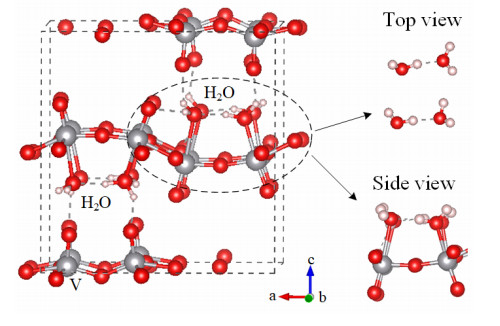
Furthermore, we also give the most stable H2O/V2O5 interface structure (Fig. 4) after an optimization of various structures. We suggest whe the ratio of H2O and V2O5 is 1 (i.e, the same number of H2O molecule and V2O5 unit), H2O/V2O5 interface structure can still maintain stable (a negative value relative to isolated H2O molecule). The adsorption energy for H2O in H2O/V2O5 interface is –0.75 eV, where the negative energy means the adsorption is exothermic. The other H2O/V2O5 interface structures are shown in Fig. S1. Fig. 4 shows that hydrogen binding interactions are generally found in H2O/V2O5, which contributes to the stability of H2O/V2O5 interface. More importantly, the right inset of Fig. 4 indicates the water forms a weakly ordered overlayer with V2O5(001) surface. Therefore, there is a locally ordered (2 × 2) superstructure of molecular water in H2O/V2O5 interface. The formation of ordered overlayers has been observed on some oxide surfaces like TiO2(101)[27].
To determine if the dissociation of H2O occurs on the V2O5(001) surface, the partial dissociation of H2O is proposed, in which products are one hydroxyl group and one hydrogen atom. Hydrogen atom approaches different oxygen sites of the surface including O(1), O(2) and O(3) sites, and the hydroxyl group attaches to a V site, as shown in Fig. S2. The calculated adsorption energies for water dissociation at O(1), O(2) and O(3) sites displayed in Fig. S2 are positive with 171.73, 197.78 and 209.36 kJ/mol, suggesting that the three types of H2O dissociative adsorption are energetically unfavorable. Therefore, the dissociation of the water hardly occurs on the stoichiometric V2O5(001) surface.
Oxygen-vacancies play an important role in catalytic reactions, and thus it is necessary to study the adsorption and dissociation of water on the oxygen-vacancy V2O5(001) surface. Considering the interlayer interaction effect on the geometrical structure and electronic characterization of the oxygen-vacancy surface, a two-layer-slabs model was built, as shown in Fig. 5. In general, water prefers to interact with the surface atoms with high electron deficiency. Thereby, the favorable site for H2O adsorption is Vcus (cus stands for one-fold coordinately unsaturated site). The optimized parameters for H2O adsorption on oxygen-vacancy surface are presented in Table 2.
 DownLoad:
CSV
DownLoad:
CSV
| Surfaces | Eads (kJ/mol) | RV-Ow (Å) | ROw-H (Å) | θH-Ow-H (°) |
| Oxygen-vacancy V2O5(001) | –98.41 | 2.071 | 0.981/1.091 | 110.3 |
| V2O5(100) | –108.06 | 2.174 | 0.977/0.978 | 107.4 |
| V2O5(010) | –84.90 | 2.275 | 0.980/0.991 | 106.1 |
| Eads, R and θ denote the adsorption energies, bond lengths and the angle of H2O, respectively. | ||||
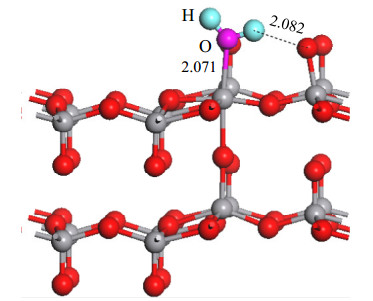
After adsorption, as shown in Fig. 5, the H2O is strongly adsorbed on the surface with an adsorption energy of –98.41 kJ/mol, forming two bonds: the Ow atom of H2O forms a covalent bond with V atom with a distance of 2.071 Å, and one H atom generates a H-bond with surface O(1) atom with a distance of 2.082 Å. The strong H-bonding gives rise to a significant OH bond stretching with the O–H distance elongating from 0.973 to 1.091 Å, suggesting the bond is somewhat activated.
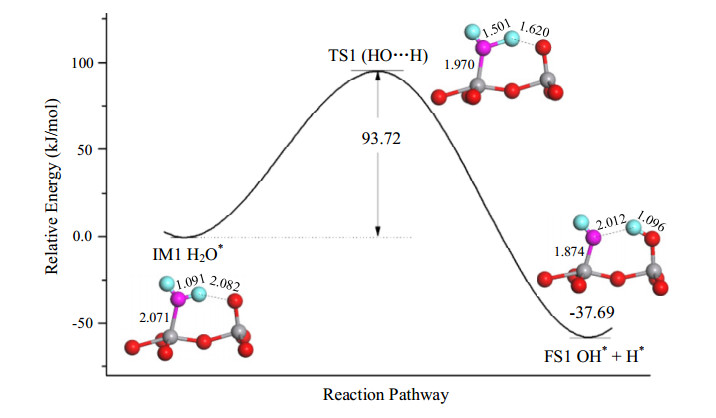
In addition, the dissociative chemisorption of H2O is investigated to understand the properties and reactivity of H2O on oxygen-vacancy V2O5(001) surface. The strong adsorption of the pre-dissociation state of H2O allows the Ow–H bond to be activated, leading to the migration of H atom to the surface O atom to form an adatom and a hydroxyl species. Thus, the energy profile of water dissociation via Ow–H scission is examined and the intermediate, transition state, and final state (FS) along the pathway are also located, as shown in Fig. 6. Relative to the adsorption configuration, the dissociation of H2O is exothermic by 37.69 kJ/mol. The energy barrier is 93.72 kJ/mol, suggesting the dissociation might be difficult at low temperature. During the reaction process, the Ow–H bond length increases gradually: 1.091 Å in IM1, 1.501 Å in TS1, and finally breakes in FS1, indicating the Ow–H bond broken process. At the same time, the H–O(1) and Ow–V bond lengths reduce gradually: 2.082 and 2.071 Å in IM1, 1.620 and 1.970 Å in TS1, and 1.096 and 1.874 Å in FS1. The changes of bond lengths indicate H–O(1) and Ow–V are gradually strengthened.
From the above analyses, H2O can undergo dissociative chemisorption on the oxygen-vacancy V2O5(001) surface forming the surface hydroxyl group and adsorbed H atom, which is consistent with the experimental result that the lattice oxygen of V2O5 undergoes isotope exchange with the adsorbed water[11, 12]. In addition, H2O dissociative adsorption may alter the structures of V2O5 surface, thereby affecting the reactivity of V2O5-based catalysts and the redox cycle of V2O5-based heterogeneous reactions, which can be applied to guide the formation of surface lattice oxygen in isotope exchange experiments.
The side ((010) and (100) planes) surfaces contribute about 15% of the total surface area of a V2O5 crystallite, indicating a non-negligible role in the catalytic activity of V2O5[28]. Therefore, in this study, the adsorption and dissociation of water on the (010) and (100) planes are also studied.
The optimized parameters of water adsorption on the side V2O5 surfaces, i.e., V2O5(100), V2O5(010), are summarized in Table 2 and the optimized configurations are shown in Fig. 7a and 8a. In Table 2, the H2O is strongly adsorbed on the V sites of V2O5(100) and (010) surfaces with the adsorption energies to be –108.06 and –84.90 kJ/mol and the V–Ow bond lengths of 2.174 and 2.275 Å, respectively. In comparison with the adsorption energy of H2O on stoichiometric V2O5(001) surface, molecular H2O adsorption on the side of V2O5 ((100) and (010)) surfaces is stronger than that on the stoichiometric V2O5(001) surface, suggesting that the side V2O5 surfaces are chemically more active and may play an important role in the activity of V2O5 as an oxidation or reduction catalyst.
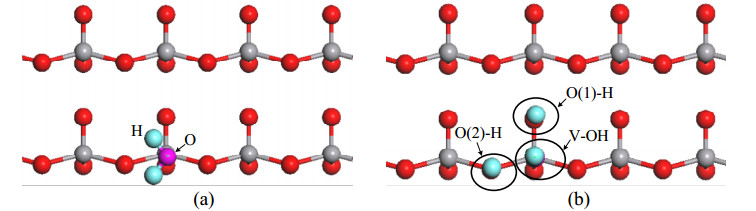
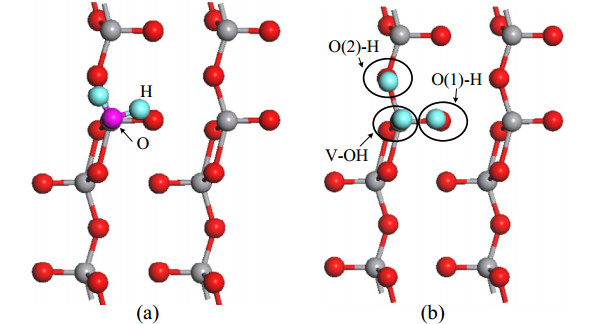
Next, the water dissociative chemisorption on the side V2O5 surfaces is investigated. The possible dissociative types of H2O on the side V2O5 surface are shown in Figs. 7b and 8b. The calculated energy profiles for (100) and (010) surfaces, along with intermediates, transition states and final states, are shown in Figs. 9 and 10, respectively.
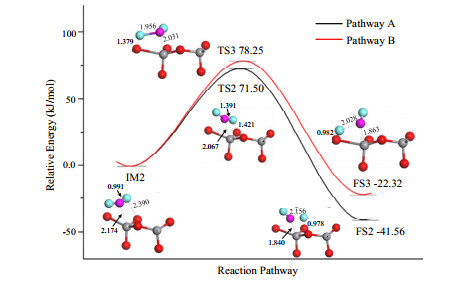
For the V2O5(100) surface, two pathways are examined, i.e., IM2 → TS2 → FS2 and IM2 → TS3 → FS3, namely pathways A and B, as shown in Fig. 9. The energies of the optimized structures are relative to the intermediate. For pathway A, H2O adsorbs on the surface to form intermediate IM2, then the Ow–H bond is broken through the transition state TS2 to form FS2 with independently adsorbed hydroxyl group on the V site and H atom on the O(1) site. The reaction barrier is 71.50 kJ/mol and the process is exothermic by 41.56 kJ/mol. During the process, the Ow–H bond length increases gradually: 0.991 Å in IM2, 1.391 Å in TS2, and finally breaks in FS2, indicating the Ow–H bond broken process. At the same time, the H–O(1) and Ow–V bond lengths reduce gradually: 2.390 and 2.174 Å in IM2, 1.421 and 2.067 Å in TS2, and 0.978 and 1.840 Å in FS2. The changes of bond lengths suggest H–O(1) and Ow–V are gradually strengthened. For pathway B, the energy barrier is 78.25 kJ/mol, which is about 6.75 kJ/mol higher than that of pathway A. The reaction is exothermic by 22.32 kJ/mol which is smaller than that of pathway A (41.56 kJ/mol). These results indicate that pathway A is kinetically and thermodynamically more favored than pathway B. Furthermore, the energy barriers of pathways A and B are 71.50 and 78.25 kJ/mol, respectively. This difference should result from different calculated models and transition state searching methods.
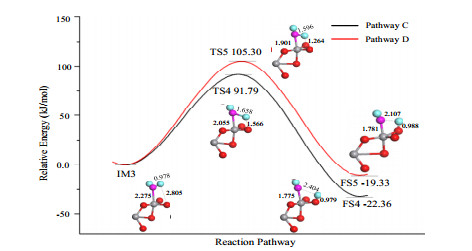
In the same way, the energy profile of H2O dissociation on V2O5(010) surface is also examined, as shown in Fig. 10. Two pathways are examined, i.e., IM3 → TS4 → FS4 and IM3 → TS5 → FS5, namely pathways C and D. For pathway C, the dissociation process is exothermic by 22.36 kJ/mol with an energy barrier of 91.79 kJ/mol, while for pathway D, the corrponding values are 19.33 and 105.30 kJ/mol, respectivley. Comparing the dissociation pathway of H2O on V2O5(100) and V2O5(010) surfaces found the H2O dissociation on V2O5(100) surface is more favorable both thermodynamically and kinetically than that on the V2O5(010) surface. Based on the above analyses, the side ((010) and (100) planes) V2O5 surfaces are more active than the stoichiometric V2O5(001) one for H2O adsorption and dissociation, which suggests that V2O5(100) and (010) surfaces show more strong reactivity for surface reactions.
The water/V2O5 interface, adsorption and dissociation of H2O on different V2O5 surfaces are investigated using periodic density functional method. Adsorption of H2O on stoichiometric V2O5(001) surface follows the physisorption mechanism and the dissociation of H2O hardly occurs due to the thermodynamic analysis. The most stable H2O/V2O5 interface structure shows that H2O adsorbs as an intact monomer with a locally ordered superstructure of molecular water. On the oxygen-vacancy V2O5(001) surface, H2O is strongly adsorbed on V site and can undergo dissociative chemisorption with a moderate energy barrier, forming a surface hydroxyl and a H adatom. For (100) and (010) of V2O5 surfaces, H2O is also strongly adsorbed on both surfaces. The energy profile analyses show that H2O can undergo dissociative chemisorption with low energy barriers, indicating (100) and (010) surfaces are more active than the V2O5(001) surface. The formation of O–V bond from the hydroxyl group adsorbed on V sites on oxygen-vacancy V2O5(001) and side V2O5 surfaces suggests that V2O5 catalysts can take the oxygen from H2O, which is consistent with the experimental results that the lattice oxygen of V2O5 undergoes isotope exchange with that of H2O.
Verdaguer, A.; Sacha, G. M.; Bluhm, H.; Salmeron, M. Molecular structure of water at interfaces: wetting at the nanometer scale. Chem. Rev. 2006, 106, 1478–1510. doi: 10.1021/cr040376l
Henderson, M. A. The interaction of water with solid surfaces: fundamental aspects revisited. Surf. Sci. Rep. 2002, 46, 1–308. doi: 10.1016/S0167-5729(01)00020-6
Fujishima, A.; Honda, K. Electrochemical photolysis of water at a semiconductor electrode. Nature 1972, 238, 37–38. doi: 10.1038/238037a0
Chen, X.; Wang, L.; Li, H.; Cheng, F.; Chen, J. Porous V2O5 nanofibers as cathode materials for rechargeable aqueous zinc-ion batteries. J. Energy Chem. 2019, 38, 20–25. doi: 10.1016/j.jechem.2018.12.023
Geng, H.; Cheng, M.; Wang, B.; Yang, Y.; Zhang, Y.; Li, C. C. Electronic structure regulation of layered vanadium oxide via interlayer doping strategy toward superior high-rate and low-temperature zinc-ion batteries. Adv. Funct. Mater. 2019, 1907684.
Zhang, B.; Liu, J.; Dai, G.; Chang, M.; Zheng, C. Insights into the mechanism of heterogeneous mercury oxidation by HCl over V2O5/TiO2 catalyst: periodic density functional theory study. P. Combust. Inst. 2015, 35, 2855–2865. doi: 10.1016/j.proci.2014.06.051
Busca, G.; Ramis, G.; Lorenzelli, V. FT-IR study of the surface properties of polycrystalline vanadia. J. Mol. Catal. 1989, 50, 231–240. doi: 10.1016/0304-5102(89)85066-7
Topsøe, N. Y. Characterization of the nature of surface sites on vanadia-titania catalysts by FTIR. J. Catal. 1991, 128, 499–511. doi: 10.1016/0021-9517(91)90307-P
Costa, A. D.; Mathieu, C.; Barbaux, Y.; Poelman, H.; Dalmai-Vennik, G.; Fiermans, L. Observation of the V2O5(001) surface using ambient atomic force microscopy. Surf. Sci. 1997, 370, 339–344. doi: 10.1016/S0039-6028(96)00956-9
Moshfegh, A. Z.; Ignatiev, A. A temperature programmed desorption study of the H2O/V2O5 system. Surf. Sci. 1992, 275, L650–L654. doi: 10.1016/0039-6028(92)90636-K
Sadovskaya, E. M.; Goncharov, V. B.; Gulyaeva, Y. K.; Popova, G. Y.; Andrushkevich, T. V. Kinetics of the H218O/H216O isotope exchange over vanadia-titania catalyst. J. Mol. Catal. A: Chem. 2010, 316, 118–125. doi: 10.1016/j.molcata.2009.10.009
Lee, E. L.; Wachs, I. E. In situ raman spectroscopy of SiO2-supported transition metal oxide catalysts: an isotopic 18O−16O exchange study. J. Phys. Chem. C 2008, 112, 6487–6498. doi: 10.1021/jp076485w
Ma, J. B.; Zhao, Y. X.; He, S. G.; Ding, X. L. Experimental and theoretical study of the reactions between vanadium oxide cluster cations and water. J. Phys. Chem. A 2012, 116, 2049–2054. doi: 10.1021/jp300279u
Goclon, J.; Grybos, R.; Witko, M.; Hafner, J. Oxygen vacancy formation on clean and hydroxylated low-index V2O5 surfaces: a density functional investigation. Phys. Rev. B 2009, 79, 075439. doi: 10.1103/PhysRevB.79.075439
Yin, X.; Fahmi, A.; Han, H.; Endou, A.; Ammal, S. S. C.; Kubo, M.; Teraishi, K.; Miyamoto, A. Adsorption of H2O on the V2O5(010) surface studied by periodic density functional calculations. J. Phys. Chem. B 1999, 103, 3218–3224. doi: 10.1021/jp9833395
Hejduk, P.; Szaleniec, M.; Witko, M. Molecular and dissociative adsorption of water at low-index V2O5 surfaces: DFT studies using cluster surface models. J. Mol. Catal. A: Chem. 2010, 325, 98–104. doi: 10.1016/j.molcata.2010.04.004
Segall, M. D.; Lindan, P. J. D.; Probert, M. J.; Pickard, C. J.; Hasnip, P. J.; Clark, S. J.; Payne, M. C. First-principles simulation: ideas, illustrations and the CASTEP code. J. Phys. : Condens. Matter. 2002, 14, 2717–2744. doi: 10.1088/0953-8984/14/11/301
Perdew, J. P.; Burke, K.; Ernzerhof, M. Generalized gradient approximation made simple. Phys. Rev. Lett. 1996, 77, 3865–3868. doi: 10.1103/PhysRevLett.77.3865
Perdew, J. P.; Burke, K.; Wang, Y. Generalized gradient approximation for the exchange-correlation hole of a many-electron system. Phys. Rev. B 1996, 54, 16533–16539. doi: 10.1103/PhysRevB.54.16533
Vanderbilt, D. Soft self-consistent pseudopotentials in a generalized eigenvalue formalism. Phys. Rev. B 1990, 41, 7892–7895. doi: 10.1103/PhysRevB.41.7892
Chadi, D. J. Special points for Brillouin-zone integrations. Phys. Rev. B 1977, 16, 1746–1747. doi: 10.1103/PhysRevB.16.1746
Enjalbert, R.; Galy, J. A refinement of the structure of V2O5. Acta Crystallogr., Sect. C. 1986, 42, 1467–1469. doi: 10.1107/S0108270186091825
Halgren, T. A.; Lipscomb, W. N. The synchronous-transit method for determining reaction pathways and locating molecular transition states. Chem. Phys. Lett. 1977, 49, 225–232. doi: 10.1016/0009-2614(77)80574-5
Zhang, B.; Liu, J.; Shen, F. Heterogeneous mercury oxidation by HCl over CeO2 catalyst: density functional theory study. J. Phys. Chem. C 2015, 119, 15047–15055. doi: 10.1021/acs.jpcc.5b00645
Zhang, B.; Liu, J.; Yang, Y.; Chang, M. Oxidation mechanism of elemental mercury by HCl over MnO2 catalyst: insights from first principles. Chem. Eng. J. 2015, 280, 354–362. doi: 10.1016/j.cej.2015.06.056
Ranea, V. A.; Vicente, J. L.; Mola, E. E.; Uyewa Mananu, R. A theoretical study of water chemisorption on the (001) plane of V2O5. Surf. Sci. 1999, 442, 498–506. doi: 10.1016/S0039-6028(99)00874-2
He, Y.; Tilocca, A.; Dulub, O.; Selloni, A.; Diebold, U. Local ordering and electronic signatures of submonolayer water on anatase TiO2(101). Nat Mater. 2009, 8, 585–589. doi: 10.1038/nmat2466
Goclon, J.; Grybos, R.; Witko, M.; Hafner, J. Relative stability of low-index V2O5 surfaces: a density functional investigation. J. Phys. : Condens. Matter. 2009, 21, 095008. doi: 10.1088/0953-8984/21/9/095008

Figure 1 Crystal structure of V2O (Red and grey spheres are O and V atoms, respectively)

Figure 2 Three low-index surfaces of V2O5. (a) V2O5(001), (b) V2O5(100), and (c) V2O5(010) (Red spheres are O atoms and the gray ones are V atoms)

Figure 3 Scheme view of the four studied cases of H2O adsorption on V2O5(001) surface. (a) Side view and (b) Top view. Three different oxygen atoms and surface V atoms are available for reactivity (Red spheres: O atoms, gray spheres: V atoms, purple spheres: Ow atoms of H2O, and blue spheres: H atoms)

Figure 4 Scheme view of the most stable H2O/V2O5 interface structure (8·H2O/8·V2O5) (Red spheres are O atoms, gray spheres are V atoms, and dashed lines are hydrogen bonding interaction)

Figure 5 H2O adsorption on the V site of oxygen-vacancy V2O5(001) surface (Red spheres: O atoms, gray spheres: V atoms, purple spheres: Ow atoms of H2O, and blue spheres: H atoms)

Figure 6 Energy profile for H2O dissociation on oxygen-vacancy V2O5(001) surface with the relative intermediate, transition state and final state. The asterisks here denote the adsorption species (Red, gray, purple and blue spheres are O, V, Ow of H2O and H atoms, respectivley)

Figure 7 (a) Optimized structures of H2O adsorbed on the V2O5(100) surface; (b) Possible dissociative types of H2O on the V2O5(100) surface (Red spheres: O atoms, gray spheres: V atoms, purple spheres: Ow atoms of H2O, and blue spheres: H atoms)

Figure 8 (a) Optimized structures of H2O adsorbed on V2O5(010) surface; (b) Possible dissociative types of H2O on the V2O5(010) surface (Red, gray, purple and blue spheres are O, V, Ow of H2O and H atoms, respectivley)

Figure 9 Energy profile for H2O dissociation on V2O5(100) surface with the relative intermediates, transition states and final states (Red spheres: O atoms, gray spheres: V atoms, purple spheres: Ow atoms of H2O, and blue spheres: H atoms)

Figure 10 Energy profile for H2O dissociation on V2O5(010) surface with the relative intermediates, transition states and final state (Red, gray, purple and blue spheres are O, V, Ow of H2O and H atoms, respectivley)
Table 1. Optimized Parameters for H2O Adsorption on the V2O5(001) Surface
| Sites | Eads (kJ/mol) | Rsurface-H2O (Å) | ROw-H (Å) | θH-Ow-H (°) | QH2O (e) | Msurface-H2O |
| O(1) | –15.60 | 2.231 | 0.978/0.978 | 106.8 | 0.01 | 0.03 |
| O(2) | –14.33 | 2.240 | 0.978/0.976 | 105.9 | 0.00 | 0.02 |
| O(3) | –8.01 | 3.010 | 0.981/0.981 | 105.2 | 0.00 | 0.00 |
| V | –14.53 | 2.674 | 0.980/0.980 | 107.1 | 0.02 | 0.04 |
| Eads denotes adsorption energies. R is bond length. For O(1), O(2), and O(3) sites, the Rsurface-H2O means the distance between surface O atoms and H atom of H2O. For V site, the Rsurface-H2O stands for the distance between surface V atoms and Ow atom of H2O. ROw-H represtents the two bond lengthes of adsorbed H2O. Q shows charge transfer from H2O to surface. And M denotes the bond population. | ||||||
 下载: 导出CSV
Table 2. Optimized Parameters for H2O Adsorption on the Oxygen-vacancy V2O5(001), V2O5(100) and V2O5(010) Surfaces
| Surfaces | Eads (kJ/mol) | RV-Ow (Å) | ROw-H (Å) | θH-Ow-H (°) |
| Oxygen-vacancy V2O5(001) | –98.41 | 2.071 | 0.981/1.091 | 110.3 |
| V2O5(100) | –108.06 | 2.174 | 0.977/0.978 | 107.4 |
| V2O5(010) | –84.90 | 2.275 | 0.980/0.991 | 106.1 |
| Eads, R and θ denote the adsorption energies, bond lengths and the angle of H2O, respectively. | ||||
下载: 导出CSV

 扫一扫看文章


扫一扫关注我们