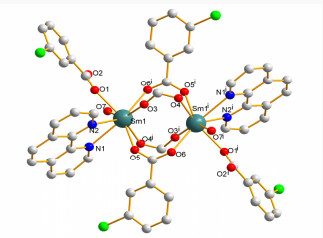
Figure 1.
Coordination structure of complex 1 (i: 1 – x, 1 – y, 1 – z)

Hydrothermal Synthesis, Crystal Structure and Luminescence Property of a New Binuclear Cage-like Samarium(Ⅲ) Complex Sm2(C7H4ClCOO)6(C12H8N2)2(H2O)2
Wei LI , Gang PENG , Hua LAI , Geng HUANG , Chang-Hong LI


In recent years, lots of people devote themselves to explore and synthesize 3d-4f heteronuclear coordination polymers, because this kind of polymer has not only various crystal structures but also potential applications in the fields of adsorption, catalysis, magnetism, etc., especially in the field of luminescence[1-3]. Lanthanide coordination complexes have gained much interest due to their broad applications in light emitting diodes, fluorescent probes, sensors, bioimaging utilities, time-resolved luminescent immunoassays, and anion sensing[4-6]. In particular, the photoluminescent properties of lanthanide complexes are notable due to their unique properties such as sharp emission bands, long emission lifetime and large stokes shift[7-9]. On the other hand, the assembly of lanthanide(Ⅲ) complexes has attracted much attention because of their interesting luminescent and magnetic properties[10-12]. In order to obtain strongly luminescent lanthanide complexes, the selection and design of organic ligands are very important, and it should be able to efficiently absorb and transfer energy to the central metal ion and encapsulate and protect the lanthanide ion from the coordination of solvent molecules[13, 14]. In this study, we have presented the synthesis, crystal structure and photoluminescent properties of a binuclear cage-like Sm(Ⅲ) complex Sm2(C7H4ClCOO)6(C12H8N2)2(H2O)2 with m-chlorobenzoic acid and 1, 10-phenanthroline (phen). The TG analysis and fluorescent properties of 1 were also reported.
All reagents were of analytical grade and used as obtained from commercial sources without further purification. Crystal structure determination was carried out on a Bruker SMART APEX CCD single-crystal diffractometer. Elemental analyses were performed on a Perkin-Elmer 2400 elemental analyzer. XT4 binocular microscope melting point apparatus was used to measure the melting point with thermometer unadjusted. IR spectra were recorded on a Bruker Vector22 FT-IR spectrophotometer using KBr discs. The luminescence spectra for the powdered samples were measured on a RF-5301PC spectrofluorometer with a xenon arc lamp as the light source. In the measurement of emission and excitation spectra, the pass width is 5 nm, and all the measurements were carried out in the solid state at room temperature. Thermogravimetric analyses were performed on a simultaneous SPRT-2 pyris1 thermal analyzer at a heating rate of 10 K/min.
A mixture of m-chlorobenzoic acid (46.8 mg, 0.3 mmol), phen (18.0 mg, 0.1 mmol), and Sm(NO3)3·5H2O (85.3 mg, 0.2 mmol) was dissolved in 25 mL of mixed solvent (the volume ratio of ethanol and water: 1:1). The pH value of the resultant mixture was adjusted to 6.5 by adding sodium hydroxide solution. The reaction was kept stirring at 150 ℃ for 54 h, and it was cooled to room temperature at the speed of 10 ℃/h, obtaining colourless crystals of 1 suitable for X-ray diffraction analysis in 45.36% yield. m.p.: 285~287 ℃. Anal. Calcd. (%) for C32H40Cu2N8O14: C, 48.62; H, 2.72; N, 3.44. Found (%): C, 48.47; H, 2.71; N, 3.45. Main IR (KBr, cm-1): IR (v/cm-1): 1678(vs), 1595(vs), 1484(vs), 1423(vs), 1290(m), 1234(w), 1105(w), 1072(m), 841(m), 806(w), 727(vs), 694(s), 601(s), 470(s).
A single crystal with dimensions of 0.25mm × 0.22mm × 0.20mm was put on a Bruker SMART APEX CCD diffractometer equipped with a graphite-monochromatic MoKα radiation (λ = 0.71073 Å) using a φ-ω scan mode at 153.72(10) K. A total of 12507 reflections were collected in the range of 3.25≤θ≤25.01°, of which 5496 were independent (Rint = 0.0555) and 4813 were observed (I > 2σ(I)). All data were corrected by Lp factors and empirical absorption. The crystal structure was solved directly by program SHELXS-97, and refined by program SHELXL-97[15]. The hydrogen and non-hydrogen atoms were corrected by isotropic and anisotropic temperature factors respectively through full-matrix least-squares method. The final R = 0.0754, wR = 0.1388 (w = 1/[σ2(Fo2) + (0.0261P)2 + 0.5359P], where P = (Fo2 + 2Fc2)/3), (∆/σ)max = 0.002, S = 1.149, (∆ρ) max = 0.985 and (∆ρ) min = –0.884 e·Å-3.
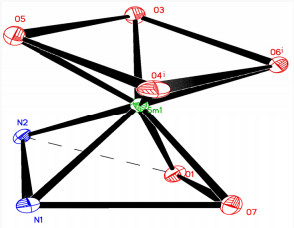
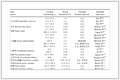
The coordination structure of 1 is revealed in Fig. 1, and square antiprism coordination geometry of the central Sm(Ⅲ) ion of 1 is shown in Fig. 2. Selected bond lengths and bond angles are listed in Table 1.
 DownLoad:
CSV
DownLoad:
CSV
| Bond | Dist. | Bond | Dist. | Bond | Dist. | ||
| Sm(1)–O(3) | 2.353(3) | Sm(1)–O(7) | 2.428(3) | Sm(1)–O(5) | 2.395(3) | ||
| Sm(1)–O(6i) | 2.417(3) | Sm(1)–O(4i) | 2.441(3) | Sm(1)–O(1) | 2.388(3) | ||
| Sm(1)–N(1) | 2.639(4) | Sm(1)–N(1) | 2.616(4) | ||||
| Angle | (°) | Angle | (°) | Angle | (°) | ||
| O(3)–Sm(1)–O(7) | 145.14(10) | O(7)–Sm(1)–O(5) | 135.94(11) | O(4i)–Sm(1)–N(1) | 76.47(12) | ||
| O(3)–Sm(1)–O(5) | 76.76(10) | O(5)–Sm(1)–O(6i) | 129.00(10) | O(1)–Sm(1)–O(7) | 71.56(11) | ||
| O(3)–Sm(1)–O(6i) | 72.81(10) | O(5)–Sm(1)–O(4i) | 72.72(10) | O(1)–Sm(1)–O(5) | 139.02(10) | ||
| O(3)–Sm(1)–O(4i) | 123.26(10) | O(5)–Sm(1)–N(2) | 71.74(10) | O(1)–Sm(1)–O(6i) | 81.10(10) | ||
| O(3)–Sm(1)–O(1) | 90.13(11) | O(5)–Sm(1)–N(1) | 74.04(11) | O(1)–Sm(1)–O(4i) | 141.90(11) | ||
| O(3)–Sm(1)–N(2) | 78.40(11) | O(6i)–Sm(1)–O(7) | 75.16(10) | O(1)–Sm(1)–N(2) | 67.61(10) | ||
| O(3)–Sm(1)–N(1) | 136.95(12) | O(6i)–Sm(1)–O(4i) | 91.21(11) | O(1)–Sm(1)–N(1) | 91.63(11) | ||
| O(7)–Sm(1)–O(4i) | 70.39(11) | O(6i)–Sm(1)–N(2) | 137.04(11) | N(1)–Sm(1)–N(2) | 62.82(13) | ||
| O(7)–Sm(1)–N(2) | 118.40(11) | O(6i)–Sm(1)–N(1) | 149.71(11) | ||||
| O(7)–Sm(1)–N(1) | 74.65(11) | O(4i)–Sm(1)–N(2) | 131.54(11) | ||||
| Symmetry code: i: 1 – x, 1 – y, 1 – z | |||||||
Sm2(C7H5ClCOO)6(C12H8N2)2(H2O)2 (1) is a binuclear cage-like structure complex in space group P
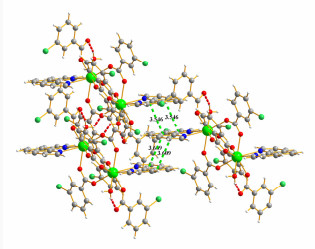
There are hydrogen bonding interactions with D···A separations in the 2.635(4)~2.774(4) Å region and the D–H–A angels vary from 132.7(1)° to 159.8(3)°. The hydrogen bonding interactions are linked by oxygen atoms between water molecules and m-chlorobenzoic acid anions (O(7)–H(7A)···O(6) and O(7)–H(7B)···O(2)), extending the mononuclear compound into a 3D supramolecular network (Fig. 3). From Fig. 3, there are lots of π-π accumulations between adjacent molecules due to a large number of aromatic rings. The results suggest that the reaction conditions have remarkable influence on the structure of the complex.
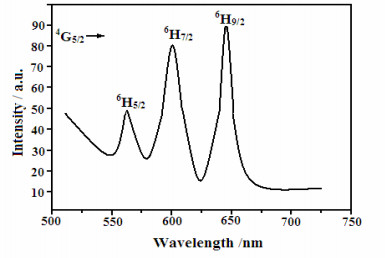
Solid-state luminescent properties of complex 1 were measured at room temperature. As can seen from Fig. 4, when excited at 356 nm, 1 presents samarium-centered luminescence with its emission peak at 561 nm (4G5/2→6H5/2), 601 nm (4G5/2→6H7/2) and 643 nm (4G5/2→6H9/2). The most intense emission peak appears at 643 nm, which is in good agreement with the previously reported Sm3+ complexes[19-21]. The intense broad band corresponds to the excitation of organic chromophore and other weaker peaks due to intra-configurational transitions from the ground state of Sm3+[13, 14].
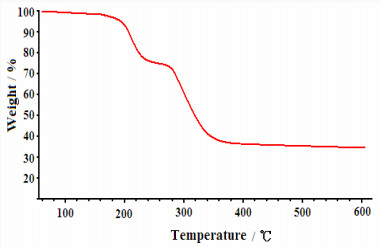
The thermogravimetric analysis (Fig. 5) of 1 demonstrated that its weight loss in air occurs mainly in 3 stages from room temperature to 600 ℃. The first one occurs from 110 to 140 ℃ with the weight loss of 2.20%, corresponding to the release of two free water molecules (calcd.: 2.21%). The second one is observed from 140 to 260 ℃ with the weight loss of 22.20% resulting from the release of two phen molecules (calcd.: 22.10%). The third stage takes place at 260 to 390 ℃ with the weight loss of 40.73% due to the departure of six m-chlorobenzoic acid anions (calcd.: 40.81%). In air, the final product is samarium oxide with the final residual rate to be about 34.87% (calcd.: 34.88%).
Veauthler, J. M.; Schelter, E. J.; Carlson, C. N.; Scott, B. L.; Re, R. E.; Thopson, J. D.; Klpllnger, J. L.; Morrls, D. E.; John, K. D. Direct comparison of the magnetic and electronic properties of samarocene and ytterbocene terpyridine complexes. Inorg. Chem. 2008, 47, 5841–5849. doi: 10.1021/ic8001465
Melo, L. L. L. S.; Castro, G. P.; Goncalves, S. M. C. Substantial intensification of the quantum yield of samarium(Ⅲ) complexes by mixing ligands: microwave-assisted synthesis and luminescence properties. Inorg. Chem. 2019, 58, 3265–3270. doi: 10.1021/acs.inorgchem.8b03340
Zhang, H. Y.; Zhang, J. J.; Ren, N.; Xu, S. L.; Tian, L.; Bai, J. H. Synthesis, crystal structure and thermal decomposition mechanism of complex [Sm(p-BrBA)3bipy·H2O]2·H2O. J. Alloys Compd. 2008, 464, 277–281. doi: 10.1016/j.jallcom.2007.09.091
Abu-Yamin, A. A.; Aldamen, M. A.; Sinnokrot, M. O.; Juwhari, H. K.; Salman, M.; Sarairah, I.; Ai-Hawarin, J.; Mubarak, M. S. Synthesis characterization, crystal structure, and fluorescence of a new samarium Schiff base complex. J. Struct. Chem. 2018, 59, 1935–1943. doi: 10.1134/S0022476618080243
Wang, Y. J.; Wu, X. M.; Xiong, C. H. Sorption behavior and mechanism of samarium(Ⅲ) on amino ethylene phosphonic acid resin. Chin. J. React. Polym. 2001, 10, 173–178.
Knope, K. E.; Lill, D. T.; Rowland, C. E.; Cantos, P. M.; Bettencourt-Dias, A.; Cahill C. L. Uranyl sensitization of samarium(Ⅲ) luminescence in a two-dimensional coordination polymer. Inorg. Chem. 2012, 51, 201–206. doi: 10.1021/ic201450e
Yan, X. W.; Wang, Y. Y.; Gao, M.; Ma, D. W.; Huang, Z. B. Magnetic and electronic properties of samarium-doped phenanthrene from first-principles study. J. Phys. Chem. C 2016, 120, 22565–22570. doi: 10.1021/acs.jpcc.6b08373
(a) Zhao, P.; Zhu, Q. H.; Fettinger, J. C.; Power, P. Characterization of a monomeric, homoleptic, solvent free samarium bis(aryloxide). Inorg. Chem. 2018, 57, 14044–14046. (b) Liu, Y. Z.; Gao, H. Y.; Yi, X. G.; Li, D. P.; Li, Y. X. Crystal structures and DNA binding properties of 2-naphthoxyacetic acid Cu(Ⅱ) complexes. Chin. J. Struct. Chem. 2019, 38, 1362–16369.
Bae, S. E.; Jung, T. S.; Cho, Y. H.; Kin, J. Y.; Kwak, K.; Park, T. H. Electrochemical formation of divalent samarium cation and its characteristics in LiCl–KCl melt. Inorg. Chem. 2018, 57, 8299–8306. doi: 10.1021/acs.inorgchem.8b00909
Yao, S.; Chan, H. S.; Lam, C. K.; Lee, H. K. Synthesis, structure, and reaction chemistry of samarium(Ⅱ), europium(Ⅱ), and ytterbium(Ⅱ) complexes of the unsymmetrical benzamidinate ligand [PhC(NSiMe3)(NC6H3Pr2i-2, 6)]−. Inorg. Chem. 2009, 48, 9936–9946. doi: 10.1021/ic901327m
Kefalidis, C. E.; Essafi, S.; Perrin, L.; Maron, L. Qualitative estimation of the single-electron transfer step energetics mediated by samarium(Ⅱ) complexes: a "SOMO-LUMO gap" approach. Inorg. Chem. 2014, 53, 3427–3433. doi: 10.1021/ic402837n
Melo, L. L. L. S.; Gerson, P.; Castro, Jr. G. P.; Goncalves, S. M. C. Substantial intensification of the quantum yield of samarium(Ⅲ) complexes by mixing ligands: microwave assisted synthesis and luminescence properties. Inorg. Chem. 2019, 58, 3265–3270. doi: 10.1021/acs.inorgchem.8b03340
Bhattacharjee, C. R.; Das, G.; Goswami, P.; Mondal, P.; Prasad, K.; Rao, D. S. S. Norel photoluminescent lanthaidomesogens forming bilayer smectic phase derived from blue light emitting liquid crystalline, one ring o-donor Schiff-base ligands. Polyhedron 2011, 30, 1040–1047. doi: 10.1016/j.poly.2011.01.015
Wu, A. Q.; Zheng, F. K.; Liu, X.; Guo, G. C.; Cai, L. Z.; Dong, Z. C.; Takano, Y.; Huang, J. S. A novel bi-layered samarium complex with an unprecedented coordination mode of orotic acid [Sm2(HL)2(OX)(H2O)2]n·2.5nH2O (H3L = orotic acid, ox2- = oxalate2-): synthesis, crystal structure and physical properties. Inorg. Chem. Commun. 2006, 9, 347–350. doi: 10.1016/j.inoche.2005.12.014
(a) Sheldrick, G. M. Program for Bruker Area Detector Absorption Correction. University of Gottingen: Gottingen, Germany 2015. (b) Sheldrick, G. M. SHELXS-97, Program for Crystal Structure Solution. University of Gottingen: Gottingen, Germany 2015.
Gangu, K. K.; Dadhich, A. S.; Mukkamala, S. B. Hydrothermal synthesis, crystal structure and luminescence property of a three dimensional Sm(Ⅲ) coordination polymer with 2, 5-pyridinedicarboxylic acid. J. Chem. Sci. 2015, 127, 2225–2230. doi: 10.1007/s12039-015-0985-9
Tahatabaee, M.; Mohammadinasab, R.; Aghaie, M. A three dimensional samarium(Ⅲ) coordination polymer with benzen-1, 2, 4, 5-tetracaroxylic acid, synthesis characterization and thermal decomposition to Sm2O3 nanoparticles. Polyhedron 2016, 26, 127–133.
Ay, B.; Dubey, N.; Yildiz, E.; Kani, I. A novel three dimensional samarium(Ⅲ) coordination polymer with an unprecedented coordination mode of the 2, 5-pyridinedicaboxylic acid ligand: hydrothermal synthesis, crystal structure and luminescence property. Polyhedron 2015, 88, 176–181. doi: 10.1016/j.poly.2014.12.035
(a) Zhang, Q. F.; Lei, M. Y.; Yuan, H.; Wang, J. Y.; Shi, Y. A water-stable 3D luminescent metal-organic framework based on heterometallic [Eu6ⅢZnⅡ] clusters showing highly sensitive selective and reversible detection of ronidazole. Inorg. Chem. 2017, 56, 7610–7614. (b) Yerrasani, R.; Karunakar, M.; Dubey, R.; Singh, A. K.; Nandi, R.; Singh, R. K.; Rao, T. R. Synthesis characterization and photophysical studies of rare earth metal complexes with a mesogenic Schiff-base. J. Mole. Liquids 2016, 215, 510–515.
(a) Wei, Q; Zheng, Z.; Feng, H. X.; Hong, X. J.; Huang, X.; Peng, H. J.; Cai, Y. P. Two samariu(Ⅲ) complexes with tunable fluorescence from in situreactions of 2-ethoxy-6-((pyridin-2-ylmethylimino)methyl)phenol with Sm3+ ion. RSC Adv. 2016, 97, 94689–94691. (b) Li, D. P.; Liu, Q.; Lian, Q. Y.; Jiao, X. Y.; Li, Y. X. Synthesis, crystal structure and luminescent property of an Eu3+ complex. Chin. J. Struct. Chem. 2014, 33, 1539–1544.
(a) Zhang, H.; Li, H. F.; Chen, P.; Yan, P. F. Syntheses, structures and photoluminescence properties of a series of 3D Zn-Ln heterometallic complexes with 2, 3-prazine dicarboxylic acid as a bridging ligand. Inorg. Chem. 2018, 644, 346–352. (b) Yuan, S.; Zhang, Y. J.; Hou, J. Y.; Liu, Q. L.; Li, D. P.; Li, Y. X. Syntheses, crystal structures and luminescent properties of two schiff base complexes. Chin. J. Struct. Chem. 2016, 35, 965–972.
Table 1. Selected Bond Lengths (Å) and Bond Angles (°) of Complex 1
| Bond | Dist. | Bond | Dist. | Bond | Dist. | ||
| Sm(1)–O(3) | 2.353(3) | Sm(1)–O(7) | 2.428(3) | Sm(1)–O(5) | 2.395(3) | ||
| Sm(1)–O(6i) | 2.417(3) | Sm(1)–O(4i) | 2.441(3) | Sm(1)–O(1) | 2.388(3) | ||
| Sm(1)–N(1) | 2.639(4) | Sm(1)–N(1) | 2.616(4) | ||||
| Angle | (°) | Angle | (°) | Angle | (°) | ||
| O(3)–Sm(1)–O(7) | 145.14(10) | O(7)–Sm(1)–O(5) | 135.94(11) | O(4i)–Sm(1)–N(1) | 76.47(12) | ||
| O(3)–Sm(1)–O(5) | 76.76(10) | O(5)–Sm(1)–O(6i) | 129.00(10) | O(1)–Sm(1)–O(7) | 71.56(11) | ||
| O(3)–Sm(1)–O(6i) | 72.81(10) | O(5)–Sm(1)–O(4i) | 72.72(10) | O(1)–Sm(1)–O(5) | 139.02(10) | ||
| O(3)–Sm(1)–O(4i) | 123.26(10) | O(5)–Sm(1)–N(2) | 71.74(10) | O(1)–Sm(1)–O(6i) | 81.10(10) | ||
| O(3)–Sm(1)–O(1) | 90.13(11) | O(5)–Sm(1)–N(1) | 74.04(11) | O(1)–Sm(1)–O(4i) | 141.90(11) | ||
| O(3)–Sm(1)–N(2) | 78.40(11) | O(6i)–Sm(1)–O(7) | 75.16(10) | O(1)–Sm(1)–N(2) | 67.61(10) | ||
| O(3)–Sm(1)–N(1) | 136.95(12) | O(6i)–Sm(1)–O(4i) | 91.21(11) | O(1)–Sm(1)–N(1) | 91.63(11) | ||
| O(7)–Sm(1)–O(4i) | 70.39(11) | O(6i)–Sm(1)–N(2) | 137.04(11) | N(1)–Sm(1)–N(2) | 62.82(13) | ||
| O(7)–Sm(1)–N(2) | 118.40(11) | O(6i)–Sm(1)–N(1) | 149.71(11) | ||||
| O(7)–Sm(1)–N(1) | 74.65(11) | O(4i)–Sm(1)–N(2) | 131.54(11) | ||||
| Symmetry code: i: 1 – x, 1 – y, 1 – z | |||||||
 下载: 导出CSV

 扫一扫看文章


扫一扫关注我们


