

Figure 1.
Infrared spectrum of TPB


Lithium-ion batteries (LIBs) have occupied dominant markets of portable electronics and electric vehicles due to their high energy density, high efficiency, and long cycle life[1]. To date, the available LIB anode materials mainly include carbon materials[2] (such as hard carbon, graphite) and alloy compounds[3] (Si-based and Sn-based alloys). The graphite materials provide a limited theoretical capacity of 372 mAh/g, while the alloy-type compounds exhibit high theoretical specific capacities (3579 mAh/g for Si) but suffer from severe volume expansion (Si: ~300%, Sn: ~259%) and consequently rapid capacity decay as well as inferior cycle life. Therefore, it is still a big challenge to explore low-cost electrode materials with a high capacity and high structural stability.
Organic electrode materials, in comparison to traditional inorganic materials, show unique advantages such as sustainability, structure stability, high species richness, wider voltage window and higher specific capacity, and are emerging as promising alternatives for LIBs[4, 5]. Moreover, organic materials can be precisely designed and synthesized at the molecular level, providing opportunities to introduce multiple redox centers for elevating Li-ion storage capacity and simultaneously maintaining structural stability[6, 7]. Despite the abovementioned merits, the practical applications of organic materials are limited due to the inferior conductivity of the organic skeleton[8]. Heteroatom doping represents one of the most effective strategies to improve their electronic conductivity and electrochemistry performance[9, 10]. In particular, N-doping not only provides additional active sites for storing Li-ions but also optimizes the electronic structure of these organic frameworks for the achievement of good rate capability. In this context, pteridine[11], Schiff bases[12], and indigo carmine[13] have been recently investigated and show promising prospects in LIBs.
Herein, we report a perimidin derivative, 1, 3, 5-tri(1H-perimidin-2-yl)-benzene (TPB), as a new anode for lithium-ion batteries. The multiple redox centers of the π-conjugated benzene ring, C=N, and -NH groups in TPB structure enable six-electron redox reactions, that is, each TPB molecule is capable of storing six Li-ions and delivering a high reversible specific capacity of 300 mAh/g at 50 mA/g. The TPB anode also achieves excellent rate capability and long-term cyclability with 98.1% capacity retention over 1500 cycles at 1000 mA/g. The results highlight perimidin derivatives as promising new anode materials for low-cost and long-lifespan lithium-ion batteries.
1, 3, 5-Tri(1H-perimidin-2-yl)-benzene (TPB) was purchased from Shanghai Kaiyulin Pharmaceutical Company and used with no further purification. The infrared spectrum of TPB was recorded on a NICOLET 6700 FT-IR spectrometer with KBr pellets in the range of 4000~400 cm-1. To prepare the working electrode, active material (70 wt%), acetylene black (20 wt%), and sodium carboxymethylcellulose (CMC) binder (10 wt%) were added into deionized water to form homogenous mixture. This mixture was coated on Cu foil and dried at 80 ℃ under vacuum for 12 hours. CR2032 coin cells were assembled in the argon-filled glove box (H2O < 0.1 ppm, O2 < 0.1 ppm) using 1 M LiPF6 in ethylene carbonate (EC)/dimethyl carbonate (DMC) (1:1, by volume) with 10 vol% vinyl fluorocarbonate (FEC) as electrolyte. Celgard porous membrane and lithium foil were used as the separator and anode, respectively. Cyclic voltammetry (CV) was tested on an electrochemical workstation (Bio-Logic, SP-300) from 0.01 to 3.2 V at a scan rate of 0.1 mV/s. The cycling tests were performed at different current densities in a voltage window of 0.01 to 2.5 V on battery testing systems (LANHE, CT2001A). The specific capacity was calculated based on the mass of TPB.
Fig. 1 shows the FT-IR spectrum of the TPB sample. The strong transmission peaks at 1121 and 822 cm-1 can be attributed to the C–H bending vibration in and out of the benzene plane, respectively[14]. The peak at 618 cm-1 can be assigned to the vibration of benzene bone, whereas those at 1610, 1573 and 1458 cm-1 correspond to the C=N, C=C and C–N stretching modes[15]. The N–H stretching at 3429 and 3528 cm-1 is also observed[16]. All the IR features in Fig. 1 confirm the C=N, -NH and C=C groups in the TPB structure.
The electrochemical performance of TPB as an anode in LIBs was explored through a group of electrochemical characterizations. Fig. 2a shows the cyclic voltammetry (CV) curves of TPB electrode at a scan rate of 0.1 mV/s. There are two paired reduction/oxidation peaks. Among them, the reduction peak at 1.71 V can be attributed to the electrochemical reactions between the Li-ions and C=N groups[15, 17], while the peak at 0.82 V corresponds to the lithiation reaction on -NH-groups and the formation of solid electrolyte interphase (SEI) on the electrode surface[18]. On the reverse scan, the two oxidation peaks correspond to the extraction of Li-ions from the TPB structure and suggest a reversible two-step lithiation/delithiation reaction.

The voltage profile of the TPB anode in the first cycle is shown in Fig. 2b. At a current density of 50 mA/g, the initial lithiation/delithiation capacities of 1043/329.9 mAh/g were achieved, which corresponds to a first-cycle Coulombic efficiency (CE) of 31.61%. This low Coulombic efficiency can be mainly attributed to the irreversible formation of the solid electrolyte interphase (SEI)[19]. The reversible delithiation capacity is comparable to that of the commercial graphite anode[2] and is about twice that of Li4Ti5O12 anode[20]. Upon an activation cycle, the greatly enhanced reversibility of Li-ion storage reactions is observed with lithiation/delithiation capacity of 303.5/335.2 mAh/g at the second cycle (Fig. 2c). Even on deep lithiation/delithiation cycling (50 mA/g, ~0.18 C-rate, 1 C = 277 mA/g), the TPB anode exhibits excellent electrochemical cyclability with a capacity retention of as high as 91.1% after 50 cycles and Coulombic efficiencies approaching 100%. What's more, ultralong lifespan is achieved at both a moderate (200 mA/g, ~0.72 C-rate) and a high current density (1000 mA/g, ~3.6 C-rate). As shown in Fig. 3a and 3b, TPB delivers a reversible capacity of 236 mAh/g after 980 cycles at 200 mA/g and 103 mAh/g after 1500 cycles at 1000 mA/g, respectively, corresponding to extremely high capacity retention of 94.4% and 98.1%. This excellent electrochemical cyclability is superior to most of the reported inorganic anode materials if not all, and is among the highest reported for organic electrode materials[10, 11, 15, 16, 21, 22]. It is noted that, at relatively high current densities, the capacity gradually increases during the initial hundreds of cycles and subsequently reaches a maximum value (250 mAh/g after 469 cycles at 200 mA/g, and 105 mAh/g after 648 cycles for 1000 mA/g). This phenomenon has also been observed on other organic electrode materials in the previous reports and could be assigned to an activation process to fully access the multiple redox centers[15, 16]. The achieved ultralong cycle-life undoubtedly demonstrates the high reversibility of the electrochemical reactions between Li-ions and TPB as well as the structural robustness of the TPB structure no matter under deep or fast lithiation/delithiation.
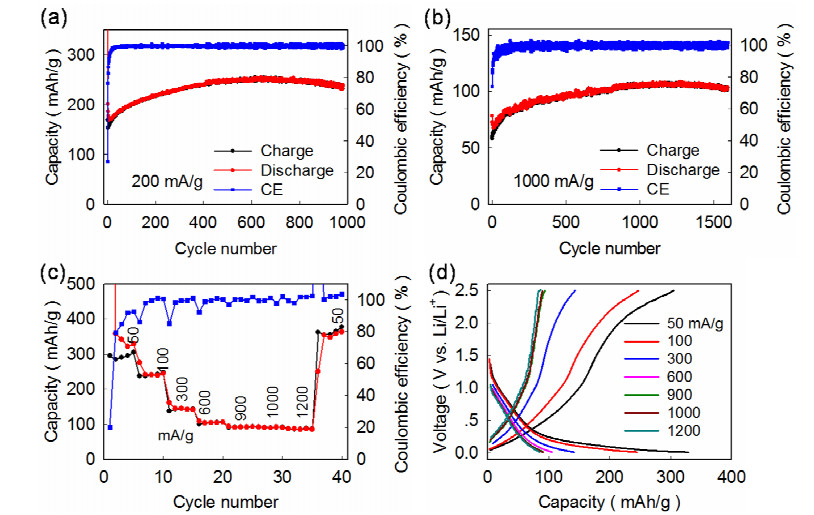
Apart from the electrochemical cyclability, the TPB anode also exhibits excellent rate capability. As shown in Fig. 3c and 3d, TPB is capable of delivering reversible capacities of 329.4, 245.2, 141.3, 105.6, 92.3 and 84.9 mAh/g at 50, 100, 300, 600, 900, 1000 and 1200 mA/g, respectively. It is equally important that the reversible capacity recovers to 354.1 mAh/g when switching the current density back to 50 mA/g, which again demonstrates the high reversibility of Li-ion storage and excellent structural stability of the TPB structure.
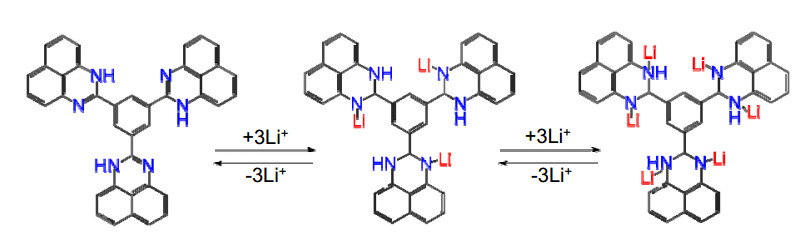
The Li-ion (de)insertion into organics typically follows three types of mechanisms depending on the structure catalogs (n-type, p-type or bipolar organics). For n-type organics, the Li-ion (de)insertion operates based on the reversible conversion of the neutral state (N) and negatively charged state (N-). In contrast, for p-type organics, the Li-ion storage relies on the transformation between its neutral state (N) and positively charged state (P+). While for bipolar organics, the neutral state (N) can be either reduced to a negative charge state (N-) or oxidized to a positive charge state (P+)[4, 5]. In this work, the TPB structure delivers a reversible capacity of 300 mAh/g which corresponds to about six Li-ion insertions per formula unit. Since n-type C=N and -NH- groups with electron-withdrawing N atom are easier to access metal ions and allow preferred Li-ion insertion compared to p-type C=C groups[15, 16, 23], it is reasonable to speculate that six Li-ion insertions take place at three C=N and three -NH- groups (Fig. 4). The proposed reaction mechanism is consistent with the two redox peaks in the CV curves and the observations in previous reports[15, 16, 23].
In conclusion, we for the first time demonstrate the potential of perimidin derivative 1, 3, 5-tri(1H-perimidin-2-yl)-benzene (TPB) as a new anode for LIBs. The multiple redox centers (π-conjugated benzene ring, C=N, and -NH groups) in the TPB structure enable a six-electron Li-ion insertion reaction and a high Li-ion storage capacity of 300 mAh/g at 50 mA/g. In addition, thanks to the unique Li-ion storage mechanism and the robust organic structure, TPB anode exhibits remarkable rate capability and long-term cyclability with a capacity retention of up to 98.1% over 1500 cycles at 1000 mA/g. These excellent electrochemical performances highlight TPB structure as a promising new anode material for long cycle-life rechargeable lithium-ion batteries and will trigger further comprehensive investigations into perimidin derivative electrodes with multiple redox centers and high structural stability.
Armand, M.; Tarascon, J. M. Building better batteries. Nature 2008, 451, 652–657. doi: 10.1038/451652a
Roselin, L. S.; Juang, R. S.; Hsieh, C. T.; Sagadevan, S.; Umar, A.; Selvin, R.; Hegazy, H. H. Recent advances and perspectives of carbon-based nanostructures as anode materials for Li-ion batteries. Materials (Basel, Switzerland) 2019, 12, 1229–1274. doi: 10.3390/ma12081229
Liu, D. Q.; Liu, Z. J.; Li, X. W.; Xie, W. H.; Wang, Q.; Liu, Q. M.; Fu, Y. J.; He, D. Y. Group IVA element (Si, Ge, Sn)-based alloying/dealloying anodes as negative electrodes for full-cell lithium-ion batteries. Small 2017, 13, 1702000. doi: 10.1002/smll.201702000
Song, Z. P.; Zhou, H. S. Towards sustainable and versatile energy storage devices: an overview of organic electrode materials. Energy Environ. Sci. 2013, 6, 2280–2301. doi: 10.1039/c3ee40709h
Lu, Y.; Zhang, Q.; Li, L.; Niu, Z. Q.; Chen, J. Design strategies toward enhancing the performance of organic electrode materials in metal-ion batteries. Chem. 2018, 4, 2786–2813. doi: 10.1016/j.chempr.2018.09.005
Xie, J.; Zhang, Q. C. Recent progress in rechargeable lithium batteries with organic materials as promising electrodes. J. Mater. Chem. A 2016, 4, 7091–7106. doi: 10.1039/C6TA01069E
Peng, C. X.; Ning, G. H.; Su, J.; Zhong, G. M.; Tang, W.; Tian, B. B.; Su, C. L.; Yu, D. Y.; Zu, L. H.; Yang, J. H. Reversible multi-electron redox chemistry of π-conjugated N-containing heteroaromatic molecule-based organic cathodes. Nat. Energy 2017, 2, 17074. doi: 10.1038/nenergy.2017.74
Liang, Y. L.; Zhang, P.; Yang, S. Q.; Tao, Z. L.; Chen, J. Fused heteroaromatic organic compounds for high-power electrodes of rechargeable lithium batteries. Adv. Energy Mater. 2013, 3, 600–605. doi: 10.1002/aenm.201200947
Shen, J. R.; Hu, W. T.; Li, Y. M.; Li, L. Q.; Lv, X. J.; Zhang, L. Fabrication of free-standing N-doped carbon/TiO2 hierarchical nanofiber films and their application in lithium and sodium storages. J. Alloys Compd. 2017, 701, 372–379. doi: 10.1016/j.jallcom.2017.01.100
Zhao, F. Y.; Zhao, X.; Peng, B.; Gan, F.; Yao, M. Y.; Tan, W. J.; Dong, J.; Zhang, Q. H. Polyimide-derived carbon nanofiber membranes as anodes for high-performance flexible lithium ion batteries. Chin. Chem. Lett. 2018, 29, 1692–1697. doi: 10.1016/j.cclet.2017.12.015
Hong, J.; Lee, M.; Lee, B.; Seo, D. H.; Park, C. B.; Kang, K. Biologically inspired pteridine redox centres for rechargeable batteries. Nat. Commun. 2014, 5, 5335. doi: 10.1038/ncomms6335
Elizabeth, C. M.; Javier, C. G.; Michel, A. Polymeric Schiff bases as low-voltage redox centers for sodium-ion batteries. Angew. Chem. Int. Ed. 2014, 126, 5445–5449. doi: 10.1002/ange.201402402
Deunf, E.; Poizot, P.; Lestriez, B. Aqueous processing and formulation of indigo carmine positive electrode for lithium organic battery. J. Electrochem. Soc. 2019, 166, A747–A753. doi: 10.1149/2.0941904jes
Zhou, M.; Li, W.; Gu, T. T.; Wang, K. L.; Cheng, S. C.; Jiang, K. A sulfonated polyaniline with high density and high rate Na-storage performances as a flexible organic cathode for sodium ion batteries. Chem. Commun. 2015, 51, 14354–14356. doi: 10.1039/C5CC05654C
Lei, Z. D.; Yang, Q. S.; Xu, Y.; Guo, S. Y.; Sun, W. W.; Liu, H.; Lv, L. P.; Zhang, Y.; Wang, Y. Boosting lithium storage in covalent organic framework via activation of 14-electron redox chemistry. Nat. Commun. 2018, 9, 576. doi: 10.1038/s41467-018-02889-7
Lei, Z. D.; Chen, X. D.; Sun, W. W.; Zhang, Y.; Wang, Y. Exfoliated triazine-based covalent organic nanosheets with multielectron redox for high-performance lithium organic batteries. Adv. Energy Mater. 2019, 9, 1801010–1801023. doi: 10.1002/aenm.201801010
Bai, L. Y.; Qiang, G.; Zhao, Y. L. Two fully conjugated covalent organic frameworks as anode materials for lithium ion batteries. J. Mater. Chem. A 2016, 4, 14106–14110. doi: 10.1039/C6TA06449C
Yang, H.; Zhang, S. L.; Han, L. H.; Zhang, Z.; Xue, Z.; Gao, J.; Li, Y. J.; Huang, C. S.; Yi, Y. P.; Liu, H. B; Li, Y. L. High conductive two-dimensional covalent organic framework for lithium storage with large capacity. ACS Appl. Mater. Interfaces 2016, 8, 5366–5375. doi: 10.1021/acsami.5b12370
An, S. J.; Li, J. L.; Daniel, C.; Mohanty, D.; Nagpure, S.; Wood, D. L. The state of understanding of the lithium-ion battery graphite solid electrolyte interphase (SEI) and its relationship to formation cycling. Carbon 2016, 105, 52–76. doi: 10.1016/j.carbon.2016.04.008
Zhao, B.; Ran, R.; Liu, M. L.; Shao, Z. P. A comprehensive review of Li4Ti5O12-based electrodes for lithium-ion batteries: the latest advancements and future perspectives. Mat. Sci. & Eng. R 2015, 98, 1–71.
Luo, Z. Q.; Liu, L. J.; Ning, J. X.; Lei, K. X.; Lu, Y.; Li, F. J.; Chen, J. A microporous covalent-organic framework with abundant accessible carbonyl groups for lithium-ion batteries. Angew. Chem. Int. Edit. 2018, 57, 9443–9446. doi: 10.1002/anie.201805540
Wu, J. S.; Rui, X. H.; Long, G. K.; Chen, W. Q.; Yan, Q. Y.; Zhang, Q. C. Pushing up lithium storage through nanostructured polyazaacene analogues as anode. Angew. Chem. 2015, 127, 7462–7466. doi: 10.1002/ange.201503072
Lee, M.; Hong, J.; Seo, D. H.; Nam, D. H.; Nam, K. T.; Kang, K.; Park, C. B. Redox cofactor from biological energy transduction as molecularly tunable energy-storage compound. Angew. Chem. Int. Edit. 2013, 52, 8322–8328. doi: 10.1002/anie.201301850

Figure 2 (a) CV curves at a scan rate of 0.1 mV/s. (b) Voltage profiles of the initial cycle and (c) Subsequent cycles at a current density of 50 mA/g. (d) Electrochemical cyclability of the TPB anode at a current density of 50 mA/g

Figure 3 Long-term cyclability of the TPB anode at a current density of (a) 200 mA/g and (b) 1000 mA/g (c) Rate capacity and (d) Corresponding voltage profiles at a current density from 50 to 1200 mA/g

 扫一扫看文章


扫一扫关注我们
 DownLoad:

 下载:
下载:
