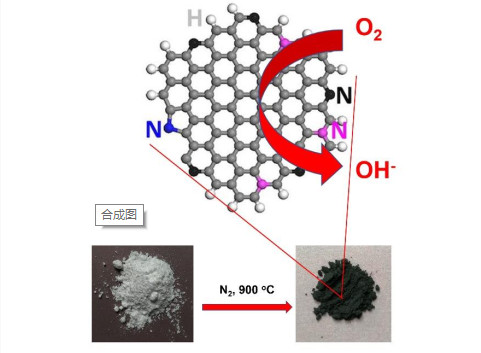
Scheme 1.
Schematic for the synthesis of NC

Nitrogen Doped Carbon as Efficient Catalyst toward Oxygen Reduction Reaction
Wei-Guang YANG , Zhi-Wei GONG , Yan-Ning CHEN , Ru-Ru CHEN , Dong-Li MENG , Min-Na CAO


The abuse of fossil fuels has led to global energy crisis and environmental pollution[1]. Therefore, it is urgent to develop efficient and environmentally friendly energy storage and conversion technologies, such as zinc-air battery and fuel cells[2-4]. Oxygen reduction reaction (ORR) is at the heart of the key renewable-energy technologies[5]. At present, platinum (Pt) based nanomaterials are still the most effective electrocatalysts in practical applications. However, Pt-based nanoparticles suffer from serious deactivation due to the agglomeration and the detachment from carbon support during the electrocatalytic ORR procedure[6]. Further, Pt-based catalysts are vulnerable to CO poison, resulting in the deactivation of catalysts[7]. Additionally, due to the scarcity and high-cost of Pt, it's still a great challenge to develop promising cost-efficient ORR electrocatalysts to substitute Pt.
In recent years, carbon-based materials are considered to be an alternative to Pt as electrocatalysts toward ORR, owing to its excellent catalytic activity, great stability, and good tolerates towards the methanol crossover effect. It is found that doping heteroatoms in carbon materials can effectively improve the catalytic performance and stability, especially nitrogen doped carbon materials. Previous studies demonstrate that the doped-nitrogen atom would change the charge distribution of carbon, therefore more favorable for chemisorption of oxygen molecule[8]. And thus, N-doped carbon can effectively weaken the O–O bonding followed by a 4-electron pathway reducing oxygen to OH- in alkaline electrolyte[9]. Generally, among various chemical states of N atoms, the pyridinicand graphitic-N contents have been considered as the most effective contribution to the ORR activity[10].
In this work, we present a nitrogen-doped carbon material derived from nitrogen-rich organic molecules glycoluril. The obtained catalyst not only exhibits efficient electrocatalytic performance under alkaline conditions, but also shows excellent long-term stability and great tolerates toward the methanol crossover effect.
Glycoluril (99.9%, AR) was purchased from Adamas Reagent, Ltd. (China). Commercial Pt/C (20 wt.% metal) was purchased from Sigma-Aldrich. All reagents were commercially available and used without future purification. The nitrogen-doped carbon (NC) was obtained by pyrolysis glycoluril under nitrogen. 0.5 g glycoluril was placed in a tube furnace, maintained at 900 ℃ for 3 hours under N2 atmosphere with a heating rate of 5 ℃·min-1, and then naturally cooled to room temperature.
X-ray powder diffraction (PXRD) patterns were conducted on a Miniflex 600 diffractometer using CuΚα radiation (λ = 0.154 nm, 5o to 70o, 2 o/min). Scanning electron microscope (SEM) images were characterized on Hitachi SU-8010 at 5 KV to study the morphology of NC. X-ray photoelectron spectroscopy (XPS, ESCALAB 250Xi spectrometer) was used to analyze the valence and chemical environment of each element in the NC material. Micromeritics Model ASAP 2460 system was used to measure the pore structure of the samples by using nitrogen sorption at 77 K. Fourier-transform infrared spectroscopy (FTIR) was conducted on a Bruker VERTEX 70 with samples prepared as KBr pellets at wavenumbers ranging from 4000 to 400 cm−1. Elemental analyses were performed on a Vario MICRO elemental analyzer.
All electrochemical tests were carried out in a standard three-electrode cell with a 1 × 1cm2 Pt mesh as the counter electrode and an Ag/AgCl electrode (in saturated KCl aqueous solution) as the reference electrode. The electrochemical experiments were performed on an IM6ex (Zahner, Germany). All potentials were calculated with respect to reversible hydrogen electrode (RHE) scale according to the Nernst equation. ORR tests were conducted in an O2-saturated 0.1 M KOH electrolyte on a rotating-disk electrode system, in which the rotational speed varied from 400 to 2205 rpm at a scan rate of 10 mV/s and corrected by iR drop compensation. Before each measurement, cyclic voltammetry (CV, 100 mV/s, 0~1200 mV) in N2-atmosphere was applied to the electrodes for surface cleaning and for obtaining a reproducible active electrochemical surface. Before the linear sweep curves (LSV) test, the electrolyte was purified with oxygen flow for 30 min. The oxygen flow was kept throughout the whole measurement process. The working electrode was fabricated by casting the catalyst ink onto a 5 mm diameter glassy carbon electrode. To prepare the catalyst ink, typically, 10 mg of catalyst and 80 μL 5 wt.% Nafion solution were dispersed in 1 mL of the mixed solvents of water/isopropanol with the volume ratio of 1:1 and ultrasonic for 3 h. Then, 10 μL of the catalyst ink was coated on the surface of a rotating disk electrode (RDE) with a glassy carbon (GC) disk of 5 mm in diameter and dried at room temperature. The methanol crossover effect was carried by current-time (i-t) chronoamperometric tests. The test was performed at 0.2 V and 350 seconds, and 2 mL methanol was injected into 48 mL electrolyte.
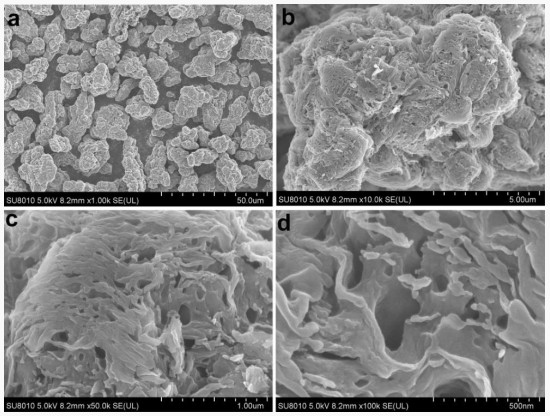
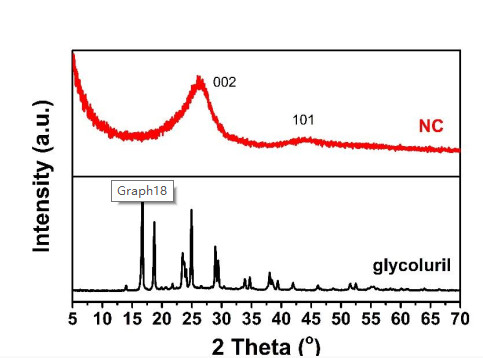
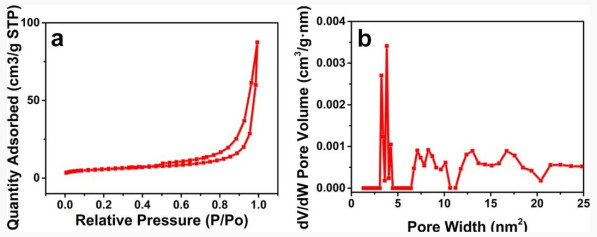
The morphology of NC material was revealed by scanning electron microscope (SEM). As shown in Fig. 1a, the obtained NC has a porous structure with a size of ca. 10 μm. Fig. 1b~d have clearly demonstrated that the obtained NC has a pretty rough surface with many folds, implying a relatively larger specific surface area. As shown in Fig. 2, two broad peaks were observed in the PXRD pattern of the obtained NC, located at 26o and 43o, which belong to the (002) and (101) planes of graphitic carbon, respectively[11]. To further study the porous structure, nitrogen adsorp-tion-desorption measurement was conducted. As shown in Fig. 3a, the obtained NC shows type-IV isotherms with a hysteresis loop located at higher relative pressure, indicating the coexistence of mesopores or micropores structure[12]. As shown in Fig. 3b, the pore size of NC is mainly distributed between 2~5 nm (pore size distributions analyzed by nonlinear density functional theory (NLDFT)).
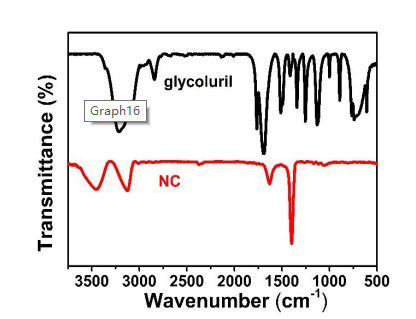
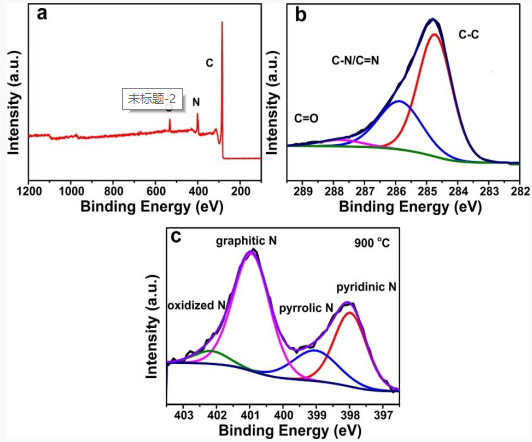
Fourier-transform infrared spectroscopy (FTIR) is a conventional method to assess the surface functional groups of nanomaterials. As shown in Fig. 4, the peaks at 3462 and 1622 cm-1 can be attributed to stretching and bending vibrations of water molecules[13]. The peaks located at 1400 and 1076 cm-1 belong to the C–N bending mode, and there is also contribution of various pyridine/pyrrolyl structures[14]. X-ray photoelectron spectroscopy (XPS) was carried out to invest the valence and chemical environment. The XPS survey spectrum of NC material indicates the presence of C, N and O without any other elements (Fig. 5a). The C 1s high-resolution XPS (HR-XPS) peak can be divided into three peaks. The fitting peaks are located at 284.7, 285.9, and 287.8 eV, which can be attributed to C–C, C–N/C=N and C=O, respectively (Fig. 5b)[15]. As shown in Fig. 5c, the N 1s HR-XPS peak can be deconvoluted into four distinct peaks at 398.0, 399.1, 401.0 and 402.2 eV. The major peak at 401.0 eV is related to the graphitic-N, which has been considered as the key factor to determine the limiting current density for ORR. The second large peak at 398.0 eV is assigned to pyridinic-N, which contributes to the improvement of onset potential for ORR. The contents of graphitic-N and pyridinic-N are shown in Table 1. Two small peaks located at 399.1 and 402.2 eV are assigned to pyrrolic-N and oxidized N, respectively[16, 17].

 DownLoad:
CSV
DownLoad:
CSV
| Sample | N (wt.%) | Pyridinic-N (wt.%) | Pyrrolic-N (wt.%) | Graphitic-N (wt.%) | Oxidized-N (wt.%) |
| NC | 13.9 | 3.5 | 2.4 | 6.7 | 1.2 |
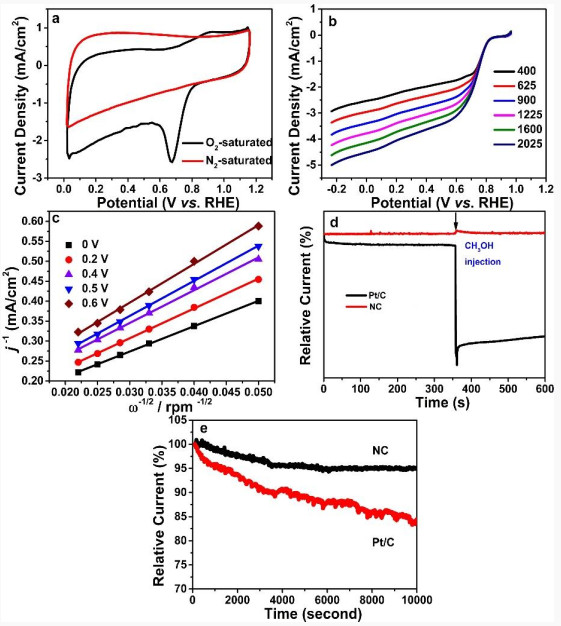
The electrocatalytic oxygen reduction reaction (ORR) activity of the obtained NC was investigated by a three-electrode system in 0.1 M KOH under oxygen-atmosphere. 1cm × 1cm platinum mesh worked as the counter electrode, and Ag/AgCl electrode as a reference electrode. As shown in Fig. 6a, cyclic voltammetry (CV) testing was conducted under nitrogen- and oxygen-atmosphere. There are no obvious oxidation and reduction peaks in the CV curve recorded in nitrogen-saturated electrolyte, indicating the pure capacitive current background. While in the oxygen-saturated electrolyte, a peak arising from the oxygen reduction appears at 0.68 V. Such results demonstrate that the obtained NC has efficient ORR catalytic activity. Then rotating disk electrode (RDE) was performed to measure the electrocatalytic activity. As shown in Fig. 6b, the onset potential of NC is 0.84 V. Further, we perform Koutecky-Levich equation to determine the kinetics of ORR catalyzed by NC. As shown in Fig. 6b, the ORR plots of NC catalyst recorded at the rotating rate range from 400 to 2025 rpm were obtained. As shown in Fig. 6c, the average electron-transfer number is calculated to 3.8 among the range from 0 to 0.6 V, indicating that the ORR catalyzed by NC is dominated by a four-electron transfer pathway. Four-electron transfer pathway is the most efficient and desirable. Additionally, chronoamperometry (CA) tests were conducted to evaluate the methanol crossover effects. As shown in Fig. 6d, the current density of the commercial Pt/C catalyst is significantly reduced after injecting 1M methanol into the electrolyte. However, the current density of the obtained NC has not been affected by the injected methanol, indicating a high methanol tolerance. The chronoamperometric durability tests for ORR have been performed to investigate the stability of the obtained NC. As shown in Fig. 6e, the obtained NC catalyst remained the current density of 95% after 10000 s, while the commercial Pt/C catalyst shows a near 20% decrease after 10000 s, indicating a superior stability of NC than commercial Pt/C in alkaline medium.
In conclusion, a new kind of N-doped carbon material was obtained via pyrolysis of the nitrogen-rich organic molecular glycoluril under nitrogen atmosphere. Elemental analysis and XPS analysis results indicate that the N content of the obtained NC 13.9 wt.%. Electrochemical measurement demonstrated that the obtained NC catalyst is an efficient ORR electrocatalyst in alkaline electrolyte. The electrocatalytic process for ORR is dominated by a fourelectron transfer pathway. In addition, the NC catalyst exhibits excellent stability and good resistance to methanol poisoning. After 10000 s of chronoam-perometric durability test, the relative current of NC catalyst retained as high as 95%. This work provides a new strategy for the preparation of cost-effective ORR catalysts with high catalytic performance.
Jacobson, M. Z. Review of solutions to global warming, air pollution, and energy security. Energy Environ. Sci. 2009, 2, 148–173. doi: 10.1039/B809990C
Yuan, K.; Sfaelou, S.; Qiu, M.; Lutzenkirchen-Hecht, D.; Zhuang, X. D.; Chen, Y. W.; Yuan, C.; Feng, X. L.; Scherf, U. Synergetic contribution of boron and Fe–Nx species in porous carbons toward efficient electrocatalysts for oxygen reduction reaction. ACS Energy Lett. 2017, 3, 252–260.
Chen, Y. J.; Ji, S. F.; Wang, Y. G.; Dong, J. C.; Chen, W. X.; Li, Z.; Shen, R. A.; Zheng, L. R.; Zhuang, Z. B.; Wang, D. S.; Li, Y. D. Isolated single iron atoms anchored on N-doped porous carbon as an efficient electrocatalyst for the oxygen reduction reaction. Angew. Chem. Int. Ed. 2017, 56, 6937–6941. doi: 10.1002/anie.201702473
Lee, J. S.; Cao, R.; Choi, N. S.; Liu, M.; Lee, K. T. Metal-air batteries with high energy density: Li-air versus Zn-air. Adv. Energy Mater. 2011, 1, 34–50. doi: 10.1002/aenm.201000010
Nie, Y.; Li, L.; Wei, Z. D. Recent advancements in Pt and Pt-free catalysts for oxygen reduction reaction. Chem. Soc. Rev. 2015, 44, 2168–2201. doi: 10.1039/C4CS00484A
Sheng, T.; Tian, N.; Zhou, Z. Y.; Lin, W. F.; Sun, S. G. Designing Pt-based electrocatalysts with high surface energy. ACS Energy Lett. 2017. 2. 1892–1900.
Gewirth, A. A.; Varnell, J. A.; DiAscro, A. M. Nonprecious metal catalysts for oxygen reduction in heterogeneous aqueous systems. Chem. Rev. 2018, 118, 2313–2339. doi: 10.1021/acs.chemrev.7b00335
Gong, K. P.; Du, F.; Xia, Z. H.; Durstock, M.; Dai, L. M. Nitrogen-doped carbon nanotube arrays with high electrocatalytic activity for oxygen reduction. Science 2009, 323, 760–764. doi: 10.1126/science.1168049
Wang, Y.; Li, J.; Wei, Z. D. Recent progress of carbon-based materials in oxygen reduction reaction catalysis. ChemElectroChem. 2018, 5, 1764–1774. doi: 10.1002/celc.201701335
Yasuda, S.; Yu, L.; Kim, J.; Murakoshi, K. Selective nitrogen doping in graphene for oxygen reduction reactions. Chem. Commun. 2013, 49, 9627–9629. doi: 10.1039/c3cc45641b
Mao, Y.; Duan, H.; Xu, B.; Zhang, L.; Hu, Y. S.; Zhao, C. C.; Wang, Z. X.; Chen, L. Q.; Yang, Y. S. Lithium storage in nitrogen-rich mesoporous carbon materials. Energy Environ. Sci. 2012, 5, 7950–7955. doi: 10.1039/c2ee21817h
Ma, X.; Zhao, X.; Huang, J. S.; Sun, L. T.; Li, Q.; Yang, X. R. Fine Co nanoparticles encapsulated in a N-doped porous carbon matrix with superficial N-doped porous carbon nanofibers for efficient oxygen reduction. ACS Appl. Mater. Inter. 2017, 9, 21747–21755. doi: 10.1021/acsami.7b02490
Ismagilov, Z. R.; Shalagina, A. E.; Podyacheva, O. Y.; Ischenko, A. V.; Kibis, L. S.; Boronin, A. I.; Chesalov, Y. A.; Kochubey, D. I.; Romanenko, A. I.; Anikeeva, O. B.; Buryakov, T. I.; Tkachev, E. N. Structure and electrical conductivity of nitrogen-doped carbon nanofibers. Carbon 2009, 47, 1922–1929. doi: 10.1016/j.carbon.2009.02.034
White, R. J.; Yoshizawa, N.; Antonietti, M.; Titirica, M. M. A sustainable synthesis of nitrogen-doped carbon aerogels. Green Chem. 2011, 13, 2428–2434. doi: 10.1039/c1gc15349h
Jurewicz, K.; Babeł, K.; Pietrzak, R.; Delpeux, S.; Wachowska, H. Capacitance properties of multi-walled carbon nanotubes modified by activation and ammoxidation. Carbon 2006, 44, 2368–2375. doi: 10.1016/j.carbon.2006.05.044
Zhang, L. J.; Wang, X. Y.; Wang, R. H.; Hong, M. C. Structural evolution from metal-organic framework to hybrids of nitrogen-doped porous carbon and carbon nanotubes for enhanced oxygen reduction activity. Chem. Mater. 2015, 27, 7610–7618. doi: 10.1021/acs.chemmater.5b02708
Zhong, S.; Zhan, C. X.; Cao, D. P. Zeolitic imidazolate framework-derived nitrogen-doped porous carbons as high performance supercapacitor electrode materials. Carbon 2015, 85, 51–59. doi: 10.1016/j.carbon.2014.12.064

Figure 3 (a) N2 adsorption-desorption isotherm of NC; (b) Pore size distribution (PSD) profile of NC

Figure 5 (a) XPS survey for NC; (b) C 1s XPS spectrum for NC; (c) N 1s XPS spectrum for NC

Figure 6 (a) Cyclic voltammetry plots of NC record under nitrogen or oxygen saturated in 0.1 M KOH, with the scan rate of 100 mV/s; (b) LSV plots of NC record at various rotational speeds; (c) K-L plots of NC at different potentials; (d) Methanol-crossover effects test of NC and Pt/C in an oxygen-saturated 0.1 M KOH solution; (e) Current-time (i−t) chronoamperometry test for NC and Pt/C
Table 1. Elemental Analyser and XPS Analysis Results of NC
| Sample | N (wt.%) | Pyridinic-N (wt.%) | Pyrrolic-N (wt.%) | Graphitic-N (wt.%) | Oxidized-N (wt.%) |
| NC | 13.9 | 3.5 | 2.4 | 6.7 | 1.2 |
 下载: 导出CSV

 扫一扫看文章


扫一扫关注我们


