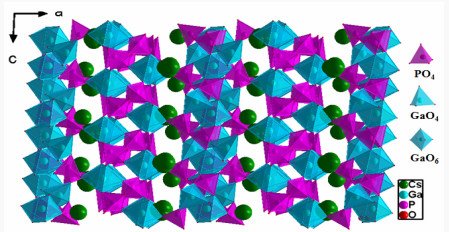
Figure 1.
View the framework structure of Cs2Ga4P8O27 along the b axis

A Mixed Metal Phosphate Containing Two Types of Phosphoric Anionic Groups: Cs2Ga4(P2O7)2(P4O13)
Wei-Long ZHANG , Zhen-Gang GUO , Da-Gui CHEN , Jian-Gang HE , Hao ZHANG , Xiao-Yan LI


Phosphates have been pursued as nonlinear optical (NLO) material for a long time owing to their che-mical benignity, blue shifting ability of optical cutoff edges, and structural diversity[1-4]. During the synthe-sis of phosphate materials with large SHG response, widely applied strategy is the involvement of NLO-active structural units, such as d0 ca-tions with second-order Jahn-Teller (SOJT) effects or stereo-active lone pair (SCALP) cations[5-7], and d10 cations centered polyhedra with large polar displacement[8- Recently, it is unanimously agreed that compounds with large alkaline and alkaline-earth metal cations are easy to form asymmetry and have short cut off edge. Meanwhile, the microscopic tetrahedral units like PO4 perceived to conducive for ensuring short UV absorption edge[11-13]. Assisted by the above ideas, during the past few years many pro-mising star NLO phosphates have been synthesized, such as single-metal phosphates Ba3P3O10X (X = Cl, Br)[14] and Ba5P6O20[15] and mixed-metal phosphates LiCs2PO4[16-17], RbBa2(PO3)5[18], CsLiCdP2O7[19], M4Mg4(P2O7)3 (M = K, Rb)[20], RbNaMgP2O7[21], and CsNaMgP2O7[22].
By introducing a transition metal with a d10 elec-tron configuration and an alkali metal with a large radius into the borate system, Pan et al. synthesized a new beryllium-free Rb3Al3B3O10F[23], which not only exhibits a large NLO response of 1.2 times that of KDP but also is transparent down to the deep-UV region (200 nm). As far as we know, few compounds have been reported in the alkali metals gallium phosphate pseudo-ternary system. In particular, there are only a few compounds in the Cs2O–Ga2O3–P2O5 system, and only CsGa2P5O16[24], Cs2GaP3O10[25, 26] and CsGa(PO3)4[27] have been reported.
Our original aim was to search for the new compound within Cs2O–Ga2O3–P2O5 system. Sur-prisingly, we obtained a new mixed metal phosphate Cs2Ga4(P2O7)2(P4O13). Though it crystallizes in a centrosymmetric space group, we are deeply attracted by its amazing structure. In this paper, we report its synthesis and crystal structure and make some meaningful comparisons.
All of the chemicals were purchased from com-mercial sources and used without further purification. NH4H2PO4 (99.5%), TeO2 (99.99%), Ga2O3 (99.99%), and Cs2CO3 (99.9%) were all purchased from the Shanghai Reagent Factory.
Single crystals of Cs2Ga4P8O27 were initially pre-pared by the reaction of a mixture of 0.60 g (5.713 mmol) NH4H2PO4, 0.20 g (1.253 mmol) TeO2, 0.20 g (1.670 mmol) Ga2O3 and 0.22 g (0.675 mmol) Cs2CO3. The powder mixture was first grounded in an agate mortar and then transferred to a corundum crucible. The sample was gradually heated in air at 573 K for 10 h, and finally heated at 1123 for 48 h. The intermediate product was slowly cooled down to 873 K at a rate of 2 K/h where it was kept for 10 h and then cooled down to room temperature at a rate of 6 K/h. Some colorless crystals of different shapes were mechanically removed from the solidified flux dealing with the hot water.
A single crystal of the title compound was selected for indexing and intensity data collection on a Rigaku Saturn70 diffractometer (2 × 2 bin mode) at 293 K. The structure was solved by direct methods and refined anisotropically by using SHELXS-97. Absorption correction by the multi-scan method was applied for the title compound[35], and its structure was solved by direct methods and then refined on F2 by full-matrix least-squares method, and performed in the Shelxl/PC program[36]. All atoms were refined with anisotropic thermal parameters. The Cs(2) atoms in the unit cell are disordered and refined to four crystallographic positions (Cs(2A), Cs(2B), Cs(2C), Cs(2D)) to eliminate the high residual peaks. The occupancy factors of these positions were allowed to be refined to have a sum occupancy factor of 1 and equal displacement parameters for each position.
The crystal and electronic structures of Cs2Ga4P8O27 were calculated by using density func-tional theory (DFT), as implemented in the Vienna Ab-initio Simulation Package (VASP). The pro-jector-augmented wave (PAW) potential[38, 39] was used to describe the electron-ion interaction. The plane-wave basis-set with a cutoff energy of 520 eV, the Monkhorst-Pack scheme k-mesh of 3×3×6, and the Perdew-Burke-Ernzerhof (PBE) version of the generalized gradient approximation (GGA) exchange-correlation functional were adopted. The crystal structure was fully relaxed until the force on each atom is less than 10 meV/Å.
Our exploration of the Cs-Ga-Te-P-O system by high temperature solid-state reaction afforded a new gallium phosphate, namely, Cs2Ga4P8O27. It features a 3D framework structure of {Ga4P8O27}2- formed by corner sharing of GaO4, GaO6, P2O7 and P4O13 groups, with the cesium cations balancing the charge (Fig. 1). It is amazing to find the coexistence of two kinds of coordination models (4 and 6) of Ga3+ cations in one single compound. Furthermore, the fundamental anionic group of Cs2Ga4P8O27 contains three non-condensed phosphoric anionic groups, two P2O7 and a P4O13, which represents the new topological type of phosphoric anionic groups within the family of phosphates.
X-ray analysis revealed that the compound Cs2Ga4P8O27 crystallizes in monoclinic system with space group P21/c. There are two cesium atoms, four gallium atoms, eight phosphorus atoms and 27 oxygen atoms in its asymmetric unit. All of the oxygen atoms belong to the phosphoric groups and are two-coordinative to form P−O−P or P−O−Ga linkages. All of the atoms represent independent crystallographic sites except the Cs(2) atoms, which are disordered and were refined to four crystallo-graphy orientations (Cs(2A), Cs(2B), Cs(2C), Cs(2D)) to eliminate the high residual peaks.
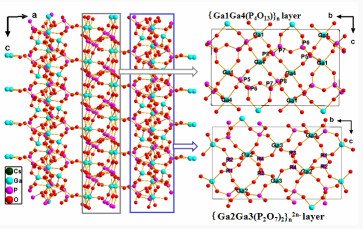
As is seen from Fig. 2, the 3D framework structure of the title compound can be regarded as further connected of the alternative layers of {Ga2(P4O13)}n and {Ga2(P2O7)2}n2n- via linkages of Ga(1)−O(5)−P(2) and Ga(4)−O(12)−P(4). The {Ga2(P4O13)}n layer parallel to the bc plane was formed by corner sharing Ga(1)O6, Ga(4)O6 and P4O13 groups, while the {Ga2(P2O7)2}n2n- layer parallel to the bc plane was formed by corner sharing Ga(2)O6, Ga(3)O4 and P2O7 groups, respectively.
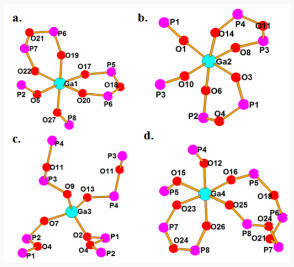
There are four independent positions of Ga atoms in the asymmetric unit with two different coor-dination models. Among them, Ga(1), Ga(2) and Ga(4) were connected by six oxygen atoms to form GaO6 distorted octahedra with the Ga–O distances ranging from 1.913(5) to 2.012(5) Å (Table 1), while Ga(3) atoms were connected by four oxygen atoms to form GaO4 distorted tetrahedra with the Ga–O distances ranging from 1.786(5) to 1.798(5) Å (Table 1). Not only GaO4 tetrahedra but also GaO6 octahedra corner share all their oxygen atoms with PO4 tetrahedra. In other words, all of the gallium atoms were separated by phosphorus atoms.
 DownLoad:
CSV
DownLoad:
CSV
| Bond | Dist. | BV | Bond | Dist. | BV | ||
| Ga(1)–O(27) | 1.932(5) | 0.579 | P(2)–O(4) | 1.616(5) | 1.003 | ||
| Ga(1)–O(17) | 1.932(5) | 0.579 | P(2)–O(5) | 1.494(5) | 1.394 | ||
| Ga(1)–O(5) | 1.943(5) | 0.562 | ∑BVS = 4.989 | ||||
| Ga(1)–O19) | 1.945(5) | 0.559 | P(3)–O(10) | 1.493(5) | 1.398 | ||
| Ga(1)–O22) | 1.972(5) | 0.520 | P(3)–O(8) | 1.516(5) | 1.314 | ||
| Ga(1)–O20) | 2.001(5) | 0.481 | P(3)–O(9) | 1.535(5) | 1.248 | ||
| ∑BVS = 3.280 | P(3)–O(11) | 1.591(5) | 1.073 | ||||
| Ga(2)–O(10) | 1.884(5) | 0.660 | ∑BVS = 5.033 | ||||
| Ga(2)–O(3)i | 1.913(5) | 0.610 | P(4)–O(12) | 1.492(5) | 1.402 | ||
| Ga(2)–O(1) | 1.918(5) | 0.602 | P(4)–O(14) | 1.507(5) | 1.346 | ||
| Ga(2)–O(8) | 1.931(5) | 0.581 | P(4)–O(13) | 1.535(5) | 1.248 | ||
| Ga(2)–O(14) | 1.995(5) | 0.489 | P(4)–O(11) | 1.596(5) | 1.058 | ||
| Ga(2)–O(6)1 | 2.012(5) | 0.467 | ∑BVS = 5.054 | ||||
| ∑BVS = 3.409 | P(5)–O(16) | 1.496(5) | 1.387 | ||||
| Ga(3)–O(2) | 1.786(5) | 0.860 | P(5)–O(15) | 1.505(5) | 1.354 | ||
| Ga(3)–O(7)ii | 1.789(5) | 0.853 | P(5)–O(17) | 1.513(5) | 1.325 | ||
| Ga(3)–O(13) | 1.797(5) | 0.834 | P(5)–O(18) | 1.627(5) | 0.973 | ||
| Ga(3)–O(9)iii | 1.798(5) | 0.832 | ∑BVS = 5.039 | ||||
| ∑BVS = 3.379 | P(6)–O(20) | 1.474(5) | 1.472 | ||||
| Ga(4)–O(12)iii | 1.909(5) | 0.616 | P(6)–O(19)1 | 1.491(5) | 1.406 | ||
| Ga(4)–O(26)iv | 1.927(5) | 0.587 | P(6)–O(18) | 1.549(5) | 1.202 | ||
| Ga(4)–O(16)v | 1.979(5) | 0.510 | P(6)–O(21) | 1.593(5) | 1.067 | ||
| Ga(4)–O(15)iv | 2.002(5) | 0.479 | ∑BVS = 5.147 | ||||
| Ga(4)–O(25) | 2.009(5) | 0.470 | P(7)–O(23) | 1.471(5) | 1.484 | ||
| Ga(4)–O(23)i | 2.012(5) | 0.467 | P(7)–O(22)i | 1.494(5) | 1.394 | ||
| ∑BVS = 3.129 | P(7)–O(24) | 1.571(5) | 1.132 | ||||
| P(1)–O(3) | 1.494(5) | 1.394 | P(7)–O(21) | 1.615(5) | 1.005 | ||
| P(1)–O(1) | 1.509(5) | 1.339 | ∑BVS = 5.015 | ||||
| P(1)–O(2) | 1.521(5) | 1.296 | P(8)–O(26) | 1.507(5) | 1.346 | ||
| P(1)–O(4) | 1.597(5) | 1.056 | P(8)–O(25) | 1.508(5) | 1.343 | ||
| ∑BVS = 5.085 | P(8)–O(27) | 1.514(4) | 1.321 | ||||
| P(2)–O(6) | 1.503(5) | 1.361 | P(8)–O(24)v | 1.615(5) | 1.005 | ||
| P(2)–O(7) | 1.540(5) | 1.231 | ∑BVS = 5.015 | ||||
| Symmetry transformations used to generate the equivalent atoms: i x, 3/2–y, 1/2+z; ii –x, 1–y, –z; iii –x, 1–y, 1–z; iv1–x, 1–y, 1–z; v 1–x, –1/2+y, 1/2–z; vi x, 3/2–y, –1/2+z; vii1–x, 1/2+y, 1/2–z |
|||||||
As shown in Fig. 3a and 3d, the (Ga(1)O6) and (Ga(4)O6) groups in the {Ga2(P4O13)}n layer use five of their oxygen atoms to corner share with three P4O13 groups, and use the last oxygen atoms to connect P(2) or P(4) atoms. The coordination models of two other gallium atoms Ga(2) and Ga(3) in the layer of {Ga2(P2O7)2}n2n- are quite different. The (Ga(2)O6) group uses all its six oxygen atoms to connect with four P2O7 groups (Fig. 3b), while the (Ga(3)O4) group is further connected to four P atoms from four different (P2O7) groups (Fig. 3c).
The bond-valence sum calculation for gallium cations within the tetra- or hexa-coordinate options of 3.379 (Ga(3)), 3.280 (Ga(1)), 3.409 (Ga(2)), and 3.129 (Ga(4)) reveals that the oxidation states of gallium cations are +3. The Ga–O bond distances, coordination models and bond-valence sums are comparable to other cesium gallium phosphates[24-27].
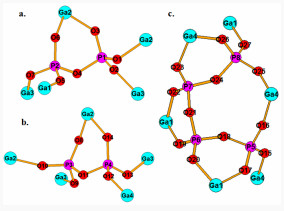
As can be seen from Fig. 4, each P atom is coor-dinated with four oxygen atoms in a tetra-coor-dinated geometry with the P–O bond distances ranging from 1.471(5) to 1.616(5) Å (Table 1). PO4 groups are further condensed via corner-sharing to form two P2O7 groups and one P4O13 tetraphosphate group. The shortest and longest P–O distances are found from the P(7)–O(23)–Ga(4) and P(1)–O(4)–P(2) linkages, respectively. These P–O bond lengths are comparable with those reported in cesium gallium phosphates[24-27]. Two non-condensed (P(1)P(2)O7) and (P(3)P(4)O7) groups are built by corner sharing of P(1)O4 and P(2)O4 tetrahedra and P(3)O4 and P(4)O4 tetrahedra, respectively (Fig. 4a and 4b). The (P4O13) group is built from four crystallographically independent PO4 groups (P(5)O4, P(6)O4, P(7)O4, and P(8)O4 groups) via corner sha-ring and features a horseshoe conformation (Fig. 4c). The bond-valence sum calculations for phosphorus within the tetra-coordinated options of 5.085 (P1), 4.989 (P(2)), 5.033 (P(3)), 5.054 (P(4)), 5.039 (P(5)), 5.147 (P(6)), 5.015 (P(7)), and 5.015 (P(8)), revealing that the oxidation states of phosphorus atoms are +5.
As shown in Fig. 1, the Cs+ cations are located in the free space between the layers of {Ga2(P4O13)}n and {Ga2(P2O7)2}n2n-. There are two unique Cs atoms in the asymmetric unit of the title compound. As mentioned above, Cs(1) atoms were refined with independent crystallographic sites and fully occupied, while Cs(2) atoms in the unit cell are disordered and were refined to four crystallographic positions (Cs(2A), Cs(2B), Cs(2C), Cs(2D)). As shown in Fig. S1, the Cs(1) atoms are surrounded by eleven oxygen atoms at the Cs–O distances less than 3.8 Å ranging from 2.970 to 3.767(7) Å with the calculated bond valence sums (BVS) of 1.121 for Cs1. The con-nection model of Cs(2) atoms is a little complicate, since it has been divided into four positions. If only the shortest connection of each oxygen atom surrounding of Cs(2A), Cs(2B), Cs(2C), Cs(2D) is remaining for simplification (Fig. S1), Cs(2) atoms are surrounded by twelve oxygen atoms with the Cs–O distances ranging from 3.241 to 3.714(7) Å with the calculated bond valence sums (BVS) of 0.790 for Cs(2). The BVS of Cs1 and Cs(2) are close to the oxidation state +1 of Cs. The Cs–O bond distances and connection models are comparable to those in other cesium phosphates[26, 27].
As we know, P atoms are always coordinated by four oxygen atoms to form the PO4 group, and then they further connect through corner sharing to form various condensed phosphoric anions. The pho-sphoric anions P2O7 and P4O13 in the title compound both belong to the non-condensed linear oligo-phosphates with the general formula of (PnO3n+1)(n+2)-. Phosphates containing two or more types of discrete phosphoric anions are rare because such structures were once believed to be beyond Pauling's fifth rule[40]. However, some of phosphates containing two types of separated phosphoric anions are presently well characterized. For example, the PO4 and P2O7 anions coexist in compounds Na4Ni5(PO4)2(P2O7)2[41], Na4M3(PO4)2(P2O7) (M = Mn, Co, Ni)[42], and Na7V4(PO4)(P2O7)4[43]. The PO4 and P4O13 anions coexist in Li6[(UO2)12(PO4)8(P4O13)][44]. S.L Pan reported that Rb3Sr2(PO3)3 was the first example of two kinds of [PO3]∞ linear chains coexisting in one phosphate and Cs3Sr2(PO3)3(P4O12) was a rare example of the non-condensed [P4O12] ring and the 1D [PO3]∞ chain[45].
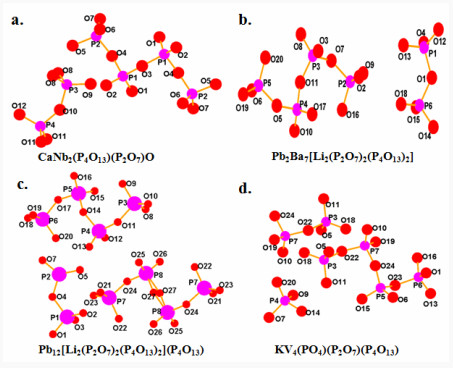
The title compound Cs2Ga4(P2O7)2(P4O13) com-posed of the P2O7 and P4O13 phosphoric anions belongs to the tetrapoly-dipolyphosphates (Fig. 4). As far as we know, tetrapoly-dipolyphosphates are rarely reported. CaNb2O(P4O13)(P2O7) is the first example of a tetrapoly-dipolyphosphate featuring a stacking of alternating rows of P4O13 and P2O7 groups (Fig. 5a)[46]. Pb12[Li2(P2O7)2(P4O13)2](P4O13) containing the isolation of P2O7 and two types of P4O13 with different symmetries has been synthesized by using Li2O as dimensional reduction agent to dismantle Pb3P4O13 by S.L Pan' group (Fig. 5b)[47], as well as Pb9−xBax[Li2(P2O7)2(P4O13)2] (x = 0, 2, 6, 7), which exhibits 0D [Li2(P2O7)2(P4O13)2]18− anionic clusters constructed by LiO4, P2O7 and P4O13 groups (Fig. 5c)[48]. KV4(PO4)(P2O7)(P4O13) contains three different types of phosphoric anions, PO4, P2O7, and P4O13 groups (Fig. 5d)[49].
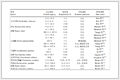
As shown in Table 2, the comparisons of the condensed phosphoric anions of the title compound (compound 1) with these reported tetrapoly-dipoly-phosphates (compound 2~5) have been summarized. Though, all phosphoric anions (P2O7 and P4O13) in these compounds are non-condensed without further connecting to form infinite chain or ring, we found some interesting differences among them.
DownLoad:
CSV
| Compounds | P/O ratio | Types of anion | Phosphoric anions | P2O7/P4O13 ratio | Structure of P4O13 | References | |
| 1 | Cs2Ga4(P2O7)2(P4O13) | 8:27 | Two | (P2O7)2(P4O13) | 2:1 | Horseshoe-shaped | This paper |
| 2 | CaNb2O (P2O7) (P4O13) | 6:21 | Three | (P2O7) (P4O13) | 1:1 | S-shaped | [46] |
| 3 | Pb12[Li2(P2O7)2(P4O13)2](P4O13) | 16:53 | Three | [(P2O7)2(P4O13)2](P4O13) | 2:3 | S-shaped | [47] |
| 4 | Pb9−xBax[Li2(P2O7)2(P4O13)2] (x = 0, 2, 6, 7) | 12:40 | Two | (P2O7)2(P4O13)2 | 2:2 | S-shaped | [48] |
| 5 | KV4(PO4)(P2O7)(P4O13) | 7:24 | Three | (PO4)(P2O7)(P4O13) | 1:1 | S-shaped | [49] |
| 6 | K2V2O2(P4O13) | 4:15 | Two | (P4O13) | Horseshoe-shaped | [50] | |
| 7 | Cs2Cr3[B(P2O7)2](P4O13) | 8:27 | Two | [B(P2O7)2](P4O13) | 2:1` | Horseshoe-shaped | [51] |
Firstly, all of the oxygen atoms in these com-pounds belong to the phosphoric groups except CaNb2O(P4O13)(P2O7), which contains one free oxy-gen atom and should be called tetraphosphate dipho-sphate oxide instead of tetrapoly-dipoly-pho-sphate.
Secondly, the ratios of P/O in compound 1~5 are 8/27, 6/21, 15/53, 12/40, and 7/24, respectively, as well as the ratios of P2O7 to P4O13 groups are 2/1, 1/1, 2/3, 2/2 and 1/1, respectively. Among them, the highest ratio of P/O is in 2 (CaNb2O(P4O13)(P2O7)), which has the lowest ratio of P2O7 to P4O13 groups (1:1) and an additional O atom beyond of phosphoric groups, while compound 5 (KV4(PO4)(P2O7)(P4O13)) has the lowest P/O ratio owing to the coexistence of threetypes of phosphoric groups (PO4, P2O7, and P4O13) and the ratio of PO4/P2O7/P4O13 is 1/1/1 (Table 2).
Thirdly, the horseshoe conformation of the P4O13 group in the title compound is different from those observed in compounds 2~5, which are principally S-shaped (Fig. 4c). As far as we know, there are only two cases containing horseshoe shaped conformation of the P4O13 group before, K2V2O2(P4O13)[50] and Cs2Cr3[B(P2O7)2](P4O13)[51]. Both of these two compounds are not tetraphosphate-diphosphates. K2V2O2(P4O13) has only one condensed phosphoric group P4O13 and two other oxygen atoms beyond the phosphoric group, and its P4O13 group is charac-terized as horseshoe-shaped with two bridging P(1)–P(2)–P(3) and P(2)–P(3)–P(4) angles of 112.07° and 99.45° (Fig. S2a). Cs2Cr3[B(P2O7)2](P4O13) contains two types of complex anionic groups, (P4O13)6− and [B(P2O7)2]5−, which were better to be called as boro-phosphate-phosphate. The P4O13 group in Cs2Cr3[B(P2O7)2]-(P4O13) is also characterized as horseshoe-shaped with two bridging P(1)–P(2)–P(3) and P(2)–P(3)–P(4) angles of 112.42° and 103.89°, respectively (Fig. S2b). The horseshoe-shaped P4O13 groups K2V2O2(P4O13) and Cs2Cr3[B(P2O7)2](P4O13) are comparable to that of the title compound Cs2Ga4-(P2O7)2(P4O13), of which two bridging P(5)–P(6)–P(7) and P(6)–P(7)–P(8) angles are 117.71° and 106.31°, respectively (Fig. S2c).
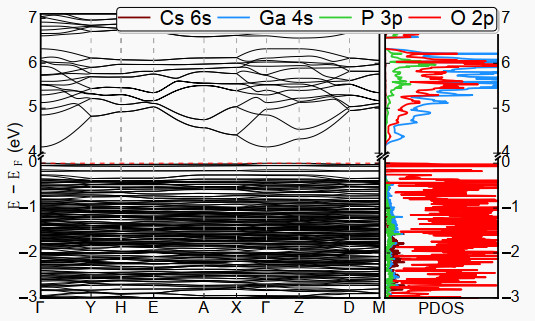
The fully relaxed lattice constants by PBE functional are a = 15.147, b = 16.454, c = 9.804 Å and β = 92.30°, which agree with the experimental values. Electronic structure calculations are performed based on the relaxed structure. The calculated band structures along the high-symmetry points of the first Brillouin zone are plotted in Fig. 6. It is clear that Cs2Ga4P8O27 is a direct band gap insulator with the conduction band minima (CBM) and valence band maximum (VBM) located at the Γ-point. The PBE calculated band gap is 4.13 eV, which is likely to be underestimated due to the shortages of the semilocal functionals. However, the unit cell size of the title compound is too large to go beyond the semilocal functionals. The valence bands are very flat and the conduction bands are highly dispersive around the Γ point. The orbital contribution of each atom to the energy band can be clearly seen from the corresponding partial density of states (PDOS) and band decomposed charge density. The flat valence band is mainly from the O 2p orbitals and the more dispersive conduction band is mainly from the more extended 4s orbitals of Ga3+, as shown in Fig. S3.
In summary, our original aim was to search for new NLO materials within the AI–GaⅢ–TeO2–P2O5 system. Luckily, we afforded a new alkali metal gallium phosphate, Cs2Ga4P8O27. It features a 3D framework structure of {Ga4P8O27}2- formed by corner sharing GaO4, GaO6, P2O7 and P4O13 groups with the cesium cations balancing the charge. With the synthesis of Cs2Ga4P8O27, we have now found the coexistence of two kinds of coordination models (4 and 6) of Ga3+ cations in one single compound. In particular, the main outstanding feature of this compound rests on the coexistence of two kinds of phosphoric anions with different degree of con-densation: a horseshoe-shaped P4O13 and linear dimer of P2O7. Furthermore, the density functional theory calculations indicate that Cs2Ga4P8O27 is a direct insulator with the band gap of 4.13 eV. Our work provides useful information on the design and search for novel phosphates, largely enriching the current classification system and full fill expanding the family of condensed phosphoric anions, which is helpful to strengthen the exploring and understan-ding of the investigation of phosphates or condensed phosphates.
Pan, Y.; Guo, S. P.; Liu, B. W.; Xue, H. G.; Guo, G. C. Second-order nonlinear optical crystals with mixed anions. Coord. Chem. Rev. 2018, 374, 464–496. doi: 10.1016/j.ccr.2018.07.013
Bass, M.; Barrett, H. H. Laser-induced damage probability at 1.06 pim and 0.69 pim. Appl. Opt. 1973, 12, 690–699. doi: 10.1364/AO.12.000690
Liu, Y. S.; Dentz, D.; Belt, R. High-average-power intracavity second-harmonic generation using KTiOPO4 in an acousto-optically Q-switched Nd: YAG laser oscillator at 5 kHz. Opt. Lett. 1983, 9, 76–78.
Yu, H.; Zhang, W.; Young, J.; Rondinelli, J. M.; Halasyamani, P. S. Bidenticity-enhanced second harmonic generation from Pb chelation in Pb3Mg3TeP2O14. J. Am. Chem. Soc. 2016, 138, 88–91. doi: 10.1021/jacs.5b11712
Huang, Y. Z.; Wu, L. M.; Wu, X. T.; Li, L. H.; Chen, L.; Zhang, Y. F. Pb2B5O9I: an iodide borate with strong second harmonic generation. J. Am. Chem. Soc. 2010, 132, 12788–12789. doi: 10.1021/ja106066k
Zhang, W. L.; Cheng, W. D.; Zhang, H.; Geng, L.; Lin, C. S.; He, Z. Z. A strong second-harmonic heneration material Cd4BiO(BO3)3 originating from 3-chromophore asymmetric structures. J. Am. Chem. Soc. 2010, 132, 1508–1509. doi: 10.1021/ja9091209
Zhao, S. G.; Yang, Y.; Shen, Y. G.; Zhao, B. Q.; Li, L.; Ji, C. M.; Wu, Z. Y.; Yuan, D. Q.; Lin, Z. S.; Hong, M. C.; Luo, J. H. Cooperation of three chromophores generates the water-resistant nitrate nonlinear optical material Bi3TeO6OH(NO3)2. Angew. Chem., Int. Ed. 2017, 56, 540–544. doi: 10.1002/anie.201609876
Zhao, S. G.; Zhang, J.; Zhang, S. Q.; Sun, Z. H.; Lin, Z. S.; Wu, Y. C.; Hong, M. C.; Luo, J. H. A new UV nonlinear optical material CsZn2B3O7: ZnO4 tetrahedra double the efficiency of second-harmonic generation. Inorg. Chem. 2014, 53, 2521–2527. doi: 10.1021/ic402667m
Pachoud, E.; Zhang, W. G.; Tapp, J.; Liang, K. C.; Lorenz, B.; Chu, P. C. W.; Halasyamani, P. S. Top-seeded single-crystal growth, structure, and physical properties of polar LiCrP2O7. Cryst. Growth Des. 2013, 13, 5473–5480. doi: 10.1021/cg401442r
Kim, M. K.; Kim, S. H.; Chang, H. Y.; Halasyamani, P. S.; Ok, K. M. New noncentrosymmetric tellurite phosphate material: synthesis, characterization, and calculations of Te2O(PO4)2. Inorg. Chem. 2010, 49, 7028–7034. doi: 10.1021/ic100706n
Abudoureheman, M.; Han, S. J.; Lei, B. H.; Yang, Z. H.; Long, X. F.; Pan, S. L. KPb2(PO3)5: a novel nonlinear optical lead polyphosphate with a short deep-UV cutoff edge. J. Mater. Chem. C 2016, 4, 10630–10637. doi: 10.1039/C6TC03424A
Yu, H. W.; Zhang, W. G.; Young, J.; Rondinelli, J. M.; Halasyamani, P. S. Design and synthesis of the beryllium-free deep-ultraviolet nonlinear optical material Ba3(ZnB5O10)PO4. Adv. Mater. 2015, 27, 7380–7385. doi: 10.1002/adma.201503951
Shan, P.; Sun, T. Q.; Chen, H.; Liu, H. D.; Chen, S. L.; Liu, X. W.; Kong, Y. F.; Xu, J. J. Crystal growth and optical characteristics of beryllium-free polyphosphate, KLa(PO3)4, a possible deep-ultraviolet nonlinear optical crystal. Sci. Rep. 2016, 6, 25201–25211. doi: 10.1038/srep25201
Yu, P.; Wu, L.; Zhou, L.; Chen, L. Deep-ultraviolet nonlinear optical crystals: Ba3P3O10X (X = Cl, Br). J. Am. Chem. Soc. 2014, 136, 480–487. doi: 10.1021/ja411272y
Zhao, S.; Gong, P.; Luo, S.; Bai, L.; Lin, Z.; Tang, Y.; Zhou, Y.; Hong, M.; Luo, J. Tailored synthesis of a nonlinear optical phosphate with a short absorption edge. Angew. Chem., Int. Ed. 2015, 54, 4217–4221. doi: 10.1002/anie.201411772
Li, L.; Wang, Y.; Lei, B.; Han, S.; Yang, Z.; Poeppelmeier, K. R.; Pan, S. A new deep-ultraviolet transparent orthophosphate LiCs2PO4 with large second harmonic generation response. J. Am. Chem. Soc. 2016, 138, 9101–9104. doi: 10.1021/jacs.6b06053
Shen, Y.; Yang, Y.; Zhao, S.; Zhao, B.; Lin, Z.; Ji, C.; Li, L.; Fu, P.; Hong, M.; Luo, J. Deep-ultraviolet transparent Cs2LiPO4 exhibits an unprecedented second harmonic generation. Chem. Mater. 2016, 28, 7110–7116. doi: 10.1021/acs.chemmater.6b03333
Zhao, S.; Gong, P.; Luo, S.; Bai, L.; Lin, Z.; Ji, C.; Chen, T.; Hong, M.; Luo, J. Deep-ultraviolet transparent phosphates RbBa2(PO3)5 and Rb2Ba3(P2O7)2 show nonlinear optical activity from condensation of [PO4]3– units. J. Am. Chem. Soc. 2014, 136, 8560–8563. doi: 10.1021/ja504319x
Shen, Y.; Zhao, S.; Zhao, B.; Ji, C.; Li, L.; Sun, Z.; Hong, M.; Luo, J. Strong nonlinear-optical response in the pyrophosphate CsLiCdP2O7 with a short cutoff edge. Inorg. Chem. 2016, 55, 11626–11629. doi: 10.1021/acs.inorgchem.6b02278
Yu, H.; Young, J.; Wu, H.; Zhang, W.; Rondinelli, J. M.; Halasyamani, P. S. M4Mg4(P2O7)3 (M = K, Rb): structural engineering of pyrophosphates for nonlinear optical applications. Chem. Mater. 2017, 29, 1845–1855. doi: 10.1021/acs.chemmater.7b00167
Zhao, S.; Yang, X.; Yang, Y.; Kuang, X.; Lu, F.; Shan, P.; Sun, Z.; Lin, Z.; Hong, M.; Luo, J. Non-centrosymmetric RbNaMgP2O7 with unprecedented thermo-induced enhancement of second harmonic generation. J. Am. Chem. Soc. 2018, 140, 1592–1595. doi: 10.1021/jacs.7b12518
Zhao, S.; Yang, Y.; Shen, Y.; Wang, X.; Ding, Q.; Li, X.; Li, Y.; Li, L.; Lin, Z.; Luo, J. A beryllium-free deep-UV nonlinear optical material CsNaMgP2O7 with honeycomb-like topological layers. J. Mater. Chem. C 2018, 6, 3910–3916. doi: 10.1039/C8TC00415C
Zhao, S. G.; Gong, P. F.; Luo, S. Y.; Liu, S. J.; Li, L. N.; Asghar, M. A.; Khan, T.; Hong, M. C.; Lin, Z. S.; Luo, J. H. Beryllium-free Rb3Al3B3O10F with reinforced interlayer bonding as a deep-ultraviolet nonlinear optical crystal. J. Am. Chem. Soc. 2015, 137, 2207–2210. doi: 10.1021/ja5128314
Lesage, J.; Guesdon, A.; Raveau, B. New gallium pentaphosphates: AGa2P5O16 (A = Rb, Cs). Solid State Sciences 2004, 6, 697–703. doi: 10.1016/j.solidstatesciences.2004.03.020
Guesdon, A.; Daguts, E.; Raveau, B. A series of cesium triphosphates with a layer structure: Cs2MP3O10 (M = Ga, Al, Cr). J. Solid State Chem. 2002, 167, 258–264. doi: 10.1006/jssc.2002.9657
Devi, N. R.; Vidyasagar, K. Synthesis and characterization of novel layered compounds, Cs2MP3O10 (M = Al or Ga), containing triphosphate groups. Dalton Trans. 2000, 1605–1608.
Grunze, I.; Palkina, K. K.; Chudinova, N. N.; Guzeeva, L. S.; Avaliani, M. A.; Maksimova, S. I. The structures and thermal transformations of cesium gallium double phosphates. Izvestiya Akademii Nauk SSSR, Neorganicheskie Materialy 1987, 23, 610–615.
Ra, H. S.; Ok, K. M.; Halasyamani, P. S. Combining second-order Jahn-Teller distorted cations to create highly efficient SHG materials: synthesis, characterization, and NLO properties of BaTeM2O9 (M = Mo6+ or W6+). J. Am. Chem. Soc. 2003, 125, 7764–7765. doi: 10.1021/ja035314b
Zhang, W. G.; Halasyamani, P. S.; Gao, Z. L.; Wang, S. P.; Wang, J.; Tao, X. T. Anisotropic thermal properties of the nonlinear optical and polar oxide material Na2TeW2O9. Cryst. Growth Des. 2011, 11, 3636–3641. doi: 10.1021/cg200659z
Goodey, J.; Broussard, J.; Halasyamani, P. S. Synthesis, structure, and characterization of a new second-harmonic-generating tellurite: Na2TeW2O9 Chem. Mater. 2002, 14, 3174–3180. doi: 10.1021/cm020087i
Zhao, P.; Wu, Q.; Li, C. L.; Zhang, S. J.; Sun, Y. X.; Zhang, C. Q.; Xia, S. Q.; Gao, Z. L.; Tao, X. T. Second order nonlinear optical properties of Cs2TeW3O12 single crystal. Opt. Mater. Express 2016, 6, 451–458.
Feng, J. H.; Xu, X.; Mao, J. G. Crystal growth and anisotropic thermal properties of the nonlinear and polar oxide Cs2TeW3O12. J. Solid State Chem. 2015, 232, 144–149. doi: 10.1016/j.jssc.2015.09.020
Goodey, J.; Ok, K. M.; Broussard, J.; Hofmann, C.; Escobedo, F. V.; Halasyamani, P. S. Syntheses, structures, and second-harmonic generating properties in new quaternary tellurites: A2TeW3O12 (A = K, Rb, or Cs). J. Solid State Chem. 2003, 175, 3–12. doi: 10.1016/S0022-4596(03)00079-3
Chang, H. Y.; Kim, S. W.; Halasyamani, P. S. Polar hexagonal tungsten oxide (HTO) materials: (1) synthesis, characterization, functional properties, and structure-property relationships in A2(MoO3)3(SeO3) (A = Rb+ and Tl+) and (2) classification, structural distortions, and second-harmonic generating properties of known polar HTOs. Chem. Mater. 2010, 22, 3241–3250. doi: 10.1021/cm100476m
CrystalClear Version 1.3. 5, Rigaku Corp. : The Woodlands, TX 1999.
Sheldrick, G. M. SHELXTL, Crystallographic Software Package, Version 5.1, Bruker-AXS: Madison, WI 1998.
Spek, A. L. PLATON, molecular geometry program. J. Appl. Crystallogr. 2003, 36, 7–13. doi: 10.1107/S0021889802022112
Kresse, G.; Hafner, J. Ab initio molecular dynamics for open-shell transition metals. J. Phys. Rev. B 48 1993, 13115–13118. http://www.onacademic.com/detail/journal_1000035561209610_a082.html
Kresse, G.; Furthmüler, J. Efficiency of ab-initio total energy calculations for metals and semiconductors using a plane-wave basis set. J. Comp. Mater. Sci. 1996, 6, 15-50. doi: 10.1016/0927-0256(96)00008-0
Pauling, L. The principles determining the structure of complex ionic crystals. J. Am. Chem. Soc. 1929, 51, 1010–1026. doi: 10.1021/ja01379a006
Sanz, F.; Parada, C.; Rojo, J. M.; Ruiz-Valero, C. Crystal structure, magnetic properties, and ionic conductivity of a new mixed-anion phosphate Na4Ni5(PO4)2(P2O7)2. Chem. Mater. 1999, 11, 2673–2679. doi: 10.1021/cm981105s
Sanz, F.; Parada, C.; Rojo, J. M.; Ruiz-Valero, C. Synthesis, structural characterization, magnetic properties, and ionic conductivity of Na4M3Ⅱ(PO4)2(P2O7) (MⅡ = Mn, Co, Ni). Chem. Mater. 2001, 13, 1334–1340. doi: 10.1021/cm001210d
Lim, S. Y.; Kim, H.; Chung, J.; Lee, J. H.; Kim, B. G.; Choi, J. J.; Chung, K. Y.; Cho, W.; Kim, S. J.; Goddard, W. A.; Jung, Y.; Choi, J. W. Role of intermediate phase for stable cycling of Na7V4(P2O7)4PO4 in sodium ion battery. Proc. Natl. Acad. Sci. USA. 2014, 111, 599–604. doi: 10.1073/pnas.1316557110
Alekseev, E. V.; Krivovichev, S. V.; Depmeier, W. Rubidium uranyl phosphates and arsenates with polymeric tetrahedral anions: syntheses and structures of Rb4[(UO2)6(P2O7)4(H2O)], Rb2[(UO2)3(P2O7)(P4O12)] and Rb[(UO2)2(As3O10)]. J. Solid State Chem. 2009, 182, 2074–2080. doi: 10.1016/j.jssc.2009.05.022
Abudoureheman, M.; Han, S. J.; Wang, Y.; Lei, B. H.; Yang, Z. H.; Pan, S. L. A3Sr2P7O21 (A = Rb, Cs): two polyphosphates based on different types of P–O chains and ring structures. Inorg. Chem. 2017, 56, 3939–3945. doi: 10.1021/acs.inorgchem.6b03032
Averbuchpouchot, M. T. Crystal structure of a tetrapoly-dipolyphosphate: CaNb2O(P4O13)(P2O7). Z. Anorg. Allg. Chem. 1987, 645, 118–124.
Zhang, X. Y.; Wu, H. P.; Wang, Y.; Dong, X. Y.; Han, S. J.; Pan, S. L. Application of the dimensional reduction formalism to Pb12[Li2(P2O7)2(P4O13)2](P4O13): a phosphate containing three types of isolated P–O groups. Inorg. Chem. 2016, 55, 7329–7331. doi: 10.1021/acs.inorgchem.6b01273
Zhang X.; Wu, H.; Liu, Q.; Dong, X.; Chen, Y.; Yang, Z.; Wen, X. D.; Pan, S. Application of the dimensional reduction formalism to Pb9−xBax[Li2(P2O7)2(P4O13)2] (x = 0, 2, 6, 7): a series of phosphates with two types of isolated polyphosphate groups. Dalton Trans. 2017, 46, 4678–4684. doi: 10.1039/C7DT00509A
Benhamada, L.; Grandin, G.; Borel, M. M.; Leclaire, A.; Raveau B. A vanadium (Ⅲ) phosphate with V2O10 octahedral units: KV4P7O24. J. Solid State Chem. 1993, 104, 193–201. doi: 10.1006/jssc.1993.1153
Borel, M. M.; Leclaire, A.; Chardon, J.; Provost, J.; Rebbah, H.; Raveau, B. AV (Ⅳ) tetraphosphate with a tunnel structure K2(VO)2P4O13. J. Solid State Chem. 1997, 132, 41–46. doi: 10.1006/jssc.1997.7404
Zhang, W. L.; Cheng, W. D.; Zhang, H.; Geng, L.; Li, Y. Y.; Lin, C. S.; He, Z. Z. Syntheses and characterizations of Cs2Cr3(BP4O14)(P4O13) and CsFe(BP3O11) compounds with novel borophosphate anionic partial structures. Inorg. Chem. 2010, 49, 2550–2556. doi: 10.1021/ic902463t

Figure 2 View the framework structure of {Ga4P8O27}2- along the b axis, and the layers of {Ga2(P4O13)}n and {Ga2(P2O7)2}n2n- along the a axis. Cs, Ga, O and P atoms are represented by green, blue, red and pink circles, respectively

Figure 3 View of the linkages of [Ga1O6], [Ga2O6], [Ga3O4] and [Ga4O6] groups in the layer. Ga, P and O atoms are represented by light blue, pink, and red circles, respectively

Figure 4 View the linkages of (P1P2O7), (P3P4O7) and (P5P6P7P8O13) groups in the title compound. Ga, P and O atoms are represented by light blue, pink and red circles, respectively

Figure 5 Configuration of the phosphoric anions; (a) in CaNb2O(P4O13)(P2O7), (b) in Pb9−xBax[Li2(P2O7)2(P4O13)2] (x = 0, 2, 6, 7), (c) in Pb12[Li2(P2O7)2(P4O13)2](P4O13), and (d) in KV4(PO4)(P2O7)(P4O13)
Table 1. Selected Bond Lengths (Å) and Bond Valence Sums for Cs2Ga4P8O27
| Bond | Dist. | BV | Bond | Dist. | BV | ||
| Ga(1)–O(27) | 1.932(5) | 0.579 | P(2)–O(4) | 1.616(5) | 1.003 | ||
| Ga(1)–O(17) | 1.932(5) | 0.579 | P(2)–O(5) | 1.494(5) | 1.394 | ||
| Ga(1)–O(5) | 1.943(5) | 0.562 | ∑BVS = 4.989 | ||||
| Ga(1)–O19) | 1.945(5) | 0.559 | P(3)–O(10) | 1.493(5) | 1.398 | ||
| Ga(1)–O22) | 1.972(5) | 0.520 | P(3)–O(8) | 1.516(5) | 1.314 | ||
| Ga(1)–O20) | 2.001(5) | 0.481 | P(3)–O(9) | 1.535(5) | 1.248 | ||
| ∑BVS = 3.280 | P(3)–O(11) | 1.591(5) | 1.073 | ||||
| Ga(2)–O(10) | 1.884(5) | 0.660 | ∑BVS = 5.033 | ||||
| Ga(2)–O(3)i | 1.913(5) | 0.610 | P(4)–O(12) | 1.492(5) | 1.402 | ||
| Ga(2)–O(1) | 1.918(5) | 0.602 | P(4)–O(14) | 1.507(5) | 1.346 | ||
| Ga(2)–O(8) | 1.931(5) | 0.581 | P(4)–O(13) | 1.535(5) | 1.248 | ||
| Ga(2)–O(14) | 1.995(5) | 0.489 | P(4)–O(11) | 1.596(5) | 1.058 | ||
| Ga(2)–O(6)1 | 2.012(5) | 0.467 | ∑BVS = 5.054 | ||||
| ∑BVS = 3.409 | P(5)–O(16) | 1.496(5) | 1.387 | ||||
| Ga(3)–O(2) | 1.786(5) | 0.860 | P(5)–O(15) | 1.505(5) | 1.354 | ||
| Ga(3)–O(7)ii | 1.789(5) | 0.853 | P(5)–O(17) | 1.513(5) | 1.325 | ||
| Ga(3)–O(13) | 1.797(5) | 0.834 | P(5)–O(18) | 1.627(5) | 0.973 | ||
| Ga(3)–O(9)iii | 1.798(5) | 0.832 | ∑BVS = 5.039 | ||||
| ∑BVS = 3.379 | P(6)–O(20) | 1.474(5) | 1.472 | ||||
| Ga(4)–O(12)iii | 1.909(5) | 0.616 | P(6)–O(19)1 | 1.491(5) | 1.406 | ||
| Ga(4)–O(26)iv | 1.927(5) | 0.587 | P(6)–O(18) | 1.549(5) | 1.202 | ||
| Ga(4)–O(16)v | 1.979(5) | 0.510 | P(6)–O(21) | 1.593(5) | 1.067 | ||
| Ga(4)–O(15)iv | 2.002(5) | 0.479 | ∑BVS = 5.147 | ||||
| Ga(4)–O(25) | 2.009(5) | 0.470 | P(7)–O(23) | 1.471(5) | 1.484 | ||
| Ga(4)–O(23)i | 2.012(5) | 0.467 | P(7)–O(22)i | 1.494(5) | 1.394 | ||
| ∑BVS = 3.129 | P(7)–O(24) | 1.571(5) | 1.132 | ||||
| P(1)–O(3) | 1.494(5) | 1.394 | P(7)–O(21) | 1.615(5) | 1.005 | ||
| P(1)–O(1) | 1.509(5) | 1.339 | ∑BVS = 5.015 | ||||
| P(1)–O(2) | 1.521(5) | 1.296 | P(8)–O(26) | 1.507(5) | 1.346 | ||
| P(1)–O(4) | 1.597(5) | 1.056 | P(8)–O(25) | 1.508(5) | 1.343 | ||
| ∑BVS = 5.085 | P(8)–O(27) | 1.514(4) | 1.321 | ||||
| P(2)–O(6) | 1.503(5) | 1.361 | P(8)–O(24)v | 1.615(5) | 1.005 | ||
| P(2)–O(7) | 1.540(5) | 1.231 | ∑BVS = 5.015 | ||||
| Symmetry transformations used to generate the equivalent atoms: i x, 3/2–y, 1/2+z; ii –x, 1–y, –z; iii –x, 1–y, 1–z; iv1–x, 1–y, 1–z; v 1–x, –1/2+y, 1/2–z; vi x, 3/2–y, –1/2+z; vii1–x, 1/2+y, 1/2–z |
|||||||
 下载: 导出CSV
Table 2. Comparison of the Corresponding Condensed Phosphates
| Compounds | P/O ratio | Types of anion | Phosphoric anions | P2O7/P4O13 ratio | Structure of P4O13 | References | |
| 1 | Cs2Ga4(P2O7)2(P4O13) | 8:27 | Two | (P2O7)2(P4O13) | 2:1 | Horseshoe-shaped | This paper |
| 2 | CaNb2O (P2O7) (P4O13) | 6:21 | Three | (P2O7) (P4O13) | 1:1 | S-shaped | [46] |
| 3 | Pb12[Li2(P2O7)2(P4O13)2](P4O13) | 16:53 | Three | [(P2O7)2(P4O13)2](P4O13) | 2:3 | S-shaped | [47] |
| 4 | Pb9−xBax[Li2(P2O7)2(P4O13)2] (x = 0, 2, 6, 7) | 12:40 | Two | (P2O7)2(P4O13)2 | 2:2 | S-shaped | [48] |
| 5 | KV4(PO4)(P2O7)(P4O13) | 7:24 | Three | (PO4)(P2O7)(P4O13) | 1:1 | S-shaped | [49] |
| 6 | K2V2O2(P4O13) | 4:15 | Two | (P4O13) | Horseshoe-shaped | [50] | |
| 7 | Cs2Cr3[B(P2O7)2](P4O13) | 8:27 | Two | [B(P2O7)2](P4O13) | 2:1` | Horseshoe-shaped | [51] |
下载: 导出CSV

 扫一扫看文章


扫一扫关注我们

