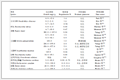
Table 1.
Selected Bond Lengths (Å) and Bond Angles (°) for MCP 1

A Chinese Lantern-like 2D Cu(Ⅱ) Coordination Polymer Constructed by Bis-imidazole and Dicarboxylate Co-ligands: Synthesis, Crystal Structure and Photocatalytic Activity
Jiu-Fu LU , Juan ZHAO , Cai-Bin ZHAO , Xiao-Hu YU , Kumar Roy SOUMENDRA , Si-Yu YUE , Li LI , Ke ZHOU , Ling-Xia JIN , Hong-Guang GE


Particular attention has been recently devoted to coordination polymers (MCPs) not only due to their undisputed structural beauty but also to their promising applications in the fields of heterogeneous catalysis[1], storage[2], degradation of organic pollutants[3-5], conductivity[6], biological activity[7], ferroelectricity[8], magnetism[9] and luminescence[10]. It has been proved that the structures of metal coordination polymers (MCPs) have a close relationship with their functions. However, the prediction and design of target MCPs are still fraught with enormous challenges[11]. Carboxylates, N-containing ligands or their co-ligand systems have received considerable attention[12] because of their versatile coordination models for the design of multifunctional coordination polymers. Compared to well-known N-donor ligands, the 1, 3-BIP is a good N-donor ligand which allows the ligands to bend and rotate when they coordinate to metal centers[13-15]. Linkers with electron withdrawing groups, such as 2, 3, 5, 6-tetrafluoro-1, 4-benzenedicarboxylylate (H2TFBDC)[16-18], have been used to build coordination polymers with transition metals. However, it has been reported that transition metal hybrids do not crystallize well in acidic environments, and the acidity of the parent acid requires a basic co-ligand such as a nitrogen base in order for the hybrid inorganic-organic materials to crystallize[19-22].
In this paper, we chose the flexible ligand 1, 3-bis(imidazole)propane as a N-donor ligand, and the rigid tetrafluoroterephthalic acid as an auxiliary linker for the construction of MCPs in order to satisfy and mediate the geometric requirements of metal centers. Herein we have prepared a new Cu(Ⅱ) coordination polymer, {[Cu(1, 3-BIP)(TFBDC)]· DMF}n (1), and determined its structure by single-crystal X-ray diffraction analysis. In addition, its thermal stability and photocatalytic property have been investigated.
All of the chemical reagents were purchased from Ji'nan Heng Hua Science and Technology Company, and used without further purification. Elemental analyses for carbon, hydrogen, and nitrogen atoms were performed on a Vario EL Ⅲ elemental analyzer. The infrared spectra (4000~400 cm–1) were recorded by using KBr pellet on an Avatar 360 E.S.P. IR spectrometer. Powder X-ray diffraction (PXRD) data were collected on a Rigaku Ultima ІV X-ray diffractometer with CuKα radiation (λ = 0.154056 nm) at room temperature in the 2θ range of 5~50º. UV-Vis spectroscopy was measured by F-4500 analytical instruments. Thermogravimetric analysis (TGA) was performed on a TA-SDT Q600 thermal analyzer under N2 atmosphere at a heating rate of 10 ℃·min–1 in the range of 30~1000 ℃.
A mixture of Cu(NO3)2·3H2O (0.1 mmol, 24.2 mg), NaOH (0.15 mmol, 12 mg), 1, 3-BIP (0.1 mmol, 17.6 mg), H2TFBDC (0.1 mmol, 23.8 mg), 2 mL DMF, and 4 mL H2O was sealed in a 20 mL vial, which was heated to 90 ℃ for 3 days, and then cooled to room temperature over 24 hours. Blue block crystals of 1 were collected. Yield: 78% based on copper. Elemental analysis Calcd. (%) for C20H19CuF4N5O5 (Mr = 548.94): C, 43.72; H, 3.16; N, 12.75. Found (%): C, 43.23; H, 3.42; N, 12.81. IR(cm–1): 3432(bs), 3125(m), 2935(m), 2363(w), 1622(s), 1563(m), 1405(w), 1345(s), 1103(m), and 762(m).
Crystal data for MCP 1 were collected on a Bruker SMART APEX Ⅱ CCD diffractometer with graphite-monochromated Mo-Kα radiation (λ = 0.71073 Å) in an ω-scan mode. A blue crystal (C20H19CuF4N5O5) with dimensions of 0.22mm × 0.15mm × 0.05mm was selected for data collection which was performed on a Bruker P4 diffractometer equipped with a graphite-monochromatic MoKα radiation (λ = 1.54187 Å) by using a multi scan mode at 293(2) K. A total of 4293 reflections were collected in the range of 3.04≤θ≤25.01° (index ranges: –18 < h < 12, –16 < k < 16 –9 < l < 14) and 2111 were independent (Rint = 0.0221), of which 203 observed reflections with I > 2σ(I) were used in the structure determination and refinements. The structure was solved by direct methods using the program SHELXS-97[23] and refined by full-matrix least-squares techniques against F2 using the SHELXL-97[24] crystallographic software package. All of the non-hydrogen atoms were easily found from difference Fourier map and refined anisotropically, whereas the hydrogen atoms of MCP 1 were placed by geometrical considerations and added to the structure factor calculation. The details of selected bond lengths and bond angles with their estimated standard deviations are listed in Table 1.
 DownLoad:
CSV
DownLoad:
CSV
| Bond | Dist. | Angle |
(°) |
| Cu(1)–N(2)#1 | 1.956(3) | N(2)#1–Cu(1)–N(2) | 164.34(19) |
| Cu(1)–N(2) | 1.956(3) | N(2)#1–Cu(1)–O(1)#1 | 90.16(11) |
| Cu(1)–O(1)#1 | 1.956(2) | N(2)–Cu(1)–O(1)#1 | 90.56(12) |
| Cu(1)–O(1) | 1.956(2) | N(2)#1–Cu(1)–O(1) | 90.56(12) |
| F(1)–C(3) | 1.351(4) | N(2)–Cu(1)–O(1) | 90.16(11) |
| F(2)–C(4) | 1.344(4) | O(1)#1–Cu(1)–O(1) | 174.66(18) |
| Symmetry transformations used to generate the equivalent atoms: #1: –x+1, y, –z; #2: –x+3/2, –y+1/2, –z+1 | |||
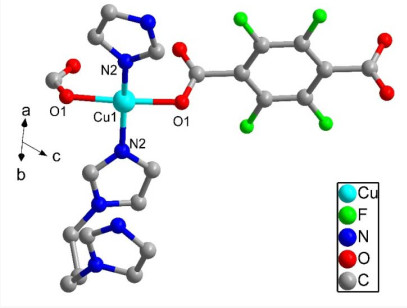
Single-crystal X-ray diffraction study revealed that MCP 1 belongs to triclinic, space group P
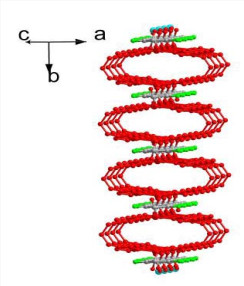
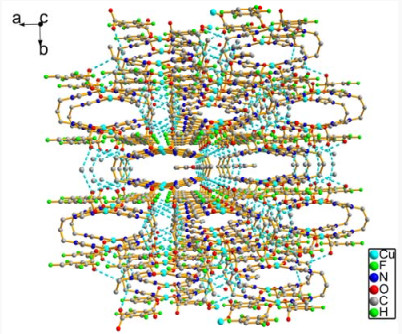
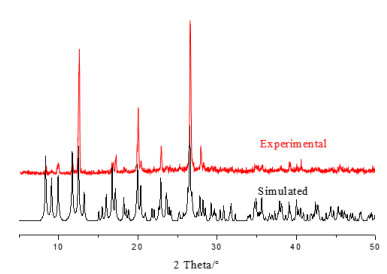
To confirm the purity of MCP 1, X-ray power dif-fraction analyses were carried out. As shown in Fig. 6, although the experimental patterns have a few un-indexed diffraction lines and some are slightly broadened in comparison with those simulated from the single-crystal models, it still can be considered that the bulk synthesized materials and the as-grown crystals for diffraction are homogeneous for MCP 1.
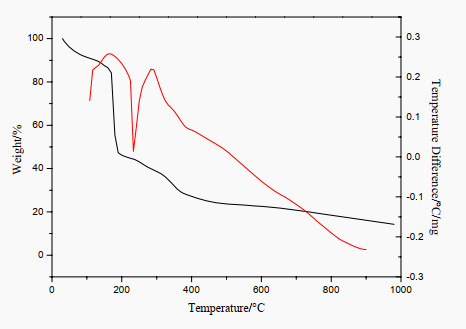
To have insight into the changes occurring during heat treatment of the prepared MCP 1, thermal gravimetric analysis (TGA) and differential thermal analysis (DTA) of the sample were carried out from 30 to 1000 ℃ at a heating rate of 10 ℃·min-1. Based on the TGA curve depicted in Fig. 7, a gradual weight loss of 12.45% (calcd. 13.31%) is observed from 30 to approximately 150 ℃. It can be ascribed to the loss of one lattice DMF molecule per unit cell (calcd.: 13.31%), which is indicated by an exothermal peak at 150 ℃ in the DTA curve. The second obvious weight loss from 150 to 400 ℃ can be attributed to the decomposition of MCP 1, which is indicated by one endothermal peak at 220 ℃ in the DTA curve. After decomposition, the final residue is 14.28%, which can be attributed to CuO (calcd. 14.57%).
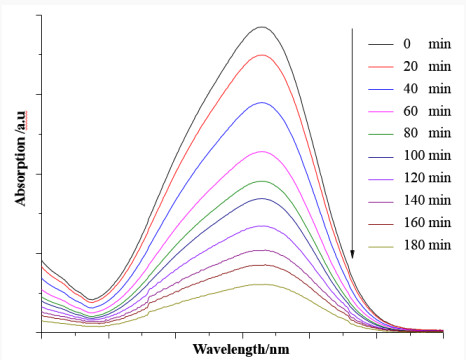
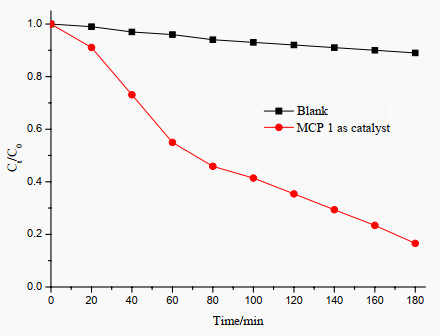
Photocatalysts have attracted much attention due to their potential applications in purifying water and air by thoroughly decomposing organic pollutants[25, 26]. The organic dye methyl orange (MO) is the most common organic dye and difficult to decompose in waste water. Therefore, it was selected as the model dye contaminants to evaluate the photocatalytic effectiveness in the purification of waste water. Inspired by the previously reported studies about Cu(Ⅱ)/Co(Ⅱ) coordination polymers for photocatalytic degradation of organic dyes[27, 28], herein the photocatalytic activity of MCP 1 for the degradation of MO under xenon arc lamp irradiation was also explored. As can be seen in Fig. 8, the characteristic absorption peak of MO (465 nm) was gradually reduced with time increasing from 0 to 180 min. Besides, the changes in the Ct/C0 plot of MO solutions versus irradiation time are shown in Fig. 9 to clarify the photocatalytic results, wherein Ct is the concentration of MO solutions at t time and C0 is the concentration of MO solutions at the beginning of irradiation. As depicted in Fig. 9, the degradation ratio of MO reaches 16.5% without any photocatalyst, while it increases to 83.4% when MCP 1 was added to the mixture as catalyst within 180 minutes.
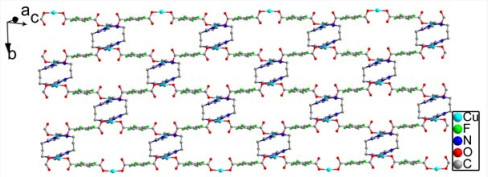
In summary, a new Cu(Ⅱ) coordination polymer has been solvothermally synthesized and structurally characterized. Single-crystal X-ray structural analysis revealed that MCP 1 shows a two-dimensional sheet layer structure. Photocatalytic property investigations show that MCP 1 can be used as a visiblelight photocatalyst for the degradation of MO.
Hao, H. J.; Sun, D.; Liu, F. J.; Huang, R. B.; Zheng, L. S. Dicarboxylate-controlled three Zn(Ⅱ) coordination polymers incorporating flexible 1, 2-bis(imidazol-10-yl)ethane ligand: syntheses, structures, thermal stabilities and photoluminescent properties. J. Mol. Struct. 2012, 1012, 131–136. doi: 10.1016/j.molstruc.2011.12.030
Li, P. X.; Lu, J. F. A novel 3D twofold Zn(Ⅱ) coordination polymer constructed by mixed flexible ligands: synthesis, crystal structure and fluorescence property. Chin. J. Struct. Chem. 2017, 36, 303–309.
Kamal, K. B.; Yadagiri, R.; Bhavesh, P.; Eringathodi, S. Mixed ligand coordination polymers with flexible bis-imidazole linker and angular sulfonyldibenzoate: crystal structure, photoluminescence and photocatalytic activity. J. Solid State Chem. 2014, 213, 43−51. doi: 10.1016/j.jssc.2014.02.007
Kamal, K. B.; Yadagiri, R.; Bhavesh, P.; Bhavesh, P.; Eringathodi, S. Structural and functional studies on ternary coordination polymers from 5-bromoisophthalate and imidazole based flexible linker. RSC Adv. 2014, 4, 7352−7360. doi: 10.1039/c3ra45411h
Wang, C. C.; Li, J. R.; Lv, X. L.; Zhang, Y. Q.; Guo, G. S. Photocatalytic organic pollutants degradation in metal-organic frameworks. Energy Environ. Sci. 2014, 7, 2831−2867. doi: 10.1039/C4EE01299B
Tranchemontagne, D. J.; Ni, Z.; O'Keeffe, M.; Yaghi, O. Reticular chemistry of metal-organic polyhedra. Angew. Chem. Int. Ed. 2008, 47, 5136−5147. doi: 10.1002/anie.200705008
Leong, W. L.; Vittal, J. J. One-dimensional coordination polymers: complexity and diversity in structures, properties, and applications. Chem. Rev. 2011, 111, 688−764. doi: 10.1021/cr100160e
Renata, L.; Halina, G.; Liliana, M.; Bogdan, T.; Vasyl, K.; Alexander, M. K. Structural diversity of alkali metal coordination polymers driven by flexible biphenyl-4, 4΄-dioxydiacetic acid. J. Solid State Chem. 2018, 265, 92−99. doi: 10.1016/j.jssc.2018.05.022
Osta, R. E.; Frigoli, M.; Marrot, J.; Medina, M. E.; Walton, R. I.; Millange, F.; Fei, H.; Liu, X.; Li, Z.; Feng, W. Synthesis, structure, and crystallization study of a layered lithium thiophene-dicarboxylate. Cryst. Growth Des. 2012, 12, 1531−1539. doi: 10.1021/cg201587u
Qiao, Y.; Ren, S. S.; Liu, L. H.; Guan, W. S. Adsorption and photocatalytic properties of transition metal zinc(Ⅱ) complex based on 5-(4-(tetrazol-5-yl)phenyl)isophthalic acid. J. Mol. Struct. 2018, 1161, 238−254. doi: 10.1016/j.molstruc.2018.02.049
Kitagawa, S.; Kitaura, R.; Noro, S. I. Functional porous coordination polymers. Angew. Chem. Int. Ed. 2004, 43, 2334−2375. doi: 10.1002/anie.200300610
Zhang, Z. J.; Shi, W.; Niu, Z.; Li, H. H.; Zhao, B.; Cheng, P.; Liao, D. Z.; Yan, S. P. A new type of polyhedron-based metal-organic frameworks with interpenetrating cationic and anionic nets demonstrating ion exchange, adsorption and luminescent properties. Chem. Commun. 2001, 47, 6425−6427.
Lu, J. F.; Min, S. T.; Ge, H. G. Synthesis, crystal structures and properties of two-dimensional complexes constructed by dicarboxylate and bis(imidazole) co-ligands. J. Chem. Res. 2014, 38, 726−730. doi: 10.3184/174751914X14176001751990
Lu, J. F.; Liu, J.; Ge, H. G.; Jiang, M. Synthesis, structure and luminescent property of a 2D Cd(Ⅱ) coordination polymer based on mixed ligands of 1, 3-bis(imidazol)propane and pyridine-3, 5-dicarboxylic acid. Chin. J. Struct. Chem. 2015, 34, 248−252.
Lu, J. F.; Xu, Y. H.; Li, P. A.; Jin, L. X.; Zhao, C. B.; Guo, X. H.; Ge, H. G. Synthesis, crystal structure, and luminescent properties of Ag(Ⅰ) coordination polymer with tricarboxylic acid and flexible N-donor ligand. Crystallogr. Rep. 2017, 2, 1046−1050.
Wang, Z. J.; Qin, L.; Zhang, X.; Chen, J. X.; Zheng, H. G. Syntheses, characterizations, luminescent properties, and controlling interpenetration of five metal-organic frameworks based on bis(4-(pyridine-4-yl)phenyl)amine. Cryst. Growth Des. 2015, 44, 4670–4679.
Zhang, Z. H.; Yang, X. S.; Guo, W.; Chen, S. C.; He, M. Y.; Chen, Q. Positional isomeric effect on CuⅡ and CdⅡ complexes based on perfluorinated dicarboxylate ligands and bipyridyl co-tectons. Polyhedron 2016, 117, 695–702. doi: 10.1016/j.poly.2016.07.015
Li, X. Y.; Han, C. X.; Yue, K. F.; Liu, Y. L.; Zhou, C. S.; Hou, Y. F.; He, T.; Yan, T. Syntheses, structures and properties of three 4-fold interpenetration coordination polymers based on two different dia interpenetrating modes. Polyhedron 2015, 87, 156–162. doi: 10.1016/j.poly.2014.11.019
Perry, J. J.; Perman, J. A.; Zaworotko, M. J. Design and synthesis of metal-organic frameworks using metal-organic polyhedra as supermolecular building blocks. Chem. Soc. Rev. 2009, 38, 1400−1417. doi: 10.1039/b807086p
Ji, X. H.; Zhao, J.; Lu, J. F.; Ji, L. X.; Ge, H. G. Synthesis, Crystal Structure and Biological Activity of 1-(3-Amino-4-morpholino-1H-indazole-1-carbonyl)-N-(4-fluorophenyl)cyclopropane-1-carboxamide. Chin. J. Struct. Chem. 2019, 38, 1889−1894.
Li, H. J.; He, Y. L.; Zhao, W. L.; Li, Q. Q.; Xu, Z. Q.; Wang, Y. Designing different functional frameworks from 0D to 3D for exploring structural correlation with photocatalytic activity. Polyhedron 2017, 133, 412−418. doi: 10.1016/j.poly.2017.05.009
Yu, Q.; Ren, S. S.; Liu, L. H.; Guan, W. S. Adsorption and photocatalytic properties of transition metal zinc(Ⅱ) complex based on 5-(4-(tetrazol-5-yl)phenyl)isophthalic acid. J. Mol. Struct. 2018, 1161, 238−245. doi: 10.1016/j.molstruc.2018.02.049
Sheldrick, G. M. SHELXS-97, Program for the Solution of Crystal Structures. University of Göttingen, Germany 1997.
Sheldrick, G. M. SHELXL-97, Program for the Refinement of Crystal Structures. University of Göttingen, Germany 1997.
Zhao, S.; Zheng, T. R.; Shi, L. L.; Li, K.; Li, B. L.; Li, H. Y. Two intriguing hydroxy-copper(Ⅱ) coordination polymers with bis(triazole) and bicarboxylate ligands: syntheses, structures and photocatalytic degradation of organic dyes. J. Mol. Struct. 2017, 1143, 146−152. doi: 10.1016/j.molstruc.2017.04.087
Wang, F.; Liu, Z. S.; Yang, H.; Tan, Y. X.; Zhang, J. Hybrid zeolitic imidazolate frameworks with catalytically active TO4 building blocks. Angew. Chem. Ed. Int. 2011, 50, 450−453. doi: 10.1002/anie.201005917
Lu, J. F.; Wang, M. Z.; Liu, Z. H. Two novel coordination polymers constructed by the same mixed ligands of 1, 3-bip and H2bpdc: syntheses, structures and catalytic properties. J. Mol. Struct. 2015, 1098, 41−46. doi: 10.1016/j.molstruc.2015.05.030
Lu, J. F.; Jin, L. X.; Song, J.; Zhao, C. B.; Yue, S. Y.; Li, L.; Yang, H. T.; Cao, X. Y.; Ge, H. G. A novel 3D metal coordination polymer based on tetranuclear cobalt cluster building blocks: synthesis, crystal structure and photocatalytic property. Chin. J. Struct. Chem. 2018, 37, 1814−1820.

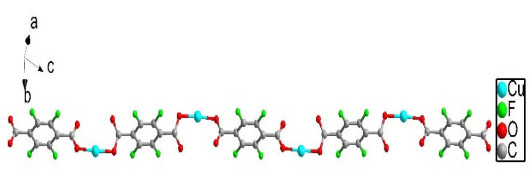
Figure 2 View of the infinite one-dimensional chain constructed by Cu(Ⅱ) cation and TFBDC ligand

Figure 8 UV-vis absorption spectra of MO solution during photocatalytic degradation of the MO solution using catalyst 1

Figure 9 Concentration changes of MO as a function of reaction time using MCP 1 catalyst and the blank experiment
Table 1. Selected Bond Lengths (Å) and Bond Angles (°) for MCP 1
| Bond | Dist. | Angle |
(°) |
| Cu(1)–N(2)#1 | 1.956(3) | N(2)#1–Cu(1)–N(2) | 164.34(19) |
| Cu(1)–N(2) | 1.956(3) | N(2)#1–Cu(1)–O(1)#1 | 90.16(11) |
| Cu(1)–O(1)#1 | 1.956(2) | N(2)–Cu(1)–O(1)#1 | 90.56(12) |
| Cu(1)–O(1) | 1.956(2) | N(2)#1–Cu(1)–O(1) | 90.56(12) |
| F(1)–C(3) | 1.351(4) | N(2)–Cu(1)–O(1) | 90.16(11) |
| F(2)–C(4) | 1.344(4) | O(1)#1–Cu(1)–O(1) | 174.66(18) |
| Symmetry transformations used to generate the equivalent atoms: #1: –x+1, y, –z; #2: –x+3/2, –y+1/2, –z+1 | |||
 下载: 导出CSV

 扫一扫看文章


扫一扫关注我们


