
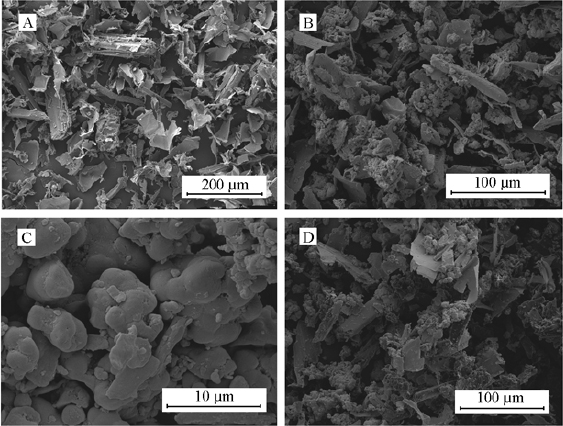
Figure 1.
SEM images of pristine corn straw fiber (A), corn straw fiber dip-coated by TiO2 sol (B,C), corn straw fiber treated by dip-coating and surface modification (D)


Nowadays, environmental pollution and ecological damage triggered by oil spills or organic pollutants during offshore oil production and marine transportation have become two of the most pressing global problems. In 2010, the disaster accident of Deepwater Horizon oil spill in the northern Gulf of Mexico resulted in the release of more than 210 million gallons of oil, which was a great loss of natural resources, and unavoidably led to the serious damage to the ecosystem [1]. Confronted with the disastrous pollution caused by the spilled oil, how to remove, collect and reuse the spilled oil or organic pollutant is highly desired and has attracted worldwide attention. Currently, traditional methods, including in situ burning, gravity separation, skimming and floatation, are often employed to collect or remove the spilled oil, but suffering from the limit of high cost, serious environmental problem and low efficiency as well as time-consuming process in practice[2]. With the consideration of the intrinsic immiscibility and different surface tension between water and oil, materials with special wettability or different affinities towards oils and water could be used to separate oil-water mixtures[3-6] .
Wettability is usually defined as the ability of a liquid to maintain contact with a solid surface, and which is closely related with the surface topography and the surface chemical composition. Wettability is commonly characterized by the contact angle[7], when the contact angle(CA) of a water or an oil droplet on a solid surface is larger than 150°, the surface is defined as superhydrophobic/superoleophobic, and when the CA is lower than 5°, it is called superhydrophilic/ superoleophilic[8-9].
To date, materials possess superhydrophobic-superoleophilic performances, such as copper mesh[10], sponge[11], filter paper[12] and porous reduced graphene oxide/polycarbonate monoliths[13], were successfully constructed to separate oil-water mixtures owing to their selective absorption to oil. For example, Zhang et al[14], fabricated a novel superhydrophilic and superoleophobic nanoparticle-polymer coated stainless steel mesh by spraying casting, and the as-prepared stainless steel mesh was employed to separate oil-water mixture as the water droplets spread over the mesh completely while oil droplets roll off the mesh without any penetration. Jiang's group[15] also reported a method to prepare Cu(OH)2 nanowire-haired copper mesh with superhydrophilicity and underwater ultralow adhesive superoleophobicity, and the obtained copper mesh could effectively separate both immiscible oil/water mixtures and oil-in-water emulsions driven solely by gravity. To some extent, the techniques described above are useful and efficient for the separation of immiscible oil-water mixtures, but still suffering from the limits of complex procedures, high cost and poor recoverability, and easily causing the secondary contamination to the environment in the application of oil-water separation. Therefore, it is quite necessary to propose a facile technique to prepare oil absorbent via simple process, low cost and high selectivity as well as recyclability.
Plant straw, as a very common, abundant, sustainable and renewable material, which is mainly composed of cellulose. As a byproduct in farming, plant straw are often discarded, piled up for natural decomposition or directly treated by burning, which is a great waste of resources and easily leads to the serious environment pollution. Corn straw, as one of the abundant plant straw, which has a compact structures of cellulose (28%~36%) and hemicelluloses (23%~28%) in close association with lignin (12%~16%)[16], and naturally has a hierarchical structures composed of well-oriented micro fibers and tracheids[17]. As one of the abundant straws with characteristics of naturally hierarchical structures, corn straw can be used as a candidate material for preparing oil absorbent. Both Zang et al and Shi′s group[18-19], designed methods respectively to prepare oil absorbent by using corn straw as raw material via depositing ZnO particles on the surface of fibers and subsequently modifying with hydrophobic material, and the obtained product with superhydropohobicity and superoleophilicity possessed the ability to efficiently dislodge oils from oily wastewater. However, the procedures of obtaining ZnO particles is time-consuming. In this paper, a more facile two-step approach of dip-coating and surface modification was adopted to prepare an oil absorbent of corn straw fiber with superhydrophobicity and superoleophilicity, and the as-prepared corn straw fibers could be employed as an oil absorbent to adsorb and recover the spilled oil in water with high separation efficiency, stable recyclability and excellent durability. The methods presented here are expected to provide a reference for the processing and utilization of corn straw as an oil absorbent to remove, collect and recover the spilled oil in water.
The surface morphologies of corn straw were observed by a Quanta 450 FEG scanning electron microscope(SEM, FEI, USA). The surface chemical composition of the samples was analyzed on a K-Alpha X-ray photoelectron spectroscopy (XPS, Thermo Electron, USA) using with AlKα radiation. The contact angles(CA) and sliding angle (SA) measurements were performed via a SL200KS contact angle meter (Kino, USA) equipped with a video camera and a tilting stage, and the average value of five different points on each sample surface using 8 μL water droplets was reported as final CA.
Corn straw was obtained from a local farm in Ganzhou district of Zhangye City. Tetra-n-butyl titanate (chemical reagent) was purchased from Shanghai Kefeng Chemical Reagent Co., Ltd. Polyethylene glycol (analytical reagent, Mr=2000) was provided by Tianjing Kaitong Chemical Reagent Co., Ltd. Anhydrous ethanol with analytical reagent was obtained from Tianjin Hengxing Chemical Reagent Co., Ltd. Commercial purity octyltrimethoxysilane, abbreviated as OTS, was provided by Jinzhou Jianghan fine chemical Reagent Co., Ltd. Oils of hexadecane, pentadecane, butadecane and tridecane as well as dodecane with a purity of 98%, were all purchased from Aladdin Industrial Corporation, shanghai, China. Diesel oil was obtained from a petrol station of China National Petroleum Corporation in Zhangye City. Edible oil, with a commercial name of golden dragon fish oil, was provided by Xingping Food Industry Co., Ltd. Xiangyang City, Shanxi Province.
TiO2 sol was prepared according to previously published literature[20]. The steps was described briefly as follows. 17.0 mL tetrabutyl titanate was added dropwise to 78 mL absolute ethanol and kept stirring for 30 min, then 0.5 mL distilled water was dripped slowly into the solution and kept stirring for 30 min, finally, 1.0 g polyethylene glycol (Mr=2000) was added to the above solution and stirring was continued for another 1 h.
3.0 g corn straw fibers sieved by a 250 μm aperture mesh were added into the prepared 48.0 mL TiO2 sol and kept stirring at room temperature, 30 min later, the corn straw fibers were taken out and placed in an oven kept at 70 ℃ until the sample was completely dried.
Corn straw fibers coated by TiO2 colloids were immersed in a 5% (volume fraction) ethanol solution of OTS for 24 h at ambient temperature under stirring. After that, the mixtures were centrifugated and dried in an oven at 70 ℃ for 24 h, following that, the corn straw fibers with superhydrophobicity and superoleophilicity were successfully obtained.
Surface morphologies play an important role in forming superhydrophobic surfaces. Fig. 1A is the image of the pristine corn straw fibers, which has shapes of irregular geometry, and possesses a relatively smooth surface. Fig. 1B corresponds to the corn straw fiber dip-coated by TiO2 sol, it can be observed that TiO2 particles were stacked and clustered on the surface of corn straw fiber. With the high magnification image, it reveals that the clustered TiO2 particles were mainly composed by spheres with diameters of 2~10 μm, and the spheres are composed of much more smaller spheres with nanometer scale, as shown in Fig. 1C. With the subsequent modification of OTS, the surface morphologies of the as-prepared sample coated by TiO2 sol did not change compared with the sample obtained before surface modification, as shown in Fig. 1D. As described above, the as-prepared corn straw fibers, having hierarchical structures modified by low surface energy material of OTS, which is favorable for the conformation of superhydrophobic performance.
Cellulose is the main component of corn straw fibers. The pristine corn straw fibers was superhydrophilic with a water contact angle of 0°due to the massive hydroxyl groups attached to cellulose, the corresponding optical CA is shown in Fig. 2A. With the treatment of dip-coating TiO2 sol, the corn straw fibers still maintained superhydrophilic, and the water droplet could spread over the corn straw fibers quickly, as shown in Fig. 2B. However, with the subsequent modification with low surface energy material of OTS, the wettability of the corn straw fibers dip-coated by TiO2 sol were suddenly changed from superhydrophilic to superhydrophobic, and the corresponding water contact angle were sharply increased from 0° to (160±1)°, as shown in Fig. 2C. On the superhydrophobic corn straw fibers surface, the water droplet basically kept spherical, with a slight tilt on one side of the slide glass, and the water droplet on the corn straw fiber began to slide off, the slide angle was estimated to be about 5°. The water droplet rolling on the superhydrophobic corn straw fibers is shown in Fig. 2D.
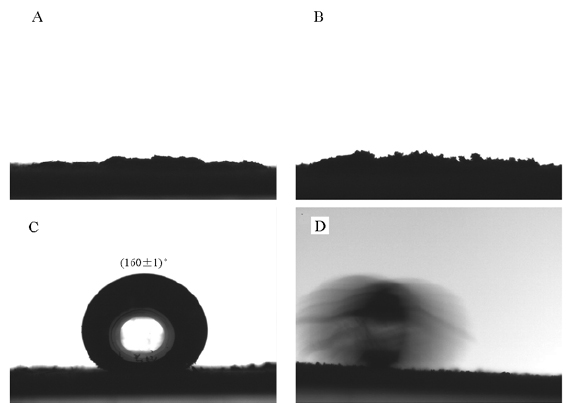
A.pristine corn straw fiber; B.corn straw fiber dip-coated by TiO2 sol; C.water droplet on corn straw fiber treated by dip-coating and surface modification; D.water droplet sliding on superhydrophobic corn straw fiber
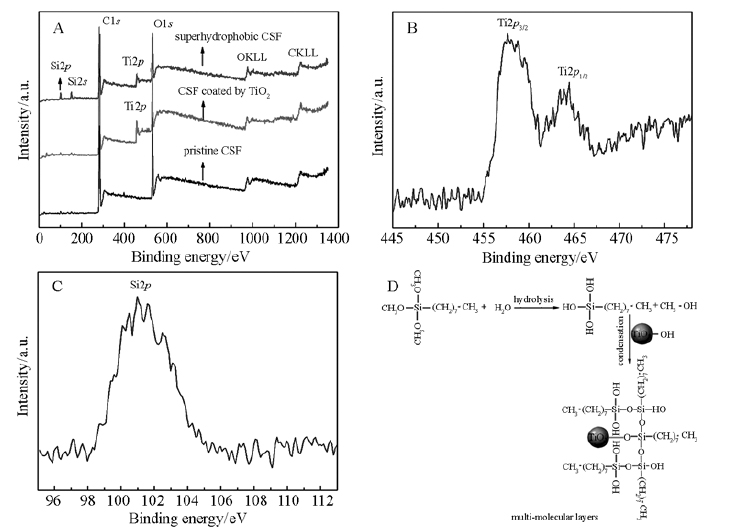
As depicted above, with the process of dip-coating and surface modification, the wettability of corn straw fibers were changed from superhydrophilicity to superhydrophobicity. The sharp conversion between superhydrophilicity to superhydrophobicity can be attributed to the synergistic effects of hierarchical structures and chemical composition with low surface energy, which is induced by surface modification of OTS. Herein, X-ray photoelectric spectroscopy was employed to verify the chemical composition of the as-prepared samples. As for the pristine corn straw fiber, which is mainly composed of cellulose, hemicelluloses and lignin, and the only peaks of C1s and O1s located at 284.6 and 531.1 eV were observed, with the treatments of dip-coating and surface modification, new peaks of Ti2p3/2, Ti2p1/2, Si2s, Si2p located at 458.1, 464.3, 152.1 and 101.7 eV were observed, as shown in Fig. 3A. In order to further verify the chemical composition on the surface of as-prepared sample, the high-resolution XPS spectra of Ti2p3/2, Ti2p1/2 and Si2p are also presented in Fig. 3B and 3C. With the modification of OTS, multi-molecular layer were formed on TiO2 particles due to the reaction of hydrolysis and condensation, and the appearance of new peaks of Ti2p, Si2p of the obtained sample were attributed to the OTS layer self-assembled on TiO2 particles which were stacked on corn straw fiber. The hydrolysis and condensation of OTS and the reaction mechanisms is similar with the reaction between SiO2 particles and silane coupling agent[21], the schematic of reaction mechanism between OTS and TiO2 is shown in Fig. 3D.
Because of the synergistic effects of hierarchical structures and the low surface energy layers self-assembled on TiO2, corn straw fibers with superhydrophobicity were easily obtained. As for the conversion mechanism between superhydrophilicity before modification to superhydrophobicity after modification, which can be discussed on the basis of Wenzel theory and Cassie theory. As for the pristine corn straw fiber and corn straw fiber dip-coated by TiO2 sol, there were massive hydrophilic —OH group attached on the surface, and the rough surface with hierarchical structures makes the hydrophilic surface more hydrophilic, that is called as superhydrophilic[22]. However, with the surface modification with hydrophobic OTS, the self-assembled layer composed of —CH2 and —CH3 were formed due to the condensation reaction between OTS and TiO2. With the surface modification, the surface free energy was sharply decreased because of the self-assembled layer of long chain of alkyl. The chain of long alkyl is composed of —CH2 and —CH3, and the corresponding surface energy is 36 mN/m and 30 mN/m, respectively[23]. Consequently, with the synergistic effects of hierarchical structures and chemical composition with low surface energy, the wettability of the as-prepared corn straw fiber was switched from superhydrophilicity to superhydrophobicity. According to the Cassie′s theory[24], on the superhydrophobic corn straw fiber, air could be trapped in the rough hierarchical structures, and the apparent contact between water droplets and superhydrophobic corn straw fiber is actually a composite contact of air-liquid-solid. When water droplets were dripped on the superhydrophobic corn straw fiber, water droplets kept spherical and were hardly immersed into the microstructures, and the water droplets began to slide off with a slight tilt. As explicated in the literature[25], the roll-off behavior of water droplets on as-prepared sample depends on the metastable state energy and the barrier energy for a drop to move from one metastable state to another. The higher contact angle and the lower tilting angle imply that the as-prepared superhydrophobic corn straw fibers possess higher metastable state energy and lower barrier energy since dual scale decreases both the triple contact line and the wetted surface fraction[26].
On the superhydrophobic corn straw fiber surface, water droplets were spherical and easily to slide off. However, when oil droplets were dripped on the superhydrophobic surface, oil droplets could easily spread over and immediately sank into the corn straw fiber, which shows that the superhydrophobic corn straw fiber is superoleophilic. Compared with water, the surface free energy of oil is relatively lower (for example, the surface tension of hexadecane, dodecane and water is 27.5, 25.4 and 72.8 mN/m, respectively[27]), therefore, the oil droplet is much easier than water droplet to spread on a solid surface. With the repellency to water and selective adsorption to oil, the as-prepared corn straw fiber with superhydrophobicity-superoleophilicity can be employed to remove the oil floating on water.
With the merits of low cost, biodegradability and plentiful biomass, the as-prepared corn straw fibers with superhydrophobic and superoleophilic performances can be an candidate of oil absorbent to remove the spilled oil in water. In the simulation experiment presented here, hexadecane was firstly dyed with Oil Red-O for clear observation, then 1.00 mL hexadecane with the mass of 0.773 g was dripped into water carefully, and the oil kept floating on water surface due to the low density and the immiscibility of oil in water, as shown in Fig. 4A. Then, corn straw fibers were carefully cast into the oil, as a result, 0.527 g pristine corn straw fibers and 0.412 g superhydrophobic/superoleophilic corn straw fibers were needed in order to thoroughly adsorb the spilled oil. During this process, the superhydrophobic corn straw fibers self-floated steadily on water due to the high buoyancy induced by the water repellency, while some pristine corn straw fibers began to sink into water due to its superhydrophilicity, as depicted in Fig. 4B. Finally, the corn straw fibers adsorbed spilled oil were carefully removed by a 177 μm copper mesh. As a result, the water surface treated by superhydrophobic corn straw fibers is relatively clean, and there were no obvious oil residues left compared the other surface treated by pristine corn straw fiber, as shown in Fig. 4C. The results show that the removal efficiency of superhydrophobic corn straw fiber to spilled oil on water is mcuh higher. Then, the corn straw fibers adsorbed oil were transferred into a double-layer tube, and there are some micro holes at the bottom of the inner tube. Put the double-layer tube in a centrifuge, with the imposed action of high centrifugation, the oil or water adsorbed by corn straw fibers was separated from corn straw fiber and successively obtained. The retrieved oil from superhydrophobic corn straw fibers is about 0.52 mL, and no observable water was collected due to its simultaneous performances of superhydrophobicity and superoleophilicity. However, with the handles of the pristine corn straw fibers, both 0.45 mL oil and 0.60 mL water were collected together due to the properties of superhydrophilicity and superoleophilicity, as shown in the inset of Fig. 4D. As for the original superhydrophobic corn straw fibers, it was still superhydrophobic after being treated by high speed centrifugation, and the water droplet on the corn straw fibers still kept spherical, as shown in Fig. 4D.
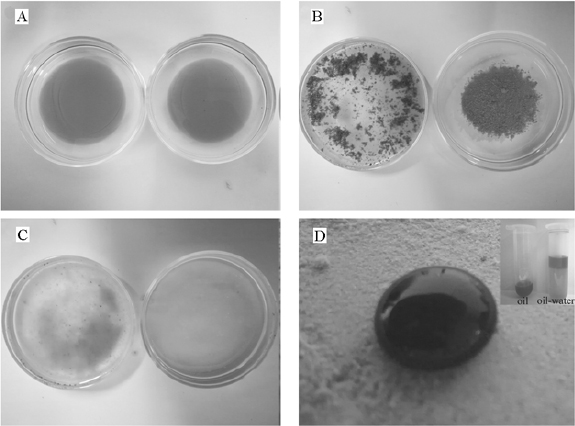
A.hexadecane floating on water surface; B.water surface with the addition of pristine corn straw fiber and superhydrophobic corn straw fiber; C.water surface with the removal of corn straw fiber; D.water droplet on the recovered corn straw fiber. The inset is the collected oil and oil-water mixture, the hexadecane was dyed with oil red dye for clear observation
In order to further evaluate the maximum absorption capability of as-prepared corn straw fiber to oil, 0.2514 g superhydrophobic corn straw fiber sealed in a 100 μm nylon net bag was suspended into a beaker filled with 50 mL hexadecene at room temperature. 30 min later, nylon net bag was taken out and hung in the air for 10 min, and the mass of hexadecane adsorbed by superhydrophobic corn straw fiber could be calculated according to the following equation (1):
|
$ q = \left( {{m_2} - {m_1}} \right)/{m_1} $ |
(1) |
In this equation, m2 (g) and m1 (g) separately denote the mass of corn straw fiber adsorbed oil and the corn straw fiber prior to oil absorption, m2=1.0047 g, m1=0.2514 g, and the maximum absorption capacity q is calculated to be about 3.16 g/g.
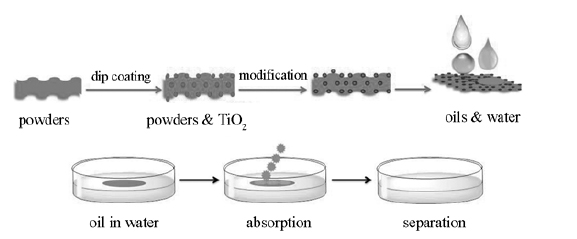
In brief, the corn straw fibers obtained by dip-coating TiO2 sol and modifying with OTS exhibit the simultaneous performances of superhydrophobicity and superoleophilicity. Water droplets kept spherical on the superhydrophobic corn straw fibers while oil droplets fully spread over the corn straw fibers. With the water repellency and selective adsorption to oil, the as-prepared corn straw fibers could be employed to remove and collect oil floating on water, both the corn straw fibers and the adsorbed oil could be recovered with the treatments of high speed centrifugation. The preparation schematic diagram of corn straw fibers with superhydrophobicity-superoleophilicity and application in the removal of spilled oil in water is shown in Fig. 5.
Besides the hexedecane, the superhydrophobic/superoleophilic corn straw fibers could also be employed to remove other oil spilled in water. Similar with the approach described above, 1 mL pentadecane, butadecane, tridecane, dodecane, diesel and edible oil named golden dragon fish oil, the corresponding mass of 0.769, 0.763, 0.756, 0.749, 0.830 and 0.920 g, were firstly dribbled into the water, respectively. Then, 0.420, 0.426, 0.420, 0.432, 0.429, 0.393 g corn straw fiber were respectively needed in order to thoroughly remove the spilled oil. With the mass of oil and corn straw fiber, the adsorption capacity of the as-prepared corn straw fiber to hexadecane, pentadecane, butadecane, tridecane, dodecane, diesel and golden dragon fish oil could be obtained as 1.876, 1.830, 1.790, 1.789, 1.770, 1.936 and 2.341 g/g, respectively, as shown in Fig. 6A. With the treatment of high speed centrifugation, the spilled oil were obtained again, and the mass of recovered oil of hexadecane, pentadecane, butadecane, tridecane, dodecane, diesel and golden dragon fish oil is 0.475, 0.524, 0.510, 0.528, 0.458, 0.482 and 0.502 g, respectively, and then, the corresponding recovery efficiency could be figured out, which is about 61.5%, 68.2%, 66.8%, 69.9%, 61.2%, 58.1% and 54.5%, respectively, as demonstrated in Fig. 6B. In the removal of the spilled hexadecane in water, the superhydrophobic corn straw fibers could be reused at least for 12 times with the treatments of centrifugation and subsequent annealing in an oven at 120 ℃ for 5 h, and the recovery efficiency did not obviously decrease with the increases of separation times, as depicted in Fig. 6C. In the process of cycle using, the water contact angle on the surface of the recovered corn straw fiber always maintained to be about (157±2)°, as shown in Fig. 6D. Moreover, the as-prepared corn straw fibers could always keep superhydrophobic with a water contact angle larger than 150° even the samples were exposed to ambient air at room temperature for 90 days, which indicates the perfect stability and durability. With the merits of biodegradability, stable durability and recyclability, the as-prepared superhydrophobic corn straw fiber may be used as a potential oil absorbent in the use of oil cleanup.
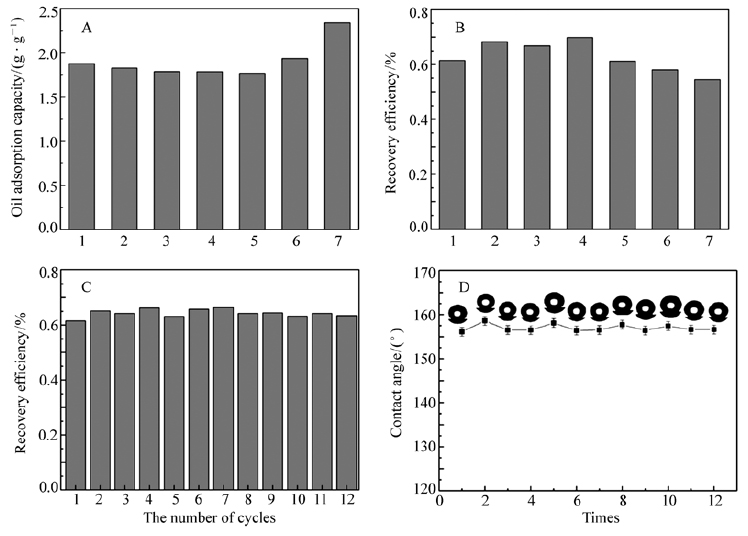
Note: the number of 1~7 in Fig (A) and (B) denotes the hexadecane, pentadecane, butadecane, tridecane, dodecane, diesel and golden dragon fish oil, respectively
In this contribution, corn straw fibers with simultaneous performances of superhydrophobicity and superoleophilicity were prepared by combination of coating TiO2 sol and octyltrimethoxysilane (OTS) modification. The results indicate that the superhydrophobicity of the as-prepared samples was attributed to the combined effects of hierarchical structures and chemical composition with low surface energy induced by the modification of OTS. With the water repellency and selective adsorption to oil, the samples could be employed to remove spilled oil on water. With the subsequent treatments of high speed centrifugation, both the corn straw fibers and spilled oil could be recovered, and the as-prepared samples could be repeatedly used in the removal of the spilled oil. With the merits of easy biodegradability, high buoyancy and stable durability as well as recyclability, the superhydrophobic/superoleophilic corn straw fibers could be employed as a potential oil absorbent and used in the field of oil cleanup.
Wang C F, Tzeng F S, Chen H G. Ultraviolet-Durable Superhydrophobic Zinc Oxide-Coated Mesh Films for Surface and Underwater-Oil Capture and Transportation[J]. Langmuir, 2012, 28(26): 10015-10019. doi: 10.1021/la301839a
Chu Z L, Feng Y J, Seeger S. Oil/Water Separation with Selective Superantiwetting/Superwetting Surface Materials[J]. Angew Chem Int Ed, 2015, 54(8): 2328-2338. doi: 10.1002/anie.201405785
Gu J H, Fan H W, Li C X. Robust Superhydrophobic/Superoleophilic Wrinkled Microspherical MOF@rGO Composites for Efficient Oil-Water Separation[J]. Angew Chem, 2019, 131(16): 5351-5355. doi: 10.1002/ange.201814487
Nanda D, Sahoo A, Kumar A. Facile Approach to Develop Durable and Reusable Superhydrophobic/Superoleophilic Coatings for Steel Mesh Surfaces[J]. J Colloid Interfaces Sci, 2019, 535: 50-57. doi: 10.1016/j.jcis.2018.09.088
Yu T L, Lu S X, Xu W G. Preparation of Superhydrophobic/Superoleophilic Copper Coated Titanium Mesh with Excellent Ice-Phobic and Water-Oil Separation Performance[J]. Appl Surf Sci, 2019, 476: 353-362. doi: 10.1016/j.apsusc.2019.01.117
Gao M L, Zhao S Y, Chen Z Y. Superhydrophobic/Superoleophilic MOF Composites for Oil-Water Separation[J]. Inorg Chem, 2019, 58(4): 2261-2264. doi: 10.1021/acs.inorgchem.8b03293
Wang S T, Liu K S, Yao X. Bioinspired Surfaces with Superwettability:New Insight on Theory, Design, and Applications[J]. Chem Rev, 2015, 115: 8230-8293. doi: 10.1021/cr400083y
Öner D, McCarthy T J. Ultrahydrophobic Surfaces. Effects of Topography Length Scales on Wettability[J]. Langmuir, 2000, 16(20): 7777-7782. doi: 10.1021/la000598o
Wang R, Hashimoto K, Fujishima A. Photogeneration of Highly Amphiphilic TiO2 Surfaces[J]. Adv Mater, 1998, 10(2): 135-138.
Cao M, Luo X M, Ren H J. Hot Water-Repellent and Mechanically Durable Superhydrophobic Mesh for Oil/Water Separation[J]. J Colloid Interfaces Sci, 2018, 512: 567-574. doi: 10.1016/j.jcis.2017.10.059
Xiang Y Q, Pang Y Y, Jiang X M. One-step Fabrication of Novel Superhydrophobic and Superoleophilic Sponge with Outstanding Absorbency and Flame-Retardancy for the Selective Removal of Oily Organic Solvent from Water[J]. Appl Surf Sci, 2018, 428: 338-347. doi: 10.1016/j.apsusc.2017.09.093
Wu H, Wu L H, Lu S C. Robust Superhydrophobic and Superoleophilic Filter Paper via Atom Transfer Radical Polymerization for Oil/Water Separation[J]. Carbohydr Polym, 2018, 181: 419-425. doi: 10.1016/j.carbpol.2017.08.078
Wang Y K, Wang B, Wang J H. Superhydrophobic and Superoleophilic Porous Reduced Graphene Oxide/Polycarbonate Monoliths for High-Efficiency Oil/Water Separation[J]. J Hazard Mater, 2018, 344: 849-856. doi: 10.1016/j.jhazmat.2017.11.040
Yang J, Zhang Z Z, Xu X H. Superhydrophilic Superoleophobic Coatings[J]. J Mater Chem, 2012, 22: 2834-2837. doi: 10.1039/c2jm15987b
Zhang F, Zhang W B, Shi Z. Nanowire-Haired Inorganic Membranes with Superhydrophilicity and Underwater Ultralow Adhesive Superoleophobicity for High-Efficiency Oil/Water Separation[J]. Adv Mater, 2013, 25: 4192-4198.
Sun X F, Sun J X. Acetylation of Rice Straw with or Without Catalysts and Its Characterization as a Natural Sorbent in Oil Spill Cleanup[J]. J Agric Food Chem, 2002, 50: 6428-6433. doi: 10.1021/jf020392o
Zhu H L, Luo W, Ciesielski P N. Wood-Derived Materials for Green Electronics, Biological Devices, and Energy Applications[J]. Chem Rev, 2016, 116: 9305-9374. doi: 10.1021/acs.chemrev.6b00225
Zang D, Zhang M, Liu F. Superhydrophobic/Superoleophilic Corn Straw Fibers as Effective Oil Sorbents for the Recovery of Spilled Oil[J]. J Chem Technol Biotechnol, 2016, 91(9): 2449-2456. doi: 10.1002/jctb.4834
石彦龙, 冯晓娟, 王永生. 玉米秸秆油污吸附剂的制备及其在油水分离中的应用[J]. 科学通报, 2019,64,87-94. SHI Yanlong, FENG Xiaojuan, WANG Yongsheng. Preparation of Oil Sorbents of Corn Straw and Its Application in Oil-Water Separation[J]. Chinese Sci Bull, 2019, 64: 87-94.
Shi Y L, Feng X J, Yang W. Preparation of Super-hydropbobic Titanium Oxide Film by Sol-Gel on Substrate of Common Filter Paper[J]. J Sol-Gel Sci Technol, 2011, 59: 43-47. doi: 10.1007/s10971-011-2459-y
陈凯玲, 赵蕴慧, 袁晓燕. 二氧化硅粒子的表面化学修饰-方法、原理及应用[J]. 化学进展, 2013,25,95-104. CHEN Kailing, ZHAO Yunhui, YUAN Xiaoyan. Chemical Modification of Silica:Method, Mechanism, and Application[J]. Prog Chem, 2013, 25: 95-104.
Wenzel R N. Resistance of Solid Surfaces to Wetting by Water[J]. Ind Eng Chem, 1936, 28(8): 988-994. doi: 10.1021/ie50320a024
Tsibouklis J, Stone M, Thorpe A A. Surface Energy Characteristics of Polymer Film Structures:A Further Insight into the Molecular Design Requirements[J]. Langmuir, 1999, 15(20): 7076-7079. doi: 10.1021/la990411x
Cassie A B D, Trans S B. Wettability of Porous Surfaces[J]. Faraday Soc, 1944, 40: 546-551. doi: 10.1039/tf9444000546
Gross M, Varnik F, Raabe D. Small Droplets on Superhydrophobic Substrates[J]. Phys Rev E, 2010, 81: 051606.
Gao L C, Mc Carthy T J. Contact Angle Hysteresis Explained[J]. Langmuir, 2006, 22(14): 6234-6237. doi: 10.1021/la060254j
Yong J L, Chen F, Yang Q. Superoleophobic Surfaces[J]. Chem Soc Rev, 2017, 46(14): 4168-4217. doi: 10.1039/C6CS00751A

Figure 1 SEM images of pristine corn straw fiber (A), corn straw fiber dip-coated by TiO2 sol (B,C), corn straw fiber treated by dip-coating and surface modification (D)

Figure 2 Optical images of a water droplet on the surfaces of corn straw fibers
A.pristine corn straw fiber; B.corn straw fiber dip-coated by TiO2 sol; C.water droplet on corn straw fiber treated by dip-coating and surface modification; D.water droplet sliding on superhydrophobic corn straw fiber

Figure 3 (A)XPS spectra of corn straw fiber (abbreviated as CSF); (B,C)high resolution XPS of Ti2p and Si2p of superhydrophobic CSF; (D)Schematic of reaction mechanism between OTS and TiO2

Figure 4 Images of the removal of hexadecane by corn straw fiber
A.hexadecane floating on water surface; B.water surface with the addition of pristine corn straw fiber and superhydrophobic corn straw fiber; C.water surface with the removal of corn straw fiber; D.water droplet on the recovered corn straw fiber. The inset is the collected oil and oil-water mixture, the hexadecane was dyed with oil red dye for clear observation

Figure 5 Schematic diagram of the preparation and use of superhydrophobic-superoleophilic corn straw fibers as oil absorbent

Figure 6 Adsorption capacity(A), and recovery efficiency(B) of as-prepared corn straw fibers in the removal of the spilled oil in water; (C) and (D) are the recovery efficiency and contact angles of superhydrophobic corn straw fiber varying with the increases of separation times in the removal of the hexadecane
Note: the number of 1~7 in Fig (A) and (B) denotes the hexadecane, pentadecane, butadecane, tridecane, dodecane, diesel and golden dragon fish oil, respectively

 扫一扫看文章


扫一扫关注我们
 下载:
下载:
 下载:
下载: