
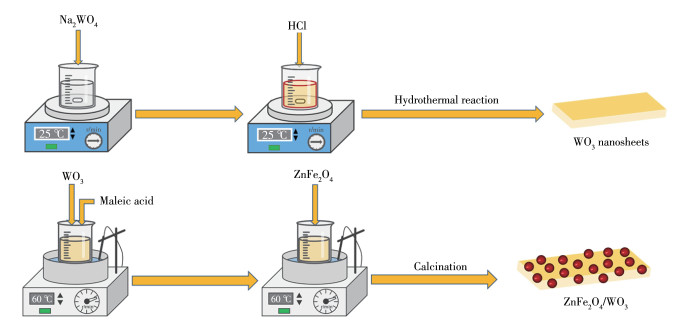
Figure 1.
Schematic diagram of the preparation process of ZFO/WO composites


The increase in carbon dioxide (CO2) concentration in the Earth′s atmosphere has significantly impacted global temperature, exacerbating the greenhouse effect. Therefore, slowing down the rise of carbon dioxide in the atmosphere and striving for carbon neutrality are two important global priorities in the forthcoming decades[1]. Among diverse strategies to mitigate CO2 concentration, solar-driven photocatalytic conversion of CO2 to value-added chemical products/fuels is regarded as an auspicious method that can provide effective remedial measures for energy crisis and environmental predicaments[2-3]. To this end, the development of efficient photocatalysts is a necessary prerequisite for achieving this goal. Over the past decades, various semiconducting photocatalysts, such as CdS[4], ZnO[5], BiOX[6], NiCo2O4[7], and g-C3N4[8-9], have been exploited for CO2 reduction since the pioneering work of Inoue et al[10]. However, the efficiency of CO2 conversion for existing photocatalysts is still far from meeting the requirements for industrial applications so far. Hence, designing and synthesizing novel photocatalysts has been a focus of research in the field of CO2 reduction.
As one of the most important spinel-type complex oxides, zinc ferrite (ZnFe2O4) has been widely used for photocatalytic degradation of pollutants, lithium-ion batteries, heterogeneous catalysis, photocatalysis, and biomedical applications owing to its unique physical, chemical, optical and electronic properties[7, 11-13]. In terms of photocatalytic applications, ZnFe2O4 has been studied in the fields of photocatalytic hydrogen production, water splitting, and CO2 conversion due to its narrow bandgap of ca. 1.9 eV, chemical stability, and unique electronic structure[14-16]. For instance, Li et al.[17] demonstrated that ultrafine ZnFe2O4 nanoparticles can convert CO2 into ethanol and acetaldehyde under visible light illumination. To prevent ZnFe2O4 from agglomerating, Yan et al.[18] in situ grew ZnFe2O4 nanoparticles on iron porphyrin covalent triazine-based frameworks via an ion-thermal method. With the assistance of Ru(bpy)3, the as-prepared material exhibited higher photocatalytic CO2 reduction activity under visible light compared to pure ZnFe2O4. However, the efficiency of photocatalytic CO2 reduction of ZnFe2O4 is still far below the real demand due to the issues that arise from light harvesting, intensive recombination of electron-hole pairs, and insufficient conduction band potential[19].
Construction of heterojunction structures, especially S-scheme (or Z-scheme) photocatalytic systems[20-21], can effectively overcome above mentioned problems by enhancing the separation of photoinduced charges, broadening the light absorption range, and widening the redox potentials[22-23]. Recently, different ZnFe2O4-based heterojunction photocatalysts with an S-/Z-scheme charge transfer model have been synthesized and exhibit impressive CO2 photoreduction activity[14, 24-25]. WO3, another photo-electronically active semiconductor, is a popular material in the field of photo(electro)catalysis due to its unique features, including narrow bandgap, non-toxicity, and chemical stability[26]. In particular, WO3 exhibits high oxidizing ability on account of its sufficient positive valence band (VB) maximum[27]. However, to the best of our knowledge, there are currently no reports on the construction of ZnFe2O4/WO3 heterojunctions for photocatalytic CO2 reduction[28].
In the present study, we synthesized a series of heterojunction ZnFe2O4/WO3 nanocomposites by loading different amounts of ZnFe2O4 nanoparticles on the surface of WO3 nanoplates. The band structure of the typical ZnFe2O4/WO3 composite was characterized and determined by UV-Vis diffuse reflection spectroscopy (UV-Vis DRS), Mott-Schottky plots, and X-ray photo-electron spectroscopy valence band (XPS-VB) spectrum. The photoreduction CO2 performance of the as-prepared samples was measured in the presence of water vapor under the irradiation of sunlight simulated by xenon light. The results show that the optimized ZnFe2O4/WO3 sample exhibits better photocatalytic CO2 conversion activity than pure ZnFe2O4 and bare WO3. The enhanced photocatalytic activity is ascribed to the effective separation of photoinduced charges and the widening of the redox potentials. An S-scheme charge transfer mode between ZnFe2O4 and WO3 heterojunctions is further proposed.
All chemicals were used as received without any further purification.
The WO3 nanosheets were synthesized by a hydrothermal method[29]. 1.979 g Na2WO4·2H2O was dissolved in 90 mL of distilled water, and 90 mL of concentrated hydrochloric acid (36%-38%) was added dropwise with constant stirring. After continuing to stir for 1 h, the mixture was transferred to a hydrothermal reactor, and heated at 180 ℃ for 12 h. After centrifugation, the obtained products were washed three times with distilled water and dried at 100 ℃ for 12 h.
Before synthesizing ZnFe2O4/WO3 nanocomposites, ZnFe2O4 was first synthesized via a facile solvent-thermal route[30]. 1 mmol of ZnCl2 and 2 mmol of FeCl3 were dissolved in 80 mL of ethylene glycol while stirring. Subsequently, 8 mmol of NaOH was added to the solution at room temperature. The resulting mixture was then transferred to a Teflon-lined stainless autoclave and heated to 180 ℃ for a duration of 12 h. Afterward, the obtained precipitate was subjected to centrifugation, washing, and drying.
To construct ZnFe2O4/WO3 heterostructure, 0.232 g of the synthesized WO3 powder was first dispersed in 30 mL deionized water, and then 0.5 g of maleic acid and different amounts of ZnFe2O4 were added to the suspension[31]. It is worth noting that the introduction of maleic acid is to make the connection between ZnFe2O4 and WO3 closer in subsequent treatment[32]. After the mixture was stirred for 12 h at 60 ℃, the obtained products were collected, washed, and dried. Subsequently, the dried products were calcined at 300 ℃ for 3 h. The preparation process of ZnFe2O4/WO3 composites is illustrated in Fig. 1.
The added amounts of ZnFe2O4 relative to 1 mmol of WO3 powder were set as 0.05, 0.1, 0.15, 0.2, 0.25, 0.3, 0.5, 0.7, 1, and 2 mmol, respectively. For clarity, the correspondingly calcined products were labeled as xZFO/WO, where x=0.05, 0.1, 0.15, 0.2, 0.25, 0.3, 0.5, 0.7, 1, and 2, respectively.
Powder X-ray diffraction (PXRD) measurements were performed with a PANalytical X′pert PRO diffractometer using Cu Kα1 radiation (λ=0.154 06 nm) at 40 kV and 15 mA in a 2θ range of 10°-80° at a scanning rate of 5 (°)·min-1. Microscopic morphology was examined via transmission electron microscopy (TEM, FEI Tecnai G2 F20) at 200 kV and spot size 2. The light absorption properties of the catalysts were determined by a UV-Vis spectrophotometer (Agilent Cary 5000). The electrochemical workstation (Chen Hua CHI 660E) was used to perform the photoelectrochemical tests. Specific tests included transient photocurrent test (initial voltage E=1.0 V, total test time t=130 s, with or without light interval 10 s); impedance size test (initial voltage E=1.0 V, frequency 105 Hz); Mott-Schottky curve test (initial voltage E=-1 V, final voltage E=1.2 V, selected frequency of 1 000 Hz).
The photocatalytic CO2 reduction activity of the catalysts was evaluated under full spectrum illumination, employing a 300 W Xenon lamp as the light source. Each time an experiment was performed, 20 mg of the catalyst was uniformly distributed onto a circular glass substrate, which was subsequently placed within a stainless-steel photocatalytic reactor. Prior to commencing the photocatalytic CO2 reduction performance assessment, the reactor was evacuated using a vacuum pump, and a mixture of CO2 and water vapor was introduced into the photocatalytic reactor. This purging process was iterated five times to remove air. After illumination for 5 h, gas chromatography (Agilent 7820A) equipped with a methanator, a flame ionization detector, and a thermal conductivity detector was utilized to quantify the yields of photocatalytic products.
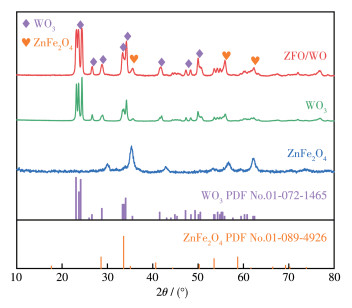
Fig. 2 shows the PXRD patterns for the representative sample 0.15ZFO/WO along with pure ZnFe2O4 and WO3 for comparison. The specific diffraction peaks observed at 29.97°, 35.31°, 42.89°, 53.18°, 56.69°, and 62.25° can be attributed to the cubic ZnFe2O4 phase[33] (PDF No. 01-089-4926), whereas the diffraction patterns of WO3 closely match the characteristic peaks of the standard monoclinic phase WO3[34] (PDF No.01-072-1465). For 0.15ZFO/WO, all the XRD patterns can be well indexed to the cubic ZnFe2O4 phase and monoclinic phase of WO3 with no appearance of other impurities.
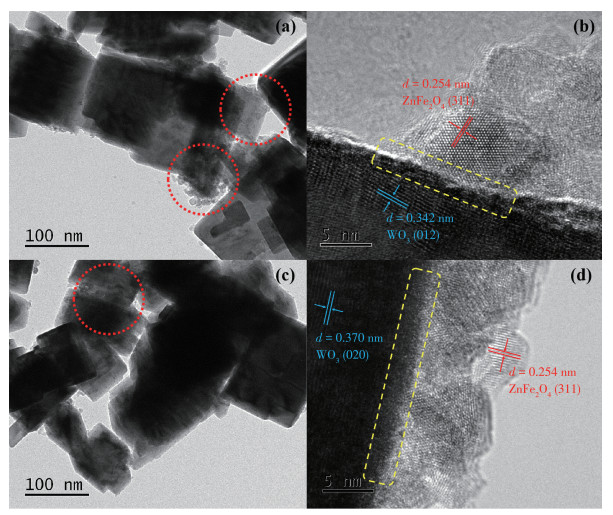
The morphology and microstructure of the representative sample 0.15ZFO/WO were measured using TEM and HRTEM, and the images are displayed in Fig. 3. As discerned in Fig. 3a, WO3 exhibited a well-defined nanoplate structure, with dimensions of approximately 200 nm in both length and width, presenting a notably smooth surface. In Fig. 3b, the fine ZnFe2O4 nanoparticles were conspicuously adhered to the surface and periphery of the nanoplates, with the interface delineated clearly in the high-resolution TEM (HRTEM) images (Fig. 3c and 3d).
The lattice fringes of ZnFe2O4 nanosheets and WO3 nanoparticles were observed through HRTEM (Fig. 3c and 3d), in which the interplanar spacings of 0.342 and 0.370 nm can be indexed to the (012) and (020) planes of WO3[35], and the interplanar space of 0.254 nm can be indexed to the (311) plane of ZnFe2O4[36]. On the other hand, the formation of heterojunctions could be observed at the interface between ZnFe2O4 and WO3, as marked by the yellow frames in Fig. 3b and 3d.
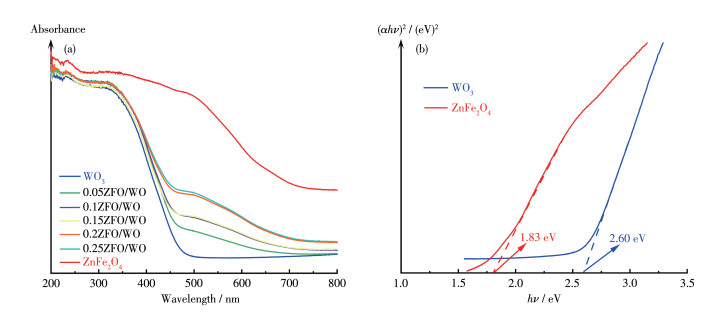
The light absorption characteristics of WO3, ZnFe2O4, and xZFO/WO (x=0.05, 0.1, 0.15, 0.2, 0.25) samples were examined in a range of 200-800 nm via UV-Vis DRS, and the results are presented in Fig. 4. The absorption onset for pure WO3 and ZnFe2O4 was observed at approximately 470 and 670 nm, respectively, in agreement with those reported[37-38]. For the xZFO/WO samples, the absorption capacity increased proportionally with the increment in ZnFe2O4 loading content. Notably, both WO3 and ZnFe2O4 exhibit characteristics of direct bandgap semiconductors[39-40]. The direct bandgap of the samples was estimated from the Kubelka-Munk function[41]. The function equation is (αhν)2 = A(hν-Eg), where α, hν, Eg, and A represent absorption coefficient, photon energy, band gap (eV), and constant, respectively. By extrapolating this figure to (αhν)2=0, it was estimated that the bandgap of WO3 and ZnFe2O4 was ca. 2.60 and ca. 1.83 eV, respectively (Fig. 4b). The results are consistent with those reported previously[39, 42].
To promote the formation of heterojunctions between ZnFe2O4 and WO3, different amounts of maleic acid to central ions were introduced as a capping agent in the preparation process, followed by calcination treatment. The effects of adding a capping agent and heat treatment on the photocatalytic CO2 reduction activity were evaluated. Fig. 5a shows the effects of adding different amounts of maleic acid as well as not adding maleic acid on the photocatalytic CO2 reduction activities after illumination for 5 h. Considering that in CO2 reduction products, producing 1 mol of methane requires 8 mol of electrons, while producing 1 mol of CO and H2 requires only 2 mol of electrons, we used Eq. 1 to quantify the total number of electrons (N, μmol·g-1) involved in the entire reaction to further compare photocatalytic activity. Fig. 5a shows the yields of CH4, CO, and H2 produced by 0.15ZFO/WO with different maleic acid loadings, 0.15ZFO/WO without maleic acid loading, and the physical mixture of ZnFe2O4 and WO3, as well as the total number of electrons required.
|
|
(1) |
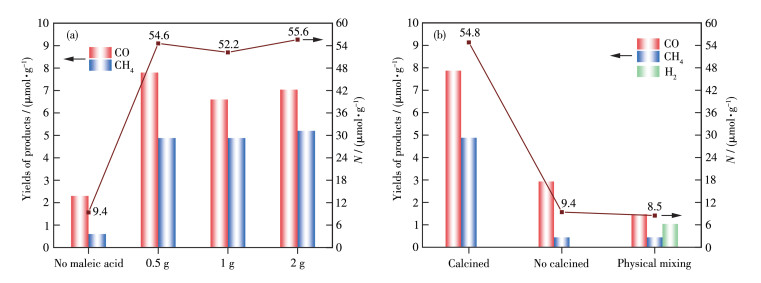
Without the addition of maleic acid, the CO and CH4 yields of the obtained samples were 2.3 and 0.6 μmol·g-1, respectively. By contrast, the CO and CH4 yields of the samples added with maleic acid increased significantly. For instance, the yields of CO and CH4 of 0.5ZFO/WO reached 7.87 and 4.88 μmol·g-1, respectively. The increase in the yields may be attributed to the addition of maleic acid promoting the interphase interaction between ZnFe2O4 and WO3[32]. It is worth noting that adding more than 0.5 g of maleic acid will not further improve the photocatalytic CO2 conversion efficiency, implying that under the conditions of this experiment, 0.5 g of maleic acid is sufficient to facilitate the grafting of ZnFe2O4 onto the surface of WO3. However, the effect of maleic acid can only be manifested after calcination, as shown in Fig. 5b. Compared with the calcined sample, the CO and CH4 yields of the uncalcined specimen and the physical mixed sample were significantly reduced, as shown in Fig. 5b. The consequences obtained from the total number of electrons are consistent with above results.
The effects of loading amount of ZnFe2O4 on photocatalytic CO2 activity were further studied (Fig. 6). For pure WO3, almost no CO and CH4 products were detected. Upon successful loading of ZnFe2O4 nanoparticles onto the surface of WO3 nanosheets, the CO and CH4 yields for all the samples increased. When the molar ratio of ZnFe2O4 to WO3 was 0.15, the yields of CO and CH4 reached their maximum values, attaining 7.87 and 4.88 μmol·g-1, respectively. Further increasing the loading of ZnFe2O4, the yields of CO and CH4 decreased instead. It is worthy of special attention that when the load amount of ZnFe2O4 exceeded 0.7, H2 began to appear in the CO2 reduction product. The reason may be the presence of single-phase ZnFe2O4. Accordingly, compared to the H2O reduction reaction, the formation of xZFO/WO heterojunctions is beneficial for the CO2 reduction reaction. From another perspective, the types and yields of CO2 reduction products can be regulated by adjusting the composition of the materials, as shown in Fig. 6a and Fig. 6b.
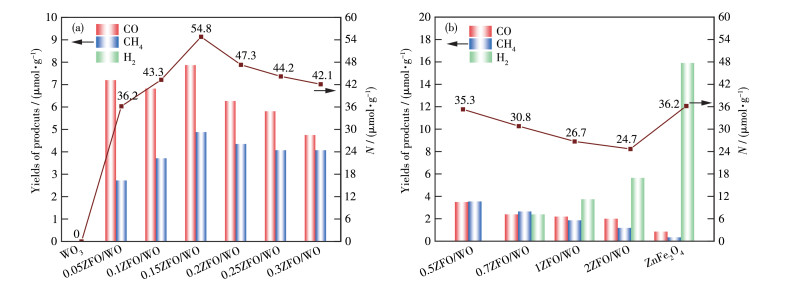
To further evaluate photocatalytic activity, we also quantified the total number of electrons for ZnFe2O4 and xZFO/WO using Eq. 1. For all the composites, 0.15ZFO/WO achieved the highest electrons (54.8 μmol·g-1), which was approximately 1.5 times that of pure ZnFe2O4 (36.2 μmol·g-1). The enhancement of electron transfer number counts may be attributed to the formation of heterojunctions between the grain boundary of ZnFe2O4 and WO3, which promotes the separation efficiency of photogenerated electrons and holes as shown below.
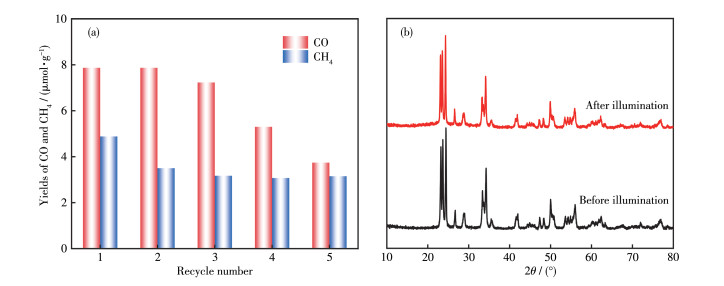
To assess the stability, the 0.15ZFO/WO sample was selected, and conducted five consecutive photocatalytic cycles with each cycle lasting 5 h. Fig. 7a shows the cyclic test results for 0.15ZFO/WO. The yields of CO and CH4 after three cycles remained at 7.23 and 3.17 μmol·g-1, respectively, almost equivalent to the initial values. However, the CO and CH4 yields after five cycles were 3.74 and 3.15 μmol·g-1, indicating partial deactivation of the catalyst. Fig. 7b compares the XRD patterns of the 0.15ZFO/WO sample before and after five cycles of illumination. No obvious changes were found. Further in-depth research is needed on the underlying reasons for the partial deactivation of catalysts.
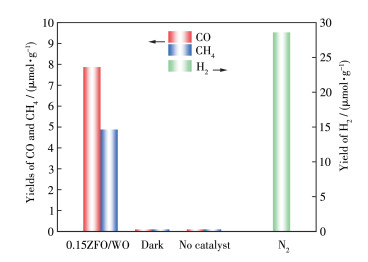
Blank and control tests were carried out to elucidate the source of C in CO and CH4, and the test results of the 0.15ZFO/WO sample are shown in Fig. 8. When CO2 in the reaction system was replaced by N2, only H2 was detected in the products, but no other products such as CO and CH4 were detectable within the detection limit of our instrument. The results indicate that the products CO and CH4 are produced from CO2. In addition, under the conditions of no catalysts or in the dark, CO and CH4 yields were extremely low, suggesting that photocatalysts and light are essential conditions for photocatalytic CO2 reduction.
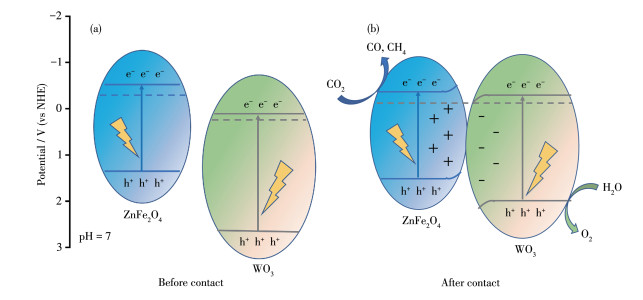
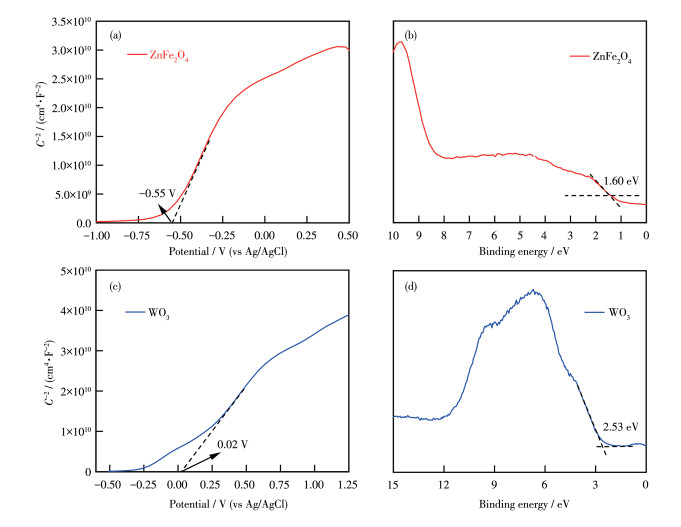
The band edge potentials of the composites are of critical importance because they have a direct impact on the redox reactions occurring at the catalyst surface[43]. Firstly, the flat band potentials of WO3 and ZnFe2O4 were determined using the Mott-Schottky analysis method. The obtained flat band potentials for WO3 and ZnFe2O4 were 0.02 and -0.55 V (vs Ag/AgCl), respectively (Fig. 9a and 9c). It is known that the flat band potential of n-type semiconductors corresponds to the Fermi level (Ef). Considering the 0.197 V difference between the standard hydrogen electrode (NHE) and the Ag/AgCl electrode[44], the Ef for WO3 and ZnFe2O4 was calculated to be 0.22 and -0.35 V (vs NHE)[38]. Secondly, the XPS-VB spectra of WO3 and ZnFe2O4 were measured, and the results are displayed in Fig. 9b and 9d. According to the linear intersection method[45], the differences between the EVB and Ef for WO3 and ZnFe2O4 were 2.53 and 1.60 eV, respectively. Consequently, the calculated VB potentials for WO3 and ZnFe2O4 were determined to be 2.75 and 1.25 V (vs NHE). According to the equation: ECB=EVB-Eg[46], the CB potentials for WO3 and ZnFe2O4 can thus be calculated to be 0.15 and 0.58 V (vs NHE), respectively. Accordingly, the band energy of WO3 and ZnFe2O4 before contact can be schemed (Fig. 10a).
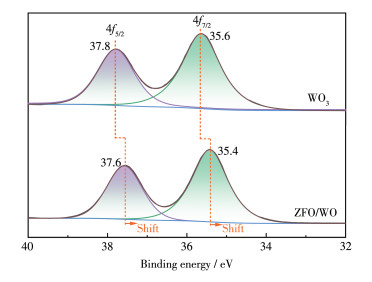
The change in elemental binding energies reflects the alteration in electron density and thus can be used to examine the direction of carrier transfer in heterojunction photocatalysts[47]. The results of XPS analysis of 0.15ZFO/WO showed that the binding energies of W4f7/2 (35.6 eV) and W4f5/2 (37.8 eV) shifted to lower binding energies compared to the pure WO3 (Fig. 11)[28]. This implies that the electrons in ZnFe2O4 flow to WO3, and the built-in electric field is generated[48].
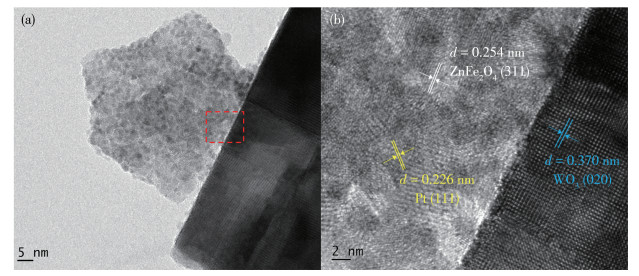
When ZnFe2O4 is in contact with WO3, the electrons in ZnFe2O4 flow towards WO3 until the Fermi level flattens out due to the difference between Fermi levels[49]. As a result, the electron band of ZnFe2O4 bends upward while that of WO3 bends downward. Under light irradiation, the VB electrons of WO3 and ZnFe2O4 are excited up and the separation process of the photoexcited charges can be drawn diagrammatically as Fig. 10b. Under the action of the internal electric field, the holes in the VB of ZnFe2O4 recombine with the electrons in the conduction band of WO3. The electrons in the conduction band of ZnFe2O4 participate in the reduction reaction to reduce CO2 to CO and CH4, whereas the holes in the VB of WO3 participate in the oxidation reaction to oxidize H2O. Thus, an S-scheme charge transfer mode is formed between the heterojunctions of ZnFe2O4 and WO3. The formation of S-scheme heterojunctions is not only beneficial for the spatial separation of photogenerated carriers but also promotes photocatalytic CO2 reduction[34, 50].To verify the S-scheme mode, the tests of Pt photo-deposition were performed on ZFO/WO. TEM and HRTEM images are shown in Fig. 12. The Pt nanoparticles with lattice stripes of 0.226 nm, corresponding to the (111) crystallographic spacing of Pt, were present only on ZnFe2O4. It is reported that Pt nanoparticles are selectively deposited on the material zone with high electron density[51]. The results show that the photogenerated electrons in the ZnFe2O4/WO3 heterojunction are concentrated on ZnFe2O4, thus confirming the S-scheme charge transfer mode.
To assess the efficiency of photogenerated electron-hole separation and migration, transient photocurrent, and electrochemical impedance tests were conducted[52]. Fig. 13a presents the transient photocurrent response of the samples. Compared to single-phase WO3, xZFO/WO exhibited higher photocurrent intensities with the order: 0.15ZFO/WO > 0.2ZFO/WO > 0.25ZFO/WO > 0.1ZFO/WO > 0.05ZFO/WO > WO3. The result suggests that the formation of a heterojunction is good for the separation of photogenerated carriers, especially when the ratio of two components is appropriate. The result is consistent with that reported previously[28].
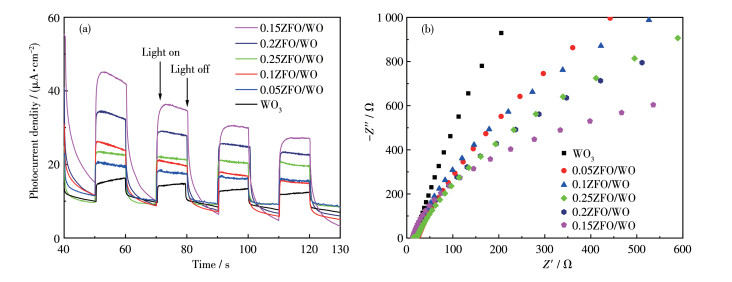
Similarly, the results of the measured electrochemical impedance spectra for the composites also indicate the efficient separation of photogenerated electron-hole pairs[53], as shown in Fig. 13b. The improvement in the efficiency of photogenerated charge separation ultimately leads to an increase in the CO2 reduction activity of the materials.
In summary, a series of ZnFe2O4/WO3 heterojunctions were successfully constructed. Under irradiation, the optimal 0.15ZFO/WO sample exhibited the highest CO2 reduction activity with the CO and CH4 yields of 7.87 and 4.88 μmol·g-1, respectively. The enhanced activity can be attributed to the formation of heterojunction with an S-scheme charge transfer mode. This charge transfer mode facilitates the efficient separation of photogenerated carriers while preserving the hole oxidation capability of WO3. The results obtained herein offer a new avenue to synthesize S-scheme heterojunction ZnFe2O4-based materials for photocatalytic CO2 reduction.
Ran J, Jaroniec M, Qiao S Z. Cocatalysts in semiconductor-based photocatalytic CO2 reduction: Achievements, challenges, and opportunities[J]. Adv. Mater., 2018, 30(7): 1704649. doi: 10.1002/adma.201704649
Nahar S, Zain M F M, Kadhum A A H, Hasan H A, Hasan M R. Advances in photocatalytic CO2 reduction with water: A review[J]. Materials, 2017, 10(6): 629. doi: 10.3390/ma10060629
Cokoja M, Bruckmeier C, Rieger B, Herrmann W A, Kuhn F E. Transformation of carbon dioxide with homogeneous transition-metal catalysts: A molecular solution to a global challenge?[J]. Angew. Chem. Int. Ed., 2011, 50: 8510-8537. doi: 10.1002/anie.201102010
Yang K H, Yang Z Z, Zhang C, Gu Y L, Wei J J, Li Z H, Ma C, Yang X, Song K X, Li Y M, Fang Q Z, Zhou J W. Recent advances in CdS-based photocatalysts for CO2 photocatalytic conversion[J]. Chem. Eng. J., 2021, 418: 129344. doi: 10.1016/j.cej.2021.129344
Goktas S, Goktas A. A comparative study on recent progress in efficient ZnO based nanocomposite and heterojunction photocatalysts: A review[J]. J. Alloy. Compd., 2021, 863: 158734. doi: 10.1016/j.jallcom.2021.158734
Sun, Younis, Kim, VanishKumar. Potential utility of BiOX photocatalysts and their design/modification strategies for the optimum reduction of CO2[J]. Sci. Total Environ., 2023, 863: 160923. doi: 10.1016/j.scitotenv.2022.160923
Chandrasekaran S, Bowen C, Zhang P X, Li Z L, Yuan Q H, Ren X Z, Deng L B. Spinel photocatalysts for environmental remediation, hydrogen generation, CO2 reduction and photoelectrochemical water splitting[J]. J. Mater. Chem. A, 2018, 6: 11078-11104. doi: 10.1039/C8TA03669A
Sun Z X, Wang H Q, Wu Z B, Wang L Z. g-C3N4 based composite photocatalysts for photocatalytic CO2 reduction[J]. Catal. Today, 2018, 300: 160-172. doi: 10.1016/j.cattod.2017.05.033
Wang Q T, Fang Z X, Zhang W, Zhang D. High-efficiency g-C3N4 based photocatalysts for CO2 reduction: Modification methods[J]. Adv. Fiber Mater., 2022, 4: 342-360. doi: 10.1007/s42765-021-00122-7
Inoue T F A, Konishi S, Honda K. Photoelectrocatalytic reduction of carbon dioxide in aqueous suspensions of semiconductor powders[J]. Nature, 1979, 277: 637-638. doi: 10.1038/277637a0
Lee D K, Lee D H, Lumley M A, Choi K S. Progress on ternary oxide-based photoanodes for use in photoelectrochemical cells for solar water splitting[J]. Chem. Soc. Rev., 2019, 48: 2126-2157. doi: 10.1039/C8CS00761F
Pham T N, Huy T Q, Le A T. Spinel ferrite (AFe2O4)-based heterostructured designs for lithium-ion battery, environmental monitoring, and biomedical applications[J]. RSC Adv., 2020, 10: 31622-31661. doi: 10.1039/D0RA05133K
Kim J H, Kim H E, Kim J H, Lee J S. Ferrites: Emerging light absorbers for solar water splitting[J]. J. Mater. Chem. A, 2020, 8: 9447-9482. doi: 10.1039/D0TA01554G
Sun H, Cai H, Li L L, Yang Y, He P, Zhou K, Han Y, Guan J, Fan X X. Photothermal synergic catalytic degradation of the gaseous organic pollutant isopropanol in oxygen vacancies utilizing ZnFe2O4[J]. J. Chem. Res., 2021, 45: 773-780. doi: 10.1177/1747519821999335
Chen J, Shen S H, Guo P H, Wu P, Guo L J. Spatial engineering of photo-active sites on g-C3N4 for efficient solar hydrogen generation[J]. J. Mater. Chem. A, 2014, 2: 4605-4612. doi: 10.1039/c3ta14811d
Hufnagel A G, Peters K, Müller A, Scheu C, Fattakhova-Rohlfing D, Bein T. Ferrite photoanode nanomorphologies with favorable kinetics for water-splitting[J]. Adv. Funct. Mater., 2016, 26: 4435-4443. doi: 10.1002/adfm.201600461
Xiao J, Yang W Y, Gao S, Sun C X, Li Q. Fabrication of ultrafine ZnFe2O4 nanoparticles for efficient photocatalytic reduction CO2 under visible light illumination[J]. J. Mater. Sci. Technol., 2018, 34: 2331-2336. doi: 10.1016/j.jmst.2018.06.001
Yan Y L, Fang Q J, Pan J K, Yang J, Zhang L L, Zhang W, Zhuang G L, Zhong X, Deng S W, Wang J G. Efficient photocatalytic reduction of CO2 using Fe-based covalent triazine frameworks decorated with in situ grown ZnFe2O4 nanoparticles[J]. Chem. Eng. J., 2021, 408: 127358. doi: 10.1016/j.cej.2020.127358
Gong E H, Ali S H, Hiragond C B, Kim H S, Powar N S, Kim D Y, Kim H, In S I. Solar fuels: research and development strategies to accelerate photocatalytic CO2 conversion into hydrocarbon fuels[J]. Energy Environ. Sci., 2022, 15: 880-937. doi: 10.1039/D1EE02714J
Zhang G Q, Wang Z Q, Wu J H. Construction of a Z-scheme heterojunction for high-efficiency visible-light-driven photocatalytic CO2 reduction[J]. Nanoscale, 2021, 13: 4359-4389. doi: 10.1039/D0NR08442E
Liu Y Q, Yi W J, Li C Q, Du X, Liu Z Y, Yue X Z. Enwrapping ZnIn2S4 on vacancy-rich Nb2O5 nanoplates for enhanced photocatalytic hydrogen evolution[J]. Inorg. Chem. Front., 2024, : . doi: 10.1039/D3QI02049E
Lin M, Chen H, Zhang Z Z, Wan X X. Engineering interface structures for heterojunction photocatalysts[J]. Phys. Chem. Chem. Phys., 2023, 25: 4388-4407. doi: 10.1039/D2CP05281D
Marschall R. Semiconductor composites: Strategies for enhancing charge carrier separation to improve photocatalytic activity[J]. Adv. Funct. Mater., 2014, 24: 2421-2440. doi: 10.1002/adfm.201303214
Jia Y F, Han H, Luo Y, Wang Q Z, Lee B W, Liu C L. SrTiO3 nanosheets decorated with ZnFe2O4 nanoparticles as Z-scheme photocatalysts for highly efficient photocatalytic degradation and CO2 conversion[J]. Sep. Purif. Technol., 2023, 306: 122667. doi: 10.1016/j.seppur.2022.122667
Li J D, Wei F, Dong C C, Mu W, Han X J. A Z-scheme ZnFe2O4/RGO/In2O3 hierarchical photocatalyst for efficient CO2 reduction enhancement[J]. J. Mater. Chem. A, 2020, 8: 6524-6531. doi: 10.1039/C9TA13774B
Mardare C C, Hassel A W. Review on the versatility of tungsten oxide coatings[J]. Phys. Status Solidi A-Appl. Mat., 2019, 216(12): 1900047. doi: 10.1002/pssa.201900047
Wang Y, Suzuki H, Xie J J, Tomita O, Martin D J, Higashi M, Kong D, Abe R, Tang J W. Mimicking natural photosynthesis: Solar to renewable H2 fuel synthesis by Z-scheme water splitting systems[J]. Chem. Rev., 2018, 118: 5201-5241. doi: 10.1021/acs.chemrev.7b00286
Das K K, Mansingh S, Sahoo D P, Mohanty R, Parida K. Engineering an oxygen-vacancy-mediated step-scheme charge carrier dynamic coupling WO3-X/ZnFe2O4 heterojunction for robust photo-Fenton-driven levofloxacin detoxification[J]. New J. Chem., 2022, 46: 5785-5798. doi: 10.1039/D2NJ00067A
Chai B, Liu C, Yan J, Ren Z, Wang Z J. In-situ synthesis of WO3 nanoplates anchored on g-C3N4 Z-scheme photocatalysts for significantly enhanced photocatalytic activity[J]. Appl. Surf. Sci., 2018, 448: 1-8. doi: 10.1016/j.apsusc.2018.04.116
Ahmadpour N, Sayadi M H, Sobhani S, Hajiani M. A potential natural solar light active photocatalyst using magnetic ZnFe2O4@TiO2/Cu nanocomposite as a high performance and recyclable platform for degradation of naproxen from aqueous solution[J]. J. Clean. Prod., 2020, 268: 122023. doi: 10.1016/j.jclepro.2020.122023
Rawal S B, Kang H J, Won D I, Lee W I. Novel ZnFe2O4/WO3, A highly efficient visible-light photocatalytic system operated by a Z-scheme mechanism[J]. Appl. Catal. B: Environ., 2019, 256: 117856. doi: 10.1016/j.apcatb.2019.117856
Das K K, Sahoo D P, Mansingh S, Parida K. ZnFe2O4@WO3-X/polypyrrole: An efficient ternary photocatalytic system for energy and environmental application[J]. ACS Omega, 2021, 6: 30401-30418. doi: 10.1021/acsomega.1c03705
Iqbal F, Mumtaz A, Shahabuddin S, Abd Mutalib M I, Shaharun M S, Nguyen T D, Khan M R, Abdullah B. Photocatalytic reduction of CO2 to methanol over ZnFe2O4/TiO2 (p-n) heterojunctions under visible light irradiation[J]. J. Chem. Technol. Biotechnol., 2020, 95: 2208-2221. doi: 10.1002/jctb.6408
Shi W N, Wang J C, Guo X W, Qiao X, Liu F, Li R L, Zhang W Q, Hou Y X, Han H J. Controllable synthesized step-scheme heterojunction of CuBi2O4 decorated WO3 plates for visible-light-driven CO2 reduction[J]. Nano Res., 2022, 15: 5962-5969. doi: 10.1007/s12274-022-4271-0
Li B, Sun L, Bian J, Sun N, Sun J, Chen L, Li Z, Jing L. Controlled synthesis of novel Z-scheme iron phthalocyanine/porous WO3 nanocomposites as efficient photocatalysts for CO2 reduction[J]. Appl. Catal. B: Environ., 2020, 270: 118849. doi: 10.1016/j.apcatb.2020.118849
Lan Y Y, Liu Z F, Guo Z G, Ruan M N, Xin Y. Accelerating the charge separation of ZnFe2O4 nanorods by Cu-Sn ions gradient doping for efficient photoelectrochemical water splitting[J]. J. Colloid Interface Sci., 2019, 552: 111-121. doi: 10.1016/j.jcis.2019.05.041
Zhang X H, Lin B Y, Li X Y, Wang X, Huang K Z, Chen Z H. MOF-derived magnetically recoverable Z-scheme ZnFe2O4/Fe2O3 perforated nanotube for efficient photocatalytic ciprofloxacin removal[J]. Chem. Eng. J., 2022, 430: 132728. doi: 10.1016/j.cej.2021.132728
Bai S L, Zuo Y, Zhang K W, Zhao Y Y, Luo R X, Li D Q, Chen A F. WO3-ZnFe2O4 heterojunction and rGO decoration synergistically improve the sensing performance of triethylamine[J]. Sens. Actuators B-Chem., 2021, 347: 130619. doi: 10.1016/j.snb.2021.130619
Sun Y Y, Wang W Z, Zhang L, Sun S M, Gao E P. Magnetic ZnFe2O4 octahedra: Synthesis and visible light induced photocatalytic activities[J]. Mater. Lett., 2013, 98: 124-127. doi: 10.1016/j.matlet.2013.02.014
Fu J W, Xu Q L, Low J X, Jiang C J, Yu J G. Ultrathin 2D/2D WO3/g-C3N4 step-scheme H2-production photocatalyst[J]. Appl. Catal. B: Environ., 2019, 243: 556-565. doi: 10.1016/j.apcatb.2018.11.011
Li C Q, Yi S S, Liu Y, Niu Z L, Yue X Z, Liu Z Y. In-situ constructing S-scheme/Schottky junction and oxygen vacancy on SrTiO3 to steer charge transfer for boosted photocatalytic H2 evolution[J]. Chem. Eng. J., 2021, 417: 129231. doi: 10.1016/j.cej.2021.129231
Zhang X, Hao W, Tsang C S, Liu M, Hwang G S, Lee L Y S. Psesudocubic phase tungsten oxide as a photocatalyst for hydrogen evolution reaction[J]. ACS Appl. Energy Mater., 2019, 2: 8792-8800. doi: 10.1021/acsaem.9b01790
Xiong J, Song P, Di J, Li H M. Ultrathin structured photocatalysts: A versatile platform for CO2 reduction[J]. Appl. Catal. B: Environ., 2019, 256: 117789. doi: 10.1016/j.apcatb.2019.117789
Long R, Li Y, Liu Y, Chen S M, Zheng X S, Gao C, He C H, Chen N S, Qi Z M, Song L, Jiang J, Zhu J F, Xiong Y J. Isolation of Cu atoms in Pd lattice: Forming highly selective sites for photocatalytic conversion of CO2 to CH4[J]. J. Am. Chem. Soc., 2017, 139: 4486-4492. doi: 10.1021/jacs.7b00452
Zhu C C, Jiang T, Yang H C, Li Y Y, Li Z J, Yao H C. ZnFe2O4 nanoparticles with iron-rich surfaces for enhanced photocatalytic water vapor splitting[J]. Appl. Surf. Sci., 2023, 636: 157842. doi: 10.1016/j.apsusc.2023.157842
Li C Q, Yi S S, Chen D, Liu Y, Li Y J, Lu S Y, Yue X Z, Liu Z Y. Oxygen vacancy engineered SrTiO3 nanofibers for enhanced photocatalytic H2 production[J]. J. Mater. Chem. A, 2019, 7: 17974-17980. doi: 10.1039/C9TA03701B
Xu Q L, Zhang L Y, Cheng B, Fan J J, Yu J G. S-Scheme heterojunction photocatalyst[J]. Chem, 2020, 6: 1543-1559. doi: 10.1016/j.chempr.2020.06.010
Wang L B, Cheng B, Zhang L Y, Yu J G. In situ irradiated XPS investigation on S-Scheme TiO2@ZnIn2S4 photocatalyst for efficient photocatalytic CO2 reduction[J]. Small, 2021, 17: 2103447. doi: 10.1002/smll.202103447
Zhou Y P, Jiao W Y, Xie Y, He F, Ling Y, Yang Q, Zhao J S, Ye H, Hou Y. Enhanced photocatalytic CO2-reduction activity to form CO and CH4 on S-scheme heterostructured ZnFe2O4/Bi2MoO6 photocatalyst[J]. J. Colloid Interface Sci., 2022, 608: 2213-2223. doi: 10.1016/j.jcis.2021.10.053
Zhang L Y, Zhang J J, Yu H G, Yu J G. Emerging S-scheme photocatalyst[J]. Adv. Mater., 2022, 34: 2107668. doi: 10.1002/adma.202107668
Wei Q G, Hao L L, Zhi J, Wen F S. In-situ pressure-induced BiVO4-Bi0.6Y0.4VO4 S-scheme heterojunction for enhanced photocatalytic overall water splitting activity[J]. Chin. J. Catal., 2022, 43: 316-328. doi: 10.1016/S1872-2067(21)63846-9
Chen Y, Yang W Y, Gao S, Sun C X, Li Q. Synthesis of Bi2MoO6 nanosheets with rich oxygen vacancies by postsynthesis etching treatment for enhanced photocatalytic performance[J]. ACS Appl. Nano Mater., 2018, 1: 3565-3578. doi: 10.1021/acsanm.8b00719
Dang H F, Qiu Y F, Cheng Z Y, Yang W, Wu H Y, Fan H B, Dong X F. Hydrothermal preparation and characterization of nanostructured CNTs/ZnFe2O4 composites for solar water splitting application[J]. Ceram. Int., 2016, 42: 10520-10525. doi: 10.1016/j.ceramint.2016.03.019

Figure 4 (a) UV-Vis DRS spectra of WO3, ZnFe2O4, and xZFO/WO; (b) Tauc plots of WO3 and ZnFe2O4

Figure 5 Effects of dosage of maleic acid (a) and calcination conditions (b) on the photocatalytic activity of the as-prepared samples

Figure 6 After illumination for 5 h, the yields of CH4, CO, and H2 as well as the total number of electrons for WO3 (a), ZnFe2O4 (b), and xZFO/WO: (a) x=0.05, 0.1, 0.15, 0.2, 0.25, 0.3; (b) x=0.5, 0.7, 1, 2

Figure 7 (a) Photocatalytic cyclic activity of 0.15ZFO/WO; (b) PXRD patterns of 0.15ZFO/WO before and after five cycles of illumination

Figure 10 Schematic diagram of band structure of WO3 and ZnFe2O4 before (a) and after (b) contact

 扫一扫看文章


扫一扫关注我们
 下载:
下载:

 下载:
下载:


