Table 1.
Crystallographic data for complexes 1 and 2

Synthesis, structure, and photochromic properties of two coordination polymers built from 1, 4, 5, 8-naphthalenediimide derivative
Ce LI , Ji-Ming XI , Zhen-Zhong LU , Rui ZHANG , Ling HUANG


Photochromic materials of reversible color change and appropriate photo-generated color lifetime are one of the core issues for the development of inkless and erasable printing technology[1-4], which is a new concept of printing technology aiming at tackling the issue of extensive use of printing ink and printing paper[5-7]. Conventional photochromic materials are usually not suitable for inkless and erasable printing because they return to the initial color within a few minutes[6].
Coordination polymers (CPs) are a new class of porous solids consisting of metalbased nodes bridged by organic linking groups, which have attracted much recent attention in many applications, such as carbon capture, molecular separation, and heterogeneous catal ysis[8-13]. For some photochromic CPs, the polymeric network of CPs can prevent the accumulation of photo-active organic motifs and prolong the photo-generated color lifetime[14-17]. Naphthalene diimide (NDI) and their derivatives possess redox - active cores and reversible photochromism. Thus, CPs built from NDI - derived ligands are excellent choices for obtaining valuable photochromic materials[18-20]. For example, a CP - based material, [Ca6(BINDI)3(DMA)2(H2O)4]·guest (H4BINDI= N, N-′bis(5-isophthalic acid)naphthalenediimide, DMA=N, N - dimethylacetamide), containing NDI core and 3D network was reported, which exhibited revers ible photochromic behavior and photo - generated color lifetime of 72 h[16]. Another NDI - based CP material, MgNDI, showed reversible photochromism via an elec tron transfer pathway due to the presence of electron deficient NDI moiety[21].
Here, we combined 1, 4, 5, 8-naphthalenetetracar- boxylic dianhydride with methionine and synthesized a di-topic NDI-based ligand (H2ncm). Two CPs, namely [Zn(ncm) (H2O)4] ·2DMF (1) and [Zn2(ncm)2(H2O)4] (2), were synthesized with Zn2+ and H2ncm through solvothermal reactions, which showed interesting structures and reversible photochromism and photo-induced color lifetime up to three weeks in air.
All reagents and solvents for the synthesis and analysis were of analytical grade and were used without further purification. The NMR experiment was record ed on the Bruker Advanced Triple HD 400 Spectrome ter. The X - ray single crystal diffraction data was col lected on a Bruker SMART APEX Ⅱ diffractometer with molybdenumcalorie radiation (λ=0.071 073 nm). Powder X - ray diffraction (PXRD) data were collected over a 2θ range of 3°-50° on a Bruker Advance D8 diffractometer using Cu Kα1 radiation (λ =0.154 056 nm, 40 kV, 40 mA). The thermogravimetric - analysis (TGA) was performed on the PerkinElmer Diamond Thermogravimetric Differential Thermal Analysis Analyzer, and the heating rate was 5 ℃ ·min-1. The electron paramagnetic resonance (EPR) spectra were tested using the Bruker Magnetech ESR5000 model EPR spectrometer.
H2ncm was synthesized according to the literature with some minor modifications[22]. A mixture of 1, 4, 5, 8- naphthalenetetracarboxylic dianhydride (3.0 g, 11.2 mmol) and L-methionine (3.5 g, 23.5mmol) was refluxed in 80 mL acetic acid for 3 d. The reaction was cooled to room temperature. The resulting brown mixture was concentrated under reduced pressure and diluted with an excess amount of deionized water. The resulting suspension solution was filtered and dried under a vacuum to obtain the desired product. Yield: 5.1 g (86.5%). 1HNMR (400 MHz, CDCl3): δ 8.72 (s, 4H, Ar—H), 5.95- 5.86 (m, 2H, N—CH—COOH), 2.78 - 2.69 (m, 2H, CHCOOH—CHH—CH2), 2.62 - 2.57 (m, 4H, CH2— CH2—S), 2.43-2.35 (m, 2H, CHCOOH—CHH—CH2), 2.05 (s, 6H, —CH3).
H2ncm (0.1 mmol, 0.053 g) and Zn(NO3)2 (0.2 mmol, 0.038 g) were added to a mixed solvent of DMF (1.0 mL) and deionized water (1.0 mL). The mixture was ultrasonically for 5 min and then transferred to a Teflon-lined autoclave. The reaction was conducted at 90 ℃ for 2 d. A brown solution was obtained and trans ferred into a test tube, diethyl ether (2.0 mL) was add ed on top of the brown solution, and the test tube was sealed. Yellow - brown crystals were obtained in two weeks. Elemental analysis Calcd. for C30H42N4O14S2Zn (%): C, 44.36; H, 5.21; N, 6.90. Found(%): C, 44.56; H, 5.31; N, 7.06.
H2ncm (0.1 mmol, 0.053 g) and Zn(NO3)2 (0.2 mmol, 0.038 g) were added to a mixed solvent of DMF (2.0 mL) and deionized water (1.0 mL). The remaining steps were the same as the preparation of compound 1. Elemental analysis Calcd. for C24H24N2O10S2Zn(%): C, 45.75; H, 3.84; N, 4.45. Found(%): C, 45.53; H, 3.96; N, 4.56.
The single crystal X-ray diffraction data was col lected on a Bruker SMART APEX Ⅱ diffractometer with Mo Kα radiation (λ =0.071 073 nm). Using the SHELXS-97 program, the crystal structure was solved by the direct methods and further refined by full - matrix least squares on F2 with the SHELXL program. The non hydrogen atoms were refined anisotropically. C - bound H atoms were positioned geometrically with C—H lengths of 0.093 - 00.097 0 nm, and constrained to ride on their parent atoms with Uiso(H) =1.2Ueq(C) or 1.5Ueq (methyl C). The H atoms of water were placed guided by difference maps, with O—H lengths of 0.082 - 0.088 nm and Uiso(H)=1.2Ueq(O).
 下载:
导出CSV
下载:
导出CSV
| Parameter | 1 | 2 |
| Empirical formula | C24H28ZnO12S2N2 | C24H26ZnO10N2S2 |
| Formula weight | 812.16 | 631.99 |
| Temperature / K | 295 | 296 |
| Crystal system | Triclinic | Triclinic |
| Space group | P1 | P1 |
| a/nm | 0.623 5(2) | 0.585 6(2) |
| b / nm | 1.028 5(4) | 1.420 9(6) |
| c / nm | 1.439 7(5) | 1.508 8(6) |
| α/(°) | 75.51(2) | 84.64(2) |
| β/(°) | 85.09(2) | 89.62(1) |
| γ/(°) | 89.44(2) | 83.71(1) |
| V / nm3 | 0.890 6(6) | 1.241 9(8) |
| Z | 1 | 2 |
| Dc / (Mg•m-3) | 1.514 | 1.684 |
| F(000) | 424 | 648 |
| Reflection collected | 10 399 | 44 719 |
| R1 (final R indices) | 0.050 8 | 0.058 7 |
| wR2 (all data) | 0.132 5 | 0.150 1 |
| GOF | 1.049 | 1.049 |
The asymmetric unit of compound 1 is composed of one Zn2+ ion, one ncm2- ligand, four coordinated water, and two DMF solvent molecules. The Zn2+ ion is in an octahedral coordination environment containing six O atoms from two ncm2- ligands and four water molecules (Fig. 1). The coordinated water molecules also form hydrogen bonds with the carboxylate O atom of ncm2- ligand and the DMF solvent molecules (Fig. 2), the H…O and O…O separation are in the ranges of 0.182 9(2)-0.186 2(2) nm and 0.260 9(2)-0.270 9(2) nm.
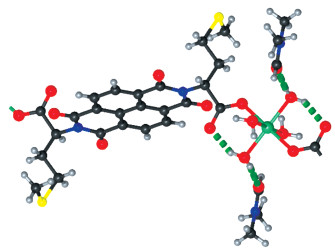
Zn: green, C: black, H: grey, N: blue, O: red, S: yellow, H-bond: green dashed line.
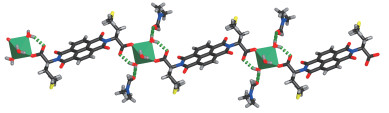
Zn: green, C: black, H: grey, N: blue, O: red, S: yellow, H-bond: green dashed line.
The ncm2- ligand bridges two Zn2+ ions into a linear chain with the methyl sulfide arms and hydrogen- bonded DMF molecules on two sides of the chain (Fig. 2). The chains are further linked by hydrogen bonds between water and acyl O atoms of ncm2- ligands from adjacent chains into a hydrogen - bonded layer structure (Fig. 3).
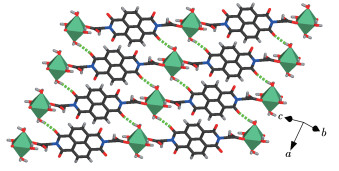
DMF guest molecules are omitted for clarity; Zn: green, C: black, H: grey, N: blue, O: red, S: yellow, H-bond: green dashed line.
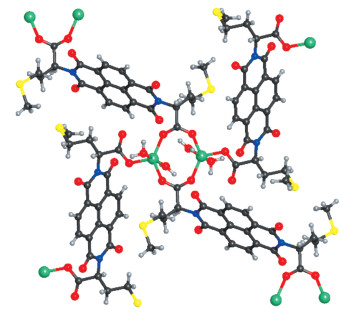
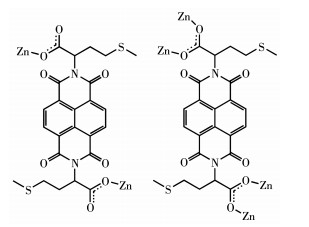
Compound 2 contains two Zn2+ ions, two ncm2- ligands, and four coordinated water molecules. The two Zn2+ ions are bridged by two carboxylate groups into a binuclear Zn2 unit. Each Zn2+ ion is in a triangular bipyramid coordination geometry with five O atoms from three ncm2- ligands on the equatorial plane and two water molecules in the axial positions (Fig. 4). The two ncm2- ligands are of different coordination modes, one ligand bridges two Zn2+ ions, and the other ligand bridges four Zn2+ ions (Scheme 1). The arms of the two ncm2- ligands were disordered over two positions.
The ncm2- ligands in compound 2 link the Zn2 binuclear units into a layer structure (Fig. 5a). The adjacent layers interact with each other via hydrogen bond interaction between coordinated water molecules with the acyl O atoms of ncm2- ligands from adjacent layers (Fig. 5b).
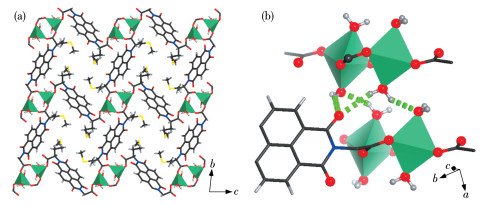
Zn: green, C: black, H: grey, N: blue, O: red, S: yellow, H-bond: green dashed lines.
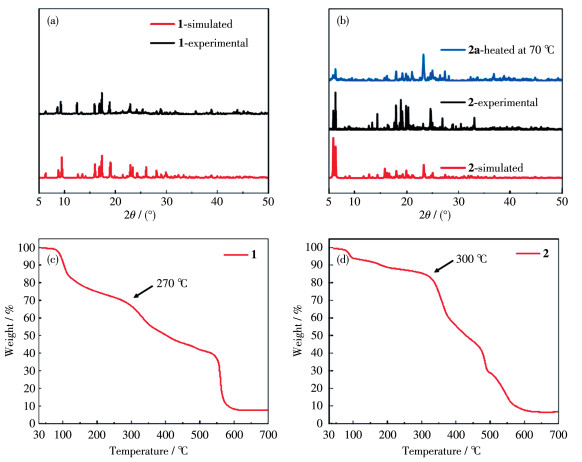
The PXRD patterns of as-synthesized samples of compounds 1 and 2 fitted well with the simulated patterns from single-crystal X-ray diffraction results, and indicated that pure phase samples of both 1 and 2 were obtained (Fig. 6a and 6b). TGA result of 1 showed a weight loss of 26% below 170 ℃ corresponding to the loss of hydrogen-bonded DMF solvent and coordinated H2O molecules, and a weight loss after 270 ℃ corresponding to the loss of ncm2- and collapse of the polymeric structure (Fig. 6c). TGA result of 2 showed a weight loss of 6% below 130 ℃ corresponding to the loss of coordinated H2O molecules and a weight loss after 300 ℃ corresponding to the loss of ncm2- and collapse of the polymeric layer structure of 2 (Fig. 6d).
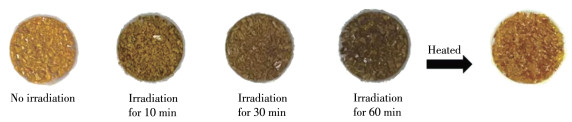
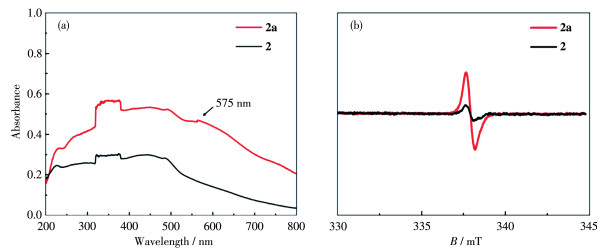
Compound 2 exhibited rapid color changes from yellow to brown in 10 min upon continuous irradiation with UV light (365 nm, the brown sample was denoted as 2a hereafter), and the color became saturated in 60 min of light irradiation (Fig. 7). UV - Vis diffuse reflec tion spectra of 2a showed that there were new broad peaks observed at 265 and 575 nm (Fig. 8a). The photo generated brown color of 2a was stable in air for at least three weeks and can be changed back to yellow when 2a was heated at 70 ℃ for 5 min (Fig. 7, right). The recovered sample could also display color transfor mation after light irradiation without any significant deterioration, indicating that the photochromic process is reversible and repeatable. Compound 1 showed a similar photo - generated color change from yellow to dark brown, while it lost crystallinity after being heated at 70 ℃ for 5 min.
It is reported that the NDI core is redox - active and can generate NDI radicals (NDI·) upon light irradiation. Therefore, the photochromic process from 2 to 2a may arise from the photo-induced radical of the ncm2- core. EPR measurement exhibited a remarkable radical signal with a g value of 2.003 5 of 2a, which was close to the value of unpaired electrons reported in the literature. It confirmed the generation of photo-induced radicals[16, 21]. Generally speaking, NDI· radical can easily be quenched by pairing with paramagnetic or single electron species (such as oxygen gas), and returns to the original color. However, the photo - generated color of 2a can be stable in air for at least three weeks. This exceptional stability should be attributed to the loosed packing of the photo - generated NDI· motifs (Fig. 5a) and the extended framework in 2, which prevent NDI· radicals from direct contact with quenchers such as oxygen gas in air, and prolong the photo-generated color lifetime[14, 16].
In summary, we designed a naphthalene diimide- based (NDI-based) ligand (H2ncm) by combining 1, 4, 5, 8-naphthalenetetracarboxylic dianhydride with methionine and synthesized two coordination polymers from Zn2+ and H2ncm through solvothermal reactions. One of the coordination polymers, [Zn2(ncm)2(H2O)4], contains an extended 2D layer structure and showed photoinduced color change from yellow to dark brown. The photo-induced brown color can be stable for up to three weeks in the air but change back to yellow within 5 min upon heating at 70 ℃. We showed that this photochromism originates from the generation of NDI· radical upon light irradiation. The long lifetime of the NDI· radical is probably because of the polymeric structure of the CP which effectively protects the photoinduced radical from quenching.
Zhu B L, Jin Y P, Jiang J, Zuo M H, Cui S X. Two new photochromic supramolecular compositions based on viologen: Photocontrolled fluorescence, aniline detection and inkless erasable printing performance[J]. New J. Chem., 2022, 46: 1905-1911. doi: 10.1039/D1NJ04918F
Zhong X F, Luo G J, Li W B, Chen X H, Wu Y, Chen Y H, Ye J W, Bai J, Mo Z W, Chen X M. A series of naphthalenediimide-based metal - organic frameworks: Synthesis, photochromism and inkless and erasable printing[J]. Dalton Trans., 2022, 51: 14852-14857. doi: 10.1039/D2DT02290G
Yang D D, Zheng H W, Fang Y H, Liang Q F, Han Q Z, Shi Y S, Zheng X J. Multistimuli-responsive materials based on Zn(Ⅱ)-viologen coordination polymers and their applications in inkless print and anticounterfeiting[J]. Inorg. Chem., 2022, 61: 7513-7522. doi: 10.1021/acs.inorgchem.2c00599
Xu X, Yang M, Lu Q, Yu S, Ma S, Tian A, Ying J. Three photochromic materials based on POMs and viologens for UV probing, visual detection of metal ions and amine detection[J]. CrystEngComm, 2022, 24: 7677-7685. doi: 10.1039/D2CE01244H
Yang D D, Shi Y S, Xiao T, Fang Y H, Zheng X J. Three-dimensional viologen based lanthanide - organic frameworks: Photochromism and fluorescence detection of quinolone antibiotics[J]. Inorg. Chem., 2023, 62(15): 6084-6091. doi: 10.1021/acs.inorgchem.3c00065
Li L, Yu Y T, Hua Y, Li X N, Zhang H. Recent progress in polyoxo-metalate-viologen photochromic hybrids: Structural design, photochromic mechanism, and applications[J]. Inorg. Chem. Front., 2023, 10: 1965-1985. doi: 10.1039/D3QI00040K
Zhou T D, Chen J T, Wang T T, Yan H, Xu Y M, Li Y X, Sun W B. One-dimensional chain viologen-based lanthanide multistimulus-responsive materials with photochromism, photoluminescence, photomagnetism, and ammonia/amine vapor sensing[J]. ACS Appl. Mater. Interfaces, 2022, 14: 57037-57046. doi: 10.1021/acsami.2c18143
Roy I, Stoddart J F. Cyclodextrin metal-organic frameworks and their applications[J]. Acc. Chem. Res., 2021, 54: 1440-1453. doi: 10.1021/acs.accounts.0c00695
Islamoglu T, Chen Z, Wasson M C, Buru C T, Kirlikovali K O, Afrin U, Mian M R, Farha O K. Metal - organic frameworks against toxic chemicals[J]. Chem. Rev., 2020, 120: 8130-8160. doi: 10.1021/acs.chemrev.9b00828
Xing S, Janiak C. Design and properties of multiple-emitter luminescent metal organic frameworks[J]. Chem. Commun., 2020, 56: 12290-12306. doi: 10.1039/D0CC04733C
Qian Q, Asinger P A, Lee M J, Han G, Rodriguez K M, Lin S, Benedetti F M, Wu A X, Chi W S, Smith Z P. MOF - based membranes for gas separations[J]. Chem. Rev., 2020, 120: 8161-8266. doi: 10.1021/acs.chemrev.0c00119
王月, 李咸贞, 来雨洁, 牛政. 锆基金属有机骨架材料用于四甲基硅烷/异戊烷分离[J]. 无机化学学报, 2023,39,(10): 1841-1847. doi: 10.11862/CJIC.2023.163WANG Y, LI X Z, LAI Y J, NIU Z. Zirconium-based metal-organic framework for tetramethylsilane/isopentane separation[J]. Chinese J. Inorg. Chem., 2023, 39(10): 1841-1847. doi: 10.11862/CJIC.2023.163
左琦, 马龙飞. 芳基四硫富瓦烯与碘电荷转移复合物的合成及其晶体结构[J]. 无机化学学报, 2023,39,(10): 1869-1876. doi: 10.11862/CJIC.2023.156ZUO Q, MA L F. Synthesis and crystal structure of the charge transfer complexes of arylthiotetrathiafulvalenes and iodine[J]. Chinese J. Inorg. Chem., 2023, 39(10): 1869-1876. doi: 10.11862/CJIC.2023.156
Xiao T, Shi Y S, Yang D D, Zheng H W, Fang Y H, Liang Q F, Zheng X J. A UV and X-ray dual photochromic Zn(Ⅱ) metal-organic framework based on viologen: Photo - controlled luminescence and temperature-dependent phosphorescence[J]. Dyes Pigment., 2022, 208: 110812.
Liu J J, Fu J J, He C X, Liu T, Cheng F X. A viologen-derived hostguest MOF material: Photochromism, photoswitchable luminescence, and inkless and erasable printing[J]. J. Solid State Chem., 2022, 306: 122812. doi: 10.1016/j.jssc.2021.122812
Li W B, Chen X H, Chen J Z, Huang R, Ye J W, Chen L, Wang H P, Yang T, Tang L Y, Bai J, Mo Z W, Chen X M. Photochromic metalorganic framework for high-resolution inkless and erasable printing[J]. ACS Appl. Mater. Interfaces, 2022, 14: 8458-8463. doi: 10.1021/acsami.1c23512
Zhang W W, Jin Y P, Yu J H, Zhu B L, Jiang J, Zuo M H, Chen Y F, Li J J, Cui S X. A novel multicolor viologen-derived Zn-organic coordination polymer for environment friendly ink free erasable printing[J]. J. Solid State Chem., 2021, 304: 122597. doi: 10.1016/j.jssc.2021.122597
Shi Y S, Yang D D, Xiao T, Fang Y H, Xia Z G. Naphthalenediimide-based photochromic MOFs: Structure visualization upon radical formation, and applications in purple light detection, inkless printing and anti-counterfeiting[J]. Chem. Eng. J., 2023, 462: 142275. doi: 10.1016/j.cej.2023.142275
Liu J J, Fu J J, Liu T, Cheng F X. Photochromic polyoxometalate/ naphthalenediimide hybrid structure with visible - light - driven dye degradation[J]. J. Solid State Chem., 2022, 312: 123236. doi: 10.1016/j.jssc.2022.123236
Yang Q, Gong W, Cui X W, Zhou C S. Functionalization of cellulose paper by coating nano metal - organic frameworks for use as photochromic material[J]. J. Chem. Soc. Pakistan, 2021, 43: 67-74. doi: 10.52568/000548/JCSP/43.01.2021
Mallick A, Garai B, Addicoat M A, Petkov P S, Heine T, Banerjee R. Solid state organic amine detection in a photochromic porous metal organic framework[J]. Chem. Sci., 2015, 6: 1420-1425. doi: 10.1039/C4SC03224A
Mollick S, Mukherjee S, Kim D, Qiao Z, Desai A V, Saha R, More Y D, Jiang J, Lah M S, Ghosh S. Hydrophobic shielding of outer surface: Enhancing the chemical stability of metal - organic polyhedra[J]. Angew. Chem. Int. Ed., 2019, 58: 1041-1045.

Figure 1 Coordination environment of the Zn2+ ion in compound 1
Zn: green, C: black, H: grey, N: blue, O: red, S: yellow, H-bond: green dashed line.

Figure 2 Chain structure of compound 1
Zn: green, C: black, H: grey, N: blue, O: red, S: yellow, H-bond: green dashed line.

Figure 3 Chains in compound 1 linked by hydrogen bonds between water and acyl O atoms from ncm2- ligand to form a layer structure
DMF guest molecules are omitted for clarity; Zn: green, C: black, H: grey, N: blue, O: red, S: yellow, H-bond: green dashed line.

Figure 5 (a) Polymeric layer structure in compound 2; (b) Hydrogen bonds formed between adjacent layers in 2
Zn: green, C: black, H: grey, N: blue, O: red, S: yellow, H-bond: green dashed lines.
Table 1. Crystallographic data for complexes 1 and 2
| Parameter | 1 | 2 |
| Empirical formula | C24H28ZnO12S2N2 | C24H26ZnO10N2S2 |
| Formula weight | 812.16 | 631.99 |
| Temperature / K | 295 | 296 |
| Crystal system | Triclinic | Triclinic |
| Space group | P1 | P1 |
| a/nm | 0.623 5(2) | 0.585 6(2) |
| b / nm | 1.028 5(4) | 1.420 9(6) |
| c / nm | 1.439 7(5) | 1.508 8(6) |
| α/(°) | 75.51(2) | 84.64(2) |
| β/(°) | 85.09(2) | 89.62(1) |
| γ/(°) | 89.44(2) | 83.71(1) |
| V / nm3 | 0.890 6(6) | 1.241 9(8) |
| Z | 1 | 2 |
| Dc / (Mg•m-3) | 1.514 | 1.684 |
| F(000) | 424 | 648 |
| Reflection collected | 10 399 | 44 719 |
| R1 (final R indices) | 0.050 8 | 0.058 7 |
| wR2 (all data) | 0.132 5 | 0.150 1 |
| GOF | 1.049 | 1.049 |
 下载: 导出CSV

 扫一扫看文章


扫一扫关注我们