Table 1.
Crystal data and structure refinement details for complexes 2, 4, and 5


[FeFe]-hydrogenases, which are found in natural bacteria, can efficiently catalyze the reduction of protons to evolve dihydrogen as a renewable and clean energy[1]. The structural elucidation of the active site of [FeFe]-hydrogenases was established in 1998[2] and 1999[3], featuring a butterfly di-iron cluster coordinated by carbonyls, cyanides, a bridged three-atom dithiolate, along with a [Fe4S4]-bearing cysteine. Previous studies focused on the biomimics for the bridged three-atom dithiolate and a lot of SCH2CH2CH2S or SCH2N(R)CH2S bearing complexes were prepared[4-9]. Encouraged by the ligands found in the di-iron center of the active site of [FeFe]-hydrogenases, some ligands like cyanides[10-11], phosphines[12-13], N-heterocyclic carbenes (NHC)[14-15] and thioethers[16-17] have been introduced into the di-iron center. Moreover, the electrocatalytic dihydrogen production by some biomimics was also investigated[18-20]. However, research on the SCH2CH2S bearing complexes is more limited and only a few examples of SCH2CH2S bearing complexes have been studied[21-23].
The five-membered heterocycle isoxazole derivatives have attracted great concerns as a result of their wide application in biological activities such as antifungal[24], cytotoxic[25], herbicidal[26], insecticidal[27], and anti-inflammatory[28]. We have previously reported that 1, 2, 3-thiadiazole[29] or pyrazole[30] containing di-iron complexes displayed some antifungal activities. Inspired by these findings, we recently developed research on the linkage of an isoxazole moiety with the di-iron cluster. Consequently, we have successfully synthesized four derivatives by esterification or CO exchange. Herein, in this paper, we report the synthesis and structural characterization of four isoxazole- containing di-iron complexes, namely [Fe2(CO)5(L)(μ-SCH2CHCH2OOC(5-C3HNOCH3)S)], where L=P(4-C6H4CH3)3 (3), P(4-C6H4F)3 (4), P(2-C6H4OCH3)3 (5), as the biomimics for the [FeFe]-hydrogenases active site. Moreover, the electrocatalytic properties and the antifungal activity of these complexes are also presented.
Tri(p-tolyl)phosphine, tris(4-fluorophenyl)phosphine, tris(2-methoxyphenyl)phosphine, 4-dimethylaminopyridine (DMAP), N, N′-dicyclohexylcarbodiimide (DCC) and Me3NO∙2H2O were available commercially and used as received. Complex [Fe2(CO)6(μ-SCH2CH(CH2OH)S)] (1)[31] and 5-methylisoxazole-4-carboxylic acid[32] were synthesized by the reported methods. FTIR spectra were measured on a Nicolet 6700 FT-IR spectrometer. NMR spectra were obtained by a Bruker Avance 500 MHz spectrometer. Elemental analyses were performed on an Elementar Vario EL cube analyzer.
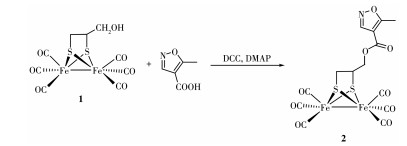
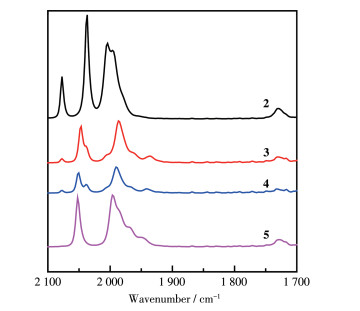
To a mixture of complex 1 (0.201 g, 0.5 mmol), DMAP (0.024 g, 0.2 mmol) and 5-methylisoxazole-4-carboxylic acid (0.076 g, 0.6 mmol) in CH2Cl2 (20 mL), DCC (0.124 g, 0.6 mmol) was added. The mixture was stirred overnight. The solvent was evaporated. The crude product was purified by thin layer chromatography (silica gel G) with a mixture of CH2Cl2/petroleum ether (2∶3, V/V) as the eluent to afford complex 2 (0.228 g, yield: 89%). IR (CH2Cl2, cm-1): νC≡O 2 077 (s), 2 037 (vs), 2 004 (vs), 1 996 (vs); νC=O 1 730 (m). 1H NMR (500 MHz, CDCl3): δ 8.49 (s, 1H, CH=N), 4.21 (dd, J=9, 14.5 Hz, 1H, OCH2), 4.12 (dd, J=9.5, 14.2 Hz, 1H, OCH2), 3.03-2.96 (m, 1H, SCH), 2.73 (s, 3H, CH3), 2.72 (dd, J=10, 16 Hz, 1H, SCH2), 1.95 (dd, J=7, 16.5 Hz, 1H, SCH2). Anal. Calcd. for C14H9Fe2NO9S2(%): C, 32.90; H, 1.78; N, 2.74. Found(%): C, 33.39; H, 1.63; N, 2.81.
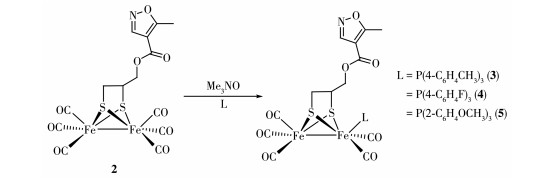
To a mixture of complex 2 (0.053 g, 0.1 mmol) and the corresponding phosphine ligand (0.1 mmol) in CH2Cl2 (5 mL), Me3NO·2H2O (0.011 g, 0.1 mmol) in MeCN (5 mL) was slowly added. The mixture was stirred at room temperature for 1 h. The solvent was evaporated. The crude product was purified by thin layer chromatography (silica gel G) with a mixture of CH2Cl2/ petroleum ether (1∶1, V/V) as the eluent to afford complexes 3-5.
Complex 3: 0.061 g, yield: 77%. IR (CH2Cl2, cm-1): νC≡O 2 046 (vs), 1 987 (vs), 1 937 (m); νC=O 1 730 (m). 1H NMR (500 MHz, CDCl3): δ 8.41 (s, 1H, CH=N), 7.47-7.43 (m, 6H, PhH), 7.18 (d, J=7 Hz, 6H, PhH), 3.97-3.89 (m, 2H, OCH2), 2.68 (s, 3H, CH3), 2.36 (s, 9H, 3CH3), 1.88-1.85 (m, 1H, SCH), 1.30 (s, 2H, SCH2). 31P{1H} NMR (200 MHz, CDCl3, 85% H3PO4): δ 60.26 (s). Anal. Calcd. for C34H30Fe2NO8PS2(%): C, 51.86; H, 3.84; N, 1.78. Found(%): C, 51.75; H, 3.83; N, 1.71.
Complex 4: 0.053 g, yield: 66%. IR (CH2Cl2, cm-1): νC≡O 2 050 (vs), 2 039 (m), 1 991 (vs), 1 942 (m); νC=O 1 732 (m). 1H NMR (500 MHz, CDCl3): δ 8.42 (s, 1H, CH=N), 7.54-7.52 (m, 6H, PhH), 7.14-7.10 (m, 6H, PhH), 3.99-3.89 (m, 2H, OCH2), 2.68 (s, 3H, CH3), 1.80 (s, 1H, SCH), 1.46-1.44 (m, 2H, SCH2). 31P{1H} NMR (200 MHz, CDCl3, 85% H3PO4): δ 61.15 (s). Anal. Calcd. for C31H21F3Fe2NO8PS2(%): C, 46.58; H, 2.65; N, 1.75. Found(%): C, 46.85; H, 2.78; N, 1.79.
Complex 5: 0.058 g, yield: 70%. IR (CH2Cl2, cm-1): νC≡O 2 052 (vs), 1 996 (vs), 1 969 (sh), 1 950 (sh); νC=O 1 728 (m). 1H NMR (500 MHz, CDCl3): δ 8.39 (s, 1H, CH=N), 7.84 (s, 2H, PhH), 7.39 (s, 4H, PhH), 6.89-6.84 (m, 6H, PhH), 3.92-3.87 (m, 2H, OCH2), 3.74 (s, 2H, SCH2), 3.55 (s, 9H, 3OCH3), 2.66 (s, 3H, CH3), 1.21-1.20 (m, 1H, SCH). 31P{1H} NMR (200 MHz, CDCl3, 85% H3PO4): δ 49.29 (s). Anal. Calcd. for C34H30Fe2NO11PS2(%): C, 48.88; H, 3.62; N, 1.68. Found(%): C, 49.29; H, 3.65; N, 1.65.
The single crystals with suitable sizes were mounted on a Bruker D8 QUEST diffractometer. Data were collected at 296 K by using a graphite-monochromatic with Mo Kα radiation (λ=0.071 073 nm) in the ω-φ scan mode. Using OLEX2, the structure was solved by direct methods using the SHELXS program and refined by full-matrix least-squares techniques SHELXL on F2. Hydrogen atoms were located using the geometric method. Non-hydrogen atoms were refined with anisotropic thermal parameters. Note that the largest difference peaks of complexes 2 (2 710 e·nm-3) and 5 (2 520 e·nm-3) are relatively high because the isoxazole ring is disordered without treatment. Details of crystal data, data collections, and structure refinements are summarized in Table 1.
 下载:
导出CSV
下载:
导出CSV
| Parameter | 2 | 4 | 5 |
| Empirical formula | C14H9Fe2NO9S2 | C31H21F3Fe2NO8PS2 | C34H30Fe2NO11PS2 |
| Formula weight | 511.04 | 799.28 | 835.38 |
| Crystal system | Monoclinic | Triclinic | Triclinic |
| Space group | C2/c | P1 | P1 |
| a/nm | 4.130 4(7) | 0.910 52(15) | 1.106 42(6) |
| b/nm | 0.689 77(11) | 1.216 98(19) | 1.164 50(6) |
| c/nm | 1.389 8(2) | 1.655 0(3) | 1.536 95(8) |
| α/(°) | 89.638(5) | 88.749(2) | |
| β/(°) | 105.432(5) | 79.658(4) | 71.403(2) |
| γ/(°) | 68.440(4) | 77.696(2) | |
| V/nm3 | 3.816 8(10) | 1.674 2(5) | 1.831 46(17) |
| Z | 8 | 2 | 2 |
| Dc/(g·cm-3) | 1.779 | 1.585 | 1.515 |
| μ /mm-1 | 1.786 | 1.106 | 1.009 |
| F(000) | 2 048.0 | 808.0 | 856.0 |
| Crystal size/mm | 0.16×0.12×0.10 | 0.26×0.22×0.16 | 0.22×0.18×0.12 |
| 2θ range/(°) | 5.878-50.07 | 4.256-50.22 | 4.656-50.29 |
| h, k, l ranges | -48 ≤ h ≤ 48, -8 ≤ k ≤ 8, -16 ≤ l ≤ 16 |
-10 ≤ h ≤ 10, -14 ≤ k ≤ 14, -19 ≤ l ≤ 19 |
-13 ≤ h ≤ 13, -13 ≤ k ≤ 13, -18 ≤ l ≤ 18 |
| Reflection collected | 23 366 | 42 954 | 35 209 |
| Independent reflection | 3 268 (Rint=0.062 1) | 5 929 (Rint=0.032 1) | 6 479 (Rint=0.047 8) |
| Data, restraint, number of parameters | 3 268, 18, 253 | 5 929, 53, 434 | 6 479, 62, 464 |
| Goodness of fit on F 2 | 1.142 | 1.037 | 1.034 |
| Final R indices [I > 2σ(I)] | 0.171 9, 0.394 0 | 0.056 5, 0.149 0 | 0.076 1, 0.217 0 |
| Final R indices (all data) | 0.180 8, 0.397 7 | 0.070 2, 0.157 9 | 0.109 2, 0.242 0 |
| Largest diff. peak and hole/(e·nm-3) | 2 710, -3 763 | 920, -628 | 2 520, -826 |
Electrochemical properties were studied by cyclic voltammetry (CV) in MeCN solution. Electrochemical measurements were carried out under nitrogen using a CHI 620 Electrochemical workstation. As the electrolyte, nBu4NPF6 was recrystallized several times from a CH2Cl2 solution by the addition of hexane. CV scans were obtained in a three-electrode cell with a glassy carbon electrode (3 mm diameter) as the working electrode, a platinum wire as the counter electrode, and a non-aqueous Ag/Ag+ electrode as the reference electrode. The potential scale was calibrated against the Fc/Fc+ couple and reported versus this reference system.
As shown in Scheme 1, the ester-product 2 can be made by the reaction of complex 1 with 5-methylisoxazole-4-carboxylic acid assisted by the reagents DCC and DMAP. Complex 2 was isolated as a red solid and structurally identified by elemental analysis and FTIR, 1H NMR spectroscopies. Four bands ranging from 2 077 to 1 996 cm-1 (Fig. 1) were found in the FTIR spectrum, which can be designated as the stretching mode of terminal carbonyls, close to the corresponding values of the hexacarbonyl di-iron analogues[4, 6, 29]. The 1H NMR spectrum exhibited two quartets at δ 4.21 and 4.12 for the OCH2 group.
As displayed in Scheme 2, the phosphine-bearing analogues 3-5 can be got from the CO-interchange of complex 2 with a phosphine ligand tri(p-tolyl)phosphine, tris(4-fluorophenyl)phosphine, or tris(2-methoxyphenyl)phosphine assisted by the reagent Me3NO∙2H2O. Complexes 3-5 were isolated as red solids and structurally identified by elemental analysis and FTIR, 1H NMR, 31P{1H} NMR spectroscopies. Three to four bands in the region of 2 052-1 937 cm-1 (Fig. 1) were observed in the FTIR spectra of complexes 3-5, assigning to the stretching mode of terminal carbonyls C≡O, migrating to lower energies with respect to those of complex 2 because of the phosphine ligands having better donation than carbonyl[33-35]. In the 1H NMR spectra of complexes 3-5, a multiplet at approximately δ 3.90 was found for the OCH2 group, shifting to the higher field with respect to complex 2 probably due to the shielding effect of the phosphine ligand. In the 31P{1H} NMR spectra of complexes 3-5, the singlets at δ 49-61 were observed for the ligated phosphine ligand, very close to those of phosphine-containing di-iron analogues[36-38].
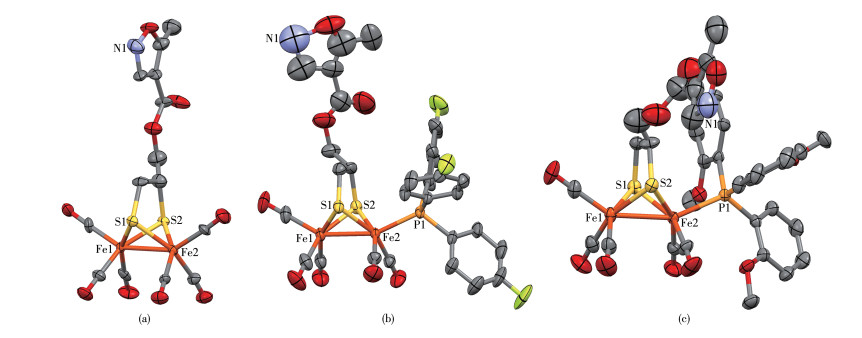
Single crystal X-ray diffraction analysis was applied to characterize the molecular structures of the new complexes. The molecular structures presented as thermal ellipsoids are depicted in Fig. 2 and Table 2 lists the selected bond lengths and angles. Complex 2 crystallizes in monoclinic space group C2/c with four molecules in the unit cell whilst complexes 4 and 5 crystallize in triclinic space group P1 with two molecules in the unit cell. Fig. 2 shows that all the complexes consist of a di-iron sub-cluster with a bridged SCH2CHS bearing an isoxazole moiety, six terminal CO or five terminal CO, and a phosphine ligand. Notably, all the P-donor ligands in complexes 4 and 5 possess an apical position of the pseudo-octahedral coordination arrangement of the Fe atom, in accord with monosubstituted di-iron analogues[29-30, 39-40]. The Fe1—Fe2 bond length of complex 2 (0.249 6(4) nm) is very similar to that of complex [Fe2(CO)6(μ-SCH2CH(CH2OO CCH3)S)] (0.249 67(11) nm)[41] as well as 1, 2, 3-thiadiazole-bearing analogue [Fe2(CO)6(μ-SCH2CHCH2OOC(4-C2N2SCH3)S)] (0.249 2(3) nm)[29] indicating that the effect of isoxazole is consistent with methyl or 1, 2, 3-thiadiazole. The Fe1—Fe2 bond lengths of complexes 4 (0.250 29(9) nm) and 5 (0.252 00(12) nm) are mildly longer than complex 2 due to the coordination of P-donor ligand. Moreover, the Fe1—Fe2 bond lengths of complexes 4 and 5 are shorter than those in natural [FeFe]-hydrogenases[2-3] along with those of P-donor ligand chelated analogues[33-34].
 下载:
导出CSV
下载:
导出CSV
| Bond | 2 | 4 | 5 |
| Fe1—Fe2 | 0.249 6(4) | 0.250 29(9) | 0.252 00(12) |
| Fe1—S1 | 0.223 6(6) | 0.225 03(13) | 0.225 80(18) |
| Fe1—S2 | 0.224 1(6) | 0.224 77(14) | 0.225 2(2) |
| Fe2—S1 | 0.224 6(6) | 0.224 96(13) | 0.225 50(19) |
| Fe2—S2 | 0.224 8(6) | 0.224 46(14) | 0.224 91(19) |
| Fe2—P1 | 0.223 27(12) | 0.227 42(17) | |
| S1—Fe1—Fe2 | 56.34(17) | 56.19(3) | 56.00(5) |
| S1—Fe1—S2 | 80.8(2) | 79.66(5) | 79.95(7) |
| S2—Fe1—Fe2 | 56.34(17) | 56.08(4) | 55.90(5) |
| S1—Fe2—Fe1 | 55.97(17) | 56.22(4) | 56.11(5) |
| S2—Fe2—Fe1 | 56.08(17) | 56.20(4) | 56.00(5) |
| S2—Fe2—S1 | 80.4(2) | 79.74(5) | 80.07(7) |
| P1—Fe2—Fe1 | 156.01(5) | 154.73(6) | |
| Fe1—S1—Fe2 | 67.69(18) | 67.59(4) | 67.89(5) |
| Fe2—S2—Fe1 | 67.58(17) | 67.72(4) | 68.10(6) |
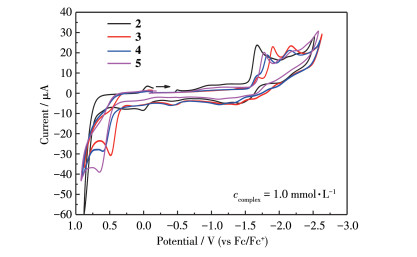
CV technique was applied to study the electrochemical and electrocatalytic properties of the new complexes. The CV curves of complexes 2-5 are overlapped in Fig. 3 and the corresponding CV data are demonstrated in Table 3. The CV curve of complex 2 only had an irreversible reduction wave at -1.67 V, assigning to the one-electron reduction of FeⅠFeⅠ to Fe0FeⅠ according to the reported work[42], and the potential was analogous to complexes [Fe2(CO)6(μ-SCH2CHCH2OOC(4-C2N2SCH3)S)] (-1.64 V)[29] and [Fe2(CO)6(μ-SCH2CHCH2OOC(CF3C3N2CH3)S)] (-1.64 V)[30] revealing that the electronic effect of isoxazole is close to 1, 2, 3-thiadiazole and pyrazole. Nevertheless, the CV curves of complexes 3-5 have an irreversible reduction wave at -1.87, -1.81, or -1.83 V together with an irreversible oxidation wave at 0.51, 0.60, or 0.58 V assigning to the one-electron oxidation of FeⅠFeⅠ to FeⅡFeⅠ[42]. The potentials for the reduction and oxidation of complexes 3-5 were comparable to other phosphine-bearing analogues[29, 30]. It is noteworthy that the reduction potentials for complexes 3-5 moved cathodically by approximately 0.2 V with respect to that of complex 2, which is consistent with the fact that the phosphine ligand can increase the electron density on the Fe center.
 下载:
导出CSV
下载:
导出CSV
| Complex | Ep, c/V | Ep, a/V | Overpotential/V |
| 2 | -1.67 | 0.63 | |
| 3 | -1.87 | 0.51 | 0.76 |
| 4 | -1.81 | 0.60 | 0.83 |
| 5 | -1.83 | 0.58 | 0.74 |
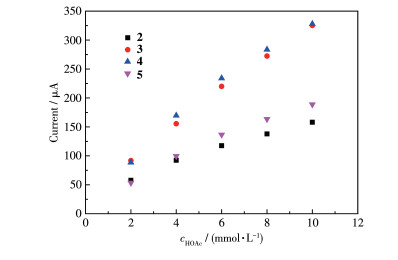
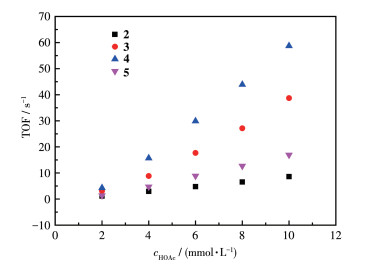
Moreover, the electrocatalytic properties of these complexes have been studied by adding HOAc as a proton source into the MeCN solution, and the results are displayed in Fig.S1-S4 (Supporting information). It can be seen that upon an increment of HOAc concentration (2-10 mmol·L-1), the current heights of the reduction waves for complexes 2-5 were slightly grown up. However, new waves at -2.14 V (2), -2.26 V (3), -2.38 V (4), and -2.32 V (5) emerged and the current heights were significantly grown up linearly (Fig. 4) with successive increment of HOAc concentration. The catalytic potentials moved positively with respect to blank (HOAc without the di-iron complex)[43]. Further, the catalytic current heights for complexes 3 and 4 were higher than HOAc blank[43]. These electrochemical observations indicate that proton reduction catalyzed by complexes 2-5 occurs[42, 44-46].
To estimate the catalytic capabilities of these complexes, overpotential and turnover frequency (TOF) were calculated by the known method[47]. As revealed in Table 3, the overpotential for complex 2 (0.63 V) was lower than other complexes reflecting that the phosphine coordination will increase the overpotential, in agreement with recently reported work[48]. Also notable in Fig. 4, the gradients of the dependence of catalytic current on the HOAc concentration of complexes 3 and 4 were steeper than other complexes suggesting that complexes 3 and 4 are more sensitive to HOAc[42]. As observed in Fig. 5, the TOF values of complexes 3-5 were higher than complex 2 indicative of the phosphine coordination will increase the catalytic capability possibly due to the more basicity on the di-iron core for easily binding protons. Further, the TOF of complex 4 was higher than those of complexes 3 and 5 revealing that the phosphine ligand with electron-withdrawing group is more favorable for H2 production than the corresponding ligand with electron-donating group. According to the results described above, an EECC (E=electrochemical, C=chemical) mechanism can be speculated for the electrocatalysis of H2 production catalyzed by the isoxazole-bearing di-iron analogues.
The antifungal activity against P. infestans (PI), G. zeae (GZ), P. oryae (PO), P. capsici (PC), C. fragariae (CF), B. cinerea (BC), R. solani (RS), F. oxysporum (FO), C. arachidicola (CA) and P. piricola (PP) was tested at a mass fraction of 0.005% by a reported method[49] and Table 4 lists the results. It revealed that complex 2 displayed moderate (40%-70%) activity against BC and RS and weak (10%-40%) activity against PI, GZ, PO, CF, and PP. Complexes 3-5 displayed weak activity against PI, PO, PC, BC, RS, and PP.
下载:
导出CSV
| Complex | Activity/% | |||||||||
| PI | GZ | PO | PC | CF | BC | RS | FO | CA | PP | |
| 2 | 16.7 | 26.9 | 33.3 | 3.4 | 21.4 | 50.0 | 65.2 | 8.7 | 7.1 | 28.6 |
| 3 | 33.3 | 7.7 | 22.2 | 13.8 | 7.1 | 26.9 | 30.4 | 17.4 | 14.3 | 21.4 |
| 4 | 16.7 | 11.5 | 11.1 | 31.0 | 14.3 | 38.5 | 30.4 | 8.7 | 7.1 | 10.7 |
| 5 | 25.0 | 23.1 | 11.1 | 10.3 | 7.1 | 34.6 | 15.2 | 8.7 | 7.1 | 28.6 |
In summary, we have presented the synthesis and spectroscopy of four isoxazole-bearing di-iron complexes. The X-ray crystallographic studies have shown that they consist of a di-iron sub-cluster with a bridged SCH2CHS containing an isoxazole moiety, six terminal CO or five terminal CO, and an apically-ligated P-donor ligand. CV studies have revealed that these complexes can electrocatalyze the reduction of protons to dihydrogen by adding an acetic acid as a proton source into the solution. The antifungal activity studies have displayed that some complexes show moderate or weak activity.
Cammack R. Hydrogenase sophistication[J]. Nature, 1999, 397(6716): 214-215. doi: 10.1038/16601
Peters J W, Lanzilotta W N, Lemon B J, Seefeldt L C. X-ray crystal structure of the Fe-only hydrogenase (CpI) from Clostridium Pasteurianum to 1[J]. 8 angstrom resolution. Science, 1998, 282(5395): 1853-1858.
Nicolet Y, Piras C, Legrand P, Hatchikian C E, Fontecilla-Camps J C. Desulfovibrio desulfuricans iron hydrogenase: The structure shows unusual coordination to an active site Fe binuclear center[J]. Structure, 1999, 7(1): 13-23. doi: 10.1016/S0969-2126(99)80005-7
Lyon E J, Georgakaki I P, Reibenspies J H, Darensbourg M Y. Carbon monoxide and cyanide ligands in a classical organometallic complex model for Fe-only hydrogenase[J]. Angew. Chem. Int. Ed., 1999, 38(21): 3178-3180. doi: 10.1002/(SICI)1521-3773(19991102)38:21<3178::AID-ANIE3178>3.0.CO;2-4
Lawrence J D, Li H X, Rauchfuss T B. Beyond Fe-only hydrogenases: N-functionalized 2-aza-1, 3-dithiolates Fe2[(SCH2)2NR](CO)x (x=5, 6)[J]. Chem. Commun., 2001, : 1482-1483.
Li H X, Rauchfuss T B. Iron carbonyl sulfides, formaldehyde, and amines condense to give the proposed azadithiolate cofactor of the Fe-only hydrogenases[J]. J. Am. Chem. Soc., 2002, 124(5): 726-727. doi: 10.1021/ja016964n
Gloaguen F, Lawrence J D, Schmidt M, Wilson S R, Rauchfuss T B. Synthetic and structural studies on[Fe2(SR)2(CN)x(CO)6-x]x- as active site models for Fe-only hydrogenases[J]. J. Am. Chem. Soc., 2001, 123(50): 12518-12527. doi: 10.1021/ja016071v
Mejia-Rodriguez R, Chong D, Reibenspies J H, Soriaga M P, Darensbourg M Y. The hydrophilic phosphatriazaadamantane ligand in the development of H2 production electrocatalysts: Iron hydrogenase model complexes[J]. J. Am. Chem. Soc., 2004, 126(38): 12004-12014. doi: 10.1021/ja039394v
Li Y L, Rauchfuss T B. Synthesis of diiron(Ⅰ) dithiolato carbonyl complexes[J]. Chem. Rev., 2016, 116(12): 7043-7077. doi: 10.1021/acs.chemrev.5b00669
Le Cloirec A, Best S P, Borg S, Davies S C, Evans D J, Hughes D L, Pickett C J. A di-iron dithiolate possessing structural elements of the carbonyl/cyanide sub-site of the H-centre of Fe-only hydrogenase[J]. Chem. Commun., 1999, : 2285-2286.
Schmidt M, Contakes S M, Rauchfuss T B. First generation analogues of the binuclear site in the Fe-only hydrogenases: Fe2(μ-SR)2(CO)4(CN)22-[J]. J. Am. Chem. Soc., 1999, 121(41): 9736-9737. doi: 10.1021/ja9924187
Gao W M, Ekström J, Liu J H, Chen C N, Eriksson L, Weng L H, Åkermark B, Sun L C. Binuclear iron-sulfur complexes with bidentate phosphine ligands as active site models of Fe-hydrogenase and their catalytic proton reduction[J]. Inorg. Chem., 2007, 46(6): 1981-1991. doi: 10.1021/ic0610278
Ghosh S, Hogarth G, Hollingsworth N, Holt K B, Richard I, Richmond M G, Sanchez B E, Unwin D. Models of the iron-only hydrogenase: A comparison of chelate and bridge isomers of Fe2(CO)4{Ph2PN(R)PPh2}(μ-pdt) as proton-reduction catalysts[J]. Dalton Trans., 2013, 42(19): 6775-6792. doi: 10.1039/c3dt50147g
Capon J F, Hassnaoui S E, Gloaguen F, Schollhammer P, Talarmin J. N-heterocyclic carbene ligands as cyanide mimics in diiron models of the all-iron hydrogenase active site[J]. Organometallics, 2005, 24(9): 2020-2022. doi: 10.1021/om049132h
Tye J W, Lee J, Wang H W, Mejia-Rodriguez R, Reibenspies J H, Hall M B, Darensbourg M Y. Dual electron uptake by simultaneous iron and ligand reduction in an N-heterocyclic carbene substituted[FeFe] hydrogenase model compound[J]. Inorg. Chem., 2005, 44(16): 5550-5552. doi: 10.1021/ic050402d
Tard C, Liu X M, Ibrahim S K, Bruschi M, De Gioia L, Davies S C, Yang X, Wang L S, Sawers G, Pickett C J. Synthesis of the H-cluster framework of iron-only hydrogenase[J]. Nature, 2005, 433(7026): 610-613. doi: 10.1038/nature03298
Hu M Q, Ma C B, Si Y T, Chen C N, Liu Q T. Diiron models for the active site of Fe-only hydrogenase with terminal organosulfur ligation: Synthesis, structures and electrochemistry[J]. J. Inorg. Biochem., 2007, 101(10): 1370-1375. doi: 10.1016/j.jinorgbio.2007.05.010
Li Z M, Xiao Z Y, Xu F F, Zeng X H, Liu X M. Enhancement in catalytic proton reduction by an internal base in a diiron pentacarbonyl complex: Its synthesis, characterization, inter-conversion and electrochemical investigation[J]. Dalton Trans., 2017, 46(6): 1864-1871. doi: 10.1039/C6DT04409C
Zhong W, Wu L, Jiang W D, Li Y L, Mookan N, Liu X M. Proton-coupled electron transfer in the reduction of diiron hexacarbonyl complexes and its enhancement on the electrocatalytic reduction of protons by a pendant basic group[J]. Dalton Trans., 2019, 48(36): 13711-13718. doi: 10.1039/C9DT02058F
Xiao Z Y, Zhong W, Liu X M. Recent developments in electrochemical investigations into iron carbonyl complexes relevant to the iron centres of hydrogenases[J]. Dalton Trans., 2022, 51(1): 40-47. doi: 10.1039/D1DT02705K
Ghosh S, Hollingsworth N, Warren M, Hrovat D A, Richmond M G, Hogarth G. Hydrogenase biomimics containing redox-active ligands: Fe2(CO)4(μ-edt)(κ2-bpcd) with electronacceptor 4, 5-bis(diphenylphosphino)-4-cyclopenten-1, 3-dione (bpcd) as a potential[Fe4-S4]H surrogate[J]. Dalton Trans., 2019, 48(18): 6051-6060. doi: 10.1039/C8DT04906H
Justice A K, Zampella G, De Gioia L, Rauchfuss T B, van der Vlugt J I, Wilson S R. Chelate control of diiron(Ⅰ) dithiolates relevant to the [Fe-Fe]-hydrogenase active site[J]. Inorg. Chem., 2007, 46(5): 1655-1664. doi: 10.1021/ic0618706
Unwin D G, Ghosh S, Ridley F, Richmond M G, Holt K B, Hogarth G. Models of the iron-only hydrogenase enzyme: Structure, electrochemistry and catalytic activity of Fe2(CO)3(μ-dithiolate)(μ, κ1, κ2-triphos)[J]. Dalton Trans., 2019, 48(18): 6174-6190. doi: 10.1039/C9DT00700H
Li Z, Liu N, Tu J, Ji C J, Han G Y, Wang Y, Sheng C Q. Discovery of novel simplified isoxazole derivatives of sampangine as potent anti-cryptococcal agents[J]. Bioorg. Med. Chem., 2019, 27(5): 832-840. doi: 10.1016/j.bmc.2019.01.029
Oubella A, Ait Itto M Y, Auhmani A, Riahi A, Robert A, Daran J C, Morjani H, Parish C A, Esseffar M. Diastereoselective synthesis and cytotoxic evaluation of new isoxazoles and pyrazoles with monoterpenic skeleton[J]. J. Mol. Struct., 2019, 1198: 126924. doi: 10.1016/j.molstruc.2019.126924
Ye F, Zhai Y, Kang T, Wu S L, Li J J, Gao S, Zhao L X, Fu Y. Rational design, synthesis and structure-activity relationship of novel substituted oxazole isoxazole carboxamides as herbicide safener[J]. Pest. Biochem. Physiol., 2019, 157: 60-68. doi: 10.1016/j.pestbp.2019.03.003
Sun R F, Li Y Q, Xiong L X, Liu Y X, Wang Q M. Design, synthesis, and insecticidal evaluation of new benzoylureas containing isoxazoline and isoxazole group[J]. J. Agric. Food Chem., 2011, 59(9): 4851-4859. doi: 10.1021/jf200395g
Kendre B V, Landge M G, Bhusare S R. Synthesis and biological evaluation of some novel pyrazole, isoxazole, benzoxazepine, benzothiazepine and benzodiazepine derivatives bearing an aryl sulfonate moiety as antimicrobial and anti-inflammatory agents[J]. Arab. J. Chem., 2019, 12(8): 2091-2097. doi: 10.1016/j.arabjc.2015.01.007
Yan L, Hu K, Liu X F, Li Y L, Liu X H, Jiang Z Q. Diiron ethane-1, 2-dithiolate complexes with 1, 2, 3-thiadiazole moiety: Synthesis, X-ray crystal structures, electrochemistry and fungicidal activity[J]. Appl. Organomet. Chem., 2021, 35(2): e6084. doi: 10.1002/aoc.6084
Liu X F, Li Y L, Liu X H. Heterocyclic pyrazole-containing diiron dithiolato analogues: Synthesis, characterization, electrochemistry, and fungicidal activity[J]. Appl. Organomet. Chem., 2022, 36(11): e6884. doi: 10.1002/aoc.6884
Razavet M, Le Cloirec A, Davies S C, Hughes D L, Pickett C J. X-ray crystallographic analysis of D, L-[Fe2{SCH2CH(CH2OH)S}(CO)6] reveals a hydrogen-bonded cyclic hexamer with ordered optical centres[J]. Dalton Trans., 2001, : 3551-3552.
Schenone P, Fossa P, Menozzi G. Reaction of 2-dimethylaminomethylene-1, 3-diones with dinucleophiles. Ⅹ. Synthesis of 5-substituted ethyl or methyl 4-isoxazolecarboxylates and methyl 4-(2, 2-dimethyl-1-oxopropyl)-5-isoxazolecarboxylate[J]. J. Heterocycl. Chem., 1991, 28(2): 453-457. doi: 10.1002/jhet.5570280247
Zhao P H, Ma Z Y, Hu M Y, He J, Wang Y Z, Jing X B, Chen H Y, Li Y L. PNP-chelated and -bridged diiron dithiolate complexes Fe2(μ-pdt)(CO)4{(Ph2P)2NR} together with related monophosphine complexes for the[2Fe]H subsite of[FeFe]-hydrogenases: Preparation, structure, and electrocatalysis[J]. Organometallics, 2018, 37(8): 1280-1290. doi: 10.1021/acs.organomet.8b00030
Zhao P H, Hu M Y, Li J R, Ma Z Y, Wang Y Z, He J, Li Y L, Liu X F. Influence of dithiolate bridges on the structures and electrocatalytic performance of small bite-angle PNP-chelated diiron complexes Fe2(μ-xdt)(CO)4{κ2-(Ph2P)2NR} related to[FeFe]-hydrogenases[J]. Organometallics, 2019, 38(2): 385-394. doi: 10.1021/acs.organomet.8b00759
Zhao P H, Hu M Y, Li J R, Wang Y Z, Lu B P, Han H F, Liu X F. Impacts of coordination modes (chelate versus bridge) of PNP-diphosphine ligands on the redox and electrocatalytic properties of diiron oxadithiolate complexes for proton reduction[J]. Electrochim. Acta, 2020, 353: 136615. doi: 10.1016/j.electacta.2020.136615
刘旭锋, 徐博, 徐航, 李玉龙. 膦配体取代的乙基乙撑双铁配合物的合成、晶体结构及电化学催化性能[J]. 无机化学学报, 2022,38,(12): 2521-2529. doi: 10.11862/CJIC.2022.245LIU X F, XU B, XU H, LI Y L. Diiron butane-1, 2-dithiolate complexes with phosphine ligands: Preparation, crystal structures, and electrochemical catalytic performance[J]. Chinese J. Inorg. Chem., 2022, 38(12): 2521-2529. doi: 10.11862/CJIC.2022.245
Li Q L, Zhang R F, Ma C L, Lü S, Mu C, Li Y L. Synthesis, characterization, and some electrocatalytic properties of heteromultinuclear FeⅠ/RuⅡ clusters[J]. Appl. Organomet. Chem., 2020, 34(4): e5461. doi: 10.1002/aoc.5461
Lü S, Huang H L, Zhang R F, Ma C L, Li Q L, He J, Yang J, Li T, Li Y L. Phosphine-substituted Fe-Te clusters related to the active site of[FeFe]-H2ases[J]. Inorg. Chem. Front., 2020, 7(12): 2352-2361. doi: 10.1039/D0QI00276C
Chen F Y, He J, Mu C, Liu X F, Li Y L, Jiang Z Q, Wu H K. Synthesis and characterization of five diiron ethanedithiolate complexes with acetate group and phosphine ligands[J]. Polyhedron, 2019, 160: 74-82. doi: 10.1016/j.poly.2018.12.027
Yan L, Yang J, Liu X F, Li Y L, Liu X H, Jiang Z Q. Binuclear iron butane-1, 2-dithiolate compounds with cyclohexyldiphenylphosphine or dicyclohexylphenylphosphine: Synthetic, spectroscopic, crystal structural, and electrochemical studies[J]. J. Sulfur Chem., 2020, 41(4): 435-445. doi: 10.1080/17415993.2020.1740225
Lian M, He J, Yu X Y, Mu C, Liu X F, Li Y L, Jiang Z Q. Diiron ethanedithiolate complexes with acetate ester: Synthesis, characterization and electrochemical properties[J]. J. Organomet. Chem., 2018, 870: 90-96. doi: 10.1016/j.jorganchem.2018.06.023
Chong D, Georgakaki I P, Mejia-Rodriguez R, Sanabria-Chinchilla J, Soriaga M P, Darensbourg M Y. Electrocatalysis of hydrogen production by active site analogues of the iron hydrogenase enzyme: Structure/function relationships[J]. Dalton Trans., 2003, : 4158-4163.
Yan L, Yang J, Lü S, Liu X F, Li Y L, Liu X H, Jiang Z Q. Phosphine-containing diiron propane-1, 2-dithiolate derivatives: Synthesis, spectroscopy, X-ray crystal structures, and electrochemistry[J]. Catal. Lett., 2021, 151(7): 1857-1867. doi: 10.1007/s10562-020-03450-2
Gloaguen F, Lawrence J D, Rauchfuss T B. Biomimetic hydrogen evolution catalyzed by an iron carbonyl thiolate[J]. J. Am. Chem. Soc., 2001, 123(38): 9476-9477. doi: 10.1021/ja016516f
Lü S, Zhang R F, Li Q L, He J, Li Y L. Synthesis, characterization and electrochemical properties of two isomers of diiron diselenolato complexes and a new pathway to the μ4-Se twin cluster[J]. J. Organomet. Chem., 2018, 873: 66-72. doi: 10.1016/j.jorganchem.2018.08.003
Liu X F, Ma Z Y, Jin B, Wang D, Zhao P H. Substituent effects of tertiary phosphines on the structures and electrochemical performances of azadithiolato-bridged diiron model complexes of[FeFe]-hydrogenases[J]. Appl. Organomet. Chem., 2022, 36(7): e6751. doi: 10.1002/aoc.6751
Helm M L, Stewart M P, Bullock R M, DuBois M R, DuBois D L. A synthetic nickel electrocatalyst with a turnover frequency above 100 000 s-1 for H2 production[J]. Science, 2011, 333(6044): 863-866. doi: 10.1126/science.1205864
刘旭锋, 徐博, 徐航, 李玉龙. 含膦配体二铁二硫五羰基配合物的合成、表征及电催化产氢性能[J]. 无机化学学报, 2023,39,(8): 1619-1627. LIU X F, XU B, XU H, LI Y L. Synthesis, characterization, and electrocatalytic hydrogen evolution of diiron dithiolato pentacarbonyl complexes bearing phosphine ligand[J]. Chinese J. Inorg. Chem., 2023, 39(8): 1619-1627.
Liu X H, Qiao L, Zhai Z W, Cai P P, Cantrell C L, Tan C X, Weng J Q, Han L, Wu H K. Novel 4-pyrazole carboxamide derivatives containing flexible chain motif: Design, synthesis and antifungal activity[J]. Pest Manag. Sci., 2019, 75(11): 2892-2900. doi: 10.1002/ps.5463

Figure 2 Molecular structures of complexes 2 (a), 4 (b), and 5 (c) as thermal ellipsoids at a 30% probability level

Figure 3 CV curves of complexes 2, 3, 4, and 5 in 0.1 mol•L-1 nBu4NPF6/MeCN at a scan rate of 0.1 V•s-1
Table 1. Crystal data and structure refinement details for complexes 2, 4, and 5
| Parameter | 2 | 4 | 5 |
| Empirical formula | C14H9Fe2NO9S2 | C31H21F3Fe2NO8PS2 | C34H30Fe2NO11PS2 |
| Formula weight | 511.04 | 799.28 | 835.38 |
| Crystal system | Monoclinic | Triclinic | Triclinic |
| Space group | C2/c | P1 | P1 |
| a/nm | 4.130 4(7) | 0.910 52(15) | 1.106 42(6) |
| b/nm | 0.689 77(11) | 1.216 98(19) | 1.164 50(6) |
| c/nm | 1.389 8(2) | 1.655 0(3) | 1.536 95(8) |
| α/(°) | 89.638(5) | 88.749(2) | |
| β/(°) | 105.432(5) | 79.658(4) | 71.403(2) |
| γ/(°) | 68.440(4) | 77.696(2) | |
| V/nm3 | 3.816 8(10) | 1.674 2(5) | 1.831 46(17) |
| Z | 8 | 2 | 2 |
| Dc/(g·cm-3) | 1.779 | 1.585 | 1.515 |
| μ /mm-1 | 1.786 | 1.106 | 1.009 |
| F(000) | 2 048.0 | 808.0 | 856.0 |
| Crystal size/mm | 0.16×0.12×0.10 | 0.26×0.22×0.16 | 0.22×0.18×0.12 |
| 2θ range/(°) | 5.878-50.07 | 4.256-50.22 | 4.656-50.29 |
| h, k, l ranges | -48 ≤ h ≤ 48, -8 ≤ k ≤ 8, -16 ≤ l ≤ 16 |
-10 ≤ h ≤ 10, -14 ≤ k ≤ 14, -19 ≤ l ≤ 19 |
-13 ≤ h ≤ 13, -13 ≤ k ≤ 13, -18 ≤ l ≤ 18 |
| Reflection collected | 23 366 | 42 954 | 35 209 |
| Independent reflection | 3 268 (Rint=0.062 1) | 5 929 (Rint=0.032 1) | 6 479 (Rint=0.047 8) |
| Data, restraint, number of parameters | 3 268, 18, 253 | 5 929, 53, 434 | 6 479, 62, 464 |
| Goodness of fit on F 2 | 1.142 | 1.037 | 1.034 |
| Final R indices [I > 2σ(I)] | 0.171 9, 0.394 0 | 0.056 5, 0.149 0 | 0.076 1, 0.217 0 |
| Final R indices (all data) | 0.180 8, 0.397 7 | 0.070 2, 0.157 9 | 0.109 2, 0.242 0 |
| Largest diff. peak and hole/(e·nm-3) | 2 710, -3 763 | 920, -628 | 2 520, -826 |
 下载: 导出CSV
Table 2. Selected bond lengths (nm) and angles (°) for complexes 2, 4, and 5
| Bond | 2 | 4 | 5 |
| Fe1—Fe2 | 0.249 6(4) | 0.250 29(9) | 0.252 00(12) |
| Fe1—S1 | 0.223 6(6) | 0.225 03(13) | 0.225 80(18) |
| Fe1—S2 | 0.224 1(6) | 0.224 77(14) | 0.225 2(2) |
| Fe2—S1 | 0.224 6(6) | 0.224 96(13) | 0.225 50(19) |
| Fe2—S2 | 0.224 8(6) | 0.224 46(14) | 0.224 91(19) |
| Fe2—P1 | 0.223 27(12) | 0.227 42(17) | |
| S1—Fe1—Fe2 | 56.34(17) | 56.19(3) | 56.00(5) |
| S1—Fe1—S2 | 80.8(2) | 79.66(5) | 79.95(7) |
| S2—Fe1—Fe2 | 56.34(17) | 56.08(4) | 55.90(5) |
| S1—Fe2—Fe1 | 55.97(17) | 56.22(4) | 56.11(5) |
| S2—Fe2—Fe1 | 56.08(17) | 56.20(4) | 56.00(5) |
| S2—Fe2—S1 | 80.4(2) | 79.74(5) | 80.07(7) |
| P1—Fe2—Fe1 | 156.01(5) | 154.73(6) | |
| Fe1—S1—Fe2 | 67.69(18) | 67.59(4) | 67.89(5) |
| Fe2—S2—Fe1 | 67.58(17) | 67.72(4) | 68.10(6) |
下载: 导出CSV
Table 3. CV data for complexes 2-5
| Complex | Ep, c/V | Ep, a/V | Overpotential/V |
| 2 | -1.67 | 0.63 | |
| 3 | -1.87 | 0.51 | 0.76 |
| 4 | -1.81 | 0.60 | 0.83 |
| 5 | -1.83 | 0.58 | 0.74 |
下载: 导出CSV
Table 4. Antifungal activity of complexes 2-5 at a mass fraction of 0.005%
| Complex | Activity/% | |||||||||
| PI | GZ | PO | PC | CF | BC | RS | FO | CA | PP | |
| 2 | 16.7 | 26.9 | 33.3 | 3.4 | 21.4 | 50.0 | 65.2 | 8.7 | 7.1 | 28.6 |
| 3 | 33.3 | 7.7 | 22.2 | 13.8 | 7.1 | 26.9 | 30.4 | 17.4 | 14.3 | 21.4 |
| 4 | 16.7 | 11.5 | 11.1 | 31.0 | 14.3 | 38.5 | 30.4 | 8.7 | 7.1 | 10.7 |
| 5 | 25.0 | 23.1 | 11.1 | 10.3 | 7.1 | 34.6 | 15.2 | 8.7 | 7.1 | 28.6 |
下载: 导出CSV

 扫一扫看文章


扫一扫关注我们