Table 1.
ICP analyses of bimetal nickel and cobalt oxides

Dual-metal ions adjustable nickel and cobalt oxide nanosheets for asymmetric supercapacitors
Yao ZHANG , Chun-Mei WANG , Xin-Yao SUN , Yuan-Yuan GAO , Yan-Fang GAO


Batteries and capacitors are considered the most efficient and practical storage methods in the field of accumulation of electric energy[1-5]. Supercapacitors have important research value because of their higher power density than various types of secondary batteries in energy storage technologies[6-8]. At present, the applications of supercapacitors are restricted by the narrow potential window and low specific capacitance during the energy storage process, which leads to the low energy density of supercapacitors. Therefore, the research focuses on increasing the energy density and maintaining the high power of supercapacitors. As an important part of asymmetric supercapacitors, the electrode determines the electrochemical performance of supercapacitors[9-10]. Therefore, it is an effective means to improve the electrochemical performance of supercapacitors to enhance the capacitance characteristics of electrodes.
As the cathode materials for supercapacitors, nickel - and cobalt - based oxides have gained wide attention because of their high theoretical capacitance and simple synthesis methods[11-13]. In the research of improving the specific capacitance of electrode materials, the researchers focus on changing the morphology of nickel- cobalt compounds and trying to improve the electrochemical properties of the materials by increasing the specific surface area of the materials[14-17]. However, in the energy storage process, the electrochemical performance of the electrode is not only related to its morphology and external reaction conditions but also depends on the structure and properties of the electrode materials. The electrochemical performances of nickel - cobalt compounds are determined by the amount of redox active sites, electronic conductivity, and wettability between electrode and electrolyte. Therefore, improving the structure of nickel - cobalt compounds can improve the electrochemical performance of nickel-cobalt-based electrodes.
The theoretical capacitance of NiO reaches up to 2 584 F·g-1 [18]. However, the capacitance rate and cycle stability of NiO is poor due to its low electrical conductivity. Cobalt oxide has good electrical conductivity and exhibits excellent electrochemical properties in alkaline electrolytes. Therefore, it is extremely important to design and prepare new electrode materials with nickel-based high specific capacitance, cobaltbased high conductivity, and high exposure active site. According to the above analysis, Kong et al. successfully prepared Co0.56Ni0.44 oxide nanosheets by a simple chemical coprecipitation. Electrochemical tests showed that bimetallic oxides exhibited advantages over monometallic oxides in energy storage[19]. Then, Lu and co-workers prepared NiCo2O4 aerogel by sol-gel method, and NiCo2O4 aerogel showed excellent electrochemical performance at a high loading of 0.4 mg·cm-2 [20]. The results show that the double transition metal electrode materials have more pseudocapacitance reactions than the single transition metal oxide electrode materials, which can effectively improve the electrochemical performance of the single transition metal oxide electrode materials.
The above studies indicate that double transition metal oxides prepared by the combination of Ni and Co transition metals can increase the electrode pseudocapacitance reaction, improve the retention rate of the electrode materials at high current density, and effectively improve the electrochemical performance of the electrode materials. However, the relationship between the rate of metal cations in bimetallic nickel - cobalt oxides and their electrochemical properties has rarely been reported[21]. Herein, the nickel-cobalt oxide (NCO) nanosheets were synthesized by adjusted via arrangement of the molar ratios of nickel and cobalt ions in precursor solutions and further applied to asymmetric supercapacitors.
Acetone was purchased from Tianjin Bohua Chemical Reagent Co., Ltd. Hydrochloric acid and potassium hydroxide were purchased from Sinopharm Chemical Reagent Co., Ltd. Cobaltous nitrate hexahydrate, nickel nitrate hexahydrate N - methylpyrrolidone were purchased from Shanghai Aladdin Reagent Co., Ltd.
All reagents used in the experiments were of analytical grade and used as received without further purification. Ni foam was cut into 1 cm×2 cm pieces. The cut Ni foam was washed using CH3COCH3 and 1 mol· L-1 HCl to remove the oxide and oil on the surface of it.
Ni(NO3)2·6H2O and Co(NO3)2·6H2O were dissolved into 30 mL N - methylpyrrolidone (NMP). The molar ratios of Ni(NO3)2·6H2O and Co(NO3)2·6H2O were controlled at 1∶2 (2 and 4 mmol, respectively), 1∶ 1 (3 and 3 mmol, respectively), and 2∶1 (4 and 2 mmol, respectively), which were named as NCO - 1, NCO - 2, and NCO - 3, respectively. The cleaned Ni foam was dropped into the above solution under vigorous stirring for 30 min. After stirring, the resulting solutions were transferred into 50 mL Teflon - lined stainless autoclaves and kept at 180 ℃ for 12 h. Shortly afterward, the Ni foam substrates, which were covered with the precursor, were collected, washed, and followed by vacuum drying overnight at 80 ℃. After the reaction, the Ni foam substrates were annealed at 350 ℃ in air for 3 h to obtain the NCOs.
X - ray diffraction (XRD) patterns were collected on a Bruker D8-Advance using a Cu Kα radiation (λ= 0.154 06 nm), a current of 40 mA, a voltage of 40 mV, a scan speed of 3 (°)·min-1, and a scan range of 5°-80°. The morphology and composition elements of the as-obtained products could be observed by scanning electron microscope (SEM, S-4300, Hitachi) with an accelerating voltage of 20 kV. The surface chemical composition of NCOs was investigated by X-ray photoelectron spectroscopy (XPS, Kratos Amicus, Kratos Group PLC) through X-radiation Mg Kα with an accelerating voltage of 12 kV. The inductively coupled plasma (ICP, Agilent, 725) with 1 150 W, and peristaltic pump speed 50 mL·min-1 was used for quantitative analysis of metal composition in NCOs.
To fabricate working electrodes, the as - prepared NCOs were pressed at 10 MPa for 60 s. The active material loadings of the NCO- 1, NCO- 2, and NCO- 3 electrodes were 5.1, 4.7, and 5.3 mg, respectively. The activated carbon (AC) loadings of the electrodes were 4.5 mg.
The electrochemical measurements of the NCOs electrodes were carried out using a standard three-lectrode testing system with 6 mol·L-1 KOH solutions. The NCOs were used as working electrodes. A platinum mesh (2.5 cm×2.5 cm) and Ag/AgCl electrode were used as the counter electrode and reference electrode, respectively. The above standard three-electrode testing system was immersed into 6.0 mol·L-1 KOH solution for 30 min to enhance the wetness degree. Electrochemical impedance spectroscopy (EIS) was carried out on Parstat 2273 (Princeton Applied Research, America), and tested in a frequency range from 105-10-2 Hz at modulation of 5 mV at the open circuit potential. Cyclic voltammetry (CV) and galvanostatic charge-discharge (GCD) measurements were conducted on the CHI 760E (Chenhua, China) electro-chemical workstation with the potential window 0.1-0.5 V. The cycling stability tests were performed on a LAND battery program-control test system. The specific capacitances (Csp) of NCOs were obtained from the formula as follows:
|
|
(1) |
where I is the discharge current, m is the mass of active materials, Δt is the discharge time, and ΔV is the potential window.
The energy density (E, Wh·kg-1) and power density (P, W·kg-1) of the NCOs asymmetrical supercapacitors were calculated as follows:
|
|
(2) |
|
|
(3) |
where Csp is the specific capacitance of the cell evaluated from the Eq.1, which is based on the total mass of active materials in a two-electrode system, and V is the cell voltage window.
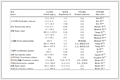
The contents of Ni and Co of NCO-1, NCO-2, and NCO - 3 were detected using ICP spectroscopy (Table 1). The contents of Ni and Co in the NCOs changed with the feeding molar ratios of Ni to Co. According to ICP, the atomic content percentages of Ni and Co in NCO-1, NCO-2, and NCO-3 were 1∶2 (Ni1Co2Ox), 1.5∶ 1.54 (Ni1Co2Ox) and 1.95∶1 (Ni1.95Co1Ox), respectively, which tallied with the theoretical values of Ni and Co in NCO-1, NCO-2, and NCO-3.
 下载:
导出CSV
下载:
导出CSV
| Material | Theoretical nNi∶nCo | Measured concentration / (mg•L-1) | Measured nNi∶nCo | |
| Ni | Co | |||
| NCO-1 | 1∶2 | 24.37 | 48.76 | 1∶2 |
| NCO-2 | 1∶1 | 37.83 | 38.92 | 1.5∶1.54 |
| NCO-3 | 2∶1 | 50.31 | 26.14 | 1.95∶1 |
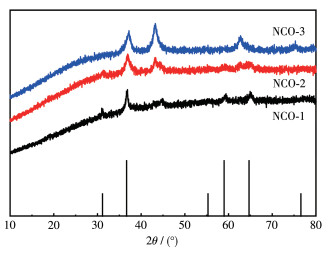
The crystalline structures of NCOs were characterized using an XRD as shown in Fig. 1. As can be seen from Fig. 1, the intensities of diffraction peaks of NCO-1, NCO-2, and NCO-3 were weak with increasing the Ni2+ concentration, which is attributed to the increase in the disorder of atomic arrangement of NCOs with ionic radius difference between nickel (0.069 nm) and cobalt (0.745 nm). Furthermore, the full widths of the half-maximum (FWHM) of the NCOs were wide, which resulted in low crystallinity. The FWHM values of the NCOs, namely NCO - 1 (80.8, 40.6, 52.6, 49.9, 59.6, 45.5, and 43.7), NCO- 2 (62.9, 39.7, 42.0, 52.6, 49.4, 47.8, and 56.4), and NCO - 3 (82.7, 37.1, 31.1, 59.8, 54.8, 43.2, and 54.1), respectively, indicate variations in their crystal structures. The diffraction peaks, corresponding to NCO-1 (31.2°, 36.8°, 44.9°, 55.4°, 59.6°, 64.9°, and 76.6°), NCO-2 (31.3°, 36.7°, 43.7°, 55.6°, 59.1°, 64.6°, and 75.3°), and NCO - 3 (31.1°, 37.1°, 43.2°, 55.1°, 59.3°, 62.8°, and 75.5°), correspond to the (220), (311), (400), (422), (511), (440), and (533) planes of the rhombohedral structure of NiCo2O4 (PDF No. 02 - 1074), respectively. These observations highlight slight differences in the relative intensity and position of the crystal plane peaks among the NCO samples, resulting from minor adjustments in the feeding ratios of Ni and Co. Consequently, the crystal structures of the NCOs exhibit inherent distinctions from one another.
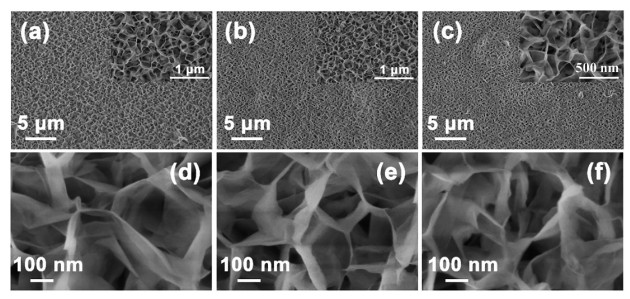
The morphologies and structures of NCO-1, NCO-2, and NCO - 3 were observed by SEM. As can be seen from Fig. 2a-2c, the SEM images of NCO - 1, NCO - 2, and NCO - 3 exhibited nanosheet structures that were slightly wrinkled and interlaced. With the increase of Ni2+ concentration in the initial solution, the size of NCOs nanosheets decreased from 200-300 nm (NCO- 1) to 100 nm (NCO- 2), and the porosity of the nanosheets increased. However, the nanosheets of NCO-3 overlapped with the feeding molar ratio of Ni2+ and Co2+ at 2∶1, which is shown in the black circle of Fig. 2f.
Inset: corresponding enlarged images.
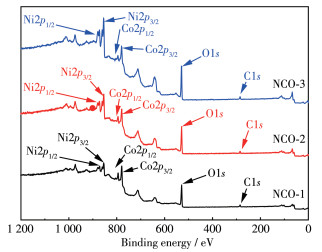
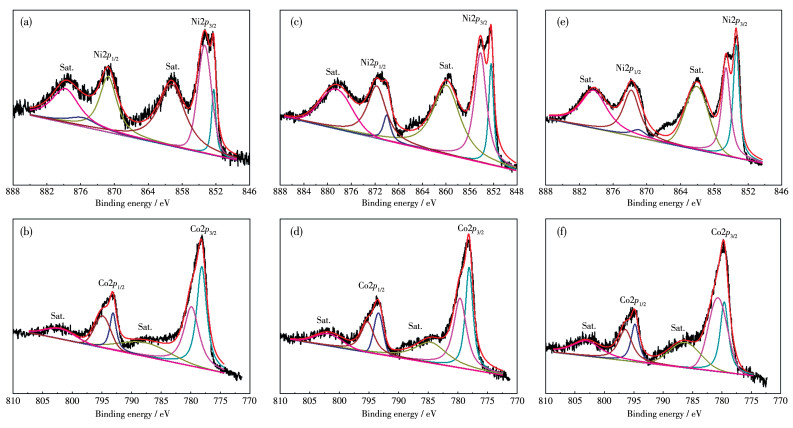
To effectively determine the surface composition and elemental valence of NCOs, NCO-1, NCO-2, and NCO-3 were characterized by XPS. As shown in Fig. 3, the XPS spectra of NCO - 1, NCO - 2, and NCO - 3 all showed the presence of Ni, Co, and O elements. In addition, the NCOs showed a C1s spectrum, which is attributed to that the NCOs were exposed to air to adsorb a small amount of CO2[22]. Fig. 4 shows the XPS spectra of Ni and Co elements in NCO-1, NCO-2, and NCO-3. The peaks of Ni2p and Co2p of NCO-1, NCO-2, and NCO - 3 were divided and fitted by XPSPEAK41 software. The Ni2p spectra of NCO - 1, NCO - 2, and NCO-3 in Fig. 4a, 4c, and 4e showed two major peaks at 854.1 and 871.4 eV, 852.4 and 871.1 eV, and 852.4 and 871.0 eV accompanied with two shakeup satellites, respectively, which indicated the presence of Ni2+. Furthermore, the peaks of Ni were located at 855.9 and 872.8 eV, 854.2 and 871.7 eV, and 854.0 and 875.5 eV, respectively, which identified the existences of Ni3+ in NCO- 1, NCO- 2, and NCO- 3. Moreover, the highresolution Co2p spectrum of NCO-1 (Fig. 4b) could be divided into four cobalt peaks which are located at 779.6 and 780.7 eV (corresponding to Co2+), 794.8 and 796.4 eV (corresponding to Co3+), respectively. The peaks of Co2p were located at 778.2 and 793.4 eV (NCO - 2: Co2+), 779.9 and 795.2 eV (NCO - 2: Co3+), 778.1 and 793.1 eV (NCO - 3: Co2+), 779.6 and 794.9 eV (NCO - 3: Co3+), respectively, which also indicated the existences of Co2+ and Co3+ in NCO-2 and NCO-3. The fitted data of NCO-1, NCO-2, and NCO-3 exhibited the peak positions of Ni2+, Ni3+, Co2+, and Co3+ had minor changes with changing the feed ratios of Ni2+ and Co2+, which were consistent with XRD results.
 下载:
导出CSV
下载:
导出CSV
| Sample | Peak position | |||||||
| Co2+2p1/2 | Co3+2p1/2 | Co2+2p3/2 | Co3+2p3/2 | Ni2+2p1/2 | Ni3+2p1/2 | Ni2+2p3/2 | Ni3+2p3/2 | |
| NCO-1 | 779.6 | 780.7 | 794.8 | 796.4 | 854.1 | 855.9 | 871.4 | 872.8 |
| NCO-2 | 778.2 | 779.9 | 793.4 | 795.2 | 852.4 | 854.2 | 871.1 | 871.7 |
| NCO-3 | 778.1 | 779.6 | 793.1 | 794.9 | 852.4 | 854.0 | 871.0 | 875.5 |
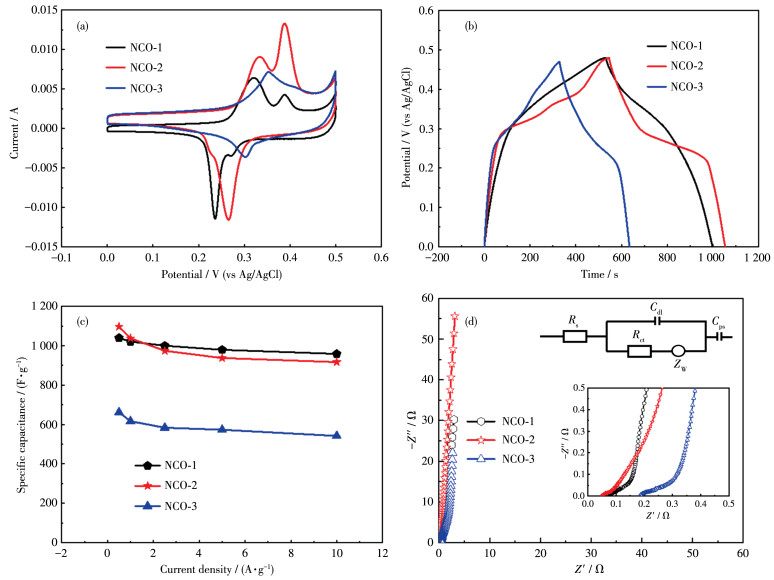
The CV and GCD measurements were conducted to evaluate the electrochemical performances of the as-prepared electrodes. Fig. 5a shows the CV curves of the NCOs at 2 mV·s-1 with a potential window of 0.0 to 0.5 V. The CV curves of NCO-1, NCO-2, and NCO-3 exhibited a pair of redox peaks, respectively, which presented that the pseudo capacitive characteristics were conducted through the faradaic process of
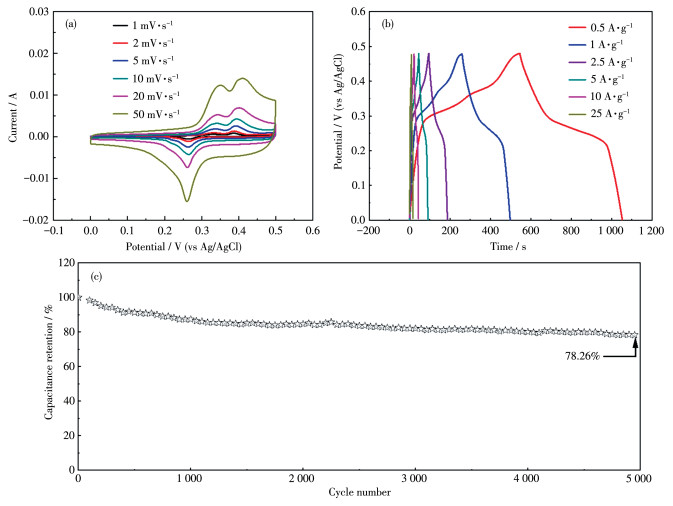
As shown in Fig. 6a, the CV at different scan rates was used to further identify the electrochemical performance of NCO-2. The CV curves had a pair of oxidation and reduction peaks, which exhibited pseudocapacitive characteristics of the NCO-2 electrode. Fig. 6b presents the GCD curves of NCO-2 at different current densities. All the GCD curves with voltage plateaus indicated that the NCO-2 electrode was an ideal pseudocapacitive material[23]. Furthermore, the cycling stability of the NCO - 2 electrode was investigated through GCD measurements at 10 A·g-1 for 5 000 cycles. Fig. 6c shows the 78.26% specific capacitance retention of the NCO-2 electrode, which demonstrated good electrochemical stability of the NCO-2.
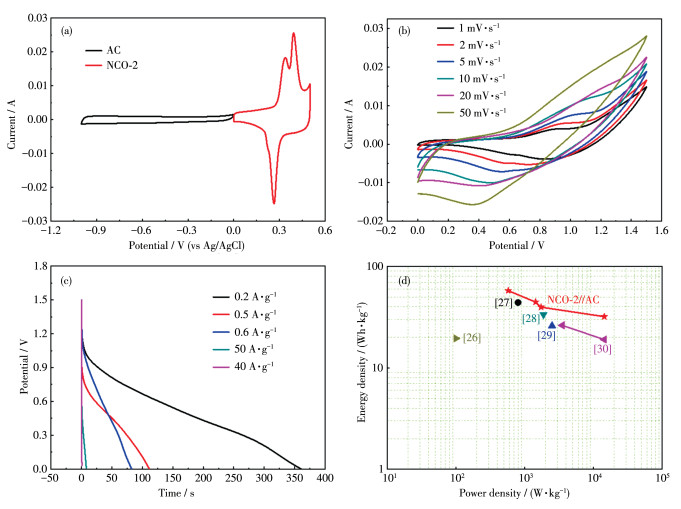
As a measure for evaluating the electrochemical performance of the electrode, the NCO-2//AC asymmetric supercapacitor was assembled, in which NCO-2 and AC were the anode and cathode, respectively. Fig. 7a shows the CV curves of NCO-2 and AC at a scan rate of 5 mV·s-1, which presents that the potential window of NCO-2 and AC were 0-0.5 V and -1.0-0 V, respectively. As shown in Fig. 7b, the CV curves of the NCO-2//AC asymmetric supercapacitor with different scan rates were presented in the potential window of 0 - 1.5 V, which indicated that the supercapacitor stored and released electrical energy. The GCD curves of the NCO - 2//AC asymmetric supercapacitor are shown in Fig. 7c, from which the specific capacitance values of 34.8, 31.0, 25.0, and 20.0 F·g-1 at various current densities 0.5, 0.6, 5.0, and 40 A·g-1 could be deduced. At low current density, it is easy to generate a charging and discharging platform, while at high current density, the charging and discharging platform is easy to disappear[24-25]. At the current density of 0.5 A·g-1, there was a charging and discharging platform, which droped rapidly before reaching the platform. When the current density increased slightly, the platform disappeared. In addition, the duration of this stage is related to voltage value, ambient temperature, discharge rate, and so on. In the Ragone plots (Fig. 7d), the maximum energy density of the NCO-2//AC was found over 57.70 Wh·kg-1 at a power density of 576 W·kg-1. Even at a high-power density of 14.4 kW·kg-1, the energy density of NCO-2//AC could still reach a value of 32 Wh·kg-1, which was higher than the asymmetric supercapacitors under similar systems[26-30]. The electrochemical performance of NCO - 2//AC was relatively better than that of various nickel-cobalt oxide//AC supercapacitors.
In summary, the nickel - cobalt oxide nanosheets were synthesized by controlled hydrothermal and calcined methods. The NCO nanosheets with a length of 100 - 200 nm exposed a large number of active sites which improved the electrochemical reaction between Ni2+ and Co2+ with OH- in electrolyte solution to produce pseudocapacitance. It was found that the pseudocapacitance reactions of the nickel and cobalt oxides were increased by appropriately adjusting the proportion of nickel and cobalt atoms. The NCO-2 nanosheets showed a superior specific capacitance of 1 096.88 F· g-1 at 0.5 A·g-1 with a cycling stability of 78.26% after 5 000 cycles. For asymmetric supercapacitors, the NCO - 2 - based device exhibited the maximum energy density of 57.70 Wh·kg-1 and the power density of 14.4 kW·kg-1, which had significantly exceeded those of previously reported nickel- and cobalt-based asymmetric supercapacitors. Therefore, this work inspired related research on bimetallic nickel cobalt oxides for potential applications in energy storage and conversion.
Zhou Y, Qi H L, Yang J Y, Bo Z, Huang F, Saifullslam M, Lu X Y, Dai L M, Amal R, Wang C H, Han Z J. Two-birds-one-stone: Multifunctional supercapacitors beyond traditional energy storage[J]. Energy Environ. Sci., 2021, 14(4): 1854-1896. doi: 10.1039/D0EE03167D
Zhang Y, Mei H X, Cao Y, Yan X H, Yan J, Gao H L, Luo H W, Wang S W, Jia X D, Kachalova L, Yang J, Xue S C, Zhou C G, Wang L X, Gui Y H. Recent advances and challenges of electrode materials for flexible supercapacitors[J]. Coord. Chem. Rev., 2021, 438: 213910. doi: 10.1016/j.ccr.2021.213910
Zhu Q C, Zhao D Y, Cheng M Y, Zhou J Q, Asare O K, Mai L Q, Yu Y. A new view of supercapacitors: Integrated supercapacitors[J]. Adv. Energy Mater., 2019, 9(36): 1901081. doi: 10.1002/aenm.201901081
Gu Z Y, Guo J Z, Sun Z H, Zhao X X, Wang X T, Liang H J, Wu X L, Liu Y C. Air/water/temperature-stable cathode for all-climate sodiumion batteries[J]. Cell Rep. Phy. Sci., 2021, 2(12): 100665. doi: 10.1016/j.xcrp.2021.100665
Wang X T, Yang Y, Guo J Z, G Z Y, Ang E H, Sun Z H, Li W H, Liang , H J, Wu X L. An advanced cathode composite for co-utilization of cations and anions in lithium batteries[J]. J. Mater. Sci. Technol., 2022, 102: 72-79. doi: 10.1016/j.jmst.2021.05.074
Yu S Y, Yang N J, Liu S T, Jiang X. Diamond supercapacitors: Progress and perspectives[J]. Curr. Opin. Solid State Mater. Sci., 2021, 25(3): 100922. doi: 10.1016/j.cossms.2021.100922
Zhang L, Hu X S, Wang Z P, Sun F C, Dorrell D G. A review of supercapacitor modeling, estimation, and applications: A control/management perspective[J]. Renew. Sust. Energ. Rev., 2018, 81: 1868-1878. doi: 10.1016/j.rser.2017.05.283
Liang G, Li X, Wang Y, Yang S, Huang Z D, Yang Q, Wang D H, Dong B B, Zhu M S, Zhi C Y. Building durable aqueous K-ion capacitors based on Mxene family[J]. Nano Res. Energy, 2022, 1(1): e9120002.
Wang S, Ma J, Shi X, Zhu Y Y, Wu Z S. Recent status and future perspectives of ultracompact and customizable micro - supercapacitors[J]. Nano Res. Energy, 2022, 1(2): e9120018.
Elango B T, Himadri T D, Maiyalagan T. Recent trends in bimetallic oxides and their composites as electrode materials for supercapacitor applications[J]. ChemElectroChem, 2021, 8(10): 1723-1746. doi: 10.1002/celc.202100098
Liang R B, Du Y Q, Xiao P, Cheng J Y, Yuan S J, Chen Y L, Yuan J, Chen J W. Transition metal oxide electrode materials for supercapacitors: A review of recent developments[J]. Nanomaterials, 2021, 11(5): 1248. doi: 10.3390/nano11051248
王贵欣, 周固民, 袁荣忠, 翟美臻, 张伯兰, 于作龙. LiNi0.8Co0.2O2/MWNTs复合物超级电容器电极材料的研究[J]. 无机化学学报, 2005,4,(21): 594-597. WANG G X, ZHOU G M, YUAN R Z, ZHAI M Z, ZHANG B L, YU Z L. Studies on LiNi0.8Co0.2O2/MWNTs composite electrode materials for supercapacitors[J]. Chinese J. Inorg. Chem., 2005, 4(21): 594-597.
Yin X M, Li H J, Yuan R M, Jiao Y M, Lu J H. Templated synthesis of spinel cobaltite MCo2O4 (M=Ni, Co and Mn) hierarchical nanofibers for high performance supercapacitors[J]. J. Materiomics, 2021, 7(4): 858-868. doi: 10.1016/j.jmat.2020.12.007
Sun T R, Shen L X, Jiang Y, Ma J L, Lv F J, Ma H T Ma, Chen D W, Zhu N. Wearable textile supercapacitors for self-Powered enzymefree smartsensors[J]. ACS Appl. Mater. Interfaces, 2022, 19: 21779.
Stoeckli F, Centeno A T. Pore size distribution and capacitance in microporous carbons[J]. Phys. Chem. Chem. Phys., 2012, 14(33): 1158911591.
谢登奎, 范爱玲, 庞伟, 郭亚奇, 高殿超. 絮状三氧镍钴氢氧化物电极材料的制备及其电化学储能性能[J]. 无机化学学报, 2021,38,(1): 31-38. XIE D K, FAN A L, PANG W, GUO Y Q, GAO D C. Flocculent ternary nickel-nobalt-iron hydroxide electrode material preparation and performance for electrochemical energy storge[J]. Chinese J. Inorg. Chem., 2021, 38(1): 31-38.
Simon P, Gogotsi Y. Materials for electrochemical capacitors[J]. Nat. Mater., 2008, 7(11): 845-854. doi: 10.1038/nmat2297
Wang B, Chen J S, Wang Z Y, Madhavi S, Lou X W. Green synthesis of NiO nanobelts with exceptional pseudo-capacitive properties[J]. Adv. Energy Mater., 2012, 2(10): 1188-1192. doi: 10.1002/aenm.201200008
Lang J W, Kong L B, Liu M, Luo Y, Kang L. Co0.56Ni0.44 oxide nanoflake materials and activated carbon for asymmetric supercapacitor[J]. J. Electrochem. Soc., 2010, 157(12): A1341-A1346. doi: 10.1149/1.3497298
Wei T Y, Chen C H, Chien H C, Lu S Y, Hu C C. A cost-effective supercapacitor material of ultrahigh specific capacitances: Spinel nickel cobaltite aerogels from an epoxide- driven sol- gel process[J]. Adv. Mater., 2010, 22(3): 347-351. doi: 10.1002/adma.200902175
Wu Z X, Khalafallah D, Teng C Q, Wang X Q, Zou Q, Chen J H, Zhi M G, Hong Z L. Vanadium doped hierarchical porous nickel-cobalt layered double hydroxides nanosheet arrays for high - performance supercapacitor[J]. J. Alloy. Compd., 2020, 838: 155604. doi: 10.1016/j.jallcom.2020.155604
Zhang Y, Shi Z J, Liu L, Gao Y F, Liu J R. High conductive architecture: Bimetal oxide with metallic properties@bimetal hydroxide for high-performance pseudocapacitor[J]. Electrochim. Acta, 2017, 231: 487494.
Augustyn V, Simon P. Pseudocapacitive oxide materials for high-rate electrochemical energy storage[J]. Energy Environ. Sci., 2014, 7(5): 15971614.
Feng Y M, Liu W F, Wang Y, Gao W N, Li J T, Liu K L, Wang X P, Liu W F, Jiang J. Oxygen vacancies enhance super capacitive performance of CuCo2O4 in high-energy-density asymmetric supercapacitors[J]. J. Power Sources, 2020, 458: 228005. doi: 10.1016/j.jpowsour.2020.228005
Zhang Y, Hu Y X, Wang Z L, Lin T G, Zhu X B, Luo B, Hu H, Xing W, Yan Z F, Wang L Z. Lithiation-induced vacancy engineering of Co3O4 with improved faradic reactivity for high-performance supercapacitor[J]. Adv. Funct. Mater., 2020, 30: 2004172. doi: 10.1002/adfm.202004172
Zhang Li X, Zheng W H, Jiu H F, Ni C H, Chang J X, Qi G. The synthesis of NiO and NiCo2O4 nanosheets by a new method and their excellent capacitive performance for asymmetric supercapacitor[J]. Electrochim. Acta, 2016, 215: 212-222. doi: 10.1016/j.electacta.2016.08.099
Cheng M, Duan S B, Fan H S, Su X R, Cui Y M, Wang R M. Core@shell CoO@Co3O4 nanocrystals assembling mesoporous microspheres for high performance asymmetric supercapacitors[J]. Chem. Eng. J., 2017, 327: 100-108. doi: 10.1016/j.cej.2017.06.042
Yin B S, Wang Z B, Zhang S W, Liu C, Ren Q Q, Ke K. In situ growth of free - standing all metal oxide asymmetric supercapacitor[J]. ACS Appl. Mater., 2016, 8(39): 26019-26029. doi: 10.1021/acsami.6b08037
Wang H L, Holt C M B, Li Z, Tan X H, Amirkhiz B S, Xu Z W, Olsen B C, Stephenson T, Mitlin D. Graphene-nickel cobaltite nanocomposite asymmetrical supercapacitor with commercial level mass loading[J]. Nano Res., 2012, 5(9): 605-617. doi: 10.1007/s12274-012-0246-x
Gawali R S, Dubal P D, Deonikar G. V, Patil S S, Patil S D, Romero P G, Patil D R, Pant J. Asymmetric supercapacitor based on nanostructured Ce-doped NiO (Ce: NiO) as positive and reduced graphene oxide (rGO) as negative electrode[J]. ChemistrySelect, 2016, 1(13): 34713478.

Figure 2 SEM images of (a, c) NCO-1, (b, d) NCO-2, and (c, f) NCO-3
Inset: corresponding enlarged images.

Figure 4 XPS spectra of NCO-1 (a, b), NCO-2 (c, d), and NCO-3 (e, f): Ni2p (a, c, e) and Co2p (b, d, f)

Figure 5 Electrochemical performances of three electrodes: (a) CV curves at a scan rate of 2 mV·s-1; (b) GCD curves at a current density of 0.5 A·g-1; (c) gravimetric capacitances as a function of current density; (d) Nyquist plots (Inset: the magnification plots of the high-frequency region and the equivalent circuit)

Figure 6 Electrochemical performance of NCO-2: (a) CV curves at different scan rates; (b) GCD curves at various current densities; (c) cycling stability at 10 A·g-1 for 5 000 cycles

Figure 7 Electrochemical performance of NCO-2//AC asymmetric supercapacitor: (a) CV curves of AC and NCO-2 at a scan rate of 5 mV·s-1; (b) CV curves at different scan rates; (c) GCD curves at various current densities; (d) Ragone plots
Table 1. ICP analyses of bimetal nickel and cobalt oxides
| Material | Theoretical nNi∶nCo | Measured concentration / (mg•L-1) | Measured nNi∶nCo | |
| Ni | Co | |||
| NCO-1 | 1∶2 | 24.37 | 48.76 | 1∶2 |
| NCO-2 | 1∶1 | 37.83 | 38.92 | 1.5∶1.54 |
| NCO-3 | 2∶1 | 50.31 | 26.14 | 1.95∶1 |
 下载: 导出CSV
Table 2.
Peak positions of Ni and Co elements of NCO-1, NCO-2, and NCO-3
| Sample | Peak position | |||||||
| Co2+2p1/2 | Co3+2p1/2 | Co2+2p3/2 | Co3+2p3/2 | Ni2+2p1/2 | Ni3+2p1/2 | Ni2+2p3/2 | Ni3+2p3/2 | |
| NCO-1 | 779.6 | 780.7 | 794.8 | 796.4 | 854.1 | 855.9 | 871.4 | 872.8 |
| NCO-2 | 778.2 | 779.9 | 793.4 | 795.2 | 852.4 | 854.2 | 871.1 | 871.7 |
| NCO-3 | 778.1 | 779.6 | 793.1 | 794.9 | 852.4 | 854.0 | 871.0 | 875.5 |
下载: 导出CSV

 扫一扫看文章


扫一扫关注我们