Table 1.
Crystal data and structure refinements details for complexes 2-5

Synthesis, characterization, and electrocatalytic hydrogen evolution of diiron dithiolato pentacarbonyl complexes bearing phosphine ligand
Xu-Feng LIU , Bo XU , Hang XU , Yu-Long LI


Currently, great efforts have been paid to produce H2 with noble-metal-free catalysts[1]. In nature, [FeFe]-hydrogenases can efficiently catalyze the reversible reduction of proton to H2 in some microorganisms[2-5]. The X-ray structure of the catalytic center of the active site of [FeFe]-hydrogenases was found in 1998[6] and 1999[7], which is featuring a diiron subcluster coordinated by a bridging azadithiolato ligand[8], carbonyls, cyanides, as well as a [Fe4S4]-linking cysteinyl ligand. While the diiron center is responsible for catalysis, the [Fe4S4] cluster is responsible for proton relay. Since the elucidation of the active site of [FeFe]-hydrogenases, a great number of diiron analogues have been synthesized, for example, diiron propane-1, 3-dithiolato complex [Fe2(CO)6(μ-SCH2CH2CH2S)][9], diiron azadithiolato complex [Fe2(CO)6(μ-SCH2NRCH2S)][10] as the mimics for the bridging three-atom dithiolate. Furthermore, diiron ethane-1, 2-dithiolato complexes[11] were synthesized due to their close relationship with the diiron propane-1, 3-dithiolato complex. Notably, cyanide[12] or phosphine[13] containing analogues were also synthesized by CO exchange reactions as mimics for the ligands found in the active site of [FeFe]-hydrogenases. It is noteworthy that the phosphine ligands, as well as the phosphine-containing analogues, are more stable than the cyanides and the cyanide-containing analogues. Moreover, recent studies have focused on the proton reduction electro-catalyzed by the diiron analogues to develop highly efficient catalysts[14-18].
Although a great number of [FeFe]-hydrogenases biomimics have been reported, the formate ester-containing derivative is still scarce in the literature. To further develop new diiron analogues as potential electrocatalysts for the production of H2, we carried out this research on the synthesis of formate and phosphine-containing derivatives. In our earlier study, we reported a series of phosphine-containing analogues as the catalysts for H2 production under electrochemical conditions[19-20]. As a continuation, we have successfully prepared four diiron analogues by the CO exchange reactions. The structures of these complexes have been fully characterized including single-crystal X-ray diffraction analysis. More significantly, the electrochemical and electrocatalytic properties of these complexes were also studied and discussed. Herein, this paper presents the synthesis, characterization, X-ray crystallography, and electrochemistry of four diiron analogues bearing formate ester and phosphine ligands as the biomimics for the active site of [FeFe]-hydrogenases.
Triphenylphosphine, tricyclohexylphosphine, tris(2-methoxyphenyl)phosphine, tris(4-(trifluoromethyl)phenyl)phosphine, and Me3NO∙2H2O were commercially available and used as received. Complex [Fe2(CO)6 (μ-SCH2CH(CH2OOCH)S)] (1) was prepared according to the literature method[21]. IR spectra were recorded on a Nicolet MAGNA 560 FTIR spectrometer. NMR spectra were obtained on a Bruker Avance 500 MHz spectrometer. Elemental analyses were performed by an Elementar Vario EL cube analyzer.
To a solution of complex 1 (0.043 g, 0.1 mmol) and the corresponding phosphine ligands (0.1 mmol) in CH2Cl2 (5 mL) was added a solution of Me3NO·2H2O (0.011 g, 0.1 mmol) in MeCN (5 mL). The mixture was stirred at room temperature for 1 h and the solvent was reduced on a rotary evaporator. The residue was subjected to TLC separation to collect the main red band. Complexes [Fe2(CO)5(L)(μ-SCH2CH(CH2OOCH)S)](L=PPh3 (2), PCy3 (3), P(2-C6H4OCH3)3 (4), P(4-C6H4CF3)3 (5)) were obtained as red solids.
Complex 2. Yield: 80%. IR (KBr disk, cm-1): νC≡O 2 046 (vs), 1 987 (vs), 1 976 (s), 1 961 (sh), 1 934 (m); νC=O 1 728 (m). 1H NMR (500 MHz, CDCl3): δ 7.94 (s, 1H, HCOO), 7.61 (s, 6H, PhH), 7.47 (s, 9H, PhH), 3.97-3.84 (m, 2H, OCH2), 1.80 (s, 1H, SCH), 1.39-1.33 (m, 2H, SCH2). 31P{1H} NMR (200 MHz, CDCl3, 85% H3PO4): δ 62.72 (s). 13C{1H} NMR (125 MHz, CDCl3): δ 214.54 (d, JP-C=8.9 Hz, PFeC≡O), 214.38 (d, JP-C=8.5 Hz, PFeC≡O), 209.91 (FeC≡O), 160.04 (C=O), 135.52 (d, JP-C=39.4 Hz, i-PhC), 133.14 (d, JP-C=11.2 Hz, o-PhC), 130.37 (s, p-PhC), 128.69 (d, JP-C=9.5 Hz, m-PhC), 65.39 (OCH2), 49.59 (SCH), 37.37 (SCH2). Anal. Calcd. for C27H21Fe2O7PS2(%): C, 48.82; H, 3.19. Found(%): C, 48.86; H, 3.61.
Complex 3. Yield: 59%. IR (KBr disk, cm-1): νC≡O 2 042 (vs), 1 970 (vs), 1 956 (sh), 1 925 (s); νC=O 1 731 (m). 1H NMR (500 MHz, CDCl3): δ 8.07 (s, 1H, HCOO), 4.14 (s, 2H, OCH2), 2.69-2.55 (m, 2H, CyH), 2.12 (s, 3H, CyH), 1.98 (s, 3H, CyH), 1.92-1.70 (m, 12H, CyH, and SCH), 1.58-1.56 (m, 4H, CyH and SCH2), 1.47-1.44 (m, 3H, CyH), 1.31 (s, 9H, CyH). 31P{1H} NMR (200 MHz, CDCl3, 85% H3PO4): δ 70.58 (s). 13C{1H} NMR (125 MHz, CDCl3): δ 216.58 (d, JP-C=11.2 Hz, PFeC≡O), 216.49 (d, JP-C=11.5 Hz, PFeC≡O), 210.40 (FeC≡O), 160.33 (C=O), 65.82 (OCH2), 50.79 (SCH), 39.30 (SCH2), 38.32, 38.18, 30.58, 29.86, 27.92, 27.88, 27.84, 27.80, 26.40 (CyC). Anal. Calcd. for C27H39Fe2O7PS2(%): C, 47.52; H, 5.76. Found(%): C, 47.28; H, 5.62.
Complex 4. Yield: 88%. IR (KBr disk, cm-1): νC≡O 2 042 (vs), 1 983 (vs), 1 973 (vs), 1 958 (sh), 1 932 (sh); νC=O 1 722 (m). 1H NMR (500 MHz, CDCl3): δ 7.91 (s, 1H, HCOO), 7.43 (s, 4H, PhH), 6.97, 6.89 (2s, 8H, PhH), 3.92, 3.76 (2s, 2H, OCH2), 3.57 (s, 9H, 3OCH3), 1.56 (s, 2H, SCH2), 1.17 (m, 1H, SCH). 31P{1H} NMR (200 MHz, CDCl3, 85% H3PO4): δ 49.25 (s). 13C{1H} NMR (125 MHz, CDCl3): δ 215.72 (d, JP-C=9.1 Hz, PFeC≡O), 215.53 (d, JP-C=10.5 Hz, PFeC≡O), 210.61 (FeC≡O), 160.21 (C=O), 135.40, 131.86, 121.22, 119.79, 119.74, 111.13 (PhC), 65.68 (OCH2), 54.70 (OCH3), 49.16 (SCH), 37.38 (SCH2). Anal. Calcd. for C30H27Fe2O10PS2(%): C, 47.77; H, 3.61. Found(%): C, 47.46; H, 2.96.
Complex 5. Yield: 72%. IR (KBr disk, cm-1): νC≡O 2 056 (vs), 1 992 (vs), 1 944 (s); νC=O 1 722 (m). 1H NMR (500 MHz, CDCl3): δ 7.91 (s, 1H, HCOO), 7.76 (s, 12H, PhH), 3.94, 3.86 (2s, 2H, OCH2), 1.78 (s, 1H, SCH), 1.28 (s, 2H, SCH2). 31P{1H} NMR (200 MHz, CDCl3, 85% H3PO4): δ 64.85 (s). 13C{1H} NMR (125 MHz, CDCl3): δ 213.58, 209.06 (C≡O), 159.87 (C=O), 139.03, 138.75, 133.41, 133.32, 125.98 (PhC), 123.38 (d, JF-C=270.0 Hz, CF3), 65.17 (OCH2), 49.93 (SCH), 37.49 (SCH2). Anal. Calcd. for C30H18F9Fe2O7PS2(%): C, 41.50; H, 2.09. Found(%): C, 41.48; H, 2.12.
Single crystals were mounted on a Bruker D8 QUEST diffractometer. Data were collected at 296 K by using a graphite-monochromatic with Mo Kα radiation (λ=0.071 073 nm) in the ω-φ scan mode. Data collection and reduction were completed by APEX2. Absorption correction was performed by the SADABS program. Using OLEX2, the structures were solved by direct methods using the SHELXS program and refined by full-matrix least-squares techniques SHELXL on F 2. Hydrogen atoms were located using the geometric method. Non-hydrogen atoms were refined with anisotropic thermal parameters. A disordered CH2Cl2 over two sites with an occupancy of 0.641 could be found in the structure of complex 4·CH2Cl2. Details of crystal data, data collections, and structure refinements are summarized in Table 1.
 下载:
导出CSV
下载:
导出CSV
| Parameter | 2 | 3 | 4·CH2Cl2 | 5 |
| Empirical formula | C27H21Fe2O7PS2 | C27H39Fe2O7PS2 | C31H29Cl2Fe2O10PS2 | C30H18F9Fe2O7PS2 |
| Formula weight | 664.23 | 682.37 | 839.23 | 868.23 |
| Crystal system | Monoclinic | Monoclinic | Triclinic | Triclinic |
| Space group | P21/c | P21/c | P1 | P1 |
| a / nm | 0.910 23(19) | 1.004 12(7) | 0.903 91(6) | 0.932 4(3) |
| b / nm | 3.009 5(6) | 1.361 45(10) | 1.296 03(8) | 1.132 4(3) |
| c / nm | 1.097 8(3) | 2.342 62(17) | 1.719 77(11) | 1.694 0(5) |
| α / (°) | 111.420(3) | 73.151(7) | ||
| β / (°) | 104.691(7) | 102.167(2) | 95.611(3) | 78.328(8) |
| γ / (°) | 103.086(3) | 84.259(8) | ||
| V / nm3 | 2.909 0(11) | 3.130 6(4) | 1.790 3(2) | 1.674 8(8) |
| Z | 4 | 4 | 2 | 2 |
| Dc / (g·cm-3) | 1.517 | 1.448 | 1.557 | 1.722 |
| μ / mm-1 | 1.238 | 1.152 | 1.174 | 1.135 |
| F(000) | 1 352.0 | 1 424.0 | 856.0 | 868.0 |
| Crystal size / mm | 0.34×0.32×0.3 | 0.32×0.24×0.18 | 0.32×0.28×0.26 | 0.18×0.16×0.14 |
| 2θ range / (°) | 4.82-50.048 | 4.864-50.186 | 5.028-55.112 | 4.724-50.218 |
| Indices range | -10 ≤ h ≤ 10, -35 ≤ k ≤ 35, -13 ≤ l ≤ 13 |
-11 ≤ h ≤ 11, -15 ≤ k ≤ 16, -27 ≤ l ≤ 27 |
-11 ≤ h ≤ 11, -16 ≤ k ≤ 16, -22 ≤ l ≤ 22 |
-11 ≤ h ≤ 11, -13 ≤ k ≤ 13, -20 ≤ l ≤ 20 |
| Reflection collected | 57 645 | 46 723 | 31 213 | 32 102 |
| Independent reflection | 5 096 (Rint=0.060 1) | 5 559 (Rint=0.064 7) | 8 209 (Rint=0.044 2) | 5 888 (Rint=0.040 0) |
| Data, restraint, parameter | 5 096, 32, 352 | 5 559, 29, 352 | 8 209, 38, 455 | 5 888, 0, 460 |
| Goodness of fit on F 2 | 1.070 | 1.049 | 1.033 | 1.042 |
| Final R indices [I > 2σ(I)] | 0.088 9, 0.207 9 | 0.071 0, 0.181 8 | 0.053 9, 0.138 8 | 0.051 6, 0.131 0 |
| Final R indices (all data) | 0.100 5, 0.215 3 | 0.100 5, 0.199 1 | 0.084 2, 0.156 2 | 0.068 8, 0.142 1 |
| Largest diff peak and hole / (e·nm-3) | 1 450, -1 193 | 1 320, -956 | 920, -802 | 720, -394 |
Electrochemical properties were studied by cyclic voltammetry (CV) in the MeCN solution. Electrochemical measurements were carried out under nitrogen using a CHI 620 Electrochemical workstation. As the electrolyte, nBu4NPF6 was recrystallized several times from a CH2Cl2 solution by the addition of hexane. CV curves were obtained in a three-electrode cell with a glassy carbon electrode (diameter: 3 mm) as the working electrode, a platinum wire as the counter electrode, and a non-aqueous Ag/Ag+ electrode as the reference electrode. The potential scale was calibrated against the Fc/Fc+ couple and reported versus this reference system.
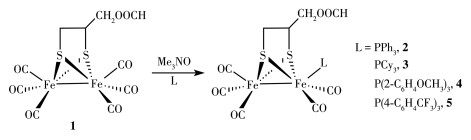
As depicted in Scheme 1, CO exchange of the starting complex 1 with the corresponding phosphine ligand assisted by the decarbonylation agent Me3NO·2H2O gave the products 2-5 in 59%-88% yields. Complexes 2-5 are air-stable red solids and soluble in medium polar solvents such as CH2Cl2 and CHCl3. We have identified the structures of complexes 2-5 by elemental analysis, IR, and NMR spectroscopy. In the IR spectra, three to five bands ranging from 2 056 to 1 925 cm-1 were observed for complexes 2-5, which can be designated to the stretching vibrations of carbonyls C≡O, shifting to lower energies relative to all-carbonyl complex [Fe2(CO)6{μ-SCH2CH(CH2OOCCH3)S}] (2 077, 2 037, 2 008, 1 990 cm-1)[21] due to the better donor of the phosphine ligands[22]. In addition, the C≡O vibrations of complexes 2-5 were close to other monosubstituted analogues[23], but smaller than phosphine-chelated analogues[24]. In the 1H NMR spectra of complexes 2-5, a single resonance at ca. δ 8.0 is ascribed to the formate ester proton. The 31P{1H} NMR spectra of complexes 2-5 displayed a singlet at δ 70.58-49.25 for the coordinated phosphine ligands, in accord with phosphine-containing analogues[25-27]. The 13C{1H} NMR spectra of complexes 2-5 showed a single resonance at ca. δ 160 for the ester carbonyl.
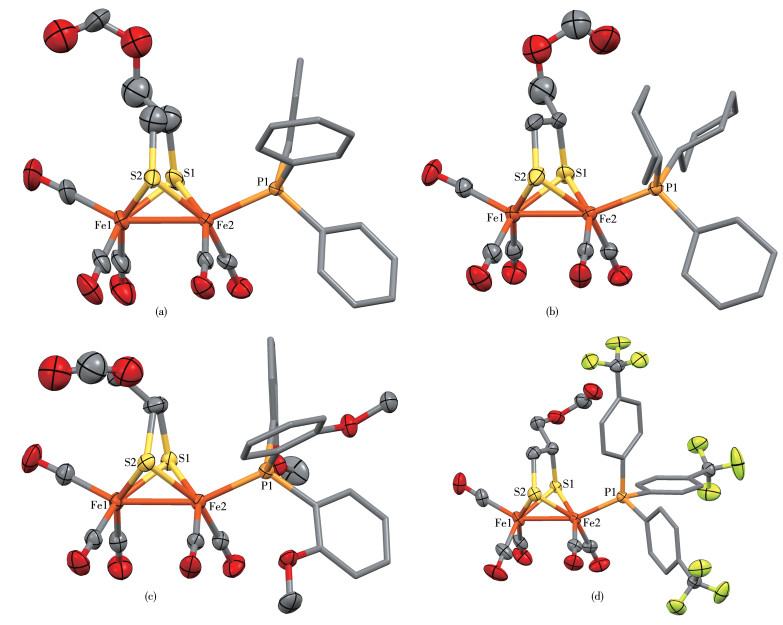
To determine the solid-state structures, high-quality single crystals were obtained and analyzed by X-ray diffraction analysis. The molecular structures of complexes 2-5 drawn as thermal ellipsoids and capped sticks are shown in Fig. 1 and the selected bond lengths and angles are given in Table 2. Complexes 2 and 3 crystallize in monoclinic space group P21/c whereas complexes 4·CH2Cl2 and 5 crystallize in triclinic space group P1. Fig. 1 shows that the molecular structures of complexes 2-5 are composed of a diiron unit with a bridged ethane-1, 2-dithiolate containing a formate ester group, five terminal carbonyls, and a phosphine ligand. The position of the phosphine ligands is apical to the pseudo-octahedral coordination arrangement of the Fe atom, in good agreement with monosubstituted analogues[28-30]. The Fe1—Fe2 bond lengths of complexes 3 (0.251 09(12) nm) and 4·CH2Cl2 (0.251 59(7) nm) are slightly longer than those of complexes 2 (0.249 96(15) nm) and 5 (0.250 93(10) nm), probably due to the better donor of tricyclohexylphosphine and tris(2-methoxyphenyl)phosphine. Moreover, the Fe1—Fe2 bond lengths of complexes 2-5 are much shorter than those in natural [FeFe]-hydrogenases (0.255-0.262 nm)[6-7]. The orientation of the formate ester group in complexes 2-5 shows some differences due to the effect of the phosphine ligand.
 下载:
导出CSV
下载:
导出CSV
| Bond | 2 | 3 | 4·CH2Cl2 | 5 |
| Fe1—Fe2 | 0.249 96(15) | 0.251 09(12) | 0.251 59(7) | 0.250 93(10) |
| Fe1—S1 | 0.225 1(3) | 0.225 5(2) | 0.225 51(11) | 0.224 32(13) |
| Fe1—S2 | 0.226 6(3) | 0.225 6(2) | 0.225 12(12) | 0.225 66(14) |
| Fe2—S1 | 0.224 7(2) | 0.224 49(19) | 0.226 05(10) | 0.226 35(13) |
| Fe2—S2 | 0.226 5(2) | 0.227 5(2) | 0.224 92(10) | 0.227 89(15) |
| Fe2—P1 | 0.224 94(18) | 0.228 16(16) | 0.227 38(11) | 0.224 29(12) |
| S1—Fe1—Fe2 | 56.17(6) | 55.89(5) | 56.24(3) | 56.55(3) |
| S1—Fe1—S2 | 79.84(11) | 79.50(8) | 79.52(4) | 80.27(5) |
| S2—Fe1—Fe2 | 56.50(6) | 56.71(5) | 55.97(3) | 56.83(4) |
| S1—Fe2—Fe1 | 56.31(7) | 56.27(5) | 56.04(3) | 55.78(4) |
| S2—Fe2—Fe1 | 56.55(7) | 55.99(5) | 56.05(3) | 55.99(4) |
| S2—Fe2—S1 | 79.95(12) | 79.31(8) | 79.45(4) | 79.37(5) |
| P1—Fe2—Fe1 | 156.16(7) | 159.76(6) | 155.57(4) | 155.87(4) |
| Fe1—S1—Fe2 | 67.52(8) | 67.84(6) | 67.72(3) | 67.67(4) |
| Fe2—S2—Fe1 | 66.95(8) | 67.31(6) | 67.98(3) | 67.18(4) |
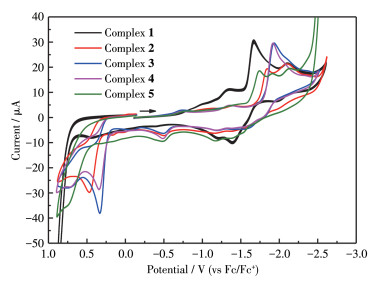
We carried out CV studies in 0.1 mol·L-1 nBu4NPF6 as the supporting electrolyte in MeCN to evaluate the redox activity. The CV curves of complexes 1-5 are shown in Fig. 2 and the electrochemical data are given in Table 3. As shown in Fig. 2 and Table 3, CV curves of complexes 2-5 displayed one irreversible reduction process in a range of -1.71 to -1.93 V as well as one irreversible oxidation process in a range of 0.33 to 0.73 V. According to the electrochemical behavior of complex [Fe2(CO)6(μ-SCH2CH2CH2S)] as described by Darensbourg and co-workers[31], the reduction process can be ascribed to the one-electron reduction from FeⅠFeⅠ to Fe0FeⅠ whereas the oxidation process can be ascribed to the one-electron oxidation from FeⅠFeⅠ to FeⅡFeⅠ. Nevertheless, the CV curve of complex 1 only had one irreversible reduction process at -1.67 V and we assume that the oxidation process is so positive that beyond the solvent window. It is worth pointing out that the reduction peaks for complexes 2-5 moved negatively in comparison with complex 1 in terms of the enhancement of the electron density on the diiron center because the phosphine ligand is a better donor than CO[22]. The reduction and oxidation process of complex 5 are very close to complex [Fe2(CO)6(μ-SCH2CH2CH2S)] (-1.74 and 0.74 V versus Fc/Fc+)[31]. However, the corresponding values of complexes 2-4 shifted cathodically with respect to complex 5 and complex [Fe2(CO)6(μ-SCH2CH2CH2S)], suggesting that the electron-withdrawing trifluoromethyl group can reduce the electron density on the diiron center.
 下载:
导出CSV
下载:
导出CSV
| Complex | Epc / V | Epa / V | Overpotential / V | TOF* / s-1 |
| 1 | -1.67 | — | 0.74 | 26.94 |
| 2 | -1.84 | 0.47 | 0.79 | 17.86 |
| 3 | -1.93 | 0.33 | 0.81 | 5.46 |
| 4 | -1.92 | 0.34 | 0.72 | 5.46 |
| 5 | -1.74 | 0.73 | 0.80 | 22.47 |
| * TOF: turnover frequency | ||||
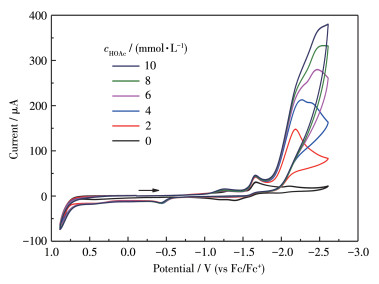
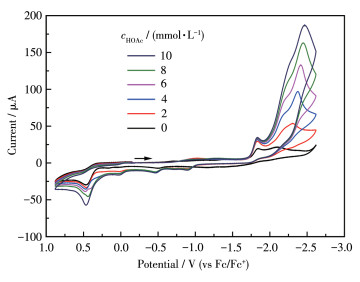
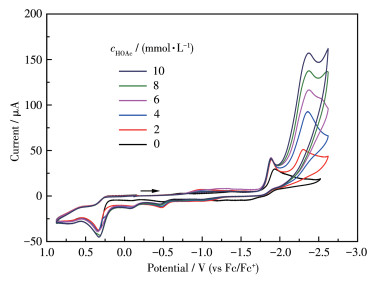
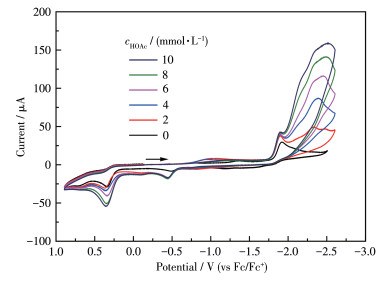
Further studies on the electrocatalytic H2 evolution were undertaken by adding a weak proton acid HOAc into the MeCN solution. As shown in Fig. 3, upon the addition of HOAc, the current height of the reduction peak for complex 1 at -1.67 V was slightly increased, however, a catalytic wave at -2.19 V can be found and the current height was significantly increased with continuous addition of HOAc, indicative of H2 evolution catalyzed by complex 1[31-33]. It should be noted that the catalytic wave shifted positively by 0.31 V as compared to the HOAc without the diiron complex (blank)[19]. Similarly, as shown in Fig. 4, 6, and 7, complexes 2, 4, and 5 could also act as electrocatalysts for H2 production in the presence of HOAc. However, we found that upon the addition of HOAc into complex 3, the reduction peak at -1.93 V shifted positively by 40 mV (Fig. 5), in agreement with the case obtained from [Fe2(CO)6{(μ-SCH2)2N(4-NO2C6H4)}] by Wang and co-workers[34]. Shoulder peaks around -2.00 V for complexes 1 (Fig. 3), 2 (Fig. 4), and 4 (Fig. 6) could be observed and we assume that this may be attributed to the dissociation of the ester group under acidic conditions.
ccomplex=1.0 mmol·L-1.
ccomplex=1.0 mmol·L-1.
ccomplex=1.0 mmol·L-1.
ccomplex=1.0 mmol·L-1.
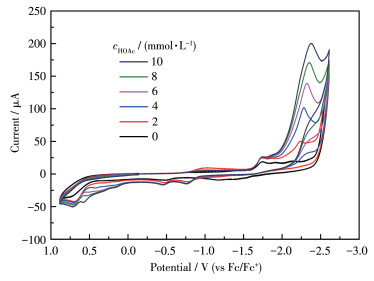
ccomplex=1.0 mmol·L-1.
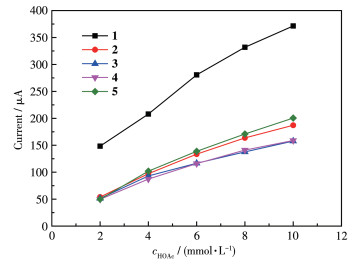
To better understand the catalytic activities for proton reduction, overpotential and turnover frequency (TOF) were calculated by the reported methods[35-36], and the results are also illustrated in Table 3. It can be seen that complex 4 had the lowest overpotential concerning the other four complexes and complex 1 possessed the highest TOF of 26.94 possibly due to the lower electron density on diiron subsite. However, the TOF for complex 4 was the same as complex 3 and they were both much lower than the other two complexes bearing phosphine ligands. Among those complexes with phosphine ligands, complex 5 had the highest TOF, indicating that the diiron complex bearing electron-withdrawing group functionalized phosphine is more favorable for proton reduction than that bearing electron-donating group. Further, the electronic effect of tricyclohexylphosphine is very close to tris(2-methoxyphenyl)phosphine. Additionally, the catalysis of complexes 1-5 was compared by the dependence of peak current of the electrocatalysis versus the addition of HOAc concentration (Fig. 8). It can be viewed that the electrocatalysis of complex 1 was faster than other complexes, in agreement with the TOFs calculation.
In conclusion, we have detailed the synthesis and characterization of four diiron ethane-1, 2-dithiolato pentacarbonyl complexes bearing phosphine ligands as the mimics for the active site of [FeFe]-hydrogenases. The electrochemical properties of these complexes were studied by CV together with electrocatalytic H2 production by adding HOAc. The results have shown that these complexes can act as catalysts for the reduction of protons to H2 under electrochemical conditions. The catalytic activities for electrochemical proton reduction were estimated and the results showed that complex 4 had the lowest overpotential and complex 1 had the best catalytic efficiency among these complexes.
Han Z J, Qiu F, Eisenberg R, Holland P L, Krauss T D. Robust photogeneration of H2 in water using semiconductor nanocrystals and a nickel catalyst[J]. Science, 2012, 338: 1321-1324. doi: 10.1126/science.1227775
Rauchfuss T B. Diiron azadithiolates as models for the [FeFe]-hydrogenase active site and paradigm for the role of the second coordination sphere[J]. Acc. Chem. Res., 2015, 48: 2107-2116. doi: 10.1021/acs.accounts.5b00177
Tard C, Pickett C J. Structural and functional analogues of the active sites of the [Fe]-, [NiFe]-, and [FeFe]-hydrogenases[J]. Chem. Rev., 2009, 109: 2245-2274. doi: 10.1021/cr800542q
Li Y L, Rauchfuss T B. Synthesis of diiron? dithiolato carbonyl complexes[J]. Chem. Rev., 2014, 116: 7043-7077.
Schilter D, Camara J M, Huynh M T, Hammes-Schiffer S, Rauchfuss T B. Hydrogenase enzymes and their synthetic models: The role of metal hydrides[J]. Chem. Rev., 2016, 116: 8693-9749. doi: 10.1021/acs.chemrev.6b00180
Peters J W, Lanzilotta W N, Lemon B J, Seefeldt L C. X-ray crystal structure of the Fe-only hydrogenase (CpI) from Clostridium Pasteurianum to 1.8 angstrom resolution[J]. Science, 1998, 282: 1853-1858. doi: 10.1126/science.282.5395.1853
Nicolet Y, Piras C, Legrand P, Hatchikian C E, Fontecilla-Camps J C. Desulfovibrio Desulfuricans iron hydrogenase: The structure shows unusual coordination to an active site Fe binuclear center[J]. Structure, 1999, 7: 13-23. doi: 10.1016/S0969-2126(99)80005-7
Fan H J, Hall M B. A capable bridging ligand for Fe-only hydrogenase: Density functional calculations of a low-energy route for heterolytic cleavage and formation of dihydrogen[J]. J. Am. Chem. Soc., 2001, 123: 3828-3829. doi: 10.1021/ja004120i
Lyon E J, Georgakaki I P, Reibenspies J H, Darensbourg M Y. Carbon monoxide and cyanide ligands in a classical organometallic complex model for Fe-only hydrogenase[J]. Angew. Chem. Int. Ed., 1999, 38: 3178-3180. doi: 10.1002/(SICI)1521-3773(19991102)38:21<3178::AID-ANIE3178>3.0.CO;2-4
Li H X, Rauchfuss T B. Iron carbonyl sulfides, formaldehyde, and amines condense to give the proposed azadithiolate cofactor of the Fe-only hydrogenases[J]. J. Am. Chem. Soc., 2002, 124: 726-727. doi: 10.1021/ja016964n
Liu X F, Jiang Z Q, Jia Z J. Synthesis, characterization and crystal structures of tetrairon ethanedithiolate complexes containing bridging bidentate phosphine ligands[J]. Polyhedron, 2012, 33: 166-170. doi: 10.1016/j.poly.2011.11.032
Lawrence J D, Li H X, Rauchfuss T B, Bénard M, Rohmer M M. Diiron azadithiolates as models for the iron-only hydrogenase active site: Synthesis, structure, and stereoelectronics[J]. Angew. Chem. Int. Ed., 2001, 40: 1768-1771. doi: 10.1002/1521-3773(20010504)40:9<1768::AID-ANIE17680>3.0.CO;2-E
Mejia-Rodriguez R, Chong D, Reibenspies J H, Soriaga M P, Darensbourg M Y. The hydrophilic phosphatriazaadamantane ligand in the development of H2 production electrocatalysts: iron hydrogenase model complexes[J]. J. Am. Chem. Soc., 2004, 126: 12004-12014. doi: 10.1021/ja039394v
Li Z M, Xiao Z Y, Xu F F, Zeng X H, Liu X M. Enhancement in catalytic proton reduction by an internal base in a diiron pentacarbonyl complex: Its synthesis, characterization, inter-conversion and electrochemical investigation[J]. Dalton Trans., 2017, 46: 1864-1871. doi: 10.1039/C6DT04409C
Zhong W, Wu L, Jiang W D, Li Y L, Mookan N, Liu X M. Proton-coupled electron transfer in the reduction of diiron hexacarbonyl complexes and its enhancement on the electrocatalytic reduction of protons by a pendant basic group[J]. Dalton Trans., 2019, 48: 13711-13718. doi: 10.1039/C9DT02058F
Xiao Z Y, Zhong W, Liu X M. Recent developments in electrochemical investigations into iron carbonyl complexes relevant to the iron centres of hydrogenases[J]. Dalton Trans., 2022, 51: 40-47. doi: 10.1039/D1DT02705K
Orton G R F, Ringenberg M R, Hogarth G. Biomimics of [FeFe]-hydrogenases incorporating redox-active ligands: Ferrocene-bridged dithiolate complexes [Fe2(CO)6(μ-EC5H4FeC5H4E)] (E=S, Se)[J]. J. Organomet. Chem., 2022, 978: 122472. doi: 10.1016/j.jorganchem.2022.122472
Orton G R F, Ghosh S, Alker L, Sarker J C, Pugh D, Richmond M G, Hartl F, Hogarth G. Biomimics of [FeFe]-hydrogenases incorporating redox-active ligands: Synthesis, redox properties and spectroelectrochemistry of diiron-dithiolate complexes with ferrocenyl-diphosphines as Fe4S4 surrogates[J]. Dalton Trans., 2022, 51: 9748-9769. doi: 10.1039/D2DT00419D
Yan L, Yang J, Lü S, Liu X F, Li Y L, Liu X H, Jiang Z Q. Phosphine-containing diiron propane-1, 2-dithiolate derivatives: Synthesis, spectroscopy, X-ray crystal structures, and electrochemistry[J]. Catal. Lett., 2021, 151: 1857-1867. doi: 10.1007/s10562-020-03450-2
Liu X F, Ma Z Y, Jin B, Wang D, Zhao P H. Substituent effects of tertiary phosphines on the structures and electrochemical performances of azadithiolato-bridged diiron model complexes of [FeFe]-hydrogenases[J]. Appl. Organomet. Chem., 2022, 36: e6751.
Lian M, He J, Yu X Y, Mu C, Liu X F, Li Y L, Jiang Z Q. Diiron ethanedithiolate complexes with acetate ester: Synthesis, characterization and electrochemical properties[J]. J. Organomet. Chem., 2018, 870: 90-96. doi: 10.1016/j.jorganchem.2018.06.023
Li P, Wang M, He C J, Li G H, Liu X Y, Chen C N, Å kermark B, Sun L C. Influence of tertiary phosphanes on the coordination configurations and electrochemical properties of iron hydrogenase model complexes: Crystal structures of [(μ-S2C3H6)Fe2(CO)6-nLn] (L=PMe2Ph, n=1, 2; PPh3, P(OEt)3, n=1)[J]. Eur. J. Inorg. Chem., 2005, : 2506-2513.
Yan L, Hu K, Liu X F, Li Y L, Liu X H, Jiang Z Q. Diiron ethane-1, 2-dithiolate complexes with 1, 2, 3-thiadiazole moiety: Synthesis, X-ray crystal structures, electrochemistry and fungicidal activity[J]. Appl. Organomet. Chem., 2021, 35: e6084.
Zhao P H, Hu M Y, Li J R, Ma Z Y, Wang Y Z, He J, Li Y L, Liu X F. Influence of dithiolate bridges on the structures and electrocatalytic performance of small bite-angle PNP-chelated diiron complexes Fe2(μ-xdt)(CO)4{κ2-(Ph2P)2NR} related to [FeFe]-hydrogenases[J]. Organometallics, 2019, 38: 385-394. doi: 10.1021/acs.organomet.8b00759
Gao W M, Ekström J, Liu J H, Chen C N, Eriksson L, Weng L H, Å kermark B, Sun L C. Binuclear iron-sulfur complexes with bidentate phosphine ligands as active site models of Fe-hydrogenase and their catalytic proton reduction[J]. Inorg. Chem., 2007, 46: 1981-1991. doi: 10.1021/ic0610278
刘旭锋, 徐博, 徐航, 李玉龙. 膦配体取代的乙基乙撑双铁配合物的合成、晶体结构及电化学催化性能[J]. 无机化学学报, 2022,38,(12): 2521-2529. LIU X F, XU B, XU H, LI Y L. Diiron butane-1, 2-dithiolate complexes with phosphine ligands: Preparation, crystal structures, and electrochemical catalytic performance[J]. Chinese J. Inorg. Chem., 2022, 38(12): 2521-2529.
Jin B, Tan X, Zhang X X, Wang Z Y, Qu Y P, He Y B, Hu T P, Zhao P H. Substituent effects in carbon-nanotube-supported diiron monophosphine complexes for hydrogen evolution reaction[J]. Electrochim. Acta, 2022, 434: 141325. doi: 10.1016/j.electacta.2022.141325
Chen F Y, He J, Yu X Y, Wang Z, Mu C, Liu X F, Li Y L, Jiang Z Q, Wu H K. Electrocatalytic properties of diiron ethanedithiolate complexes containing benzoate ester[J]. Appl. Organomet. Chem., 2018, 32: e4549. doi: 10.1002/aoc.4549
Lin H M, Li J R, Mu C, Li A, Liu X F, Zhao P H, Li Y L, Jiang Z Q, Wu H K. Synthesis, characterization, and electrochemistry of monophosphine‐containing diiron propane‐1, 2‐dithiolate complexes related to the active site of [FeFe]‐hydrogenases[J]. Appl. Organomet. Chem., 2019, 33: e5196.
Hu M Y, Zhao P H, Li J R, Gu X L, Jing X B, Liu X F. Synthesis, structures, and electrocatalytic properties of phosphine-monodentate, -chelate, and -bridge diiron 2, 2-dimethylpropanedithiolate complexes related to [FeFe]-hydrogenases[J]. Appl. Organomet. Chem., 2020, 34: e5523.
Chong D, Georgakaki I P, Mejia-Rodriguez R, Sanabria-Chinchilla J, Soriaga M P, Darensbourg M Y. Electrocatalysis of hydrogen production by active site analogues of the iron hydrogenase enzyme: structure/function relationships[J]. Dalton Trans., 2003, : 4158-4163.
Gloaguen F, Lawrence J D, Rauchfuss T B. Biomimetic hydrogen evolution catalyzed by an iron carbonyl thiolate[J]. J. Am. Chem. Soc., 2001, 123: 9476-9477. doi: 10.1021/ja016516f
Vannucci A K, Wang S, Nichol G S, Lichtenberger D L, Evans D H, Glass R S. Electronic and geometric effects of phosphatriazaadamantane ligands on the catalytic activity of a [FeFe] hydrogenase inspired complex[J]. Dalton Trans., 2010, 39: 3050-3056. doi: 10.1039/B921067A
Liu T B, Wang M, Shi Z, Cui H G, Dong W B, Chen J S, Å kermark B, Sun L C. Synthesis, structures and electrochemical properties of nitro- and amino-functionalized diiron azadithiolates as active site models of Fe-only hydrogenases[J]. Chem.-Eur. J., 2004, 10: 4474-4479. doi: 10.1002/chem.200400004
Fourmond V, Jacques P A, Fontecave M, Artero M. H2 Evolution and molecular electrocatalysts: Determination of overpotentials and effect of homoconjugation[J]. Inorg. Chem., 2010, 49: 10338-10347. doi: 10.1021/ic101187v
Tatematsu R, Inomata T, Ozawa T, Masuda H. Electrocatalytic hydrogen production by a Nickel(Ⅱ) complex with a phosphinopyridyl ligand[J]. Angew. Chem. Int. Ed., 2016, 55: 5247-5250. doi: 10.1002/anie.201511621

Figure 1 Molecular structures of complexes 2 (a), 3 (b), 4‧CH2Cl2 (c), and 5 (d) drawn as ORTEP with a 30% probability level and capped sticks

Figure 2 CV curves of complexes 1 (black line), 2 (red line), 3 (blue line), 4 (pink line), and 5 (green line) in <0.1 mol·L-1 nBu4NPF6/MeCN at a scan rate of 0.1 V·s-1

Figure 3 CV curves of complex 1 with HOAc in 0.1 mol·L-1 nBu4NPF6/MeCN at a scan rate of 0.1 V·s-1
ccomplex=1.0 mmol·L-1.

Figure 4 CV curves of complex 2 with HOAc in 0.1 mol·L-1 nBu4NPF6/MeCN at a scan rate of 0.1 V·s-1
ccomplex=1.0 mmol·L-1.

Figure 5 CV curves of complex 3 with HOAc in 0.1 mol·L-1 nBu4NPF6/MeCN at a scan rate of 0.1 V·s-1
ccomplex=1.0 mmol·L-1.

Figure 6 CV curves of complex 4 with HOAc in 0.1 mol·L-1 nBu4NPF6/MeCN at a scan rate of 0.1 V·s-1
ccomplex=1.0 mmol·L-1.

Figure 7 CV curves of complex 5 with HOAc in 0.1 mol·L-1 nBu4NPF6/MeCN at a scan rate of 0.1 V·s-1
ccomplex=1.0 mmol·L-1.

Figure 8 Plots of the peak current of electrocatalysis versus the concentration of added HOAc for complexes 1-5
Table 1. Crystal data and structure refinements details for complexes 2-5
| Parameter | 2 | 3 | 4·CH2Cl2 | 5 |
| Empirical formula | C27H21Fe2O7PS2 | C27H39Fe2O7PS2 | C31H29Cl2Fe2O10PS2 | C30H18F9Fe2O7PS2 |
| Formula weight | 664.23 | 682.37 | 839.23 | 868.23 |
| Crystal system | Monoclinic | Monoclinic | Triclinic | Triclinic |
| Space group | P21/c | P21/c | P1 | P1 |
| a / nm | 0.910 23(19) | 1.004 12(7) | 0.903 91(6) | 0.932 4(3) |
| b / nm | 3.009 5(6) | 1.361 45(10) | 1.296 03(8) | 1.132 4(3) |
| c / nm | 1.097 8(3) | 2.342 62(17) | 1.719 77(11) | 1.694 0(5) |
| α / (°) | 111.420(3) | 73.151(7) | ||
| β / (°) | 104.691(7) | 102.167(2) | 95.611(3) | 78.328(8) |
| γ / (°) | 103.086(3) | 84.259(8) | ||
| V / nm3 | 2.909 0(11) | 3.130 6(4) | 1.790 3(2) | 1.674 8(8) |
| Z | 4 | 4 | 2 | 2 |
| Dc / (g·cm-3) | 1.517 | 1.448 | 1.557 | 1.722 |
| μ / mm-1 | 1.238 | 1.152 | 1.174 | 1.135 |
| F(000) | 1 352.0 | 1 424.0 | 856.0 | 868.0 |
| Crystal size / mm | 0.34×0.32×0.3 | 0.32×0.24×0.18 | 0.32×0.28×0.26 | 0.18×0.16×0.14 |
| 2θ range / (°) | 4.82-50.048 | 4.864-50.186 | 5.028-55.112 | 4.724-50.218 |
| Indices range | -10 ≤ h ≤ 10, -35 ≤ k ≤ 35, -13 ≤ l ≤ 13 |
-11 ≤ h ≤ 11, -15 ≤ k ≤ 16, -27 ≤ l ≤ 27 |
-11 ≤ h ≤ 11, -16 ≤ k ≤ 16, -22 ≤ l ≤ 22 |
-11 ≤ h ≤ 11, -13 ≤ k ≤ 13, -20 ≤ l ≤ 20 |
| Reflection collected | 57 645 | 46 723 | 31 213 | 32 102 |
| Independent reflection | 5 096 (Rint=0.060 1) | 5 559 (Rint=0.064 7) | 8 209 (Rint=0.044 2) | 5 888 (Rint=0.040 0) |
| Data, restraint, parameter | 5 096, 32, 352 | 5 559, 29, 352 | 8 209, 38, 455 | 5 888, 0, 460 |
| Goodness of fit on F 2 | 1.070 | 1.049 | 1.033 | 1.042 |
| Final R indices [I > 2σ(I)] | 0.088 9, 0.207 9 | 0.071 0, 0.181 8 | 0.053 9, 0.138 8 | 0.051 6, 0.131 0 |
| Final R indices (all data) | 0.100 5, 0.215 3 | 0.100 5, 0.199 1 | 0.084 2, 0.156 2 | 0.068 8, 0.142 1 |
| Largest diff peak and hole / (e·nm-3) | 1 450, -1 193 | 1 320, -956 | 920, -802 | 720, -394 |
 下载: 导出CSV
Table 2. Selected bond lengths (nm) and angles (°) for complexes 2-5
| Bond | 2 | 3 | 4·CH2Cl2 | 5 |
| Fe1—Fe2 | 0.249 96(15) | 0.251 09(12) | 0.251 59(7) | 0.250 93(10) |
| Fe1—S1 | 0.225 1(3) | 0.225 5(2) | 0.225 51(11) | 0.224 32(13) |
| Fe1—S2 | 0.226 6(3) | 0.225 6(2) | 0.225 12(12) | 0.225 66(14) |
| Fe2—S1 | 0.224 7(2) | 0.224 49(19) | 0.226 05(10) | 0.226 35(13) |
| Fe2—S2 | 0.226 5(2) | 0.227 5(2) | 0.224 92(10) | 0.227 89(15) |
| Fe2—P1 | 0.224 94(18) | 0.228 16(16) | 0.227 38(11) | 0.224 29(12) |
| S1—Fe1—Fe2 | 56.17(6) | 55.89(5) | 56.24(3) | 56.55(3) |
| S1—Fe1—S2 | 79.84(11) | 79.50(8) | 79.52(4) | 80.27(5) |
| S2—Fe1—Fe2 | 56.50(6) | 56.71(5) | 55.97(3) | 56.83(4) |
| S1—Fe2—Fe1 | 56.31(7) | 56.27(5) | 56.04(3) | 55.78(4) |
| S2—Fe2—Fe1 | 56.55(7) | 55.99(5) | 56.05(3) | 55.99(4) |
| S2—Fe2—S1 | 79.95(12) | 79.31(8) | 79.45(4) | 79.37(5) |
| P1—Fe2—Fe1 | 156.16(7) | 159.76(6) | 155.57(4) | 155.87(4) |
| Fe1—S1—Fe2 | 67.52(8) | 67.84(6) | 67.72(3) | 67.67(4) |
| Fe2—S2—Fe1 | 66.95(8) | 67.31(6) | 67.98(3) | 67.18(4) |
下载: 导出CSV
Table 3. Electrochemical data for complexes 1-5
| Complex | Epc / V | Epa / V | Overpotential / V | TOF* / s-1 |
| 1 | -1.67 | — | 0.74 | 26.94 |
| 2 | -1.84 | 0.47 | 0.79 | 17.86 |
| 3 | -1.93 | 0.33 | 0.81 | 5.46 |
| 4 | -1.92 | 0.34 | 0.72 | 5.46 |
| 5 | -1.74 | 0.73 | 0.80 | 22.47 |
| * TOF: turnover frequency | ||||
下载: 导出CSV

 扫一扫看文章


扫一扫关注我们