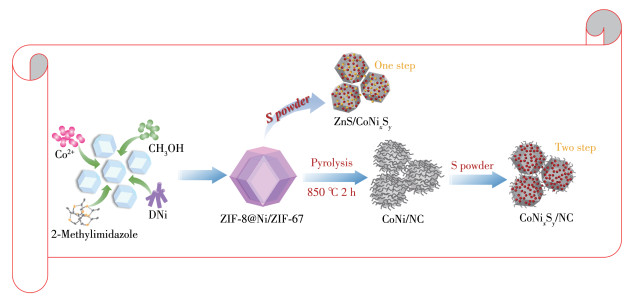
Scheme 1.
Schematic illustration of the production of CoNixSy/NC

Nitrogen-rich doped carbon hollow nanocage structure cooperating with cobalt-nickel sulfide to improve the performance of supercapacitors
Hai-Feng YU , Ting FENG , Shao-Juan CHENG , Ya-Hui GAO , Qi XIAO , Fang WANG


The sharpening of energy and environmental problems and the intermittent nature of alternative renewable energy (wind, solar, tidal, etc.) have pushed efficient energy storage systems into the research boom. Until now, the available energy storage techniques contained rechargeable batteries, fuel cells, and supercapacitors. What stands out is that supercapacitors possess faster charging rates, a high power density, a wide operating temperature range, and a long cycle life compared with other energy storage devices[1-3]. It is worth mentioning that the electrode is the most key component, compared with the other two components (electrolyte and separator)[4-5]. It is the performance of electrode materials, for instance, their thermal and structural stability, electronic conductivity, large specific surface area, high porosity, and redox activity, that determines the performance of supercapacitors[6-8].
Transition metal sulfides (TMSs) have been testified to be promising electrode materials for supercapacitors[9-11], which can be ascribed to their rich redox active sites, low cost, environmental friendliness, and high theoretical capacitance. Particularly, TMSs demonstrate better specific capacity than transition metal oxides, which are mainly derived from the sulfur element and exhibit a lower electronegativity than oxygen, making them have a flexible phase structure. This feature promotes electron transfer and further improves electrochemical performance[12-13]. According to the research that has been reported, TMSs can be divided into Mo-based, Co-based, Ni-based, Cu-based, and W-based sulfides[14]. Although TMSs have been employed as electrode materials in the research of supercapacitor performance, it is proven that they still suffer from intrinsic low conductivity, large volume expansion, low surface area, poor cyclability, and nanoparticle aggregation issues[15-17]. As a consequence, it is urgent to develop novel electrode materials that can overcome the above problems.
In recent years, researchers have testified several approaches such as structure engineering (hollow structure), interface engineering (heterostructure), interface expansion, phase transformation, heteroatom doping, and combination with carbon materials (graphene) or conductive polymers (polypyrrole, polyaniline)[18-19]. For example, Wu et al. adopted a simple nitrilotriacetic acid-assisted hydrothermal technique to prepare a series of hierarchical NiS/carbon hexahedrons that consist of self-assembling nanosheets or nanorods[20]. Owing to the synergetic effect of void space and hierarchical assembly mode, the specific capacitance of optimized NiS/carbon electrode can reach up to 1 530.4 F·g-1 at 1 A·g-1 and it showed excellent cycle stability with 85.6% after 5 000 cycles. Yan et al. reported double-layered yolk-shell microspheres of NiCo2S4-Ni9S8-C by using bimetallic MOFs as self-template[21]. The prepared sample showed a high specific capacity of 293.6 mAh·g-1 at 1 A·g-1 and excellent rate capacity (81.1% from 1 to 20 A·g-1). Benefitting from the hetero-interfaces of NiCo2S4-Ni9S8 can optimize the electronic distribution, coupled with the excellent electroconductivity of carbon within microspheres, which boosts the electrochemical performance. Except for Co or Ni-based sulfides, several works have confirmed that Co-Ni-based sulfides also exhibit remarkable performance[22-23], which is caused by they can produce a generous redox reaction derived from the coexistence of Co and Ni ions instead of single metal sulfides[24-25]. In summary, it is still challenging to prepare high-performance electrode materials that can simultaneously achieve both composition optimization and structure design. Metal-organic frameworks (MOFs), which possess the advantages of unique morphology, high specific surface area, rich metal sites, and adjustable pore size[26-28], can solve this issue. Except for direct use, MOFs are acted as excellent precursors or templates to form unique hollow architecture.
In this work, the novel electrode materials CoNixSy/NC (NC: nitrogen-rich doped carbon hollow nanocage) were fabricated by core-shell MOFs precursor ZIF-8@Ni-ZIF-67 through the pyrolysis-sulfurization two-step method. CoNixSy/NC well inherits the polyhedron morphology of ZIFs, and multi-component metal sulfides uniformly disperse in the MOFs-derived hollow carbon nanocage, which can alleviate the agglomeration tendency of active nanoparticles, restrain the volume expansion, and accelerate the electron and ion transfer, resulting in high electrochemical performance.
Co(NO3)2·6H2O and 2-methylimidazole were obtained from Aladdin Chemical Co., Ltd. Meanwhile, Zn(NO3)2·6H2O, S powder and potassium hydroxide (KOH, 85%) were purchased from China Pharmaceutical Chemicals Co., Ltd., respectively. Finally, dimethylglyoxime nickel (DNi) and Nafion were achieved from Alfa-Aesar. In particular, all reagents were analytically pure and without further purification.
ZIF-8@Ni/ZIF-67 precursor can be prepared through simple methods of epitaxial growth and ion exchange. In the first place, the crystal seed (ZIF-8) was synthesized by the reported technique[29]. Specifically, Zn(NO3)2·6H2O (8.926 g) and 2-methylimidazole (9.248 g) were dissolved in 225 mL methanol, respectively. After ultrasonic treatment for 5 min, the ligand solution was poured into another solution. Then, the mixed solution was constantly stirred for 24 h at room temperature. ZIF-8 can be obtained by centrifugation, methanol washing, and drying at 70 ℃. As-prepared ZIF-8 (0.747 g) was added to 150 mL methanol by ultrasound (5 min). Simultaneously, DNi (0.913 g) was dissolved in 200 mL methanol containing 8.76 g Co(NO3)2·6H2O and the mixture was subjected to ultrasonic treatment for 25 min. 2-Methylimidazole (9.24 g) was also dissolved in 50 mL methanol and the mixture was subjected to ultrasonic treatment for 5 min. Subsequently, all solutions were uniformly mixed and stirred magnetically for 24 h. After standing for 1 h, the precipitate was collected by centrifuging with methanol, finally, dried in a 70 ℃ vacuum to obtain precursor ZIF-8@Ni/ZIF-67.
CoNi/NC was obtained by pyrolysis precursor. Briefly, ZIF-8@Ni-ZIF-67 was placed in a tube furnace and heated to 850 ℃ with a ramp rate of 2 ℃·min-1 and kept for 2 h in flowing N2. To obtain N-doped carbon-supported CoNixSy composite materials (CoNixSy/NC), CoNi/NC was further mixed with S powder in a mass ratio of 2∶1 and the mixture was ground for 10 min. Finally, the mixture was heated to 600 ℃ with a ramp rate of 3 ℃ min-1 and kept for 2 h in a N2 atmosphere.
ZnS/CoNixSy was prepared by using the same procedure to directly sulfurize the precursor ZIF-8@Ni/ZIF-67.
The crystal phase of products was determined by X-ray diffraction (XRD, Bruker AXS D8 Advance, Cu Kα radiation, λ=0.154 18 nm), with a step size of 0.2 (°)·s-1 in the 2θ ranging from 5° to 80°. In addition, the test voltage and current were 40 kV and 40 mA. Simultaneously, microstructure and morphology were analyzed by scanning electron microscope (SEM, FEI Quanta FEG 250) at an accelerating voltage of 30 kV.
The electrochemical performance was also investigated by a typically three-electrode system. The working electrode was prepared via the reported method by our group[30]. Briefly, a mass fraction of 75% of the active material was mixed with 20% acetylene black and 5% Nafion to form a uniform slurry, then coated on a piece of nickel foam (1 cm2). The active mass loading on the electrode was 1.5 mg·cm-2. Simultaneously, Hg/HgO electrode and platinum sheet were used as reference electrodes and counter electrodes respectively, and 6 mol·L-1 KOH was employed as the electrolyte. The cyclic voltammetry (CV), galvanostatic charge-discharge (GCD) test, and electrochemical impedance spectroscopy (EIS) test of electrode materials were performed on the CHI760E electrochemical workstation. The specific capacitance (C, F·g-1) of electrode material was calculated by the equation[31]: C=IΔt/(ΔVm), where I is the discharge current (A), Δt is the discharge time (s), ΔV is the charge-discharge voltage window (V), and m is the mass of active material (g). In addition, the specific capacity (Q, mAh·g-1) of the battery type of the individual electrode was calculated according to the equation[32]: Q=IΔt/m.
An asymmetric two-electrode supercapacitor (CoNixSy/NC//CoNixSy/NC) was assembled by taking the active material and 6 mol·L-1 KOH as cathode/anode and electrolyte, respectively.
As depicted in Scheme 1, the structural design philosophy of CoNixSy/NC was delivered. First, the core-shell precursor ZIF-8@Ni-ZIF-67 was synthesized by an epitaxial growth strategy. In particular, the nanorod-shaped DNi was introduced as a Ni source.
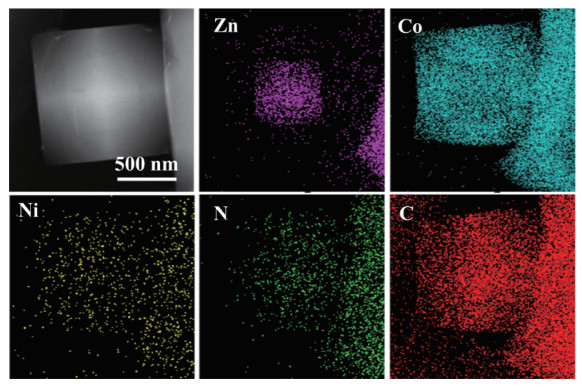
During the fabrication of the precursor, the Co nodes in ZIF-67 were partially substituted with Ni by ion exchange reaction, and the Ni-ZIF-67 shell with metal Co and Ni alternating was constructed. This regular alternation avoids the formation of large-size Co nanoparticles and agglomeration between particles during high-temperature carbonation, which is conducive to exposing more active sites. From Fig. 1, it can be seen that the distributions of Zn, Ni, Co, N, and C atoms were uniform in the core-shell precursor ZIF-8@Ni-ZIF-67. The N and C atoms were distributed all around the precursor, while the Zn atom was located in the core, and the Co or Ni atoms in the outer shell, indicating the successful preparation of the core-shell structure and the introduction of Ni atom. The comparison material ZnS/CoNixSy can be obtained by directly sulfurizing the precursor at 600 ℃. To achieve a porous hollow carbon nanocage structure, the precursor was pyrolyzed at 850 ℃ under a N2 atmosphere, the hollow structure is favorable to the rapid diffusion of electrolytes and ions, enhancing the rate performance of material[33-34]. Ultimately, the intermediate product CoNi/NC was evenly mixed with sulfur powder and sulfurized by the same process.
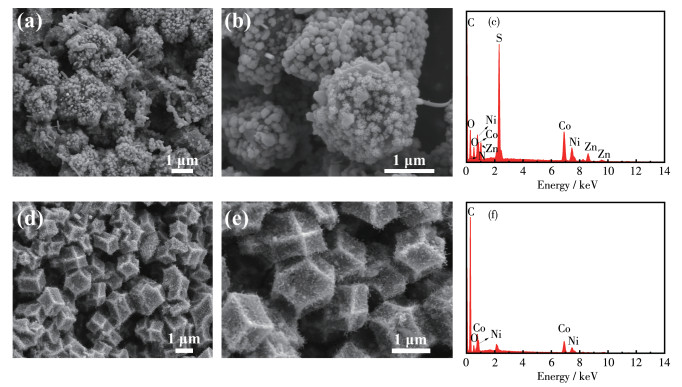
The micromorphology and element composition of prepared samples were investigated by SEM images and corresponding energy dispersive X-ray spectra (EDS). It can be seen from Fig. 2a that the directly sulfurized product ZnS/CoNixSy still maintained the morphology of the precursor, which means the sulfurization process will not make the polyhedron collapse. In addition, the amplified SEM image (Fig. 2b) revealed that the metal sulfide particles were uniformly loaded on the surface of the whole polyhedron. Fig. 2c verified the existence of Zn, Co, Ni, C, and O elements. It can be speculated that uniformly dispersed metal sulfide particles may be ZnS, cobalt, or nickel sulfides. The micromorphology and element composition of CoNi/NC were also analyzed, as shown in Fig. 2d-2f. The polyhedron morphology of the precursor was still inherited and the corresponding diameter was about 1.5 μm. After calcination at high temperatures, the surface of the polyhedron happened slight shrinkage due to the carbon restructure, and rich carbon nanotubes grown on the surface under in-situ catalysis of metal Co and Ni, which is consistent with the previously reported results[35-36]. The in-situ grown carbon nanotubes fabricated a 3D conductive network which can enhance the conductivity of composites and promote electronic and ions rapid shuttle. Especially, when the calcination temperature reached 850 ℃, the core ZIF-8 derived N-doped carbon (Zn will evaporate) employs as a nanostructured hollow framework to accelerate the diffusion kinetics[37-39]. Simultaneously, the produced gas is conducive to metal ions moving outside, promoting the formation of the hollow structure. The hollow structure has a large specific surface and the hollow interior space can also be used as an electrolyte ion reservoir[40], which can make it possible that fast Faraday redox reactions during charge/discharge. Meanwhile, this unique hollow structure can alleviate volume expansion during the electrochemical process and improve the cycle stability of electrode materials. From Fig. 2f, it is observed that Co, Ni, and C were uniformly distributed in CoNi/NC material. Moreover, the Zn peak was not detected in the EDS, indicating that it has completely evaporated at high temperatures.
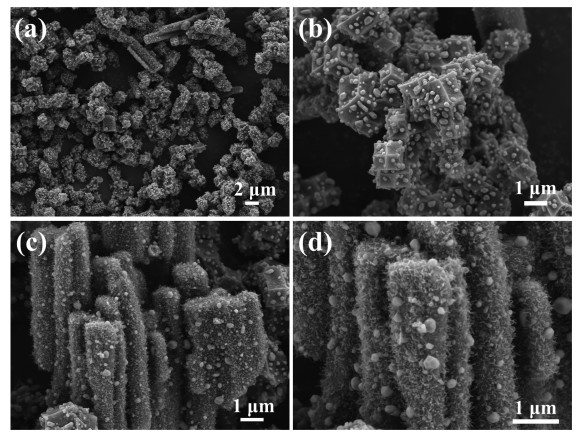
To further improve the electrochemical performance of materials, the low-activity CoNi nanoparticles were transformed into multi-component metal sulfides with higher activity by the sulfurization process. The achieved CoNixSy/NC still maintained the morphology of polyhedron and the produced metal sulfides were uniformly dispersed on the surface of hollow carbon nanocage, as shown in Fig. 3a and 3b. From Fig. 3c and 3d, the hollow nanorod structure with carbon nano tube (CNTs) and nanoparticles on the surface was also seen, which came from the unreacted DNi. The metal Ni nanoparticles can effectively catalyze the formation of CNTs at 850 ℃. Then, after sulfurization, the evenly dispersed Ni nanoparticles were transformed into NiS and Ni9S8. Many studies have confirmed that NiS and Ni9S8 can be used as active components to improve the supercapacitor′s performance of electrode materials[41-44]. Therefore, the unreacted DNi can increase the electrochemical performance of the prepared material.
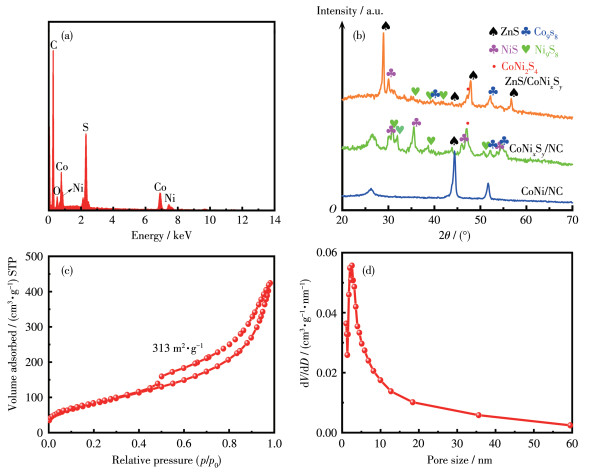
The corresponding elemental content of CoNixSy/NC can be obtained through EDS, as shown in Fig. 4a. The contents of Co, Ni, and S were 4.5%, 1.3%, and 4.3%, respectively. The XRD patterns for ZnS/CoNixSy, CoNi/NC, and CoNixSy/NC are presented in Fig. 4b. For ZnS/CoNixSy, the diffraction peaks of 28.93°, 43.87°, 47.83°, and 56.64° correspond to the (0120), (1064), (1073) and (0219) planes, respectively, suggesting the formation of ZnS phase (PDF No.83-1700). The peaks at 2θ of 39.6° and 52.2° can be ascribed to the (331) and (440) planes of Co9S8 (PDF No.86-2273). In addition, some weak diffraction peaks can be owned to the CoNi2S4 (PDF No.86-2247), NiS (PDF No.75-0612), and Ni9S8 (PDF No.78-1886) phases. The results confirm the coexistence of multi-component metal sulfides after direct vulcanization of precursor, including ZnS, Co9S8, CoNi2S4, Ni9S8, and NiS, which is in good agreement with the EDS result. From the XRD pattern of CoNi/NC, it can be seen three major diffraction peaks at 26.22°, 44.38°, and 51.68°, which can be ascribed to the graphitic carbon, metal Co or Ni, and CoNi alloy, respectively[29]. Compared with CoNi/NC, the peak of graphitic carbon in ZnS/CoNixSy was not detected, indicating that the high-temperature pyrolysis process is conducive to the formation of graphitic carbon with outstanding conductivity. The XRD pattern of CoNixSy/NC still possessed the diffraction peaks of Co9S8, CoNi2S4, Ni9S8, and NiS. The weak peaks of ZnS are due to lots of Zn having been evaporated and removed during high-temperature carbonization. It is noteworthy that the peak intensities of CoNi2S4, Ni9S8, and NiS increased significantly, demonstrating that there were a large amount of nickel sulfide and Co-Ni-based sulfides in the material. The peak at 26.58° can be well assigned to the graphitic carbon. These results are also consistent with EDS. The N2 adsorption-desorption isotherm of CoNixSy/NC was further analyzed (Fig. 4c) which displayed the reversible type Ⅳ isotherm, indicating its mesoporous structures. CoNixSy/NC possessed a specific surface area of 313 m2·g-1. Simultaneously, the pore size distribution curve (Fig. 4d) presented that the average pore diameter of CoNixSy/NC was about 6.3 nm. A highly abundant porous structure and large specific surface area can provide more active sites and rich channels for rapid electronic transport, and then the electrocatalytic performance of CoNixSy/NC can be enhanced.
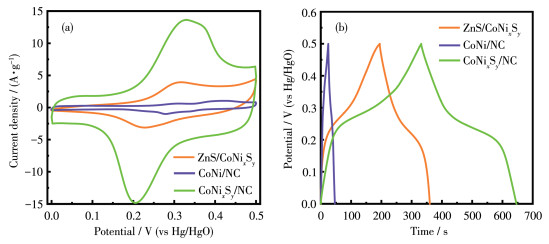
The electrochemical performance of ZnS/CoNixSy, CoNi/NC, and CoNixSy/NC was investigated in a three-electrode system with 6 mol·L-1 KOH. As shown in Fig. 5a, it can be seen from different CV curves of three materials that ZnS/CoNixSy and CoNixSy/NC all exhibited significant redox peaks compared with CoNi/NC, which is due to the Faraday redox reaction between multi-component metal sulfides and OH-. Particularly, the CV curve of CoNixSy/NC manifested a larger integral area in the whole potential range than others, suggesting the importance of the combination of multi-component metal sulfides with a unique hollow carbon nanocage for improved capacitance. Remarkably, CoNixSy/NC exhibited a larger closed CV curve area than ZnS/CoNixSy, indicating the electrochemical activity of material that contains high-content of CoNi2S4, Ni9S8, and NiS is higher than ZnS-based material. Some researchers have testified that ternary Co-Ni-based sulfides can be considered as the hopeful electrode materials for high-performance supercapacitors, owing to Co ions and Ni ions can realize rich redox reactions[45]. For the CV curve of CoNi/NC, there was the smallest CV closed area due to the lack of an active component of metal sulfides in this material, which will not undergo a typical redox reaction. The corresponding conclusion could also be verified from the GCD curves, as shown in Fig. 5b. The CoNixSy/NC possessed a maximum discharge time of 314.6 s at 1 A·g-1 compared with ZnS/CoNixSy (165.3 s) and CoNi/NC (21.8 s). Corresponding to the redox peak of CV curves, the GCD curves of all samples presented non-linear with a stable discharge-charge platform.
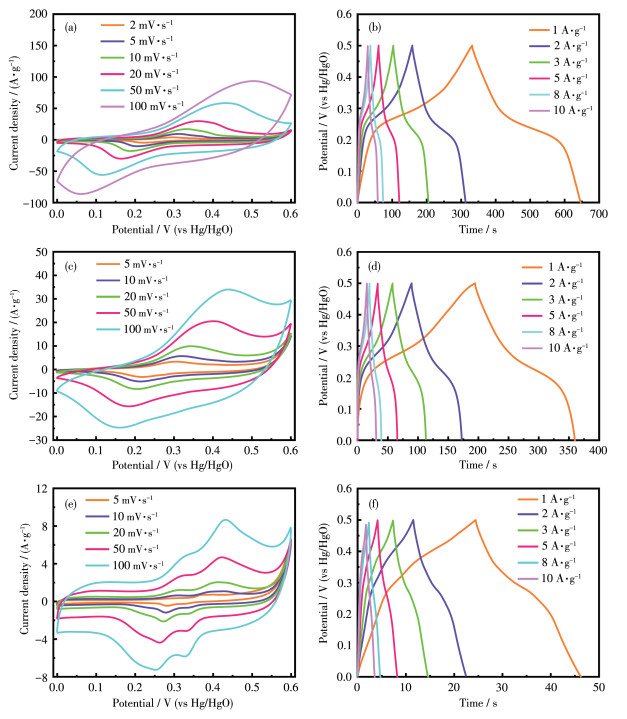
Subsequently, the CV curves at different scan rates and GCD curves at different current densities of CoNixSy/NC, ZnS/CoNixSy, and CoNi/NC were evaluated. From Fig. 6a, 6c, and 6e, it can be seen that all electrodes remained electrochemical stable at the potential window of 0 to 0.6 V when the scan rates are different. For ZnS/CoNixSy and CoNixSy/NC, with the increase in scan rate, the redox peak can be observed in each curve, revealing that the charge storage mainly depended on Faraday redox transformation. Simultaneously, the curve can be well retained and showed a symmetrical redox peak, proving the remarkable discharge-charge reversibility of electrodes. Fig. 6b, 6d, and 6f show the GCD curves of CoNixSy/NC, ZnS/CoNixSy, and CoNi/NC at various current densities. The obvious voltage plateau can be well consistent with the Faraday property in CV curves. There is no doubt that the discharge times of CoNixSy/NC at different current densities were highest than ZnS/CoNixSy and CoNi/NC.
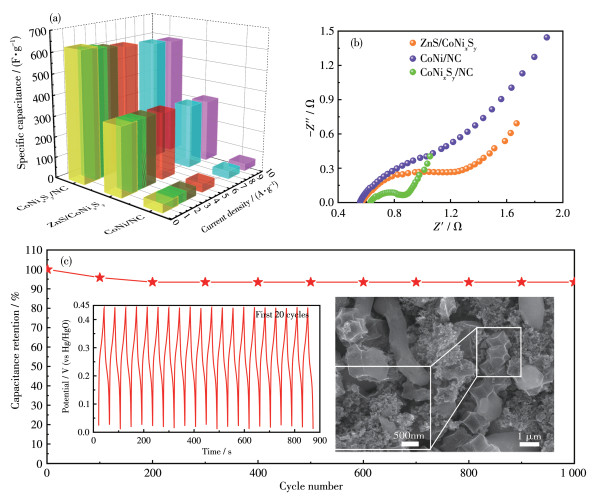
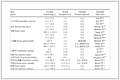
Specifically, the specific capacitances of all prepared electrode materials at different current densities can be observed in Fig. 7a. When the current density was 1, 2, 3, 5, 8, and 10 A·g-1, the specific capacitance of CoNixSy/NC reached 629.2, 618.4, 610.2, 600.0, 585.6, and 578.0 F·g-1, respectively. Which is superior over than some reported Co or Ni-based electrode materials (Table 1). Simultaneously, the specific capacitance of ZnS/CoNixSy was 330.2, 331.8, 331.6, 323.8, 310.2, and 303.8 F·g-1. The specific capacitance of CoNi/NC was respectively 41.5, 43.6, 43.2, 40.0, 36.8, and 34.0 F·g-1. In addition, the calculated specific capacity of CoNixSy/NC was 87.4, 85.9, 84.8, 83.3, 81.3, and 80.3 mAh·g-1 under different current densities. To further evaluate the ion/electron transfer behavior of three electrodes, the Nyquist plots were measured, as shown in Fig. 7b. The high-frequency semicircle area is considered as transfer resistance (Rct), which mainly comes from the electrode reaction. Notably, CoNixSy/NC had a smaller Rct than others, indicating CoNixSy/NC electrode material is endowed with high conductivity, which benefits from the formation of graphitic carbon and fabrication of 3D hollow conductive network can accelerate the ion and electron transfer and shorten diffusion path.
Inset: GCD curves at the first 20 cycles and SEM images of CoNixSy/NC after cycles.
 下载:
导出CSV
下载:
导出CSV
| Composite | Rate capability | Cycle performance | Electrolyte | Ref. |
| CoNixSy/NC | 629.2 F·g-1 (1 A·g-1) | 93.4% (1 000 cycles, 10 A·g-1) | 6 mol·L-1 KOH | This work |
| Flower-like CoS | 357 F·g-1 (0.5 A·g-1) | 87.3% (2 000 cycles, 0.5 A·g-1) | 6 mol·L-1 KOH | [46] |
| PPy/CoS/BC | 614 F·g-1 (0.7 A·g-1) | 62.4% (3 00 cycles, 0.7 A·g-1) | 2 mol·L-1 NaCl | [47] |
| CoS/N-doped CDs-3 | 697 F·g-1 (1 A·g-1) | ca. 100% (10 000 cycles, 10 A·g-1) | 3 mol·L-1 KOH | [48] |
| CC/Co9S8/PPy | 429 F·g-1 (1 mA·cm-2) | 83.5% (2 500 cycles, 4 mA·cm-2) | 2 mol·L-1 KOH | [49] |
| Co9S8@S-rGO | 348.45 F·g-1 (1 A·g-1) | 92.6% (5 000 cycles, 1 A·g-1) | 6 mol·L-1 KOH | [50] |
| CN-Co/Co9S8 | 334 F·g-1 (1 A·g-1) | — | 6 mol·L-1 KOH | [51] |
| Co9S8 NPs | 502 F·g-1 (1 A·g-1) | 98.2% (7 000 cycles, 8 A·g-1) | 1 mol·L-1 KOH | [43] |
| Ni9S8 NSs | 281 F·g-1 (1 A·g-1) | 82% (5 000 cycles, 10 A·g-1) | 1 mol·L-1 KOH | [52] |
| NiS/CNFs-2 | 133.3 mAh·g-1 (1 A·g-1) | 82.52% (1 000 cycles, 2 A·g-1) | 6 mol·L-1 KOH | [53] |
| w-NiS-3D-Nf | 770 F·g-1 (1 A·g-1) | 92.67% (2 200 cycles, 1A·g-1) | 2 mol·L-1 KOH | [54] |
As expected, the electrode material CoNixSy/NC with its unique structure and optimization component displayed excellent rate performance, which is closely related to the N-doped carbon hollow network and various metal sulfide compositions in the electrode. Given the high specific capacitance and outstanding rate performance, the long cycle life of the CoNixSy/NC electrode was also evaluated, as shown in Fig. 7c. After for 1 000 charge-discharge cycles at 10 A·g-1, CoNixSy/NC still maintained 93.4% of initial capacitance value. It can be seen from the inset of Fig. 7c that the discharge time can be well-kept without significant reduction at the first 20 cycles. The higher capacitance retention manifests the electrode material is endowed with superior cycle stability and electrochemical stability. The morphology of CoNixSy/NC after a long-term cycle test was also characterized. It can be seen from the SEM image that the polyhedron and rod-like structure were still clearly visible and without apparent collapse, implying the excellent structural stability of the material.
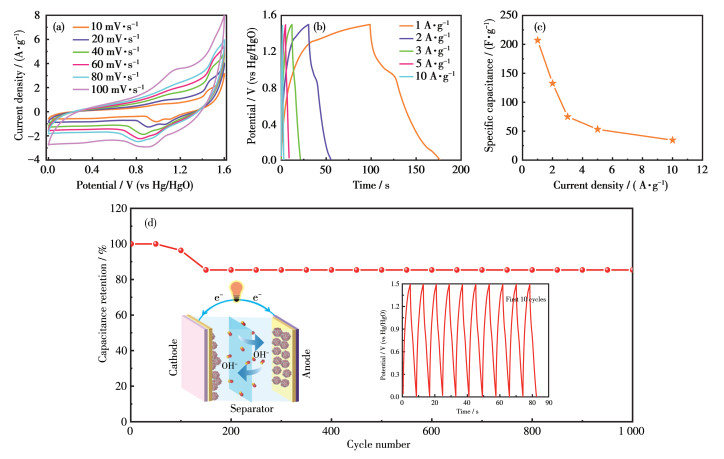
To verify the potential practical application of CoNixSy/NC, the powder CoNixSy/NC was coated on the Ni foam (NF). Then, two pieces of CoNixSy/NC/NF were used as cathode and anode to assemble a symmetrical supercapacitor device. The schematic diagram of this device can be observed from the inset of Fig. 8d. In two-electrode system tests, CV curves of different scan rates can be obtained at the voltage window range from 0 to 1.6 V (Fig. 8a). A rectangular shape and a pair of obvious redox peaks appeared in all CV curves, indicating the capacitance contribution is determined by electric double layer capacitance and redox reaction[55]. The GCD curves at different current densities can be achieved, as shown in Fig. 8b. The discharge time decreased with the increase in current density. Fig. 8c displays the specific capacitances at different current densities, the specific capacitances of the symmetrical supercapacitor device were 207.2, 132.8, 75.2, 53.3, and 34.6 F·g-1 at 1, 2, 3, 5 and 10 A·g-1, respectively. The result reveals poor performance at high current density than low. Finally, the cycle stability was also evaluated at 5 A·g-1 for 1 000 cycles. As shown in Fig. 8d, the capacitance retention can maintain 85.36% and undergoes 1 000 cycles, indicating the assembled device has excellent long cycle life. Therefore, the better electrochemical performance of the device exhibits the potential for the practical application of CoNixSy/NC.
Inset: schematic diagram of the CoNixSy/NC//CoNixSy/NC device and GCD curves at the first 10 cycles.
In summary, the multi-component Co-Ni-based sulfides that decorated the N-doped carbon hollow nanocage structure were synthesized via pyrolysis-sulfurization in two steps. Benefitting from the unique hollow structure and optimized component, the prepared CoNixSy/NC composite delivered a high electrochemical performance, including an excellent specific capacitance reaching 629.2 F·g-1 at 1 A·g-1 and superior long cycle stability of 93.4% retention after 1 000 cycles. In addition, the assembled symmetrical supercapacitor device also showed high specific capacitance (207.2 F·g-1 at 1 A·g-1) and long cycle life (85.36% retention after 1 000 cycles). The enhanced performance can be ascribed: (ⅰ) optimized components can fabricate multi-component metal sulfides, and the interaction between them can provide an adequate number of active sites and improve the conductivity of materials. (ⅱ) Rich N-doped carbon enhances the wettability between the electrode and electrolyte and changes the electronic structure of carbon to improve conductivity. (ⅲ) Fabricated 3D hollow carbon network not only makes metal sulfides uniformly dispersed and exposes more active sites, resulting in remarkable improvements in ion/electron conductivity but also can effectively restrain the volume expansion of electrode material during the charge-discharge process. Consequently, the high performance of multi-component Co-Ni-based sulfides can be further modified to become a promising electrode material for supercapacitors.
Li C, Huang Y, Feng X S, Zhang Z, Gao H, Huang J X. Silica-assisted cross-linked polymer electrolyte membrane with high electrochemical stability for lithium-ion batteries[J]. J. Colloid Interface Sci., 2021, 594: 1-8. doi: 10.1016/j.jcis.2021.02.128
Gayathri S, Arunkumar P, Saha D, Han J H. Composition engineering of ZIF-derived cobalt phosphide/cobalt monoxide heterostructures for high-performance asymmetric supercapacitors[J]. J. Colloid Interface Sci., 2021, 588: 557-570. doi: 10.1016/j.jcis.2020.11.129
Li C, Zhang X, Wang K, Su F Y, Chen C M, Liu F Y, Wu Z S, Ma Y W. Recent advances in carbon nanostructures prepared from carbon dioxide for high-performance supercapacitors[J]. J. Energy Chem., 2021, 54: 352-367. doi: 10.1016/j.jechem.2020.05.058
Wu Y L, Guo W, Lian X J, Tian Y M, Wang W G, Li J Y, Wang S. Self-assembled three-dimensional hierarchical CoMoO4 nanosheets on NiCo2O4 for high-performance supercapacitor[J]. J. Alloy. Compd., 2019, 793: 418-424. doi: 10.1016/j.jallcom.2019.04.189
Wen Y X, Liu Y P, Dang S, Tian S H, Li H Q, Wang Z L, He D Y, Wu Z S, Cao G Z, Peng S L. High mass loading Ni-decorated Co9S8 with enhanced electrochemical performance for flexible quasi-solid-state asymmetric supercapacitors[J]. J. Power Sources, 2019, 423: 106-114. doi: 10.1016/j.jpowsour.2019.03.045
Zhang J T, Zhao X S. On the configuration of supercapacitors for maximizing electrochemical performance[J]. ChemSusChem, 2012, 5: 818-841. doi: 10.1002/cssc.201100571
Robert F. New 'supercapacitor' promises to pack more electrical punch[J]. Science, 2006, 313: 902. doi: 10.1126/science.313.5789.902
Miller J R, Burker A. Electrochemical capacitors: Challenges and opportunities for real-world applications[J]. Electrochem. Soc. Interface, 2021, 17: 53-57.
何业增, 赵后强, 柳朋, 隋艳伟, 委福祥, 戚继球, 孟庆坤, 任耀剑, 庄栋栋. CoNi2S4上电沉积NiS用于柔性固态非对称超级电容器[J]. 无机化学学报, 2021,37,171-179. doi: 10.11862/CJIC.2021.011HE Y Z, ZHAO H Q, LIU P, SUI Y W, WEI F X, QI J Q, MENG Q K, REN Y J, ZHUANG D D. Electrodeposition of NiS on CoNi2S4 for flexible solid-state asymmetric supercapacitors[J]. Chinese J. Inorg. Chem., 2021, 37: 171-179. doi: 10.11862/CJIC.2021.011
陈鑫林, 朱志平, 吴宝鑫, 陈曙光, 周攀, 贺浩. 用于高性能超级电容器的"三明治"结构Co9S8/NiTe/Ni的设计与合成[J]. 无机化学学报, 2021,37,(2): 295-304. CHEN X L, ZHU Z P, WU B X, CHEN S G, ZHOU P, HE H. Design and synthesis of sandwich-like Co9S8/NiTe/Ni composites for high-performance supercapacitors[J]. Chinese J. Inorg. Chem., 2021, 37(2): 295-304.
Gao Y, Zhao L J. Review on recent advances on nanostructured transition-metal-sulfide-based electrode materials for cathode materials of asymmetric supercapacitors[J]. Chem. Eng. J., 2022, 430: 132745. doi: 10.1016/j.cej.2021.132745
Kang C X, Ma L, Chen Y C, Fu L K, Hu Q, Zhou C B, Liu Q M. Metal-organic framework derived hollow rod-like NiCoMn ternary metal sulfide for high-performance asymmetric supercapacitors[J]. Chem. Eng. J., 2022, 427: 131003. doi: 10.1016/j.cej.2021.131003
Yang X, Mao J J, Niu H, Wang Q, Zhu K, Ye K, Wang G L, Cao D X, Yan J. NiS2/MoS2 mixed phases with abundant active edge sites induced by sulfidation and graphene introduction towards high-rate supercapacitors[J]. Chem. Eng. J., 2021, 406: 126713. doi: 10.1016/j.cej.2020.126713
Dahiya Y, Hariram M, Kumar M, Jain A, Sarkar D. Modified transition metal chalcogenides for high performance supercapacitors: Current trends and emerging opportunities[J]. Coord. Chem. Rev., 2022, 451: 214265. doi: 10.1016/j.ccr.2021.214265
Dong C F, Liang J W, He Y Y, Li C C, Chen X X, Guo L J, Tian F, Qian Y T, Xu L Q. NiS1.03 hollow spheres and cages as superhigh rate capacity and stable anode materials for half/full sodium-ion batteries[J]. ACS Nano, 2018, 12: 8277-8287. doi: 10.1021/acsnano.8b03541
Shi J H, Li X C, He G H, Zhang L, Li M. Electrodeposition of high-capacitance 3D CoS/graphene nanosheets on nickel foam for high-performance aqueous asymmetric supercapacitors[J]. J. Mater. Chem. A, 2015, 3: 20619-20626. doi: 10.1039/C5TA04464B
Wang H F, Zhang K F, Song Y Q, Qiu J, Wu J, Yan L F. MnCo2S4 nanoparticles anchored N and S dual-doped 3D graphene as a prominent electrode for asymmetric supercapacitors[J]. Carbon, 2019, 146: 420-429. doi: 10.1016/j.carbon.2019.02.035
姜美惠, 盛利志, 王超, 江丽丽, 范壮军. 超级电容器用石墨烯薄膜: 制备、基元结构及表面调控[J]. 物理化学学报, 2022,38,(2): 2012085. JIANG M H, SHENG L Z, WANG C, JIANG L L, FAN Z J. Graphene film for supercapacitors: Preparation, foundational unit structure and surface regulation[J]. Acta Phys.-Chim. Sin., 2022, 38(2): 2012085.
魏风, 毕宏晖, 焦帅, 何孝军. 超级电容器用相互连接的类石墨烯纳米片[J]. 物理化学学报, 2020,36,(2): 1903043. WEI F, BI H H, JIAO S, HE X J. Interconnected graphene-like nanosheets for supercapacitors[J]. Acta Phys.-Chim. Sin., 2020, 36(2): 1903043.
Wu D, Xie X B, Ma Y P, Zhang J J, Hou C X, Sun X Q, Yang X Y, Zhang Y P, Kimura H, Du W. Morphology controlled hierarchical NiS/carbon hexahedrons derived from nitrilotriacetic acid-assembly strategy for high-performance hybrid supercapacitors[J]. Chem. Eng. J., 2022, 433: 133673. doi: 10.1016/j.cej.2021.133673
Yan Y, Li A R, Lu C X, Zhai T F, Lu S F, Li W M, Zhou W. Double-layered yolk-shell microspheres with NiCo2S4-Ni9S8-C hetero-interfaces as advanced battery-type electrode for hybrid supercapacitors[J]. Chem. Eng. J., 2020, 396: 125316. doi: 10.1016/j.cej.2020.125316
Qi J Q, Huang M Y, Ruan C Y, Zhu D D, Zhu L, Wei F X, Sui Y W, Meng Q K. Construction of CoNi2S4 nanocubes interlinked by few-layer Ti3C2Tx MXene with high performance for asymmetric supercapacitors[J]. Rare Met., 2022, 41: 4116-4126. doi: 10.1007/s12598-022-02167-y
Xie L X, Li M J, Zhu P, Xiao X B, Jia Z F, Wei Z Q, Jiang J L. Novel combination of nickel-cobalt sulfide and oxide derived from Ni2CoS4@ZIF-67 for high performance supercapacitor[J]. J. Alloy. Compd., 2022, 898: 162861. doi: 10.1016/j.jallcom.2021.162861
Yang Q J, Liu Y, Yan M, Lei Y, Shi W D. MOF-derived hierarchical nanosheet arrays constructed by interconnected core-shell nanoparticles for high-performance asymmetric supercapacitors[J]. Chem. Eng. J., 2019, 370: 666-676. doi: 10.1016/j.cej.2019.03.239
Yang Q J, Liu Y, Deng C Y, Yan M, Shi W D. MOF-derived 3D hierarchical nanoarrays consisting of NiCoZn-S nanosheets coupled with granular NiCo2S4 nanowires for high-performance hybrid supercapacitors[J]. J. Mater. Chem. A, 2019, 7: 26131-26138. doi: 10.1039/C9TA09692B
Qu G M, Zhang X X, Xiang G T, Wei Y R, Yin J M, Wang Z H, Zhang X L, Xu X J. ZIF-67 derived hollow Ni-Co-Se nano-polyhedrons for flexible hybrid supercapacitors with remarkable electrochemical performances[J]. Chin. Chem. Lett., 2020, 31: 2007-2012. doi: 10.1016/j.cclet.2020.01.040
Yang B L, Li B J, Xiang Z H. Advanced MOF-based electrode materials for supercapacitors and electrocatalytic oxygen reduction[J]. Nano Res., 2022, 16: 1338-1361.
Wang K B, Li Q Q, Ren Z J, Li C, Chu Y, Wang Z K, Zhang M D, Wu H, Zhang Q C. 2D metal-organic frameworks (MOFs) for high-performance BatCap hybrid devices[J]. Small, 2020, 16: 2001987. doi: 10.1002/smll.202001987
Feng T, Wang F, Xu Y J, Chang M J, Jinn X J, Zhou Y L, Piao J H, Lei J F. CoP/Ni2P heteronanoparticles integrated with atomic Co/Ni dual sites for enhanced electrocatalytic performance toward hydrogen evolution[J]. Int. J. Hydrog. Energy, 2021, 46: 8431-8443. doi: 10.1016/j.ijhydene.2020.12.060
于海峰, 王芳, 冯婷, 刘少兵, 马福贵, 杨孟新, 梁鹏举. Zn掺杂Co9S8纳米材料的制备及其在超级电容器和电催化析氢中的应用[J]. 无机化学学报, 2020,36,1318-1326. doi: 10.11862/CJIC.2020.147YU H F, WANG F, FENG T, LIU S B, MA F G, YANG M X, LIANG P J. Preparation of Zn-doped Co9S8 nanomaterials and application for supercapacitor and hydrogen evolution reaction of electrocatalysis[J]. Chinese J. Inorg. Chem., 2020, 36: 1318-1326. doi: 10.11862/CJIC.2020.147
Wang J M, Huang Y, Han X P, Zhang S, Wang M Y, Yan J, Chen C, Zong M. Construction of hierarchical Co9S8@NiO synergistic microstructure for high-performance asymmetric supercapacitor[J]. J. Colloid Interface Sci., 2021, 603: 440-449. doi: 10.1016/j.jcis.2021.06.118
Wang X Z, Wang S J, Su D C, Xu S G, Cao S K, Xiao Y H. Constructing a p-n heterojunction in 3D urchin-like CoNixSy/g-C3N4 composite microsphere for high performance asymmetric supercapacitors[J]. J. Alloy. Compd., 2022, 902: 163784. doi: 10.1016/j.jallcom.2022.163784
Wang C, Sui G Z, Guo D X, Li J L, Zhang L, Li S B, Xin J J, Chai D F, Guo W X. Structure-designed synthesis of hollow/porous cobalt sulfide/phosphide based materials for optimizing supercapacitor storage properties and hydrogen evolution reaction[J]. J. Colloid Interface Sci., 2021, 599: 577-585. doi: 10.1016/j.jcis.2021.04.118
Gong J X, Wang Y R, Wang J H, Liu Y X, Hu C H, Zhou T L, Yu Q L, Yang J X, Dai Y T. Hollow nickel-cobalt sulfide nanospheres cathode hybridized with carbon spheres anode for ultrahigh energy density asymmetric supercapacitors[J]. Int. J. Hydrog. Energy, 2022, 47: 10056-10068. doi: 10.1016/j.ijhydene.2022.01.083
Li H J, Liu M Y, Li Y, Yuan L, Zhang P, Cai Z, Chen H, Zhou J L. ZIF-8@ZIF-67-derived ZnCo2O4@nitrogen-doped carbon/carbon nanotubes wrapped by a carbon layer: A stable oxygen reduction catalyst with a competitive strength in acid media[J]. Mater. Today Energy, 2021, 19: 100574. doi: 10.1016/j.mtener.2020.100574
Pan Y, Sun K A, Liu S J, Cao X, Wu K L, Chen Z, Wang Y, Li Y, Liu Y Q, Wang D S, Peng Q, Chen C, Li Y D. Core-shell ZIF-8@ZIF-67 derived CoP nanoparticles-embedded N-doped carbon nanotube hollow polyhedron for efficient over-all water splitting[J]. J. Am. Chem. Soc., 2018, 140: 2610-2618. doi: 10.1021/jacs.7b12420
Tang J, Salunkhe R R, Liu J, Torad N L, Lmura M, Furukawa S, Yamauchi Y. Thermal conversion of core-shell metal-organic frameworks: A new method for selectively functionalized nanoporous hybrid carbon[J]. J. Am. Chem. Soc., 2015, 137: 1572-1580. doi: 10.1021/ja511539a
Chen Y Z, Wang C, Wu Z Y, Xiong Y J, Xu Q, Yu S H, Jiang H L. From bimetallic metal-organic framework to porous carbon: High surface area and multicomponent active dopants for excellent electrocatalysis[J]. Adv. Mater., 2015, 27: 5010-5016. doi: 10.1002/adma.201502315
Liu S, Wang Z, Zhou S, Yu F, Yu M, Chiang C Y, Zhou W, Zhao J, Qiu J. Metal-organic-framework-derived hybrid carbon nanocages as a bifunctional electrocatalyst for oxygen reduction and evolution[J]. Adv. Mater., 2017, 29: 1700874. doi: 10.1002/adma.201700874
Wu Z B, Pu X L, Ji X B, Zhu Y R, Jing M J, Chen Q Y, Jiao F P. High energy density asymmetric supercapacitors from mesoporous NiCo2S4 nanosheets[J]. Electrochim. Acta, 2015, 174: 238-245. doi: 10.1016/j.electacta.2015.06.011
Zhang D Y, Gao S Y, Zhang J W, Wang J R, She W N, Wang K J, Xia X, Yang B, Meng X X. Facile solid-phase synthesis of layered NiS/rGO nanocomposite for high-performance hybrid supercapacitor[J]. J. Power Sources, 2021, 514: 230590. doi: 10.1016/j.jpowsour.2021.230590
Nandhini S, Muralidharan G. Graphene encapsulated NiS/Ni3S4 mesoporous nanostructure: A superlative high energy supercapacitor device with excellent cycling performance[J]. Electrochim. Acta, 2021, 365: 137367. doi: 10.1016/j.electacta.2020.137367
Sambathkumar C, Ranjithkumar R, Arasi S E, Manikandan A, Nallamuthu N, Kumar M K, Arivarrasan A, Devendran P. High-performance nickel sulfide modified electrode material from single-source precursor for energy storage application[J]. J. Mater. Sci.-Mater. Electron., 2021, 32: 20058-20070. doi: 10.1007/s10854-021-06383-7
Wu Y, Tong H, Chen X D, Zhou Y, Wu C Q, Gong D X, Xiao J P, Zhang X G. Preparation of nanosheets of Ni5P2@Ni9S8/CoS1.097 heterostructure for aqueous asymmetric supercapacitors with high electrochemical performance[J]. J. Alloy. Compd., 2022, 923: 166378. doi: 10.1016/j.jallcom.2022.166378
Chen L N, Wan J F, Fan L, Wei Y H, Zou J L. Construction of CoNi2S4 hollow cube structures for excellent performance asymmetric supercapacitors[J]. Appl. Surf. Sci., 2021, 570: 151174. doi: 10.1016/j.apsusc.2021.151174
Zhu J, Xiang L, Xi D, Zhou Y Z, Yang J. One-step hydrothermal synthesis of flower-like CoS hierarchitectures for application in supercapacitors[J]. Bull. Mater. Sci., 2018, 41: 54. doi: 10.1007/s12034-018-1570-x
Peng S, Xu Q, Fan L L, Wei C Z, Bao H F, Xu W L, Xu J. Flexible polypyrrole/cobalt sulfide/bacterial cellulose composite membranes for supercapacitor application[J]. Synth. Met., 2016, 222: 285-292. doi: 10.1016/j.synthmet.2016.11.002
Ji Z Y, Li N, Xie M H, Shen X P, Dai W Y, Liu K, Xu K Q, Zhu G X. High-performance hybrid supercapacitor realized by nitrogen-doped carbon dots modified cobalt sulfide and reduced graphene oxide[J]. Electrochim. Acta, 2020, 334: 135632. doi: 10.1016/j.electacta.2020.135632
Wu X Y, Wang C C, Wang Z, Qin Y, Kong Y. Nanostructured Co9S8/polypyrrole hybrids grown on carbon cloth for battery-type supercapacitor electrode[J]. Synth. Met., 2022, 286: 117034. doi: 10.1016/j.synthmet.2022.117034
Mao X L, He X, Yang W Y, Liu H, Zhou Y J, Xu J H, Yang Y J. Hierarchical holey Co9S8@S-rGO hybrid electrodes for high-performance asymmetric supercapacitors[J]. Electrochim. Acta, 2019, 328: 135078. doi: 10.1016/j.electacta.2019.135078
Gao J S, Zhang Z M, Wang H H, Liu Z M, He Y. Construction of 3D Co/Co9S8 encapsulated by graphite carbon for high performance supercapacitor[J]. J. Electroanal. Chem., 2022, 921: 116670. doi: 10.1016/j.jelechem.2022.116670
Sambathkumara C, Nallamuthua N, Kumar M K, Sudhaharb S, Devendran P. Electrochemical exploration of cobalt sulfide nanoparticles synthesis using cobalt diethyldithiocarbamate as single source precursor for hybrid supercapacitor device[J]. J. Alloy. Compd., 2022, 920: 165839. doi: 10.1016/j.jallcom.2022.165839
Qiu L R, Yang W S, Zhao Q, Lu S S, Wang X H, Zhou M, Tao B F, Xie Q, Ruan Y J. Electrochemical exploration of cobalt sulfide nanoparticles synthesis using cobalt diethyldithiocarbamate as single source precursor for hybrid supercapacitor device[J]. ACS Appl. Nano Mater., 2022, 5: 6192-6200. doi: 10.1021/acsanm.2c00142
Ansari S A, Kotb H M, Ahmad M M. Wrinkle-shaped nickel sulfide grown on three-dimensional nickel foam: A binder-free electrode designed for high-performance electrochemical supercapacitor applications[J]. Crystals, 2022, 12: 757. doi: 10.3390/cryst12060757
Zhang Y P, Shen Y H, Xie X B, Du W, Kang L T, Wang Y, Sun X Q, Li Z H, Wang B. One-step synthesis of the reduced graphene oxide@ NiO composites for supercapacitor electrodes by electrode-assisted plasma electrolysis[J]. Mater. Des., 2020, 196: 109111. doi: 10.1016/j.matdes.2020.109111

Figure 2 (a, b, d, e) SEM images and (e, f) EDS of (a-c) ZnS/CoNixSy and (d-f) CoNi/NC

Figure 4 (a) EDS of CoNixSy/NC; (b) XRD patterns of ZnS/CoNixSy, CoNi/NC, and CoNixSy/NC; (c) N2 adsorption-desorption isotherm and (d) pore size distribution of CoNixSy/NC

Figure 5 Electrochemical performance of ZnS/CoNixSy, CoNi/NC, and CoNixSy/NC in 6 mol·L-1 KOH electrolyte: (a) CV curves at the scan rate of 10 mV·s-1; (b) GCD curves at the current density of 1 A·g-1

Figure 6 Electrochemical performance in 6 mol·L-1 KOH electrolyte: CV curves of (a) CoNixSy/NC, (c) ZnS/CoNixSy, and (e) CoNi/NC at scan rates from 5 to 100 mV·s-1, respectively; GCD curves of (b) CoNixSy/NC, (d) ZnS/CoNixSy, and (f) CoNi/NC at different densities

Figure 7 (a) Specific capacitance comparison at 1-10 A·g-1 and (b) Nyquist plots of the samples; (c) Cycle life of CoNixSy/NC at 10 A·g-1
Inset: GCD curves at the first 20 cycles and SEM images of CoNixSy/NC after cycles.

Figure 8 Electrochemical performances of CoNixSy/NC//CoNixSy/NC device in 6 mol·L-1 KOH: (a) CV curves at different scan rates from 10-100 mV·s-1; (b) GCD curves at different current densities at 1-10 A·g-1; (c) specific capacitance comparison at different current densities; (d) cycle life at 5 A·g-1
Inset: schematic diagram of the CoNixSy/NC//CoNixSy/NC device and GCD curves at the first 10 cycles.
Table 1. Electrochemical performance of some reported similar electrode materials
| Composite | Rate capability | Cycle performance | Electrolyte | Ref. |
| CoNixSy/NC | 629.2 F·g-1 (1 A·g-1) | 93.4% (1 000 cycles, 10 A·g-1) | 6 mol·L-1 KOH | This work |
| Flower-like CoS | 357 F·g-1 (0.5 A·g-1) | 87.3% (2 000 cycles, 0.5 A·g-1) | 6 mol·L-1 KOH | [46] |
| PPy/CoS/BC | 614 F·g-1 (0.7 A·g-1) | 62.4% (3 00 cycles, 0.7 A·g-1) | 2 mol·L-1 NaCl | [47] |
| CoS/N-doped CDs-3 | 697 F·g-1 (1 A·g-1) | ca. 100% (10 000 cycles, 10 A·g-1) | 3 mol·L-1 KOH | [48] |
| CC/Co9S8/PPy | 429 F·g-1 (1 mA·cm-2) | 83.5% (2 500 cycles, 4 mA·cm-2) | 2 mol·L-1 KOH | [49] |
| Co9S8@S-rGO | 348.45 F·g-1 (1 A·g-1) | 92.6% (5 000 cycles, 1 A·g-1) | 6 mol·L-1 KOH | [50] |
| CN-Co/Co9S8 | 334 F·g-1 (1 A·g-1) | — | 6 mol·L-1 KOH | [51] |
| Co9S8 NPs | 502 F·g-1 (1 A·g-1) | 98.2% (7 000 cycles, 8 A·g-1) | 1 mol·L-1 KOH | [43] |
| Ni9S8 NSs | 281 F·g-1 (1 A·g-1) | 82% (5 000 cycles, 10 A·g-1) | 1 mol·L-1 KOH | [52] |
| NiS/CNFs-2 | 133.3 mAh·g-1 (1 A·g-1) | 82.52% (1 000 cycles, 2 A·g-1) | 6 mol·L-1 KOH | [53] |
| w-NiS-3D-Nf | 770 F·g-1 (1 A·g-1) | 92.67% (2 200 cycles, 1A·g-1) | 2 mol·L-1 KOH | [54] |
 下载: 导出CSV

 扫一扫看文章


扫一扫关注我们